
Integração do Huawei AirEngine e CloudCampus com o Purple WiFi
Este guia fornece instruções passo a passo para integrar os pontos de acesso Huawei AirEngine e o iMaster NCE-Campus com o Purple WiFi. Abrange a configuração do Captive Portal, a autenticação de funcionários por 802.1X e o direcionamento dinâmico de VLAN por PPSK para redes empresariais.
Ouça este guia
Ver transcrição do podcast

Resumo Executivo
As redes empresariais exigem hardware fiável combinado com uma gestão de identidade inteligente. Os pontos de acesso Huawei AirEngine e o controlador iMaster NCE-Campus oferecem conectividade de alta densidade, enquanto a Purple fornece a sobreposição na nuvem para autenticação, análise e aplicação de políticas. Este guia detalha a arquitetura de integração necessária para implementar WiFi para Visitantes , WiFi seguro para Funcionários e WiFi Multi-Tenant utilizando um único controlador Huawei.
Ao integrar o Huawei CloudCampus com a Purple, substitui silos de autenticação díspares por uma Rede Baseada em Identidade unificada. Operamos em mais de 80.000 locais ativos e processámos 440 milhões de inícios de sessão em 2024. A nossa plataforma agnóstica de hardware integra-se nativamente com a Huawei através de protocolos RADIUS e Captive Portal padrão. Esta integração permite opt-ins de escolha consciente para visitantes, validação de certificados 802.1X para funcionários e direcionamento dinâmico de VLAN através de Private Pre-Shared Keys (PPSK) para inquilinos.
Quer gira um estádio, um campus universitário ou uma cadeia de retalho, este documento fornece os passos de configuração exatos, atributos RADIUS e listas de controlo de acesso necessários para proteger a sua infraestrutura sem fios e recolher dados primários (first-party data) à escala.
Ouça o podcast de briefing técnico:
Análise Técnica Detalhada
A integração baseia-se em protocolos padrão: RADIUS (UDP 1812/1813) para autenticação e contabilização (accounting), e HTTPS (TCP 443) para redirecionamento de Captive Portal. O iMaster NCE-Campus atua como o servidor de acesso à rede (NAS) e retransmissor (relay) RADIUS, encaminhando os pedidos dos pontos de acesso AirEngine para a infraestrutura RADIUS na nuvem da Purple.
Visão Geral da Arquitetura
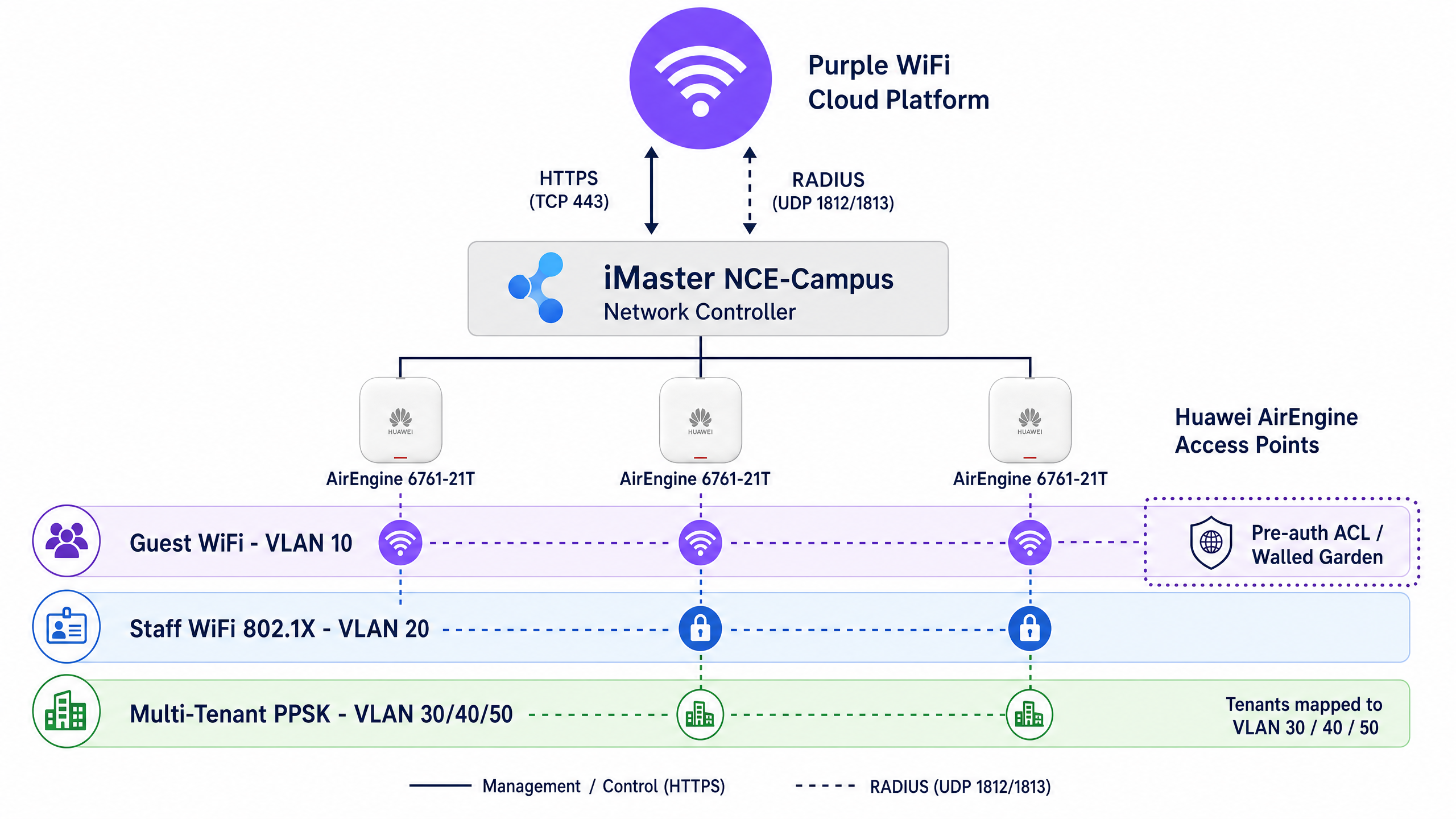
A Purple suporta três modelos de autenticação primários no hardware Huawei:
- WiFi para Visitantes (Captive Portal): O tráfego não autenticado é intercetado pelo controlador Huawei e redirecionado para a splash page da Purple. O acesso pré-autenticação é restrito por uma ACL de Walled Garden. Após o início de sessão bem-sucedido, a Purple envia um Access-Accept de RADIUS, concedendo ao cliente acesso total à rede.
- WiFi para Funcionários (802.1X): Os funcionários autenticam-se utilizando credenciais corporativas via EAP-PEAP ou EAP-TLS. A Purple valida estas credenciais face a fornecedores de identidade como o Microsoft Entra ID, Okta ou Google Workspace.
- WiFi Multi-Tenant (PPSK): Os inquilinos ligam-se a um único SSID partilhado utilizando palavras-passe exclusivas. A Purple valida a palavra-passe e devolve atributos RADIUS específicos para direcionar dinamicamente o inquilino para a sua VLAN isolada.
Walled Garden e ACLs de Pré-Autenticação
Um Captive Portal requer um Walled Garden - uma Lista de Controlo de Acesso (ACL) que permite o tráfego para serviços essenciais antes de o utilizador se autenticar. Se o Walled Garden estiver incompleto, a splash page não será carregada, resultando numa má experiência para o visitante.
Para o Huawei iMaster NCE-Campus, a ACL de pré-autenticação deve permitir:
- Resolução de DNS (UDP 53)
- Domínios de Captive Portal da Purple (
*.purpleportal.net,*.purple.ai) - Redes de Distribuição de Conteúdo (CDNs) que alojam recursos da splash page
- Domínios de fornecedores de identidade se o início de sessão social (Apple, Google, Facebook) estiver ativado
Todo o restante tráfego deve ser negado até que a Purple devolva o Access-Accept de RADIUS.
Direcionamento Dinâmico de VLAN e Atributos RADIUS
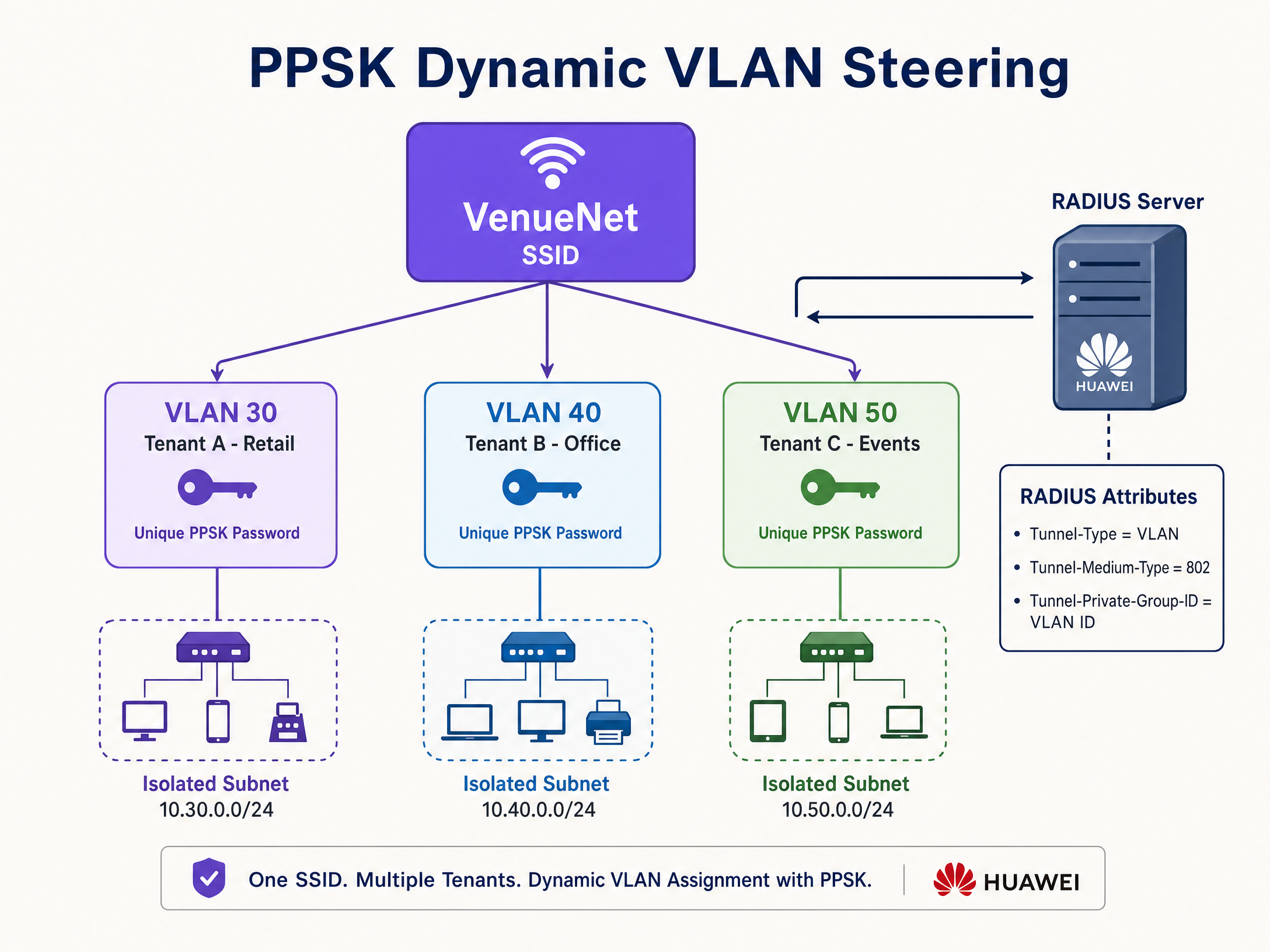
Para isolar o tráfego de rede, a Purple utiliza a atribuição dinâmica de VLAN. Em vez de transmitir múltiplos SSIDs, transmite apenas um SSID e atribui a VLAN dinamicamente com base na identidade do utilizador.
Quando a Purple autentica um utilizador (via 802.1X ou PPSK), devolve um pacote Access-Accept contendo três atributos RADIUS padrão da IETF obrigatórios:
Tunnel-Type=VLAN(ou 13)Tunnel-Medium-Type=802(ou 6)Tunnel-Private-Group-ID=[VLAN ID]
O controlador Huawei recebe estes atributos e instrui o ponto de acesso AirEngine a etiquetar o tráfego do cliente com o ID de VLAN especificado.
Guia de Implementação
Esta secção abrange os passos exatos para configurar o iMaster NCE-Campus para a integração com a Purple.
Passo 1: Configurar o Servidor de Retransmissão (Relay) RADIUS
Primeiro, defina a Purple como o servidor de autenticação externo.
- No iMaster NCE-Campus, navegue para Design > Network Design > Template Management.
- Selecione RADIUS Server e clique em Create.
- Defina o Authentication service para Portal authentication.
- Introduza os endereços IP RADIUS primário e secundário da Purple (disponíveis no seu painel de controlo da Purple).
- Defina a porta de autenticação para 1812 e a porta de contabilização (accounting) para 1813.
- Introduza o Segredo Partilhado (Shared Secret) RADIUS fornecido pela Purple.
- Defina o NAS identifier para Device MAC.
Passo 2: Criar a ACL de Walled Garden
Crie a ACL para permitir o tráfego de pré-autenticação.
- Navegue para Design > Network Design > Template Management > ACL.
- Crie uma nova ACL com o nome
Purple_Walled_Garden. - Defina o ACL Type para User.
- Adicione regras de permissão (permit) para o DNS e para os domínios exigidos pela Purple (por exemplo,
*.purpleportal.net). - Guarde o modelo de ACL.
Passo 3: Configurar o Modelo de URL do Captive Portal
A Huawei requer um modelo de URL para mapear os parâmetros de redirecionamento padrão para o formato exigido pela Purple.
- Navegue para Design > Network Design > Template Management > URL Template.
- Crie um novo modelo com o nome
Purple_URL_Template`. - Set the Template Type to Cloud platform-based relay authentication.
- Configure the parameter mapping exactly as follows:
redirect-urlmaps toredirect-urlloginurlmaps tologin-urldevice-macmaps toap-macuser-ipmaps touaddressuser-macmaps toumacssidmaps tossid
Passo 4: Provisionar o SSID de Visitantes
Associe o servidor RADIUS, a ACL e o modelo de URL ao SSID.
- Navegue para Provision > Device Configuration > Site Configuration.
- Selecione AP e crie um novo SSID.
- Defina o Network Type para Open.
- Selecione Open+Portal authentication.
- Defina o tipo de autenticação para Relay authentication by cloud platform.
- Defina o modo de interligação para RADIUS relay.
- Selecione o
Purple_URL_Templatecriado anteriormente. - No campo de URL de autenticação de terceiros, cole o seu URL exclusivo da splash page Purple.
- Selecione o modelo de servidor RADIUS Purple.
- Selecione a ACL
Purple_Walled_Gardenpara a regra de permissão predefinida. - Guarde e implemente a configuração nos pontos de acesso AirEngine.
Boas Práticas
Para garantir uma implementação segura e fiável, siga estas boas práticas neutras em termos de fornecedor:
- Implementar 802.1X para Colaboradores: Nunca utilize PSKs partilhados para redes de funcionários. Implemente 802.1X com EAP-TLS utilizando o suplemento SecurePass da Purple para emitir certificados de cliente. Isto elimina vetores de phishing baseados em palavras-passe e alinha-se com os requisitos da norma ISO 27001.
- Consolidar SSIDs: A transmissão de demasiados SSIDs degrada a eficiência do tempo de antena devido à sobrecarga de tráfego de gestão (management frames). Utilize PPSK e direcionamento dinâmico de VLAN para consolidar redes multi-inquilino num único SSID.
- Verificar Configurações de Trunk: A atribuição dinâmica de VLAN falha silenciosamente se a VLAN atribuída não for permitida na porta trunk do switch que liga o ponto de acesso. Audite sempre as configurações de switchport antes de testar o direcionamento RADIUS.
- Monitorizar a Latência do RADIUS: Os tempos limite de autenticação (timeouts) resultam frequentemente da latência da WAN. Certifique-se de que o seu controlador iMaster NCE-Campus tem um caminho de baixa latência para a infraestrutura RADIUS regional da Purple.
Resolução de Problemas e Mitigação de Riscos
Ao integrar o RADIUS na nuvem com controladores empresariais, os problemas geralmente isolam-se em três áreas: o Walled Garden, o segredo partilhado do RADIUS ou o trunking de VLAN.
A Splash Page Não Carrega
Sintoma: Um dispositivo liga-se ao WiFi de Visitantes, mas o navegador apresenta um erro de limite de tempo (timeout) em vez da splash page da Purple.
Causa Raiz: A ACL do Walled Garden está incompleta, bloqueando o acesso aos domínios do portal da Purple ou aos CDNs necessários.
Mitigação: Ligue um dispositivo de teste ao SSID. Tente efetuar um ping para purpleportal.net. Se o ping falhar, reveja a configuração da ACL do iMaster NCE-Campus e certifique-se de que a mesma é aplicada ao estado de pré-autenticação do SSID.
Falhas de Autenticação Silenciosas
Sintoma: Um utilizador introduz credenciais válidas, mas a ligação cai sem qualquer mensagem de erro. Causa Raiz: Uma incompatibilidade no segredo partilhado do RADIUS entre o iMaster NCE-Campus e a Purple. Mitigação: Copie o segredo partilhado diretamente do painel de controlo da Purple e cole-o no modelo de servidor RADIUS da Huawei. Um único espaço final quebrará o hash MD5 utilizado nos pacotes RADIUS.
Limite de Tempo (Timeout) de DHCP Após Autenticação
Sintoma: Um membro da equipa autentica-se com sucesso via 802.1X, mas o dispositivo recebe um endereço APIPA 169.254.x.x em vez de um IP válido.
Causa Raiz: A Purple atribuiu com sucesso uma VLAN dinâmica via RADIUS, mas essa VLAN não está configurada em modo trunk para o ponto de acesso AirEngine.
Mitigação: Inicie sessão no switch de acesso e verifique se o comando port trunk allow-pass vlan inclui o ID da VLAN de destino na interface ligada ao AP.
ROI e Impacto no Negócio
A implementação do Huawei AirEngine com a Purple transforma uma infraestrutura de rede padrão num ativo de negócio mensurável.
Para operadores de Retalho , esta integração recolhe dados primários (first-party data) dos compradores, permitindo campanhas de marketing direcionadas que aumentam as visitas físicas e o valor médio das transações. O painel de controlo de WiFi Analytics da Purple fornece mapas de calor e métricas de tempo de permanência, permitindo aos gestores de espaços otimizar o layout das lojas com base no comportamento real dos visitantes.
Em ambientes de Hotelaria , a autenticação automatizada via OpenRoaming ou Passpoint elimina a fricção dos inícios de sessão manuais, aumentando as pontuações de satisfação dos hóspedes. Para edifícios multi-inquilino, o direcionamento dinâmico de VLAN por PPSK reduz os custos operacionais de TI, eliminando a necessidade de provisionar e gerir manualmente SSIDs separados para cada novo inquilino.
Ao unificar o envolvimento dos visitantes, a segurança da equipa e o isolamento de inquilinos numa única infraestrutura de hardware, as organizações maximizam o retorno do seu investimento no Huawei CloudCampus.
Definições Principais
iMaster NCE-Campus
Huawei's cloud-based or on-premises network automation and management platform.
IT teams use this as the central controller to configure SSIDs, push policies to AirEngine APs, and set up RADIUS relay to Purple.
PPSK (Private Pre-Shared Key)
A security feature that allows multiple unique passwords to be used on a single SSID, with each password tying the user to a specific network policy or VLAN.
Essential for multi-tenant environments (like coworking spaces or retail parks) where tenants need isolated networks without broadcasting dozens of SSIDs.
Dynamic VLAN Steering
The process of assigning a device to a specific Virtual Local Area Network based on its authenticated identity, rather than the SSID it connected to.
Used by Purple to ensure that a manager, a cashier, and a guest connecting to the same physical access point are placed on completely separate, secure network segments.
Walled Garden
An Access Control List (ACL) applied to unauthenticated users, permitting access only to specific IP addresses or domains required to complete the login process.
If the Walled Garden is misconfigured, guests will see a blank screen or a timeout error instead of the Purple splash page.
RADIUS Relay
A configuration where the local network controller forwards authentication requests from access points to an external RADIUS server.
Huawei iMaster NCE-Campus acts as the relay, securely passing credentials from the venue to Purple's cloud infrastructure for validation.
802.1X
An IEEE standard for port-based network access control that provides an authentication mechanism to devices wishing to attach to a LAN or WLAN.
The enterprise standard for Staff WiFi. It replaces shared passwords with individual user credentials or digital certificates.
EAP-TLS
Extensible Authentication Protocol - Transport Layer Security. An 802.1X authentication method that relies on client and server certificates rather than passwords.
The most secure authentication method available. Purple's SecurePass issues these certificates to employee devices to eliminate phishing risks.
Captive Portal
A web page that a user of a public-access network is obliged to view and interact with before access is granted.
The primary mechanism Purple uses to capture first-party data and consent from venue visitors.
Exemplos Práticos
A 200-room hotel needs to provide secure, isolated WiFi for guests, staff, and a third-party coffee shop operating in the lobby, using only two SSIDs to preserve airtime.
Deploy one SSID named 'Hotel_Guest' configured with an Open+Portal authentication policy pointing to Purple's captive portal. Deploy a second SSID named 'Hotel_Secure' configured with WPA3-Enterprise and 802.1X authentication. Staff authenticate via EAP-TLS, and Purple returns a RADIUS attribute assigning them to VLAN 20. The coffee shop uses PPSK on the same 'Hotel_Secure' SSID; they enter a unique passphrase, and Purple returns a RADIUS attribute assigning them to VLAN 30.
A large retail chain is migrating to Huawei AirEngine and needs to ensure their existing Purple splash page loads correctly across all stores without triggering security warnings on modern smartphones.
Configure the iMaster NCE-Campus URL template to map the required parameters (ap-mac, uaddress, umac, ssid, redirect-url) precisely. Build a comprehensive Walled Garden ACL that permits DNS (UDP 53) and HTTPS (TCP 443) traffic to Purple's domains and any required social login APIs. Ensure the controller intercepts HTTP traffic and redirects it to the HTTPS splash page.
Perguntas de Prática
Q1. You have configured the Guest SSID and the Walled Garden ACL on iMaster NCE-Campus. When you test the connection, your phone detects the captive portal, but the screen remains blank. What is the most likely cause?
Dica: Consider what the device needs to load a modern web page hosted on a cloud platform.
Ver resposta modelo
The Walled Garden ACL is likely missing permit rules for required domains. Specifically, DNS (UDP 53) must be permitted, along with HTTPS access to Purple's portal domains and any Content Delivery Networks (CDNs) hosting the page assets. If social login is enabled, those specific API endpoints must also be permitted pre-authentication.
Q2. A tenant using your PPSK network complains they cannot reach the internet. You check the iMaster NCE-Campus logs and see that Purple returned a RADIUS Access-Accept with Tunnel-Private-Group-ID set to 40. However, the client device has an IP address of 169.254.x.x. What is the configuration error?
Dica: Authentication succeeded, but network routing failed at the edge.
Ver resposta modelo
The switchport connecting the Huawei AirEngine access point to the network is not configured to trunk VLAN 40. While Purple successfully authorised the user and the controller instructed the AP to tag traffic with VLAN 40, the upstream switch dropped the packets because the VLAN is not permitted on the trunk. You must add VLAN 40 to the trunk allow-pass list on the access switch.
Q3. You are migrating from a legacy controller to Huawei iMaster NCE-Campus. You configure the RADIUS server template exactly as it was on the old system, but all authentication requests fail silently. What should you check first?
Dica: Silent failures in RADIUS usually indicate a cryptographic mismatch.
Ver resposta modelo
Verify the RADIUS Shared Secret. If the secret configured in iMaster NCE-Campus does not perfectly match the secret in the Purple dashboard, the RADIUS packets cannot be decrypted, resulting in silent failures or Access-Reject messages without clear error codes. Ensure there are no trailing spaces when copying the secret.
Continue a ler esta série
Integração do Cambium Networks cnPilot e cnMaestro com o Purple WiFi
Este guia de referência detalha a integração dos pontos de acesso Cambium Networks cnPilot e do controlador de nuvem cnMaestro com a plataforma de inteligência Purple WiFi. Abrange a arquitetura, a configuração do Captive Portal, os requisitos de walled garden, o WiFi para funcionários 802.1X e a segmentação dinâmica de VLAN usando Cambium ePSK para ambientes multi-tenant.
Integração da Alta Labs com o Purple WiFi: Instalação e Configuração do Captive Portal
Este guia de referência técnica abrange a integração de ponta a ponta dos pontos de acesso Alta Labs AP6 e AP6 Pro com o Captive Portal alojado na nuvem da Purple. Detalha a configuração de redirecionamento externo, autenticação RADIUS, requisitos de walled garden e segmentação multi-tenant utilizando as Private Pre-Shared Keys do AltaPass. Os operadores de espaços e as equipas de TI terão acesso a um manual de implementação replicável para ambientes de hotelaria, retalho e escritórios inteligentes.
Integração de Access Points NETGEAR Insight e Enterprise com a Purple WiFi
Este guia fornece aos gestores de TI um roteiro técnico definitivo para integrar os access points enterprise NETGEAR Insight e WAX com a Purple WiFi. Abrange configurações essenciais, incluindo Captive Portals de convidados, redes de funcionários 802.1X e segmentação multi-tenant utilizando PPSK e atribuição dinâmica de VLAN.