
Tempo médio para a inocência: como provar que a culpa não é do WiFi
O tempo médio para a inocência (MTTI) é a métrica crítica que define quanto tempo as equipas de TI passam a provar que um problema de rede não é culpa delas. Este guia detalha uma metodologia de observabilidade em cinco etapas para eliminar o jogo da culpa em ambientes multi-tenant, substituindo a troca de acusações por provas partilhadas para reduzir o tempo médio de resolução (MTTR).
Video overview
Ouça este guia
Ver transcrição do podcast
Parte da nossa série principal: Guia de WiFi Multi-Tenant →
Resumo Executivo
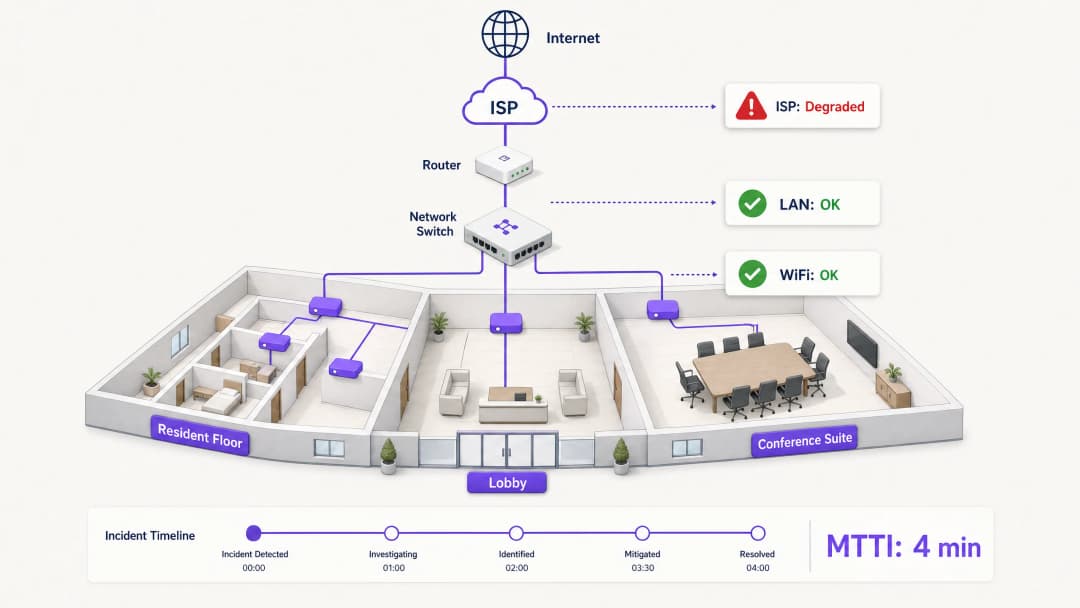
Quando a conectividade falha num ambiente multi-inquilino, o WiFi é o primeiro a ser culpado. É o limite visível da rede, o último salto antes do dispositivo e o alvo mais fácil para os utilizadores frustrados. Para os gestores de TI, arquitetos de rede e diretores de operações de espaços, isto cria uma taxa operacional persistente: o tempo despendido a provar a inocência.
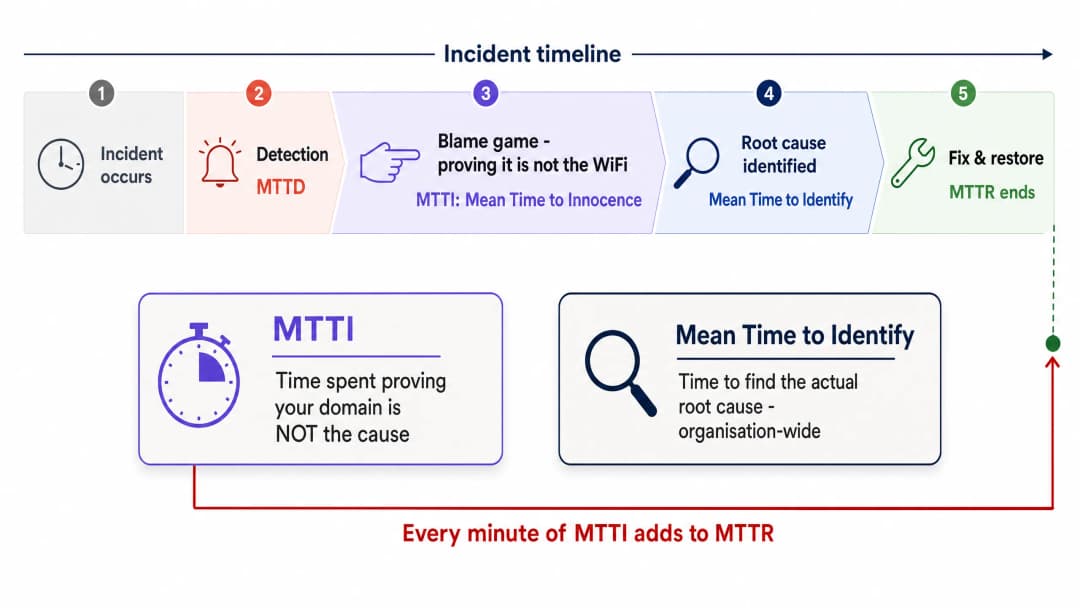
O tempo médio para a inocência (MTTI) mede o tempo médio decorrido entre a sinalização de um incidente e a capacidade de uma equipa demonstrar que o seu domínio não é a causa raiz. Em ambientes complexos, como edifícios construídos para arrendamento (BTR), hotéis ou centros de conferências, a rede está fragmentada entre gestores de propriedades, fornecedores de WiFi gerido e fornecedores de serviços de internet (ISPs). Sem uma telemetria definitiva, o MTTI inflaciona o tempo médio de resolução (MTTR), à medida que as equipas discutem sobre a responsabilidade em vez de corrigirem a falha.
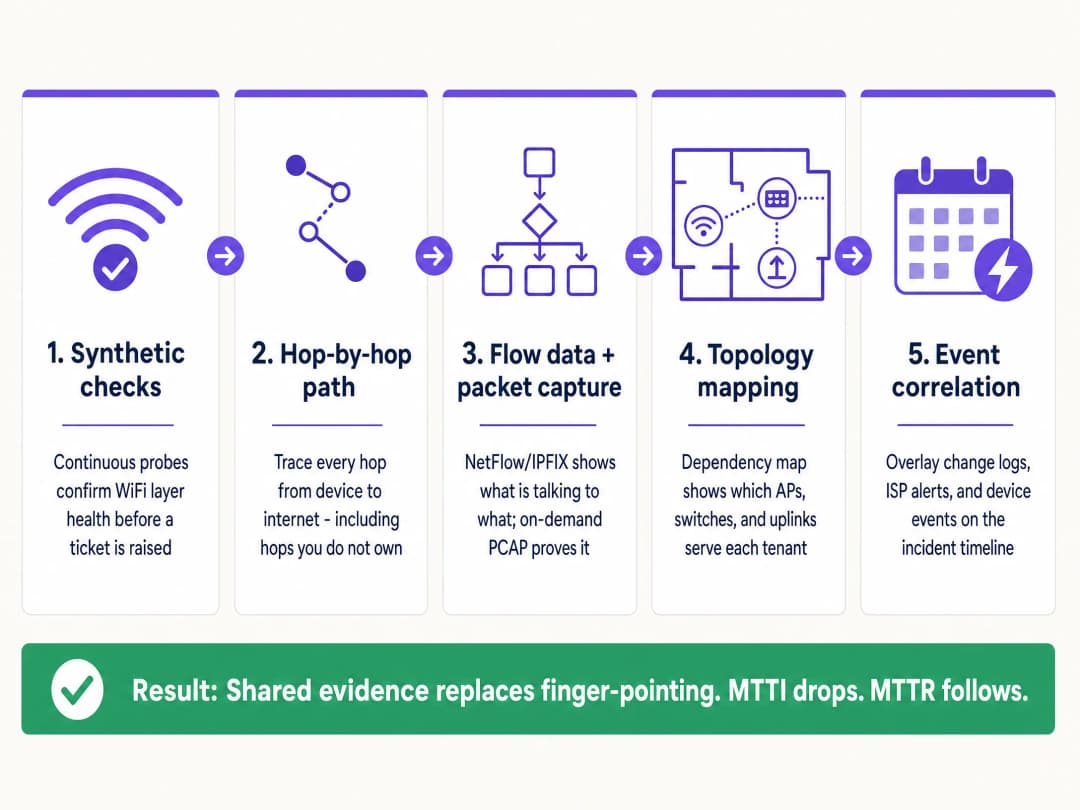
Este guia detalha uma metodologia de observabilidade em cinco etapas para reduzir sistematicamente o MTTI. Ao implementar testes sintéticos contínuos, visibilidade de caminho salto a salto, análise de dados de fluxo, mapeamento de topologia e correlação de eventos, pode substituir a troca mútua de acusações por provas partilhadas. O objetivo não é ganhar o jogo da culpa mais rapidamente, mas sim acabar com ele por completo.
Análise Técnica Detalhada: A Mecânica do MTTI
A Distinção Entre MTTI e Tempo Médio de Identificação
É vital separar o MTTI do tempo médio de identificação. O tempo médio de identificação é uma métrica que abrange toda a organização e monitoriza quanto tempo demora a encontrar a causa raiz real de uma interrupção. O MTTI é uma métrica isolada, específica de um domínio, que monitoriza quanto tempo uma equipa demora a provar que não é a culpada.
Cada minuto de MTTI adiciona-se diretamente ao MTTR. Se um fornecedor de WiFi gerido passar 40 minutos a verificar manualmente os pontos de acesso (APs) e os registos do switch antes de concluir que o problema reside no ISP, o MTTR tem uma penalização de 40 minutos incorporada antes de a remediação real começar.
Por que o WiFi Leva a Culpa
Em ambientes que servem 350 milhões de utilizadores únicos em mais de 80.000 locais ativos, a Purple observa o mesmo padrão repetidamente. A camada WiFi é culpada por predefinição devido a três realidades estruturais:
- Viés de visibilidade: O indicador de sinal de WiFi é a única ferramenta de diagnóstico de rede disponível para o utilizador comum do local.
- Proximidade da periferia: Sendo o último salto para o dispositivo cliente, o WiFi herda os sintomas de todas as falhas a montante. Um tempo limite de DNS no ISP parece idêntico a uma falha de AP do ponto de vista do utilizador.
- Lacunas de telemetria: Historicamente, provar a saúde da rede sem fios exigia intervenção manual. Se não conseguir apresentar um atestado de boa saúde para a camada sem fios em menos de dois minutos, perde o controlo da situação.
A Complicação Multi-Tenant
Numa empresa single-tenant, as equipas de rede detêm a infraestrutura desde o AP até à firewall. Em ambientes WiFi Multi-Tenant, a responsabilidade é fracionada.
Um residente de BTR paga ao gestor da propriedade. O gestor da propriedade contrata um fornecedor de WiFi gerido. O fornecedor de WiFi gerido depende de um circuito ISP de terceiros e, frequentemente, da rede de distribuição interna do senhorio. Quando um residente não consegue transmitir vídeo, o fornecedor deve desculpar rapidamente o hardware WiFi (Cisco Meraki, HPE Aruba, Ruckus ou Juniper Mist) e isolar a falha no dispositivo cliente, no switch do edifício ou no ISP. A falha em fazê-lo prejudica a relação comercial entre o fornecedor e o gestor da propriedade.
Tem dúvidas sobre a sua configuração específica?
A nossa equipa trabalha com operadores de espaços, gestores de TI e engenheiros de rede em 80.000 espaços. Agende uma chamada de 20 minutos e mostraremos como outros profissionais na sua área o resolveram.
Guia de Implementação: A Metodologia de 5 Passos
Para reduzir sistematicamente o MTTI, implemente esta arquitetura de observabilidade de cinco camadas.
1. Verificações Sintéticas Contínuas
Não espere que um utilizador se queixe. Implemente sondas sintéticas automatizadas que emulam continuamente o comportamento do utilizador a partir da periferia da rede.
- Implementação: Configure APs ou sensores dedicados para executar testes agendados de resposta DHCP, resolução DNS, acessibilidade HTTP e fluxos de autenticação (como logins 802.1X ou Captive Portal).
- Resultado: Quando um ticket é criado, verifica primeiro o painel sintético. Se as sondas mostrarem uma acessibilidade HTTP limpa no momento exato da reclamação, exonera imediatamente a camada WiFi e o circuito WAN, mudando o foco para o dispositivo cliente específico ou para a aplicação de destino.
2. Visibilidade de Caminho Salto a Salto
Provar que o seu hardware está saudável é insuficiente se não conseguir provar que o caminho para a internet está desimpedido.
- Implementação: Utilize ferramentas de visualização de caminho para rastrear o tráfego desde a camada de acesso através da LAN, passando pelo ponto de demarcação e entrando na rede do ISP.
- Resultado: Quando ocorrem picos de latência, um rastreio de caminho revela exatamente qual o nó que introduziu o atraso. Se os saltos de um a quatro (o seu domínio) mostrarem uma latência de 2ms, e o salto cinco (o router de borda do ISP) mostrar 150ms de latência e 12% de perda de pacotes, tem uma prova definitiva para apresentar ao ISP.
3. Dados de Fluxo e Captura de Pacotes Sob Procura
Quando os utilizadores reportam falhas específicas de aplicações, precisa de visibilidade ao nível da conversação.
- Implementação: Exporte dados NetFlow ou IPFIX dos seus switches centrais ou firewalls. Garanta que o hardware da sua camada de acesso suporta a captura remota de pacotes (PCAP) sob procura, sem necessitar de um engenheiro no local.
- Resultado: Os dados de fluxo provam se o tráfego para um serviço específico está a sair da sua rede de forma limpa. Se estiver, a rede está inocente. Se for necessária uma prova forense mais detalhada, um PCAP direcionado na VLAN específica fornece provas inegáveis de retransmissões TCP ou resets do lado do servidor.
4. Mapeamento de Topologia e Dependências
Num ambiente multi-tenant, isolar o raio de impacto é a forma mais rápida de categorizar uma falha.
- Implementação: Mantenha um mapa de dependências ativo e atualizado dinamicamente que ligue cada AP ao seu switch, uplink e circuito WAN, mapeado contra as VLANs dos inquilinos.
- Resultado: Se uma falha afetar APs em vários pisos, mas apenas num único switch, o problema é o switch. Se afetar todos os APs, mas apenas a VLAN de um inquilino, trata-se de um problema de configuração lógica. O dimensionamento rápido do âmbito evita o desperdício de esforço a investigar infraestruturas saudáveis.
5. Correlação de Eventos
Dados sem contexto prolongam as investigações.
- Implementação: Introduza registos de alterações, alertas de manutenção do ISP, atualizações de firmware de hardware e tickets de utilizadores numa única vista de linha de tempo.
- Resultado: Sobrepor um pico de falhas de autenticação com um evento de expiração de certificado do Microsoft Entra ID que ocorreu 10 minutos antes identifica imediatamente a causa raiz, contornando completamente o hardware de rede.
Melhores Práticas
- Padronize o Hardware: Limite as implementações a fornecedores empresariais canónicos (Cisco Meraki, HPE Aruba, Ruckus, Juniper Mist, Ubiquiti UniFi, Cambium, Extreme, Fortinet) que disponibilizam APIs para testes sintéticos e PCAP remoto.
- Automatize a Prova: Configure a sua plataforma de monitorização para anexar automaticamente resultados de testes sintéticos e rastreios de rotas a pedidos de suporte ITSM no momento em que são criados.
- Partilhe o Dashboard: Forneça aos gestores de propriedades acesso de leitura a um dashboard de estado geral de alto nível. A transparência evita o jogo das culpas.
- Registe o MTTI de Forma Formal: Meça o tempo decorrido entre a criação do pedido de suporte e o momento em que a sua equipa apresenta provas de inocência. Trate-o como um KPI principal a par do MTTR.
Resolução de Problemas e Mitigação de Riscos
- Risco: O Ciclo 'Nenhuma Falha Detetada': Os utilizadores reportam problemas, mas as verificações sintéticas aparecem a verde.
- Mitigação: O problema é provavelmente específico do dispositivo ou está relacionado com interferências de RF (interferência de canal partilhado ou obstrução física). Utilize análises do lado do cliente para verificar o RSSI e o histórico de roaming do dispositivo específico.
- Risco: Recusa do ISP: O ISP recusa assumir a falha apesar das suas provas.
- Mitigação: Forneça rastreios de rota passo a passo que mostrem o endereço IP exato onde a perda de pacotes começa. Partilhe PCAPs que demonstrem uma saída limpa do seu ponto de demarcação. Dados concretos forçam a escalada para além do suporte de Nível 1.
- Risco: Falhas no Captive Portal: Os utilizadores culpam o WiFi quando o portal não carrega.
- Mitigação: Isole o fornecedor de identidade. Verifique o estado da integração (Microsoft Entra ID, Okta, Google Workspace). Se a rede permitir tráfego de pré-autenticação mas o IdP expirar, a rede está inocente.
ROI e Impacto no Negócio
A redução do MTTI proporciona um valor comercial mensurável que vai muito além de simplesmente poupar horas de engenharia.
- Redução do MTTR: Eliminar 40 minutos de trocas de acusações num incidente reduz diretamente o tempo de inatividade, protegendo as receitas em ambientes de retalho e hotelaria.
- Cumprimento de SLAs: Uma exoneração mais rápida evita a aplicação de penalizações injustas ao fornecedor de WiFi gerido quando a falha reside no ISP ou na infraestrutura do edifício.
- Retenção de Clientes: No setor de WiFi multi-inquilino (Multi-Tenant), os gestores de propriedades renovam contratos com fornecedores que oferecem transparência e respostas rápidas. Provas partilhadas geram confiança; argumentos defensivos destroem-na.
- Otimização de Recursos: Engenheiros de rede de Nível 3 altamente remunerados dedicam o seu tempo a conceber soluções, em vez de provarem manualmente que o funcionamento do WiFi está correto.
Definições Principais
Tempo Médio para a Inocência (MTTI)
O tempo médio necessário para que uma equipa de TI específica prove, utilizando dados objetivos, que o seu domínio ou infraestrutura não é a causa raiz de um incidente reportado.
Crítico para fornecedores de WiFi gerido que precisam de defender o seu serviço perante gestores de propriedades e ISPs.
Tempo Médio de Identificação
A métrica à escala da organização que regista o tempo total decorrido desde a deteção do incidente até à descoberta da verdadeira causa raiz.
O MTTI é um subconjunto desta métrica. Reduzir o MTTI reduz diretamente o tempo global de identificação.
Verificações Sintéticas
Testes automatizados e contínuos que emulam o tráfego do utilizador (por exemplo, consultas DNS, pedidos HTTP) para monitorizar proativamente a saúde da rede.
Utilizadas para provar que a camada de WiFi estava a funcionar corretamente no momento exato em que um utilizador se queixou.
Visibilidade de Caminho Salto a Salto
Telemetria que rastreia o tráfego de rede nó a nó, do cliente ao destino, medindo a latência e a perda de pacotes em cada router ou switch específico.
Essencial para provar que uma falha reside na rede de um ISP ou no switch de distribuição de um senhorio, e não no hardware de WiFi gerido.
Dados de Fluxo (NetFlow/IPFIX)
Dados de protocolo de rede que fornecem um resumo das conversações de tráfego, mostrando a origem, o destino, o protocolo e o volume.
Utilizados para provar que o tráfego de uma aplicação específica está a sair com sucesso da rede local.
Captura de Pacotes a Pedido (PCAP)
A capacidade de gravar remotamente o tráfego de rede em bruto a partir de um ponto de acesso ou switch para análise forense.
A prova final utilizada para demonstrar erros do lado do servidor ou comportamentos incorretos de dispositivos clientes.
Raio de Impacto
O âmbito do impacto de um incidente específico (por exemplo, um utilizador, um AP, um switch, um tenant ou todo o edifício).
Determinar o raio de impacto através do mapeamento de topologia é a forma mais rápida de excluir a infraestrutura saudável de uma investigação.
Correlação de Eventos
A prática de sobrepor diferentes fluxos de dados (logs, alertas, atualizações) numa única linha temporal para identificar causa e efeito.
Utilizado para provar que uma quebra de rede foi causada por uma alteração de terceiros, como uma janela de manutenção não anunciada do ISP.
Exemplos Práticos
Um hotel com 350 quartos reporta que o WiFi nos quartos está lento em toda a propriedade. A receção culpa o fornecedor de WiFi gerido. Como exonerar a rede e encontrar a causa raiz?
- Verifique as sondas sintéticas: os testes de alcançabilidade DNS e HTTP mostram que os APs têm uma ligação limpa à internet. 2. Reveja o mapa de topologia: o problema afeta todos os APs em todos os switches, excluindo falhas no hardware de borda. 3. Execute um rastreio de caminho: o rastreio mostra 2ms de latência dentro da LAN do hotel, mas 180ms de latência no terceiro salto (o router de agregação do ISP). 4. Exporte as provas: envie a captura de ecrã do rastreio de caminho para o gerente do hotel e para o ISP.
Um retalhista nacional reporta que os terminais de ponto de venda (POS) numa região estão a perder ligações com o processador de pagamentos. A equipa de rede é culpada por uma configuração incorreta de firewall ou de encaminhamento.
- Isole o raio de impacto: confirme que apenas os terminais POS (VLAN específica) são afetados; o WiFi de convidados e os sistemas de back-office estão operacionais. 2. Analise os dados de fluxo: o NetFlow confirma que o tráfego destinado à gama de IPs do processador de pagamentos está a sair com sucesso dos routers das lojas. 3. Capture pacotes: um PCAP a pedido na VLAN dos POS revela que o servidor do processador de pagamentos está a enviar resets TCP (RST). 4. Partilhe o PCAP com a equipa de suporte do processador de pagamentos.
Perguntas de Prática
Q1. Um tenant num espaço de coworking queixa-se de que não consegue aceder à sua VPN corporativa. Outros tenants estão a navegar na internet sem problemas. Qual é a forma mais eficiente de provar que a rede WiFi não é a culpada?
Dica: Considere o raio de impacto e o tipo específico de tráfego que está a falhar.
Ver resposta modelo
Primeiro, utilize o mapa de topologia para confirmar que o raio de impacto está limitado a um utilizador ou a um serviço específico, excluindo uma falha geral de AP ou switch. Segundo, analise os dados de fluxo (NetFlow/IPFIX) para o endereço IP desse cliente. Se os dados de fluxo mostrarem que o tráfego da VPN (por exemplo, UDP 500 ou TCP 443) está a sair da rede de forma limpa, a rede WiFi e a LAN estão inocentes. O problema deve-se à configuração da VPN do cliente ou ao firewall corporativo que está a bloquear a ligação.
Q2. O seu painel de monitorização mostra que um AP ficou offline, mas o gestor do imóvel insiste que a rede WiFi está avariada porque o ISP está em baixo. Como prova que o problema é de energia interna e não do ISP?
Dica: Procure uma correlação entre o estado da infraestrutura e os eventos externos.
Ver resposta modelo
Utilize a correlação de eventos e o mapeamento de topologia. Se o mapa de topologia mostrar que apenas um AP está offline enquanto outros no mesmo switch estão a funcionar, o circuito do ISP está claramente ativo. A correlação de eventos pode mostrar um log de falha de PoE (Power over Ethernet) na porta do switch ligada a esse AP específico. Isto prova que o problema é do hardware local ou da cablagem, e não do circuito WAN.
Q3. O diretor de operações de um estádio afirma que a rede WiFi falhou durante o intervalo porque os leitores de bilhetes pararam de funcionar. Precisa de ilibar a rede em menos de dois minutos. Que telemetria utiliza?
Dica: Precisa de uma prova histórica do estado de funcionamento no momento exato da falha reportada.
Ver resposta modelo
Extraia os dados históricos das verificações sintéticas contínuas. Mostre ao diretor de operações o painel de controlo confirmando que, durante a janela exata de 15 minutos do intervalo, os APs estavam a resolver o DNS com sucesso e a alcançar o endereço IP do servidor de bilheteira com baixa latência. Isto prova imediatamente que a rede sem fios estava operacional e desvia a investigação para os servidores da aplicação de bilheteira, que provavelmente cederam sob a carga súbita.
Continue a ler esta série
Por que o WiFi de convidados de estilo hoteleiro falha em edifícios residenciais
Será capaz de diagnosticar por que os residentes em blocos BTR, residências de estudantes e MDUs continuam a reportar falhas de WiFi, e escolher o modelo de autenticação que as resolve. A resposta é uma chave iPSK por agregado familiar nos seus pontos de acesso existentes, mantendo uma rede de Captive Portal separada para os visitantes.
Conceção de Redes WiFi para Edifícios de Escritórios Multi-Inquilino
Este guia fornece aos gestores de TI, arquitetos de rede e CTOs um plano neutro em termos de fornecedor para conceber redes WiFi escaláveis, seguras e isoladas em edifícios de escritórios multi-inquilino. Aborda a segmentação de VLAN sob IEEE 802.1Q, a Atribuição Dinâmica de VLAN através de 802.1X e RADIUS, o planeamento de RF para ambientes de alta densidade e considerações de conformidade sob GDPR e PCI-DSS. Os operadores de espaços e gestores de edifícios encontrarão orientações de arquitetura práticas, estudos de caso do mundo real e erros de configuração a evitar antes da implementação.
Requisitos Legais e de Conformidade para Infraestruturas Partilhadas de WiFi
Este guia de referência técnica e de autoridade descreve os requisitos legais, regulamentares e de arquitetura críticos para a implementação e gestão de infraestruturas partilhadas de WiFi. Fornece aos gestores de TI, arquitetos de rede e operadores de recintos estruturas de ação práticas para garantir uma proteção de dados robusta, conformidade rigorosa com a segurança de pagamentos e isolamento de inquilinos de alto desempenho utilizando padrões empresariais.
Tem dúvidas sobre a sua configuração específica?
A nossa equipa trabalha com operadores de espaços, gestores de TI e engenheiros de rede em 80.000 espaços. Agende uma chamada de 20 minutos e mostraremos como outros profissionais na sua área o resolveram.