
Rechtliche und Compliance-Anforderungen für gemeinsam genutzte WiFi-Infrastrukturen
Dieser maßgebliche technische Referenzleitfaden beschreibt die kritischen rechtlichen, regulatorischen und architektonischen Anforderungen für die Bereitstellung und Verwaltung gemeinsam genutzter WiFi-Infrastrukturen. Er bietet IT-Managern, Netzwerkarchitekten und Betreibern von Veranstaltungsorten praktische Frameworks zur Gewährleistung eines robusten Datenschutzes, einer strengen Einhaltung der Zahlungssicherheitsstandards und einer leistungsstarken Mandantenisolierung unter Verwendung von Unternehmensstandards.
Video overview
Diesen Leitfaden anhören
Podcast-Transkript ansehen
Teil unserer Kernserie: Multi-Tenant WiFi Leitfaden →
Executive Summary
Moderne Unternehmensstandorte agieren in einer hypervernetzten, stark regulierten Landschaft. Die Bereitstellung einer gemeinsamen drahtlosen Infrastruktur - ob in einem Hotel, einem Einkaufszentrum, einem Verkehrsknotenpunkt oder auf einem Campus des öffentlichen Sektors - ist keine einfache Dienstleistung mehr; sie ist eine regulierte Aktivität. In dem Moment, in dem ein Unternehmen Datenverkehr über ein einziges physisches Netzwerk leitet oder Daten von mehreren unabhängigen Mietern, Mitarbeitern und öffentlichen Gästen sammelt, übernimmt es erhebliche rechtliche Haftungsrisiken. Diese Verpflichtungen erstrecken sich über Datenschutzvorschriften wie die GDPR [1], Standards für die Sicherheit von Zahlungskarten (PCI-DSS 4.0) [2] und nationale Sicherheitsgesetze wie den UK Investigatory Powers Act [3].
Für den Chief Technology Officer (CTO) und den Chief Information Security Officer (CISO) führt ein Versäumnis bei der korrekten Architektur dieser Netzwerke zu schwerwiegenden behördlichen Geldstrafen - bis zu 4 % des weltweiten Jahresumsatzes unter der GDPR - und katastrophalen Sicherheitsverletzungen. Für den Venue Operations Director stellt die Nichteinhaltung eine direkte Bedrohung für die Geschäftskontinuität, die Mieterbindung und das Kundenvertrauen dar.
Dieser Leitfaden bietet ein umfassendes, herstellerunabhängiges Architekturkonzept zur Bewältigung dieser Herausforderungen. Durch die Implementierung virtueller Netzwerksegmentierung (VLANs), robuster identitätsbasierter Zugriffskontrolle (IEEE 802.1X) und automatisiertem Einwilligungsmanagement können Unternehmen ihr gemeinsam genutztes drahtlose Netzwerk von einem risikoreichen Haftungsrisiko in ein sicheres, konformes und hochgradig wertvolles Geschäftsgut verwandeln. Die Integration von Enterprise-Intelligence-Plattformen wie Purple Guest WiFi und WiFi Analytics stellt sicher, dass Compliance nicht auf Kosten der Benutzererfahrung geht, sondern vielmehr als Wegbereiter für eine sichere Erfassung von First-Party-Daten und betriebliche Effizienz dient.
Technischer Deep-Dive
Der Übergang von einer drahtlosen Bereitstellung an einem einzelnen Standort zu einer gemeinsam genutzten Multi-Tenant-Infrastruktur erfordert eine grundlegende Änderung der Netzwerk-Designphilosophie: weg von einer flachen, vertrauenswürdigen Umgebung hin zu einem segmentierten Zero-Trust-Framework. Das Hauptziel besteht darin, sicherzustellen, dass mehrere unabhängige Mieter auf einer einzigen physischen Infrastruktur koexistieren, ohne Sicherheit, Leistung oder Datenschutz zu gefährden.
Die grundlegende Notwendigkeit der VLAN-Segmentierung
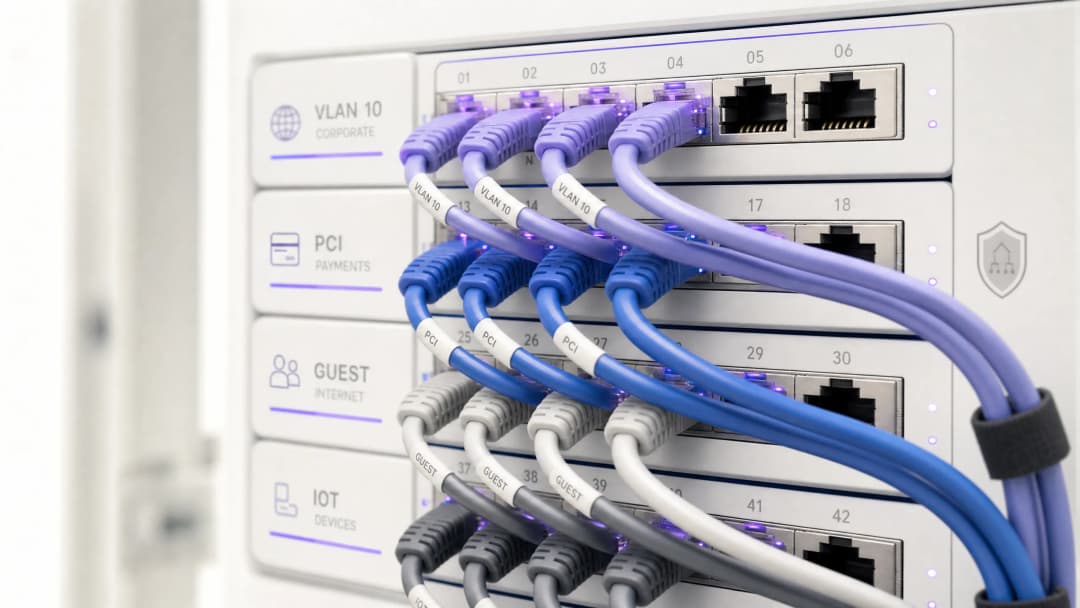
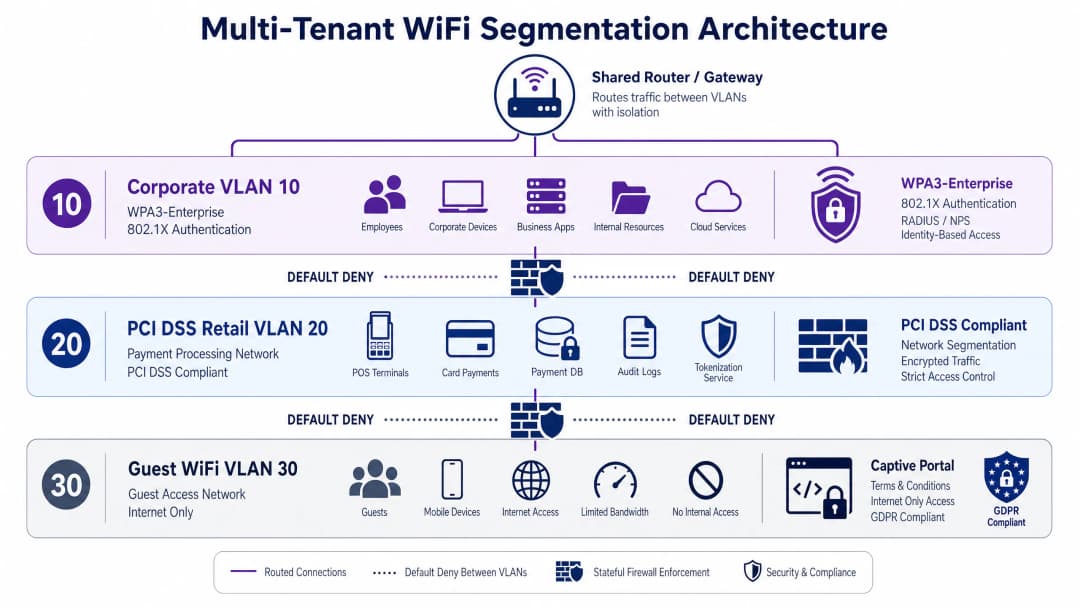
Der Grundstein eines jeden mehrmandantenfähigen Netzwerks ist das Virtual Local Area Network (VLAN). Wie im Standard IEEE 802.1Q definiert, ermöglichen VLANs die Aufteilung eines einzelnen physischen Netzwerk-Switches in mehrere, logisch getrennte Broadcast-Domänen [4]. In einer gemeinsam genutzten Umgebung bedeutet dies, dass der Datenverkehr eines Mandanten - beispielsweise eines Einzelhandelsgeschäfts auf VLAN 10 - für den Datenverkehr eines anderen Mandanten, wie etwa eines Unternehmensbüros auf VLAN 20, völlig unsichtbar und unzugänglich ist, selbst wenn ihre Geräte eine Verbindung zu denselben physischen Access Points herstellen.
Architekturregel: Ohne ordnungsgemäße VLAN-Implementierung ist die Mandantentrennung lediglich kosmetischer Natur. Mehrere SSIDs auf einem einzigen, flachen LAN bieten keine Sicherheitsisolation; jedes Gerät im Netzwerk kann Broadcast-Datenverkehr mitschnüffeln und laterale Aufklärung betreiben.
Um eine strikte Mandantentrennung durchzusetzen, muss der Netzwerkkern Stateful-Inter-VLAN-Firewall-Regeln implementieren. Standardmäßig muss das gesamte Inter-VLAN-Routing blockiert werden (Default Deny). Datenverkehr darf VLAN-Grenzen nur überschreiten, wenn er expliziten, stark eingeschränkten Firewall-Regeln entspricht (z. B. das Routing bestimmter Ports zu einem gemeinsam genutzten lokalen Drucker oder Zahlungs-Gateway).
Authentifizierungsstandards: WPA3 und IEEE 802.1X
Die Absicherung des Zugriffs auf die gemeinsam genutzte Infrastruktur erfordert die Anpassung des Authentifizierungsprotokolls an das spezifische Risikoprofil des Mandanten. Ein einheitlicher Pre-Shared Key (PSK)-Ansatz stellt eine kritische Sicherheitslücke und einen direkten Compliance-Fehler in Unternehmensumgebungen dar.
- Unternehmens- und regulierte Mandanten: Diese Umgebungen erfordern WPA3-Enterprise in Kombination mit der portbasierten Netzwerkzugriffskontrolle nach IEEE 802.1X [5]. Diese Architektur ersetzt statische Passwörter durch individuelle, dynamische Anmeldedaten, die über eine EAP-Methode (Extensible Authentication Protocol) wie EAP-TLS (zertifikatsbasiert) oder PEAP-MSCHAPv2 (anmeldedatenbasiert) authentifiziert werden und mit einem zentralen RADIUS-Server (Remote Authentication Dial-In User Service) kommunizieren. Dadurch wird sichergestellt, dass beim Ausscheiden eines Mitarbeiters oder bei der Kompromittierung eines Geräts der Zugriff sofort entzogen werden kann, ohne dass andere Benutzer oder Mandanten beeinträchtigt werden. Detaillierte Bereitstellungsschritte finden Sie in unserem Leitfaden zur Implementierung der 802.1X-Authentifizierung mit Cloud RADIUS.
- IoT- und Headless-Geräte: Smart-Building-Sensoren, digitale Beschilderung und Umweltsteuerungen verfügen oft nicht über die Fähigkeit, eine 802.1X-Authentifizierung durchzuführen. Für diese Geräte müssen Multi-Pre-Shared Key (MPSK) oder Dynamic PSK (DPSK) Technologien eingesetzt werden. Dies ermöglicht es dem Netzwerk, jedem Gerät einen eindeutigen, individuellen PSK zuzuweisen und es automatisch einem eingeschränkten IoT-VLAN zuzuordnen, ohne dass eine Client-Software der Enterprise-Klasse erforderlich ist.* Öffentlicher Gastzugang: Um den öffentlichen Gastdatenverkehr vor passivem WLAN-Sniffing zu schützen, ohne die Reibung von Passwörtern einzuführen, sollten Standorte WPA3-Enhanced Open auf Basis von Opportunistic Wireless Encryption (OWE) implementieren [6]. OWE etabliert automatisch individuelle, verschlüsselte Funksitzungen für jedes Gastgerät und gewährleistet so die Privatsphäre in offenen Netzwerken, während gleichzeitig ein nahtloser Onboarding-Flow über ein Captive Portal beibehalten wird.
Die Datenschutzebene: GDPR und UK GDPR Konformität
Wenn ein Standort ein Gast-WiFi-Netzwerk betreibt, wird er rechtlich als Verantwortlicher (Data Controller) im Sinne der GDPR und der UK GDPR eingestuft. Der Anbieter des Captive Portals agiert als Auftragsverarbeiter (Data Processor). Diese Unterscheidung ist von entscheidender Bedeutung: Der Standort trägt die letztendliche rechtliche Haftung dafür, wie Gastdaten erfasst, verarbeitet und gespeichert werden.
Gemäß Artikel 4 der GDPR gehören zu den personenbezogenen Daten alle Informationen, die sich auf eine identifizierte oder identifizierbare natürliche Person beziehen [1]. In einer Gast-WiFi-Umgebung umfasst dies sowohl explizite Daten (Namen, E-Mail-Adressen, Telefonnummern oder Social-Media-Profile, die über das Captive Portal erfasst werden) als auch implizite Daten (MAC-Adressen, IP-Adressen, Sitzungszeitstempel und Gerätestandortdaten, die automatisch vom Wireless Controller erfasst werden).
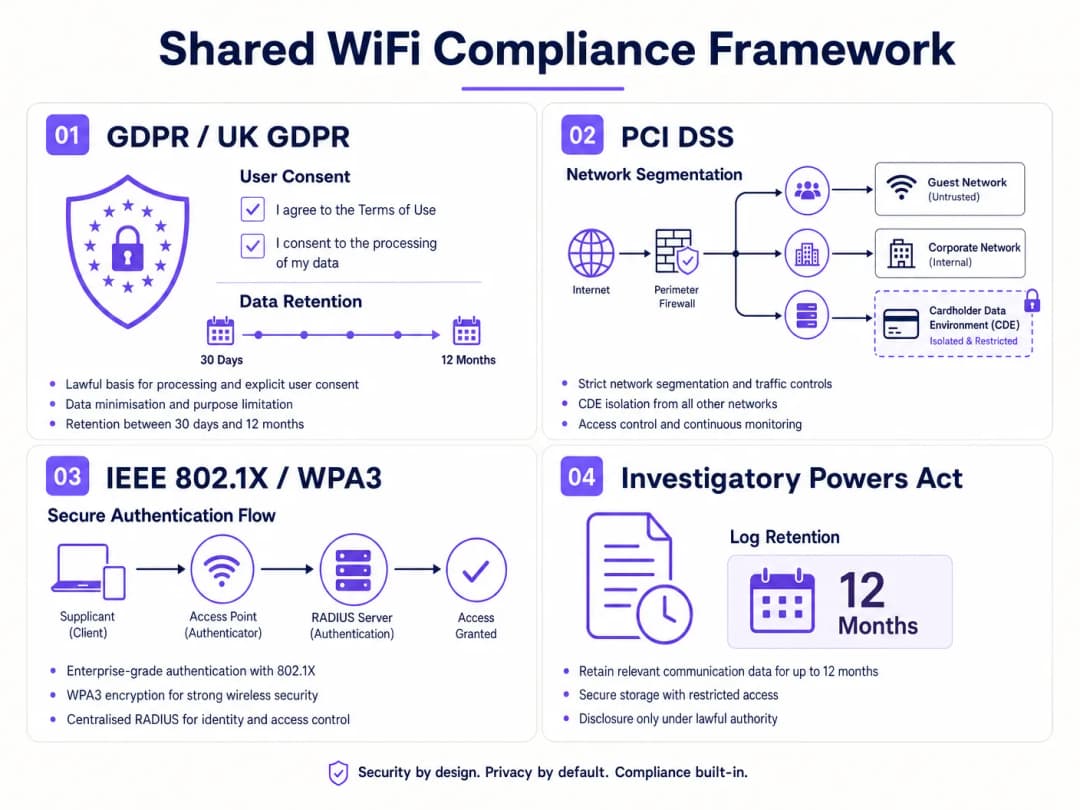
Um diese personenbezogenen Daten rechtmäßig zu verarbeiten, müssen Standorte eine gültige Rechtsgrundlage gemäß GDPR Artikel 6 schaffen. Für die grundlegende Netzwerkkonnektivität und die Sicherheitsprotokollierung können Standorte ein berechtigtes Interesse geltend machen (Artikel 6(1)(f)). Wenn der Standort diese Daten jedoch für Marketing, Verhaltensprofilierung oder Analysen nutzen möchte, muss er eine ausdrückliche Einwilligung (Artikel 6(1)(a)) einholen.
Einwilligungsstandard: Die Einwilligung muss freiwillig, für den bestimmten Fall, in informierter Weise und unmissverständlich erteilt werden. Sie muss durch eine eindeutige, bestätigende Handlung erfolgen. Die Verknüpfung der Einwilligung zu Marketingzwecken mit den Nutzungsbedingungen für den Netzwerkzugang ist ein direkter Verstoß gegen die Verordnung.
Um diesen Standard zu erfüllen, muss die Splash-Page des Captive Portals mit separaten, nicht vorab ausgewählten Kontrollkästchen für jeden einzelnen Verarbeitungszweck gestaltet sein. Beispielsweise muss ein Nutzer in der Lage sein, die Nutzungsbedingungen des Netzwerks zu akzeptieren, um online zu gehen, ohne gezwungen zu sein, dem Erhalt von Marketingmitteilungen zuzustimmen. Darüber hinaus muss das System ein detailliertes, fälschungssicheres Einwilligungs-Audit-Trail führen, in dem genau protokolliert wird, wer wann eingewilligt hat, welche Informationen angezeigt wurden und welche Version der Datenschutzrichtlinie zu diesem Zeitpunkt aktiv war.
Datenaufbewahrung und der regulatorische Konflikt
IT-Teams stehen bei der Verwaltung der Aufbewahrung von Netzwerkprotokollen vor einer komplexen, zweiseitigen Herausforderung. Sie müssen das GDPR-Prinzip der Datenminimierung (Aufbewahrung personenbezogener Daten nicht länger als unbedingt erforderlich) mit nationalen Sicherheitsgesetzen in Einklang bringen, die eine Protokollaufbewahrung vorschreiben.
Beispielsweise verlangt der UK Investigatory Powers Act 2016 (IPA) von Anbietern von Kommunikationsdiensten, Internet-Verbindungsdaten (ICRs) bis zu 12 Monate lang aufzubewahren, um Strafverfolgungsbehörden bei Ermittlungen zu schweren Straftaten zu unterstützen [3]. Ähnlich schreiben verschiedene nationale europäische Telekommunikationsvorschriften die Aufbewahrung von Verbindungsprotokollen für einen Zeitraum von 30 Tagen bis zu 12 Monaten vor.
Um diesen Konflikt zu bewältigen, müssen Veranstaltungsorte eine gestufte Aufbewahrungsarchitektur implementieren, die Aufbewahrungsfristen basierend auf der Datenklassifizierung trennt und automatisiert:
- Netzwerksitzungsprotokolle (IP-Zuweisungen, MAC-Adressen, Zeitstempel): Werden 12 Monate lang in einem sicheren, verschlüsselten Syslog-Repository mit eingeschränktem Zugriff aufbewahrt, um gesetzliche Verpflichtungen zur Strafverfolgung zu erfüllen, und anschließend automatisch gelöscht.
- Captive Portal Registrierungsdaten (ohne Einwilligung): Werden innerhalb von 30 Tagen nach Beendigung der Sitzung gelöscht oder vollständig anonymisiert.
- Marketingprofile (mit Einwilligung): Werden aufbewahrt, bis der Benutzer die Einwilligung widerruft (Opt-out). Inaktive Profile (z. B. Benutzer, die sich seit 180 Tagen nicht verbunden haben) müssen automatisch für Löschungen oder erneute Einwilligungskampagnen markiert werden.
Implementierungshandbuch
Die Bereitstellung eines sicheren, konformen, mandantenfähigen Drahtlosnetzwerks erfordert einen strukturierten Phase-Gate-Ansatz. Dieser Abschnitt beschreibt die kritischen Konfigurationsschritte und konzentriert sich auf herstellerneutrale Best Practices für Netzwerkarchitekten und IT-Manager.
Schritt 1: Physische und logische VLAN-Konfiguration
Beginnen Sie mit der Definition des VLAN-Schemas auf dem Core-Switch und verteilen Sie es über 802.1Q-Trunking auf alle Distribution-Switches und Access Points (APs). Weisen Sie separate Subnetze und VLAN-IDs zu, um Traffic-Domains vollständig zu isolieren:
Configure Core Switch:
  vlan 10 -> Name: Corporate_Tenant (Subnet: 10.10.10.0/24)
  vlan 20 -> Name: Retail_POS_PCI (Subnet: 10.20.20.0/24)
  vlan 30 -> Name: Guest_WiFi (Subnet: 172.16.0.0/16)
Konfigurieren Sie an den Edge-Switches die Ports, die mit den drahtlosen Access Points verbunden sind, als Trunk-Ports, die die VLANs 10, 20 und 30 zulassen. Stellen Sie sicher, dass das native (ungetaggte) VLAN auf ein nicht-routingfähiges Management-VLAN (z. B. VLAN 99) eingestellt ist, um den Management-Traffic vor dem Abfangen durch Mandanten zu schützen.
Schritt 2: Durchsetzung von Access Control Lists (ACL) und Firewalls
Setzen Sie an der Layer-3-Grenze (normalerweise dem Core-Switch oder Security Gateway) eine strikte Inter-VLAN-Sperrung durch. Der Standardzustand für den gesamten Inter-VLAN-Traffic muss blockiert sein. Implementieren Sie stateful Access Control Lists (ACLs) oder Firewall-Regeln, um laterale Bewegungen zu verhindern:
Create Access-List (Cisco IOS Example):
  ip access-list extended BLOCK_LATERAL
    deny ip 172.16.0.0 0.0.255.255 10.10.10.0 0.0.0.255 (Block Guest to Corp)
    deny ip 172.16.0.0 0.0.255.255 10.20.20.0 0.0.0.255 (Block Guest to PCI)
    permit ip 172.16.0.0 0.0.255.255 any (Permit Guest to WAN)
Wenden Sie diese ACL eingehend (inbound) auf dem SVI (Switch Virtual Interface) für VLAN 30 an. Konfigurieren Sie für das PCI-konforme VLAN 20 eine Stateful-Inspection-Regel, die den gesamten eingehenden Datenverkehr von allen anderen VLANs blockiert und nur ausgehende verschlüsselte TLS-Sitzungen an die spezifischen IP-Adressen des Zahlungsabwicklers zulässt.
Schritt 3: Enterprise RADIUS- und 802.1X-Integration
Integrieren Sie für Unternehmenskunden den Wireless-Controller mit einem sicheren RADIUS-Server (z. B. FreeRADIUS, Microsoft NPS oder einer cloudbasierten RADIUS-Lösung). Konfigurieren Sie die Unternehmens-SSID so, dass WPA3-Enterprise (AES-CCMP- oder GCMP-256-Verschlüsselung) mit 802.1X-Authentifizierung verwendet wird.
Konfigurieren Sie den RADIUS-Server so, dass er eine zertifikatsbasierte Authentifizierung (EAP-TLS) durchführt. Generieren und verteilen Sie eindeutige Client-Zertifikate über eine MDM-Plattform (Mobile Device Management) an alle Unternehmensgeräte. Dies verhindert, dass sich unbefugte private Geräte mit dem Unternehmensnetzwerk verbinden, selbst wenn Benutzerdaten kompromittiert wurden.
Schritt 4: Einrichtung von Captive Portal und Einwilligungserfassung
Konfigurieren Sie für das öffentliche Gäste-WiFi (VLAN 30) den Wireless-Controller so, dass der gesamte nicht authentifizierte HTTP/HTTPS-Datenverkehr an ein externes Captive Portal weitergeleitet wird. Stellen Sie sicher, dass das Portal auf einem sicheren, HTTPS-fähigen Server mit einem gültigen SSL/TLS-Zertifikat gehostet wird.
Nutzen Sie eine auf Compliance ausgerichtete Plattform wie Purple, um die Splash Page des Captive Portals so zu gestalten, dass die folgenden UI-Elemente erzwungen werden:
- Klare Datenschutzhinweise: Zeigen Sie eine gut sichtbare, leicht lesbare Zusammenfassung an, in der erklärt wird, welche Daten erfasst werden (z. B. Name, E-Mail-Adresse, MAC-Adresse) und zu welchen Zwecken die Verarbeitung erfolgt.
- Separate Kontrollkästchen für die Einwilligung: Implementieren Sie separate, nicht vorab ausgewählte und nicht obligatorische Kontrollkästchen für Marketing-Opt-ins. Das Kontrollkästchen „Nutzungsbedingungen akzeptieren“ muss vom Marketing-Opt-in getrennt sein.
- Link zu Betroffenenrechten: Stellen Sie direkte, funktionale Links zur vollständigen Datenschutzerklärung des Standorts sowie zu einem Self-Service-Portal bereit, auf dem Gäste Datenauskunft oder -löschung (DSARs) beantragen können.
Haben Sie Fragen zu Ihrem spezifischen Setup?
Unser Team arbeitet mit Standortbetreibern, IT-Managern und Netzwerktechnikern an über 80.000 Standorten zusammen. Buchen Sie ein 20-minütiges Gespräch und wir zeigen Ihnen, wie andere diese Herausforderungen gelöst haben.
Best Practices und regulatorische Zuordnung
Um eine langfristige Compliance zu gewährleisten, müssen IT-Teams ihre technischen Kontrollmaßnahmen an etablierten internationalen Vorschriften und Standards ausrichten. Die folgende Tabelle ordnet spezifische regulatorische Anforderungen den entsprechenden technischen Kontrollen und architektonischen Best Practices zu.
| Verordnung / Standard | Spezifische Anforderung | Technische Kontrolle / Best Practice | Funktion der Purple Plattform |
|---|---|---|---|
| GDPR / UK GDPR [1] | Artikel 6: Rechtmäßigkeit der Verarbeitung; Artikel 7: Bedingungen für die Einwilligung. | Nicht vorausgewählte, granulare Kontrollkästchen für die Einwilligung auf dem Captive Portal; sichere, unveränderliche Protokollierung der Einwilligung. | Automatisierte, mehrsprachige Captive Portals mit gesetzeskonformer Einwilligungsprotokollierung und auditbereiten Exporten. |
| PCI DSS 4.0 [2] | Anforderung 1.2: Einschränkung des Datenverkehrs zwischen der Karteninhaber-Datenumgebung (CDE) und anderen Netzwerken. | Layer 3 VLAN Segmentierung; Stateful Default-Deny Firewall-Regeln; physische/logische Isolation von POS-Netzwerken. | Vollständige Kompatibilität mit Netzwerisolierung; herstellerunabhängige Bereitstellung über segmentierte VLANs. |
| PCI DSS 4.0 [2] | Anforderung 11.4: Erkennung und Verhinderung unbefugter drahtloser Zugriffspunkte (Rogue APs). | Implementierung von Wireless Intrusion Prevention Systems (WIPS); Durchführung vierteljährlicher Wireless-Scans. | Integration mit Enterprise-Controller-APIs zur Kennzeichnung unbefugter oder schädlicher Zugriffspunkte. |
| UK Investigatory Powers Act [3] | Abschnitt 87: Speicherung von Internetverbindungsdaten (ICRs) für Strafverfolgungsbehörden. | Segregierter Syslog-Speicher; 12-monatige Aufbewahrung von IP-zu-MAC-Zuordnungen und Sitzungs-Zeitstempeln. | Automatische Syslog-Weiterleitung an sichere, externe Aufbewahrungsorte mit konformer Archivierung. |
| IEEE 802.1X / WPA3 [5] | Sichere Over-the-Air-Verschlüsselung und robuste portbasierte Zugriffskontrolle. | WPA3-Enterprise für Unternehmensnetzwerke; WPA3-Enhanced Open (OWE) für öffentliche Gastnetzwerke. | Nahtlose Integration mit Enterprise-RADIUS und Unterstützung für fortschrittliche WPA3 Sicherheitsstandards. |
Branchenspezifische Best Practices für die Implementierung
- Hotellerie (Hotels & Resorts): Gastnetzwerke müssen pro Zimmer oder pro Gast mithilfe von Private VLANs (PVLANs) oder Client Isolation auf AP-Ebene segmentiert werden. Dies verhindert, dass Gäste in Zimmer 101 Geräte (wie Smart-TVs oder Laptops) in Zimmer 102 scannen oder darauf zugreifen. Für die vor Ort tätigen Einzelhandels- und Gastronomie-Mieter ist eine strikte VLAN-Segregation durchzusetzen, um deren Point-of-Sale-Systeme (POS) vollständig außerhalb des Gastbereichs der Hotellerie zu halten [7]. Weitere detaillierte Branchen-Einblicke finden Sie in unserem Leitfaden für die Hotellerie.
- Einzelhandelsketten & Einkaufszentren: Einzelhändler müssen ihre primären POS-Netzwerke sowohl vom öffentlichen Gast-WiFi als auch von den Corporate-Netzwerken im Backoffice isolieren. Bei der Bereitstellung standortbasierter Analysen (wie der Erfassung von Verweilzeiten der Kunden über WiFi-Probe-Requests) muss das System MAC-Adressen an der Edge sofort hashen oder anonymisieren, um die Verfolgung identifizierbarer Personen ohne Einwilligung zu verhindern. In unserem Leitfaden für den Einzelhandel erfahren Sie, wie Sie eine konforme Datenerfassung mit Marketing-Intelligence in Einklang bringen.
- Öffentlicher Sektor & Bildungswesen: Kommunen und Schulbezirke müssen eine strenge Inhaltsfilterung durchsetzen (CIPA-Konformität in den USA oder lokale Filterrichtlinien des öffentlichen Sektors im Vereinigten Königreich), um den Zugriff auf schädliche oder illegale Inhalte in öffentlichen Netzwerken zu blockieren [8]. Darüber hinaus müssen Netzwerke segmentiert werden, um sicherzustellen, dass administrative Systeme, Schülerakten und öffentliche Gastnetzwerke vollständig isoliert sind. Informationen zur Konformität im Bildungsbereich finden Sie in unserem umfassenden Leitfaden unter WiFi in Schools: The 2026 Administrator & IT Guide.
Fehlerbehebung & Risikominderung
Selbst die am sorgfältigsten konzipierten Netzwerke können Konfigurationsabweichungen oder Betriebsausfälle aufweisen, die die Konformität gefährden. Dieser Abschnitt beschreibt häufige Fehlerszenarien und bietet technische Strategien zur Risikominderung.
Häufige Fehlerszenarien und technische Abhilfemaßnahmen
1. Der "Noisy Neighbour" und Bandbreitenerschöpfung
- Risiko: Ein einzelner Mieter oder öffentlicher Gast verbraucht übermäßig viel Bandbreite (z. B. durch Streaming von HD-Videos) und beeinträchtigt dadurch die Netzwerkleistung für geschäftskritische Anwendungen oder andere Mieter.
- Abhilfemaßnahme: Setzen Sie Quality of Service (QoS) Richtlinien und eine strikte Ratenbegrenzung durch. Wenden Sie Upstream- und Downstream-Bandbreitenbegrenzungen pro Benutzersitzung im Gast-VLAN an (z. B. 5 Mbps Downstream, 1 Mbps Upstream). Konfigurieren Sie am WAN-Edge klassenbasiertes Queuing, um einen minimalen dedizierten Bandbreitenpool für kritische Unternehmens- und Zahlungsverarbeitungs-VLANs zu garantieren - unabhängig von der Auslastung des Gastnetzwerks.
2. VLAN-Leaks und fehlkonfigurierte Switch-Ports
- Risiko: Ein Switch-Port ist fehlkonfiguriert (z. B. ein ungetaggter Access-Port, der dem falschen VLAN zugewiesen ist, oder ein Trunk-Port, der Management-Traffic durchlässt), sodass Datenpakete Mandantengrenzen überschreiten können, ohne die Firewall zu passieren.
- Abhilfemaßnahme: Implementieren Sie Dynamic ARP Inspection (DAI), DHCP Snooping und IP Source Guard auf allen Switches, um MAC-Spoofing und unbefugte IP-Adresszuweisungen zu verhindern. Führen Sie halbjährliche Netzwerkaudits mit automatisierten Tools zur Überprüfung der Konfigurationskonformität durch, um unbefugte VLAN-Änderungen oder Port-Fehlkonfigurationen zu erkennen.
3. Rogue Access Points und "Evil Twin"-Angriffe
- Risiko: Ein Angreifer stellt einen nicht autorisierten Access Point bereit, der dieselbe SSID wie das Gast-WiFi des Standorts ausstrahlt, und erfasst über ein gefälschtes Captive Portal die Anmeldedaten und persönlichen Daten der Gäste.
- Abhilfemaßnahme: Aktivieren Sie das Wireless Intrusion Prevention System (WIPS) auf allen Enterprise APs. Konfigurieren Sie WIPS so, dass es den Funkraum aktiv überwacht, nicht autorisierte APs erkennt, die Unternehmens- oder Gast-SSIDs ausstrahlen, und die unbefugten Geräte automatisch mithilfe von De-Authentifizierungs-Frames eindämmt. Setzen Sie WPA3-Enterprise und WPA3-Enhanced Open durch, um das Risiko von passivem Abhören und Offline-Wörterbuchangriffen zu verringern.
4. Ausfälle bei der Nachweisbarkeit von Einwilligungen
- Risiko: Die Captive Portal Plattform speichert den Zeitstempel der Marketing-Zustimmung eines Gasts nicht oder fehlerhaft ab, sodass der Standort bei einer behördlichen Prüfung die Compliance nicht nachweisen kann.
- Abmilderung: Nutzen Sie eine robuste, cloudbasierte Plattform wie Purple, die Einwilligungsprotokolle über mehrere geografisch isolierte Rechenzentren hinweg repliziert. Stellen Sie sicher, dass Einwilligungsprotokolle in einer schreibgeschützten, fortlaufend beschreibbaren Datenbank mit kryptografischem Hashing gespeichert werden, um die Integrität der Protokolle zu garantieren. Implementieren Sie automatisierte tägliche Systemprüfungen, um zu verifizieren, dass die Datenbankschreibvorgänge erfolgreich ausgeführt werden.
ROI & geschäftliche Auswirkungen
IT-Verantwortliche betrachten rechtliche und Compliance-Anforderungen oft ausschließlich unter dem Aspekt der Kosten- und Risikominderung. Eine gut strukturierte, rechtskonforme gemeinsam genutzte WiFi Infrastruktur ist jedoch ein starker Treiber für betriebliche Effizienz, Kundenvertrauen und messbaren Geschäftswert.
Das Kosten-Nutzen-Verhältnis von Compliance
Die finanziellen Auswirkungen von Non-Compliance sind gravierend. Gemäß der GDPR beträgt das maximale Bußgeld für einen schweren Verstoß 20 Millionen Euro oder 4 % des weltweiten Jahresumsatzes, je nachdem, welcher Wert höher ist [1]. Für eine große Hotelgruppe oder einen multinationalen Einzelhandelskonzern kann ein einziger Compliance-Verstoß eine Strafe in Millionenhöhe nach sich ziehen - die damit verbundenen Anwaltskosten, Kosten für forensische Untersuchungen und den katastrophalen Schaden für den Ruf der Marke noch nicht eingerechnet.
Umgekehrt sind die Kosten für die Implementierung einer rechtskonformen Enterprise-Lösung wie Purple nur ein Bruchteil dieses Risikos. Durch die Zusammenführung mehrerer fragmentierter Netzwerklösungen in einer einzigen, zentral verwalteten, mandantenfähigen physischen Infrastruktur erzielen Unternehmen erhebliche Einsparungen bei den Investitionsausgaben (CapEx) und den Betriebskosten (OpEx):
- Konsolidierung der Infrastruktur: Anstatt für jeden Mandanten oder Dienst separate physische Verkabelungen, Switches und Access Points zu installieren, wird ein einziges physisches Hochleistungsnetzwerk logisch segmentiert. Dies reduziert die Kosten für die Hardwareanschaffung um bis zu 40 % und senkt den Energieverbrauch sowie den laufenden Wartungsaufwand drastisch.
- Zentralisiertes Management: Die Verwaltung mehrerer Mandanten über ein einziges, cloudbasiertes Dashboard reduziert den administrativen Aufwand für interne IT-Teams. Das Onboarding eines neuen Mandanten, das Anpassen von Bandbreitenlimits oder das Aktualisieren von Datenschutzrichtlinien auf dem Captive Portal können in Minuten statt Tagen erledigt werden, was einen enormen Gewinn an betrieblicher Effizienz bedeutet.
Compliance als strategischen Vorteil nutzen
Durch die Bereitstellung eines rechtskonformen Captive Portals können Standorte rechtssicher hochwertige First-Party-Daten ihrer Besucher erfassen. Diese Daten sind für Marketing und Business Intelligence von unschätzbarem Wert, vorausgesetzt, sie wurden ethisch und transparent erhoben:
- Ethische Marketing-Datenbanken: Da sich Gäste aktiv und transparent über konforme, nicht vorab ausgewählte Checkboxen für Marketing-Kommunikation entschieden haben, weist die resultierende Marketing-Datenbank eine deutlich höhere Interaktion, niedrigere Abmelderaten und bessere Konversionsraten im Vergleich zu unsegmentierten oder nicht konformen Listen auf.
- Detaillierte Besucher-Analysen: Durch die Nutzung einer konformen, anonymisierten Standortverfolgung erhalten Standortbetreiber tiefe Einblicke in das Besucherverhalten - wie Besucherzahlen, durchschnittliche Verweildauer und die Häufigkeit von Wiederholungsbesuchen. Diese Daten können mit Mietern im Einzelhandel geteilt werden, um sie bei der Personalplanung zu unterstützen, Schaufensterdekorationen zu bewerten und den Marketing-ROI zu messen, was ein starkes Differenzierungsmerkmal in wettbewerbsintensiven Immobilienmärkten darstellt.
Um ein detailliertes Audio-Briefing zu diesen Konzepten zu hören, spielen Sie bitte die professionelle Podcast-Episode unten ab:
Referenzen
- Europäisches Parlament und Rat. (2016). Verordnung (EU) 2016/679 (Datenschutz-Grundverordnung). Amtsblatt der Europäischen Union. https://gdpr-info.eu/
- PCI Security Standards Council. (2022). Payment Card Industry (PCI) Data Security Standard, Version 4.0. https://www.pcisecuritystandards.org/
- UK Parliament. (2016). Investigatory Powers Act 2016. UK Statute Law Database. https://www.legislation.gov.uk/ukpga/2016/25/contents
- IEEE Computer Society. (2018). IEEE Standard for Local and Metropolitan Area Networks—Bridges and Bridged Networks (IEEE Std 802.1Q-2018). IEEE Xplore. https://ieeexplore.ieee.org/document/8403927
- Wi-Fi Alliance. (2018). WPA3™ Security White Paper. https://www.wi-fi.org/
- IETF RFC 8110. (2017). Opportunistic Wireless Encryption (OWE). Internet Engineering Task Force. https://tools.ietf.org/html/rfc8110
- PCI Security Standards Council. (2009). PCI DSS Wireless Guidelines. https://www.pcisecuritystandards.org/pdfs/PCI_DSS_v2_Wireless_Guidelines.pdf
- Federal Communications Commission. (2001). Children's Internet Protection Act (CIPA). FCC Consumer Guide. https://www.fcc.gov/consumers/guides/childrens-internet-protection-act
Schlüsseldefinitionen
Virtual LAN (VLAN)
Ein logisches Subnetzwerk, das eine Gruppe von Geräten aus verschiedenen physischen LANs zusammenfasst und deren Broadcast-Domänen mithilfe von IEEE 802.1Q-Tagging isoliert.
Unerlässlich für Multi-Tenant-Umgebungen, um Unternehmens-, Gast- und Zahlungsnetzwerke auf gemeinsam genutzter physischer Hardware zu trennen.
IEEE 802.1X
Ein IEEE-Standard für portbasierte Netzwerksicherheitskontrolle (PNAC), der einen Authentifizierungsmechanismus für Geräte bereitstellt, die eine Verbindung mit einem LAN oder WLAN herstellen möchten.
Der Standard zur Absicherung von Unternehmens- und Mandantennetzwerken, bei dem Geräte einzeln an einem RADIUS-Server authentifiziert werden.
WPA3-Enterprise
Die neueste Generation der WiFi Protected Access-Sicherheit für Unternehmensnetzwerke, die eine 192-Bit-Verschlüsselungsstärke und obligatorische Protected Management Frames (PMF) erfordert.
Zwingend erforderlich für hochsichere, regulierte und geschäftliche Mandanten in einer gemeinsam genutzten Wireless-Umgebung.
WPA3-Enhanced Open (OWE)
Ein WiFi Alliance-Standard basierend auf Opportunistic Wireless Encryption, der eine individuelle Datenverschlüsselung für offene, öffentliche drahtlose Netzwerke bietet, ohne dass Benutzerpasswörter erforderlich sind.
Der Best-Practice-Standard für öffentliches Gast-WiFi, der Benutzer vor lokalem, passivem Mitlesen schützt und gleichzeitig den einfachen Zugang beibehält.
Data Controller
Die natürliche oder juristische Person, Behörde, Einrichtung oder andere Stelle, die allein oder gemeinsam mit anderen über die Zwecke und Mittel der Verarbeitung von personenbezogenen Daten entscheidet.
Beim Gast-WiFi ist der Betreiber des Standorts der Data Controller und trägt die letztendliche rechtliche Haftung gemäß GDPR.
Data Processor
Eine natürliche oder juristische Person, Behörde, Einrichtung oder andere Stelle, die personenbezogene Daten im Auftrag des Verantwortlichen verarbeitet.
Der Anbieter der Gast-WiFi-Plattform (z. B. Purple) agiert als Data Processor und verarbeitet Daten gemäß den Weisungen des Controllers.
Cardholder Data Environment (CDE)
Die Personen, Prozesse und Technologien, die Karteninhaberdaten oder sensible Authentifizierungsdaten speichern, verarbeiten oder übertragen.
Das Hauptziel der PCI-DSS-Konformität; muss vollständig von Gast- und Unternehmens-Wireless-Netzwerken isoliert sein.
Internet Connection Record (ICR)
Eine Aufzeichnung der von einem bestimmten Gerät genutzten Internetdienste, einschließlich IP-Adressen, Portnummern und Verbindungszeitstempeln, jedoch unter Ausschluss der spezifischen Inhalte der Kommunikation.
Unter dem UK Investigatory Powers Act können Kommunikationsanbieter verpflichtet werden, ICRs für einen Zeitraum von 12 Monaten für den Zugriff durch Strafverfolgungsbehörden aufzubewahren.
Ausgearbeitete Beispiele
Ein historisches Hotel mit 250 Zimmern in London verfügt über eine Einkaufsgalerie im Erdgeschoss mit fünf unabhängigen Geschäften und ein großes Konferenzzentrum, in dem wöchentlich Firmenveranstaltungen stattfinden. Das Hotel betreibt eine einzige physische Glasfaser-Internetverbindung. Das Hotel muss Hotelgästen einen sicheren WiFi-Zugang bieten, isolierte Zahlungsabwicklungsnetzwerke für die Einzelhandelsmieter bereitstellen und Firmenkunden im Konferenzbereich eine leistungsstarke, dedizierte Wireless-Kapazität bieten - und das alles unter Einhaltung von UK GDPR, PCI DSS und dem UK Investigatory Powers Act.
Der Netzwerkarchitekt implementiert ein über VLANs segmentiertes Multi-Tenant Wireless-Netzwerk auf Hardware der Enterprise-Klasse. Es werden drei verschiedene VLANs konfiguriert: VLAN 100 für Hotelgäste, VLAN 200 für Einzelhandels-POS (im PCI DSS-Bereich) und VLAN 300 für Konferenzkunden.
Hotelgast-Netzwerk (VLAN 100): Konfiguriert mit WPA3-Enhanced Open (OWE), um eine Verschlüsselung über die Luft ohne Passwort zu ermöglichen. Benutzer werden zu einem sicheren, HTTPS-aktivierten Captive Portal weitergeleitet, das von Purple gehostet wird. Das Portal verfügt über separate, nicht vorab ausgewählte Kontrollkästchen für Marketing-Einwilligungen. Sitzungsprotokolle werden an einen lokalen Syslog-Server weitergeleitet und 12 Monate lang aufbewahrt, um die Verpflichtungen des UK Investigatory Powers Act zu erfüllen, während die Marketingprofile des Captive Portals nur für Gäste, die dem ausdrücklich zugestimmt haben, mit dem CRM synchronisiert werden.
Einzelhandels-POS-Netzwerk (VLAN 200): Vollständig isoliert von allen anderen VLANs durch eine Stateful 'Default Deny' Firewall-Richtlinie auf dem Core-Gateway. Nur ausgehender TLS 1.3-Verkehr an die spezifischen IP-Adressen des Payment-Gateways ist zulässig. Kein Gast- oder Unternehmensgerät kann Datenverkehr zu diesem VLAN leiten. Vierteljährliche externe Schwachstellenscans sind geplant, um die PCI DSS-Compliance aufrechtzuerhalten.
Konferenznetzwerk (VLAN 300): Konfiguriert mit WPA3-Enterprise und IEEE 802.1X-Authentifizierung. Auf dem RADIUS-Server ist eine dynamische VLAN-Zuweisung konfiguriert, sodass ein Firmenkunde bei der Authentifizierung mit seinen eindeutigen Anmeldedaten dynamisch einem dedizierten Sub-VLAN mit einem garantierten Quality of Service (QoS) Bandbreiten-Pool von symmetrischen 100 Mbps zugewiesen wird, was das Problem von 'Noisy Neighbours' durch Streaming von Gästen verhindert.
Eine nationale Einzelhandelskette mit 150 Filialen in Großbritannien und Europa möchte ein öffentliches Gast-WiFi bereitstellen, um E-Mail-Adressen von Kunden für lokalisierte Marketingkampagnen zu erfassen. Sie nutzen auch WiFi-Standortanalysen (Tracking von Probe Requests), um die Besucherzahlen, die Verweildauer in den Filialen und die Wiederkehrerraten von Kunden zu messen. Sie müssen sicherstellen, dass ihre Datenerfassung und ihr Standort-Tracking vollständig mit der GDPR und der UK GDPR konform sind.
Die Einzelhandelskette implementiert die Enterprise-Gast-WiFi- und Analyse-Plattform von Purple an allen 150 Standorten.
Einrichtung des Captive Portal: Das Captive Portal ist mit einer standortabhängigen Sprachauswahl konfiguriert. Es zeigt einen klaren, prägnanten Datenschutzhinweis in der Landessprache an, bevor Registrierungsfelder sichtbar werden. Das Formular fragt im Sinne der Datenminimierung nur nach dem Namen und der E-Mail-Adresse des Kunden. Für die Marketing-Zustimmung wird ein separates, nicht vorab ausgewähltes Kontrollkästchen implementiert, mit dem klaren Hinweis, dass die Zustimmung optional ist und den Zugriff auf das kostenlose WiFi nicht beeinträchtigt.
DSGVO-konforme Standortanalyse: Um die Besucherzahlen konform und ohne ausdrückliche Zustimmung zu erfassen (da Probe Requests automatisch erfasst werden, wenn am Gerät WiFi aktiviert ist, noch vor dem Verbindungsaufbau), sind die Wireless Controller so konfiguriert, dass sie alle erfassten MAC-Adressen sofort an der Edge mittels eines gesalzenen SHA-256-Algorithmus hashen. Das Salt wird alle 24 Stunden automatisch rotiert. Dieses Verfahren anonymisiert die Geräte-IDs dauerhaft und wandelt sie von personenbezogenen Daten in aggregierte, nicht identifizierbare statistische Daten um, die nicht in den Anwendungsbereich der GDPR fallen.
Betroffenenrechte: Ein dediziertes Self-Service-Datenschutzportal ist im Captive Portal verlinkt. Kunden können dort ihre E-Mail-Adresse eingeben, um alle vom Einzelhändler gespeicherten personenbezogenen Daten einzusehen, ihre Einstellungen zu aktualisieren oder die sofortige Löschung zu beantragen (Ausübung ihres Rechts auf Vergessenwerden gemäß GDPR Artikel 17).
Übungsfragen
Q1. Ein IT-Manager konfiguriert ein gemeinsam genutztes kabelloses Netzwerk für ein Einkaufszentrum. Das Management-Team des Zentrums möchte E-Mail-Adressen von Besuchern für Marketingzwecke erfassen und zudem die Gerätebewegungen im gesamten Einkaufszentrum verfolgen, um die Mietpreise für die Mieter zu optimieren. Der Marketingleiter schlägt vor, "kostenloses High-Speed-WiFi" nur für Besucher anzubieten, die sich für den Marketing-Newsletter anmelden. Ist dieser Ansatz im Rahmen der GDPR zulässig, und wie sollte das Netzwerk konfiguriert werden?
Hinweis: Berücksichtigen Sie die GDPR-Prinzipien der "freiwilligen" Einwilligung und der Datenminimierung sowie den Umgang mit dem Standort-Tracking.
Musterlösung anzeigen
Dieser Ansatz ist gemäß GDPR nicht zulässig. Die Kopplung der Marketing-Anmeldung mit dem Netzwerkzugang verstößt gegen das Gebot der "Freiwilligkeit" gemäß Artikel 7 Absatz 4. Das Netzwerk muss so konfiguriert werden, dass Nutzer auf das kostenlose WiFi zugreifen können, indem sie die Nutzungsbedingungen des Netzwerks akzeptieren, ohne zur Einwilligung in Marketingmaßnahmen gezwungen zu werden. Da die Geräte der Besucher automatisch Probe-Requests senden, müssen die MAC-Adressen beim Standort-Tracking direkt am Netzwerkrand mittels eines gesalzenen SHA-256-Algorithmus mit einem täglich rotierenden Salt gehasht und anonymisiert werden. Dies wandelt die personenbezogenen Tracking-Daten in anonyme statistische Besucherdaten um. So wird die Einhaltung der Vorschriften gewährleistet, während das Center-Management weiterhin die betrieblichen Erkenntnisse erhält, die für die Preisgestaltung der Mietverträge erforderlich sind.
Q2. Das Point-of-Sale (POS)-System eines Hotels für sein Restaurant und seine Bar läuft auf derselben physischen Switch-Infrastruktur wie das WiFi für Gäste. Bei einem Compliance-Audit bemängelt der QSA (Qualified Security Assessor) das Netzwerk als nicht konform mit PCI DSS 4.0. Der IT-Leiter des Hotels argumentiert, dass das Gäste-WiFi und das POS-System sicher isoliert seien, da sie unterschiedliche SSIDs verwenden. Wie sollte der Netzwerkarchitekt diesen Streit beilegen?
Hinweis: SSIDs allein bieten keine Netzwerksegmentierung. Denken Sie an die Trennung auf Layer 2 und Layer 3.
Musterlösung anzeigen
Der QSA hat recht, und das Argument des IT-Leiters ist ungültig. SSIDs sind lediglich drahtlose Zugangspunkte. Wenn sie auf dasselbe flache Local Area Network (LAN) verweisen, können Geräte im Gästenetzwerk problemlos den POS-Datenverkehr abhören, ARP-Poisoning durchführen oder laterale Angriffe starten. Um dieses Problem zu lösen und das Netzwerk in Übereinstimmung mit PCI DSS 4.0 zu bringen, muss der Netzwerkarchitekt separate VLANs auf dem Switch und den Access Points konfigurieren (z. B. VLAN 20 für POS, VLAN 30 für Gäste). Das Core-Gateway muss eine Stateful "Default Deny" Firewall-Richtlinie zwischen diesen VLANs erzwingen, die jegliches Inter-VLAN-Routing blockiert. Das Gäste-VLAN darf nur Zugriff auf das WAN (Internet) haben, und das POS-VLAN muss auf ausgehende verschlüsselte TLS-Sitzungen zum Zahlungsabwickler beschränkt sein, wodurch das Gästenetzwerk vollständig aus dem PCI DSS Compliance-Bereich entfernt wird.
Q3. Eine Organisation des öffentlichen Sektors, die ein Bürgerzentrum im Vereinigten Königreich betreibt, erhält eine formelle Anfrage von Strafverfolgungsbehörden zur Herausgabe von Verbindungsprotokollen für eine bestimmte IP-Adresse, die vor drei Monaten mit einem Cyberkriminalitätsvorfall in Verbindung gebracht wurde. Der Datenschutzbeauftragte (DPO) der Organisation argumentiert, dass sie gemäß den GDPR-Prinzipien zur Datenminimierung alle Verbindungsprotokolle nach 30 Tagen löschen und die Daten daher nicht mehr besitzen. Setzt sich die Organisation dadurch einer rechtlichen Haftung aus, und wie sollte die Protokollaufbewahrung architektonisch gestaltet werden?
Hinweis: Finden Sie ein Gleichgewicht zwischen dem Prinzip der Datenminimierung der GDPR und den gesetzlichen Verpflichtungen des UK Investigatory Powers Act.
Musterlösung anzeigen
Ja, dies setzt die Organisation einer erheblichen rechtlichen Haftung aus. Während die GDPR das Prinzip der Datenminimierung fördert, bietet Artikel 6 Absatz 1 Buchstabe c eine rechtmäßige Grundlage für die Verarbeitung, wenn diese zur Erfüllung einer rechtlichen Verpflichtung erforderlich ist. Im Vereinigten Königreich schreibt der Investigatory Powers Act 2016 vor, dass Anbieter von Kommunikationsdiensten (wozu auch Betreiber großer öffentlicher WiFi Netze im öffentlichen Sektor gehören können) Verbindungsdaten (Internet Connection Records - ICRs) bis zu 12 Monate lang aufbewahren müssen. Durch das Löschen aller Protokolle nach 30 Tagen hat die Organisation ihre gesetzlichen Verpflichtungen aus dem IPA verletzt. Der Netzwerkarchitekt muss eine gestaffelte Speicherarchitektur implementieren: Sitzungsverbindungsprotokolle (IP-zu-MAC-Zuordnungen und Zeitstempel) müssen an einen sicheren, verschlüsselten Syslog-Server weitergeleitet und für genau 12 Monate mit eingeschränktem Zugriff aufbewahrt werden, während personenbezogene Marketingdaten, die über das Captive Portal erfasst wurden, separat verwaltet und innerhalb von 30 Tagen gelöscht oder anonymisiert werden müssen, sofern keine Marketingeinwilligung erteilt wurde.
Quellen
- https://gdpr-info.eu/
- https://www.pcisecuritystandards.org/
- https://www.legislation.gov.uk/ukpga/2016/25/contents
- https://ieeexplore.ieee.org/document/8403927
- https://www.wi-fi.org/
- https://tools.ietf.org/html/rfc8110
- https://www.pcisecuritystandards.org/pdfs/PCIDSSv2WirelessGuidelines.pdf
- https://www.fcc.gov/consumers/guides/childrens-internet-protection-act
Weiterlesen in dieser Reihe
Warum Gäste-WiFi im Hotel-Stil in Wohngebäuden scheitert
Sie werden in der Lage sein, zu diagnostizieren, warum Bewohner in BTR-Blocks, Studentenheimen und MDUs ständig WiFi-Störungen melden, und das passende Authentifizierungsmodell wählen, um diese zu beheben. Die Lösung ist ein pro Haushalt vergebener iPSK-Schlüssel auf Ihren bestehenden Access Points, während für Besucher ein separates Captive Portal-Netzwerk bereitgehalten wird.
Entwurf von WiFi Netzwerken für Bürogebäude mit mehreren Mietern
Dieser Leitfaden bietet IT-Managern, Netzwerkarchitekten und CTOs ein herstellerneutrales Konzept für den Entwurf skalierbarer, sicherer und isolierter WiFi Netzwerke in Bürogebäuden mit mehreren Mietern. Er behandelt VLAN-Segmentierung nach IEEE 802.1Q, dynamische VLAN-Zuweisung über 802.1X und RADIUS, RF-Planung für Umgebungen mit hoher Dichte sowie Compliance-Anforderungen unter GDPR und PCI-DSS. Betreiber von Veranstaltungsorten und Gebäudemanager finden hier praxisnahe Architektur-Richtlinien, reale Fallstudien und Konfigurationsfehler, die es vor der Bereitstellung zu vermeiden gilt.
Mean Time to Innocence: So beweisen Sie, dass es nicht am WiFi liegt
Mean Time to Innocence (MTTI) ist die entscheidende Kennzahl, die definiert, wie viel Zeit IT-Teams damit verbringen, zu beweisen, dass ein Netzwerkproblem nicht ihre Schuld ist. Dieser Leitfaden beschreibt eine fünfstufige Observability-Methodik, um gegenseitige Schuldzuweisungen in mandantenfähigen Umgebungen zu eliminieren und diese durch gemeinsame Beweise zu ersetzen, um die Mean Time to Resolution (MTTR) zu senken.
Haben Sie Fragen zu Ihrem spezifischen Setup?
Unser Team arbeitet mit Standortbetreibern, IT-Managern und Netzwerktechnikern an über 80.000 Standorten zusammen. Buchen Sie ein 20-minütiges Gespräch und wir zeigen Ihnen, wie andere diese Herausforderungen gelöst haben.