
The Compliance Playbook: GDPR und Guest WiFi Datenschutz
Dieser umfassende Leitfaden bietet IT-Managern und Betreibern von Veranstaltungsorten ein technisches Framework für die Architektur GDPR-konformer Guest WiFi Netzwerke. Er beschreibt detailliert die Einwilligungsmechanismen, die Netzwerksegmentierung, die automatisierte Datenspeicherung und wie Sie Compliance von einer regulatorischen Verpflichtung in ein vertretbares First-Party-Daten-Asset verwandeln.
Video overview
Diesen Leitfaden anhören
Podcast-Transkript ansehen
Teil unserer Kernserie: Guest WiFi Leitfaden →

Executive Summary
Guest WiFi ist ein regulierter Endpunkt für die Datenerfassung. Jedes Hotel, jede Einzelhandelskette, jedes Stadion und jedes Konferenzzentrum, das einen öffentlichen Netzwerkzugang bereitstellt, wird in dem Moment, in dem sich ein Gast verbindet, zum Datenverantwortlichen gemäß der GDPR. Das Information Commissioner's Office (ICO) kann bei Nichteinhaltung Bußgelder von bis zu 20 Millionen Euro oder 4 % des weltweiten Jahresumsatzes verhängen.
Dieser Leitfaden bietet IT-Managern, Netzwerkarchitekten und Operations Directors einen praktischen, umsetzbaren Rahmen, um sicherzustellen, dass ihre Guest WiFi-Dienste vollständig konform sind. Wir untersuchen die spezifischen Datentypen, die über Guest WiFi erfasst werden, die rechtlichen Anforderungen an die Einwilligung und Datenverarbeitung sowie herstellerunabhängige Best Practices für die Implementierung einer konformen Lösung.
Sie erfahren, wie Sie rechtliche und finanzielle Risiken im Zusammenhang mit Non-Compliance minimieren, indem Sie ein sicheres System konzipieren - vom Design des Captive Portal bis zur Automatisierung von Datenaufbewahrungsrichtlinien. Durch die Einhaltung dieser Prinzipien können Unternehmen ihr Guest WiFi von einem potenziellen Compliance-Risiko in ein strategisches Asset verwandeln, das das Geschäftswachstum fördert und gleichzeitig die Privatsphäre der Nutzer respektiert.
Technical Deep-Dive
Das Verständnis der GDPR-Compliance für Guest WiFi beginnt mit einer klaren Bewertung der verarbeiteten Daten. Gemäß der Verordnung werden personenbezogene Daten weit gefasst als alle Informationen definiert, die sich auf eine identifizierte oder identifizierbare natürliche Person beziehen. Im Kontext eines Guest WiFi-Netzwerks umfasst dies ein breiteres Spektrum an Datenpunkten, als viele Unternehmen annehmen. Eine fehlerhafte Klassifizierung dieser Daten ist ein grundlegender Fehler in der Compliance-Strategie.
Datenkategorien im Guest WiFi
Die über ein Guest WiFi-Netzwerk erfassten Daten lassen sich in vier Hauptkategorien unterteilen. Jede hat unterschiedliche Auswirkungen auf die GDPR-Compliance, insbesondere im Hinblick auf die Rechtsgrundlage für die Verarbeitung und die erforderliche Aufbewahrungsfrist.
- Registrierungsdaten: Name, E-Mail-Adresse, Telefonnummer und Social-Media-Profildaten. Dies sind die expliziten Informationen, die Gäste auf Ihrem Captive Portal angeben. Die primäre Rechtsgrundlage ist die Einwilligung, und diese muss freiwillig, für den konkreten Fall, in informierter Weise und unmissverständlich erteilt werden.
- Geräte- und Sitzungsdaten: MAC-Adressen, IP-Adressen, Verbindungszeitstempel und Sitzungsdauer. Diese werden automatisch erfasst. Die Rechtsgrundlage ist in der Regel ein berechtigtes Interesse für das Netzwerkmanagement und die Netzwerksicherheit, vorausgesetzt, Sie haben eine Interessenabwägung (Legitimate Interest Assessment) durchgeführt.
- Standortdaten: Physische Standortkoordinaten, Verweildauer und Bewegungspfade, die aus der Triangulation von WiFi-Zugangspunkten abgeleitet werden. Dies wird von WiFi Analytics-Systemen verarbeitet. Da die Standortverfolgung aufdringlich sein kann, erfordert sie eine ausdrückliche Offenlegung und häufig eine explizite Einwilligung, insbesondere wenn sie zur Profilerstellung verwendet wird.
- Nutzungsdaten: Anwendungsnutzung, Surfverhalten und Bandbreitenverbrauch. Wenn Sie den Inhalt des Datenverkehrs überprüfen, benötigen Sie eine sehr klare Rechtsgrundlage. Eine Anleitung zur sicheren Verwaltung dieses Datenverkehrs finden Sie in unserem Leitfaden Bandwidth Management: A Practical Guide for 2026.
Captive Portal Compliance-Architektur
Das Captive Portal ist Ihre primäre Schnittstelle für die Compliance. Hier schaffen Sie die Rechtsgrundlage für die Datenverarbeitung.
Der häufigste architektonische Fehler ist die Koppelung. Wenn Sie von einem Gast verlangen, dass er Marketing-E-Mails akzeptiert, um auf das Netzwerk zuzugreifen, ist diese Einwilligung nicht freiwillig erteilt und gemäß GDPR Artikel 7 ungültig. Sie müssen eine entkoppelte Einwilligung implementieren.
Ihr Captive Portal muss mindestens zwei separate Einwilligungselemente aufweisen:
- Ein obligatorisches Kontrollkästchen zur Annahme der Nutzungsbedingungen für den Netzwerkzugriff.
- Ein optionales, nicht angekreuztes Kontrollkästchen für die Einwilligung in die Marketingkommunikation.
GDPR Erwägungsgrund 32 verbietet vorab angekreuzte Kästchen ausdrücklich. Darüber hinaus muss Ihr Portal gemäß Artikel 13 eine klare Datenschutzerklärung anzeigen, bevor der Nutzer Daten übermittelt. Diese Erklärung muss erläutern, welche Daten Sie erfassen, warum, wie lange Sie diese aufbewahren und mit wem Sie sie teilen.
Entscheidend ist, dass Ihr System ein Einwilligungs-Audit-Protokoll führt. Dieses Protokoll muss aufzeichnen, wer eingewilligt hat, wann eingewilligt wurde, in was eingewilligt wurde und welche genaue Version der Datenschutzerklärung angezeigt wurde. Dies ist Ihr Nachweis der Compliance.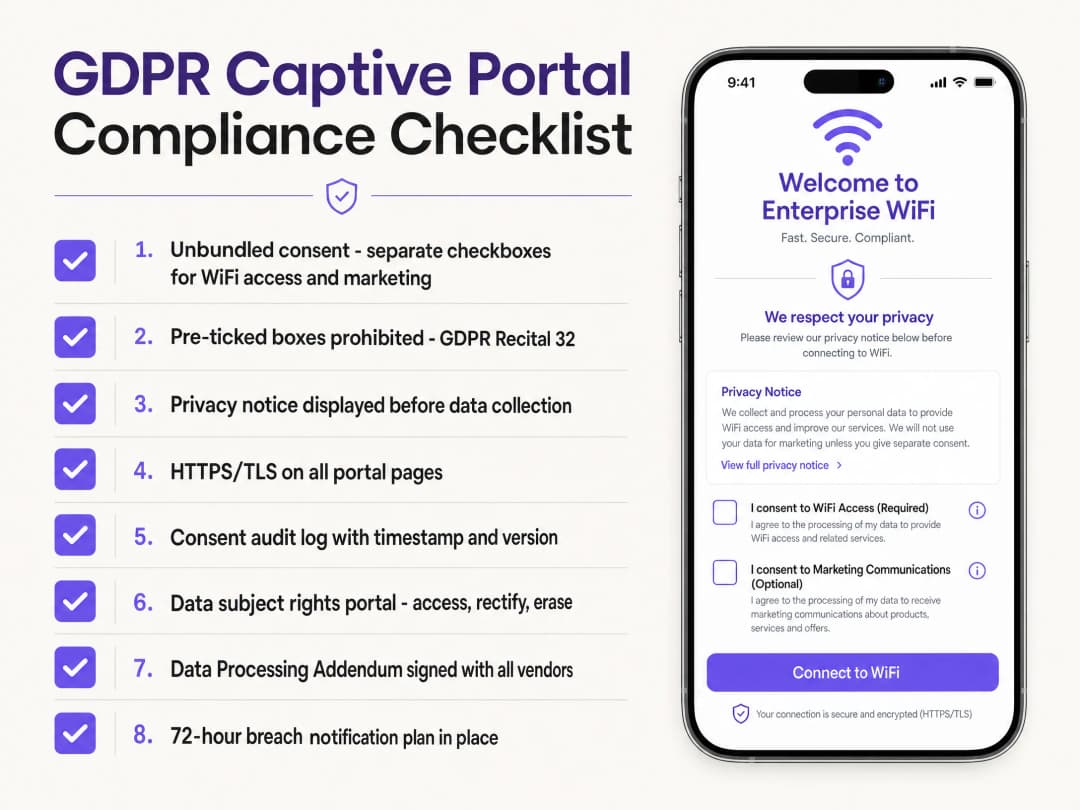
Netzwerksegmentierung und Sicherheit
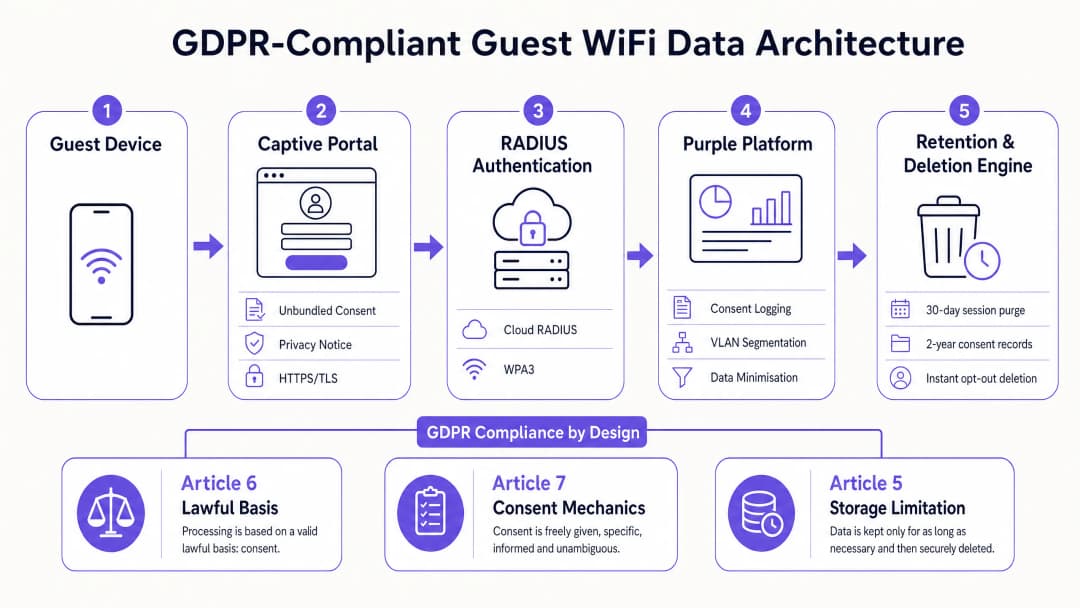
Aus Sicht der Netzwerkarchitektur ist die Segmentierung nicht verhandelbar. Ihr Gast-WiFi-Datenverkehr muss in einem dedizierten VLAN (Virtual Local Area Network) isoliert werden, das vollständig von Ihrem Unternehmensnetzwerk getrennt ist. Verwenden Sie Zugriffskontrolllisten, um zu verhindern, dass Gastgeräte auf interne Subnetze zugreifen, und aktivieren Sie die Client-Isolierung, damit Gastgeräte nicht untereinander kommunizieren können. Dies schützt sowohl die Gäste als auch Ihre Unternehmenswerte. Weitere Informationen zu diesen Prinzipien finden Sie unter What Is Secure WiFi: Essential Guide for Business 2026.
Integrieren Sie zur Authentifizierung Ihren Wireless-LAN-Controller mit einem Cloud-RADIUS-Server. Wenn ein Benutzer den Captive Portal-Flow abschließt, sendet die Plattform eine RADIUS-Access-Accept-Nachricht an den Controller, um den Zugriff zu gewähren. Dies sorgt für eine saubere Trennung zwischen der Authentifizierungsschicht und der Datenerfassungsschicht. Bei der Verschlüsselung sollte Ihre Gäste-SSID WPA3 verwenden, sofern Ihre Hardware dies unterstützt. Erzwingen Sie mindestens WPA2 mit AES-Verschlüsselung. Zudem muss Ihr Captive Portal über HTTPS mit einem gültigen TLS-Zertifikat bereitgestellt werden. Das Bereitstellen eines Formulars zur Erfassung personenbezogener Daten über HTTP ist ein kritischer Sicherheitsfehler.
Haben Sie Fragen zu Ihrem spezifischen Setup?
Unser Team arbeitet mit Standortbetreibern, IT-Managern und Netzwerktechnikern an über 80.000 Standorten zusammen. Buchen Sie ein 20-minütiges Gespräch und wir zeigen Ihnen, wie andere diese Herausforderungen gelöst haben.
Implementierungsleitfaden
Die Bereitstellung eines DSGVO-konformen Gäste-WiFi-Netzwerks erfordert einen strukturierten Ansatz über Hardware-, Software- und Richtlinienebenen hinweg.
- Hardware-Auswahl: Stellen Sie sicher, dass Ihre Access Points VLAN-Tagging, Client-Isolierung und WPA3 unterstützen. Die Plattform von Purple ist hardwareunabhängig und lässt sich nahtlos in Cisco Meraki, HPE Aruba, Ruckus, Juniper Mist, Ubiquiti UniFi, Cambium, Extreme und Fortinet integrieren. Verwenden Sie keine Hardware für Endverbraucher; siehe Warum Consumer-WiFi-Geräte nicht in Ihr Gästenetzwerk gehören.
- Captive Portal Design: Erstellen Sie eine Splash-Page mit entkoppelter Einwilligung. Stellen Sie sicher, dass die Datenschutzerklärung zugänglich ist, bevor Daten übermittelt werden. Wenn Sie in Regionen tätig sind, die bestimmte Social-Logins erfordern, stellen Sie sicher, dass der Datenaustausch transparent ist. Siehe dazu beispielsweise unseren Leitfaden zur Integration der WeChat-WiFi-Authentifizierung: Captive Portal Onboarding für APAC-Kunden.
- Automatisierung der Datenaufbewahrung: Konfigurieren Sie Ihre Plattform so, dass Daten gemäß Ihrer Aufbewahrungsrichtlinie automatisch gelöscht werden. Eine manuelle Löschung ist bei großen Datenmengen nicht praktikabel.
- Anbietervereinbarungen: Stellen Sie sicher, dass Sie eine unterzeichnete Auftragsverarbeitungsvereinbarung (AVV) mit Ihrem Gäste-WiFi-Anbieter, CRM-Anbieter und allen anderen Dritten haben, die diese Daten verarbeiten.
Best Practices
Um die Compliance zu wahren und Vertrauen aufzubauen, halten Sie sich an diese branchenüblichen Best Practices:
- Datenminimierung: Erheben Sie nur die Daten, die Sie unbedingt benötigen. Wenn Sie keinen definierten geschäftlichen Anwendungsfall für eine Telefonnummer haben, fragen Sie diese nicht im Captive Portal ab.
- Automatisierte Speicherbegrenzung: Implementieren Sie strenge Aufbewahrungsfristen für Daten. Sitzungsprotokolle sollten nach 30 Tagen gelöscht werden. Einwilligungsnachweise sollten für die Dauer der Servicebeziehung plus zwei Jahre aufbewahrt werden. Marketingprofile müssen unverzüglich nach Widerruf der Einwilligung gelöscht werden.
- Betroffenenrechte ermöglichen: Stellen Sie ein Self-Service-Präferenzzentrum bereit, in dem Gäste ihre Einwilligung verwalten, Auskunft über ihre Daten verlangen oder die Löschung (das Recht auf Vergessenwerden) beantragen können. Dies reduziert den operativen Aufwand für die Bearbeitung von Auskunftsbegehren (DSARs) drastisch.
- Durchführung einer DSFA: Eine Datenschutz-Folgenabschätzung ist gemäß GDPR Artikel 35 gesetzlich vorgeschrieben, wenn Ihre Bereitstellung großflächiges Standort-Tracking oder Verhaltens-Profiling umfasst.
Fehlerbehebung & Risikominderung
Selbst bei einer starken Architektur bleiben Risiken bestehen. Gehen Sie diese häufigen Fehlerquellen proaktiv an:
- Einwilligungsmüdigkeit: Wenn Ihr Portal zu komplex ist, brechen Nutzer die Verbindung ab oder klicken blindlings weiter. Halten Sie den Wertaustausch klar: schnelles, kostenloses WiFi im Austausch für eine E-Mail-Adresse und optionales Marketing.
- Fehlende AVVs: Ihr Anbieter der Guest-WiFi-Plattform ist ein Auftragsverarbeiter. Wenn Sie personenbezogene Daten ohne einen unterzeichneten AVV mit ihm teilen, verstoßen Sie gegen die Vorschriften. Stellen Sie sicher, dass Verträge geschlossen sind, bevor Daten fließen.
- Verzögerte Meldung von Datenschutzverletzungen: Gemäß GDPR Artikel 33 haben Sie ab dem Zeitpunkt, an dem Sie davon erfahren, 72 Stunden Zeit, um der Aufsichtsbehörde eine Verletzung des Schutzes personenbezogener Daten zu melden. Integrieren Sie diesen Zeitrahmen in Ihren Vorfall-Reaktionsplan; warten Sie mit der Meldung nicht, bis die Untersuchung abgeschlossen ist.
ROI & geschäftliche Auswirkungen
Compliance ist nicht nur eine regulatorische Hürde, sondern ein strategischer Wegbereiter. Eine GDPR-konforme Guest WiFi-Plattform schützt Sie vor Bußgeldern von bis zu 4 % des weltweiten Umsatzes, liefert aber auch einen messbaren ROI.
Durch die Implementierung von entkoppelten, bewussten Opt-ins bauen Sie eine qualitativ hochwertige Datenbank mit First-Party-Daten auf. Während das reine Volumen an Marketing-Opt-ins zwar geringer sein mag als bei einem nicht-konformen, gekoppelten Ansatz, sind die Interaktionsraten (Öffnungsraten, Klickraten und Konversionen) deutlich höher, da sich die Zielgruppe aktiv dafür entschieden hat, von Ihnen zu hören.
Darüber hinaus liefert eine konforme Plattform ethisch gewonnene Business Intelligence. In Branchen wie dem Einzelhandel und dem Gastgewerbe treiben diese Daten betriebliche Verbesserungen voran - von der Optimierung des Personaleinsatzes basierend auf der Besucherfrequenz bis hin zur Personalisierung des Gästeerlebnisses. Die nach ISO 27001 zertifizierte Plattform von Purple hat bereits 440 Millionen Logins verarbeitet und 29 Milliarden Datenpunkte gesammelt, was beweist, dass Skalierbarkeit und strenge Compliance gewinnbringend koexistieren können.
Schlüsseldefinitionen
Data Controller
Die Stelle, die über die Zwecke und Mittel der Verarbeitung von personenbezogenen Daten entscheidet. Wenn ein Veranstaltungsort Guest WiFi anbietet, fungiert er als Data Controller und trägt die primäre rechtliche Verantwortung.
IT-Manager müssen verstehen, dass die Auslagerung der WiFi Plattform nicht die rechtliche Haftung auslagert.
Data Processor
Eine Stelle, die personenbezogene Daten im Auftrag des Data Controller verarbeitet. Purple, als Anbieter der WiFi Plattform, fungiert als Data Processor.
Erfordert eine formelle Auftragsverarbeitungsvereinbarung (DPA), um die Gästedaten des Veranstaltungsorts rechtmäßig zu verarbeiten.
Captive Portal
Die Vorschaltseite oder Webseite, die ein Benutzer sehen und mit der er interagieren muss, bevor ihm Zugriff auf ein öffentliches Netzwerk gewährt wird.
Dies ist die primäre Schnittstelle, auf der Veranstaltungsorte Datenschutzerklärungen präsentieren und rechtswirksame Einwilligungen einholen.
Entbündelte Einwilligung
Die Praxis, Einwilligungsanfragen von anderen allgemeinen Geschäftsbedingungen zu trennen. Die Einwilligung zu Marketingzwecken darf keine Bedingung für die Dienstleistung sein.
Unerlässlich für das Design von Captive Portals, um sicherzustellen, dass die Einwilligung gemäß der GDPR als "freiwillig erteilt" gilt.
MAC-Adresse
Media Access Control-Adresse - eine eindeutige Kennung, die einem Netzwerk-Interface-Controller zugewiesen ist. Unter der GDPR gilt dies als personenbezogenes Datum, wenn es mit einem Benutzer verknüpft ist.
Selbst wenn ein Benutzer keine E-Mail-Adresse angibt, stellt die Protokollierung seiner MAC-Adresse eine Verarbeitung personenbezogener Daten dar.
VLAN-Segmentierung
Aufteilung eines physischen Netzwerks in mehrere logische Netzwerke. Der Guest WiFi Traffic muss vom internen Traffic des Unternehmens isoliert werden.
Eine grundlegende Sicherheitsmaßnahme, um zu verhindern, dass Gastgeräte auf interne Unternehmensressourcen zugreifen.
RADIUS
Remote Authentication Dial-In User Service - ein Netzwerkprotokoll, das eine zentralisierte Verwaltung von Authentifizierung, Autorisierung und Accounting bietet.
Wird verwendet, um Benutzer, die den Captive Portal Fluss abgeschlossen haben, sicher zu authentifizieren, bevor der Netzwerkzugriff gewährt wird.
DSAR
Data Subject Access Request (Auskunftsbegehren der betroffenen Person); ein Mechanismus für Einzelpersonen, um eine Kopie ihrer personenbezogenen Daten anzufordern oder deren Berichtigung oder Löschung zu verlangen.
Veranstaltungsorte müssen einen Prozess haben, um diese Anfragen innerhalb von 30 Tagen zu bearbeiten. Self-Service-Präferenzzentren automatisieren diesen Aufwand.
Ausgearbeitete Beispiele
Ein Hotel mit 200 Zimmern möchte E-Mail-Adressen von Gästen sammeln, um die Anmeldung für das Treueprogramm zu fördern. Ihr aktuelles System verlangt von den Gästen, dass sie dem Erhalt von Marketing-E-Mails zustimmen, um online gehen zu können.
Das Hotel muss ein konformes Captive Portal mit entbündelter Einwilligung einrichten. Es müssen zwei separate Kontrollkästchen implementiert werden: ein obligatorisches zur Akzeptanz der Nutzungsbedingungen für den Netzwerkzugang und ein optionales, nicht angekreuztes Kontrollkästchen für die Marketing-Einwilligung. Die Datenschutzerklärung muss vor der Schaltfläche zum Absenden der Daten klar verlinkt sein.
Ein IT-Team im Stadion möchte WiFi Analysen nutzen, um die Crowd-Dichte zu überwachen und die Sicherheit bei Veranstaltungen zu verwalten. Das Rechtsteam ist besorgt, dass die Verfolgung von Gerätestandorten ohne ausdrückliche Einwilligung gegen die GDPR verstößt.
Die Lösung ist zweigeteilt. Erstens muss die Datenschutzerklärung des Captive Portal explizit darauf hinweisen, dass Standortdaten zur Crowd-Überwachung und für Sicherheitszwecke im Rahmen des berechtigten Interesses verarbeitet werden. Zweitens muss das IT-Team eine MAC-Adressen-Pseudonymisierung am Edge (auf den Access Points) implementieren, bevor die Daten die Cloud-Analyseplattform erreichen.
Übungsfragen
Q1. Ihr Marketingteam möchte die E-Mail-Datenbank vergrößern. Es schlägt vor, das Kontrollkästchen für das Marketing-Opt-in auf dem Captive Portal des Gäste-WiFi standardmäßig vorzubelegen, um die Conversion-Rate zu erhöhen. Was raten Sie dem Team?
Hinweis: Berücksichtigen Sie die GDPR-Definition einer eindeutigen Einwilligung und Erwägungsgrund 32.
Musterlösung anzeigen
Sie müssen diesen Vorschlag ablehnen. GDPR Erwägungsgrund 32 stellt ausdrücklich klar, dass Stillschweigen, bereits angekreuzte Kästchen oder Untätigkeit keine Einwilligung darstellen. Eine Einwilligung muss durch eine eindeutige bestätigende Handlung erfolgen. Die Verwendung von vorab angekreuzten Kästchen macht die Einwilligung ungültig und setzt das Unternehmen behördlichen Bußgeldern aus.
Q2. Ein Gast verbindet sich mit Ihrem WiFi, gibt aber keine E-Mail-Adresse an, sondern meldet sich über eine "Überspringen"-Option an. Ihr System protokolliert die MAC-Adresse des Geräts, die Verbindungszeit und den Access Point, mit dem er sich verbunden hat. Verarbeiten Sie personenbezogene Daten?
Hinweis: Berücksichtigen Sie die Richtlinien der ICO zu Identifikatoren und der Möglichkeit, eine Person eindeutig herauszufiltern.
Musterlösung anzeigen
Ja. Auch ohne Name oder E-Mail-Adresse kann eine MAC-Adresse in Kombination mit Standort- und Zeitdaten verwendet werden, um ein bestimmtes Gerät zu identifizieren und dessen Bewegungen im Zeitverlauf zu verfolgen. Die ICO betrachtet dies als personenbezogene Daten. Sie müssen sicherstellen, dass Sie eine Rechtsgrundlage haben (in der Regel berechtigtes Interesse für die grundlegende Netzwerkprotokollierung) und diese Verarbeitung in Ihren Datenschutzhinweisen transparent offenlegen.
Q3. Bei einer Routineprüfung stellen Sie fest, dass Ihre Plattform für Gäste-WiFi in den letzten vier Jahren detaillierte Sitzungsprotokolle (IP-Adressen, MAC-Adressen, Verbindungszeiten) gespeichert hat. Welche Maßnahmen sollten Sie ergreifen?
Hinweis: Beziehen Sie sich auf den GDPR-Grundsatz der Speicherbegrenzung (Artikel 5).
Musterlösung anzeigen
Sie müssen unverzüglich eine automatisierte Datenlöschungsrichtlinie einführen. Nach dem Grundsatz der Speicherbegrenzung dürfen Daten nicht länger als erforderlich aufbewahrt werden. Eine vierjährige Speicherung von Sitzungsprotokollen ist für die Netzwerk-Fehlerbehebung unverhältnismäßig. Sie sollten historische Sitzungsdaten, die älter als 30 Tage sind, löschen und die Plattform so konfigurieren, dass zukünftige Sitzungsprotokolle nach 30 Tagen automatisch gelöscht werden.
Weiterlesen in dieser Reihe
Planung eines Upgrades von WiFi 6 auf WiFi 7 Access Points, wenn Cisco Meraki WiFi 6 das End-of-Sale erreicht
Diese technische Referenz bietet Betreibern von Multi-Site-Standorten ein Entscheidungs-Framework für das Upgrade von Cisco Meraki WiFi 6 auf WiFi 7 vor dem letztmöglichen Bestelldatum am 31. Dezember 2026. Sie kombiniert die Bestands- und Backhaul-Planung mit Prüfungen im Meraki Dashboard, um die Kontinuität von Purple Authentifizierung und Standortanalysen bei jedem Austausch von Access Points zu sichern.
GDPR und Guest WiFi: Compliance-Leitfaden für Veranstaltungsort-Marketer und die IT
Dieser technische Leitfaden zeigt IT- und Marketing-Teams an Veranstaltungsorten, wie sie die Datenerfassung über Guest WiFi unter der GDPR steuern, ohne ein Captive Portal in einen Compliance-Schattenbereich zu verwandeln. Er trennt Netzwerkzugang, Datenschutzinformationen, optionale Marketing-Entscheidungen sowie CRM-Flüsse und ordnet diesen betrieblichen Entscheidungen Purple Connect, Capture und Engage zu.
Cisco Catalyst WLC und Gäste-WiFi: Captive Portal-Einrichtung mit Purple
Wie ein Cisco Catalyst 9800 (IOS-XE) Wireless LAN Controller mit Purple Gäste-WiFi funktioniert: externe Web-Authentifizierung, RADIUS und ein Walled Garden, mit einem Link zur Schritt-für-Schritt-Installationsanleitung von Purple für die genaue Konfiguration.
Haben Sie Fragen zu Ihrem spezifischen Setup?
Unser Team arbeitet mit Standortbetreibern, IT-Managern und Netzwerktechnikern an über 80.000 Standorten zusammen. Buchen Sie ein 20-minütiges Gespräch und wir zeigen Ihnen, wie andere diese Herausforderungen gelöst haben.