
Privacy by Design: Anonymisierung von WiFi-Daten für die GDPR-Konformität
Dieser maßgebliche Leitfaden beschreibt die technische Architektur und Implementierungsstrategien zur Anonymisierung von WiFi-Daten, um die GDPR-Konformität sicherzustellen. Er bietet IT-Führungskräften und Netzwerkarchitekten umsetzbare Frameworks, um robuste Standortanalysen mit strengen Datenschutzanforderungen in Einklang zu bringen.
Diesen Leitfaden anhören
Podcast-Transkript ansehen
Zusammenfassung für die Geschäftsleitung
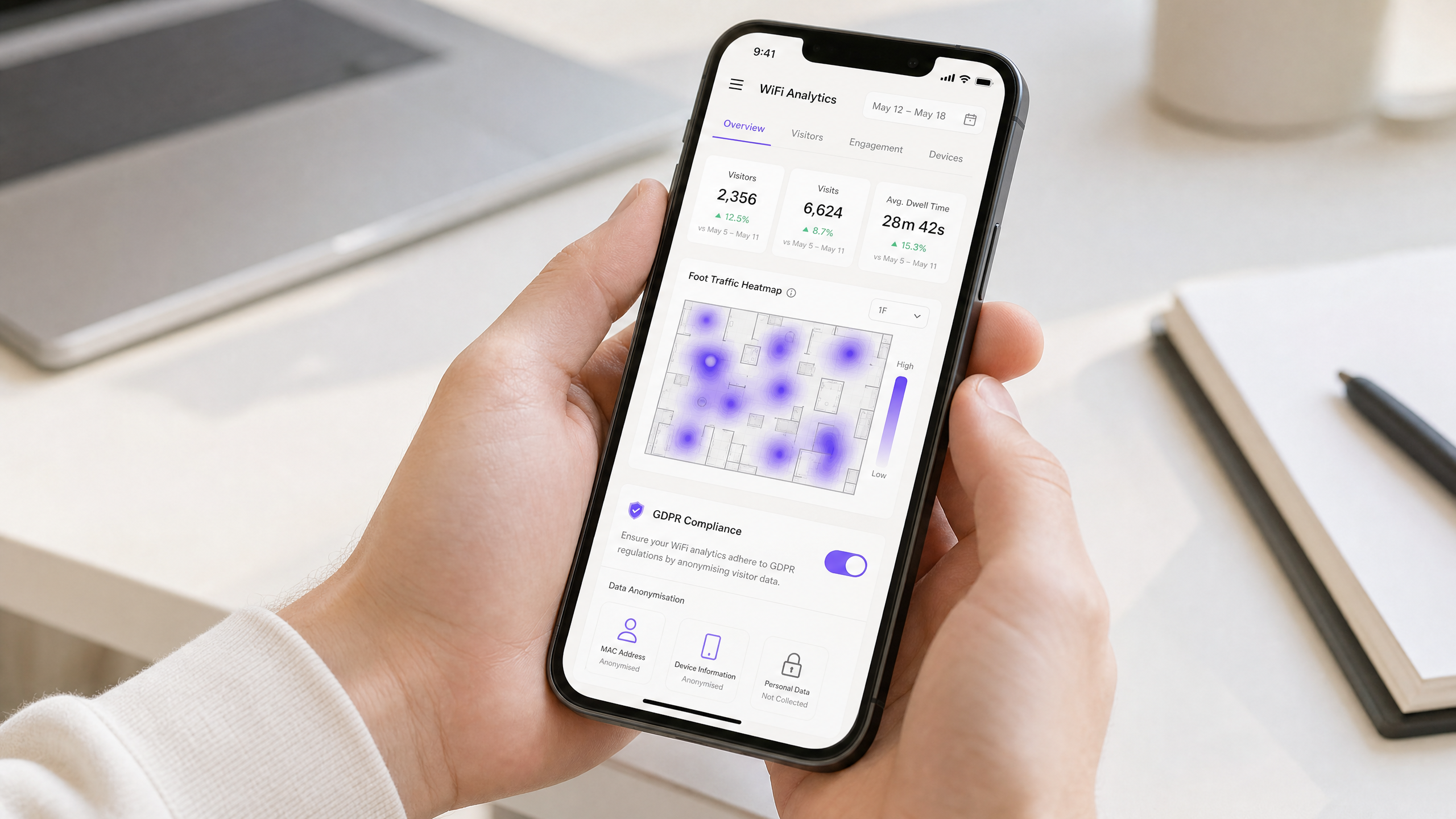
Für IT-Direktoren und Netzwerkarchitekten in Unternehmen, die große Standorte verwalten, ist das Spannungsfeld zwischen Business Intelligence und regulatorischer Compliance eine tägliche Realität. Betriebsteams fordern detaillierte WiFi Analytics , um Besucherfrequenz, Verweildauer und Konversionsraten zu verstehen. Gleichzeitig verlangen Compliance-Beauftragte die strikte Einhaltung der Datenschutz-Grundverordnung (GDPR) und ähnlicher Datenschutzrahmen.
Dieser Leitfaden untersucht die technische Implementierung von Privacy by Design innerhalb der drahtlosen Infrastruktur. Wir werden die Architektur analysieren, die erforderlich ist, um rohe Probe Requests und MAC-Adressen zu anonymisieren und so sicherzustellen, dass verwertbare Erkenntnisse gewonnen werden können, ohne das Unternehmen regulatorischen Risiken auszusetzen. Indem der Datenschutz auf Architekturebene verankert wird – anstatt ihn als nachträglichen Gedanken zu behandeln – können Standorte ihre Guest WiFi -Netzwerke nutzen, um den ROI zu steigern und gleichzeitig die absolute Datenintegrität zu wahren.
Technischer Einblick: Die Anatomie von WiFi-Daten
Um die Compliance-Herausforderung zu verstehen, müssen wir zunächst die Rohdaten untersuchen, die von drahtlosen Access Points (APs) generiert werden.
Das MAC-Adressen-Dilemma
Wenn ein mobiles Gerät WiFi aktiviert hat, sendet es regelmäßig "Probe Requests" aus, um Netzwerke in der Nähe zu entdecken. Diese Anfragen enthalten die Media Access Control (MAC)-Adresse des Geräts. Gemäß GDPR (Erwägungsgrund 30) werden MAC-Adressen explizit als personenbezogene Daten eingestuft, da sie verwendet werden können, um eine Person zu identifizieren und zu verfolgen, selbst wenn deren reale Identität unbekannt bleibt.
Die Anonymisierungs-Pipeline
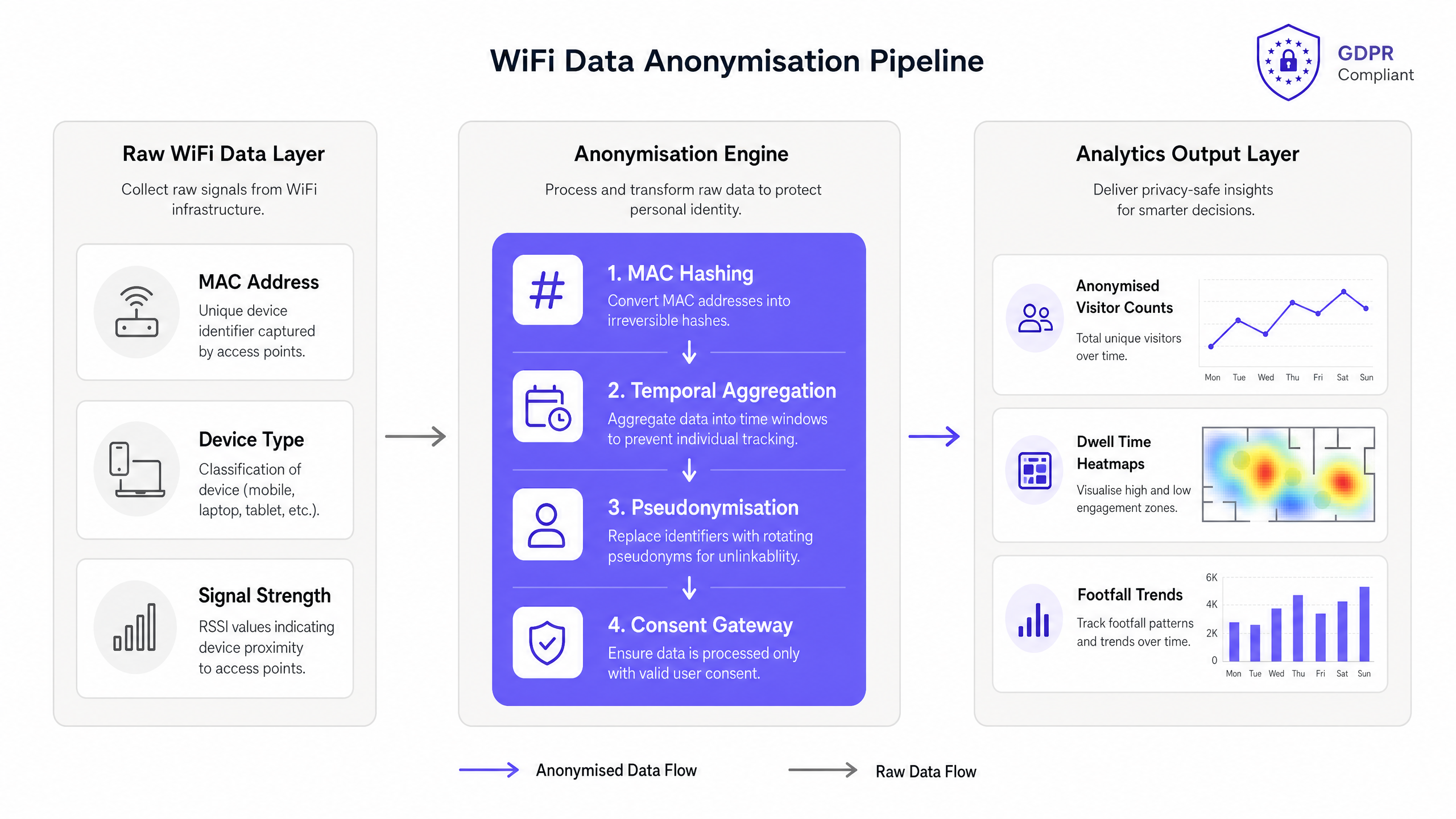
Um diese Daten für Analysen ohne explizite Zustimmung rechtmäßig zu verarbeiten, müssen sie irreversibel anonymisiert werden. Pseudonymisierung (Ersetzen der MAC durch einen statischen Bezeichner) ist unzureichend, da die Daten weiterhin der GDPR unterliegen. Echte Anonymisierung erfordert eine mehrstufige Pipeline:
- Kryptografisches Hashing: Rohe MAC-Adressen müssen mit starken Algorithmen (z. B. SHA-256) am Edge oder sofort nach der Erfassung durch den Controller gehasht werden.
- Dynamisches Salting: Um Wörterbuchangriffe oder Rainbow-Table-Lookups zu verhindern, muss dem Hash ein "Salt" (zufällige Daten) hinzugefügt werden. Entscheidend ist, dass dieses Salt häufig (z. B. täglich) rotiert werden muss. Sobald das Salt verworfen wird, können die Hashes nicht über Tage hinweg verknüpft werden, was eine temporale Anonymisierung gewährleistet.
- Datenaggregation: Analysen sollten sich auf aggregierte Metriken (z. B. "50 Geräte in Zone A zwischen 10:00 und 10:15 Uhr") stützen und nicht auf individuelle Gerätepfade.
Implementierungsleitfaden: Architektur für Compliance
Die Bereitstellung einer konformen Analyselösung erfordert einen herstellerneutralen Ansatz, der sich nahtlos in die bestehende Infrastruktur integriert.
Schritt 1: Datenminimierung am Edge
Konfigurieren Sie Ihre WLAN-Controller oder APs so, dass unnötige Datenfelder vor der Übertragung an die Analyse-Engine verworfen werden. Wenn Sie nur Präsenzdaten benötigen, leiten Sie keine Deep Packet Inspection (DPI)-Payloads oder präzisen RSSI-Trilaterationsprotokolle weiter, es sei denn, dies ist absolut notwendig.
Schritt 2: Das Zustimmungs-Gateway
Wenn Benutzer sich aktiv über ein Captive Portal mit dem Netzwerk verbinden, wechseln Sie von passiver Analyse zu aktiver Interaktion. Hier ist die explizite Zustimmung von größter Bedeutung. Das Portal muss klare, entbündelte Opt-ins für Marketing und Tracking präsentieren. Moderne Lösungen, wie solche, die einen wi fi assistant nutzen, können diesen Prozess optimieren und gleichzeitig die Compliance aufrechterhalten.
Schritt 3: Sichere Datenübertragung
Stellen Sie sicher, dass alle von den APs an die Analyseplattform übertragenen Daten während der Übertragung mit TLS 1.2 oder höher verschlüsselt werden, in Übereinstimmung mit Standards wie IEEE 802.1X und PCI DSS, wo zutreffend.
Best Practices: Die 7 Prinzipien von Privacy by Design
Das von Dr. Ann Cavoukian entwickelte Privacy by Design-Framework ist heute grundlegend für die GDPR (Artikel 25).
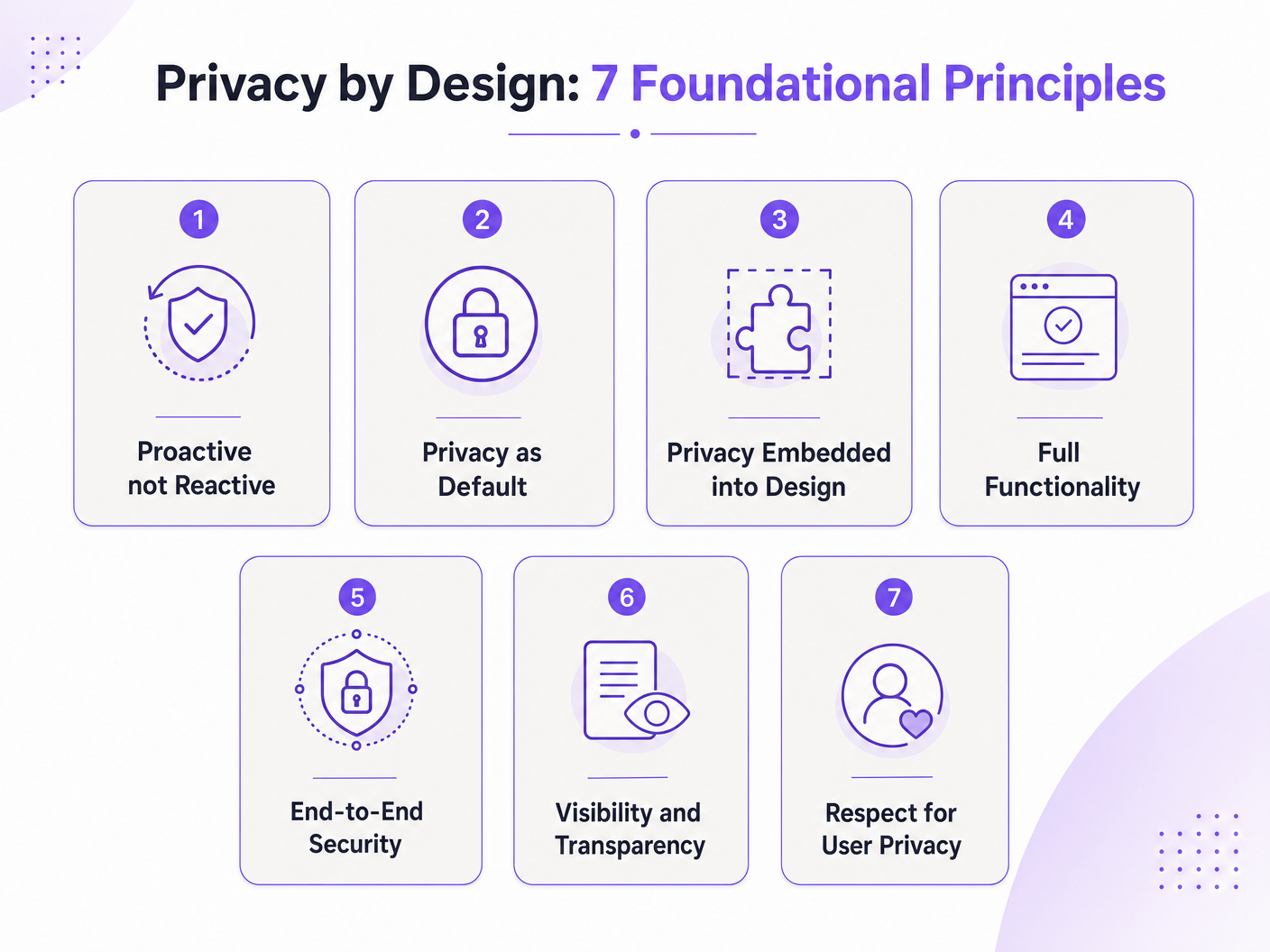
- Proaktiv statt reaktiv: Datenschutzrisiken antizipieren, bevor sie eintreten. Anonymisierungspipelines implementieren, bevor Daten gespeichert werden.
- Datenschutz als Standard: Die Standardeinstellung muss immer die datenschutzfreundlichste sein. Benutzer sollten keine Maßnahmen ergreifen müssen, um ihre Daten zu schützen.
- Datenschutz im Design verankert: Datenschutz muss ein Kernbestandteil der Netzwerkarchitektur sein, kein aufgesetztes Modul.
- Volle Funktionalität (Positive-Sum): Sie können sowohl Datenschutz als auch Analysen haben. Es ist kein Nullsummenspiel.
- End-to-End-Sicherheit: Daten müssen während ihres gesamten Lebenszyklus geschützt werden, von der Erfassung bis zur Vernichtung.
- Sichtbarkeit und Transparenz: Vorgänge müssen überprüfbar sein. Benutzer müssen wissen, welche Daten gesammelt werden und warum.
- Respekt vor der Privatsphäre der Benutzer: Die Interessen der Benutzer stehen an erster Stelle, mit starken Standardeinstellungen und klaren Hinweisen.
Fehlerbehebung & Risikominderung
Die Herausforderung der MAC-Randomisierung
Moderne Betriebssysteme (iOS 14+, Android 10+) verwenden MAC-Randomisierung, um Tracking zu verhindern. Obwohl dies die Privatsphäre der Benutzer verbessert, erschwert es die Analysen.
Risiko: Überzählung eindeutiger Besucher aufgrund rotierender MAC-Adressen. Minderung: Verlassen Sie sich auf authentifizierte Sitzungen für präzise Loyalitätsmetriken. Akzeptieren Sie für passive Analysen eine Fehlermarge und konzentrieren Sie sich auf relative Trends statt auf absolute Anzahlen eindeutiger Geräte. Stellen Sie sicher, dass Ihre Kanalplanung optimal ist; schlechte HF-Umgebungen verschärfen Tracking-Probleme. Überprüfen Sie Leitfäden wie 20MHz vs 40MHz vs 80MHz: Welche Kanalbreite sollten Sie verwenden? kann helfen, die Verbindungsqualität zu stabilisieren.
ROI & Geschäftsauswirkungen
Die Implementierung robuster, konformer Analysen schafft messbaren Geschäftswert in verschiedenen Sektoren:
- Einzelhandel: Das Verständnis der Konversionsraten (Passanten vs. Eintretende) ermöglicht datengesteuerte Anpassungen von Schaufensterauslagen und Personalbestand.
- Gastgewerbe: Die Analyse der Verweildauer in F&B-Bereichen hilft, die Servicegeschwindigkeit und den Tischumsatz zu optimieren, was sich direkt auf den Umsatz auswirkt. Weitere Strategien finden Sie unter Wie Sie die Gästezufriedenheit verbessern: Das ultimative Playbook .
- Transport: Die Überwachung des Passagierflusses verhindert Engpässe und informiert über die Ressourcenzuweisung während Spitzenzeiten.
Indem sichergestellt wird, dass diese Erkenntnisse konform gesammelt werden, schützen Organisationen ihren Markenruf und vermeiden hohe GDPR-Strafen, wodurch der langfristige ROI ihrer drahtlosen Infrastruktur gesichert wird.
Schlüsseldefinitionen
Probe Request
A frame broadcast by a WiFi-enabled device to discover nearby wireless networks.
This is the primary source of data for passive analytics and contains the device's MAC address.
MAC Address
Media Access Control address; a unique identifier assigned to a network interface controller.
Classified as personal data under GDPR, requiring protection and anonymisation.
Cryptographic Hashing
A one-way mathematical function that converts data (like a MAC address) into a fixed-size string of characters.
Used to obscure the original MAC address, though insufficient on its own without salting.
Salting
Adding random data to the input of a hash function to guarantee a unique output.
Prevents attackers from using pre-computed tables (rainbow tables) to reverse-engineer hashed MAC addresses.
Pseudonymisation
Replacing identifying data with artificial identifiers.
Useful for security, but pseudonymised data remains subject to GDPR as it can potentially be re-identified.
Anonymisation
Processing data in such a way that the data subject can no longer be identified, irreversibly.
The ultimate goal for passive analytics, removing the data from the scope of GDPR.
RSSI
Received Signal Strength Indicator; a measurement of the power present in a received radio signal.
Used in analytics to estimate the distance of a device from an access point, determining if a user is inside or outside a venue.
Data Minimisation
The principle that personal data should be adequate, relevant, and limited to what is necessary.
A core GDPR requirement dictating that venues should not collect or store more WiFi data than strictly required for their stated purpose.
Ausgearbeitete Beispiele
A 500-store retail chain needs to measure window conversion rates (passers-by vs. store entrants) using passive WiFi analytics without violating GDPR.
- Deploy sensors/APs configured to capture probe requests.
- Implement an edge-based hashing agent. The agent applies a SHA-256 hash to the MAC address, combined with a daily rotating salt.
- The agent forwards only the hashed identifier, RSSI (signal strength), and timestamp to the central analytics platform.
- The platform uses RSSI thresholds to distinguish between 'passers-by' (weak signal) and 'entrants' (strong signal).
- At midnight, the salt is discarded. Hashes from Monday cannot be linked to hashes from Tuesday.
A large exhibition centre wants to track repeat visitor attendance across a multi-day event, requiring data linkage beyond a 24-hour period.
Passive analytics with daily salt rotation cannot link days. The venue must transition to active analytics.
- Deploy a captive portal offering high-speed WiFi.
- Present a clear, unbundled consent request for tracking and analytics during the login process.
- Once consent is granted, the system generates a persistent pseudonym linked to the user's authenticated profile.
- This pseudonym is used to track the user across the multi-day event.
Übungsfragen
Q1. A hospital IT director wants to track patient flow through outpatient clinics using WiFi. They plan to hash the MAC addresses but use a static salt so they can track individuals across multiple visits over a month. Is this compliant?
Hinweis: Consider the difference between anonymisation and pseudonymisation, and the requirement for consent.
Musterlösung anzeigen
No, this is not compliant for passive tracking. Using a static salt means the data is pseudonymised, not anonymised, because the individual can still be singled out over time. To track individuals over a month, the hospital must obtain explicit consent (e.g., via a captive portal). Without consent, the salt must be rotated frequently (e.g., daily) to ensure true anonymisation.
Q2. Your network architecture team proposes sending raw MAC addresses to a cloud analytics provider, arguing that the provider's terms of service state they will anonymise the data upon receipt. Should you approve this architecture?
Hinweis: Apply the 'Privacy Embedded into Design' and 'End-to-End Security' principles.
Musterlösung anzeigen
No, you should not approve this. Transmitting raw MAC addresses across the internet, even to a trusted processor, introduces unnecessary risk and violates the principle of Privacy Embedded into Design. The anonymisation pipeline (hashing and salting) should occur at the edge (on the controller or AP) before the data leaves the corporate network.
Q3. Following an iOS update that increases MAC randomisation frequency, your marketing team notices a 30% drop in 'repeat visitor' metrics from passive analytics. They ask IT to find a technical workaround to identify these devices. What is the appropriate response?
Hinweis: Focus on the intent of MAC randomisation and the boundaries of passive vs. active analytics.
Musterlösung anzeigen
The appropriate response is to explain that circumventing MAC randomisation to identify individuals without their knowledge violates privacy principles and GDPR. The solution is not a technical workaround for passive tracking, but a strategic shift to active tracking. IT should work with marketing to implement a compelling Guest WiFi portal that incentivises users to authenticate and provide consent, thereby providing accurate loyalty metrics.