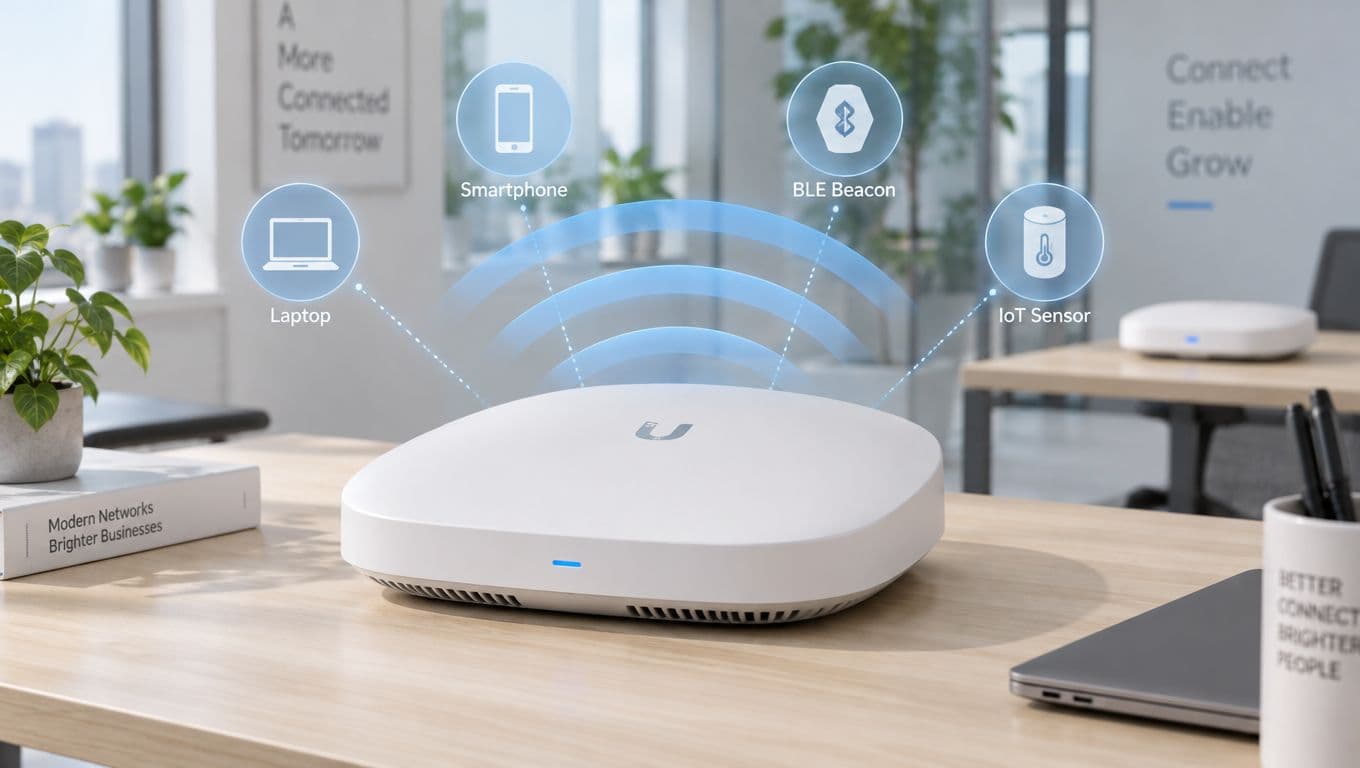
Enterprise Network Downtime Cost & Resilience Calculator
Model hourly and annual downtime costs across your venue estate. Compare single vs redundant WAN circuits, evaluate high-availability RADIUS authentication, and plan sub-second failover SLAs.
Annual Outage Financial Exposure
SLA Allowed Downtime Breakdown
In 2023, UK businesses endured 50.5 million hours of disruptive downtime across 8.8 million internet failures, with an estimated cost of £3.7 billion. That figure, reported in Beaming's UK internet failure analysis, reframes downtime as more than an IT inconvenience. Connectivity now supports payments, access control, workforce collaboration, guest WiFi, cloud applications and venue operations, so a failure can stop the business even when every server appears healthy.
The practical response isn't to keep adding emergency procedures after each incident. It's to build a resilience plan that combines architecture, identity, monitoring, automation and disciplined recovery. In enterprise networks and high-density venues, the overlooked dependency is often authentication. A certificate that expires, an on-premises RADIUS service that stops responding or a directory integration that fails can lock out users while the switches, access points and WAN links remain technically online.
This playbook focuses on downtime reduction through failure-aware design. It starts with diagnosis, then moves through resilient network architecture, proactive monitoring, automated failover, incident response and measurable improvement. The objective is straightforward: detect problems sooner, keep critical services available and recover predictably when prevention fails.
Moving Beyond Firefighting on Downtime
Firefighting feels productive because it produces immediate activity. Engineers replace a failed device, restart a service or renew a certificate manually, and users regain access. The underlying dependency often remains unchanged, so the same failure returns during a trading peak, event opening or production shift.
A resilient operation treats every incident as evidence about the design. If a hotel loses guest access because one authentication service stops responding, the review should cover more than restart time. Why did every login depend on that service? Was a fallback path available? Were certificate expiry and RADIUS health monitored? Had recovery been tested with realistic demand?
Practical rule: Restore service first, then remove the dependency that made restoration so difficult.
The economics justify this change in operating practice. UK businesses recorded fewer downtime hours in 2023 than in 2018, yet the estimated financial impact increased from £742 million to £3.7 billion, while downtime hours fell from 60 million to 50.5 million, according to Beaming's comparison of UK internet failure costs. Greater reliance on cloud services and connectivity means a shorter outage can still interrupt more revenue-producing activity.
Resilience is an operating capability
Downtime reduction has three jobs. Prevention removes fragile dependencies and adds suitable redundancy. Detection identifies degraded service before users report it. Recovery gives engineers a tested route to a known-good state.
The priorities vary by environment. An enterprise may focus on identity platforms, branch connectivity and secure access to cloud applications. A stadium, shopping centre or transport hub must also handle concentrated demand, roaming users, point-of-sale systems, digital signage and operations teams moving between zones. A dashboard may show the network as available while customers face failed authentication or unusable latency.
Authentication deserves the same design attention as switching and WAN capacity. Expired certificates, unavailable RADIUS services and broken directory integrations can create user-facing downtime even when access points and links remain online.
A practical resilience plan combines dual connectivity, resilient power, controlled changes, certificate lifecycle management, RADIUS alternatives, synthetic login tests, automated failover and runbooks that work under pressure. Purple can fit into that operating model by giving teams a modern platform for managing network access and authentication dependencies. The objective is fewer emergencies and a shorter, more predictable recovery when prevention fails.
Diagnosing Your Real Downtime Root Causes
Start with the user-visible symptom, not the component that failed. “The WiFi is down” might mean an access point has lost power, the WAN circuit is saturated, DHCP is unavailable, a cloud identity provider can't be reached or a certificate chain has expired. Each condition demands a different response, and replacing hardware won't fix an authentication failure.
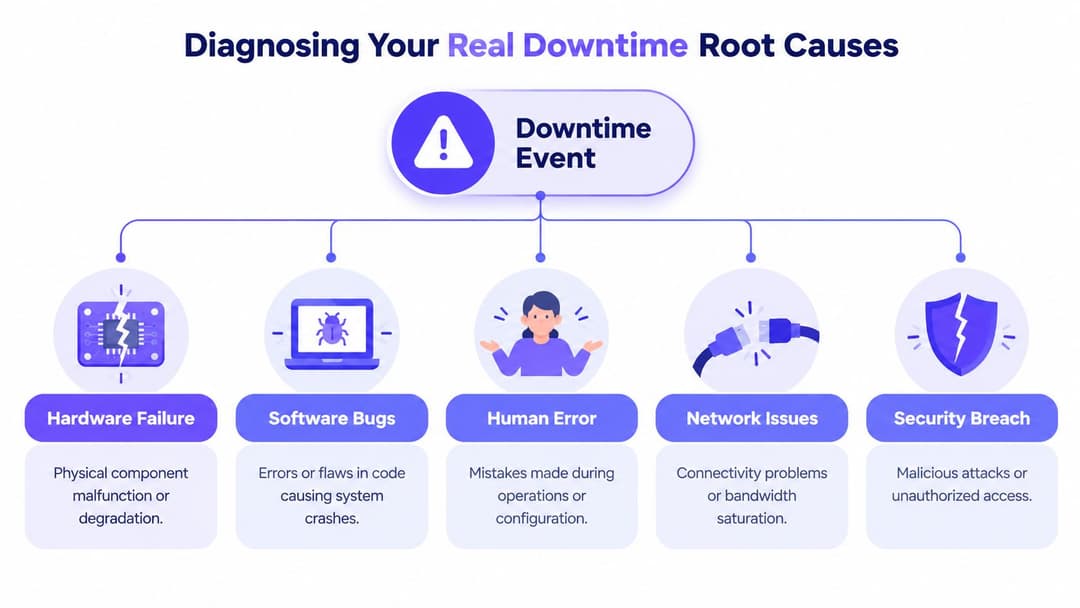
A useful diagnostic review separates incidents into five groups:
- Hardware failure: Check switches, access points, firewalls, power supplies, optics and cabling for single points of failure or ageing components.
- Software defects: Review firmware, patches, controller versions and recent changes. A stable device can still become unavailable after a bad release.
- Human error: Examine configuration changes, maintenance steps, permissions and handovers. Manual work without peer review creates avoidable risk.
- Network issues: Test the circuit, routing, DNS, addressing, packet loss, jitter and capacity. Use the WiFi latency and jitter test to distinguish a local radio problem from a wider performance issue.
- Security incidents: Investigate compromised accounts, malicious traffic, quarantine actions and containment measures that may interrupt legitimate service.
Check the basic dependency chain
Foundational connectivity deserves attention before complex resilience projects. A 2024 UK SME study found that 91% of small businesses experienced internet outages, while about a quarter had no backup connectivity, as reported by Telecoms News on SME connectivity conditions. A business can't fail over to an alternative circuit if it hasn't installed one, documented it or trained staff to use it.
Trace the service path from the user to the application. For a staff WiFi connection, that path may include the access point, switching layer, firewall, WAN, identity directory, certificate authority, RADIUS service and cloud application. Mark each dependency as primary, redundant, monitored or untested. The untested category is where operational assumptions hide.
Treat identity as part of the network
Authentication failures are especially deceptive. An on-premises RADIUS server may be reachable but unable to validate requests. A certificate may have expired on endpoints, network devices or the authentication service. A directory sync problem may prevent new credentials from being recognised, while existing sessions continue working and mask the fault.
Record which services are required for each user class. Staff, contractors, guests, point-of-sale devices, scanners and building systems shouldn't all depend on the same authentication path. Define what should happen if the directory, certificate service or RADIUS platform is unreachable. If the answer is “everyone loses access”, you've found a high-impact root cause that hardware redundancy alone won't solve.
Building a Resilient Network Architecture
Redundancy should follow business criticality, not habit. Start by identifying the services that must continue during a component failure, then design independent paths around them. A branch office may need dual WAN circuits, automatic path selection and redundant power. A dense venue may need diverse carrier entry points, resilient switching and capacity that remains usable during peak demand.
Common architectural controls include:
- Dual WAN links: Use separate carriers or diverse physical routes. Two services delivered through the same building entry point may share one failure domain.
- High-availability firewalls: Configure state synchronisation and test whether sessions survive a device transition.
- Stacked or paired switches: Keep access-layer failure from disconnecting an entire floor, retail zone or event area.
- Redundant power: Separate power supplies and tested uninterruptible power protection reduce failures caused by a single electrical event.
- Documented rollback paths: Every major change needs a known-good configuration and a clear method for restoring it.
These controls matter, but they don't address identity fragility. Many organisations build duplicate network hardware around a single on-premises controller or RADIUS service. The topology looks resilient until authentication fails and every wireless user receives the same access denial.

Design authentication as a distributed service
Identity needs the same design discipline as routing. Separate administrative access from user access, avoid one shared credential path and ensure certificate issuance, validation and revocation remain manageable during an incident. Certificate-based authentication removes password handling from the user experience, but it creates a lifecycle obligation. Operators must monitor expiry, renewal, trust chains and device state.
A cloud-native identity architecture can reduce dependence on a single local RADIUS server or controller. Integrations with Microsoft Entra ID or Google Workspace can connect network access to existing directory controls, while automated provisioning and revocation align access with the user's current status. That approach suits enterprises with distributed offices and venues where local infrastructure is difficult to maintain consistently.
The design still needs a failure policy. Decide whether already-provisioned devices can continue to connect when a directory is temporarily unavailable, how new devices are handled and which emergency access method is protected for responders. Test those conditions rather than assuming the platform will behave as expected.
Purple is one platform option for teams assessing WiFi capabilities for IT and network teams, particularly where certificate-based access, directory integrations and reduced reliance on on-premises RADIUS are part of the resilience design. The key architectural principle remains vendor-neutral: remove shared credentials and local single points of failure without creating an untested cloud dependency.
Implementing Proactive Monitoring and Automated Failover
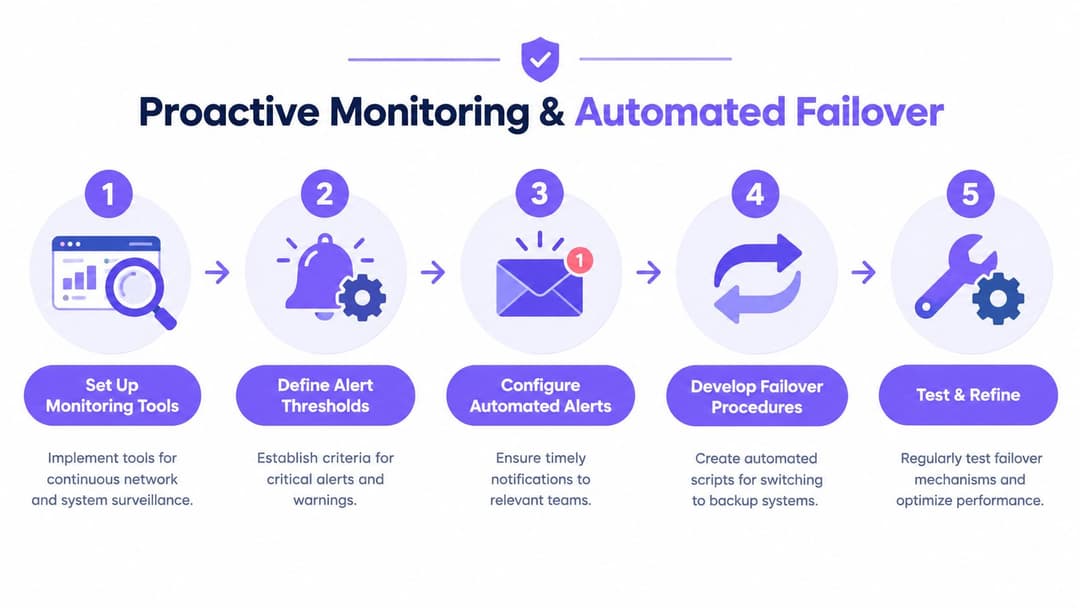
Monitoring should answer three operational questions quickly. Is the service available? Is it performing acceptably? If it has failed, what action can restore it safely? A dashboard full of device status indicators won't answer those questions if users are failing authentication or applications are timing out.
Build monitoring around transactions and dependencies, not only infrastructure health. For wireless access, test association, address assignment, DNS resolution and an authenticated application request. For a high-density venue, run tests from more than one zone because a successful probe in the network room says little about the experience at the far end of a crowded concourse.
Create useful signals
Define warning and critical conditions for latency, packet loss, jitter, circuit health, authentication response and certificate validity. Don't alert every time a single probe fails. Require a meaningful pattern, then attach the alert to an owner and a runbook. An alert without a decision path is noise.
Synthetic login monitoring deserves special attention. Test a controlled staff account through the actual access flow, while excluding it from normal business reporting. A failed transaction can reveal a RADIUS, directory or certificate problem before the helpdesk receives a wave of complaints.
Also monitor the expiry path, not just the date. Confirm that renewal completes, the new certificate is trusted by clients and network devices accept it. A certificate dashboard that says “renewed” isn't enough if the service still presents the old chain.
Automate only reversible actions
Failover works when the alternative path is ready before the incident. SD-WAN policies can move traffic to a backup 4G or 5G connection when the primary circuit breaches a defined health condition. Routing changes, service restarts and access-point recovery scripts can also reduce manual intervention, but each action needs safeguards.
Use automation for actions with a bounded blast radius:
- Circuit transition: Move defined application classes to the secondary path, then verify reachability.
- Service restart: Restart a failed process only after confirming the fault and limiting repeated attempts.
- Configuration rollback: Restore the last validated state when a controlled change causes a known failure.
- Escalation: Open an incident, notify the owner and record the event automatically.
Failover can create its own outage if the backup circuit lacks capacity, the identity service is shared by both paths or the change causes asymmetric routing. Test during a planned window, observe user transactions and document the exact conditions that trigger a return to the primary path.
Mastering Incident Response and Key Metrics
Automation handles routine recovery, but incidents still require judgement. Engineers must decide whether to fail over, roll back, isolate a faulty zone or preserve evidence for a security investigation. In a crowded venue, that decision may affect guest WiFi, point-of-sale systems and staff access at the same time. A short, searchable runbook is more useful under pressure than a long document nobody can scan.
Write runbooks around decisions and verification. The opening page should name the service owner, escalation route, customer-impact definition and safe initial checks. Include commands or console paths where they help, while keeping the sequence readable for an engineer who did not build the system. Authentication failures deserve explicit branches. A certificate chain, RADIUS response or directory dependency can make a healthy access point appear to be the problem.
Use this incident sequence:
- Confirm the symptom: Check whether the failure affects one user, one location, one identity group or the entire service.
- Establish the timeline: Record the first known failure, recent changes and relevant authentication or certificate events.
- Protect the service: Apply the lowest-risk workaround, such as moving traffic or disabling a faulty segment.
- Restore a known-good state: Roll back or fail over through the documented procedure.
- Verify user journeys: Test staff access, guest onboarding, application reachability and critical operational systems.
- Communicate clearly: State the current impact, action underway and next update point.
Measure recovery, not just availability
Mean Time Between Failures, or MTBF, indicates how frequently a service fails. Mean Time To Repair, or MTTR, measures the time required to restore it. Better architecture and maintenance can improve MTBF, while monitoring, clear ownership, automation and prepared spares often reduce MTTR faster.
Availability targets must translate into operating time. 99.9% availability permits about 8 hours and 45 minutes of downtime per year, while 99.99% permits roughly 52 minutes, according to Little Big Tech's uptime guidance. Set RTO and RPO by service class, then test whether actual recovery meets those objectives.
Where recovery depends on preserving information, include specialist data recovery services in the continuity plan. Validate backups, document restoration dependencies and confirm that recovered data is usable. For security investigations, define who may access logs, how evidence is retained and how data integrity is protected. Purple's data and security overview can support that review when evaluating platform controls.
Make the post-mortem useful
A blameless review preserves accountability by examining why one mistake became an outage. Record the trigger, contributing conditions, detection gap, customer impact, recovery actions and permanent fixes. Assign owners and due dates, then revisit the incident until corrective work is complete. Include identity-system findings, such as expired certificates, failed RADIUS responses or unclear ownership, so the same user-facing failure does not return.
Your First Steps and Quick Wins with Purple
Resilience is built through small, tested improvements. Don't begin with a platform purchase or a wholesale redesign. Begin by listing the access flows that matter, identifying where passwords, certificates and local RADIUS services sit in those flows, and checking whether a real fallback exists.
Use the following quick wins as a practical starting point:
- Map authentication dependencies: Document how staff, guests, contractors and operational devices gain access. Mark every directory, certificate service, controller and RADIUS dependency.
- Consolidate network policy: Use iPSK where legacy devices or tenant isolation make separate credentials necessary, while reducing unnecessary SSIDs and configuration drift.
- Move staff access towards certificates: Replace shared WiFi passwords with certificate-based authentication where device management and directory integration support it.
- Automate lifecycle changes: Connect joiner, mover and leaver processes to access provisioning and revocation so former users don't retain network access.
- Test the user journey: Monitor association, authentication and application access from representative enterprise and venue locations.
- Exercise failover: Switch WAN paths and authentication dependencies during a controlled window, then record what users experience.
- Review the evidence: Track MTTR, recurring authentication failures, certificate incidents, failed transactions and recovery-test results.
For a hotel, that could mean protecting reception and payment workflows while keeping guest onboarding independent from staff identity. In a stadium or retail centre, it may mean isolating tenants and operational systems while maintaining a consistent access experience across dense, changing environments. In a corporate estate, it can mean reducing local infrastructure dependencies and giving the network team clearer control over certificate and directory-driven access.
Purple supports WiFi authentication and identity-based networking across guest, staff and multi-tenant environments. Its capabilities include directory integrations, certificate-oriented access, iPSK, analytics and automated connectivity failover, but the operational value depends on correct design, monitoring and testing.
The immediate priority is to select one critical access flow, document its failure modes and establish a baseline. Then remove one fragile dependency, automate one recovery action and test both before expanding the pattern to other sites.
Purple provides identity-based WiFi access, certificate-oriented authentication, directory integrations and resilience features for enterprise networks and high-density venues. Visit Purple to assess how its platform can help reduce authentication-related downtime and strengthen your recovery plan.