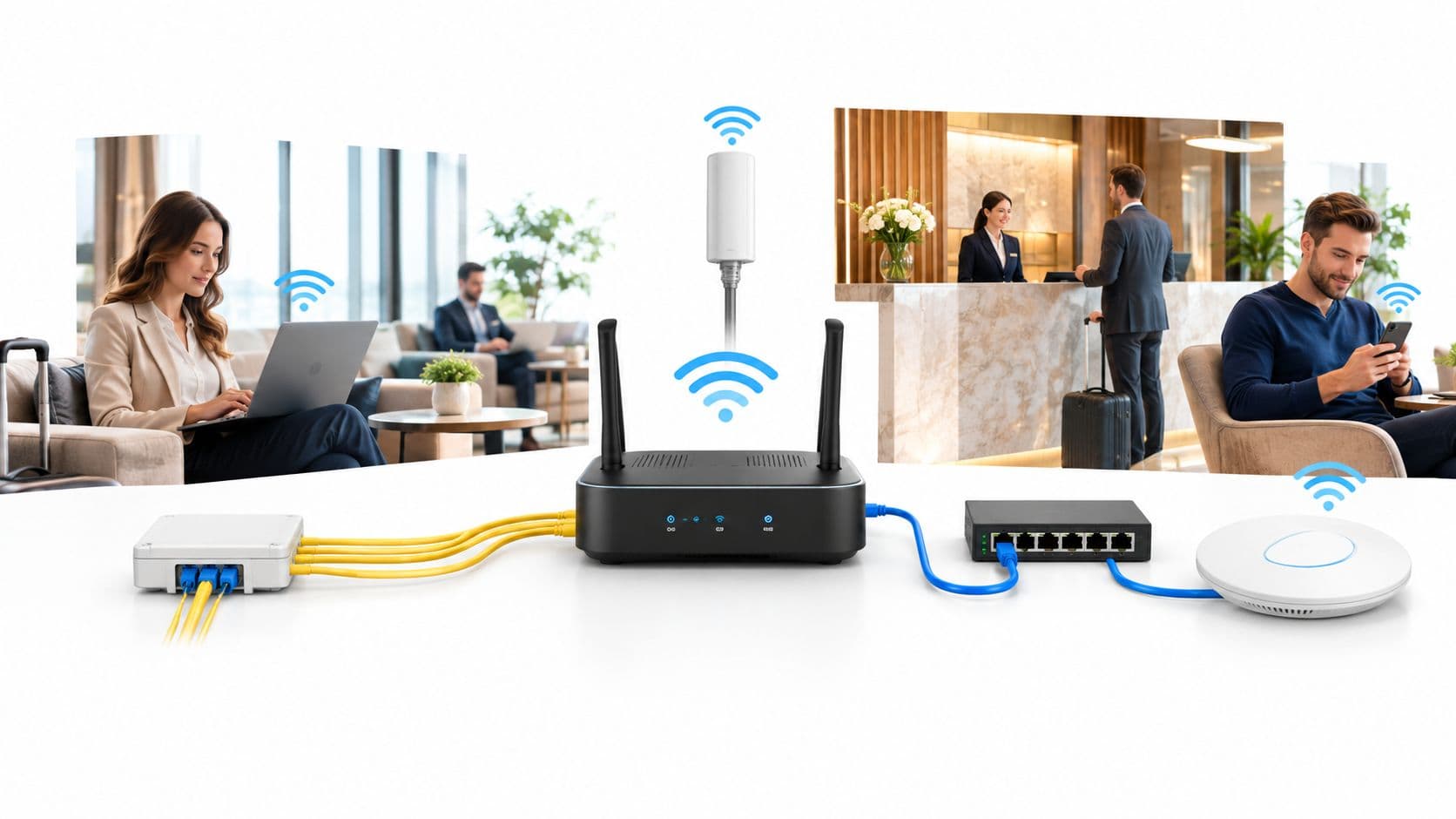
Your regional hotel group has a cheaper fibre broadband proposal on the desk and a leased line quote that finance wants you to justify. Meanwhile, reception reports unreliable payments, guests complain about Wi-Fi login, and the operations director wants to move more services into the cloud. The wrong procurement question is which supplier offers the fastest download. The right question is which design keeps those services usable when demand peaks or a circuit fails.
What Makes a Connection Business-Grade
Business-grade is a contractual and architectural standard, not a product label. A business-branded broadband package might suit a small branch perfectly, but the name alone tells procurement nothing about reserved capacity, repair obligations or routing support.
For the hotel group, I'd define the required service before comparing prices. Treat the internet circuit as the external part of the wide area network, or WAN, supporting cloud applications, authentication and customer access, rather than an isolated utility.
Consumer broadband versus business-grade connectivity
| Trait | Consumer Broadband | Business-Grade Circuit |
|---|---|---|
| Symmetric speeds | Don't assume upload matches download | Specify equal capacity where workloads require it |
| Committed information rate | Don't assume reserved bandwidth | Require the committed capacity in writing |
| Contractual SLA | Check whether commitments extend beyond best effort | Define availability, performance and remedies |
| Rapid fault response | Don't assume priority engineering support | Specify acknowledgement, escalation and restoration obligations |
| Static routable address block | Verify availability and restrictions | Include the required address allocation and routing support |
These are acceptance criteria, not promises that every business tariff meets. Consumer-grade access fails the procurement test whenever the supplier won't commit to the capacity, support or addressing your operation needs. Conversely, shared business broadband can remain a sensible choice when you deliberately accept its limitations and design around them.
Symmetry protects outbound workloads. A committed information rate distinguishes capacity you've bought from a headline ceiling. The SLA makes service expectations enforceable, while fault-response provisions identify who acts when something breaks. Static routable addresses support requirements such as controlled inbound access and fixed-address allowlisting, but buy the allocation your architecture needs rather than treating it as a badge of quality.
Set a business threshold, not a coverage threshold
Ofcom's Spring update defines decent broadband as at least 10 Mbit/s download and 1 Mbit/s upload, yet approximately 48,000 premises still lacked that fixed-line or fixed-wireless threshold, as summarised in this business internet evaluation guide. That's a minimum-connectivity benchmark, not a hotel acceptance specification.
For physical infrastructure planning, use resources such as ATEK Distribution data telecom infrastructure alongside the carrier proposal to frame questions about cabling, termination and equipment. Keep the supplier responsible for documenting the complete service boundary.
Procurement rule: Buy an operational commitment you can test, not a speed label you can advertise.
The Seven Main Connection Types Compared
These options aren't a simple ladder from slow to fast. FTTP, cable, DSL, Ethernet access and cellular describe access choices; MPLS describes a provider-managed private networking service, while SD-WAN adds policy and path control over underlying connections. Neither overlay removes the need to procure suitable access.
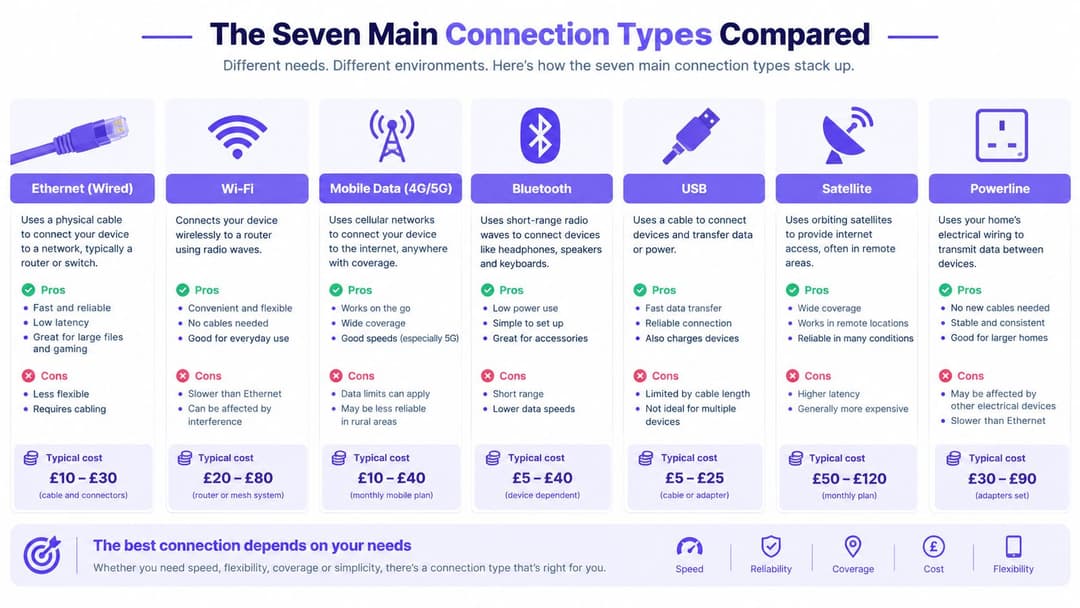
Compare the service, not just the medium
| Option | Capacity and symmetry to verify | SLA, latency and growth questions | Procurement verdict and cost model |
|---|---|---|---|
| FTTP fibre | Check the actual upload tier and whether capacity is shared | Request peak-period evidence and upgrade options | Strong branch candidate; compare its shared-access quote with dedicated access |
| Coax cable | Validate outbound capacity independently of download | Test contention and repair terms at the premises | Consider where available; assess the complete package rather than access price alone |
| DSL | Establish achievable capacity at the installation address | Check whether the service supports the application workload | Retain only where measured requirements justify it or alternatives are unavailable |
| Ethernet leased line | Specify symmetric committed bandwidth and handoff capacity | Require contractual performance and restoration terms | Choose for predictable access; obtain site-specific installation and recurring charges |
| MPLS | Capacity and symmetry depend on its access circuits | Define site-to-site performance and responsibility boundaries | Consider for managed private connectivity; price access and network services separately |
| SD-WAN | Doesn't create bandwidth or improve bearer symmetry | Validate steering, monitoring and encrypted throughput | Useful for application policy; include licences, management and underlying circuits |
| 4G/5G fixed wireless | Measure upload and download at the installed router | Test busy-period variability, coverage and data restrictions | Suitable for temporary access or backup after testing; include hardware and usage costs |
Don't accept a generic monthly price or speed band as a procurement baseline. Ask each bidder to quote the same address, committed service, installation scope and support model. A cheap bearer with separately charged security, management and usage can be a poor comparison with an inclusive managed service.
Keep access, routing and security separate
Ofcom's measurements found that a 10 MB download took 0.8 seconds on Three to 1.4 seconds on EE over 5G, compared with 2.0 seconds on EE to 3.2 seconds on O2 over 4G in its Mobile Matters report. That supports testing cellular seriously, not treating those results as an installation guarantee or business SLA.
A private network or SD-WAN contract also isn't a substitute for cloud workload security. For that adjacent discussion, ThreatExploit AI's CNAPP vs CSPM breakdown is a separate resource to review with the cloud-security team, not a criterion for selecting an access circuit.
Group bids into shared or best-effort access, dedicated access, and managed network overlays. Cellular can sit in the access category as primary or backup. Compare like with like before combining them into a design.
Reading SLAs, Uptime Figures, and Fine Print
An uptime commitment is a measurement agreement with remedies, not a promise that outages won't happen. Procurement needs to establish exactly what the provider measures, where it measures it and which interruptions count.
Start with the denominator. An availability percentage means little without the measurement period, covered service boundary and exclusions. Ask bidders to translate their commitment into permitted downtime using the contract's own calculation, rather than comparing headline percentages stripped of their conditions.
Read restoration obligations separately
A response target tells you when someone acknowledges the incident. A restoration commitment tells you when the service should return. Mean time to repair describes an average and shouldn't be mistaken for a maximum duration for your particular fault.
Check when the clock starts, whether it pauses while the supplier awaits site access, and whether temporary restoration satisfies the clause. Planned maintenance, force majeure and narrowly defined service-affecting faults can all change what the contract recognises as downtime. Require the supplier to explain those consequences against a realistic incident scenario.
For cloud-dependent sites, test beyond simple reachability. A latency and jitter test can help establish a baseline, but contractual performance measurements still need agreed endpoints and methods. A circuit that passes traffic may still be unsuitable for voice or interactive applications.
Make the remedy and escalation usable
Service credits aren't business-interruption insurance. Examine the eligible charge, credit cap, claim deadline and evidence requirements, then assign an internal owner to submit claims.
Use WebinOne's reliability approach as an adjacent application-stability resource when discussing responsibilities with software teams. Keep circuit availability, application health and user experience as distinct acceptance measures.
Send procurement these questions:
- Coverage: Does the SLA include the access tail, provider equipment and internet breakout?
- Performance: What sustained throughput, loss and delay commitments apply?
- Restoration: Is the obligation a target, an average or a contractual maximum?
- Escalation: Who owns incidents outside normal office hours?
- Remedies: What exclusions, caps and claim procedures apply?
- Diversity: Are promised separate routes documented as contractual deliverables?
Service credits may reduce an invoice. Your continuity design must keep the operation running.
Designing Redundancy With Dual Circuits and Failover
Supplier diversity isn't physical diversity. Different logos on the invoices don't prove that circuits use separate ducts, building entries or upstream infrastructure. Ask for route evidence and document the dependencies the provider cannot disclose or guarantee.
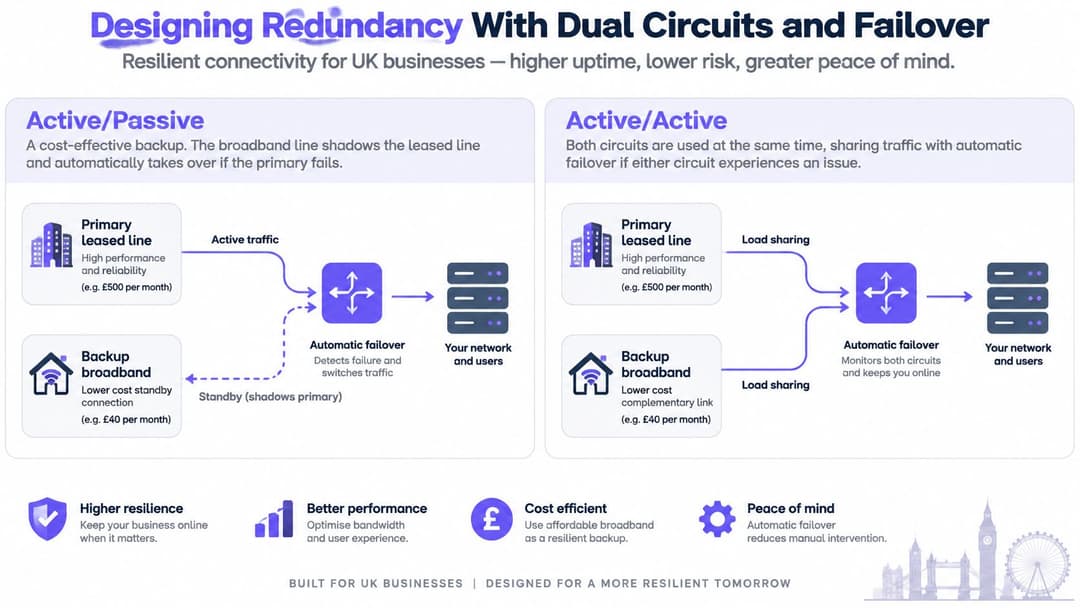
Choose the operating model deliberately
With active/passive, the secondary connection takes essential traffic when the preferred path becomes unusable. I'd favour this where operational simplicity matters and the backup has less capacity. Exercise the standby path routinely so a dormant SIM, failed router or expired service doesn't remain undiscovered.
With active/active, both circuits carry traffic during normal operation. The design must still work after either disappears: load sharing isn't resilience if the surviving circuit cannot support the protected workload. Specify which applications may degrade or stop during an outage.
SD-WAN can steer traffic using measured path quality, but its policies need application-aware health checks. A reachable gateway doesn't prove that payment processing, name resolution or an identity endpoint works.
A retail branch design to test
For a high-street branch, my starting recommendation is FTTP into an SD-WAN-capable edge device, with cellular backup on an independently tested operator. This is a proposed topology, not a guarantee that any available FTTP or mobile service will meet the requirement.
Set the policy around business priorities:
- Protect transactions: Reserve backup capacity for payment and operational systems.
- Preserve communications: Test voice quality under the surviving path's load.
- Constrain guest access: Reduce or suspend non-essential guest traffic during failover.
- Control recovery: Require stable primary-path recovery before moving traffic back.
- Check dependencies: Validate router power, firewall rules, tunnels and changed public addresses.
Test mobile reception at the installation point. Consider an external antenna where measurements justify it, rather than assuming an indoor router will perform adequately. Include upstream saturation in fault testing so the system can respond to a degraded circuit, not just a disconnected cable.
SME full-fibre adoption increased from 14% where availability was a year or less, to 30% after one to two years, and 55% after more than three years, according to the UK SME broadband statistics summary. Don't let an upgrade decision postpone basic resilience work: establish the continuity requirement independently of the preferred primary technology.
How the Upstream Link Shapes Wi-Fi Design
A guest can have a strong wireless signal and still experience a failed login, stalled upload or broken video call. Diagnose the whole path before approving another access-point refresh.
Upload saturation is a different problem from poor radio coverage. Authentication exchanges, cloud synchronisation, cameras and video calls can compete for outbound capacity. The remedy depends on which workload fills the queue and where the delay occurs.

Map the authentication path
Document what happens between joining the wireless network and receiving usable access. Include address assignment, DNS, portal hosting, certificate validation, identity-provider access and any RADIUS exchange. Establish which services sit locally and which require external reachability.
Don't assume authentication traffic is the dominant bandwidth consumer. Login failures can instead reflect latency, packet loss, unreachable dependencies or overloaded authentication services. Capture evidence before blaming the access circuit.
Passpoint and OpenRoaming change the onboarding workflow by avoiding repeated browser-based splash-page interaction for compatible deployments. They don't eliminate authentication or make the external service path irrelevant. Test both initial onboarding and returning-device access under normal and degraded conditions.
Size the service around concurrent activity
Use the Wi-Fi buying guide alongside a site survey and application inventory. For capacity planning, distinguish connected devices from devices actively transmitting.
Build the requirement from observed behaviour:
- Measure busy periods: Record WAN throughput, queueing, loss and application response alongside wireless airtime.
- Separate traffic classes: Identify staff, guests, building systems and resident workloads.
- Inspect each direction: Capture outbound demand independently of inbound consumption.
- Test realistic mixtures: Combine calls, uploads, onboarding and ordinary browsing.
- Reserve operating headroom: Agree how growth and circuit failure affect the supported experience.
Symmetric access can remove an upstream capacity constraint, but it won't repair interference, poor roaming or an overloaded portal. Likewise, more access points won't resolve a saturated internet uplink.
Diagnostic test: If wired and wireless users experience the same external-application slowdown, investigate the shared service path before changing the radio design.
For hospitality and healthcare, prioritise the application outcome: successful access, intelligible calls and usable cloud sessions. Treat a speed-test result as supporting evidence, not the acceptance test itself.
Matching Connections to Real Business Profiles
Choose business internet connections by the consequences of service loss, not by an organisation's sector label alone. A small branch with cloud-only payments may need stronger continuity than a larger office with workable offline processes.
Geography also constrains the options. Ofcom reported 84% gigabit-capable availability for UK properties in January 2025, while SME full-fibre coverage was 81% in urban areas versus 58% in rural areas, in its Connected Nations coverage reporting. Obtain address-specific offers before standardising a national estate.
Customer-facing branches and hotels
For a high-street retail branch, start with FTTP plus tested cellular failover. Ask for a managed fault process on the primary and prove transaction continuity on the backup. Compare the combined recurring cost, router management and mobile allowance against a leased line proposal; don't assume the cheaper access package delivers the cheaper supported design.
The outcome is payment continuity, not unlimited guest browsing during an outage. Agree that priority with the retail operations team before deployment.
For a substantial hotel, I'd prioritise a symmetric leased line with a separately routed secondary service. Require restoration commitments, named escalation and evidence of route separation. Budget for the complete resilient design rather than comparing the leased line alone against a broadband subscription.
Measure successful guest onboarding, reception application availability and busy-period call quality. Track guest feedback, but don't promise that a circuit upgrade alone will improve satisfaction.
Clinical and residential environments
For an outpatient clinic, assess dedicated Ethernet access with independently tested backup against the clinical application requirements. Confirm approved routing, security controls and application-owner acceptance before allowing clinical traffic onto the secondary service. Demand clear incident ownership across the carrier, managed-service provider and healthcare IT team.
For build-to-rent or student residences, evaluate symmetric access with centrally managed policy across sites. Use SD-WAN where it solves a defined routing or operational requirement, not because the portfolio has several buildings. Include tenant isolation, fair-use controls, support ownership and expansion capacity in the commercial comparison.
Here, the recurring budget must cover access and resident service operations. A low circuit price doesn't compensate for an unresolved support boundary between the landlord and network operator.
Temporary venues and events
For a pop-up or event, cellular primary access with an independently tested secondary mobile path can be practical. Consider bonding only after confirming its equipment, tunnel endpoint and operational requirements; don't assume it will preserve every application session.
Prioritise on-site support, usage terms and pre-event testing over a paper promise of peak speed. If crowd loading makes mobile performance unacceptable, procure an alternative before opening, rather than discovering the limit at the payment desk.
A Pre-Procurement Audit and Decision Checklist
Gigabit availability isn't business readiness. A coverage result doesn't establish that the premises can support your applications, that installation will meet your deadline or that the supplier will restore service within your operational tolerance.
Use a focused procurement review to turn assumptions into acceptance criteria. Give finance a costed service design, not competing download-speed headlines.
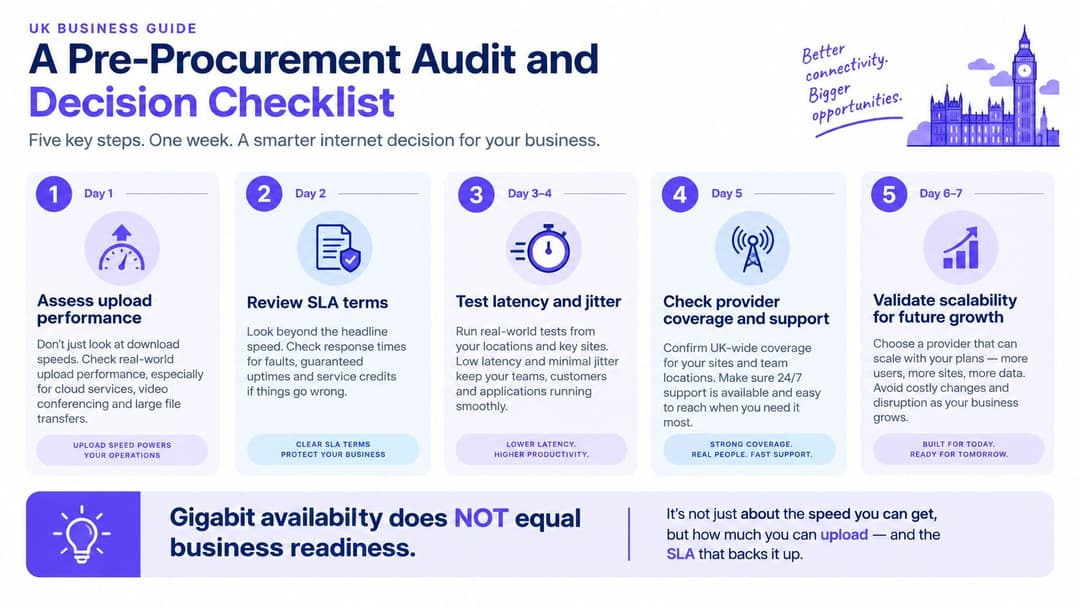
Assemble the evidence before approval
Verify the exact premises. Confirm service availability, installation responsibilities, landlord permissions and building-entry constraints. Request site-specific quotes with lead times, construction dependencies and cancellation conditions.
Establish the baseline. Gather busy-period application measurements and identify whether the constraint sits in access capacity, wireless design, switching, security inspection or authentication. Don't buy bandwidth to solve an unidentified fault.
Pilot the proposed service. Test at the intended installation point across representative trading conditions. Include uploads, calls, onboarding, path failure and recovery, then record whether the protected applications remain usable.
Pressure-test the contract. Walk procurement through a damaged access cable, an unreachable identity provider and a degraded upstream path. Assign an owner to each response and identify what the supplier explicitly excludes.
Attach a technical acceptance checklist
- Identity integration: Confirm required identity-provider endpoints remain reachable on primary and backup paths.
- RADIUS reachability: Validate routing, filtering and recovery behaviour wherever RADIUS is used.
- Public addressing: Document static address, inbound access and allowlisting requirements.
- Cloud management: Test controller connectivity and behaviour during external-service loss.
- Operational handover: Record escalation contacts, monitoring ownership and failover procedures.
- Commercial completeness: Include installation, equipment, licences, management and usage charges.
Approve the purchase only when the supplier's deliverables match the documented acceptance tests. Keep the signed service specification with the network design so operations can verify what procurement bought.
Purple offers Wi-Fi authentication and identity-based access for guest, staff and multi-tenant environments, alongside your chosen connectivity and network infrastructure. Visit to discuss how passwordless onboarding and identity integration fit your primary circuit, backup path and Wi-Fi acceptance tests before you commit to an upgrade.