
You have paid the rent, reported a leaking ceiling and asked when it will be inspected. Then your manager says you breached the tenancy because a contractor could not enter while you were at work. Meanwhile, a neighbour's late-night noise is making the flat difficult to live in, and nobody agrees whether you, the landlord, the agent or the council should act.
That confusion comes from treating a tenant and tenant rights as the same idea. A tenant is a person who occupies a property under a tenancy agreement and must meet agreed duties. Tenant rights are the legal protections that limit what a landlord or agent may demand, impose or do in response.
The difference works like two sides of the same arrangement. Your obligations cover conduct such as paying rent, caring for the home and cooperating with properly arranged access. Your protections cover matters such as safety, repairs, privacy, deposit handling and the process required before possession can be taken. Meeting your duties does not remove those protections, and having protections does not cancel your responsibilities.
| Area | What the tenant must do | What the tenant can expect |
|---|---|---|
| Rent | Pay rent according to the agreement | A lawful process before possession is taken |
| Property condition | Avoid damage beyond fair wear and tear and report problems | Repairs and safe living conditions |
| Access | Cooperate with properly arranged visits | Reasonable notice and respect for privacy |
| Deposit | Leave the property in the agreed condition | Proper protection and a fair dispute process |
| Neighbour problems | Avoid causing nuisance and keep useful records | Clear signposting to the landlord, council or other body |
The distinction affects a substantial part of the UK housing system. Government impact assessment material estimates that 4.6 million households rent privately, representing about 11 million people and 19% of the housing market, while 2.3 million landlords provide homes for those tenants (UK government Renters' Rights Bill impact assessment). Those figures also show why unclear responsibility can create practical risk, particularly around deposits, eviction steps and neighbour complaints.
Rules differ by jurisdiction, but the role-versus-protection test remains useful. For example, renters facing HOA enforcement in Texas may need to separate tenancy protections from duties created by a homeowners' association. Start with three questions: what role do you hold, what duty applies, and what protection controls the other party's response?
What Being a Tenant Means in Practice
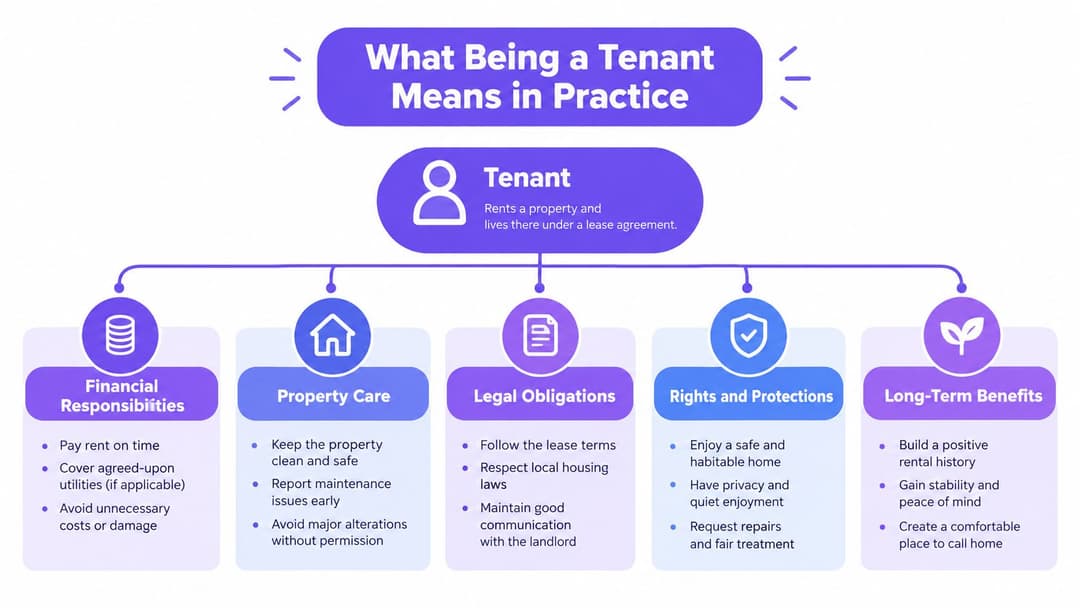
A tenant is more than someone who transfers money each month. The role usually begins when a person receives the right to occupy a property in return for rent or another agreed consideration. That arrangement may be written, verbal or established through conduct, but written terms are far easier to check when there's a disagreement.
The agreement should identify the property, rent, payment dates, length of the tenancy, restrictions, repair-reporting route and arrangements for access. It may also explain responsibility for gardens, utilities, cleaning, pets or alterations. A term in the contract can organise the relationship, but it can't override legal protections that apply regardless of what the document says.
The everyday duties that follow
Good tenancy conduct rests on a few practical habits:
- Pay rent as agreed: If rent may be late, contact the landlord or agent promptly and keep the communication. Silence makes it harder to show that you tried to resolve the problem.
- Look after the home: Use the property reasonably, prevent avoidable damage and tell the landlord about defects before they become more serious.
- Report repairs clearly: Describe what happened, when you noticed it and whether it creates an urgent safety risk. Photographs and dated messages create a reliable record.
- Allow lawful access: A tenant generally needs to cooperate with reasonable visits arranged for repairs, inspections or other legitimate purposes. That doesn't mean accepting unexpected entry whenever someone chooses.
- Follow the tenancy terms: Restrictions on subletting, alterations, smoking, pets or business use can affect whether conduct amounts to a breach.
The tenant's duty to report a problem doesn't transfer the repair obligation to the tenant. If a boiler fails, the renter should raise it through the agreed route, while the responsible housing provider must assess and address the issue within the applicable legal and contractual framework.
Why condition records matter
An inventory is a practical bridge between responsibilities and financial risk. At move-in, compare it with the property, note missing or damaged items and add dated photographs. At move-out, clean the property consistently with the agreed standard, remove belongings and keep evidence of the handover.
Practical rule: A tenant should make it easy to prove what the property looked like, when a problem was reported and how access was offered.
Managers benefit from the same discipline. Clear check-in records, repair logs and written access arrangements reduce arguments because each party can see what was reported and what happened next.
What Tenant Rights Actually Protect
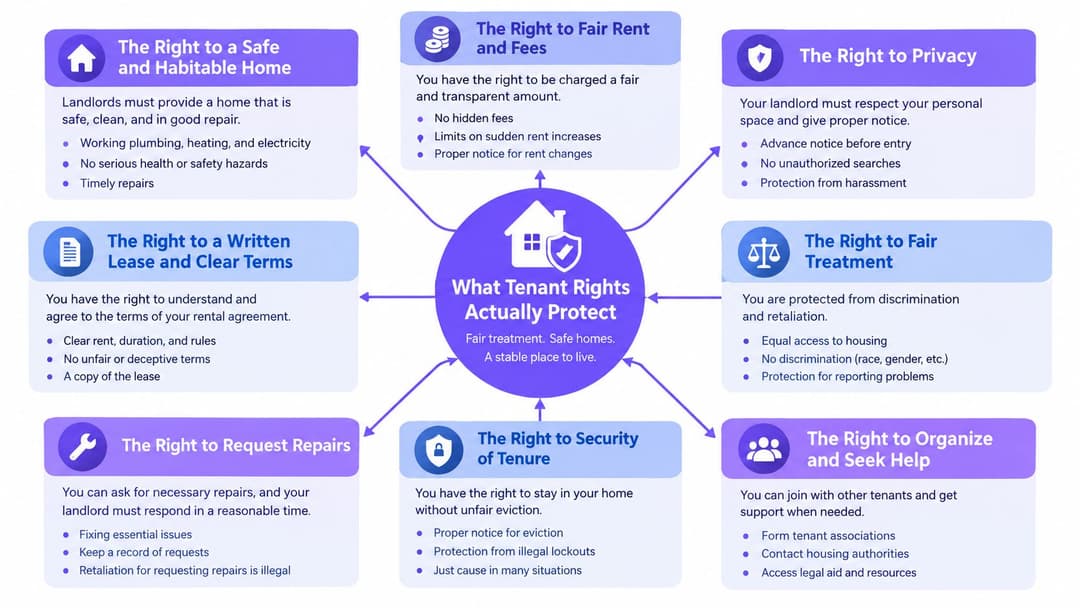
A tenant's role is to meet the tenancy's agreed requirements. Tenant rights define the protection that remains around that role. The renter may need to pay rent and treat the home responsibly, while the landlord or agent must still respect safety, privacy, fair treatment and lawful possession procedures.
The core protection areas
Tenant rights usually cover these areas:
- Safety and repairs: The responsible landlord or agent must meet the housing standards that apply to the property and tenancy. Reporting a defect is the tenant's route to raising the issue, not an agreement to live with unsafe conditions indefinitely.
- Privacy and quiet enjoyment: A tenant should be able to use the home without unreasonable interference. Access for a legitimate purpose must follow the notice and entry rules that apply in the relevant jurisdiction.
- Fair treatment: Housing decisions must not involve unlawful discrimination or retaliation because a tenant exercised a legal right.
- Deposit safeguards: Deposit rules may require protection, prescribed information and a fair process for proposed deductions. The scheme and available remedy depend on the location and tenancy type.
- Due process before eviction: A landlord generally needs a valid notice and, where required, a possession order. Lock changes, removal of belongings and intimidation do not replace the legal process.
The UK's recent reforms show how these protections are being made more visible. The Renters' Rights Act 2025 was introduced in September 2024, completed passage in October 2025 and has phase one taking effect on 1 May 2026, as described in the Renters' Rights Act factsheet from Age UK. The Act is intended to give tenants greater security and stronger protection against unfair eviction while preserving fairness for landlords.
Compliance is becoming easier to test
Under the framework, landlords of assured and regulated tenancies in England will be legally required to register their properties in a Private Rented Sector database. The duty is connected to possession because a landlord who breaches registration requirements will generally be unable to obtain a possession order, apart from limited grounds involving antisocial behaviour. Rollout is phased, beginning in late 2026.
For renters, the practical question is therefore wider than whether a landlord wants possession. They also need to ask whether the correct legal route and compliance steps have been followed. A notice can exist on paper and still fail to provide a lawful route to eviction.
The same role-versus-protection distinction applies in shared buildings. A tenant remains responsible for conduct under the tenancy, while management must respond lawfully to problems affecting residents. People assessing buildings with several households may also review the ownership and management setting, including multi-family homes from Royal LePage Brookside Realty.
Privacy includes more than physical entry. Connected services can collect or handle personal information, so tenants and managers should review guest WiFi and data privacy alongside the rules for access to the home.
Tenant Obligations Versus Tenant Rights Side by Side
The easiest way to apply the tenant vs tenant rights distinction is to examine the same issue from both directions. A tenant's obligation often creates the conditions for a right to operate, while the landlord's response must remain proportionate and lawful.
| Tenancy Topic | Tenant Obligation | Tenant Right Protection | Practical Implication |
|---|---|---|---|
| Rent and arrears | Pay by the agreed date and raise payment problems promptly | Protection from unlawful pressure or possession action outside the required process | Keep payment records and respond to arrears notices rather than ignoring them |
| Property care | Use the home reasonably and avoid preventable damage | Repairs and safety duties remain with the responsible landlord or agent | Reporting a defect isn't an admission that the tenant caused it |
| Access | Cooperate with legitimate visits | Privacy and reasonable arrangements | Agree a time where possible and keep written notice |
| Ending a tenancy | Give the notice required by the agreement or law | Protection from an invalid notice or unlawful eviction | Check dates, wording and the stated possession route |
| Deposits | Return the property in the agreed condition | Protection from unsupported deductions and access to dispute resolution | Compare the claim with the inventory and request evidence |
| Neighbour conduct | Avoid nuisance and document problems affecting the home | A route to complain without being blamed automatically | Identify whether the landlord, council, police or another body has authority |
The differentiator: A tenant can breach a term and still have rights. A landlord can have a legitimate concern and still need to use the correct process.
Rent is a duty, not a waiver
Non-payment can create serious consequences, but it doesn't give a landlord a free pass to bypass notice or court requirements. Conversely, a repair complaint doesn't normally remove the tenant's obligation to pay rent unless a lawful arrangement or specific legal remedy applies. Renters should obtain advice before withholding payment.
Access needs cooperation and restraint
A tenant who repeatedly refuses reasonable access may obstruct repairs or inspections. A landlord or agent who enters without proper authority may interfere with privacy. Written notice, a clear purpose and a workable appointment protect both sides.
Possession is a process
Ending a tenancy voluntarily is different from being evicted. A tenant may choose to leave under the applicable notice rules, while a landlord seeking possession must rely on the route available to that tenancy. The validity of a notice, the grounds relied on and the court process can all matter.
Deposits require evidence
The tenant should leave the property appropriately clean and report damage. The landlord should distinguish fair wear and tear from chargeable loss and support proposed deductions with records. Neither party benefits from treating a deposit as an automatic final month's rent or an automatic repair fund.
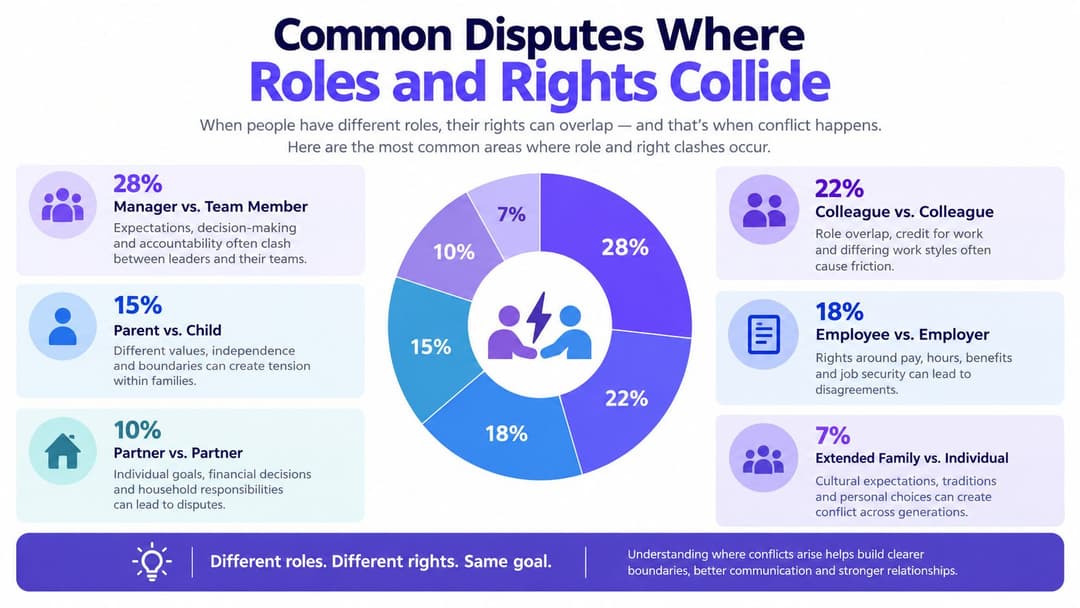
Common Disputes Where Roles and Rights Collide
A tenant may see end-of-tenancy cleaning as routine. A landlord may compare the property with its documented check-in condition. The disagreement is rarely resolved by expectation alone. An inventory, dated photographs, invoices and written messages give both sides the same evidence to examine.
In England and Wales, 4,706,470 deposits were protected, with a combined value of £5.53 billion and an average deposit of £1,175, according to the 2025 Tenancy Deposit Scheme briefing cited in sector reporting (deposit protection and eviction statistics). The same briefing reports that only 1.00% of deposits ended in a formal dispute, so 99% were resolved without adjudication.
The leading dispute reasons were cleaning at 54%, damage at 49% and redecorating at 31%. These figures do not establish that tenants or landlords are generally at fault. They identify the areas where clear records, fair expectations and a careful comparison of condition matter most.
Eviction disputes involve power and procedure
The English Private Landlord Survey found that over two-thirds of landlords who evicted tenants in the previous year used a Section 21 notice, the long-standing no-fault route. One in four used Section 8 because a tenant had allegedly breached the tenancy agreement, according to the same sector summary (English eviction routes and deposit statistics).
That pattern helps explain why abolishing Section 21 became a central reform goal of the Renters' Rights Bill. It reflects a move away from possession based mainly on landlord choice and towards stronger tenant security. Tenant protections still sit alongside the tenant's responsibility to comply with the agreement.
Satisfaction can signal unresolved friction
The 2024–2025 English Housing Survey found that 15% of private renters were neither satisfied nor dissatisfied with their tenure, while 19% were dissatisfied (English Housing Survey private rented sector overview). A neutral response does not prove a legal breach, but it may indicate that concerns remain unresolved.
Repeated repair delays, unclear deductions and unanswered complaints can become early warning signs. Renters should turn informal discussions into dated written records, while managers should preserve the complaint history and explain the next action. In multi-tenant buildings, reviewing private area network considerations can also help managers address connectivity, shared-facility access and privacy questions separately from the tenancy dispute.
Neighbour Issues Antisocial Behaviour and Who Owns the Problem
A noisy neighbour might be another tenant, an owner-occupier, a visitor or someone outside the landlord's control. Responsibility follows the person causing the problem and the powers available to address it. A landlord may act if the alleged offender is their tenant, or if the tenancy agreement includes a relevant obligation. That does not give the landlord control over everyone nearby.
Research into private renters found that 42% of renters who experienced neighbour or antisocial behaviour believed the issue was the landlord or agent's responsibility. The same research recorded dissatisfaction with landlord responses to antisocial behaviour in the area among 64% of private renters and complaint administration issues among 76% (Private Rented Sector Tenants Research Report). These findings show why the role-versus-protection distinction matters. A tenant can expect a fair response to a report, while the landlord may still lack authority to stop the conduct directly.
Use a simple responsibility test
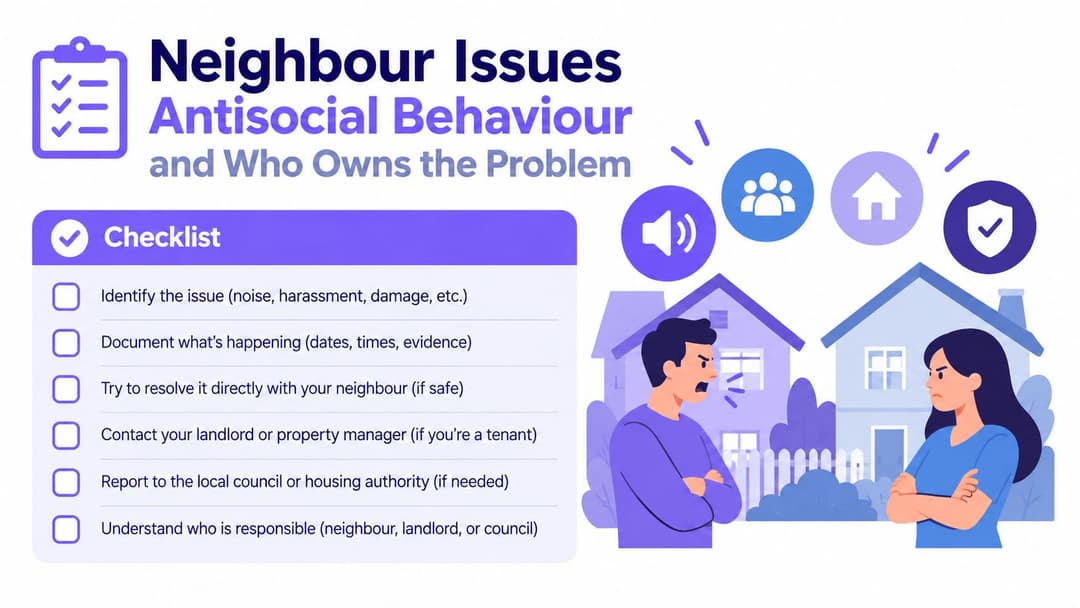
Record dates, times, descriptions, witnesses and any immediate risk. Keep the account factual. Avoid threats or direct confrontation if either could increase danger.
- Contact the landlord or agent when the suspected nuisance comes from another tenant in the same managed property, affects a tenancy term or involves a repair, such as inadequate sound insulation.
- Contact the council or environmental health team where noise, waste, harassment or antisocial behaviour may breach public regulation or require local authority powers.
- Contact the police where there is immediate danger, violence, criminal damage or another suspected crime.
- Use an ombudsman, mediation or formal complaints route after the landlord or agent has received a clear complaint but has not handled it through the relevant process.
A manager should not promise an outcome outside their control. A useful response acknowledges the report, explains which part falls within the management role, identifies any referral route and states what evidence is needed. That approach separates the tenant's duty to report from the protection of receiving a clear, properly handled response.
Practical Guidance for Renters and Property Managers
Renters should treat the tenancy as a documented working relationship. Before signing, read the payment terms, restrictions, repair route, access provisions and deposit information. At move-in, photograph the condition, save the inventory and keep communications in one organised place.
When a problem appears, report it promptly and describe the impact without overstating the law. If you receive an eviction notice, don't assume it's valid or invalid from the title alone. Check the tenancy type, dates, stated grounds, compliance steps and whether a possession order is required. Where the consequences are serious, obtain independent housing advice quickly.
Property managers and landlords should make the distinction visible in their processes. Give tenants a clear reporting channel, acknowledge complaints, record decisions and explain whether an issue belongs to the landlord, another agency or the tenant. Consistent check-in inspections and evidence-based deposit decisions prevent avoidable conflict.
Registration, deposit compliance and possession procedures also deserve an organised review as the UK framework changes. For broader operational context, this rental property management guide from Gregory Property Agents offers a useful comparison point, although local rules must always be checked before applying any process.
A short decision checklist can keep the response proportionate:
- Identify the role: Who is the tenant, landlord, agent, neighbour or enforcement body?
- Name the duty: What must the tenant do, and what must the housing provider do?
- Test the protection: Is there a privacy, repair, deposit, discrimination or possession issue?
- Preserve evidence: Keep the agreement, inventory, notices, photographs and messages.
- Choose the right escalation: Use the landlord, council, court, ombudsman, mediator or emergency service according to the problem.
- Protect shared services: In managed residential settings, review the practical issues in this multi-tenant WiFi guide, especially where resident access and privacy must coexist.
A sound tenancy isn't one where nobody raises a concern. It's one where tenants meet their obligations, managers respond consistently and both sides understand which legal protections apply.
Purple helps property teams manage secure, passwordless connectivity across multi-tenant environments without relying on shared passwords or clumsy captive portals. Visit Purple to see how resident, guest and staff access can be separated, managed and measured alongside your tenancy operations.