
Configuring RADIUS Policies for Fine-Grained Network Access Control
This authoritative guide provides IT managers, network architects, and venue operations directors with a complete technical blueprint for configuring RADIUS policies to achieve fine-grained network access control. It covers 802.1X architecture, dynamic VLAN assignment, EAP method selection, and phased deployment strategies. Real-world implementation scenarios from hospitality and retail demonstrate how these techniques deliver measurable compliance, security, and operational ROI.
Video overview
Listen to this guide
View podcast transcript
📚 Part of our core series: Enterprise WiFi Security Guide →

कार्यकारी सारांश
एंटरप्राइज़ वेन्यू के लिए — बड़े रिटेल कॉम्प्लेक्स से लेकर हाई-डेंसिटी स्टेडियम तक — नेटवर्क सिक्योरिटी और यूज़र एक्सपीरियंस एक-दूसरे से गहराई से जुड़े हुए हैं। फाइन-ग्रेन्ड नेटवर्क एक्सेस कंट्रोल के लिए RADIUS पॉलिसी कॉन्फ़िगर करना ट्रैफ़िक को डायनामिक रूप से सेगमेंट करने का मैकेनिज़्म प्रदान करता है, जिससे यह सुनिश्चित होता है कि कॉर्पोरेट एसेट गेस्ट नेटवर्क और कमज़ोर IoT डिवाइस से अलग रहें। यह अब कोई ऐच्छिक अपग्रेड नहीं है; यह PCI DSS और GDPR सहित कंप्लायंस मैंडेट द्वारा संचालित एक बुनियादी आवश्यकता है。
यह गाइड RADIUS-आधारित एक्सेस कंट्रोल को डिप्लॉय करने के लिए एक डीप-डाइव टेक्निकल ब्लूप्रिंट प्रदान करती है। हम IEEE 802.1X ऑथेंटिकेशन के आर्किटेक्चर, वेंडर-स्पेसिफिक एट्रिब्यूट्स (VSAs) के माध्यम से डायनामिक VLAN असाइनमेंट के मैकेनिज़्म, और Active Directory, Entra ID, और Purple के OpenRoaming आइडेंटिटी प्रोवाइडर सहित आइडेंटिटी प्रोवाइडर्स के इंटीग्रेशन का परीक्षण करते हैं। बेसिक प्री-शेयर्ड कीज़ (PSKs) से आगे बढ़कर कॉन्टेक्स्ट-अवेयर पॉलिसी एन्फोर्समेंट की ओर बढ़ने से, IT लीडर्स जोखिम को कम कर सकते हैं, ऑपरेशन्स को सुव्यवस्थित कर सकते हैं, और गेस्ट WiFi को कॉस्ट सेंटर से एक रणनीतिक एसेट में बदलने के लिए Purple जैसे प्लेटफ़ॉर्म का लाभ उठा सकते हैं। इसमें मुख्य रूप से एक्शनेबल, वेंडर-न्यूट्रल रणनीतियों पर ध्यान केंद्रित किया गया है जो मापने योग्य ROI और ऑपरेशनल रेज़िलिएंस प्रदान करती हैं।
टेक्निकल डीप-डाइव
कॉन्टेक्स्ट-अवेयर एक्सेस का आर्किटेक्चर
मूल रूप से, फाइन-ग्रेन्ड नेटवर्क एक्सेस कंट्रोल के लिए RADIUS पॉलिसी कॉन्फ़िगर करना IEEE 802.1X स्टैंडर्ड पर निर्भर करता है। यह फ्रेमवर्क पोर्ट-आधारित नेटवर्क एक्सेस कंट्रोल की सुविधा देता है, यह सुनिश्चित करते हुए कि केवल ऑथेंटिकेटेड और ऑथराइज़्ड डिवाइस ही विशिष्ट नेटवर्क सेगमेंट में प्रवेश प्राप्त करें। इस आर्किटेक्चर में तीन प्राथमिक घटक होते हैं: सप्लिकेंट (क्लाइंट डिवाइस), ऑथेंटिकेटर (वायरलेस एक्सेस पॉइंट या स्विच), और ऑथेंटिकेशन सर्वर (RADIUS)।
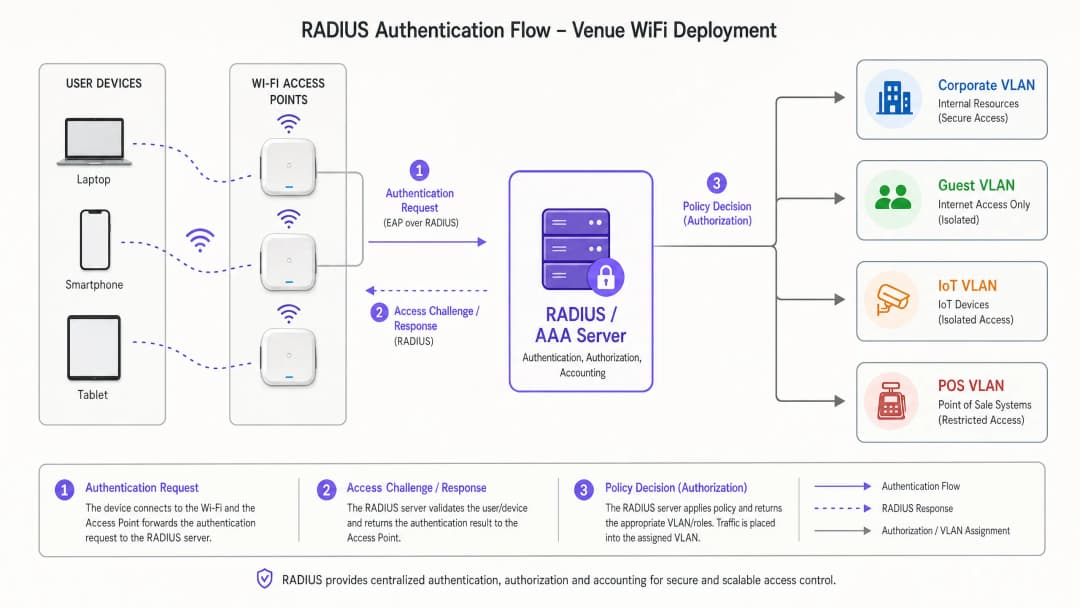
जब कोई डिवाइस कनेक्ट होता है, तो ऑथेंटिकेटर एक्सटेंसिबल ऑथेंटिकेशन प्रोटोकॉल (EAP) मैसेज को एनकैप्सुलेट करता है और उन्हें RADIUS सर्वर पर फॉरवर्ड करता है। RADIUS सर्वर एक आइडेंटिटी स्टोर — जैसे Active Directory, LDAP, या क्लाउड-आधारित आइडेंटिटी प्रोवाइडर के विरुद्ध क्रेडेंशियल्स का मूल्यांकन करता है। महत्वपूर्ण रूप से, आधुनिक RADIUS इम्प्लीमेंटेशन केवल Access-Accept या Access-Reject मैसेज वापस नहीं करते हैं। वे वेंडर-स्पेसिफिक एट्रिब्यूट्स (VSAs) वापस करते हैं जो यूज़र के नेटवर्क कॉन्टेक्स्ट को निर्धारित करते हैं: VLAN असाइनमेंट, एक्सेस कंट्रोल लिस्ट (ACL) एप्लीकेशन, और बैंडविड्थ थ्रॉटलिंग पैरामीटर।
एंटरप्राइज़ डिप्लॉयमेंट के लिए, Wi-Fi फ़्रीक्वेंसी: 2026 में Wi-Fi फ़्रीक्वेंसी के लिए एक गाइड को समझना आवश्यक है, क्योंकि फिजिकल लेयर की विशेषताएं हाई-डेंसिटी वाले वातावरण में ऑथेंटिकेशन हैंडशेक की परफॉरमेंस को सीधे प्रभावित करती हैं।
डायनामिक VLAN असाइनमेंट और माइक्रो-सेगमेंटेशन
RADIUS पॉलिसी का सबसे शक्तिशाली एप्लीकेशन डायनामिक VLAN असाइनमेंट है। विभिन्न यूज़र ग्रुप्स के लिए कई SSIDs ब्रॉडकास्ट करने के बजाय — जो बीकन ओवरहेड के कारण RF परफॉरमेंस को कम करता है — एक सिंगल 802.1X-सक्षम SSID सभी कॉर्पोरेट यूज़र्स को सेवा दे सकता है। RADIUS सर्वर यूज़र की ग्रुप मेंबरशिप और कॉन्टेक्चुअल फैक्टर्स के आधार पर उपयुक्त VLAN निर्धारित करता है।
उदाहरण के लिए, जब फाइनेंस टीम का कोई सदस्य ऑथेंटिकेट करता है, तो RADIUS सर्वर एक्सेस पॉइंट को उनके ट्रैफ़िक को VLAN 10 पर रखने का निर्देश देता है। जब कोई IoT डिवाइस MAC ऑथेंटिकेशन बायपास (MAB) के माध्यम से ऑथेंटिकेट करता है, तो उसे सख्त ACLs के साथ एक आइसोलेटेड VLAN 40 पर रखा जाता है। यह दृष्टिकोण अटैक सरफेस को काफी कम कर देता है और साथ ही RF वातावरण को सरल बनाता है। विशिष्ट वेंडर इम्प्लीमेंटेशन के लिए, Cisco Meraki में VLAN स्टीयरिंग के लिए NAC पॉलिसी कैसे कॉन्फ़िगर करें देखें।

EAP मेथड का चयन
EAP मेथड के चयन का सिक्योरिटी पोस्चर और ऑपरेशनल जटिलता दोनों पर महत्वपूर्ण प्रभाव पड़ता है। नीचे दी गई टेबल प्रमुख विकल्पों का सारांश देती है:
| EAP मेथड | ऑथेंटिकेशन मैकेनिज़्म | अनुशंसित यूज़ केस | सिक्योरिटी लेवल |
|---|---|---|---|
| EAP-TLS | म्यूचुअल सर्टिफिकेट-आधारित | MDM के साथ कॉर्पोरेट मैनेज्ड डिवाइस | उच्चतम |
| PEAP-MSCHAPv2 | सर्वर सर्ट + यूज़रनेम/पासवर्ड | BYOD, स्टाफ डिवाइस | उच्च |
| EAP-TTLS | सर्वर सर्ट + इनर क्रेडेंशियल्स | मिक्स्ड वातावरण | उच्च |
| MAB | क्रेडेंशियल के रूप में MAC एड्रेस | हेडलेस IoT, लिगेसी डिवाइस | निम्न (सख्त ACLs के साथ उपयोग करें) |
LEAP और EAP-MD5 जैसे लिगेसी प्रोटोकॉल से पूरी तरह बचें; वे क्रिप्टोग्राफ़िक रूप से कमज़ोर हैं और किसी भी आधुनिक डिप्लॉयमेंट में दिखाई नहीं देने चाहिए।
Got questions about your specific setup?
Our team works with venue operators, IT managers, and network engineers across 80,000 venues. Book a 20-minute call and we will show you how others like you solved it.
इम्प्लीमेंटेशन गाइड
एक मज़बूत RADIUS इंफ्रास्ट्रक्चर को डिप्लॉय करने के लिए सावधानीपूर्वक प्लानिंग और चरणबद्ध निष्पादन की आवश्यकता होती है। निम्नलिखित चरण फाइन-ग्रेन्ड नेटवर्क एक्सेस कंट्रोल के लिए RADIUS पॉलिसी कॉन्फ़िगर करने के लिए एक वेंडर-न्यूट्रल दृष्टिकोण की रूपरेखा तैयार करते हैं।
चरण 1: आइडेंटिटी सोर्स इंटीग्रेशन
किसी भी पॉलिसी की नींव एक क्लीन, अच्छी तरह से स्ट्रक्चर्ड आइडेंटिटी डायरेक्टरी होती है। चाहे ऑन-प्रिमाइसेस Active Directory का उपयोग कर रहे हों या Entra ID या Okta जैसे क्लाउड-नेटिव सॉल्यूशंस का, डायरेक्टरी ग्रुप्स को सीधे आपके इच्छित नेटवर्क सेगमेंट से मैप होना चाहिए।
- मौजूदा ग्रुप्स का ऑडिट करें: सुनिश्चित करें कि यूज़र ग्रुप्स लॉजिकल हैं और जहां संभव हो वहां परस्पर अनन्य (mutually exclusive) हैं। पुराने अकाउंट्स को हटा दें और ओवरलैपिंग ग्रुप्स को समेकित करें।
- एक्सेस टियर्स को परिभाषित करें: स्पष्ट टियर्स स्थापित करें — एग्जीक्यूटिव, स्टाफ, कॉन्ट्रैक्टर, गेस्ट, IoT — जिनमें से प्रत्येक के लिए डॉक्यूमेंटेड एक्सेस अधिकार हों।
- Purple को एक आइडेंटिटी प्रोवाइडर के रूप में इंटीग्रेट करें: पब्लिक-फेसिंग नेटवर्क के लिए, Purple कनेक्ट लाइसेंस के तहत OpenRoaming जैसी सेवाओं के लिए एक मुफ़्त आइडेंटिटी प्रोवाइडर के रूप में कार्य करता है। यह पब्लिक Guest WiFi एक्सेस और सुरक्षित ऑथेंटिकेशन फ्रेमवर्क के बीच की खाई को सहजता से पाटता है, जिससे लौटने वाले यूज़र्स के लिए पारंपरिक Captive Portal की आवश्यकता समाप्त हो जाती है।
चरण 2: पॉलिसी कॉन्फ़िगरेशन और एट्रिब्यूट मैपिंग
RADIUS सर्वर को केवल क्रेडेंशियल्स के बजाय कई कॉन्टेक्चुअल फैक्टर्स के आधार पर आने वाली रिक्वेस्ट्स का मूल्यांकन करने के लिए कॉन्फ़िगर करें。
- ऑथेंटिकेशन प्रोटोकॉल: कॉर्पोरेट डिवाइस के लिए EAP-TLS अनिवार्य करें। BYOD के लिए PEAP-MSCHAPv2 डिप्लॉय करें। कमज़ोर तरीकों का प्रयास करने वाले कनेक्शन्स को रिजेक्ट करते हुए, इन्हें RADIUS पॉलिसी के माध्यम से लागू करें।
- कंडीशन मैचिंग: ऐसी पॉलिसी बनाएं जो
NAS-IP-Address(ऑथेंटिकेटर का IP),Called-Station-Id(SSID), और दिन के समय का मूल्यांकन करें। 02:00 बजे किसी कॉन्ट्रैक्टर का एक्सेस प्रोफ़ाइल 09:00 बजे उनके प्रोफ़ाइल से भौतिक रूप से भिन्न होना चाहिए। - एन्फोर्समेंट प्रोफ़ाइल: वापस किए जाने वाले RADIUS एट्रिब्यूट्स को परिभाषित करें। स्टैंडर्ड VLAN असाइनमेंट एट्रिब्यूट्स हैं:
Tunnel-Type=VLAN,Tunnel-Medium-Type=802, औरTunnel-Private-Group-Id=[VLAN_ID]।
चरण 3: चरणबद्ध रोलआउट और मॉनिटरिंग
कभी भी पूरे एंटरप्राइज़ में एक साथ 802.1X एन्फोर्समेंट डिप्लॉय न करें।
- मॉनिटर मोड: पॉलिसी को मॉनिटर या ऑडिट मोड में डिप्लॉय करें जहां ऑथेंटिकेशन विफलताओं को लॉग किया जाता है लेकिन एक्सेस अभी भी प्रदान किया जाता है। यह एन्फोर्समेंट शुरू होने से पहले मिसकॉन्फ़िगर किए गए सप्लिकेंट्स और लिगेसी डिवाइस की पहचान करता है。
- लक्षित एन्फोर्समेंट: स्कोप का विस्तार करने से पहले समस्याओं को हल करते हुए, प्रति-लोकेशन या प्रति-डिपार्टमेंट के आधार पर एन्फोर्समेंट सक्षम करें।
- एनालिटिक्स इंटीग्रेशन: ऑथेंटिकेशन सफलता दर, सेशन अवधि, और रोमिंग व्यवहार की मॉनिटरिंग करने के लिए Purple के WiFi Analytics जैसे प्लेटफ़ॉर्म का लाभ उठाएं। यह डेटा कवरेज गैप और ऑथेंटिकेशन बॉटलनेक की पहचान करने के लिए महत्वपूर्ण है।
बेस्ट प्रैक्टिस
फाइन-ग्रेन्ड नेटवर्क एक्सेस कंट्रोल के लिए RADIUS पॉलिसी कॉन्फ़िगर करते समय, इंडस्ट्री स्टैंडर्ड्स का पालन दीर्घकालिक स्थिरता और सुरक्षा सुनिश्चित करता है।
सर्टिफिकेट-आधारित ऑथेंटिकेशन (EAP-TLS): जहां भी संभव हो, EAP-TLS डिप्लॉय करें। यह क्रेडेंशियल चोरी और पासवर्ड फटीग से जुड़े जोखिमों को पूरी तरह समाप्त कर देता है। मोबाइल डिवाइस मैनेजमेंट (MDM) प्लेटफ़ॉर्म बड़े पैमाने पर सर्टिफिकेट प्रोविज़निंग को ऑटोमेट कर सकते हैं।
MAC रैंडमाइज़ेशन मिटिगेशन लागू करें: आधुनिक मोबाइल ऑपरेटिंग सिस्टम यूज़र की प्राइवेसी की सुरक्षा के लिए MAC एड्रेस रैंडमाइज़ेशन का उपयोग करते हैं। Guest WiFi डिप्लॉयमेंट के लिए, सुनिश्चित करें कि आपका Captive Portal और RADIUS अकाउंटिंग सिस्टम बदलते MAC एड्रेस को सुचारू रूप से हैंडल करते हैं — उदाहरण के लिए, शुरुआती ऑनबोर्डिंग के दौरान जनरेट किए गए सेशन टोकन या पर्सिस्टेंट डिवाइस प्रोफ़ाइल पर निर्भर रहकर।
रिडंडेंसी और फेलओवर: RADIUS एक महत्वपूर्ण इंफ्रास्ट्रक्चर घटक है। भौगोलिक रूप से विविध लोकेशन्स पर अत्यधिक उपलब्ध क्लस्टर्स में RADIUS सर्वर डिप्लॉय करें। ऑथेंटिकेटर्स को प्राइमरी और सेकेंडरी सर्वर IPs के साथ कॉन्फ़िगर करें, और फेलओवर इवेंट्स के दौरान ऑथेंटिकेशन में देरी को कम करने के लिए एग्रेसिव टाइमआउट और रिट्राई वैल्यूज़ स्थापित करें।
कॉन्टेक्चुअल डेटा का लाभ उठाएं: पॉलिसी निर्णयों में लोकेशन डेटा को शामिल करें। किसी कॉन्ट्रैक्टर को इंजीनियरिंग ब्लॉक में AP से कनेक्ट होने पर इंटरनल रिसोर्सेज तक एक्सेस दिया जा सकता है, लेकिन कैफेटेरिया में कनेक्ट होने पर केवल इंटरनेट एक्सेस तक सीमित किया जा सकता है। एंटरप्राइज़ के लिए BLE लो एनर्जी की व्याख्या में चर्चा की गई तकनीकें इस लोकेशन कॉन्टेक्स्ट को सटीक पोज़िशनिंग डेटा के साथ बढ़ा सकती हैं।
ट्रबलशूटिंग और रिस्क मिटिगेशन
802.1X डिप्लॉयमेंट की जटिलता विशिष्ट फेलियर मोड्स पेश करती है। अपटाइम बनाए रखने के लिए प्रोएक्टिव रिस्क मिटिगेशन आवश्यक है।
सामान्य फेलियर मोड्स
| फेलियर मोड | मूल कारण | मिटिगेशन |
|---|---|---|
| मास ऑथेंटिकेशन फेलियर | एक्सपायर हो चुका RADIUS सर्वर या रूट CA सर्टिफिकेट | 90/60/30 दिनों पर ऑटोमेटेड अलर्ट के साथ सर्टिफिकेट लाइफसाइकिल मैनेजमेंट |
| व्यक्तिगत डिवाइस फेलियर | सप्लिकेंट मिसकॉन्फ़िगरेशन या मिसिंग रूट CA | सही ट्रस्ट स्टोर के साथ MDM-पुश्ड वायरलेस प्रोफ़ाइल |
| EAP टाइमआउट | सेंट्रलाइज़्ड RADIUS के लिए उच्च WAN लेटेंसी | WAN पाथ को ऑप्टिमाइज़ करें; डिस्ट्रीब्यूटेड RADIUS या RADIUS प्रॉक्सी पर विचार करें |
| IoT डिवाइस फेलियर | डिवाइस 802.1X को सपोर्ट नहीं करता है | सख्त VLAN आइसोलेशन और ACLs के साथ MAB डिप्लॉय करें |
डिस्ट्रीब्यूटेड एंटरप्राइज़ के लिए, SD WAN बनाम MPLS: 2026 एंटरप्राइज़ नेटवर्क गाइड में चर्चा किया गया आर्किटेक्चर कई साइट्स पर सेंट्रलाइज़्ड AAA सेवाओं के लिए लो-लेटेंसी कनेक्टिविटी सुनिश्चित करने के लिए सीधे तौर पर प्रासंगिक है।
ROI और बिज़नेस इम्पैक्ट
फाइन-ग्रेन्ड नेटवर्क एक्सेस कंट्रोल के लिए RADIUS पॉलिसी कॉन्फ़िगर करने के लिए आवश्यक इंजीनियरिंग प्रयास का निवेश करने से कई आयामों में पर्याप्त, मापने योग्य रिटर्न मिलता है।
कम ऑपरेशनल ओवरहेड: डायनामिक VLAN असाइनमेंट के साथ कई SSIDs को एक सिंगल 802.1X नेटवर्क में समेकित करने से RF इंटरफेरेंस कम होता है, उपलब्ध एयरटाइम में सुधार होता है, और चल रहे मैनेजमेंट को सरल बनाता है। एक बार स्थिर 802.1X डिप्लॉयमेंट लागू हो जाने के बाद टीमें WiFi कनेक्टिविटी से संबंधित हेल्पडेस्क टिकटों में उल्लेखनीय कमी की रिपोर्ट करती हैं।
बेहतर कंप्लायंस पोस्चर: रिटेल और हेल्थकेयर जैसे सेक्टर्स के लिए, सख्त नेटवर्क सेगमेंटेशन एक रेगुलेटरी आवश्यकता है — क्रमशः PCI DSS और HIPAA। RADIUS पॉलिसी कंप्लायंस ऑडिट पास करने और भारी वित्तीय दंड से बचने के लिए आवश्यक वेरिफ़िएबल, ऑडिबल कंट्रोल प्रदान करती हैं। पब्लिक-सेक्टर के संगठनों के लिए, डेटा सेग्रीगेशन के इर्द-गिर्द GDPR दायित्वों को भी इसी तरह संबोधित किया जाता है।
बेहतर यूज़र एक्सपीरियंस: निर्बाध, सुरक्षित ऑथेंटिकेशन — विशेष रूप से EAP-TLS या OpenRoaming के माध्यम से — लौटने वाले कॉर्पोरेट यूज़र्स और VIP गेस्ट्स के लिए Captive Portal के घर्षण को समाप्त करता है। हॉस्पिटैलिटी और ट्रांसपोर्ट वेन्यू में, यह सीधे तौर पर संतुष्टि मेट्रिक्स और रिपीट एंगेजमेंट को प्रभावित करता है।
Key Definitions
RADIUS (Remote Authentication Dial-In User Service)
A networking protocol that provides centralised Authentication, Authorisation, and Accounting (AAA) management for users who connect and use a network service. Defined in RFC 2865.
The core engine for enterprise network access control, determining who gets on the network, what they can access, and logging the activity for audit purposes.
IEEE 802.1X
An IEEE Standard for port-based Network Access Control (PNAC). It provides an authentication mechanism to devices wishing to attach to a LAN or WLAN, blocking all traffic until authentication is complete.
The standard that forces a device to prove its identity before it is allowed to send any data traffic on the network. The enforcement mechanism that makes RADIUS policies actionable.
EAP (Extensible Authentication Protocol)
An authentication framework frequently used in wireless networks and point-to-point connections. It provides a transport layer for authentication methods (EAP methods) such as TLS or MSCHAPv2.
The envelope that carries the actual authentication credentials between the client and the RADIUS server. The choice of EAP method determines the security level of the authentication exchange.
VSA (Vendor-Specific Attribute)
Attributes within a RADIUS message that allow vendors to support extended attributes not defined in the base RADIUS RFCs. Used to convey network policy instructions from the RADIUS server to the authenticator.
The mechanism by which RADIUS instructs network hardware to assign a user to a specific VLAN, apply a firewall role, or enforce bandwidth limits. Without VSAs, RADIUS can only permit or deny access.
Dynamic VLAN Assignment
The process where a RADIUS server instructs an access point or switch to place a user's traffic onto a specific Virtual LAN based on their identity, group membership, or contextual attributes.
The key technique for network micro-segmentation. Allows a single physical infrastructure to securely support multiple distinct user groups without broadcasting multiple SSIDs.
Supplicant
The software client on an end-user device (laptop, smartphone, IoT device) that initiates and negotiates the 802.1X authentication exchange with the network authenticator.
Built into modern operating systems (Windows, macOS, iOS, Android). Misconfigured supplicants — particularly incorrect certificate trust settings — are the most common source of 802.1X connectivity issues.
Authenticator
The network device (wireless access point or Ethernet switch) that acts as the enforcement point in an 802.1X deployment. It relays EAP messages between the supplicant and the RADIUS server, and enforces the policy decision.
The gatekeeper. The authenticator blocks all traffic from a port or wireless association until the RADIUS server returns an Access-Accept message, at which point it applies the returned VSAs.
MAB (MAC Authentication Bypass)
A fallback authentication method where the network device's MAC address is submitted as its credential to the RADIUS server. Used for devices that do not support 802.1X supplicants.
A necessary operational tool for legacy and headless IoT devices, but inherently less secure than cryptographic authentication. Should always be paired with strict VLAN isolation and ACLs.
EAP-TLS (EAP Transport Layer Security)
A certificate-based EAP method that provides mutual authentication between the client and the RADIUS server using X.509 certificates. Considered the most secure EAP method available.
The recommended authentication method for corporate-managed devices. Eliminates password-based credential risks entirely. Requires a PKI infrastructure and MDM for certificate provisioning.
Worked Examples
A large conference centre needs to provide secure, segmented WiFi access for event staff, exhibitors, and general attendees. They currently broadcast three separate SSIDs, which is causing significant co-channel interference and poor performance in high-density exhibition halls.
The venue transitions to a single, 802.1X-enabled SSID named 'Conference_Secure'. They implement a RADIUS server integrated with their event management database.
- Event staff authenticate using their corporate credentials via PEAP-MSCHAPv2. The RADIUS policy matches their Active Directory group and returns Tunnel-Private-Group-Id=10 (Staff VLAN), granting access to internal AV management systems.
- Exhibitors are provided unique, time-limited credentials tied to their stand booking. Upon authentication, the RADIUS server returns Tunnel-Private-Group-Id=20 (Exhibitor VLAN), which has ACLs permitting access to specific presentation servers and internet egress.
- General attendees use a separate open SSID with a Captive Portal integrated with Purple for marketing data collection, consent management, and basic internet access.
The result is a 40% reduction in management frame overhead, measurably improved throughput in exhibition halls, and a clear audit trail for compliance purposes.
A retail chain needs to secure thousands of wireless Point of Sale (POS) terminals across 500 locations. They are currently using WPA2-PSK, and IT is concerned about the operational risk of rotating the pre-shared key across 500 sites, as well as PCI DSS audit findings.
The IT team deploys a centralised RADIUS infrastructure and configures the POS terminals for EAP-TLS authentication.
- An MDM solution pushes a unique client certificate to each POS terminal during provisioning.
- The wireless access points at each store are configured to forward authentication requests to the central RADIUS servers over the SD-WAN fabric.
- The RADIUS policy verifies the client certificate against the internal PKI and returns attributes to place the device on the isolated POS VLAN (VLAN 50), satisfying PCI DSS network segmentation requirements.
- A certificate revocation list (CRL) is maintained, allowing IT to instantly quarantine a lost or stolen terminal by revoking its certificate — without impacting any other device.
Practice Questions
Q1. A hospital needs to deploy new wireless infusion pumps across three wards. These devices do not support 802.1X supplicants. The CISO requires that these devices are completely isolated from the corporate network and can only communicate with the specific clinical management server at 10.5.1.20. How should you configure the network access control policy?
Hint: Consider how devices without 802.1X capabilities can be identified and the principle of least privilege when defining the ACL.
View model answer
Implement MAC Authentication Bypass (MAB). Register the MAC addresses of all infusion pumps in the RADIUS database during the provisioning process. Create a specific RADIUS policy that matches these MAC addresses and returns VSAs assigning them to an isolated IoT VLAN (e.g., VLAN 60). Apply strict ACLs to this VLAN permitting outbound traffic only to 10.5.1.20 on the required clinical management ports, and blocking all other inter-VLAN and internet traffic. Additionally, configure DHCP snooping and dynamic ARP inspection on the IoT VLAN to prevent spoofing attacks.
Q2. Following a recent acquisition, an enterprise now has two distinct Active Directory domains: corp.acme.com and corp.legacy.com. They want all employees from both entities to use the same 'ACME_Corporate' SSID without migrating the legacy domain. How can RADIUS facilitate this?
Hint: Think about how RADIUS handles authentication routing based on the identity realm and how policy servers can proxy requests to different backend directories.
View model answer
Configure the RADIUS infrastructure (using a policy server such as Cisco ISE, Aruba ClearPass, or a RADIUS proxy) to evaluate the realm suffix provided in the user's EAP identity — for example, user@corp.acme.com versus user@corp.legacy.com . Create routing policies that forward authentication requests to the appropriate backend Active Directory domain based on the realm. Define standardised enforcement profiles that return consistent VLAN VSAs regardless of the backend domain, ensuring users from both entities receive the correct network placement. This approach avoids a disruptive directory migration while maintaining a unified user experience.
Q3. You are designing the WiFi for a 60,000-seat stadium. The client's current design specifies 8 separate SSIDs for different staff functions: Ticketing, Security, Concessions, Medical, Media, Operations, VIP, and Maintenance. What is your recommendation and why?
Hint: Consider the impact of management frame overhead on wireless performance in a high-density RF environment.
View model answer
Strongly advise against broadcasting 8 SSIDs. In a high-density environment, each SSID generates beacon frames on every access point at regular intervals, consuming significant airtime and reducing the capacity available for actual data traffic. The recommendation is to consolidate all staff functions onto a single 802.1X-enabled SSID. Utilise RADIUS dynamic VLAN assignment to segment the traffic on the backend — when a ticketing device authenticates, RADIUS places it on the Ticketing VLAN; when a medical device authenticates, it goes to the Medical VLAN with appropriate ACLs. This provides the required logical separation while optimising the physical RF environment. A separate open SSID with a Captive Portal can handle general public access.
Continue reading in this series
PPSK wpa3: comparing features and deployment models
This technical reference guide compares PPSK and WPA3-SAE, explaining their architectural differences and deployment models for multi-tenant environments. It provides actionable guidance for IT managers and property developers on achieving secure, isolated WiFi networks using Purple's identity-based solutions.
PPSK WiFi: comparing features and deployment models
This technical reference guide compares Private Pre-Shared Key (PPSK) WiFi architecture against traditional 802.1X and standard PSK deployments. It provides network architects and IT managers with vendor-neutral implementation strategies for multi-tenant residential, IoT, and BTR environments.
How to Reduce the Number of WiFi SSIDs Using Per-Device PSK (iPSK, DPSK, MPSK)
This authoritative technical reference guide explains how IT teams can eliminate WiFi performance degradation caused by SSID beacon overhead by collapsing multiple purpose-built networks into a single SSID using per-device PSK (xPSK). It covers the vendor landscape across Cisco iPSK, HPE Aruba MPSK, Ruckus DPSK, Juniper Mist PPSK, and Ubiquiti UniFi PPSK, with practical implementation guidance on dynamic VLAN assignment, IoT onboarding, and PCI DSS compliance. Venue operators in hospitality, retail, stadiums, and public-sector organisations will find actionable architecture guidance and real-world worked examples.
Got questions about your specific setup?
Our team works with venue operators, IT managers, and network engineers across 80,000 venues. Book a 20-minute call and we will show you how others like you solved it.