
The Role of SCEP and NAC in Modern MDM Infrastructure
This guide provides a comprehensive technical breakdown of how SCEP and NAC integrate with MDM platforms to deliver secure, zero-touch network access at enterprise scale. It covers the full architecture from certificate issuance through 802.1X enforcement, with real-world implementation scenarios from hospitality and retail. Designed for IT leaders at large venues who need to eliminate password vulnerabilities, automate device provisioning, and satisfy compliance requirements this quarter.
Listen to this guide
View podcast transcript
执行摘要
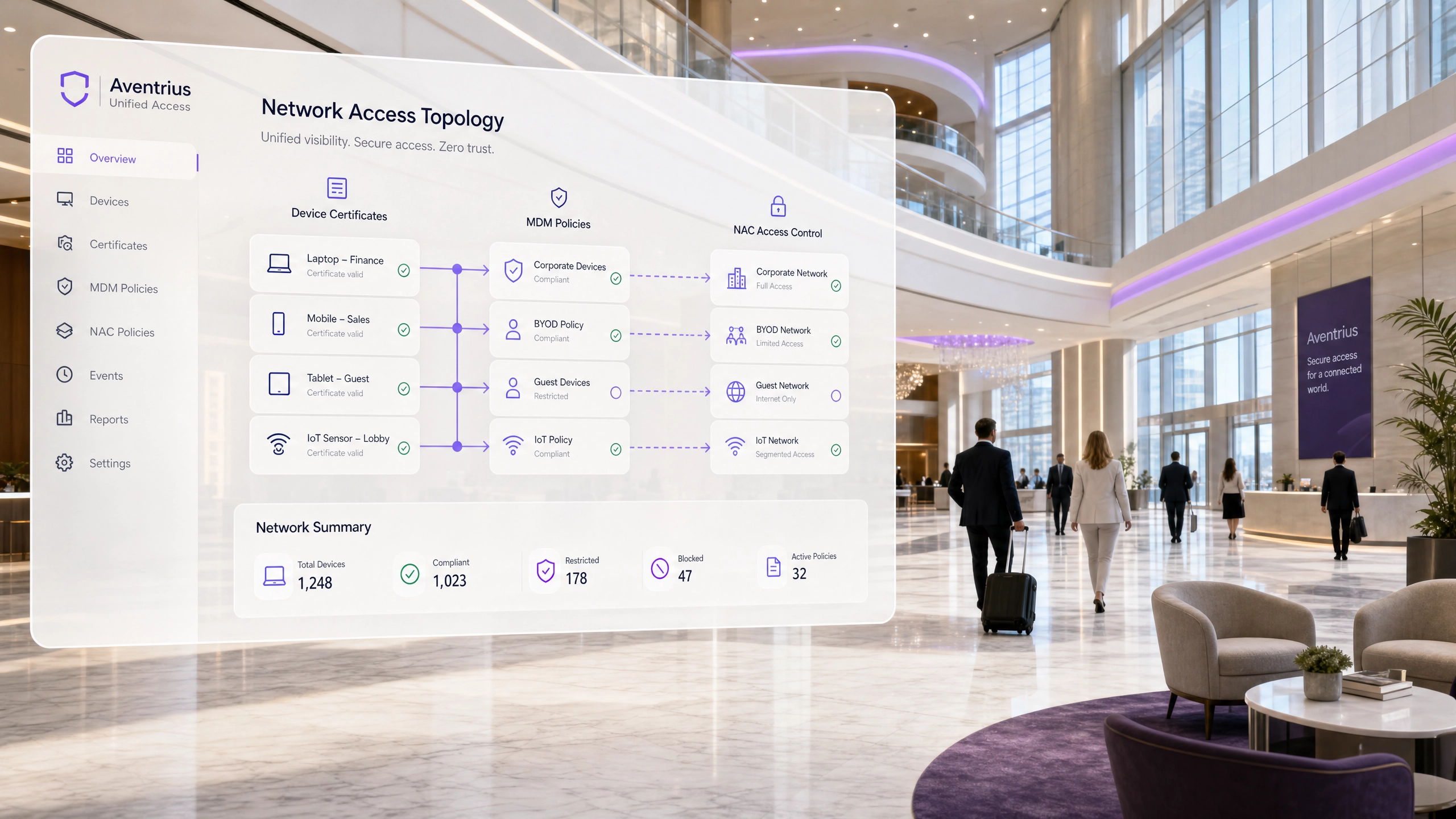
对于企业场所——从拥有 80,000 个座位的体育场到多站点零售连锁店——确保网络边缘的安全已果断地超越了预共享密钥和手动凭证管理。企业终端、BYOD 设备和物联网基础设施的激增要求采用零信任架构,该架构能够在不给 IT 服务台带来负担的情况下扩展。
本指南详细介绍了将简单证书注册协议(SCEP)和网络准入控制(NAC)与移动设备管理(MDM)基础设施集成的技术架构。通过利用 SCEP 自动分发 X.509 证书,并利用 NAC 强制执行 IEEE 802.1X EAP-TLS 身份验证,组织可以实现零接触配置、消除凭证窃取途径,并强制执行基于姿态的动态网络访问。虽然面向公众的访问通过专用的 Guest WiFi 解决方案进行管理,但此架构可确保关键的幕后操作安全,从而维持场所的正常运行。其结果是 IT 开销显著降低、PCI DSS 和 GDPR 下的合规性更强,以及网络边缘主动执行零信任原则。
技术深入探讨
三层架构
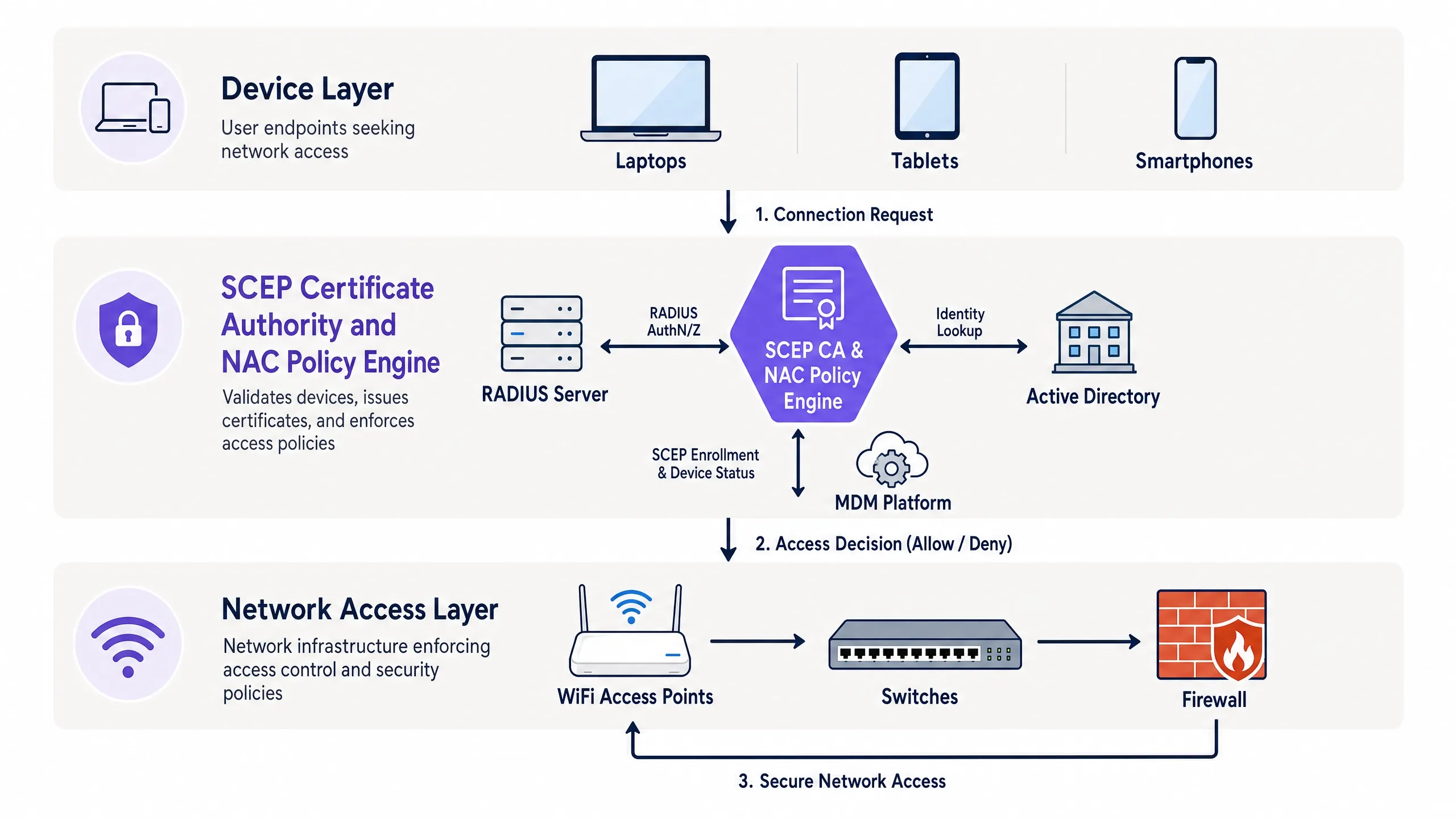
现代网络安全依赖于加密身份而非用户知识。SCEP-NAC-MDM 堆栈跨三个主要层面运行:
| 层面 | 组件 | 功能 |
|---|---|---|
| 设备管理 | MDM / UEM | 设备配置、合规性和生命周期的中央权威机构 |
| 身份与颁发 | PKI / SCEP / CA | 生成、颁发和管理数字证书 |
| 访问强制执行 | NAC / RADIUS | 在授予网络访问权限之前评估证书和设备姿态 |
这些层面并非顺序关系——它们在一个连续的反馈循环中运行。MDM 实时将合规性状态通知 NAC,而 NAC 可以在设备未通过姿态检查时触发 MDM 修复工作流。
SCEP 如何大规模自动化 PKI
手动部署证书在规模上操作上是不可能的。一个拥有 500 台设备的资产需要 IT 管理员为每台设备生成、签名和安装单独的 X.509 证书——这个过程每台设备需要几分钟,并且会引入重大的人为错误风险。SCEP 完全消除了这一点。
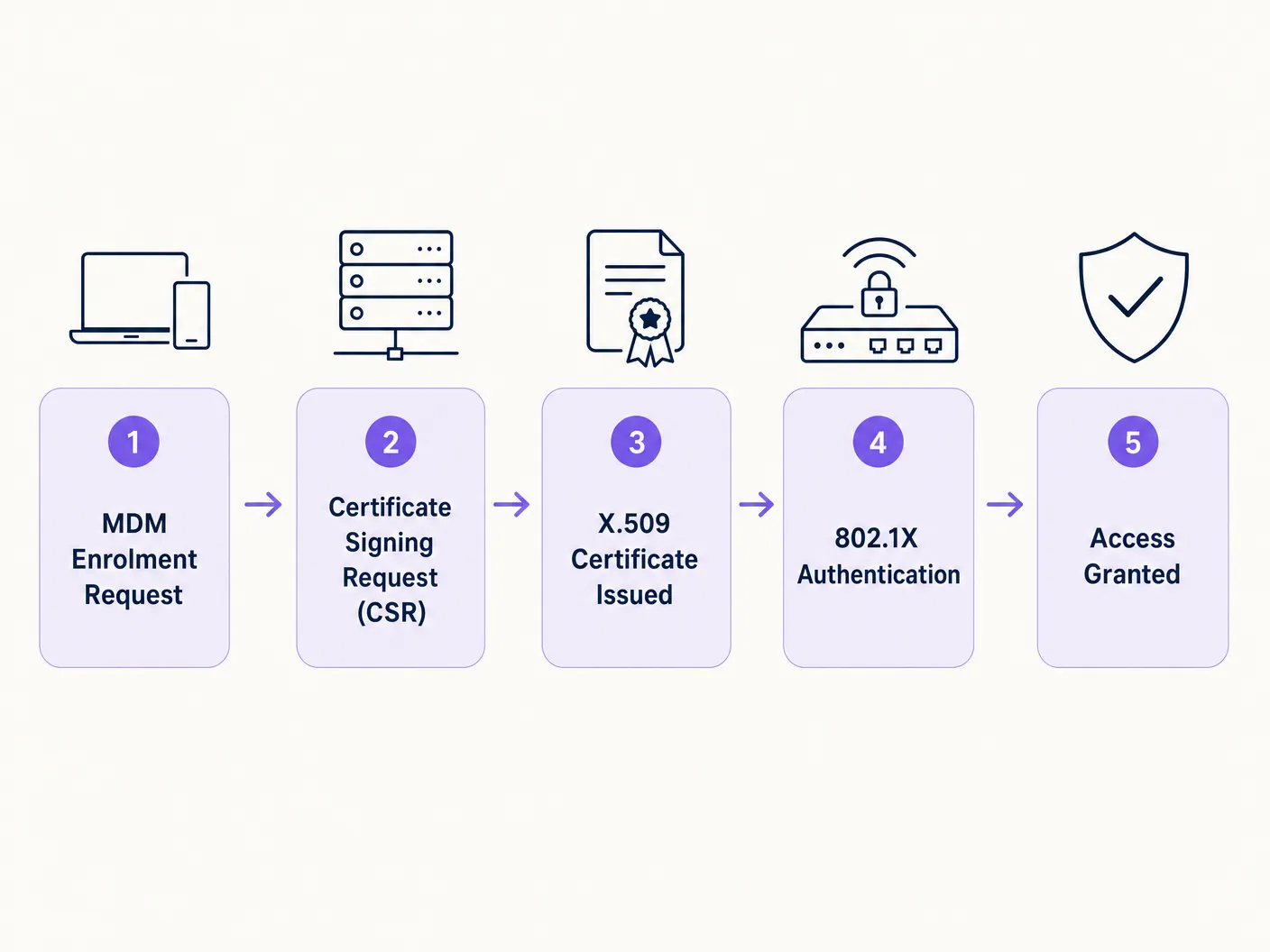
当设备在 MDM 中注册时,MDM 推送一个包含 SCEP 负载的配置描述文件。该负载指示设备在本地生成密钥对——关键的是,私钥永远不会离开设备——并向 SCEP 服务器提交证书签名请求(CSR)。SCEP 服务器(通常是微软的网络设备注册服务(NDES)或基于云的等效服务)根据 MDM 验证请求,以确认设备已获授权。然后,它将 CSR 转发给证书颁发机构(CA),CA 签发已签名的 X.509 证书。证书返回给设备并安装在其安全隔区或系统密钥库中。
整个过程静默地进行,通过无线方式完成,无需用户交互。对于部署 1,000 台设备,整个证书资产可以在 MDM 注册完成后的数小时内完成配置。
NAC 和 802.1X EAP-TLS:强制执行层
一旦设备持有有效证书,它就会尝试使用 IEEE 802.1X 连接到企业 SSID 或有线端口。接入点或交换机充当认证器,将请求转发给由 NAC 策略引擎控制的 RADIUS 服务器。最安全的 EAP 方法是 EAP-TLS,它要求相互认证——客户端和 RADIUS 服务器都必须提供有效证书,从而防止通过欺诈接入点进行的中间人攻击。 NAC 按顺序执行几项关键检查:
- **密码学验证:**证书在数学上是否有效,并且由受信任的根 CA 签名?
- **吊销检查:**证书是否列在证书吊销列表(CRL)中,或通过在线证书状态协议(OCSP)标记?
- **姿态评估:**通过 API 查询 MDM,NAC 询问:设备是否合规?操作系统是否达到所需的补丁级别?磁盘加密是否启用?
如果所有检查均通过,NAC 会发送 RADIUS 访问接受消息,通常附带供应商特定属性(VSA),这些属性动态地将设备分配到特定的 VLAN 或应用访问控制列表(ACL)。不合规的设备将被放入权限有限的修复 VLAN 中——通常仅足以触发 MDM 驱动的修复工作流。
访客网络隔离
在任何场所环境中,企业基础设施必须与面向公众的网络严格隔离。 Guest WiFi 平台完全运行在独立的 SSID 和 VLAN 上,没有路由到企业资源的路径。SCEP-NAC 架构管控企业层;访客层由强制门户认证和数据捕获工作流控制。对于部署 WiFi Analytics 的场所,这种隔离是前提条件——分析数据流经访客网络,而运营数据流经由证书认证的企业网络。有关支撑这两个网络的基础射频架构的更多背景信息,请参阅 Wi-Fi 频率:2026 年 Wi-Fi 频率指南 。
实施指南
部署此架构需要仔细排序,以避免在过渡期间将合法用户拒之门外。
第 1 步:PKI 和 SCEP 准备
建立强大的内部 PKI 或利用基于云的托管 PKI(mPKI)服务。部署并加固 SCEP 服务器——如果使用 Microsoft NDES,请确保它在专用服务器上运行,而不是与 CA 共置。配置 SCEP 服务器使用由 MDM 为每台设备生成的动态挑战口令,而不是静态共享密钥。这可以防止在发现 SCEP URL 时进行未经授权的证书请求。
第 2 步:MDM 配置
在您的 MDM 平台中创建 SCEP 负载。仔细定义主题备用名称(SAN)字段——SAN 必须包含唯一标识符(例如设备序列号或用户 UPN),NAC 将使用这些标识符进行策略决策。首先将配置文件推送到 IT 团队设备的测试组,并在更广泛推出之前验证完整的注册流程。
第 3 步:NAC 和 RADIUS 设置
配置您的 NAC 以信任签发了客户端证书的根 CA。在 RADIUS 服务器上安装服务器证书以进行 EAP-TLS 相互认证。根据证书属性和 MDM 合规性状态定义访问策略。实施动态 VLAN 分配规则:将合规的企业设备分配到企业 VLAN,将不合规的设备分配到修复 VLAN,将物联网设备分配到专用的、限制互联网访问的 VLAN。
第 4 步:网络基础设施集成
为 802.1X 配置交换机和无线接入点。对于 零售业 环境中拥有传统销售点硬件的场景,或 酒店业 场所中拥有智能房间控制器的场景,为无法参与 EAP-TLS 的设备实施 MAC 认证绕过(MAB)作为后备方案。将 MAB 限制到特定的交换机端口,并确保 MAC 地址数据库得到严格控制。对于 医疗保健 和 交通运输 环境,应配置姿态评估规则以满足特定行业的合规性要求。
第 5 步:并行部署和切换
切勿立即切换。与现有网络并行广播新的 802.1X SSID。通过 MDM 推送新的 WiFi 配置文件。监控采用情况并解决注册失败问题。一旦 95% 以上的设备在新的 SSID 上成功认证,就停用旧网络。
最佳实践
**强制使用 EAP-TLS。**绝不要接受 EAP-PEAP 或 EAP-TTLS 作为企业设备的主要认证方法。这些方法依赖于 TLS 隧道内的用户名/密码凭据,仍然容易受到凭据收集的攻击。EAP-TLS 完全消除了这种攻击面。
**实施实时吊销。**计划性的 CRL 下载会产生漏洞窗口。配置 NAC 实时执行 OCSP 检查。当设备被报告丢失或被盗时,在 CA 中吊销证书,设备将在下次认证尝试时失去网络访问权限——如果实施了更改授权(CoA),甚至可以立即断开。
**设置合理的证书有效期。**一年有效期,并在有效期届满前 30 天触发 SCEP 自动续订,这是行业标准。更长的有效期会增加证书被泄露时的漏洞窗口;更短的有效期会增加续订失败导致中断的风险。
**积极隔离物联网。**物联网设备绝不应与企业终端共享 VLAN。使用 NAC 在物联网 VLAN 上强制执行严格的 ACL,仅允许每个设备类型所需的特定协议和目的地。对于部署定位服务的场所,请参阅 室内 WiFi 定位系统:它们如何工作以及如何部署 ,以了解定位基础设施如何与更广泛的网络架构相集成。
**与 WPA3 保持一致。**在硬件支持的情况下,将企业 SSID 配置为使用 WPA3-Enterprise,该协议强制要求受保护的管理帧(PMF),并提供比 WPA2 更强的密码学保护。有关这如何融入更广泛的企业连接环境的详细信息,请参阅 SD-WAN 与 MPLS:2026 年企业网络指南 。
故障排除与风险缓解
| 故障模式 | 根本原因 | 缓解措施 |
|---|---|---|
| 设备在证书续订后 EAP-TLS 失败 | SCEP 续订静默失败 | 监控 SCEP 服务器日志;为失败的 CSR 提交设置警报 |
| 时钟偏差导致证书验证失败 | NTP 配置错误 | 在所有终端和基础设施上强制执行 NTP 同步 |
| 物联网设备无法认证 | 没有 802.1X 认证客户端 | 实施具有严格 MAC 地址控制和隔离 VLAN 的 MAB |
| CA 迁移后大量设备锁定 | 旧的根 CA 不受 NAC 信任 | 分阶段进行 CA 迁移;在吊销旧根 CA 之前,将新的根 CA 添加到 NAC 信任存储区 |
| 已吊销的设备仍保留网络访问权限 | 仅使用 CRL 吊销且下载间隔较长 | 实时实施 OCSP 和 CoA 以进行实时吊销 |
对于特定的基于 BLE 的物联网设备,认证架构与 WiFi 连接的终端有所不同。请参阅 面向企业的 BLE 低功耗解释 ,以了解适用于蓝牙低功耗基础设施的具体安全注意事项。
投资回报率与业务影响
当与替代方案的成本进行衡量时,SCEP-NAC-MDM 集成的商业案例是简单明了的。
| 指标 | 实施前 | 实施后 |
|---|---|---|
| IT 服务台工单(网络访问) | 高——密码重置、密钥轮换 | 接近零——自动化证书生命周期 |
| 吊销受损设备的平均时间 | 数小时(手动流程) | 数秒(OCSP + CoA) |
| PCI DSS 访问控制合规性 | 手动、审计密集 | 自动化、持续强制执行 |
| BYOD 入门时间 | 每台设备 15-30 分钟 | 不到 5 分钟,零 IT 参与 |
对于拥有 500 台设备的资产,消除手动证书管理和与密码相关的服务台工单,通常可将网络相关的 IT 支持开销降低 25-35%。风险缓解价值——避免一次基于凭据的泄露——通常超过整个实施成本。对于 GDPR 约束下的公共部门和医疗保健组织,能够展示自动化、可审计的访问控制是一项重要的合规资产。
Key Definitions
SCEP (Simple Certificate Enrollment Protocol)
A protocol that automates the issuance and revocation of digital certificates to devices without user intervention, acting as the communication layer between the MDM platform and the Certificate Authority.
Used by MDM platforms to seamlessly deploy X.509 certificates to thousands of endpoints at scale. IT teams encounter SCEP when configuring MDM profiles for 802.1X WiFi authentication.
NAC (Network Access Control)
A security solution that enforces policy on devices seeking to access network infrastructure, evaluating authentication credentials, certificate validity, and device compliance posture before granting access.
Acts as the gatekeeper at the network edge. IT teams configure NAC policies to define which devices get access to which VLANs based on their certificate attributes and MDM compliance status.
MDM (Mobile Device Management)
Software used by IT departments to monitor, manage, and secure employees' endpoints across multiple operating systems, serving as the central source of truth for device identity and compliance.
The initiator of the SCEP enrolment process and the source of posture data queried by the NAC. Without MDM integration, the NAC cannot perform posture-based access control.
IEEE 802.1X
An IEEE standard for port-based Network Access Control that provides an authentication mechanism to devices wishing to attach to a LAN or WLAN, requiring successful authentication before the port is opened.
The underlying protocol that forces devices to authenticate before the switch or access point allows any traffic to pass. Configured on both the network infrastructure and the device's 802.1X supplicant.
EAP-TLS (Extensible Authentication Protocol - Transport Layer Security)
The most secure EAP standard, requiring mutual authentication where both the client device and the RADIUS server must present valid digital certificates, eliminating password-based credential attacks.
The gold standard for enterprise wireless security. IT architects should mandate EAP-TLS over PEAP or TTLS wherever device certificate infrastructure is in place.
CSR (Certificate Signing Request)
A block of encoded text generated by a device containing its public key and identity details, submitted to the Certificate Authority to request a signed X.509 certificate.
Generated automatically by the device during the SCEP enrolment process. The private key corresponding to the CSR never leaves the device, ensuring the certificate cannot be duplicated.
MAB (MAC Authentication Bypass)
A fallback authentication method where the network uses the device's hardware MAC address as its credential, used for devices that lack 802.1X supplicant capability.
Used for legacy IoT devices such as printers, sensors, and smart room controllers that cannot participate in EAP-TLS. Should always result in assignment to a highly restricted VLAN.
OCSP (Online Certificate Status Protocol)
An internet protocol used for obtaining the revocation status of an X.509 digital certificate in real-time, providing an alternative to downloading and parsing Certificate Revocation Lists.
Critical for NAC systems that need to immediately block network access when a device is compromised or reported stolen. OCSP provides real-time status; CRL downloads create a revocation window.
CoA (Change of Authorization)
A RADIUS extension (RFC 5176) that allows the NAC to dynamically modify or terminate an active network session without waiting for the session to expire or the device to re-authenticate.
Used to immediately disconnect a device when its certificate is revoked or its MDM compliance status changes. Essential for real-time zero-trust enforcement.
Worked Examples
A 500-room luxury resort needs to secure its back-of-house operations network. Staff use shared tablets for housekeeping management, and management use corporate laptops. The current WPA2-PSK network has had the pre-shared key leaked multiple times, resulting in two security incidents in the past year. How should the IT team transition to certificate-based authentication without disrupting operations?
Phase 1 — Preparation (Weeks 1–2): Deploy a cloud-based RADIUS/NAC solution and integrate it with the existing MDM. Configure a SCEP profile in the MDM to push device-based certificates to all tablets and laptops. Use device-based certificates (tied to the device serial number) rather than user-based certificates, so shared tablets authenticate automatically regardless of which staff member is using them. Phase 2 — Parallel Deployment (Weeks 3–4): Broadcast a new, hidden SSID configured for 802.1X EAP-TLS. Push the new WiFi profile via MDM to all enrolled devices. Monitor the NAC dashboard for successful authentications. Phase 3 — Cutover (Week 5): Once 95%+ of devices are connected to the new SSID, decommission the legacy WPA2-PSK network. Revoke the old PSK from all documentation and access points.
A national retail chain is deploying 3,000 new Point of Sale terminals across 150 stores. The security team mandates strict PCI DSS network segmentation and zero-trust access. The deployment timeline is 8 weeks. How does SCEP and NAC facilitate this at scale without requiring IT staff at each store?
Pre-Deployment: The POS vendor pre-enrols all 3,000 devices in the retailer's MDM using the vendor's zero-touch enrolment programme. The MDM is configured with a SCEP profile that will fire automatically upon first boot. Deployment: When a POS terminal is powered on at the store, it connects to a temporary onboarding SSID (internet-only, no corporate access). The MDM profile is pushed, the SCEP payload fires, and the device requests and receives its X.509 certificate from the CA. The MDM then pushes the corporate WiFi profile. Network Access: When the POS connects to the store's switch port, the switch initiates 802.1X. The NAC validates the certificate, queries the MDM to confirm the POS is compliant (encryption enabled, MDM agent active, no jailbreak detected), and dynamically assigns the switch port to the PCI-DSS VLAN. The POS is now operational. Zero IT staff were required at the store.
Practice Questions
Q1. Your organisation is migrating from WPA2-Enterprise using PEAP-MSCHAPv2 to EAP-TLS. During the pilot, Windows laptops and iPhones connect successfully, but 200 warehouse barcode scanners fail to authenticate. The scanners support 802.1X but cannot process the SCEP payload from the MDM — they run a proprietary embedded OS with no MDM agent support. What is the most secure architectural solution that maintains network segmentation without requiring replacement of the scanners?
Hint: Consider alternative certificate delivery mechanisms that do not require an MDM agent, and what network segmentation controls should apply to devices that cannot participate in full posture assessment.
View model answer
Since the scanners support 802.1X but not SCEP or MDM enrolment, the most secure approach is to manually provision device certificates using a dedicated certificate template with a restricted key usage profile. The certificates are installed once during a maintenance window. The NAC is configured to accept these certificates but assign the scanners to a dedicated warehouse operations VLAN with strict ACLs — not the full corporate VLAN — because posture assessment is not possible. Alternatively, if manual certificate provisioning is operationally unscalable, configure MAB as a fallback specifically for the MAC OUIs of the scanner hardware, with the NAC assigning them to the same restricted VLAN. Document this as a known exception in your risk register and schedule scanner replacement in the next hardware refresh cycle.
Q2. A network security manager notices that when an employee reports a laptop stolen, the MDM sends a remote wipe command, but the device remains connected to the corporate WiFi for up to 12 hours — the current RADIUS session timeout. During this window, the device could be used to exfiltrate data. How should the architecture be modified to terminate network access immediately upon a device being reported stolen?
Hint: The NAC needs to be informed of the status change instantly rather than waiting for the next authentication cycle. Consider both the session termination mechanism and the re-authentication prevention mechanism.
View model answer
Implement two complementary controls. First, configure the MDM to send a webhook to the NAC immediately upon a device being marked as lost or stolen. The NAC then sends a RADIUS Change of Authorization (CoA) Disconnect-Request message to the specific access point or switch port, terminating the active session immediately. Second, revoke the device's certificate in the CA and ensure the NAC is configured for real-time OCSP checking rather than CRL-based revocation. This means that even if the device reconnects before the CoA is processed, the EAP-TLS authentication will fail at the OCSP check. Both controls together reduce the exposure window from 12 hours to under 60 seconds.
Q3. During a security audit of a large conference centre's network, it is discovered that the SCEP server is exposed to the public internet using a static challenge password to allow remote device enrollment. The auditor flags this as a critical vulnerability. How should the SCEP enrollment process be re-architected to maintain remote enrollment capability while eliminating the static password risk?
Hint: The SCEP server needs a way to verify that the device requesting a certificate is actually authorised by the MDM, without relying on a shared secret that could be extracted from a device or intercepted.
View model answer
Replace the static challenge password with dynamic, per-device one-time challenge passwords generated by the MDM. The workflow becomes: (1) The MDM generates a unique, time-limited challenge password for each device during enrolment. (2) The MDM includes this challenge in the SCEP payload pushed to the device. (3) The device includes the challenge in its CSR. (4) The SCEP server validates the challenge against the MDM via API before forwarding the CSR to the CA. (5) The challenge is invalidated immediately after use. This ensures that only MDM-managed devices can successfully obtain a certificate, and that even if the SCEP URL is discovered, an attacker cannot generate valid certificates without a valid one-time challenge. Additionally, restrict the SCEP server to HTTPS only and implement IP allowlisting for the MDM's egress IPs where possible.
Continue reading in this series
Staff WiFi vs. Guest WiFi: Best Practices for Corporate Network Segmentation
A comprehensive technical guide for IT leaders on segmenting staff and guest WiFi networks. It covers VLAN architecture, 802.1X authentication, firewall policies, and the business impact of secure network design.
Staff WiFi vs. Guest WiFi: Best Practices for Corporate Network Segmentation
A comprehensive technical guide for IT leaders on segmenting staff and guest WiFi networks. It covers VLAN architecture, 802.1X authentication, firewall policies, and the business impact of secure network design.
Apartment WiFi solutions: a comprehensive guide for businesses
This guide covers the architecture, deployment, and business case for apartment WiFi solutions in Build to Rent and multi-dwelling unit properties. It explains how Identity Pre-Shared Key (iPSK) technology creates secure, isolated network bubbles for each resident while supporting smart devices and IoT. Property developers, landlords, and BTR operators will find actionable deployment guidance, ROI data, and worked implementation scenarios.