
The Role of SCEP and NAC in Modern MDM Infrastructure
This guide provides a comprehensive technical breakdown of how SCEP and NAC integrate with MDM platforms to deliver secure, zero-touch network access at enterprise scale. It covers the full architecture from certificate issuance through 802.1X enforcement, with real-world implementation scenarios from hospitality and retail. Designed for IT leaders at large venues who need to eliminate password vulnerabilities, automate device provisioning, and satisfy compliance requirements this quarter.
Video overview
Listen to this guide
View podcast transcript
Part of our core series: Enterprise WiFi Security Guide →

Executive Summary
For enterprise venues - from 80,000-seat stadiums to multi-site retail chains - securing the network edge has moved decisively beyond pre-shared keys and manual credential management. The proliferation of corporate endpoints, BYOD devices, and IoT infrastructure demands a zero-trust architecture that scales without burdening the IT service desk.
This guide details the technical architecture for integrating the Simple Certificate Enrolment Protocol (SCEP) and Network Access Control (NAC) with Mobile Device Management (MDM) infrastructure. By leveraging SCEP to automate the distribution of X.509 certificates, and NAC to enforce IEEE 802.1X EAP-TLS authentication, organizations can achieve zero-touch provisioning, eliminate credential-theft pathways, and enforce dynamic, posture-based network access. While public-facing access is managed through a dedicated Guest WiFi solution, this architecture secures the critical back-of-house operations that keep the venue running. The result is dramatically lower IT overhead, stronger compliance under PCI-DSS and CCPA/CPRA, and zero-trust principles enforced proactively at the network edge.
Technical Deep Dive
The Three-Layer Architecture
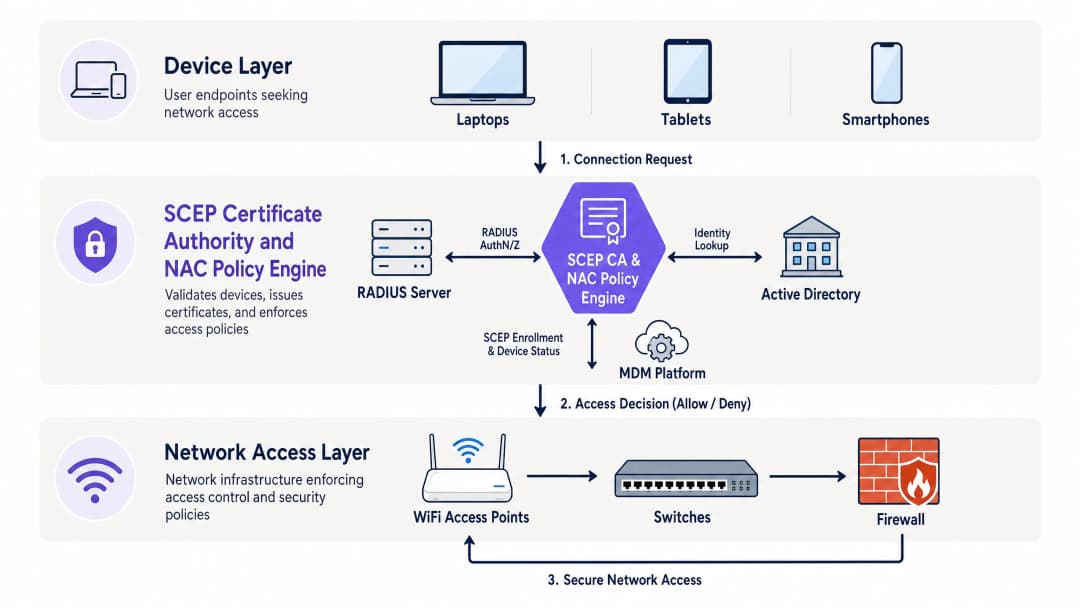
Modern network security relies on cryptographic identity rather than user knowledge. The SCEP-NAC-MDM stack operates across three principal layers:
| Layer | Components | Function |
|---|---|---|
| Device management | MDM / UEM | Central authority for device configuration, compliance, and lifecycle |
| Identity and issuance | PKI / SCEP / CA | Generates, issues, and manages digital certificates |
| Access enforcement | NAC / RADIUS | Evaluates certificates and device posture before granting network access |
These layers are not sequential - they operate in a continuous feedback loop. The MDM informs the NAC of compliance status in real time, while the NAC can trigger MDM remediation workflows when a device fails a posture check.
How SCEP Automates PKI at Scale
Manual certificate deployment is operationally impossible at scale. A 500-device estate would require an IT administrator to generate, sign, and install an individual X.509 certificate on every device - a process taking several minutes per device and introducing significant risk of human error. SCEP eliminates this entirely.
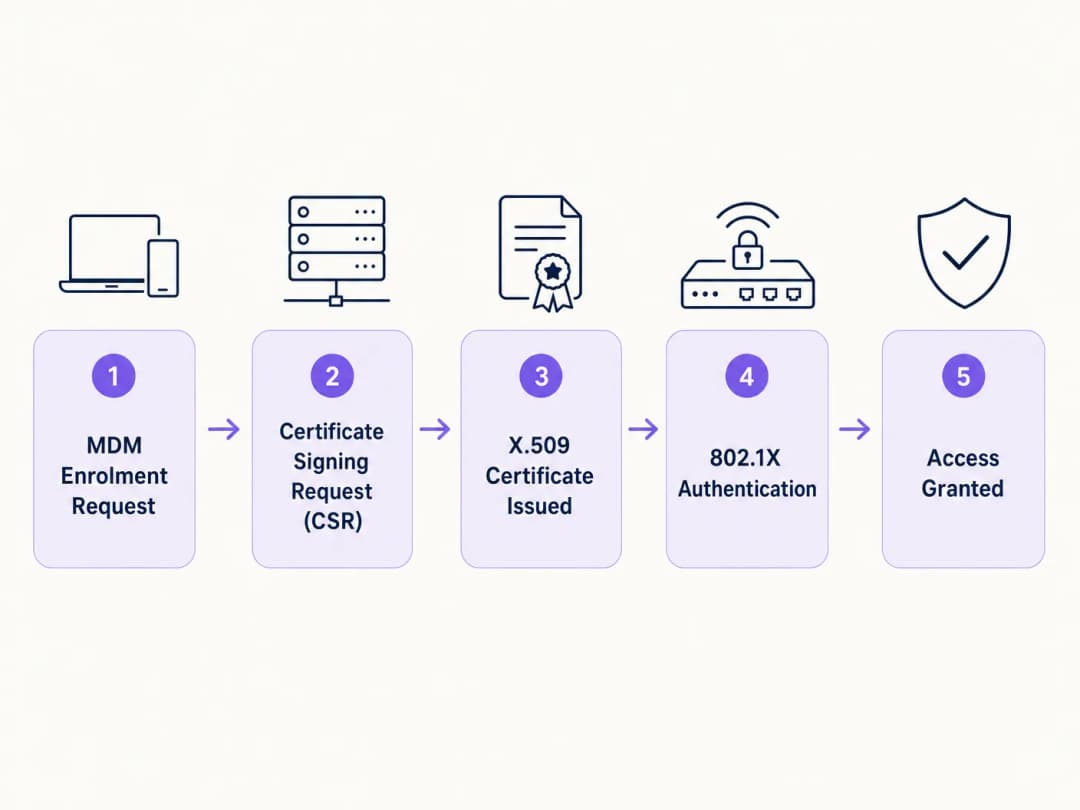
When a device enrolls in the MDM, the MDM pushes a configuration profile containing a SCEP payload. The payload instructs the device to generate a key pair locally - crucially, the private key never leaves the device - and submit a Certificate Signing Request (CSR) to the SCEP server. The SCEP server (typically Microsoft's Network Device Enrollment Service (NDES) or a cloud-based equivalent) validates the request against the MDM to confirm the device is authorized. It then forwards the CSR to the Certificate Authority (CA), which issues the signed X.509 certificate. The certificate is returned to the device and installed in its secure enclave or system keystore.
The entire process happens silently, over the air, with no user interaction. For a 1,000-device deployment, the full certificate estate can be provisioned within hours of MDM enrollment completing.
NAC and 802.1X EAP-TLS: The Enforcement Layer
Once a device holds a valid certificate, it attempts to connect to the corporate SSID or wired port using IEEE 802.1X. The access point or switch acts as the authenticator, forwarding the request to a RADIUS server governed by the NAC policy engine. The most secure EAP method is EAP-TLS, which requires mutual authentication - both the client and the RADIUS server must present valid certificates, preventing man-in-the-middle attacks via fraudulent access points. The NAC performs several critical checks in sequence:
- Cryptographic validation: Is the certificate mathematically valid and signed by a trusted root CA?
- Revocation checking: Is the certificate listed on a Certificate Revocation List (CRL) or flagged via the Online Certificate Status Protocol (OCSP)?
- Posture assessment: Querying the MDM via API, the NAC asks: Is the device compliant? Is the operating system at the required patch level? Is disk encryption enabled?
If all checks pass, the NAC sends a RADIUS Access-Accept message, typically carrying vendor-specific attributes (VSAs) that dynamically assign the device to a specific VLAN or apply access control lists (ACLs). Non-compliant devices are placed in a remediation VLAN with limited permissions - typically just enough to trigger MDM-driven remediation workflows.
Guest Network Segregation
In any venue environment, the corporate infrastructure must be strictly segregated from public-facing networks. The Guest WiFi platform operates entirely on separate SSIDs and VLANs, with no routed path to corporate resources. The SCEP-NAC architecture governs the corporate tier; the guest tier is controlled by captive portal authentication and data capture workflows. For venues deploying WiFi Analytics, this segregation is a prerequisite - analytics data flows through the guest network, while operational data flows through the certificate-authenticated corporate network. For further background on the underlying RF architecture supporting both networks, see WiFi Frequencies: A 2026 Guide to WiFi Frequencies.
Got questions about your specific setup?
Our team works with venue operators, IT managers, and network engineers across 80,000 venues. Book a 20-minute call and we will show you how others like you solved it.
Implementation Guide
Deploying this architecture requires careful sequencing to avoid locking legitimate users out during the transition.
Step 1: PKI and SCEP Preparation
Establish a robust internal PKI or leverage a cloud-based managed PKI (mPKI) service. Deploy and harden the SCEP server - if using Microsoft NDES, ensure it runs on a dedicated server rather than co-located with the CA. Configure the SCEP server to use dynamic challenge passwords generated per device by the MDM, rather than a static shared secret. This prevents unauthorized certificate requests if the SCEP URL is discovered.
Step 2: MDM Configuration
Create the SCEP payload in your MDM platform. Define the Subject Alternative Name (SAN) fields carefully - the SAN must contain unique identifiers (such as the device serial number or user UPN) that the NAC will use for policy decisions. Push the profile to a pilot group of IT team devices first, and validate the full enrollment flow before any wider rollout.
Step 3: NAC and RADIUS Setup
Configure your NAC to trust the root CA that issued the client certificates. Install a server certificate on the RADIUS server for EAP-TLS mutual authentication. Define access policies based on certificate attributes and MDM compliance status. Implement dynamic VLAN assignment rules: compliant corporate devices to the corporate VLAN, non-compliant devices to the remediation VLAN, and IoT devices to a dedicated, internet-restricted VLAN.
Step 4: Network Infrastructure Integration
Configure switches and wireless access points for 802.1X. For scenarios with legacy point-of-sale hardware in retail environments, or smart room controllers in hospitality venues, implement MAC Authentication Bypass (MAB) as a fallback for devices that cannot participate in EAP-TLS. Restrict MAB to specific switch ports and ensure the MAC address database is tightly controlled. For healthcare and transport environments, configure posture assessment rules to satisfy sector-specific compliance requirements.
Step 5: Parallel Rollout and Cutover
Never cut over immediately. Broadcast the new 802.1X SSID in parallel with the existing network. Push the new WiFi profile via the MDM. Monitor adoption and resolve enrollment failures. Once more than 95% of devices are authenticating successfully on the new SSID, decommission the legacy network.
Best Practices
Mandate EAP-TLS. Never accept EAP-PEAP or EAP-TTLS as the primary authentication method for corporate devices. These methods rely on username/password credentials inside a TLS tunnel and remain vulnerable to credential harvesting. EAP-TLS eliminates that attack surface entirely.
Implement real-time revocation. Scheduled CRL downloads create windows of exposure. Configure the NAC to perform OCSP checks in real time. When a device is reported lost or stolen, revoke the certificate at the CA and the device loses network access at its next authentication attempt - or immediately, if Change of Authorization (CoA) is implemented.
Set sensible certificate validity periods. A one-year validity period, with automated SCEP renewal triggered 30 days before expiration, is the industry standard. Longer validity increases the window of exposure if a certificate is compromised; shorter validity increases the risk of renewal failures causing outages.
Aggressively segregate IoT. IoT devices should never share a VLAN with corporate endpoints. Use the NAC to enforce strict ACLs on the IoT VLAN, permitting only the specific protocols and destinations each device class requires. For venues deploying location services, see Indoor WiFi Positioning Systems: How They Work and How to Deploy Them for how positioning infrastructure integrates with the broader network architecture.
Align with WPA3. Where hardware supports it, configure corporate SSIDs to use WPA3-Enterprise, which mandates Protected Management Frames (PMF) and provides stronger cryptographic protection than WPA2. For details on how this fits into the broader enterprise connectivity landscape, see SD-WAN vs MPLS: A 2026 Guide to Enterprise Networking.
Troubleshooting and Risk Mitigation
| Failure mode | Root cause | Mitigation |
|---|---|---|
| Devices fail EAP-TLS after certificate renewal | SCEP renewal failing silently | Monitor SCEP server logs; set alerts for failed CSR submissions |
| Certificate validation fails due to clock skew | NTP misconfiguration | Enforce NTP synchronization across all endpoints and infrastructure |
| IoT devices cannot authenticate | No 802.1X supplicant | Implement MAB with strict MAC address controls and an isolated VLAN |
| Mass device lockout after CA migration | Legacy root CA not trusted by NAC | Stage CA migrations; add the new root CA to the NAC trust store before revoking the old one |
| Revoked devices retain network access | CRL-only revocation with long download intervals | Implement OCSP and CoA for real-time revocation |
For specific BLE-based IoT devices, the authentication architecture differs from WiFi-connected endpoints. See BLE Low Energy Explained for the Enterprise for the specific security considerations that apply to Bluetooth Low Energy infrastructure.
ROI and Business Impact
The business case for SCEP-NAC-MDM integration is straightforward when measured against the cost of the alternatives.
| Metric | Before implementation | After implementation |
|---|---|---|
| IT service desk tickets (network access) | High - password resets, key rotations | Near zero - automated certificate lifecycle |
| Mean time to revoke a compromised device | Hours (manual process) | Seconds (OCSP + CoA) |
| PCI DSS access control compliance | Manual, audit-intensive | Automated, continuously enforced |
| BYOD onboarding time | 15-30 minutes per device | Under 5 minutes with zero IT involvement |
For a 500-device estate, eliminating manual certificate management and password-related service desk tickets typically reduces network-related IT support overhead by 25-35%. The risk mitigation value - avoiding a single credential-based breach - routinely exceeds the entire implementation cost. For public-sector and healthcare organizations bound by CCPA/CPRA, the ability to demonstrate automated, auditable access control is a significant compliance asset.
Key Definitions
SCEP (Simple Certificate Enrollment Protocol)
A protocol that automates the issuance and revocation of digital certificates to devices without user intervention, acting as the communication layer between the MDM platform and the Certificate Authority.
Used by MDM platforms to seamlessly deploy X.509 certificates to thousands of endpoints at scale. IT teams encounter SCEP when configuring MDM profiles for 802.1X WiFi authentication.
NAC (Network Access Control)
A security solution that enforces policy on devices seeking to access network infrastructure, evaluating authentication credentials, certificate validity, and device compliance posture before granting access.
Acts as the gatekeeper at the network edge. IT teams configure NAC policies to define which devices get access to which VLANs based on their certificate attributes and MDM compliance status.
MDM (Mobile Device Management)
Software used by IT departments to monitor, manage, and secure employees' endpoints across multiple operating systems, serving as the central source of truth for device identity and compliance.
The initiator of the SCEP enrollment process and the source of posture data queried by the NAC. Without MDM integration, the NAC cannot perform posture-based access control.
IEEE 802.1X
An IEEE standard for port-based Network Access Control that provides an authentication mechanism to devices wishing to attach to a LAN or WLAN, requiring successful authentication before the port is opened.
The underlying protocol that forces devices to authenticate before the switch or access point allows any traffic to pass. Configured on both the network infrastructure and the device's 802.1X supplicant.
EAP-TLS (Extensible Authentication Protocol - Transport Layer Security)
The most secure EAP standard, requiring mutual authentication where both the client device and the RADIUS server must present valid digital certificates, eliminating password-based credential attacks.
The gold standard for enterprise wireless security. IT architects should mandate EAP-TLS over PEAP or TTLS wherever device certificate infrastructure is in place.
CSR (Certificate Signing Request)
A block of encoded text generated by a device containing its public key and identity details, submitted to the Certificate Authority to request a signed X.509 certificate.
Generated automatically by the device during the SCEP enrollment process. The private key corresponding to the CSR never leaves the device, ensuring the certificate cannot be duplicated.
MAB (MAC Authentication Bypass)
A fallback authentication method where the network uses the device's hardware MAC address as its credential, used for devices that lack 802.1X supplicant capability.
Used for legacy IoT devices such as printers, sensors, and smart room controllers that cannot participate in EAP-TLS. Should always result in assignment to a highly restricted VLAN.
OCSP (Online Certificate Status Protocol)
An internet protocol used for obtaining the revocation status of an X.509 digital certificate in real-time, providing an alternative to downloading and parsing Certificate Revocation Lists.
Critical for NAC systems that need to immediately block network access when a device is compromised or reported stolen. OCSP provides real-time status; CRL downloads create a revocation window.
CoA (Change of Authorization)
A RADIUS extension (RFC 5176) that allows the NAC to dynamically modify or terminate an active network session without waiting for the session to expire or the device to re-authenticate.
Used to immediately disconnect a device when its certificate is revoked or its MDM compliance status changes. Essential for real-time zero-trust enforcement.
Worked Examples
A 500-room luxury resort needs to secure its back-of-house operations network. Staff use shared tablets for housekeeping management, and management use corporate laptops. The current WPA2-PSK network has had the pre-shared key leaked multiple times, resulting in two security incidents in the past year. How should the IT team transition to certificate-based authentication without disrupting operations?
Phase 1 - Preparation (Weeks 1 - 2): Deploy a cloud-based RADIUS/NAC solution and integrate it with the existing MDM. Configure a SCEP profile in the MDM to push device-based certificates to all tablets and laptops. Use device-based certificates (tied to the device serial number) rather than user-based certificates, so shared tablets authenticate automatically regardless of which staff member is using them. Phase 2 - Parallel Deployment (Weeks 3 - 4): Broadcast a new, hidden SSID configured for 802.1X EAP-TLS. Push the new WiFi profile via MDM to all enrolled devices. Monitor the NAC dashboard for successful authentications. Phase 3 - Cutover (Week 5): Once 95%+ of devices are connected to the new SSID, decommission the legacy WPA2-PSK network. Revoke the old PSK from all documentation and access points.
A national retail chain is deploying 3,000 new Point of Sale terminals across 150 stores. The security team mandates strict PCI-DSS network segmentation and zero-trust access. The deployment timeline is 8 weeks. How does SCEP and NAC facilitate this at scale without requiring IT staff at each store?
Pre-Deployment: The POS vendor pre-enrolls all 3,000 devices in the retailer's MDM using the vendor's zero-touch enrollment program. The MDM is configured with a SCEP profile that will fire automatically upon first boot. Deployment: When a POS terminal is powered on at the store, it connects to a temporary onboarding SSID (internet-only, no corporate access). The MDM profile is pushed, the SCEP payload fires, and the device requests and receives its X.509 certificate from the CA. The MDM then pushes the corporate WiFi profile. Network Access: When the POS connects to the store's switch port, the switch initiates 802.1X. The NAC validates the certificate, queries the MDM to confirm the POS is compliant (encryption enabled, MDM agent active, no jailbreak detected), and dynamically assigns the switch port to the PCI-DSS VLAN. The POS is now operational. Zero IT staff were required at the store.
Practice Questions
Q1. Your organization is migrating from WPA2-Enterprise using PEAP-MSCHAPv2 to EAP-TLS. During the pilot, Windows laptops and iPhones connect successfully, but 200 warehouse barcode scanners fail to authenticate. The scanners support 802.1X but cannot process the SCEP payload from the MDM - they run a proprietary embedded OS with no MDM agent support. What is the most secure architectural solution that maintains network segmentation without requiring replacement of the scanners?
Hint: Consider alternative certificate delivery mechanisms that do not require an MDM agent, and what network segmentation controls should apply to devices that cannot participate in full posture assessment.
View model answer
Since the scanners support 802.1X but not SCEP or MDM enrollment, the most secure approach is to manually provision device certificates using a dedicated certificate template with a restricted key usage profile. The certificates are installed once during a maintenance window. The NAC is configured to accept these certificates but assign the scanners to a dedicated warehouse operations VLAN with strict ACLs - not the full corporate VLAN - because posture assessment is not possible. Alternatively, if manual certificate provisioning is operationally unscalable, configure MAB as a fallback specifically for the MAC OUIs of the scanner hardware, with the NAC assigning them to the same restricted VLAN. Document this as a known exception in your risk register and schedule scanner replacement in the next hardware refresh cycle.
Q2. A network security manager notices that when an employee reports a laptop stolen, the MDM sends a remote wipe command, but the device remains connected to the corporate WiFi for up to 12 hours - the current RADIUS session timeout. During this window, the device could be used to exfiltrate data. How should the architecture be modified to terminate network access immediately upon a device being reported stolen?
Hint: The NAC needs to be informed of the status change instantly rather than waiting for the next authentication cycle. Consider both the session termination mechanism and the re-authentication prevention mechanism.
View model answer
Implement two complementary controls. First, configure the MDM to send a webhook to the NAC immediately upon a device being marked as lost or stolen. The NAC then sends a RADIUS Change of Authorization (CoA) Disconnect-Request message to the specific access point or switch port, terminating the active session immediately. Second, revoke the device's certificate in the CA and ensure the NAC is configured for real-time OCSP checking rather than CRL-based revocation. This means that even if the device reconnects before the CoA is processed, the EAP-TLS authentication will fail at the OCSP check. Both controls together reduce the exposure window from 12 hours to under 60 seconds.
Q3. During a security audit of a large conference center's network, it is discovered that the SCEP server is exposed to the public internet using a static challenge password to allow remote device enrollment. The auditor flags this as a critical vulnerability. How should the SCEP enrollment process be re-architected to maintain remote enrollment capability while eliminating the static password risk?
Hint: The SCEP server needs a way to verify that the device requesting a certificate is actually authorized by the MDM, without relying on a shared secret that could be extracted from a device or intercepted.
View model answer
Replace the static challenge password with dynamic, per-device one-time challenge passwords generated by the MDM. The workflow becomes: (1) The MDM generates a unique, time-limited challenge password for each device during enrollment. (2) The MDM includes this challenge in the SCEP payload pushed to the device. (3) The device includes the challenge in its CSR. (4) The SCEP server validates the challenge against the MDM via API before forwarding the CSR to the CA. (5) The challenge is invalidated immediately after use. This ensures that only MDM-managed devices can successfully obtain a certificate, and that even if the SCEP URL is discovered, an attacker cannot generate valid certificates without a valid one-time challenge. Additionally, restrict the SCEP server to HTTPS only and implement IP allowlisting for the MDM's egress IPs where possible.
Continue reading in this series
PPSK wpa3: comparing features and deployment models
This technical reference guide compares PPSK and WPA3-SAE, explaining their architectural differences and deployment models for multi-tenant environments. It provides actionable guidance for IT managers and property developers on achieving secure, isolated WiFi networks using Purple's identity-based solutions.
Managing Bandwidth for Staff WiFi: Shaping, QoS and Reducing Traffic
This guide details practical methods for managing bandwidth for staff WiFi in enterprise venues. It covers traffic shaping, QoS implementation, and how deploying Purple Shield reduces network load without requiring infrastructure upgrades.
How to Reduce the Number of WiFi SSIDs Using Per-Device PSK (iPSK, DPSK, MPSK)
This authoritative technical reference guide explains how IT teams can eliminate WiFi performance degradation caused by SSID beacon overhead by collapsing multiple purpose-built networks into a single SSID using per-device PSK (xPSK). It covers the vendor landscape across Cisco iPSK, HPE Aruba MPSK, Ruckus DPSK, Juniper Mist PPSK, and Ubiquiti UniFi PPSK, with practical implementation guidance on dynamic VLAN assignment, IoT onboarding, and PCI DSS compliance. Venue operators in hospitality, retail, stadiums, and public-sector organisations will find actionable architecture guidance and real-world worked examples.
Got questions about your specific setup?
Our team works with venue operators, IT managers, and network engineers across 80,000 venues. Book a 20-minute call and we will show you how others like you solved it.