
How to Improve Customer Experience in Hotels Using WiFi
This guide provides IT leaders and venue operators with a technical blueprint for transforming hotel WiFi from a basic amenity into an active engagement channel. It covers the architecture, PMS integrations, and deployment strategies required to deliver personalised guest experiences, drive room upgrades, and increase loyalty programme acquisition. From captive portal design and GDPR compliance to presence analytics and post-stay survey automation, this is the definitive operational reference for hospitality IT teams.
Listen to this guide
View podcast transcript
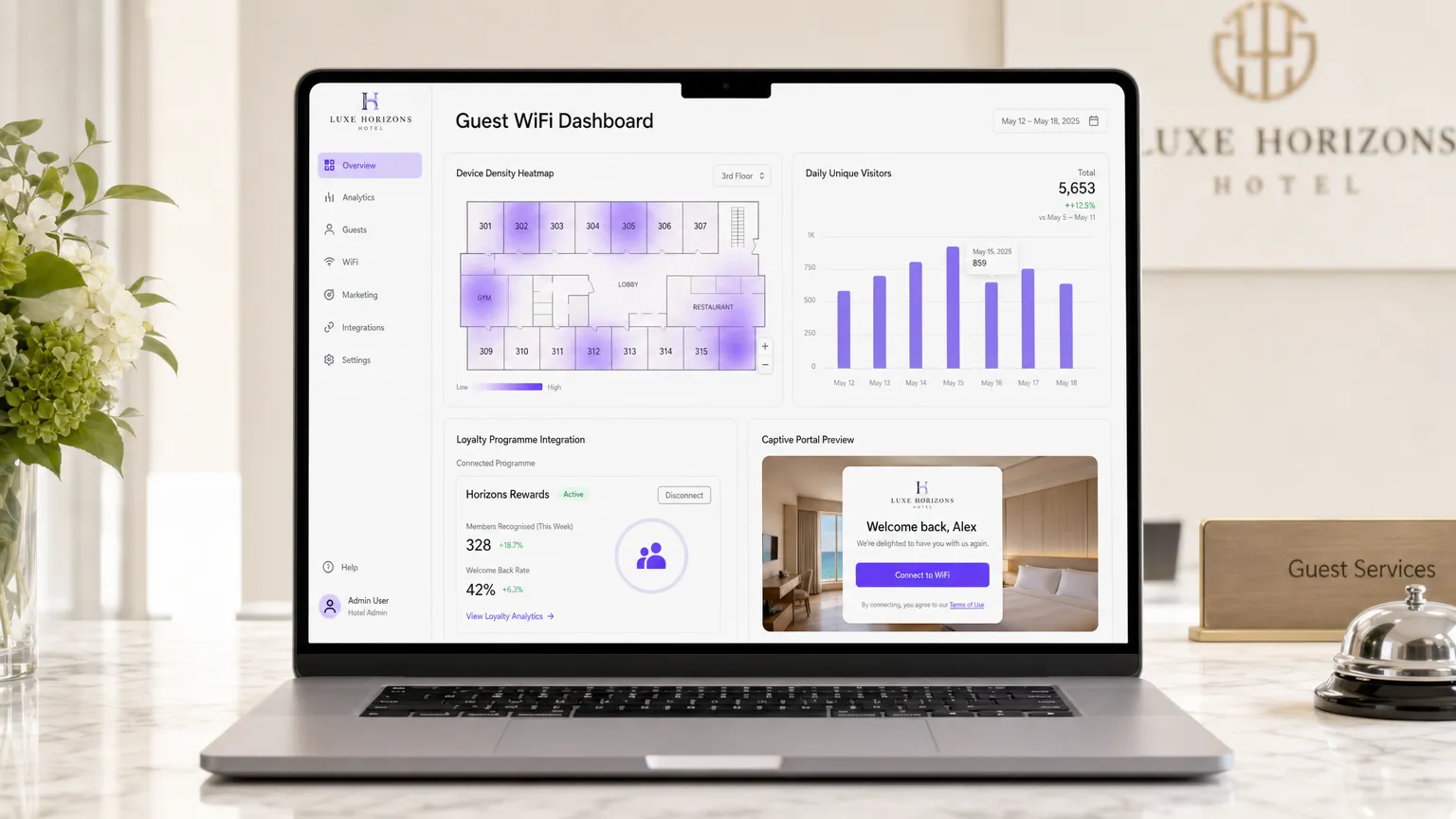
执行摘要
对于现代酒店运营而言,客人WiFi已从一项基本便利设施演变为推动收入、忠诚度和运营效率的关键基础设施层。本指南详细介绍了如何通过WiFi提升酒店客户体验,将被动连接转变为主动互动渠道。我们探讨了实现个性化欢迎、定向客房升级、无缝忠诚度计划整合以及自动化离店调查所需的技术架构。
通过利用像 Purple 这样的企业级平台,IT领导者可以超越简单的带宽提供,交付可衡量的商业价值。本参考涵盖了部署考虑因素、集成模式以及实施满足当今互联旅行者需求的稳健 Guest WiFi 和 WiFi Analytics 解决方案所必需的安全标准,同时确保遵守包括GDPR和PCI DSS在内的全球数据保护法规。
技术深潜:个性化架构
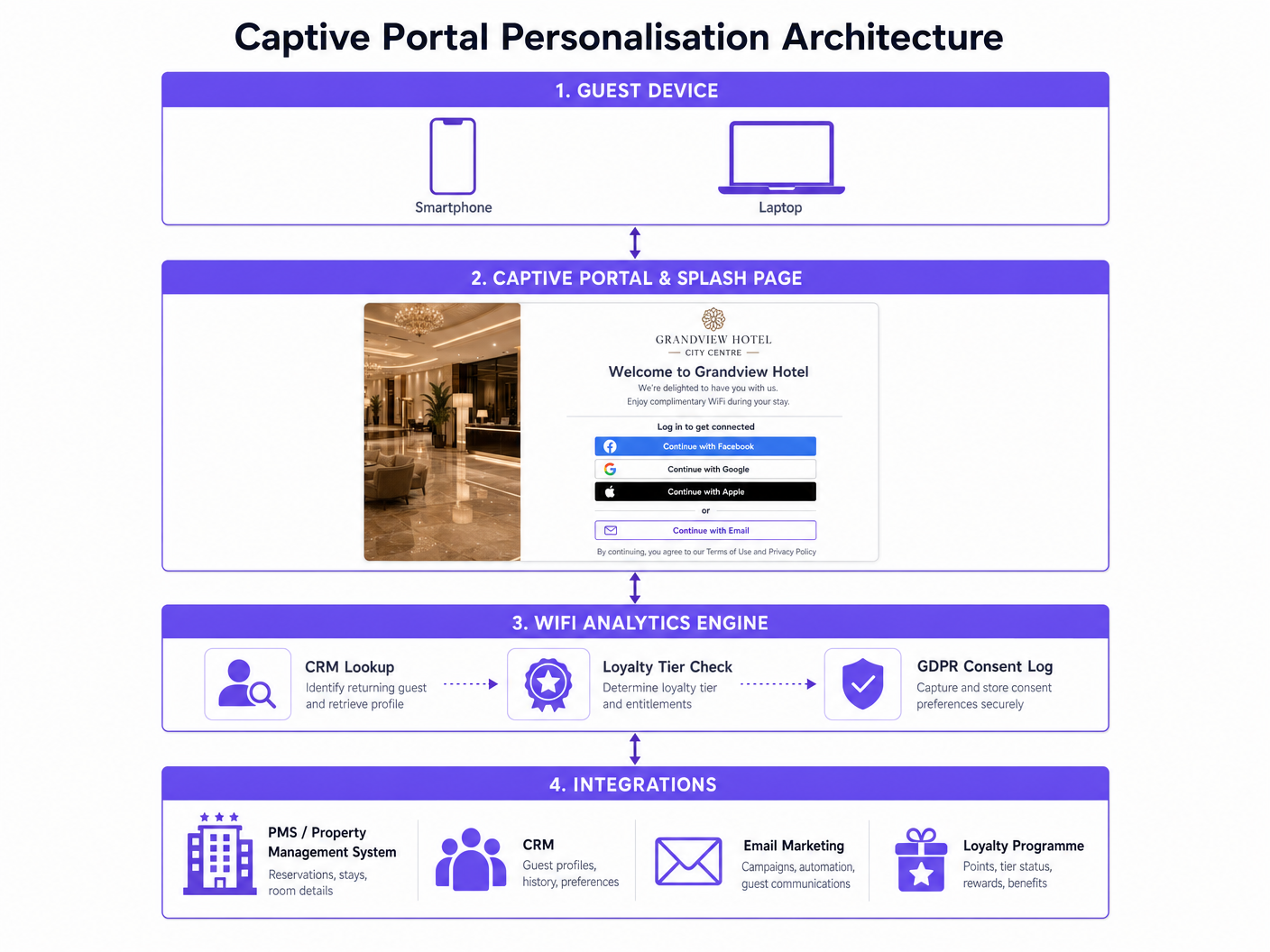
要实现有意义的个性化,WiFi基础设施必须与酒店更广泛的技术栈无缝集成,特别是物业管理系统(PMS)和客户关系管理(CRM)平台。本节将介绍核心架构组件及其协同工作方式。
Captive Portal作为身份层
Captive Portal作为主要的身份验证和数据获取机制。现代部署不再使用通用的预共享密钥(PSK),而是利用复杂的启动页面,支持多种身份验证方式,包括社交登录(通过Google、Facebook或Apple的OAuth 2.0)、电子邮件注册以及直接的忠诚度计划凭证认证。该层负责识别用户、根据GDPR第7条获取必要同意,并将身份上下文传递给下游的分析引擎。
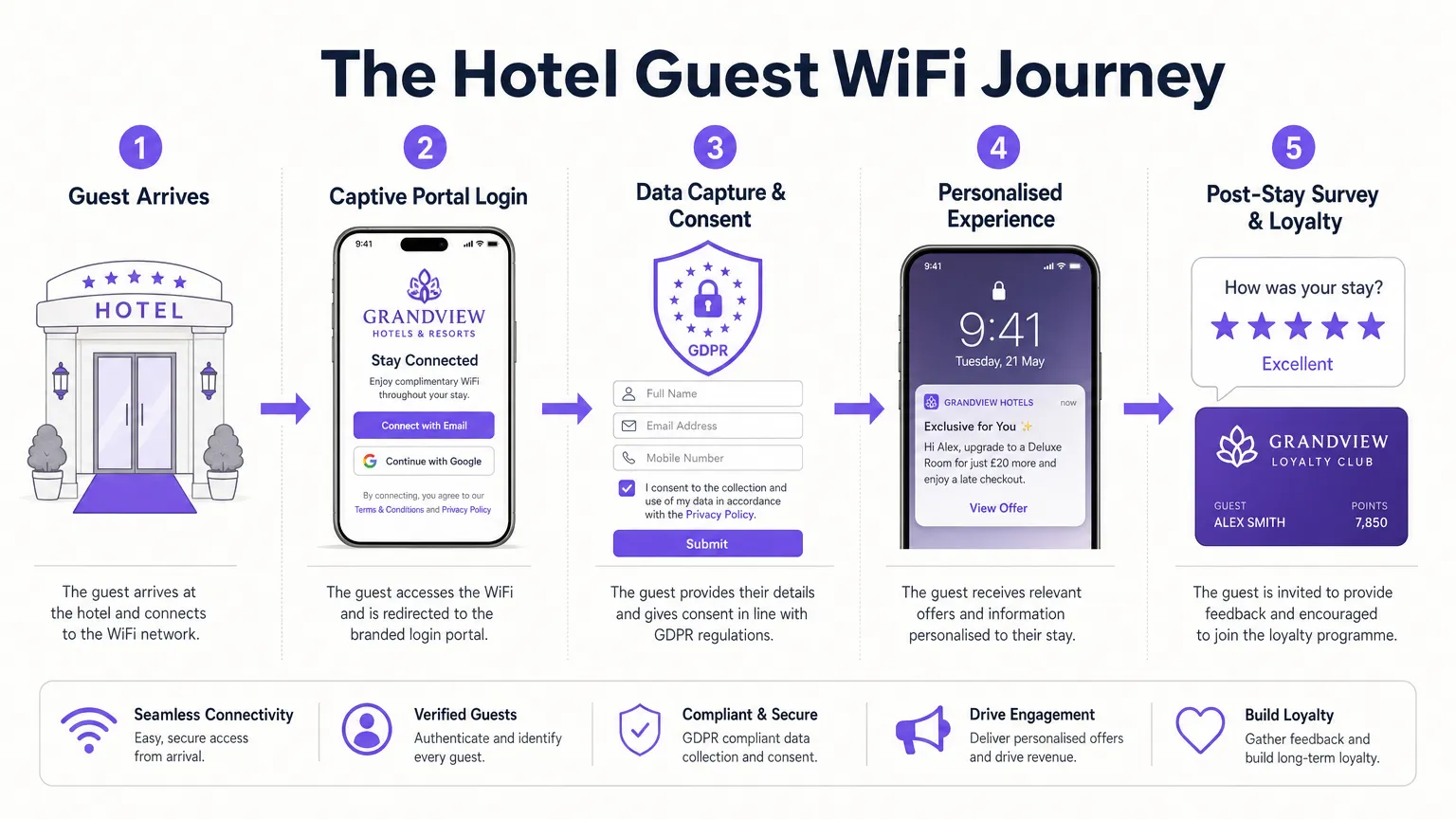
SSID架构应设计为关注点分离。一个面向客人的SSID将所有未认证流量通过DNS拦截路由至captive portal控制器。必须细致维护围墙花园配置,以在客人完成登录流程之前,允许访问所有必需的外部域——社交登录提供商、CDN托管的portal资产以及任何第三方认证服务。未能维护围墙花园是生产部署中captive portal故障的最常见原因。
与物业管理系统的集成
WiFi Analytics 平台的真正价值在于与PMS集成后得以释放。当客人连接时,系统可以使用其认证身份(电子邮件或忠诚度编号)查询PMS,实时获取其当前预订状态、房间号和忠诚度等级。这种数据交换使得captive portal能够动态呈现个性化内容:以姓名问候客人的欢迎信息、当前忠诚度积分余额,或与当前预订相关的定向升级优惠。
集成通常通过在成功认证时触发从WiFi分析平台到PMS的REST API调用来实现。然后,PMS响应载荷用于填充动态模板引擎,该引擎呈现相应的启动页面变体。此API调用的延迟是一个关键的绩效考虑因素;调用必须在几百毫秒内完成,以避免降低用户体验。
存在分析与空间智能
一旦认证通过,分析引擎便开始处理存在数据。通过分析来自多个接入点的信号强度(RSSI),系统可以确定在场馆内的停留时间和移动模式。对于理解客人如何利用酒店设施——从大堂到餐厅再到水疗中心——这种空间智能至关重要。Purple作为Connect许可下OpenRoaming等服务的免费身份提供商,进一步简化了这一过程,允许回头客在不同物业之间安全、自动地登录,无需重新认证。
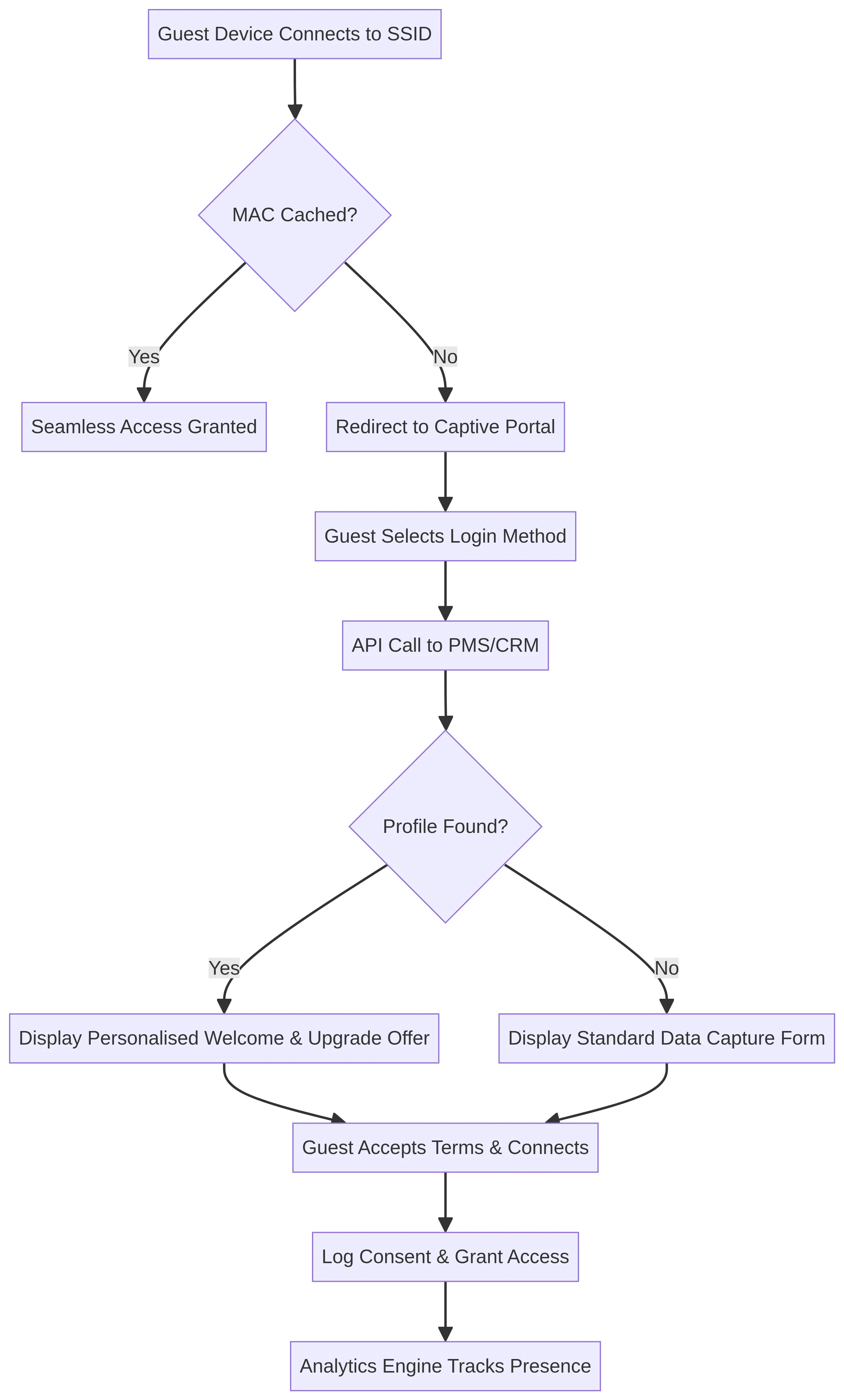
下面的图表展示了认证与个性化决策流程:
实施指南:分步部署
部署全面的WiFi互动解决方案需要IT、营销和运营团队之间的周密规划和协调。以下阶段提供了一个结构化的部署路线图。
第一阶段:基础设施就绪与网络架构
在实施captive portal之前,确保底层无线基础设施能够支持预期的设备密度和吞吐量要求。
| 考虑因素 | 建议 | 标准 |
|---|---|---|
| SSID策略 | 使用captive portal的单一客人SSID;使用802.1X的独立公司SSID | IEEE 802.11i |
| 网络分段 | 专用VLAN用于客人流量,与公司网络和POS网络隔离 | PCI DSS要求1 |
| AP密度 | 进行射频站点调查;整个场馆目标最低RSSI为-65 dBm | IEEE 802.11k/v/r |
| 安全协议 | 在设备兼容性允许的情况下,对客人SSID使用WPA3-SAE | IEEE 802.11ax |
| 吞吐量基线 | 高密度区域每台并发设备最低5 Mbps | 厂商中立的最佳实践 |
确保客人流量通过专用VLAN与公司网络和运营网络严格隔离。这不仅仅是最佳实践;如果任何支付系统在同一物理基础设施上运行,根据PCI DSS这是强制性控制。
第二阶段:Captive Portal配置与品牌化
Captive portal往往是客人在现场体验的第一个数字触点。其设计和性能直接影响客人对酒店品牌的感知。
配置认证选项以平衡摩擦与数据获取。电子邮件和社交登录是标准配置,但集成直接忠诚度计划认证可提供最高价值的身份数据。实施动态内容规则,根据回头客与新客状态、一天中的时间或特定场馆位置等变量显示不同的启动页面。例如,在水疗中心连接的客人应看到与大堂连接的客人不同的欢迎体验。
所有数据获取必须遵守GDPR。为营销传播实施清晰、细粒度的选择加入复选框,并确保同意日志写入防篡改审计轨迹。处理的法律依据应在启动页面上明确说明。
第三阶段:PMS与CRM集成
这是实现个性化欢迎和客房升级交付的最关键步骤。
在WiFi平台与PMS和CRM之间建立安全的API连接。定义captive portal中的字段如何映射到CRM中的客户档案,并设置自动化触发器。例如,如果客人认证并且PMS确认他们入住在标准客房且套房有可用库存,则触发captive portal插页广告,提供付费升级。该优惠应附带明确的行动号召和限时激励,以促进转化。
第四阶段:离店调查自动化
配置分析平台以监控客人存在状态。当客人的设备在指定的时间段内(通常为12-24小时,表示退房)未在网络中出现时,触发一个webhook到电子邮件营销平台。此webhook会触发离店NPS或CSAT调查邮件,确保在体验仍然新鲜时发送,从而最大化回复率。
酒店WiFi部署的最佳实践
以下建议反映了面向 酒店业 WiFi部署的行业标准方法,并适用于包括 零售 、 医疗 和 交通 在内的多种场馆类型。
优先考虑回头客的无摩擦登录。 利用MAC地址缓存或像Passpoint (Hotspot 2.0 / IEEE 802.11u)这样的标准,自动认证回头客,无需他们重新输入凭据。住三晚的客人应该只遇到一次captive portal。
负责任地利用基于位置的分析。 存在分析数据功能强大,但必须谨慎处理。确保您的数据保留政策明确规定,并确保客人在captive portal链接的隐私政策中被告知存在跟踪。
自动化离店互动。 不要依赖手动PMS导出触发调查邮件。使用网络存在数据作为触发器,以确保及时性和准确性。
确保任何支付流程符合PCI DSS。 如果captive portal处理高级带宽层或升级购买的支付,整个支付流程必须符合PCI DSS。使用来自认证支付网关的代币化托管支付页面,而不是在自己的基础设施上处理卡数据。
将WiFi与忠诚度策略对齐。 允许客人使用其忠诚度凭据认证WiFi。这在物业数字行为与忠诚度档案之间建立了直接、持久的联系,从而在未来的住宿中实现更丰富的个性化。
有关企业网络演进的更多背景信息,请参见 酒店WiFi:酒店经营者完整指南 和 WiFi para Hoteles: La Guía Completa para Hoteleros 。
故障排除与风险缓解
Captive Portal未呈现
症状: 客人连接到SSID但启动页面未出现,或显示异常。
根本原因: 最常见的原因是围墙花园配置错误、DNS拦截失败,或设备级安全功能阻止了触发portal的HTTP重定向。
缓解措施: 定期审计围墙花园,确保所有必需的域都列入白名单。培训前台工作人员引导客人通过导航到非HTTPS URL手动触发portal。通过分析仪表板监控portal呈现成功率,并为异常下降设置警报。
营销选择加入率低
症状: WiFi连接率高,但可操作的电子邮件地址或营销同意获取率低。
根本原因: 选择加入的价值主张不明确,或者表格太长且繁琐。
缓解措施: 实施渐进式画像。为基本访问提供无摩擦的一键社交登录,然后提供明确的价值交换——更高的带宽、免费饮品或即时忠诚度积分——以换取完成扩展档案。
不准确的存在分析
症状: 热力图显示不稳定或不合逻辑的客人移动模式,与实际观察不符。
根本原因: AP密度不足、AP位置不佳、区域间射频信号泄漏,或分析平台缺乏校准。
缓解措施: 定期进行射频站点调查。确保AP的部署密度既满足覆盖需求,也满足位置分析需求。使用准确的平面图和物理比例测量校准分析平台。
MAC随机化影响客人识别
症状: 系统未能识别回头客,导致已知忠诚会员获得通用的portal体验。
根本原因: 现代iOS和Android设备使用按网络随机的MAC地址,这些地址可能在访问之间变化。
缓解措施: 将识别策略从硬件层(MAC地址)转移到身份层。要求客人在captive portal使用持久标识符(电子邮件或忠诚度编号)进行认证。将此身份存储在CRM中,并将其用作所有个性化逻辑的主键。
投资回报率与业务影响
实施复杂的WiFi分析平台将成本中心转变为创收资产。业务影响可以从多个维度衡量。
| 指标 | 典型基准 | 使用WiFi Analytics平台 | 提升 |
|---|---|---|---|
| 忠诚度计划注册率 | 5-8%的客人(前台) | 20-35%的连接客人 | 3-4倍提升 |
| 房间升级转化率 | 2-3%(前台加售) | 8-15%(定向portal优惠) | 3-5倍提升 |
| 离店调查回复率 | 8-12%(延迟邮件) | 25-40%(数小时内触发) | 2-3倍提升 |
| 客人满意度评分(NPS) | 基准 | +10-15个NPS点 | 可衡量的提升 |
这些数字具有指示性,会因物业类型、客人人口统计特征以及所实施的个性化逻辑质量而异。投资回报率的关键驱动因素是PMS与CRM集成的质量;一个集成不佳、无法区分回头客和新客的系统将产生显著更低的回报。
有关企业WiFi投资回报率和部署考虑因素的更多背景信息,请参见 什么是专线?专用商业互联网 和 汽车中的Wi-Fi:2026年企业完整指南 。
Key Definitions
Captive Portal
A web page that a user of a public-access network is obliged to view and interact with before full internet access is granted. Implemented via DNS interception or HTTP redirect at the network layer.
This is the primary mechanism for IT to enforce terms of service, capture guest identity data, present targeted marketing messages, and log GDPR consent. Its design and performance directly impact the guest's first digital impression of the hotel.
Walled Garden
A network access control mechanism that restricts unauthenticated users to a limited set of pre-approved domains before they complete the captive portal authentication flow.
Crucial for allowing devices to reach social login providers (Google, Facebook, Apple) and CDN-hosted portal assets before the guest has authenticated. Misconfiguration is the most common cause of captive portal failures in production.
MAC Randomization
A privacy feature in modern operating systems (iOS 14+, Android 10+) that generates a unique, randomised MAC address for each WiFi network a device connects to, preventing long-term cross-session device tracking.
IT teams must design authentication flows that rely on captured identity (email or loyalty ID) rather than persistent MAC addresses for long-term guest profiling and recognition.
Passpoint / Hotspot 2.0
An IEEE 802.11u-based standard that enables devices to automatically and securely connect to WiFi networks using pre-provisioned credentials, without requiring manual interaction with a captive portal.
Used to provide a seamless, cellular-like roaming experience for returning guests or loyalty members, eliminating captive portal friction on subsequent visits and across multiple properties.
Property Management System (PMS)
The core software application used by hotels to manage reservations, room assignments, check-in and check-out, billing, and guest profiles. Common platforms include Oracle OPERA, Mews, and Cloudbeds.
Integrating the WiFi analytics platform with the PMS via REST API is essential for enabling real-time, personalised captive portal experiences based on live reservation data, loyalty tier, and room type.
Presence Analytics
The use of WiFi infrastructure to detect the location and movement of wireless devices within a physical space by analysing RSSI (Received Signal Strength Indicator) data from multiple access points. Provides metrics including dwell time, footfall, and zone-to-zone movement.
Provides venue operations directors with actionable data on how guests use hotel facilities, informing staffing decisions, space layout optimisation, and the timing of targeted marketing communications.
VLAN Segmentation
The practice of dividing a single physical network into multiple logical networks (Virtual Local Area Networks) to isolate traffic flows and enforce access control policies at the network layer.
A mandatory security control to ensure that guest WiFi traffic is completely isolated from corporate systems, payment card networks, and operational infrastructure. Required under PCI DSS Requirement 1 for any environment where payment systems share physical network infrastructure.
OpenRoaming
A Wireless Broadband Alliance (WBA) federation standard that enables devices to automatically and securely connect to participating WiFi networks using a single identity credential, providing a seamless roaming experience across venues and operators.
Purple's role as a free identity provider for OpenRoaming under the Connect license simplifies connectivity for guests, reducing login friction across multiple properties or participating venues. Particularly valuable for frequent business travellers.
Progressive Profiling
A data capture strategy that collects guest information incrementally across multiple interactions, rather than requiring all data fields to be completed in a single form submission.
Resolves the tension between marketing's desire for rich guest data and operations' requirement for frictionless onboarding. Guests provide basic information on first connection and are incentivised to provide additional data over time in exchange for tangible benefits.
Worked Examples
A 300-room business hotel wants to increase sign-ups for its new loyalty programme. Currently, guests connect via a generic PSK and front desk staff are struggling to meet sign-up targets during busy check-in periods. The hotel's CRM is Salesforce and the PMS is Oracle OPERA.
- Replace the PSK with an open SSID and deploy a captive portal via Purple's Guest WiFi platform.
- Configure the captive portal to offer tiered bandwidth: basic speed (5 Mbps) for email login, and premium high-speed access (25 Mbps) in exchange for joining the loyalty programme directly on the splash page.
- Integrate the WiFi platform's API with Salesforce CRM to automatically provision the new loyalty account and send a welcome email with the guest's points balance instantly upon sign-up.
- Configure a secondary trigger: if the guest's email is already in Salesforce (returning guest), skip the sign-up form and present a personalised welcome with their current points balance instead.
- Monitor conversion rates via the WiFi analytics dashboard and A/B test different value propositions (bandwidth vs. F&B voucher) to optimise the sign-up rate.
A luxury resort with 5 properties wants to send automated post-stay NPS surveys. Their current process relies on manual daily exports from the PMS, resulting in surveys arriving 3-4 days after checkout. Response rates are below 8%. They want to achieve a 25%+ response rate.
- Deploy a WiFi analytics platform that tracks guest presence via device association with access points across all 5 properties.
- Configure a 'Checkout Trigger' within the analytics engine: when a guest's device is not seen on the network for 18 hours (a threshold calibrated to avoid false triggers from guests who leave the property during the day), the system flags the profile as 'checked out'.
- Use a webhook to automatically push this event to the email marketing platform (e.g., Mailchimp or Braze), triggering the NPS survey email within 2-4 hours of the inferred departure.
- Personalise the survey email with the guest's name, property name, and stay dates pulled from the CRM.
- Set up a dashboard to monitor response rates per property and per survey trigger delay, allowing ongoing optimisation of the trigger threshold.
Practice Questions
Q1. You are deploying a new captive portal for a hotel chain with 10 properties. The marketing team wants to include a 10-field form to capture extensive guest data at every login, while the operations team wants a frictionless 1-click login to minimise complaints. How do you architect a solution that satisfies both requirements without compromising either goal?
Hint: Consider progressive profiling and the value exchange principle. Think about what the guest receives in return for each piece of data they provide.
View model answer
Implement progressive profiling with tiered access. Configure the captive portal to offer a frictionless one-click social login (Google or Apple) or simple email capture for basic, time-limited WiFi access at standard speed. Present a separate, optional 'Complete Your Profile' screen offering a clear value exchange — premium bandwidth tier, a complimentary F&B voucher, or immediate loyalty points — in return for completing the extended 10-field profile. This approach captures the data marketing needs from motivated guests without creating friction for every single connection. Track completion rates per field to identify and remove low-value data points that reduce conversion.
Q2. During a pilot deployment at a 250-room hotel, the analytics engine reports that guests are spending an average of 4 hours in the lobby, which contradicts physical observations by the operations team who estimate average lobby dwell time at under 30 minutes. What is the most likely technical cause and how do you resolve it?
Hint: Think about how devices behave when not actively in use, how the system defines 'presence', and what happens to device associations when guests move to their rooms.
View model answer
The most likely cause is RF signal bleed from the lobby access points into adjacent guest rooms, combined with an overly generous 'last seen' timeout in the analytics platform. Devices in rooms directly above or adjacent to the lobby are associating with lobby APs due to stronger signal strength, and the analytics platform is attributing their presence to the lobby zone. To resolve this: first, reduce the transmit power of lobby APs to limit signal bleed into upper floors; second, ensure guest room APs are deployed with sufficient density so devices prefer them over lobby APs; third, calibrate the analytics platform's zone boundary RSSI thresholds using physical floor plan data; and fourth, reduce the 'last seen' timeout to a value that reflects realistic lobby dwell patterns (e.g., 15 minutes).
Q3. A hotel wants to deliver a 'Welcome Back' personalised message to returning guests on the captive portal. After deployment, the system fails to recognise approximately 65% of guests who have stayed before and have profiles in the CRM. The hotel's IT team suspects MAC randomisation is the cause. How do you architect a permanent solution that resolves this without requiring hardware changes?
Hint: If the hardware identifier is unreliable between sessions, what other identifier can serve as a persistent anchor? Consider the authentication flow and what the guest already knows.
View model answer
Shift the identification strategy entirely from the hardware layer (MAC address) to the identity layer. The solution has two components. First, on the captive portal, require guests to authenticate using a persistent identifier — email address or loyalty programme number — rather than relying on MAC address recognition for returning guest detection. Second, configure the WiFi platform to perform a CRM lookup using the authenticated email or loyalty number at the point of login. If a matching profile is found, serve the personalised 'Welcome Back' experience regardless of the device's MAC address. The MAC address should be retained only as a session-level identifier for the duration of the current stay (for MAC caching to avoid re-authentication during the stay), not as a long-term identity anchor. This architectural change also resolves the issue for guests who use multiple devices during their stay.