
Mitigating Rogue Access Points on Enterprise Networks
This technical reference guide details the architecture, deployment, and operational procedures for mitigating rogue access points on enterprise networks using Wireless Intrusion Prevention Systems (WIPS) and Wireless Intrusion Detection Systems (WIDS). It provides actionable frameworks for IT security administrators to detect, classify, and neutralise unauthorised APs across complex physical environments including hospitality, retail, healthcare, and public-sector venues. The guide covers threat classification, automated containment mechanisms, compliance implications (PCI DSS, GDPR, HIPAA), and measurable business outcomes.
Listen to this guide
View podcast transcript
执行摘要
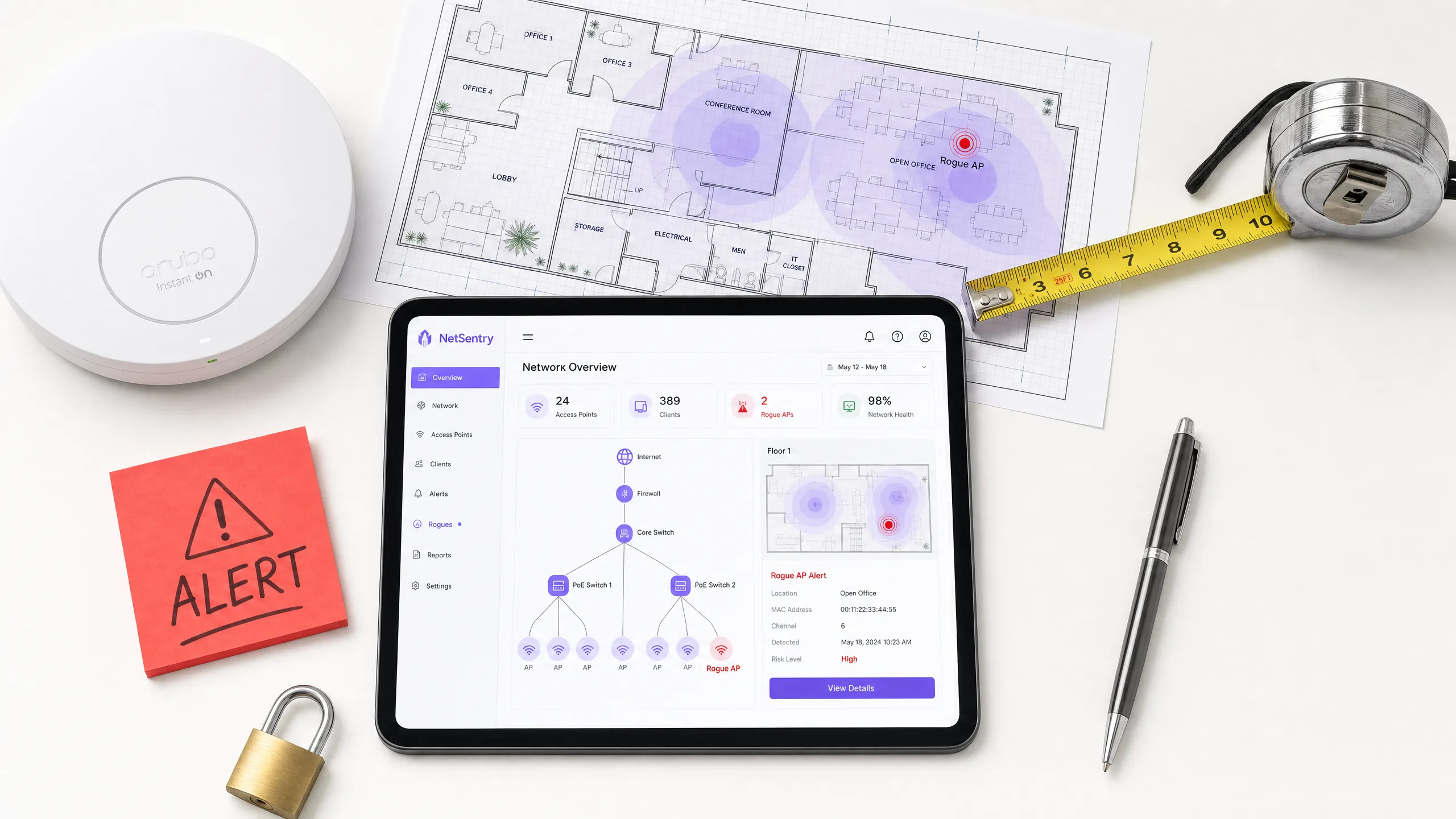
对于跨越分布式环境的企业网络—— 零售业 足迹、 酒店业 场所、 医疗保健 设施和 交通 枢纽——非法接入点是最被低估的数据泄露、合规违规和网络中断的载体之一。非法AP是任何连接到企业网络但未经授权的无线接入点,实际上绕过了边缘安全控制,创建了一个通往内部LAN的未管理桥梁。
缓解这一威胁需要从被动、定期扫描过渡到持续、自动化的无线入侵防御系统(WIPS)。本指南详细介绍了检测、分类和消除未经授权AP所需的技术架构,重点关注将WIPS与现有交换基础设施和 访客WiFi 部署相集成。我们涵盖了部署拓扑、自动遏制机制(包括定向解除认证和有线端口抑制)以及成熟的无线安全态势带来的直接业务影响。
技术深度剖析:WIPS架构和威胁向量
非法AP威胁剖析
并非所有未经授权的无线设备都带来同等风险。IT团队必须区分良性干扰和主动威胁,以防止警报疲劳和意外自动遏制合法邻近网络——这在大多数司法管辖区都是法律风险。
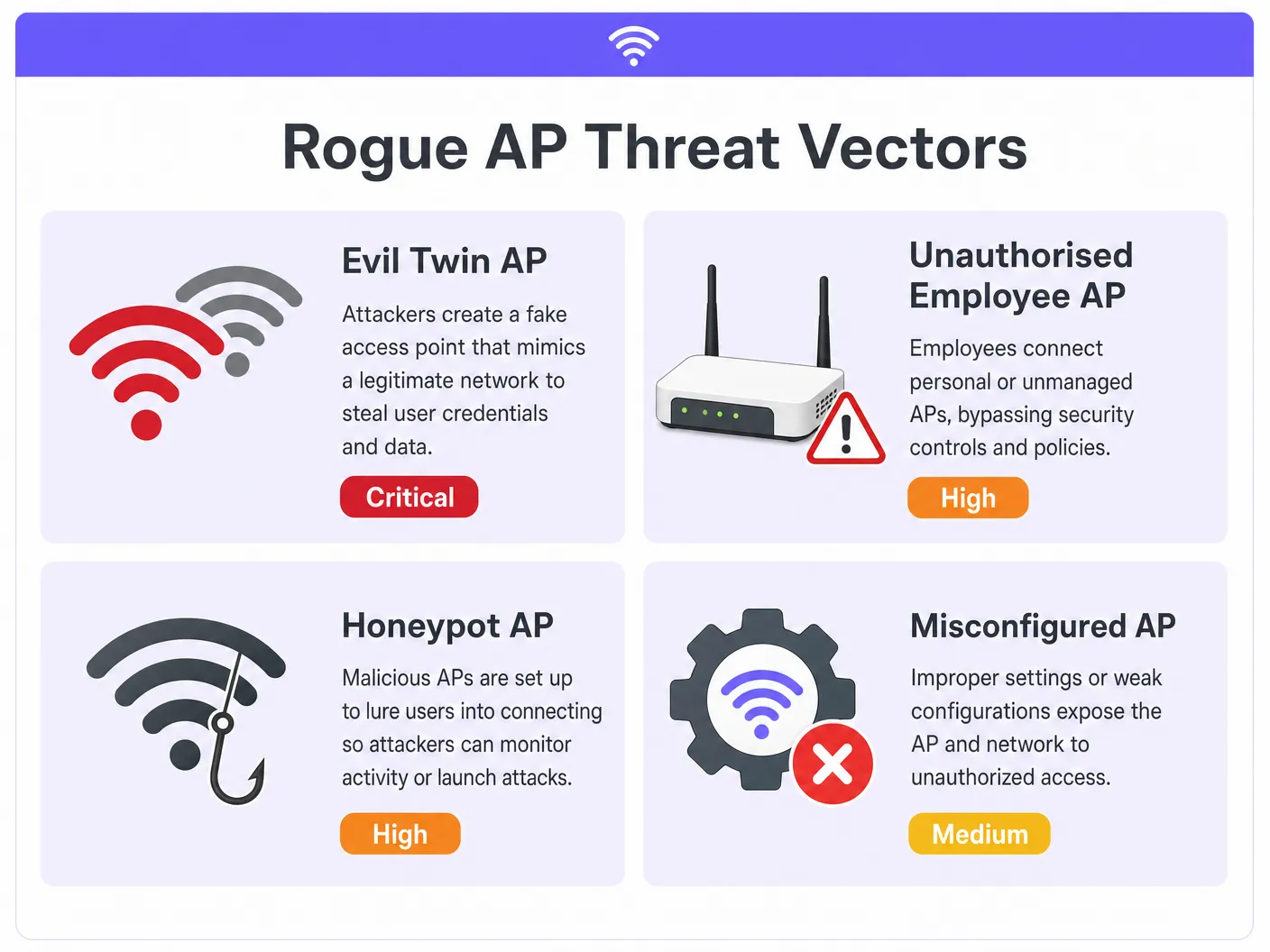
真正的非法AP(内部桥接): 物理连接到企业LAN的未经授权AP。这通常是员工为了获得更好的覆盖或绕过限制性代理设置,无意中将内部网络暴露给RF范围内的任何人。该设备直接将无线流量桥接到有线LAN上,完全绕过防火墙。
Evil Twin(外部欺骗): 攻击者在物理边界外设置AP,但广播企业SSID(例如,“Corp-WiFi”),信号更强,迫使客户端设备关联恶意AP,从而实现中间人(MitM)攻击。凭据、会话令牌和未加密数据全部暴露。
蜜罐AP: 类似于Evil Twin,但针对 访客WiFi 用户,广播常见的开放式SSID,如“Free Public WiFi”或模仿场所的访客网络。在 酒店业 和零售环境中尤为普遍。
配置错误的企业AP: 合法的企业AP由于配置失败、固件回滚或未经授权的本地配置更改而丢失了其安全配置——例如,从具有802.1X认证的WPA3-Enterprise降为开放式SSID。
WIPS传感器覆盖架构
有效的缓解依赖于在所有运行频段上进行持续的频谱分析。现代WIPS部署采用专用传感器AP或现有基础设施AP在专用监控模式或时分(后台扫描)模式下运行。
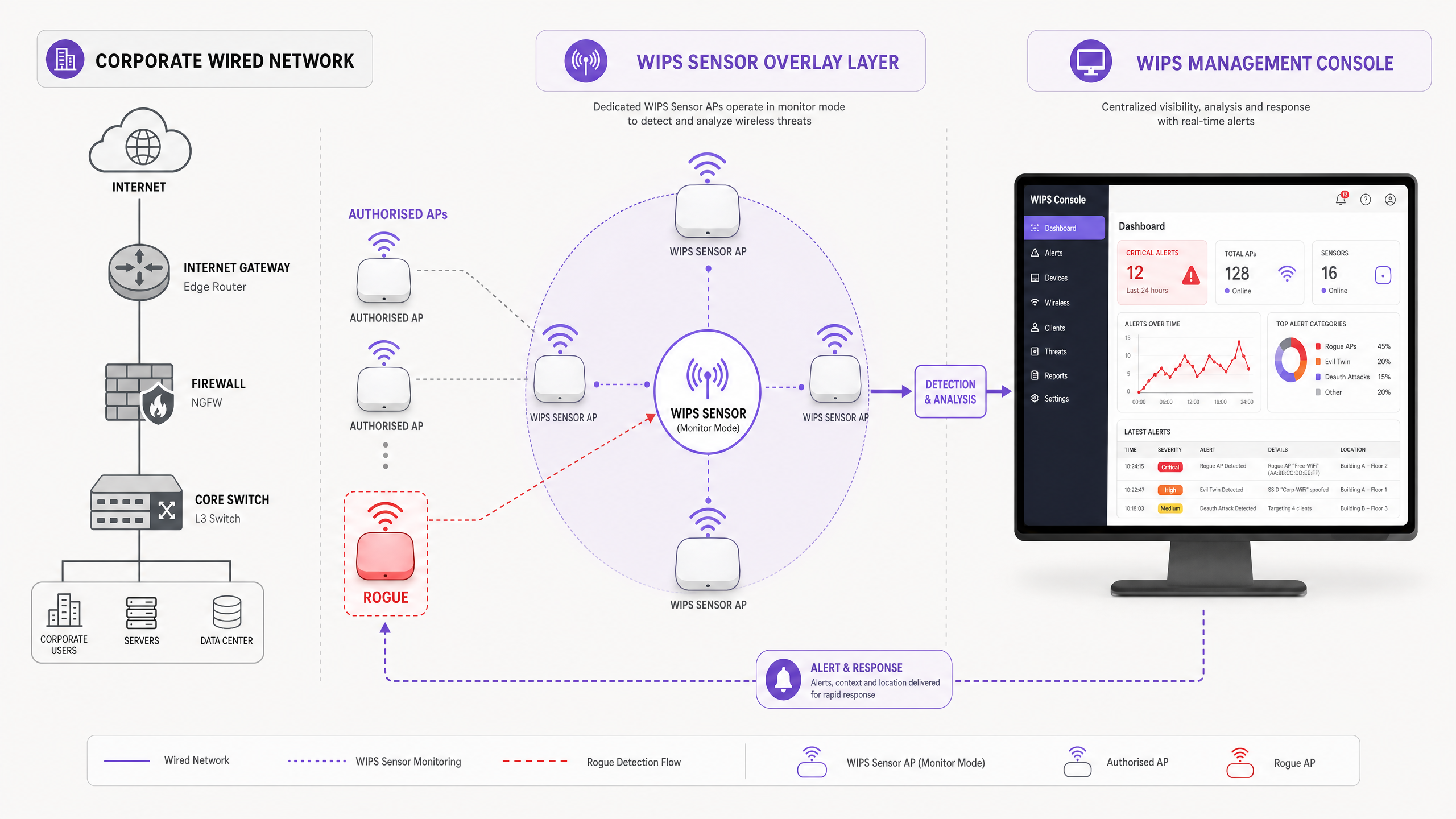
专用传感器模式部署仅用于监控2.4 GHz、5 GHz和6 GHz所有信道的RF频谱的AP。这提供了最高保真度的检测和持续的遏制能力,而不影响客户端数据吞吐量。对于高安全性环境——PCI合规零售、 医疗保健 或金融服务——推荐使用专用传感器覆盖架构。
**后台扫描(时分)**允许接入点服务客户端流量,同时定期切换信道以扫描威胁。虽然对分布式部署具有成本效益,但这种方法会在扫描周期内为客户端流量引入延迟,并提供间歇性的可见性,可能错过在扫描窗口之间活动的瞬时威胁。
| 部署模式 | 检测连续性 | 客户端吞吐量影响 | 最适合 |
|---|---|---|---|
| 专用传感器 | 连续 | 无 | 高安全性、PCI、医疗保健 |
| 后台扫描 | 周期性 | 轻微(~5%) | 分布式零售、低风险场所 |
| 混合(混合) | 近乎连续 | 最小 | 大型园区、混合风险环境 |
实施指南:检测、分类和遏制
阶段1:基线和分类
任何WIPS实施的第一阶段是建立全面的RF基线。系统必须在启用自动遏制之前,学习所有授权AP的MAC地址(BSSID)并记录合法的邻近网络。
**步骤1 — 导入授权基础设施:**将WIPS管理控制台与无线LAN控制器(WLC)同步,导入所有受管理AP的MAC地址、SSID和预期运行信道。这构成了授权白名单。
**步骤2 — 定义分类规则:**配置自动化策略,将发现的AP归类到风险层级。一个健壮的分类矩阵应包括:
- 如果BSSID不在授权列表中且SSID与企业SSID匹配且RSSI > -65 dBm → 分类为Evil Twin(关键风险)
- 如果BSSID不在授权列表中且WIPS通过MAC地址关联确认AP存在于有线LAN上 → 分类为有线非法(关键风险)
- 如果BSSID不在授权列表中且RSSI介于-65 dBm和-75 dBm之间 → 分类为疑似蜜罐(高风险——人工调查)
- 如果BSSID不在授权列表中且RSSI < -75 dBm → 分类为邻近网络(低风险——基线并忽略)
**步骤3 — 自动化前验证:**在启用自动遏制之前,至少以仅检测模式运行WIPS 72小时。这允许团队审查分类、调整阈值,并确认没有合法设备被错误标记。
阶段2:自动遏制
一旦威胁被正面分类,WIPS必须消除它。遏制方法的选择取决于非法AP是否物理连接到企业LAN。
有线端口抑制(首选): 对于确认的“有线非法”场景,WIPS通过SNMP或REST API与核心交换基础设施集成。检测到时,WIPS通过MAC地址表关联识别非法AP连接到的特定交换机端口,并管理性地禁用该端口。这是决定性的——无论其无线配置如何,设备都会失去网络连接。
无线遏制(解除认证): 对于未连接到企业LAN的Evil Twin和蜜罐威胁,WIPS传感器伪造非法AP的MAC地址,并向所有关联的客户端发送定向的IEEE 802.11解除认证帧。同时,它伪造客户端MAC地址,并将解除认证帧发送回非法AP。这持续中断关联,迫使客户端寻找合法AP。
> 重要: 自动无线遏制必须配置严格的RSSI边界。遏制合法邻近网络——即使是意外——也构成故意干扰,并违反大多数司法管辖区的电信法规。仅自动遏制确认为在您物理场所内的威胁。
阶段3:物理修复
WIPS通过使用来自多个传感器的信号强度数据进行RF三角定位提供非法AP的物理位置。此位置数据应自动生成工单,供IT或设施工作人员物理定位和移除设备。为物理响应定义明确的SLA——通常关键威胁为30分钟,高风险威胁为4小时。
企业部署最佳实践
在有线边缘优先使用802.1X: 在所有有线交换机端口上的IEEE 802.1X网络访问控制(NAC)是最有效的预防措施。如果员工将消费级路由器插入墙插,交换机端口要求认证,未管理的设备失败,端口保持未授权状态。非法AP永远不会获得IP地址,也不会作为RF威胁出现。
关联有线和无线数据: 仅依赖RF签名不足以进行准确的威胁分类。最关键的WIPS功能是将无线BSSID与交换机上的有线MAC地址表相关联,以确认设备是否物理连接到企业LAN。
与分析平台集成: 使用 WiFi Analytics 监控特定区域内合法客户端关联的意外下降。特定AP集群上客户端数量的突然下降可能表明存在Evil Twin攻击,正积极吸引客户端连接到附近的恶意AP。
强制使用WPA3-Enterprise: 在所有企业SSID上强制使用WPA3-Enterprise与802.1X认证。这消除了客户端连接到广播企业SSID的开放式或WPA2-PSK非法AP的风险,因为相互认证过程将在非法AP上失败。
定期进行物理审计: 补充WIPS的同时,定期进行物理巡检审计,特别是在人流量大或闭路电视覆盖有限的区域。有关确保全面传感器覆盖以支持WIPS检测准确性的指导,请参阅我们的指南 如何测量WiFi信号强度和覆盖范围 。
维护非法AP注册表: 记录每个检测到的非法AP——包括其MAC地址、检测时间戳、物理位置、分类和修复措施。该注册表是PCI DSS和GDPR合规审计的重要证据。
真实世界实施场景
场景1:城市酒店——针对访客网络的Evil Twin攻击
一家位于密集城市环境中的400间客房企业酒店,经历了间歇性的客人投诉,称连接缓慢,并报告了一起凭据盗窃事件。WLC显示无硬件故障。酒店周围是餐厅和办公室。
在专用传感器模式下部署WIPS后,系统检测到一个名为“Hotel_Guest_Free”的SSID,信号强度为-52 dBm,经三角定位位于四楼走廊。MAC地址关联确认该设备未连接到酒店的有线LAN——它是一个通过蜂窝网络连接的移动热点,充当蜜罐。
启用自动无线遏制。48小时内,客人投诉停止。物理位置被识别,设备——一个藏在清洁间的移动热点——被移除。酒店随后在企业SSID上实施了WPA3-Enterprise,并在其 访客WiFi 网络上实施了强制门户认证,显著减少了攻击面。
成果: 部署后的12个月内零凭据盗窃事件。PCI合规审计通过,无无线安全发现。
场景2:零售连锁——在500个地点实现PCI DSS合规自动化
一家大型零售连锁店每年花费约180,000英镑在500家商店进行手动季度无线安全评估,以满足PCI DSS要求11.1。每次评估都需要专业工程师携带频谱分析仪访问每个地点。 该连锁店在所有地点部署了后台扫描WIPS,并在单一管理控制台下集中管理。同时,每个商店的所有有线交换机端口上实施了802.1X。WIPS管理控制台被配置为每月自动生成PCI合规报告。
在部署后的第一个季度,WIPS在整个网络中检测到23个未经授权的AP——其中18个是员工连接的消费级路由器。所有18个在检测后几分钟内通过端口抑制被遏制。其余5个是邻近的零售网络,并被正确分类为低风险邻居。
成果: 年度合规评估成本从180,000英镑降至约22,000英镑(集中化的WIPS许可和管理)。审计准备时间减少了85%。连续两次年度审计中无线安全发现为零。
随着Purple扩展其公共部门和企业能力,此类基础设施智能变得越来越重要——正如 Purple任命Iain Fox为公共部门增长副总裁,以推动数字包容和智慧城市创新 所强调的那样。
故障排除与风险缓解
自动遏制中的误报
WIPS部署中最重要的运营风险是误报遏制邻近企业的WiFi网络。这既是法律风险,也是声誉风险。
缓解措施: 为自动遏制实施严格的RSSI阈值——通常为-65 dBm或更强。在基线阶段进行彻底的邻近AP调查,并明确将所有识别的邻近BSSID加入白名单。运营的第一个月每周审查分类日志。
隐藏SSID和空信标
攻击者通常将非法AP配置为不广播其SSID(空SSID信标),以逃避基本检测工具。
缓解措施: 现代WIPS不仅依赖信标帧。它们监控来自客户端设备的802.11探测请求和来自AP的探测响应,以识别隐藏网络。确保您的WIPS策略标记任何未识别的BSSID,无论SSID是否可见。
受保护的管理帧(802.11w)
IEEE 802.11w(受保护的管理帧)使对支持它的客户端执行无线解除认证攻击变得更加困难,因为管理帧是加密和认证的。
缓解措施: 虽然802.11w降低了无线遏制对受保护客户端的有效性,但它也保护您的合法客户端免受攻击者解除认证。WIPS仍然可以破坏非法AP维持关联的能力。在所有企业SSID上强制使用802.11w——这保护您的客户端,同时限制非法AP吸引和保持连接的能力。
传感器覆盖盲区
在大型或建筑结构复杂的场所——多层停车场、地下室会议设施、厚墙历史建筑——WIPS传感器覆盖可能存在盲区。
缓解措施: 在最终确定传感器位置之前进行彻底的RF调查。利用WIPS的三角定位精度数据识别定位精度低的区域,并相应增加传感器。有关详细方法,请参考 如何测量WiFi信号强度和覆盖范围 。
投资回报率和业务影响
部署强大的WIPS架构在三个维度上提供可衡量的回报:合规成本降低、事件响应效率和风险缓解。
| 业务影响领域 | 指标 | 典型改进 |
|---|---|---|
| PCI DSS合规 | 审计准备时间 | -80至-85% |
| 事件响应 | 平均解决时间(MTTR) | 数小时→数分钟 |
| 合规评估成本 | 手动扫描年度支出 | -70至-90% |
| 数据泄露风险 | 通过非法AP凭据盗窃的概率 | 使用WIPS + 802.1X时接近零 |
合规自动化: 自动化的WIPS报告满足PCI DSS要求11.1,并支持HIPAA无线安全规定,显著减少审计准备时间,并提供控制有效性的持续证据。
事件响应时间: 通过在平面图上精确定位非法AP的物理位置,IT团队将MTTR从数小时的手动频谱分析减少到数分钟。这直接缩短了暴露窗口,限制了潜在的数据丢失。
品牌和法规保护: 防止通过Evil Twin攻击导致的数据泄露,保护组织免受GDPR下的ICO执法行动、PCI罚款以及公开泄露造成的声誉损害。单个重大泄露的成本——监管罚款、取证调查、客户通知——通常超过WIPS部署多年的总成本。
随着企业WiFi向更智能、更集成的平台发展——包括如 WiFi助手如何在2026年实现无密码访问 中探索的无密码访问模型,以及像 Purple的离线地图模式 这样的无缝导航功能——底层无线基础设施的安全性成为所有这些功能依赖的基础。
Key Definitions
Rogue Access Point
Any wireless access point connected to a network without explicit authorisation from the network administrator, regardless of the intent of the person who installed it.
The primary wireless threat vector for bypassing perimeter security and exposing the internal LAN to unauthorised access.
Evil Twin AP
A fraudulent access point that broadcasts the same SSID as a legitimate network to deceive clients into connecting, enabling Man-in-the-Middle interception of traffic.
Typically deployed by external attackers near the target premises. Requires wireless containment rather than port suppression.
WIPS (Wireless Intrusion Prevention System)
A network security system that continuously monitors the RF spectrum for unauthorised wireless devices and can automatically take countermeasures including deauthentication and port suppression.
The enterprise standard for automated rogue AP detection and containment. Provides the continuous monitoring required by PCI DSS Requirement 11.1.
WIDS (Wireless Intrusion Detection System)
A passive variant of WIPS that detects and alerts on wireless threats but does not take automated containment actions.
Used in environments where automated containment carries legal or operational risk. Requires manual response to each alert.
Deauthentication Frame (802.11)
An IEEE 802.11 management frame used to terminate a wireless association between a client and an access point. Used by WIPS to disrupt connections to rogue APs.
The primary mechanism for wireless containment. Effectiveness is reduced against clients supporting 802.11w (Protected Management Frames).
BSSID (Basic Service Set Identifier)
The MAC address of a wireless access point's radio interface. Uniquely identifies each AP in the RF environment.
The primary identifier used by WIPS to track, classify, and target specific APs for containment.
Port Suppression
The act of administratively disabling a wired switch port via SNMP or API, cutting network connectivity to any device connected to that port.
The most effective containment method for rogue APs physically connected to the corporate LAN. Preferred over wireless deauthentication.
IEEE 802.1X (Port-Based NAC)
An IEEE standard for port-based Network Access Control that requires devices to authenticate before being granted network access via a wired or wireless port.
The foundational preventative control against rogue APs. An unauthenticated consumer router plugged into an 802.1X-enabled port will be denied network access entirely.
Background Scanning (Time-Slicing)
A WIPS deployment mode where serving APs periodically switch channels to scan for threats, rather than using dedicated sensor hardware.
A cost-effective alternative to dedicated sensor overlays for distributed or lower-risk environments. Provides periodic rather than continuous visibility.
PCI DSS Requirement 11.1
The Payment Card Industry Data Security Standard requirement mandating that organisations implement processes to detect and identify authorised and unauthorised wireless access points on a quarterly basis.
The primary compliance driver for WIPS adoption in retail and hospitality. Automated WIPS reporting directly satisfies this requirement.
Worked Examples
A 400-room corporate hotel in a dense urban environment is experiencing intermittent network performance issues and one confirmed guest credential theft incident. The WLC shows no hardware faults. The hotel is surrounded by cafés, restaurants, and offices. How should the IT team approach detection and containment?
- Deploy WIPS sensors in dedicated monitor mode across all floors to establish a 72-hour RF baseline. Configure RSSI thresholds to filter out neighbouring networks below -75 dBm.
- Review the classification log. The WIPS detects an SSID named 'Hotel_Guest_Free' broadcasting at -52 dBm, triangulated to the fourth-floor corridor.
- Perform MAC address correlation. The WIPS confirms the device is NOT connected to the hotel's wired LAN — it is a cellular-connected mobile hotspot. Port suppression is not available.
- Enable automated wireless containment (deauthentication frames) targeting the specific BSSID. Monitor client association logs to confirm guests are reconnecting to authorised APs.
- Dispatch security to the triangulated location. The device — a mobile hotspot — is found and removed from a housekeeping cupboard.
- Post-incident: implement WPA3-Enterprise on the corporate SSID and captive portal authentication on the guest network to reduce future attack surface.
A major retail chain needs to satisfy PCI DSS Requirement 11.1 across 500 locations. Manual quarterly wireless assessments cost £180,000 annually and are operationally disruptive. What is the recommended architecture?
- Deploy background-scanning WIPS on existing AP infrastructure across all 500 locations. This avoids the capital cost of dedicated sensor hardware while providing near-continuous visibility.
- Centralise WIPS management to a single console with role-based access for regional IT managers.
- Implement IEEE 802.1X on all wired switch ports in each store. This prevents rogue APs from connecting to the LAN, making WIPS the secondary (not primary) control.
- Configure automated monthly PCI compliance reports from the WIPS console, documenting all detected APs, their classification, and remediation actions.
- Define an escalation SLA: Critical rogue (on wire) → 30-minute physical response. High rogue (wireless only) → 4-hour investigation.
- Review and tune classification rules quarterly based on new threat intelligence.
Practice Questions
Q1. Your WIPS alerts you to an AP broadcasting your corporate SSID at -52 dBm. The WIPS cannot correlate the AP's MAC address to any wired switch port. What is the correct automated response, and what is the legal constraint you must consider?
Hint: Consider the difference between wired and wireless containment capabilities, and the RSSI threshold for safe automated containment.
View model answer
Initiate automated wireless containment (deauthentication frames) targeting the specific BSSID. Because the AP is not on the wired LAN, port suppression is impossible. The strong RSSI (-52 dBm) indicates the device is physically within or immediately adjacent to your premises, and spoofing the corporate SSID indicates malicious intent (Evil Twin), justifying immediate wireless containment. The legal constraint is that containment must only target this specific BSSID — not broadcast deauthentication — and the RSSI threshold confirms the device is within your perimeter, not a neighbouring network.
Q2. An employee plugs a consumer WiFi router into a wall ethernet jack in a conference room to provide connectivity for a visiting vendor. The WIPS detects the AP's SSID broadcasting at -48 dBm. Describe the two-layer defence that should prevent this from becoming a critical vulnerability.
Hint: Think about the control that should stop the threat at the wired edge, before the WIPS even detects the RF signal.
View model answer
Layer 1 (Prevention): IEEE 802.1X on the conference room switch port should demand authentication when the consumer router is connected. The unmanaged router will fail authentication, and the switch port will remain in an unauthorised VLAN or blocked state, preventing the rogue AP from obtaining an IP address or bridging traffic to the corporate LAN. Layer 2 (Detection and Containment): If 802.1X is not deployed on that port, the WIPS detects the AP broadcasting at -48 dBm, correlates the MAC address to the wired LAN via switch MAC tables, classifies it as Critical (Rogue on Wire), and triggers automated port suppression — administratively disabling the specific switch port via SNMP or API.
Q3. A neighbouring retail unit upgrades their WiFi infrastructure. Their new APs are now visible to your WIPS sensors at -68 dBm. Your automated containment policy triggers and begins deauthenticating their clients. What went wrong, what is the immediate risk, and how do you prevent recurrence?
Hint: Consider the RSSI threshold configuration and the legal implications of interfering with third-party networks.
View model answer
What went wrong: The automated containment RSSI threshold was set too low (or not configured), causing the WIPS to target a legitimate neighbouring network. The -68 dBm signal is within the containment trigger range but the device is not within the organisation's premises. Immediate risk: This constitutes intentional jamming and denial of service against a third-party network, violating telecommunications regulations (e.g., Ofcom regulations in the UK, FCC rules in the US). The organisation faces significant legal liability and potential regulatory enforcement. Prevention: Raise the automated containment RSSI threshold to -65 dBm or stronger. Conduct a neighbour AP survey and explicitly whitelist all identified neighbouring BSSIDs. Implement a manual review step for any AP between -65 dBm and -75 dBm before containment is authorised.
Continue reading in this series
Roaming Optimization for VoIP and Video Calls on Corporate WiFi
This guide provides IT managers, network architects, and CTOs with a comprehensive, vendor-neutral blueprint for optimizing WiFi roaming to support seamless VoIP and video calls on corporate staff networks. It covers the IEEE 802.11k/r/v protocol stack, WMM QoS configuration, RF cell design, and end-to-end wired QoS mapping required to achieve sub-50ms handoff latency. Applicable across hospitality, retail, healthcare, and large-venue environments, this reference includes real-world implementation scenarios, troubleshooting frameworks, and a measurable ROI analysis.
Roaming Optimisation for VoIP and Video Calls on Corporate WiFi
This guide provides IT managers, network architects, and CTOs with a comprehensive, vendor-neutral blueprint for optimising WiFi roaming to support seamless VoIP and video calls on corporate staff networks. It covers the IEEE 802.11k/r/v protocol stack, WMM QoS configuration, RF cell design, and end-to-end wired QoS mapping required to achieve sub-50ms handoff latency. Applicable across hospitality, retail, healthcare, and large-venue environments, this reference includes real-world implementation scenarios, troubleshooting frameworks, and a measurable ROI analysis.
Certificate-Based Authentication for Corporate Devices (EAP-TLS)
This authoritative technical reference guide covers the architecture, deployment, and operational best practices of EAP-TLS certificate-based authentication for corporate devices. Designed for IT architects and venue operations leaders, it provides a practical roadmap to eliminate password-based credential risks and achieve robust 802.1X network access control across multi-site enterprise environments.