
Certificate-Based Authentication for Corporate Devices (EAP-TLS)
This authoritative technical reference guide covers the architecture, deployment, and operational best practices of EAP-TLS certificate-based authentication for corporate devices. Designed for IT architects and venue operations leaders, it provides a practical roadmap to eliminate password-based credential risks and achieve robust 802.1X network access control across multi-site enterprise environments.
Video overview
Listen to this guide
View podcast transcript
Part of our core series: Enterprise WiFi Security Guide →
Corporate EAP-TLS certificate authentication architect and ROI planner
Model enterprise certificate-based WiFi access control, size MDM SCEP distribution protocols, diagnose 802.1X handshake failure modes, and calculate annual helpdesk ticket savings from eliminating password resets.
Multi-platform corporate fleet (Windows, macOS, iOS, Android) automated via MDM SCEP integration, Cloud PKI, and global Cloud RADIUS with real-time OCSP revocation checking.
Architecture evaluation and cryptographic boundary
- Key isolation: Hardware-backed multi-OS cryptographic keystores. Private keys are generated on-chip and marked non-exportable, preventing credential leakage even if an endpoint is compromised.
- Shared-secret attack surface removed: 94%. Brute-force credential stuffing, password spray and evil-twin passphrase harvesting all stop working. A stolen enrolled device and an exportable private key remain, which is why this is not 100%.
- Revocation overhead: 24 ms added to the handshake while certificate status is checked.
- Server identity validation: All client profiles must match the SAN dNSName attribute
radius.purple.aiagainst the trusted enterprise Root CA.
Executive Summary
In the modern enterprise network environment, password-based wireless authentication is one of the most vulnerable avenues for credential theft, man-in-the-middle attacks, and unauthorised network access. Legacy protocols such as PEAP-MSCHAPv2, while historically popular due to their low barrier to entry, rely on user credentials that are readily intercepted via rogue access points or compromised through social engineering. For IT managers, network architects, and CTOs managing high-traffic, multi-site estates - hotels, retail chains, stadiums, and public-sector offices - securing the "staff WiFi" network is a business-critical priority that directly affects business continuity, brand trust, and regulatory compliance.
This guide lays out the technical blueprint for migrating corporate-owned devices to EAP-TLS (Extensible Authentication Protocol - Transport Layer Security), the industry-standard cryptographic protocol for certificate-based mutual authentication under the IEEE 802.1X standard. By replacing fallible user passwords with cryptographically bound X.509 digital certificates, EAP-TLS eliminates the credential-based attack surface entirely. Implementing EAP-TLS ensures that only verified, corporately managed devices can associate with internal networks, simplifying compliance with stringent standards such as PCI DSS and GDPR while drastically reducing help-desk tickets related to password expiry and resets.
Although the security benefits of EAP-TLS are absolute, successful deployment demands a structured approach to Public Key Infrastructure (PKI), Mobile Device Management (MDM) integration, and certificate lifecycle automation. This document provides the actionable technical guidance and architectural patterns required to deploy, scale, and maintain a robust EAP-TLS infrastructure across complex, multi-site enterprise environments.
Technical Deep-Dive
Cryptographic Foundations and Mutual Authentication
At its core, EAP-TLS applies the Transport Layer Security (TLS) handshake to network access control under the Extensible Authentication Protocol (EAP) framework, as defined in RFC 5216 [1]. Unlike password-based EAP methods (such as PEAP or EAP-TTLS), which establish a tunnel to protect a legacy credential exchange, EAP-TLS uses TLS to perform mutual cryptographic authentication.
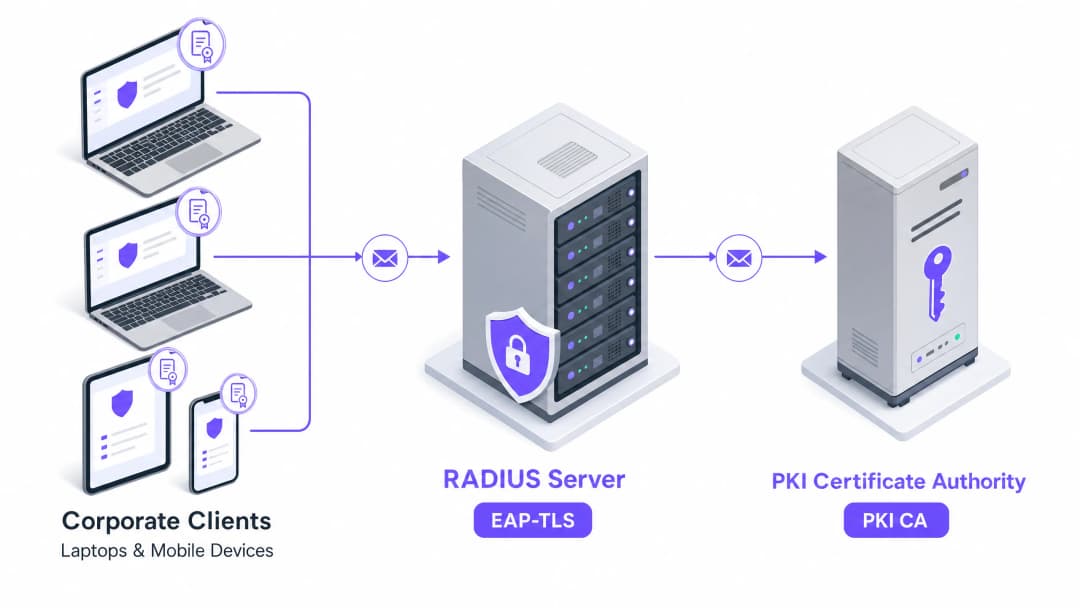
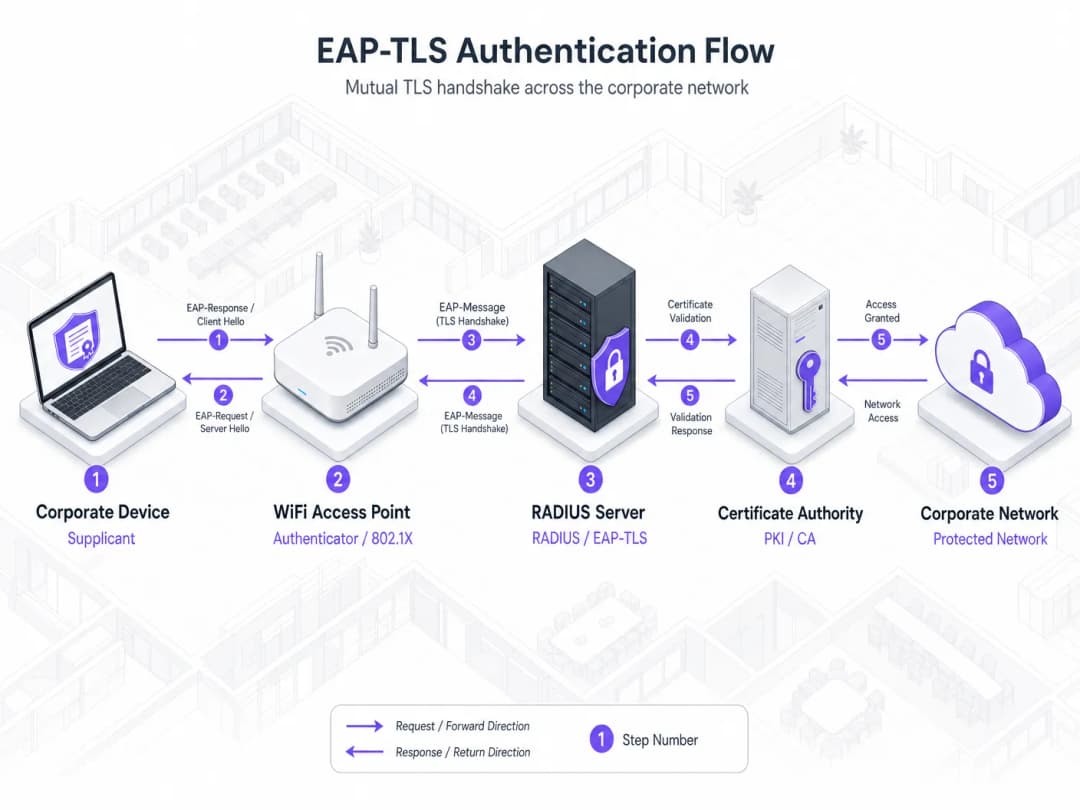
During the EAP-TLS handshake, both the client (known as the supplicant in 802.1X terminology) and the RADIUS server (the authentication server) must present valid X.509 digital certificates. The authentication flow proceeds as follows:
- Server authentication: The RADIUS server presents its server certificate to the client. The client validates this certificate against its local trust store, confirming that it is signed by a trusted root Certificate Authority (CA), has not expired, and matches the expected server identity (Common Name/Subject Alternative Name).
- Client authentication: Once the server's identity has been verified, the client presents its unique device certificate to the RADIUS server. The server validates this certificate against its trust store, confirming its signature, validity period, and revocation status.
- Key derivation: After both parties have completed mutual verification, they cryptographically derive a unique Pairwise Master Key (PMK) and Group Temporal Key (GTK). These keys are used to encrypt wireless traffic over the air via WPA2-Enterprise or WPA3-Enterprise, ensuring every session uses unique, non-reusable encryption keys.
Because authentication relies entirely on asymmetric cryptography (RSA or elliptic curve cryptography), no password, hash, or shared secret is ever transmitted over the air or stored on the authentication server. This design renders the network completely immune to offline brute-force attacks, dictionary attacks, and credential harvesting via rogue access points.
Architectural Components
A production-grade EAP-TLS deployment comprises four core infrastructure pillars, each fulfilling a distinct role within the chain of trust:
| Pillar | Component | Technical Function | Enterprise-Grade Options |
|---|---|---|---|
| PKI | Certificate Authority (CA) | Issues, signs, and manages the X.509 digital certificate lifecycle for servers and devices. | Active Directory Certificate Services (AD CS), Cloud PKI (Sectigo, EZCA, Smallstep), EJBCA |
| RADIUS | Authentication Server | Terminates the EAP-TLS handshake, validates certificates, and makes 802.1X admission allow/deny decisions. | Cisco ISE, Aruba ClearPass, FreeRADIUS, Cloud RADIUS (JoinNow, Foxpass) |
| MDM | Endpoint Management | Automatically deploys root CA trust profiles and triggers SCEP/EST certificate enrolment on devices. | Microsoft Intune, Jamf Pro, Ivanti Neurons (MobileIron), VMware Workspace ONE |
| WLAN | Network Infrastructure | Acts as the 802.1X authenticator, relaying EAP frames between the client and RADIUS via RADIUS-over-UDP/TCP. | Cisco Catalyst, Aruba AP, Ruckus Wireless, Mist Systems, Meraki AP |
| Identity | Identity Provider (IdP) | Maintains the single source of truth for user and device accounts, referenced by RADIUS during policy evaluation. | Microsoft Entra ID, Okta, Active Directory, Google Workspace |
EAP Method Comparison
To understand why EAP-TLS is the mandatory standard for corporate-owned devices, it is worth comparing it against the other EAP methods commonly found in enterprise environments:

As the chart above illustrates, EAP-TLS is the only method that achieves a high security posture while eliminating password-based risk entirely. Methods such as PEAP-MSCHAPv2 remain highly susceptible to credential-theft attacks using basic toolchains such as Hostapd-WPE, making them unsuitable for protecting sensitive corporate resources in the modern threat landscape.
Implementation Guide
Deploying EAP-TLS across a multi-site enterprise network requires systematic execution across the PKI, MDM, RADIUS, and wireless infrastructure layers. The following steps outline a vendor-agnostic, production-tested deployment framework.
Step 1: Establish the Public Key Infrastructure (PKI)
The PKI is the cryptographic cornerstone of EAP-TLS. For enterprise security, a two-tier CA architecture is strongly recommended:
- Offline Root CA: A highly secured, offline Certificate Authority used solely to sign the certificates of the Issuing CAs. The Root CA's private key must be protected by a Hardware Security Module (HSM) or strict physical access controls.
- Online Issuing CA: An active, online Certificate Authority integrated with your network and MDM platform, used to issue certificates to RADIUS servers and client devices.
RADIUS server certificate configuration:
- Issue a server certificate to your RADIUS server from the Issuing CA.
- Ensure the certificate includes the Server Authentication Extended Key Usage (EKU) OID (
1.3.6.1.5.5.7.3.1). - Configure the Subject Alternative Name (SAN) to match the fully qualified domain name (FQDN) of the RADIUS server.
Step 2: Automate Client Certificate Enrolment via MDM
Manual certificate installation does not scale and introduces serious security risk. Enterprise deployments must use an MDM platform to automate certificate provisioning via the Simple Certificate Enrolment Protocol (SCEP) or Enrolment over Secure Transport (EST).
+-------------+         1. SCEP Profile Push         +------------+
|             | -----------------------------------> |            |
|     MDM     |                                      |   Client   |
|  (Intune/   | <----------------------------------- |   Device   |
|    Jamf)    |    3. SCEP Challenge Validation      |            |
+-------------+                                      +------------+
       ^                                                   |
       | 2. Challenge Get                                  | 4. SCEP Request
       v                                                   v
+-------------+                                      +------------+
|  SCEP/EST   | <----------------------------------- |  Issuing   |
|   Gateway   |       5. Certificate Issuance        |     CA     |
+-------------+                                      +------------+
MDM profile deployment sequence:
- Root CA profile: Deploy a trusted certificate profile containing the public certificates of the Root CA and Issuing CA to the device's trusted root Certificate Authorities store. This ensures the device trusts the RADIUS server certificate.
- SCEP/EST profile: Configure a SCEP certificate profile pointing to the SCEP gateway of your Issuing CA. Configure the profile with:
- Subject name format:
CN={{DevicePhysicalIds:AADDeviceId}}orCN={{UserPrincipalName}}, to bind the certificate to a unique device or user identity. - Extended Key Usage (EKU): Must include Client Authentication (
1.3.6.1.5.5.7.3.2). - Key usage: Digital signature, key encipherment.
- Key size: Minimum RSA 2048-bit or ECC SECP256R1.
- Subject name format:
- WiFi profile: Deploy a wireless network profile configured for WPA3-Enterprise (with WPA2-Enterprise fallback) containing:
- EAP type: EAP-TLS.
- Trusted server certificate: Explicitly specify the FQDN of your RADIUS server and select the Root CA profile deployed in Step 1 as the trust anchor. This prevents devices from connecting to a malicious RADIUS server.
- Authentication method: Use the certificate enrolled via the SCEP profile.
Step 3: Configure the RADIUS Policy Engine
Your RADIUS server (for example, Cisco ISE, Aruba ClearPass, or Cloud RADIUS) must be configured to process incoming 802.1X authentication requests from the access points.
- Trust store configuration: Import the public certificates of the Root CA and Issuing CA into the RADIUS server's trusted certificate store. Enable certificate validation for client authentication.
- Identity source mapping: Configure the RADIUS policy to map the identity extracted from the client certificate's Subject or SAN (for example, the UPN or Azure AD device ID) to your identity provider (such as Microsoft Entra ID or Okta). This allows the RADIUS server to verify that the user or device account is still active in the directory before granting network access.
- Authorisation rules: Create granular authorisation policies based on certificate attributes and directory group memberships. For example:
- Rule 1: If
Certificate:IssuerequalsCorporate Issuing CAandEntraID:DeviceStatusequalsCompliant, assign VLAN 10 (corporate data network) and apply a high-priority role-based ACL. - Rule 2: If
Certificate:IssuerequalsCorporate Issuing CAandEntraID:UserGroupequalsFinance, assign VLAN 20 (finance segmented network).
- Rule 1: If
Step 4: Configure the Wireless LAN (WLAN) Infrastructure
Configure your wireless controllers or cloud-managed access points (for example, Cisco Catalyst, Aruba, or Meraki) to enforce 802.1X authentication on the corporate SSID.
- Define the RADIUS servers: Add your RADIUS server IP addresses and configure a strong, unique shared secret for each AP or wireless controller.
- Enable WPA3-Enterprise: Configure the corporate SSID to use WPA3-Enterprise. WPA3 provides robust protection against offline dictionary attacks and mandates Protected Management Frames (PMF), securing control traffic over the air. Offer WPA2-Enterprise as a transition mode only where legacy corporate clients exist.
- 802.1X/EAP configuration: Set the authentication type to 802.1X. Enable dynamic VLAN assignment if your RADIUS server is configured to return VLAN attributes in the
Access-Acceptpacket.
Got questions about your specific setup?
Our team works with venue operators, IT managers, and network engineers across 80,000 venues. Book a 20-minute call and we will show you how others like you solved it.
Best Practices
To ensure operational stability, high availability, and robust security, enterprise-grade EAP-TLS deployments must adhere to the following industry-standard best practices:
1. Certificate Revocation Checking
Real-time validation of certificate validity is non-negotiable. If a corporate laptop is lost or stolen, its network access must be terminated immediately. Configure your RADIUS server to enforce strict revocation checking using:
- Online Certificate Status Protocol (OCSP): Highly recommended for real-time, low-latency validation of individual certificates.
- Certificate Revocation Lists (CRLs): Configure a local cache of the CRL on the RADIUS server with frequent updates (for example, every 2 to 4 hours) to prevent authentication outages if the CA goes offline.
- Fail-safe policy: Define the RADIUS behaviour when revocation servers are unreachable. For high-security environments, default to "deny access" (hard-fail). For business continuity across distributed retail or hospitality estates, a "soft-fail" policy can be applied that temporarily restricts access to a quarantined VLAN.
2. Strict Client-Side Trust Validation
To mitigate man-in-the-middle (MitM) attacks - where an attacker stands up a rogue access point impersonating the corporate SSID - client devices must be rigorously configured to validate the RADIUS server's identity. This is enforced via the MDM wireless profile:
- Disable user prompts: Ensure the option to "prompt the user to trust new servers or certificate authorities" is disabled. If a server certificate mismatch occurs, the device must silently disconnect rather than allow the user to bypass the warning.
- Explicit domain matching: Restrict trusted servers to specific FQDNs (for example,
radius01.purple.aiorradius02.purple.ai).
3. Network Segmentation and Role-Based Access Control (RBAC)
Successful 802.1X authentication should not grant unrestricted lateral access to the corporate network. Implement network segmentation at the wireless edge:
- Use RADIUS attributes (for example,
Tunnel-Private-Group-IDfor VLANs orFilter-Idfor ACLs) to dynamically assign clients to isolated network segments based on their role (for example, executive, engineering, HR, finance). - Pair this with a modern Network Access Control (NAC) solution to continuously monitor device compliance. If an active device becomes non-compliant in your MDM (for example, firewall disabled or malware detected), the MDM should trigger certificate revocation, or notify the NAC to dynamically reassign the device to a quarantine VLAN. For a comprehensive view of leading control systems, see our guide: 10 Best Network Access Control (NAC) Solutions for 2026.
4. High Availability and Geographic Redundancy
For multi-site venue operations, a RADIUS outage means staff devices stop working instantly. Ensure your architecture is fully redundant:
- Deploy at least two RADIUS servers per region behind an enterprise-grade load balancer, or configure them as primary/secondary targets in the wireless controller.
- For global deployments (for example, international hotel chains or retail brands), leverage a Cloud RADIUS architecture with geographically distributed points of presence (PoPs) to ensure low-latency handshakes and local survivability. This pattern is explored in depth in our technical guide How to Implement 802.1X Authentication with Cloud RADIUS.
Troubleshooting and Risk Mitigation
Deploying EAP-TLS eliminates password-related issues but introduces cryptographic and infrastructure dependencies. Understanding the common failure modes and establishing a structured troubleshooting protocol for operational teams is essential.
Common Failure Modes and Resolution Workflows
1. Handshake Failure: "Unknown CA" or "Certificate Untrusted"
- Symptom: The client device attempts to connect but disconnects immediately during the TLS handshake. RADIUS logs show
TLS Alert: Alert Certificate Unknown. - Root cause: The client does not trust the Certificate Authority (CA) that signed the RADIUS server certificate, or the RADIUS server does not trust the CA that signed the client certificate.
- Resolution: Verify that the Root CA and Issuing CA public certificates are correctly installed in the client's trusted root store via MDM. Check that the RADIUS server's trust store contains the client's Issuing CA certificate, and that the certificate chain of the RADIUS server certificate itself is complete.
2. SCEP Enrolment Failure
- Symptom: A new corporate device cannot connect to WiFi because it has no client certificate. MDM logs show SCEP enrolment errors.
- Root cause: The SCEP gateway is unreachable, the SCEP challenge password has expired, or the NDES (Network Device Enrollment Service) server is resource-exhausted.
- Resolution: Verify network connectivity between the client, the MDM, and the SCEP gateway. Restart the NDES IIS application pool and verify the SCEP challenge validation service is operating correctly. Ensure the MDM service account holds the appropriate permissions on the CA.
3. Silent Handshake Timeouts
- Symptom: The client attempts to authenticate but the connection times out. The RADIUS log shows no record of the attempt, or shows a partially interrupted handshake.
- Root cause: IP fragmentation. The EAP-TLS exchange involves large certificate payloads, causing EAP packets to exceed the standard 1500-byte MTU. If an intermediate switch or router drops the fragmented packets, the handshake times out.
- Resolution: Configure the Framed-MTU attribute on the RADIUS server and wireless controllers. Setting Framed-MTU to
1344or1300forces the RADIUS server to fragment EAP messages into smaller packets that traverse the network cleanly without fragmentation at the IP layer.
Structured Diagnostic Protocol
When troubleshooting authentication issues, network engineers should follow this sequential diagnostic protocol:
+-------------------------------------------------------------+
| Step 1: Check physical/wireless association at the Access Point |
+-------------------------------------------------------------+
                               |
                               v
+-------------------------------------------------------------+
| Step 2: Verify the active EAP-TLS session in the RADIUS live logs |
+-------------------------------------------------------------+
                               |
                               v
+-------------------------------------------------------------+
| Step 3: Inspect the TLS handshake details and certificate EKU OIDs |
+-------------------------------------------------------------+
                               |
                               v
+-------------------------------------------------------------+
| Step 4: Validate CRL/OCSP reachability and latency status   |
+-------------------------------------------------------------+
                               |
                               v
+-------------------------------------------------------------+
| Step 5: Check endpoint directory status in the Identity Provider |
+-------------------------------------------------------------+
ROI and Business Impact
Transitioning to EAP-TLS represents a significant technical shift, but its return on investment (ROI) is rapid and measurable across security, operational, and financial dimensions.
1. Elimination of Credential-Based Risk
Password-based networks are inherently vulnerable to credential sharing, brute-force attacks, and social engineering. In sectors with high staff turnover, such as Hospitality and Retail, managing password security is an operational nightmare. When an employee leaves, changing a shared WPA2 password across hundreds of devices is practically impossible, creating a persistent insider threat. EAP-TLS binds network access to the physical device. When an employee departs or a device is decommissioned, the certificate is revoked in the MDM, instantly terminating network access across every physical location without affecting any other device.
2. Reduced Operational Costs
According to industry data, up to 30% of IT help-desk tickets relate to password resets, lockouts, and wireless connectivity issues caused by credential expiry. EAP-TLS operates entirely in the background. Once provisioned via MDM, connectivity is automatic, silent, and permanent. Automated certificate renewal workflows ensure devices remain connected without user intervention, eliminating thousands of hours of lost productivity and drastically reducing help-desk overhead. For large-scale environments such as Healthcare or Transport hubs, this operational efficiency translates directly into hundreds of thousands of pounds in annual support-cost savings.
3. Compliance and Regulatory Alignment
For venues handling sensitive data, robust network access control is a legal mandate. EAP-TLS directly satisfies and accelerates compliance with key regulatory frameworks:
- PCI DSS 4.0 (Requirement 8): Mandates strong cryptographic authentication and unique credential verification for all system components accessing the cardholder data environment. EAP-TLS provides a unique, cryptographically bound device identity that fully satisfies this requirement for corporate networks in retail and hospitality environments.
- GDPR: Requires organisations to implement appropriate technical and organisational measures to ensure a level of security appropriate to the risk. Mutual TLS authentication provides the highest level of protection against unauthorised access to corporate systems containing personal data.
- ISO/IEC 27001 (Control A.8): Requires strict access control and secure authentication. EAP-TLS provides a precise, cryptographically auditable record of which physical device accessed the network, at what time, and from which access point.
Business Value Matrix
To justify the transition to executive leadership, IT directors can leverage the following business value matrix:
| Business Driver | Before EAP-TLS (Passwords/PEAP) | After EAP-TLS (Certificates) | Financial & Operational Impact |
|---|---|---|---|
| Credential Security | Extremely high risk of credential harvesting, sharing, and brute-force attacks. | Cryptographically secure. Zero risk of over-the-air credential theft. | Reduced data-breach risk (average breach cost exceeds £3.4 million). |
| Onboarding Overhead | Manual credential entry, user training, frequent connectivity troubleshooting. | Zero-touch background provisioning via MDM. Instant connectivity. | 90% reduction in WiFi-related onboarding tickets. |
| Offboarding/Revocation | Requires changing shared secrets or manually disabling accounts across multiple systems. | Instant one-click certificate revocation via MDM/RADIUS. | Immediate elimination of insider threat vectors and rogue device access. |
| Compliance Audits | Difficult to prove exact device identity; logs rely on fallible user credentials. | Cryptographically verifiable audit trail binding physical devices to sessions. | Seamless compliance audits for PCI DSS, GDPR, and SOC 2. |
| Help-Desk Workload | Heavy ticket volume for password resets, credential expiry, and lockout states. | Near-zero tickets. Certificates renew silently and automatically in the background. | Reallocation of IT staff to high-value strategic initiatives. |
By framing the EAP-TLS migration around risk mitigation, operational efficiency, and compliance, IT leaders can present a compelling business case that aligns network security directly with corporate financial and strategic objectives.
References
- [1] RFC 5216: The EAP-TLS Authentication Protocol. Extensible Authentication Protocol (EAP) Working Group. https://datatracker.ietf.org/doc/html/rfc5216
- [2] IEEE 802.1X-2020: Standard for Local and Metropolitan Area Networks--Port-Based Network Access Control. IEEE Computer Society. https://standards.ieee.org/ieee/802.1X/7343/
- [3] WPA3-Enterprise Security Specification: Wi-Fi Alliance WPA3 Technical Specifications. Wi-Fi Alliance. https://www.wi-fi.org/discover-wi-fi/security
- [4] PCI DSS v4.0 Standard: Payment Card Industry Data Security Standard. PCI Security Standards Council. https://www.pcisecuritystandards.org/
- [5] GDPR Technical Security Measures: European Data Protection Board Guidelines on Network Security. European Union. https://gdpr-info.eu/
- [6] Purple Cloud RADIUS Architecture: Enterprise WiFi Security & Cloud RADIUS Integration Guide. Purple. https://purple.ai/guides/implementing-8021x-with-cloud-radius
- [7] Network Access Control Best Practices: 10 Best Network Access Control (NAC) Solutions for 2026. Purple Blog. https://purple.ai/blog/best-network-access-control
Key Definitions
EAP-TLS
Extensible Authentication Protocol - Transport Layer Security. An RFC-defined network authentication protocol that uses mutual certificate-based cryptography to secure connections under IEEE 802.1X.
The absolute gold standard for corporate wireless security, eliminating passwords entirely.
Supplicant
The software client running on an endpoint device (such as a laptop, tablet, or smartphone) that initiates an 802.1X authentication request and negotiates the EAP handshake.
The supplicant must be configured via MDM to present the correct client certificate and trust the RADIUS server.
Authenticator
The network device (typically a wireless Access Point or wired Switch) that controls physical access to the network. It passes EAP packets between the Supplicant and the RADIUS server but does not process the credentials itself.
The AP acts as a gatekeeper, keeping the port blocked until the RADIUS server returns an Access-Accept.
RADIUS
Remote Authentication Dial-In User Service. A networking protocol that provides centralised Authentication, Authorisation, and Accounting (AAA) management for users and devices connecting to a network.
The RADIUS server terminates the EAP-TLS handshake, validates certificates, and instructs the AP to grant or deny access.
PKI
Public Key Infrastructure. A framework of roles, policies, hardware, software, and procedures needed to create, manage, distribute, use, store, and revoke digital certificates and manage public-key encryption.
The PKI acts as the root of trust; its Certificate Authority signs the credentials that prove identity on the network.
SCEP
Simple Certificate Enrolment Protocol. An IP-based protocol that automates the securing and provisioning of digital certificates to network devices, typically managed via an MDM platform.
SCEP is critical for scaling EAP-TLS, allowing devices to enrol and renew certificates silently without IT intervention.
OCSP
Online Certificate Status Protocol. An internet protocol used by network devices to obtain the revocation status of an X.509 digital certificate in real time, serving as an alternative to CRLs.
RADIUS servers use OCSP to verify instantly if a presented client certificate has been revoked due to device loss or employee termination.
WPA3-Enterprise
The latest WiFi Alliance security standard for enterprise networks. It mandates Protected Management Frames (PMF) and offers a 192-bit security mode that aligns with NSA Suite B cryptography.
Combining WPA3-Enterprise with EAP-TLS provides the highest commercially available wireless security posture.
Worked Examples
A luxury hotel brand with 45 properties globally wants to secure its back-of-house corporate devices (front-desk laptops, housekeeping tablets, and manager smartphones) on a dedicated SSID. Currently, they use a single pre-shared key (PSK) across all properties, which has leaked multiple times. They have Microsoft Entra ID and Microsoft Intune for device management but no on-premises Active Directory or PKI.
Deploy a Cloud-Native EAP-TLS architecture using Microsoft Intune and a cloud-hosted PKI integrated with Cloud RADIUS.
- PKI Setup: Stand up a cloud-hosted PKI (such as SCEPman or EZCA) integrated directly with Microsoft Entra ID. Generate an Issuing CA certificate.
- Intune Configuration:
- Create a Trusted Certificate Profile in Intune and upload the public certificate of the Cloud Issuing CA. Assign this profile to 'All Devices' (Windows, iOS, Android).
- Configure a SCEP Certificate Profile in Intune pointing to the Cloud PKI SCEP URL. Set the Subject Name Format to
CN={{AADDeviceId}}and Subject Alternative Name to UPN. Add the 'Client Authentication' EKU OID (1.3.6.1.5.5.7.3.2). - Create a WiFi Profile in Intune. Set the SSID to 'Purple-Staff', security type to WPA3-Enterprise, EAP type to EAP-TLS. Select the Trusted Certificate Profile as the root anchor and specify the FQDNs of the Cloud RADIUS servers. Bind the SCEP certificate profile as the client credential.
- RADIUS Integration: Configure the Cloud RADIUS service (e.g., JoinNow or Foxpass) to trust the Cloud Issuing CA. Configure the RADIUS policy to validate client certificates against Entra ID, checking that the device is marked as 'Compliant' in Intune before returning an Access-Accept packet.
- Wireless Controller Setup: On the centralised wireless controller (or cloud dashboard like Meraki/Aruba Central), configure the 'Purple-Staff' SSID to point to the Cloud RADIUS IP addresses using 802.1X. Enable WPA3-Enterprise with WPA2-Enterprise transition mode.
A public-sector organisation managing 12 local council offices wants to transition 1,500 corporate Windows laptops from PEAP-MSCHAPv2 to EAP-TLS. They currently have an on-premises Microsoft Active Directory Domain Services (AD DS) environment with Active Directory Certificate Services (AD CS) acting as their Enterprise CA. Laptops are domain-joined and managed via Group Policy Objects (GPOs).
Leverage the existing AD CS and Active Directory infrastructure to deploy EAP-TLS via Group Policy auto-enrolment.
- CA Configuration: On the AD CS Issuing CA, duplicate the default 'Workstation Authentication' certificate template. Name the new template 'Corporate Wireless Authentication'. Under the Security tab, grant 'Domain Computers' permissions to Read, Enroll, and Autoenroll. Ensure the template contains the 'Client Authentication' EKU.
- Group Policy Configuration:
- Create a new GPO named 'Wireless Certificate Auto-Enrollment'. Navigate to
Computer Configuration -> Policies -> Windows Settings -> Security Settings -> Public Key Policies. Open 'Certificate Services Client - Auto-Enrollment', set it to 'Enabled', and check 'Renew expired certificates, update pending certificates, and remove revoked certificates'. - In the same GPO, navigate to
Wireless Network (802.11) Policies. Create a new wireless policy. Configure the SSID name, set security to WPA3-Enterprise, select EAP-TLS, and explicitly check the AD CS Root CA certificate in the trusted certificates list. Specify the FQDN of the local RADIUS servers (e.g., Cisco ISE).
- Create a new GPO named 'Wireless Certificate Auto-Enrollment'. Navigate to
- RADIUS Policy (Cisco ISE): Import the AD CS Root CA certificate into the Cisco ISE Trusted Certificates store. Configure an Authentication Policy to accept EAP-TLS. Configure an Authorisation Policy that checks if the connecting computer belongs to the 'Domain Computers' Active Directory group, and if so, dynamically assigns them to the secure corporate VLAN.
An enterprise operating a major exhibition and conference centre wants to secure its corporate network used by event staff scanners, ticket terminals, and media production rigs. The venue experiences high RF interference during events and requires sub-second roaming times for staff moving across a 50,000-square-metre floor plan. They use a physical Ruckus SmartZone controller and on-premises FreeRADIUS servers.
Deploy EAP-TLS on-premises with FreeRADIUS, optimised for Fast Transition (802.11r) and packet fragmentation mitigation.
- PKI & Certificate Generation: Use an on-premises CA to issue certificates. Because ticket terminals and scanners may run specialised operating systems (Android Enterprise, custom Linux), generate client certificates using ECC SECP256R1 keys to reduce certificate payload size, which speeds up the cryptographic handshake.
- FreeRADIUS Tuning:
- In
eap.conf, setfragment_size = 1024. This forces FreeRADIUS to fragment large certificate payloads into EAP packets smaller than the standard network MTU, preventing packet drops over WAN links or congested wireless channels. - Ensure
cache = yesis configured under the TLS section to enable TLS session resumption. This allows roaming clients to re-authenticate using a shortened handshake (without re-sending full certificates), reducing roam times to under 50 milliseconds.
- In
- Wireless Controller (SmartZone) Tuning:
- Configure the Staff SSID with WPA3-Enterprise and enable 802.11r (Fast BSS Transition). Configure Over-the-Air (OTA) roaming.
- Map the SSID to the primary and secondary FreeRADIUS servers.
- Set the RADIUS timeout on the controller to 5 seconds with 3 retries to handle occasional RF packet loss without dropping client sessions.
Practice Questions
Q1. A retail chain with 300 stores wants to implement EAP-TLS for their corporate inventory scanners. During the pilot, they discover that while laptops authenticate in under a second, some older handheld scanners take up to 10 seconds to authenticate or fail entirely over remote WAN links connecting the stores to the central RADIUS server. What is the most likely technical cause of this issue, and how should it be resolved?
Hint: Consider the size of the certificate payload and the impact of WAN latency and packet fragmentation on UDP-based RADIUS traffic.
View model answer
The technical issue is caused by EAP packet fragmentation combined with WAN packet loss and latency. EAP-TLS handshakes involve transmitting full X.509 certificate chains, which frequently exceed the standard network MTU (1500 bytes). When these payloads are sent over UDP-based RADIUS, they must be fragmented. If intermediate WAN routers drop any single fragment, the entire EAP handshake fails and must time out and restart, which is highly noticeable on high-latency remote links.
To resolve this issue, the network team must:
- Tune Framed-MTU: Configure the
Framed-MTUattribute on the RADIUS server and the wireless controller to a lower value (such as1300or1200). This forces the RADIUS server to fragment the EAP messages at the application layer into smaller packets that can traverse the WAN without IP-layer fragmentation. - Optimize Certificate Size: Re-issue client certificates for the scanners using Elliptic Curve Cryptography (ECC) with SECP256R1 keys instead of RSA 2048. ECC certificates are significantly smaller (approx. 300 bytes vs 2048 bytes for RSA), reducing the number of fragments required for the handshake.
- Enable TLS Session Resumption: Configure FreeRADIUS/RADIUS to cache TLS sessions. When a scanner roams or reconnects, it can perform an abbreviated handshake that does not require transmitting the full certificate chain, reducing authentication time to under 100 milliseconds.
Q2. An IT security administrator configures an EAP-TLS SSID via MDM. They push the client certificate and the wireless profile to all corporate laptops. However, during testing, they notice that laptops still occasionally connect to a rogue access point broadcasting the same SSID name, and a prompt appears asking the user to trust a new server certificate. What configuration error was made in the MDM profile, and what is the security risk?
Hint: Look at the trust verification settings within the MDM's wireless profile configuration.
View model answer
The configuration error is that the wireless profile pushed via MDM does not have Strict Server Trust Validation enforced. Specifically, the administrator failed to explicitly specify the trusted RADIUS server FQDNs and did not disable the option to 'Prompt user to trust new servers'.
The security risk is a Man-in-the-Middle (MitM) / Rogue AP attack. If an attacker sets up a rogue access point broadcasting the corporate SSID and presenting a self-signed certificate, the client device will attempt to authenticate. Because strict validation is not enforced, the operating system prompts the user to trust the new certificate. If a non-technical employee clicks 'Trust' or 'Connect anyway', the rogue AP can establish a connection. While EAP-TLS prevents the attacker from stealing the user's password (as none is sent), the attacker can now intercept unencrypted network traffic, perform DNS spoofing, or conduct local exploit delivery on the endpoint.
Q3. A stadium operator deployed EAP-TLS for 200 staff mobile POS (Point of Sale) terminals used during matches. On game day, when 50,000 fans entered the stadium, POS terminals experienced frequent authentication drops and disconnects, severely impacting concession sales. RADIUS logs showed high rates of 'Handshake Timeout' and 'Max Retries Exceeded' errors, but the CPU and memory utilisation on the RADIUS servers remained below 15%. What physical and logical layer factors caused this failure, and how should the architecture be optimised?
Hint: Consider the impact of extreme RF congestion on cryptographic handshakes and the role of roaming optimisation protocols.
View model answer
This failure is a classic case of RF congestion leading to cryptographic handshake timeouts. EAP-TLS requires multiple round-trip frames (typically 4 to 6 round trips) to complete the mutual TLS handshake. In a stadium environment with 50,000 active client devices, the 2.4GHz and 5GHz bands experience severe packet collision and high retry rates. Because EAP-TLS is highly chatty over the air, a packet drop on any of the handshake frames forces the EAP state machine to time out and restart the entire handshake, leading to a cascade of failures.
To optimise the architecture and resolve the issue, the operator must implement the following physical and logical optimisations:
- Enable Fast Roaming (802.11r): Configure 802.11r (Fast BSS Transition) on the POS SSID. This allows the terminals to negotiate roaming keys prior to moving to a new AP, reducing the over-the-air exchange during roams.
- Implement TLS Session Resumption: Ensure the RADIUS server has TLS session caching enabled. When a terminal reconnects or roams, it can perform an abbreviated handshake (requiring only 1-2 round trips and no certificate transmission), significantly reducing airtime consumption and exposure to RF packet loss.
- Dedicated RF Tuning: Move the POS terminals exclusively to the 5GHz or 6GHz bands. Disable 2.4GHz on the POS SSID. Implement strict channel planning, reduce channel width to 20MHz to maximise available non-overlapping channels, and configure minimum basic data rates (e.g., disabling rates below 12Mbps or 24Mbps) to clear management frame overhead from the airwaves.
Frequently asked questions
What is certificate-based authentication (EAP-TLS) for corporate devices?
EAP-TLS (RFC 5216) is the industry standard for enterprise 802.1X wireless security. It replaces shared passwords with mutual cryptographic authentication: the client device verifies the RADIUS server certificate against a trusted Root CA, and the RADIUS server verifies the client X.509 certificate before granting network access.
How does EAP-TLS eliminate password-related security risks on enterprise WiFi?
By utilizing asymmetric public-key cryptography and hardware-backed key storage (TPM 2.0 or Apple Secure Enclave), EAP-TLS makes private keys non-exportable. This neutralizes brute-force dictionary attacks, credential stuffing, evil twin rogue AP harvesting, and phishing. Organizations also eliminate employee password expiration disruptions and helpdesk reset tickets entirely.
How do IT administrators automate client certificate deployment across corporate fleets?
Organizations automate certificate lifecycle management by pairing Mobile Device Management (MDM) solutions - such as Microsoft Intune, Jamf Pro, or VMware Workspace ONE - with SCEP (RFC 8894) or EST (RFC 7030). The MDM delivers an enterprise WiFi configuration and instructs the device to generate a private key on-chip and request a signed certificate from the enterprise PKI without end-user intervention.
What is the difference between SCEP and EST for enterprise certificate enrollment?
SCEP is the established protocol supported across enterprise MDMs and operating systems; it relies on HTTP with PKCS#7 envelope encryption and shared challenge passwords. EST is the TLS-native successor providing direct TLS client authentication, ECC curve support, and server-side key generation, making it popular in high-security and IoT environments.
How does certificate revocation checking (OCSP and CRL) work during 802.1X authentication?
During the EAP-TLS handshake, the RADIUS server verifies whether the presented client certificate has been revoked. With CRLs, the RADIUS server periodically downloads a signed list of revoked certificate serial numbers. With OCSP (RFC 6960), the RADIUS server queries an OCSP responder in real time to confirm certificate validity before returning a RADIUS Access-Accept.
How does Purple Cloud RADIUS simplify enterprise EAP-TLS deployment?
Purple Cloud RADIUS eliminates on-premises FreeRADIUS, Microsoft NPS, and Cisco ISE hardware infrastructure. It delivers high-availability multi-region 802.1X authentication, integrates directly with leading cloud PKIs and MDM providers, validates client certificates in milliseconds, and enforces dynamic VLAN steering and role-based network segmentation at cloud scale.
Continue reading in this series
Managing BYOD (Bring Your Own Device) Security on Staff Networks
An authoritative, technical reference guide for enterprise IT managers and network architects on securing Bring Your Own Device (BYOD) access on staff networks. This guide outlines the exact network architecture, authentication protocols, and MDM integration workflows required to mitigate data leakages and maintain regulatory compliance across high-footfall venues.
Mitigating Rogue Access Points on Enterprise Networks
This technical reference guide details the architecture, deployment, and operational procedures for mitigating rogue access points on enterprise networks using Wireless Intrusion Prevention Systems (WIPS) and Wireless Intrusion Detection Systems (WIDS). It provides actionable frameworks for IT security administrators to detect, classify, and neutralise unauthorised APs across complex physical environments including hospitality, retail, healthcare, and public-sector venues. The guide covers threat classification, automated containment mechanisms, compliance implications (PCI DSS, GDPR, HIPAA), and measurable business outcomes.
Secure BYOD Policies for Staff WiFi Networks
This authoritative guide provides IT leaders with a vendor-neutral framework for securely onboarding staff personal devices. It details the critical architecture decisions - including network segmentation, EAP-TLS authentication, and MDM integration - required to support BYOD without compromising core corporate infrastructure.
Got questions about your specific setup?
Our team works with venue operators, IT managers, and network engineers across 80,000 venues. Book a 20-minute call and we will show you how others like you solved it.