
Managed WiFi services in Dubai: a comprehensive guide for businesses
This guide gives IT managers, network architects, and property developers a practical framework for deploying managed WiFi services in Dubai. It covers multi-tenant isolation using iPSK, VLAN segmentation architecture, TDRA and UAE PDPL compliance, and the commercial case for treating connectivity as a managed amenity across hospitality, retail, and BTR environments.
Video overview
Listen to this guide
View podcast transcript
Executive summary
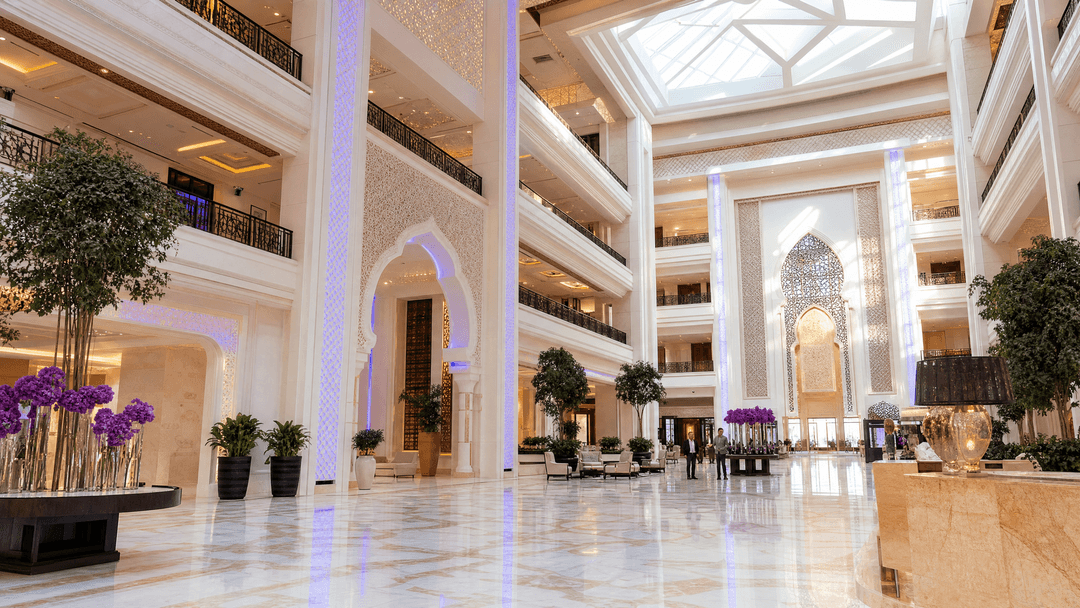
Dubai's commercial real estate market demands connectivity that matches its architectural ambition. For IT managers and venue operations directors, deploying managed WiFi services in Dubai is no longer about simply providing internet access. It requires building an identity-based network that supports thousands of concurrent devices, isolates tenant traffic securely, and complies with the UAE Personal Data Protection Law (PDPL). This guide breaks down the technical architecture required to deliver enterprise-grade WiFi across hospitality, retail, and multi-tenant environments. We examine how iPSK (Identity Pre-Shared Key) technology replaces shared passwords with per-resident network bubbles, reducing support overhead and increasing Net Operating Income (NOI). Whether you are upgrading a 200-room hotel on Sheikh Zayed Road or outfitting a new Build-to-Rent (BTR) development in Dubai Marina, this reference provides the vendor-neutral frameworks and Purple integrations needed to deploy resilient, scalable wireless infrastructure. Purple runs 80,000+ live venues globally, with 99.999% uptime and ISO 27001 certification.
Technical deep-dive: architecture and isolation
Modern enterprise WiFi requires strict logical separation on shared physical infrastructure. A flat network is a security vulnerability and an operational liability. The standard approach for large venues in Dubai is a three-tier architecture: a cloud management platform, a robust core network (firewalls and RADIUS servers), and a high-density access layer.
The multi-tenant isolation problem
In a BTR or Multi-Dwelling Unit (MDU) environment, residents expect their smart TVs, games consoles, and voice assistants to communicate seamlessly. However, they must not see the devices of the resident next door. Traditional guest WiFi, which isolates every device from every other device, breaks smart home functionality. Traditional home WiFi, which puts everyone on the same subnet, exposes resident data and violates privacy expectations.
The technical solution is iPSK (Identity Pre-Shared Key), referred to as Personal Private Network by Cisco Meraki or PPSK by HPE Aruba. iPSK assigns a unique WPA2/WPA3 passphrase to each resident or tenant. The RADIUS server uses this passphrase to dynamically assign the user's devices to a specific VLAN or micro-segment.
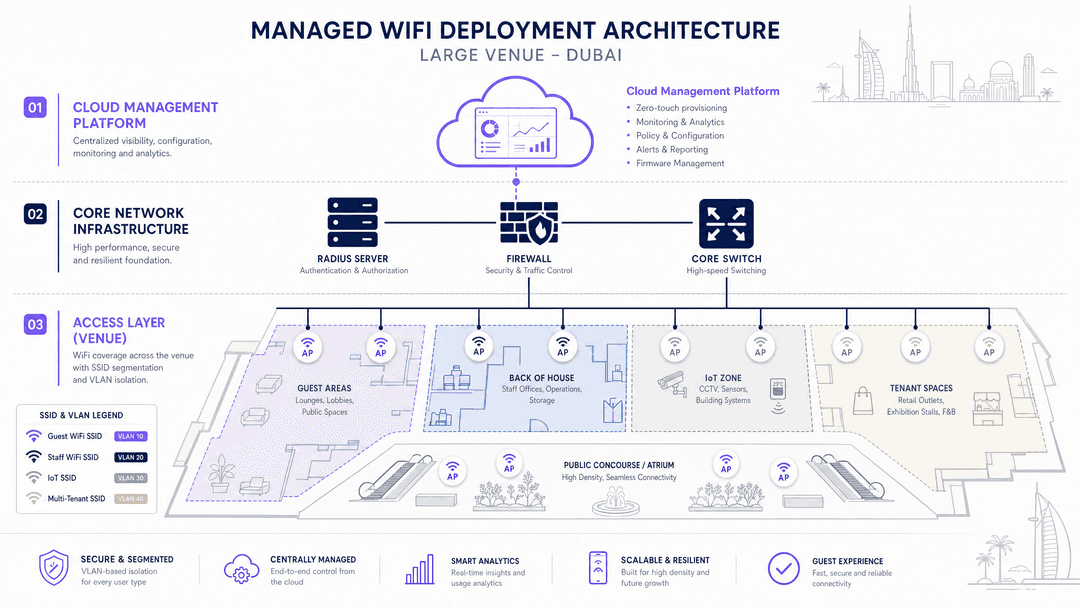
This creates a private network bubble. All devices using Resident A's passphrase can discover and communicate with each other via mDNS reflection - so their Chromecast, smart speaker, and console all connect as they would at home. Devices using Resident B's passphrase, even when connected to the exact same access point, remain completely invisible. When Resident A moves out, Purple revokes their specific passphrase. The building-wide network remains untouched, and no other resident needs to update their settings. For a deeper comparison of PPSK deployment models, see our guide: Power probe PPSK: comparing features and deployment models .
SSID design: three networks, one infrastructure
A well-designed venue network uses three SSIDs, each mapped to a distinct VLAN. Read more about this architecture in our guide: Three SSIDs to rule them all: guest, Passpoint, and IoT WiFi .
| SSID | Authentication | VLAN | Use case |
|---|---|---|---|
| Staff WiFi | 802.1X via Microsoft Entra ID, Okta, or Google Workspace | Corporate (e.g., VLAN 10) | Employees, operations, back-of-house |
| Resident/Tenant WiFi | iPSK (per-unit unique passphrase) | Per-unit micro-segment (e.g., VLANs 101-500) | BTR residents, hotel guests, coworking members |
| Guest WiFi | Open with captive portal | Internet-only (e.g., VLAN 900) | Visitors, delivery personnel, retail shoppers |
Hardware and standards
Deployments must support high device density. A 200-unit BTR building will typically see 3,000 to 5,000 concurrent devices. Purple integrates with Cisco Meraki, HPE Aruba, Ruckus, Juniper Mist, Ubiquiti UniFi, Cambium, Extreme, and Fortinet. Deploy WiFi 6 (802.11ax) or WiFi 6E hardware as the baseline for all new builds. Enforce WPA3-Enterprise where supported, falling back to WPA2-Enterprise for legacy devices. For authentication, use 802.1X with a cloud RADIUS backend for staff networks, and iPSK for resident and IoT networks.
Implementation guide: deployment strategies
Deploying managed WiFi services in Dubai requires careful planning to align with Telecommunications and Digital Government Regulatory Authority (TDRA) guidelines and local construction realities.
Step 1: RF planning and access point placement
Concrete, steel, and mirrored glass dominate Dubai's architecture. These materials severely attenuate RF signals. Do not rely on predictive surveys alone. Conduct active site surveys (AP-on-a-stick) before finalising cable runs. For hospitality and BTR, the standard is an in-room deployment model: one access point per room, mounted on the ceiling rather than hidden in media enclosures. Ceiling-mounted access points deliver consistent coverage across the room and avoid the signal degradation caused by furniture and walls.
Step 2: Network segmentation design
Design your SSID and VLAN structure before configuring hardware. The three-SSID model described above is the starting point. For large venues with distinct operational zones (conference areas, food and beverage, retail concessions), add additional VLANs per zone to contain broadcast traffic and simplify troubleshooting.
Step 3: Selecting the service model
Operators must choose how to manage the infrastructure.
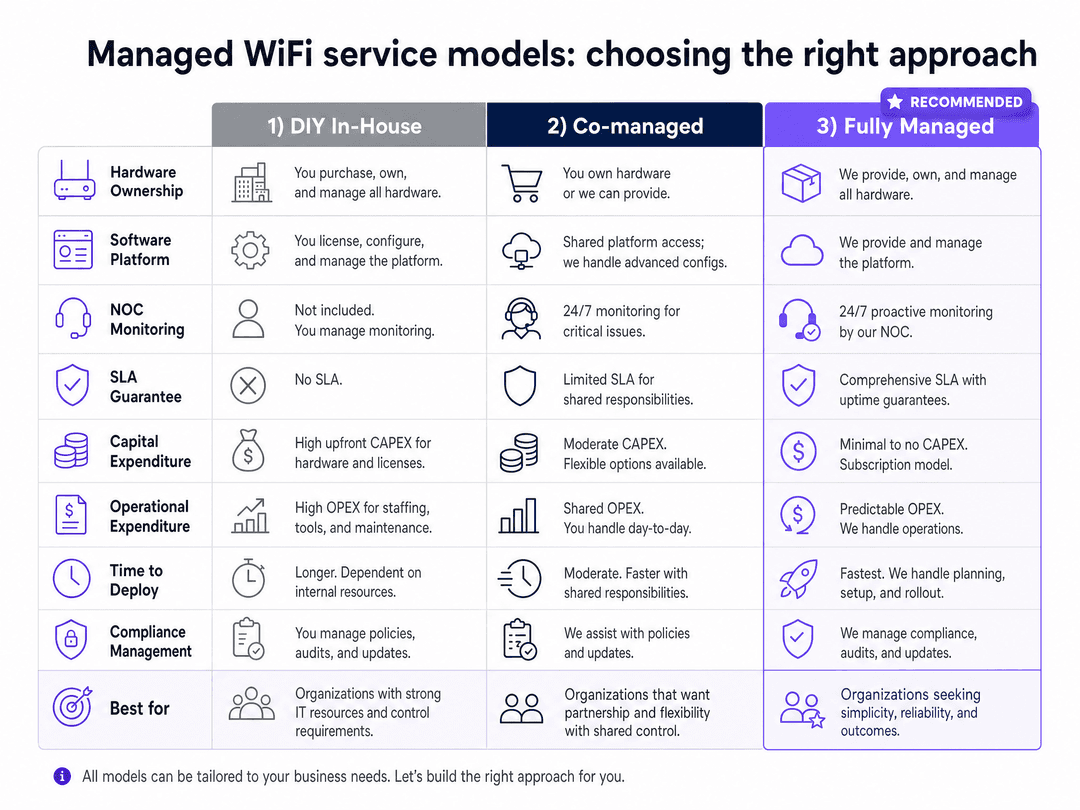
We recommend a software overlay model. You purchase and own the hardware (e.g., Cisco Meraki or HPE Aruba), and Purple provides the cloud RADIUS, captive portal, and management layer via our hardware-agnostic platform. This prevents vendor lock-in and keeps capital expenditure manageable. Purple's cloud RADIUS has maintained 99.999% uptime across 80,000+ venues.
Step 4: Captive portal and data capture
For Guest WiFi in retail and hospitality, the captive portal is where business value is generated. Purple's conscious-choice opt-in model collects first-party data - email addresses, visit frequency, dwell time - with explicit consent. This data feeds directly into WiFi Analytics , giving you actionable insight into venue utilisation. Harrods and Manchester Airports Group (MAG) use this infrastructure to drive personalised engagement at scale.
Best practices for the UAE market
Data privacy and PDPL compliance
The UAE Personal Data Protection Law (Federal Decree-Law No. 45 of 2021) governs how you collect and store user data. When operating a captive portal for guest WiFi in retail or hospitality, you must obtain explicit opt-in consent before collecting email addresses or phone numbers for marketing, practise data minimisation, and implement automated data deletion policies. Purple stores data in secure regional instances and automates compliance with GDPR, CCPA, and UAE PDPL. For venues hosting international visitors, GDPR obligations apply to EU residents regardless of where the network is located.
TDRA compliance
Ensure all wireless hardware imported and deployed is type-approved by the TDRA. Unapproved hardware can lead to fines and forced removal. The TDRA has published a Telecommunications Networks Specifications Manual for Buildings and, in partnership with Dubai Municipality, a Smart Buildings Guideline that defines technical requirements for telecommunications integration, IoT, and cybersecurity in new developments. Work with local system integrators who understand these requirements.
PCI DSS for payment environments
If your venue processes card payments over the network, PCI-DSS compliance is mandatory. Segment payment terminal traffic onto a dedicated VLAN, isolated from both guest and staff networks. Disable split tunnelling on any access points serving payment zones.
Troubleshooting and risk mitigation
The captive portal will not load on mobile
Modern smartphones use strict captive portal detection. If your firewall blocks the specific domains Apple and Google use to test connectivity, the portal fails to render. Ensure your walled garden allows traffic to captive.apple.com and connectivitycheck.gstatic.com.
IoT device onboarding failures
Many smart home devices lack a web browser and cannot navigate a captive portal. They also often only support the 2.4GHz band. Use iPSK: the resident generates a device-specific password via the Purple app and enters it into the IoT device. Ensure your network broadcasts a 2.4GHz signal on the resident SSID.
IP address exhaustion
A 500-user venue can exhaust a standard /24 DHCP scope within hours due to MAC address randomisation on modern smartphones. Use a /22 or /21 subnet for guest networks and reduce the DHCP lease time to 30 minutes for transient areas like retail floors or hotel lobbies.
Roaming failures in large venues
In venues with many access points, poor roaming configuration causes devices to stay connected to a distant, weak access point rather than roaming to a closer one. Enable 802.11r (Fast BSS Transition) and 802.11k (Neighbour Reports) on all access points to enable seamless roaming.
ROI and business impact
Managed WiFi is a revenue driver, not a cost centre.
For BTR operators, providing immediate, high-speed WiFi as an amenity increases the monthly rent premium by $20 to $40 per unit (Purple internal data, National Apartment Association benchmarks). Research from WiredScore's 2024 Smart Living report found that 89% of Middle East residents expect fast internet from day one, and nine in ten are willing to pay a premium of 2.3% for a residence with smart technology features. Managed WiFi eliminates the 5 to 10-day wait for traditional broadband installation, reducing vacancy periods and improving Net Operating Income.
For retail and hospitality , Purple captures first-party data via conscious-choice opt-ins. McDonald's, Harrods, and Manchester Airports Group use this infrastructure to understand venue utilisation and drive personalised engagement. Purple has collected 29 billion data points across 80,000+ venues globally (Purple internal data, 2024). By analysing authentication data, you can track dwell times, measure the impact of physical layout changes, and deliver targeted promotions.
For transport hubs and large public venues, the Expo 2020 Dubai deployment provides a benchmark: Cisco deployed 8,645 access points including 453 WiFi 6 access points, enabling three million unique WiFi connections over six months across a 4.38 square kilometre site (Cisco, 2022). That network is now the backbone of Expo City Dubai.
When you own the hardware and use Purple as the management overlay, the per-door cost is 30% to 50% lower than bundling WiFi with a third-party broadband contract (Purple internal data). You retain control of the network, the data, and the resident experience.
Key Definitions
iPSK (Identity Pre-Shared Key)
A security mechanism that allows multiple unique passphrases to be used on a single SSID. The network uses the passphrase to identify the user and dynamically assign specific network policies or VLANs. Called PPSK by HPE Aruba and Personal Private Network by Cisco Meraki.
Essential for BTR and MDU deployments to provide private network bubbles without requiring 802.1X enterprise authentication, which many IoT devices do not support.
VLAN (Virtual Local Area Network)
A logical subnetwork that groups a collection of devices from different physical LAN segments. Configured on switches and access points using 802.1Q tagging.
Used to separate staff traffic from guest traffic, and to isolate individual tenant networks within a shared building infrastructure. A correctly designed VLAN structure prevents cross-tenant visibility and contains broadcast traffic.
Captive Portal
A web page that a user must view and interact with before access is granted to a public network. Typically used to collect user data, display terms of service, and obtain marketing consent.
The primary mechanism for capturing first-party data and enforcing terms of service in retail and hospitality environments. Requires careful walled garden configuration to function correctly on modern iOS and Android devices.
mDNS (Multicast DNS)
A protocol that resolves hostnames to IP addresses within small networks that do not include a local name server. Used by Chromecast, Apple TV, AirPlay, and Sonos for device discovery.
The technology that allows a smartphone to find a Chromecast or Apple TV. It requires devices to be in the same broadcast domain. iPSK with mDNS reflection enables this within a resident's private network bubble without exposing them to other residents.
RADIUS (Remote Authentication Dial-In User Service)
A networking protocol that provides centralised Authentication, Authorisation, and Accounting (AAA) management for users connecting to a network.
The core engine that validates user credentials or iPSK passphrases and instructs the access point which VLAN to assign to the connecting device. Purple provides cloud RADIUS-as-a-Service, eliminating the need for on-premise servers.
PDPL (Personal Data Protection Law)
UAE Federal Decree-Law No. 45 of 2021, which governs the processing and protection of personal data within the UAE. Came into effect on 2 January 2022.
Dictates how venue operators must handle guest data collected via Captive Portals. Requires explicit consent, data minimisation, and secure storage. Non-compliance carries significant financial penalties.
BTR (Build-to-Rent)
Purpose-built residential developments designed specifically for the rental market rather than for sale. Characterised by professional management, shared amenities, and long-term tenancy.
A rapidly growing sector in Dubai that requires enterprise-grade Multi-Tenant WiFi architecture. Residents in BTR developments expect WiFi to be included as a managed amenity from move-in day.
WPA3-Enterprise
The latest WiFi security standard, providing improved encryption using 192-bit security mode and requiring server certificate validation to prevent man-in-the-middle attacks.
The target security standard for new corporate and staff networks. Provides superior protection against brute-force attacks compared to WPA2. Requires client device support, so WPA2-Enterprise fallback is needed for legacy hardware.
TDRA (Telecommunications and Digital Government Regulatory Authority)
The UAE federal body responsible for regulating telecommunications services and digital government. Oversees type approval for wireless equipment and publishes technical standards for building telecommunications infrastructure.
All wireless hardware deployed in the UAE must be TDRA type-approved. The TDRA has published a Telecommunications Networks Specifications Manual for Buildings and, with Dubai Municipality, a Smart Buildings Guideline covering IoT and cybersecurity requirements.
802.1X
An IEEE standard for port-based Network Access Control (PNAC). Provides an authentication mechanism for devices connecting to a LAN or WLAN, using EAP (Extensible Authentication Protocol) over the network.
Used for Staff WiFi authentication, typically backed by Microsoft Entra ID, Okta, or Google Workspace. Provides per-user identity and enables dynamic VLAN assignment based on user role.
Worked Examples
A 300-unit BTR development in Dubai Marina requires WiFi where residents can use smart home devices securely. The developer wants to include WiFi in the rent but avoid managing hundreds of individual broadband accounts. How should this be architectured?
Deploy a centralised enterprise network using HPE Aruba access points (one per unit, ceiling-mounted). Implement Purple's Multi-Tenant WiFi solution using iPSK. Integrate Purple with the property management system via API. When a resident signs a lease, the system automatically generates a unique iPSK passphrase and sends it to the resident via the Purple app. The resident uses this single passphrase for their phone, laptop, Apple TV, and smart speaker. The RADIUS server assigns all devices using that passphrase to a dedicated VLAN, creating a private network bubble isolated from the other 299 units. mDNS reflection within the VLAN allows device discovery (Chromecast, AirPlay, etc.) to work exactly as it does on a home network. When the resident moves out, Purple revokes the passphrase. No other resident is affected.
A luxury hotel on Palm Jumeirah is experiencing high support volumes because guests cannot connect their personal gaming consoles and smart TVs to the captive portal network. The IT team has tried adding the devices to a MAC bypass list but cannot keep up with the volume. What is the scalable solution?
Transition from a pure captive portal model to a hybrid model using iPSK for headless devices. Maintain the captive portal for standard mobile and laptop connections to preserve data capture and PDPL consent flows. Add a self-service flow within the Purple app: after a guest authenticates via the captive portal, they can generate a device-specific iPSK passphrase for their console or smart TV. The guest enters this passphrase directly into the device. The RADIUS server places the device on the correct guest VLAN, in the same network segment as the guest's other devices. This eliminates the IT team's manual MAC bypass workload entirely.
Practice Questions
Q1. A retail chain operating across five malls in Dubai wants to implement guest WiFi to collect shopper data. Their IT team proposes using a single shared WPA2 password printed on receipts. What are the technical and business flaws in this approach, and what should they implement instead?
Hint: Consider the goals of first-party data collection and the requirements of the UAE PDPL for marketing consent.
View model answer
A shared WPA2 password provides encryption but no user identification. The retailer collects zero first-party data because there is no captive portal to capture email addresses, visit frequency, or demographics. There is also no mechanism to obtain the explicit opt-in consent required by the UAE PDPL for marketing communications. The correct approach is an open SSID with a captive portal that requires users to authenticate (via email, social login, or phone number) and explicitly accept marketing terms. This generates the first-party data needed for personalised engagement while satisfying PDPL requirements.
Q2. You are designing the network for a new 50-storey residential tower in Business Bay. The developer suggests placing all 400 apartments on a single /16 subnet to simplify routing. Why must you reject this design, and what architecture should you specify instead?
Hint: Think about what happens when devices discover each other on a local network, and consider the scale of broadcast traffic.
View model answer
A single flat subnet destroys resident privacy. Any resident could discover and potentially interact with devices in other apartments via mDNS or SMB. It also creates an enormous broadcast domain: 400 apartments with 15 to 25 devices each generates 6,000 to 10,000 devices sending broadcast traffic, severely degrading network performance. The correct architecture uses iPSK to assign each apartment to its own isolated VLAN. Each VLAN is a /24 or /25 subnet, large enough for the apartment's devices but small enough to contain broadcasts. mDNS reflection within each VLAN allows device discovery to work correctly within the apartment without exposing residents to each other.
Q3. A hotel IT manager reports that the captive portal loads instantly on laptops but fails completely on newer iPhones and Android devices. The portal is confirmed to be running correctly. What is the most likely cause and how do you fix it?
Hint: How do mobile operating systems detect that they are behind a captive portal before opening a browser?
View model answer
The firewall or walled garden configuration is blocking the specific URLs that mobile operating systems use for captive portal detection. iOS devices probe captive.apple.com; Android devices probe connectivitycheck.gstatic.com. If these probes are blocked or return unexpected responses, the device assumes there is no internet connection and drops the WiFi association before the portal can render. The fix is to update the walled garden rules to allow HTTP/HTTPS traffic to these detection endpoints. This allows the OS to detect the captive portal and automatically open the browser to the splash page.
Q4. A BTR operator in Dubai is evaluating two options: bundling WiFi with a third-party broadband contract at AED 150 per unit per month, or deploying owned HPE Aruba hardware with Purple as the software overlay at an estimated AED 60 per unit per month OPEX after hardware amortisation. What factors beyond cost should inform this decision?
Hint: Consider data ownership, vendor lock-in, resident experience, and long-term flexibility.
View model answer
Beyond the 60% cost saving, the owned-hardware software-overlay model provides: (1) data ownership - the operator retains all resident connection data and analytics, rather than the broadband provider; (2) hardware flexibility - if the operator wants to change the software platform in future, the HPE Aruba access points remain in place; (3) resident experience control - the operator controls the onboarding flow, branding, and support model; (4) multi-tenant capability - iPSK-based isolation is not available in standard broadband bundle models; (5) compliance control - the operator directly manages PDPL data retention policies rather than relying on a third party. The bundled model is simpler to procure but surrenders all of these strategic advantages.
Continue reading in this series
Staff WiFi vs. Guest WiFi: Best Practices for Corporate Network Segmentation
A comprehensive technical guide for IT leaders on segmenting staff and guest WiFi networks. It covers VLAN architecture, 802.1X authentication, firewall policies, and the business impact of secure network design.
Apartment WiFi solutions: a comprehensive guide for businesses
This guide covers the architecture, deployment, and business case for apartment WiFi solutions in Build to Rent and multi-dwelling unit properties. It explains how Identity Pre-Shared Key (iPSK) technology creates secure, isolated network bubbles for each resident while supporting smart devices and IoT. Property developers, landlords, and BTR operators will find actionable deployment guidance, ROI data, and worked implementation scenarios.
Cox business managed WiFi: a comprehensive guide for businesses
This guide details how property developers and BTR operators can deploy scalable, secure networks using Cox Business managed WiFi. It covers network architecture, vendor-neutral hardware deployment, and the business impact of transitioning connectivity from an operational headache to reliable infrastructure.