
Train WiFi: The Complete Guide for Rail Operators and Passengers
This authoritative guide breaks down the architecture, deployment challenges, and commercial opportunities of passenger WiFi on trains. Designed for senior IT and operations leaders, it covers backhaul aggregation, network segmentation, and how to turn a compliance liability into actionable passenger analytics.
Video overview
Listen to this guide
View podcast transcript
Part of our core series: Guest WiFi Guide →
Executive Summary
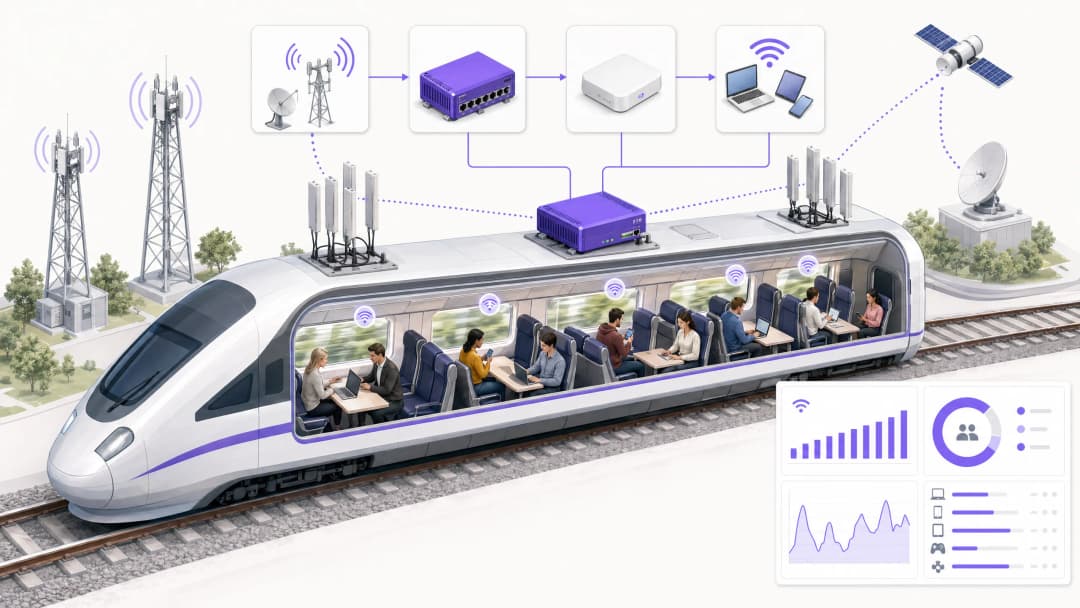
For rail operators, high-quality train WiFi is no longer just a passenger amenity but has become an essential operational infrastructure. The gap between the best and legacy deployments is clear: according to Ookla's Q2 2025 data, Sweden achieves a median download speed of 64.58 Mbps, while the UK is stuck at 1.09 Mbps [1]. This 59-fold difference is not primarily a technology problem; rather, it is a failure of architecture and investment strategy.
This guide provides a vendor-neutral blueprint for IT directors, network architects, and venue operations leaders. We analyse the three-layer architecture required for resilient onboard connectivity, explore the critical security requirements of network segmentation, and demonstrate how platforms like Guest WiFi transform raw connection data into actionable business intelligence. Whether you are managing a high-speed intercity route or a regional commuter service, the principles of backhaul aggregation and GDPR-compliant data capture remain the same.
Technical Deep Dive: Three-Layer Architecture
Modern train WiFi deployment is fundamentally different from static venue deployments found in Retail or Hospitality. The network must maintain session persistence while travelling at speeds of 300 km/h, handing off between trackside cells, and penetrating heavily insulated rolling stock.
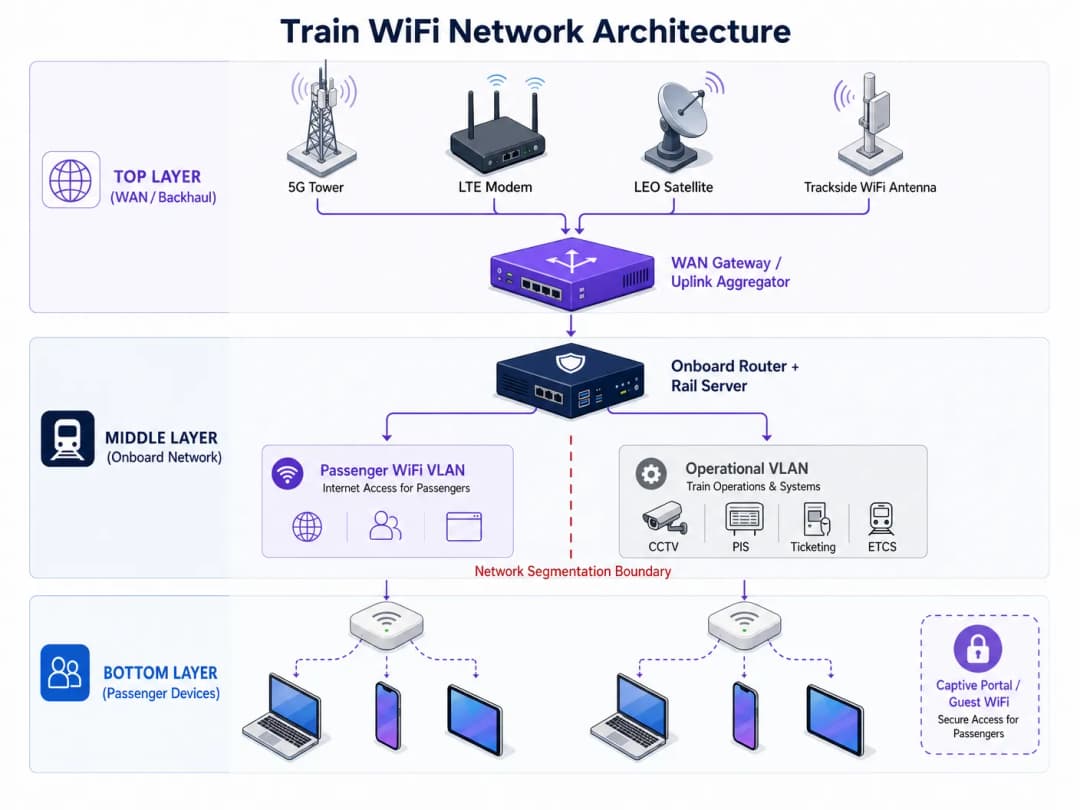
Layer 1: WAN Backhaul and Aggregation
The limit of your passenger experience depends entirely on your backhaul capacity. A single LTE modem with a roof-mounted antenna is no longer viable. Modern architectures use a WAN gateway to aggregate multiple uplinks:
- Cellular bonding: Combining 4G/5G connections from multiple mobile network operators (MNOs) to mitigate single-network coverage black spots.
- Trackside infrastructure: Dedicated 5 GHz or 60 GHz wireless networks deployed along the rail corridor.
- LEO satellite: Low-Earth-orbit constellations (e.g. Starlink) providing 100-200 Mbps throughput in rural or cross-border areas where terrestrial cellular fails [2].
Layer 2: Onboard Network and Segmentation
The WAN gateway feeds the onboard router and rail server. This layer handles the critical function of network segmentation.
"Passenger WiFi must run on a completely isolated VLAN, with no routing path to operational networks carrying CCTV feeds, Passenger Information Systems (PIS), or European Train Control System (ETCS) signalling data."
The 2024 cyber attack on passenger WiFi networks in the UK highlighted the severe risks of inadequate segmentation, where public-facing vulnerabilities compromised wider terminal infrastructure [3]. Implementing IEEE 802.1X port-based authentication and strict inter-VLAN firewall rules is a non-negotiable security requirement. Furthermore, the rail server provides containerised application hosting, allowing local content caching and Captive Portal services to function even when backhaul connectivity is lost.
Layer 3: Passenger Access and Cabin Hardware
The final layer comprises access points (APs) distributed throughout the carriages. Legacy hardware represents a major performance bottleneck. In Germany, upgrading from WiFi 4 (802.11n) to WiFi 5 (802.11ac) improved speeds by 241%, while shifting traffic from the 2.4 GHz band to 5 GHz yielded a 328% increase [1]. Yet, nearly 40% of European rail connections still rely on WiFi 4.

Got questions about your specific setup?
Our team works with venue operators, IT managers, and network engineers across 80,000 venues. Book a 20-minute call and we will show you how others like you solved it.
Implementation Guide: Deployment and Compliance
Deploying train WiFi is a complex systems integration project. The following steps outline a robust deployment strategy:
- Conduct a backhaul audit: Before specifying cabin APs, audit your route for cellular coverage gaps. Design your uplink aggregation strategy based on these black spots.
- Specify RF-permeable windows: Modern train windows use metallic coatings for thermal efficiency, which can attenuate cellular signals by 20-30 dB. Roof-mounted antennas feeding internal APs are mandatory to overcome this.
- Implement a robust Captive Portal: The Captive Portal is the primary interface between the passenger and the operator. It must securely capture verified credentials (email or social login) while presenting terms of service.
- Ensure GDPR compliance: Operators must establish a lawful basis for processing passenger data. Consent must be freely given and clearly recorded. Protect your network with robust DNS and security is a key consideration here.
ROI and Commercial Impact: Turning Data into Intelligence
Providing free WiFi is a significant operational expense. To generate ROI, operators must leverage the connection layer to collect first-party data.
When passengers authenticate via a compliant Captive Portal, operators can build rich profiles of travel behaviour. This is where WiFi analytics becomes transformative. By analysing connection frequency, dwell times at specific stations, and carriage occupancy patterns, operators gain operational intelligence that rivals insights gathered at Transport hubs and airports.
For example, understanding that a specific cohort of business travellers consistently connects on the 07:30 service enables targeted, high-value marketing communications or loyalty programme integration. This data-driven approach transforms the WiFi network from a cost centre into a revenue-enabling asset.
Listen to the Briefing
For a deeper dive into the architecture and commercial strategy, listen to our full technical briefing:
References: [1] Ookla Speedtest Intelligence, "Fast Trains, Slow WiFi: The Reality of Onboard Connectivity in Europe and Asia", Q2 2025. [2] Industry Trials, LEO Satellite Integration for Mobility, 2024-2025. [3] Railway Technology, "UK passenger WiFi network hacked", September 2024.
Key Definitions
WAN Aggregation
The process of combining multiple Wide Area Network connections (e.g., two 5G connections and a satellite link) into a single logical connection to increase throughput and resilience.
Critical for trains moving through varying cellular coverage areas to prevent dropped connections.
Network Segmentation (VLAN)
Dividing a computer network into smaller, isolated sub-networks. Virtual Local Area Networks (VLANs) keep traffic separated logically even if it shares the same physical switches.
Essential for preventing a compromised passenger device from accessing critical train control systems.
Captive Portal
A web page that a user of a public-access network is obliged to view and interact with before access is granted.
Used to enforce terms of service, collect user data, and secure GDPR consent.
RF Attenuation
The reduction in signal strength as radio waves pass through a medium.
Modern train windows with metallic thermal coatings cause massive RF attenuation, requiring roof-mounted antennas.
LEO Satellite
Low Earth Orbit satellites that operate much closer to Earth than traditional geostationary satellites, offering lower latency and higher bandwidth.
Increasingly used as a backhaul solution for trains in rural or cross-border areas.
IEEE 802.1X
An IEEE Standard for port-based Network Access Control (PNAC), providing an authentication mechanism to devices wishing to attach to a LAN or WLAN.
Used to secure the operational network interfaces on the train from unauthorised access.
Rail Server
A ruggedised onboard computer designed to host containerised applications locally on the train.
Used to host local entertainment, caching, and captive portal services to reduce reliance on the WAN link.
First-Party Data
Information a company collects directly from its customers and owns.
The primary commercial output of a properly configured Guest WiFi network.
Worked Examples
A regional rail operator running 4-carriage commuter trains through a mix of dense urban areas and deep rural valleys is experiencing severe passenger complaints regarding WiFi dropouts. Their current setup uses a single 4G LTE modem per train. How should they redesign their architecture?
- Upgrade the WAN Backhaul: Replace the single LTE modem with a WAN Gateway capable of uplink aggregation. Install dual-SIM routers using two different Mobile Network Operators (MNOs) to provide failover in urban areas.
- Address Rural Gaps: For the deep valleys where cellular coverage is non-existent, integrate a LEO satellite terminal (e.g., Starlink Mobility) into the WAN Gateway as a secondary aggregated link.
- Local Caching: Deploy an onboard rail server to cache the captive portal and key journey information locally, ensuring the passenger UI remains responsive even during brief total connection losses in tunnels.
An intercity rail franchise is upgrading its fleet and wants to use the new onboard WiFi to gather passenger analytics for marketing, similar to how [Retail](/industries/retail) venues operate. What compliance and technical steps must they take?
- Captive Portal Deployment: Implement a robust captive portal that requires users to authenticate via email or social login before accessing the internet.
- GDPR Compliance: Ensure the portal explicitly asks for opt-in consent for marketing communications. Pre-ticked boxes must not be used. The system must log the timestamp and version of the privacy policy consented to.
- Analytics Integration: Route the authenticated session data into a centralised WiFi Analytics platform to track journey frequency, dwell time, and cross-reference with ticketing data where permissible.
Practice Questions
Q1. Your CTO wants to upgrade all carriage access points to WiFi 6 to solve passenger complaints about slow internet speeds. Your current backhaul is a single 4G connection. What is the correct architectural response?
Hint: Consider where the actual bottleneck in the data flow is occurring.
View model answer
Advise the CTO to halt the AP upgrade and invest the budget in a WAN Gateway capable of uplink aggregation. Upgrading to WiFi 6 will improve local device-to-AP speeds within the carriage, but the total throughput to the internet remains choked by the single 4G connection. Fix the backhaul bottleneck first.
Q2. During a network design review, an engineer suggests routing the train's CCTV data through the same router interfaces as the passenger WiFi to save on cabling costs. How do you respond?
Hint: Consider the security implications of mixing public and operational traffic.
View model answer
Reject the proposal immediately. Passenger WiFi and operational systems like CCTV must be strictly segmented into isolated VLANs with deny-all firewall rules between them. Mixing this traffic creates a critical security vulnerability, potentially allowing a malicious actor on the public WiFi to access or disrupt train operations.
Q3. The marketing team wants to automatically subscribe all passengers who use the free WiFi to a weekly newsletter to boost engagement. What must you configure on the captive portal to ensure this is legal?
Hint: Review the requirements for lawful data processing under GDPR.
View model answer
You must configure the captive portal to include an explicit, unticked opt-in checkbox for marketing communications. Automatic subscription or pre-ticked boxes violate GDPR requirements for freely given, unambiguous consent. The system must also log the timestamp of this consent for audit purposes.
Continue reading in this series
Staff WiFi vs. Guest WiFi: Best Practices for Corporate Network Segmentation
A comprehensive technical guide for IT leaders on segmenting staff and guest WiFi networks. It covers VLAN architecture, 802.1X authentication, firewall policies, and the business impact of secure network design.
Hotel Guest WiFi Management: Integrating PMS, Portals, and Brand Standards
This technical guide details how to architect enterprise-grade hotel WiFi networks, focusing on VLAN segmentation, PMS integration for automated session management, and captive portal optimisation for GDPR-compliant data capture.
How to Set Up Guest WiFi: A Secure Enterprise Configuration Guide
This authoritative guide provides IT leaders and network architects with a definitive blueprint for deploying secure enterprise guest WiFi. It covers essential architecture, WPA3 migration, VLAN segmentation, and captive portal integration to protect internal systems while capturing compliant first-party data.
Got questions about your specific setup?
Our team works with venue operators, IT managers, and network engineers across 80,000 venues. Book a 20-minute call and we will show you how others like you solved it.