

WiFi Survey Software: How to Map and Optimise Your Wireless Network
This guide provides IT managers and network architects with actionable strategies for using WiFi survey software to map, optimise, and troubleshoot enterprise wireless networks. It covers essential survey types, critical RF metrics, deployment best practices, and the integration of survey data with business analytics.
🎧 Listen to this Guide
View Transcript
Executive Summary
For modern venues, the wireless network is no longer merely an IT utility; it is the critical infrastructure underpinning guest satisfaction, operational efficiency, and digital revenue streams. Whether you are managing a 200-room hotel, a retail estate with 50 branches, or a large-scale stadium, relying on networks that were deployed without rigorous validation is a significant operational risk.
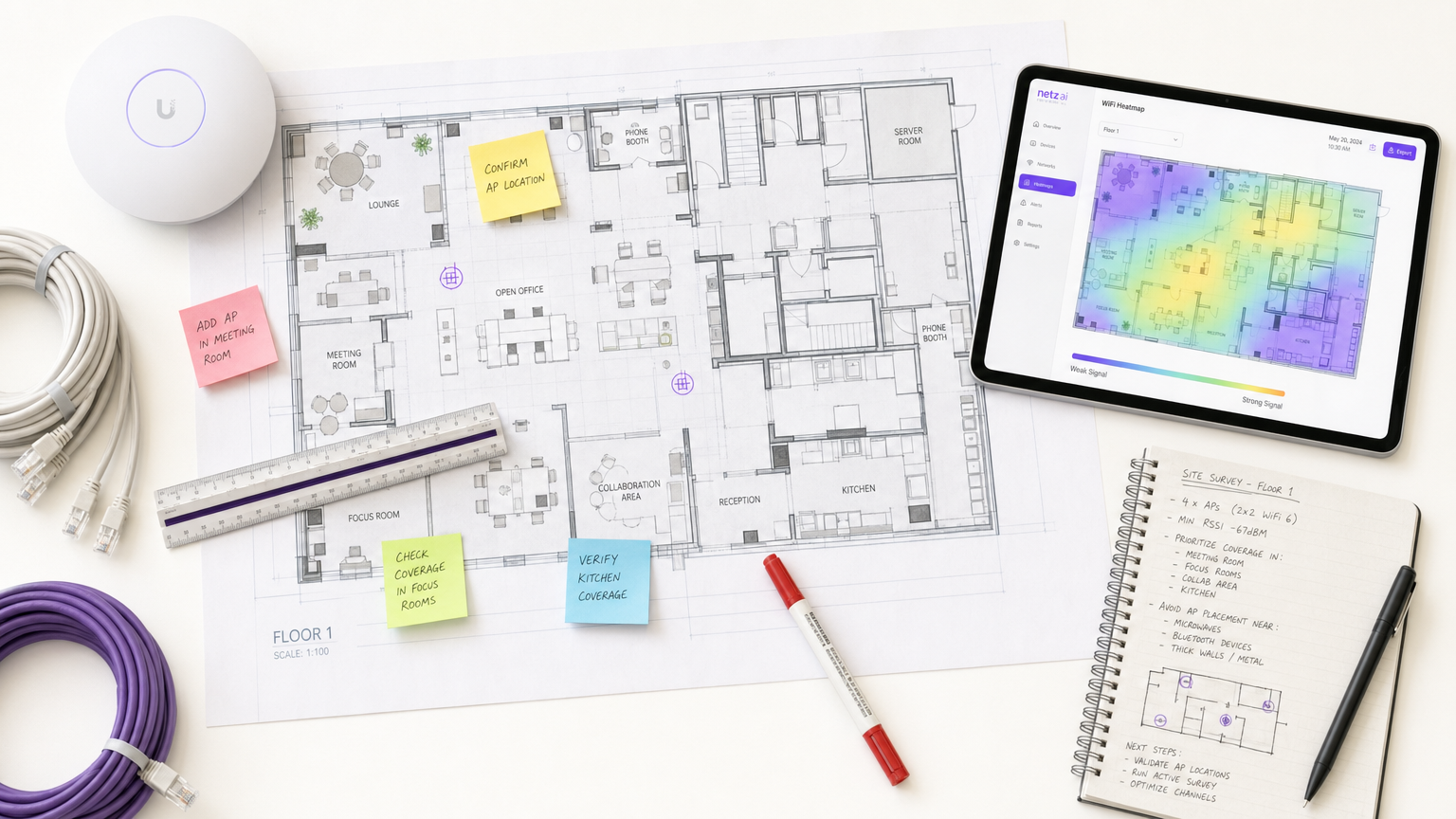
WiFi survey software is the essential tool for mitigating this risk. It allows network architects to measure, map, and model the radio frequency (RF) environment, translating invisible signal propagation into actionable heatmaps. This guide outlines the core mechanics of WiFi site surveys, details the critical metrics required for high-density environments, and provides a vendor-neutral implementation framework to ensure your wireless infrastructure delivers consistent, high-performance connectivity.
Technical Deep-Dive
WiFi site survey software transforms raw RF data into visual heatmaps, enabling precise network engineering. Understanding the distinct types of surveys and the metrics they capture is fundamental to effective network design.
Types of WiFi Surveys
- Passive Survey: The survey device listens to the RF environment without associating with an access point (AP). It captures beacon frames, measures Received Signal Strength Indicator (RSSI) across all visible APs, and logs data against floor plan coordinates. This establishes your baseline and identifies rogue APs or external interference.
- Active Survey: The survey device connects to the network to perform real-world throughput tests (UDP and TCP). This measures actual data rates, packet loss, and latency. Active surveys are non-negotiable for venues supporting real-time applications such as video conferencing or IoT sensor networks.
- Predictive (Virtual) Survey: Using the software, engineers import a floor plan, define construction materials (e.g., concrete, glass), and assign attenuation values. The software models RF propagation before any hardware is installed. This is critical for greenfield deployments to prevent over- or under-provisioning.
Critical RF Metrics
To ensure a robust deployment, your survey must evaluate the following metrics:
- RSSI (Received Signal Strength Indicator): Measured in dBm. A minimum of -70 dBm is required for general connectivity, while -67 dBm or better is necessary for voice and video applications.
- Signal-to-Noise Ratio (SNR): The difference between the signal level and the background noise floor. A minimum of 25 dB SNR is required for reliable operation, scaling to 30 dB+ for high-density environments.
- Channel Utilisation: Measures how busy a radio channel is. High signal strength with high channel utilisation results in poor throughput due to airtime contention.
- Roaming Behaviour: Validating clean handoffs between APs using enterprise standards (IEEE 802.11r/k/v). Poor roaming is a primary cause of dropped connections in hospitality and campus environments.
- Co-Channel Interference (CCI): Overlapping coverage cells on the same channel. Survey software identifies these conflicts, allowing for channel and transmit power adjustments.
Implementation Guide
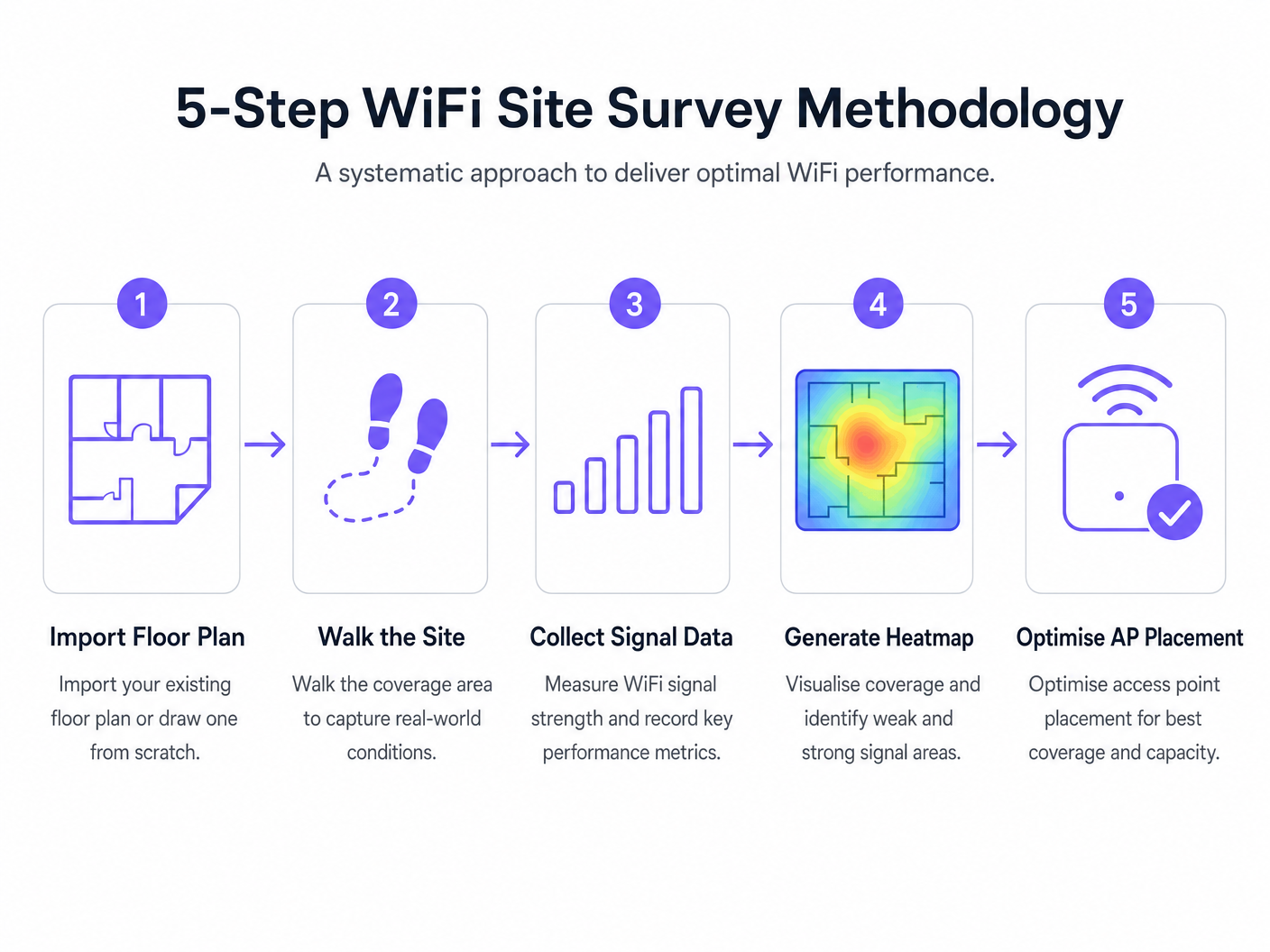
Deploying a wireless network requires a systematic approach. The following methodology ensures optimal AP placement and network performance.
- Pre-Deployment Predictive Survey: Always conduct a predictive survey before procuring hardware. Relying on generic vendor calculators often fails to account for structural RF shadows (e.g., concrete pillars, lift shafts).
- Validate with an Active Survey at Load: An empty venue does not reflect operational reality. Conduct active surveys under simulated or actual client load to measure performance in high-density scenarios.
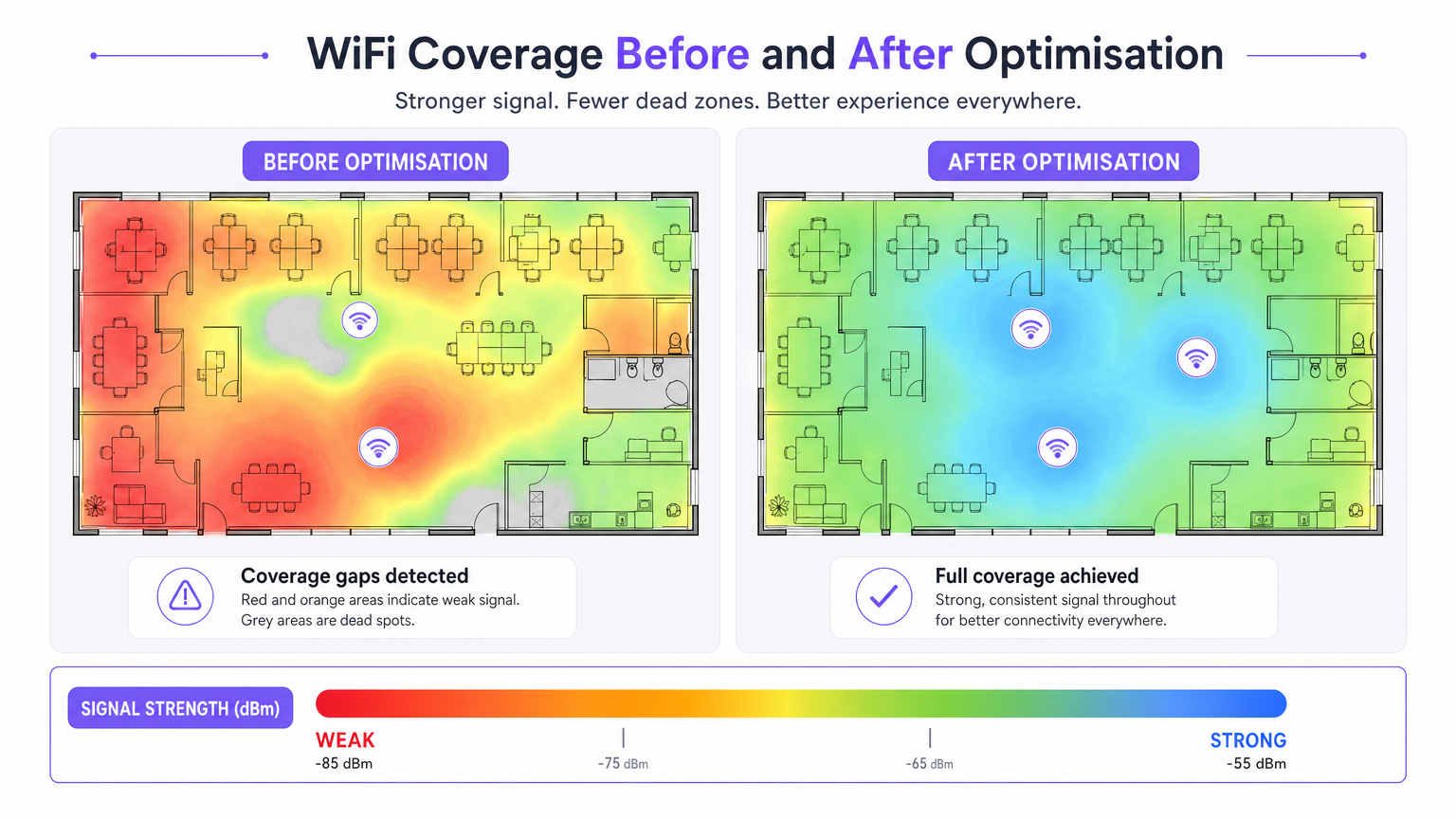
- Iterative Optimisation: After initial deployment, use active and passive surveys to fine-tune AP placement, channel assignments, and transmit power.
- Integration with Analytics: Connect your RF performance data to business intelligence platforms. Layering Guest WiFi and WiFi Analytics over a well-surveyed network allows you to correlate signal quality with visitor dwell time and footfall.
Best Practices
- Document Everything: A survey report is a living document. Any modification to AP locations, channel plans, or transmit power must be documented and re-surveyed to maintain an accurate baseline.
- Account for the 6 GHz Band: As deployments shift towards WiFi 6E and WiFi 7, survey methodologies must account for the 6 GHz spectrum, which offers lower interference but higher attenuation (shorter range).
- Establish a Survey Cadence: Treat site surveys as an ongoing operational practice. RF environments change due to new tenants, structural modifications, or seasonal occupancy shifts. High-density venues should adopt a quarterly cadence, while standard offices may require annual surveys.
Troubleshooting & Risk Mitigation
- Coverage Gaps (Dead Spots): Often caused by unforeseen structural attenuation. Mitigation: Rely on predictive surveys validated by post-deployment passive surveys.
- High Interference: Neighbouring networks or non-WiFi devices (e.g., microwaves, Bluetooth) raising the noise floor. Mitigation: Utilise spectrum analysis tools within your survey software to identify and avoid congested channels.
- Sticky Clients: Devices refusing to roam to a closer AP. Mitigation: Validate 802.11r/k/v configuration and ensure AP transmit power is not set too high, which can artificially inflate the perceived cell size.
ROI & Business Impact
The return on investment for professional WiFi survey software is measured in risk mitigation and operational efficiency.
- Capital Expenditure (CapEx) Optimisation: Predictive surveys prevent the costly over-provisioning of APs and switching infrastructure.
- Operational Expenditure (OpEx) Reduction: A properly surveyed network generates fewer support tickets and requires less time to troubleshoot.
- Revenue Enablement: In sectors like Retail and Hospitality , robust WiFi underpins digital engagement strategies, enabling accurate WiFi Footfall Analytics: How to Measure and Act on Visitor Data and targeted marketing campaigns.
Key Terms & Definitions
RSSI (Received Signal Strength Indicator)
A measurement of the power level being received by the client device's antenna.
Used to determine if a device is close enough to an AP to maintain a stable connection. Measured in negative decibels (dBm).
SNR (Signal-to-Noise Ratio)
The difference between the received wireless signal strength and the background RF noise.
Crucial for determining data throughput. A high SNR means a clean signal capable of supporting high data rates.
Channel Utilisation
The percentage of time a specific WiFi channel is busy transmitting data or handling interference.
High utilisation leads to network congestion and slow speeds, even if the signal strength is excellent.
Co-Channel Interference (CCI)
Interference caused when two or more APs are transmitting on the exact same channel within hearing distance of each other.
Forces APs and clients to wait their turn to transmit, severely degrading network capacity.
Attenuation
The loss of signal strength as RF waves pass through physical obstacles like walls, doors, or human bodies.
Must be accurately modelled in predictive surveys to ensure adequate coverage post-installation.
Sticky Client
A wireless device that remains connected to an AP even when a closer, stronger AP is available.
Often caused by poor roaming configuration or AP transmit power being set too high.
Predictive Survey
A software-based simulation of RF coverage using a floor plan and defined building materials, performed before hardware installation.
Used to estimate the number and placement of APs required for a new deployment.
Active Survey
A site survey where the device connects to the network to measure actual data throughput, latency, and packet loss.
Essential for validating the real-world performance of the network for the end-user.
Case Studies
A 200-room hotel is experiencing frequent dropped WiFi calls when guests walk from the lobby to their rooms. The IT manager suspects a coverage issue, but the dashboard shows all APs are online.
- Conduct an active survey walking the exact path guests take from the lobby to the rooms.
- Monitor the roaming behaviour specifically looking for IEEE 802.11r (Fast BSS Transition) handoffs.
- Analyse the RSSI overlap between the lobby APs and the corridor APs.
- Adjust the transmit power of the lobby APs down slightly to encourage client devices to roam sooner, rather than 'sticking' to the lobby AP until the signal drops completely.
A large retail chain is rolling out a new inventory management system that relies on handheld scanners. They need to ensure seamless coverage across a 50,000 sq ft warehouse with high metal shelving.
- Perform a predictive survey importing the warehouse floor plan and explicitly defining the metal shelving as high-attenuation obstacles.
- Design the AP layout using directional antennas positioned down the aisles, rather than omnidirectional antennas that would bounce signals off the metal racks.
- Post-installation, conduct a passive survey to validate the coverage cell boundaries and ensure a minimum RSSI of -67 dBm in all aisles.
Scenario Analysis
Q1. You are reviewing a site survey report for a new corporate office. The RSSI in the main boardroom is excellent (-55 dBm), but the SNR is only 12 dB. What is the likely impact on user experience, and what should be your next troubleshooting step?
💡 Hint:Consider the relationship between signal strength and background noise.
Show Recommended Approach
Despite the strong signal, the low SNR (12 dB) indicates a high noise floor, likely due to interference. Users will experience slow speeds, dropped packets, and poor video call quality. The next step is to use a spectrum analyser to identify the source of the interference (e.g., a neighbouring network on the same channel, or non-WiFi devices) and change the AP's channel assignment.
Q2. A stadium deployment requires APs to be mounted 15 metres high in the roof structure. Should you use omnidirectional or directional antennas, and why?
💡 Hint:Think about how RF energy propagates from different antenna types over long distances.
Show Recommended Approach
You should use directional antennas. Omnidirectional antennas broadcast energy in all directions (like a lightbulb), which would waste signal propagating upwards and cause massive co-channel interference across the stadium seating. Directional antennas focus the RF energy downwards into specific seating sectors (like a spotlight), increasing signal strength for users and reducing interference between APs.
Q3. During a post-installation active survey in a hospital, you notice that devices are not roaming smoothly between APs in the corridors, leading to dropped VoIP calls for nurses. What specific configuration should you verify on the wireless controller?
💡 Hint:Look for enterprise roaming standards.
Show Recommended Approach
You should verify that IEEE 802.11r (Fast BSS Transition), 802.11k (Radio Resource Measurement), and 802.11v (BSS Transition Management) are enabled and supported by the client devices. Additionally, check that the AP transmit power is not set too high, which can create artificially large coverage cells and cause 'sticky clients'.




