You can tell when a restaurant's Facebook spend is drifting off course. The dashboard shows clicks, the ads are getting comments, and the agency is sending neat weekly reports, but the dining room still isn't fuller on the nights that matter. That gap is where most facebook ads for restaurants break down, because the platform can optimize for easy activity while the venue only cares about covers, bookings, orders, and repeat visits.
A lot of operators get pulled into the same pattern, broad interest stacks, lookalikes, boosted posts, and last-click ROAS as the headline number. That setup can look tidy in Ads Manager and still miss the actual outcome at the host stand. If you're comparing what Meta reports with what your POS and reservation system show, the problem usually isn't “Facebook doesn't work,” it's that the campaign was built to win the wrong game. For a useful external reference on the usual agency playbook, see AdManage.ai restaurant ad tips, then come back to the harder question, which is how to make paid social answer to the venue instead of the dashboard.
Table of Contents
- Why Most Restaurant Facebook Campaigns Underperform
- How Diners Actually Decide Where to Eat
- Planning Campaigns Around Venue Outcomes
- Building Audiences From Real Guest Data
- Creative That Does the Real Segmentation Work
- Measuring Incremental Visits Instead of Clicks
- Launch Checklist and Decision Rules for Scaling
Why Most Restaurant Facebook Campaigns Underperform
A restaurant manager opens Meta on Monday morning and sees a clean story, plenty of link clicks, a low cost per result, maybe even a few comments from people tagging their dinner group. Then the floor manager asks whether Friday covers improved, and the answer is fuzzy. That's the normal failure mode: the campaign is optimized around what's easiest to generate, not what the restaurant can bank.
The industry pattern is clear. Restaurant and bar advertising on Facebook expanded sharply in 2021, and quick-service restaurants were a major driver of that growth, which shows the platform had already become a scaled acquisition channel rather than a side experiment (MenuTiger restaurant marketing statistics). The mistake many teams still make is treating every venue goal as if it were one audience problem. A reservations push, a delivery push, and a lapsed-guest win-back campaign do not deserve the same structure, the same creative, or the same success metric.
What breaks the standard playbook
The usual setup leans on interest stacks, lookalikes, and last-click ROAS. That can be fine for ecommerce, where the click and the sale live on the same page, but restaurants close the loop offline, in booking systems, on phone calls, at the host stand, and at the register. Meta can only optimize for the signal you hand it, so if you hand it cheap traffic or low-friction leads, that's what it will hunt.
Practical rule: if the campaign brief can't name the venue outcome in one sentence, the media plan is too vague.
A restaurant campaign needs a different setup for each job. Acquisition campaigns should exclude recent customers. Win-back campaigns should target guests with a clear lapse condition. Event campaigns should optimize for registrations or ticket sales, not generic awareness. When teams blend all of that into one “promote the restaurant” campaign, the algorithm usually finds the easiest conversion and starves the outcome that matters.
How Diners Actually Decide Where to Eat
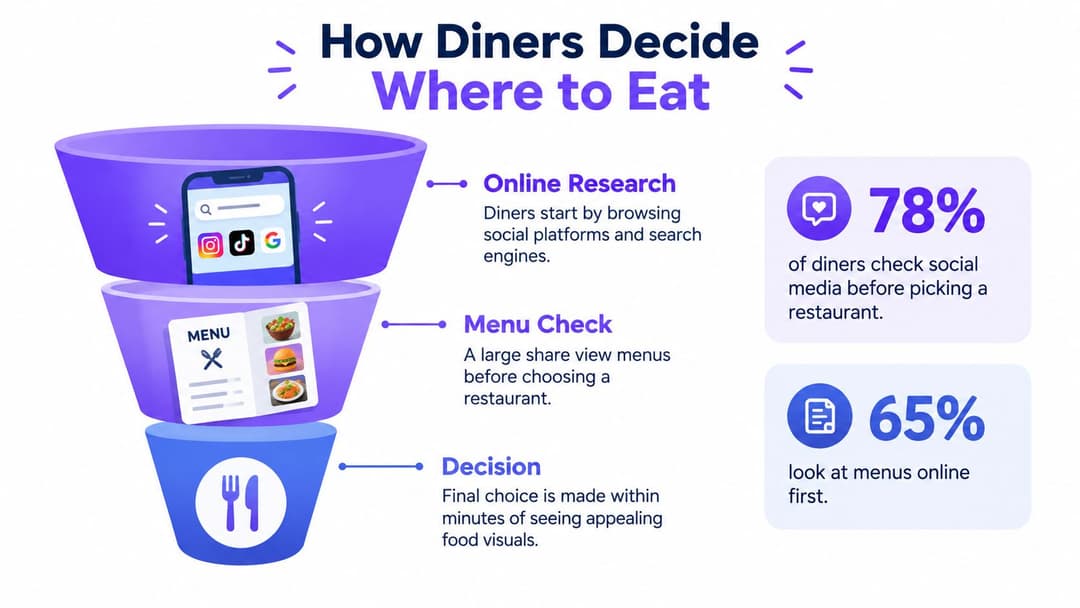
Restaurant ads work when they show up during the choice itself. Diners are already checking options, scanning menus, and comparing venues before they commit, and 90% of diners research restaurants online before selecting a venue (FoodShot social media advertising restaurants). A Facebook ad is often part of that decision, not just a reminder after the fact.
Social is part of the menu check
Social platforms now act like a pre-visit menu board. 72% use social platforms such as Facebook, Instagram, and Twitter to discover dining options, inspect menus, and judge reviews and updates (FoodShot social media advertising restaurants). That means your creative has to answer the questions guests are already asking: what is available, when can I come, and why choose this place now.
The response can be immediate. 57% of people reported taking an action after seeing a restaurant's social-media post, and 45% reported ordering food through a restaurant's social-media page (FoodShot social media advertising restaurants). For restaurants, that is the value of Facebook ads, because they can move someone from browsing to booking, ordering, or visiting in the same session.
Creative should show useful proof
The strongest ads usually show one of three things, a menu item, a time-sensitive offer, or a reason to visit now. If the goal is bookings, show table availability and a clear path to reserve. If the goal is redemptions, show the offer plainly and make the next step obvious. If the goal is orders, show the menu and remove as much friction as possible.
Diners do not reward cleverness when they are deciding where to eat. They reward clarity, appetite, and convenience.
For restaurants, the scoreboard is concrete venue behavior, reservations, redemptions, visits, and orders. Reach and engagement can support those outcomes, but they do not replace them.
Planning Campaigns Around Venue Outcomes
Start with the outcome, not the ad format. A campaign built to drive completed bookings should not share a structure with one built to win back lapsed guests, because the audience, offer, and conversion event are different. The same logic applies to delivery orders and ticketed events.
Separate campaigns by what success looks like
Use one campaign for one measurable outcome. If a venue wants bookings, optimize against the booking confirmation page. If it wants delivery orders, optimize against the paid-order confirmation page. If it wants event attendance, optimize for ticket sales or registrations. If it wants a win-back campaign, define the audience as lapsed and the conversion as a return visit or purchase.
Here's the planning split I'd use in practice:
| Venue outcome | Primary conversion | Audience focus |
|---|---|---|
| Bookings | Completed reservation | Nearby prospects and high-intent visitors |
| Delivery orders | Paid order | Local acquisition plus past non-buyers |
| Lapsed-guest win-back | Repeat visit or return purchase | Consent-based guest list with a lapse rule |
| Special events | Ticket sale or registration | Local diners, subscribers, and prior attendees |
That structure prevents Meta from optimizing the whole budget toward the easiest signal. If reservations and delivery sit in the same campaign, the system may spend where conversions come cheapest, even if that drains the more valuable channel.
Put the tracking in place before launch
The basic setup is essential. Install and validate the Meta Pixel and Conversions API on the relevant confirmation page, define one primary conversion, and constrain the audience geographically around each venue. If the objective is acquisition, exclude recent purchasers so the ads are not paying to reacquire people who were already going to return.
This is also the place to decide how the campaign will be judged. If the team can't report cost per completed booking, cost per paid order, or revenue tied to the venue outcome, the launch is too early. Use the ad account to drive the signal, then use the venue systems to verify it.
Building Audiences From Real Guest Data
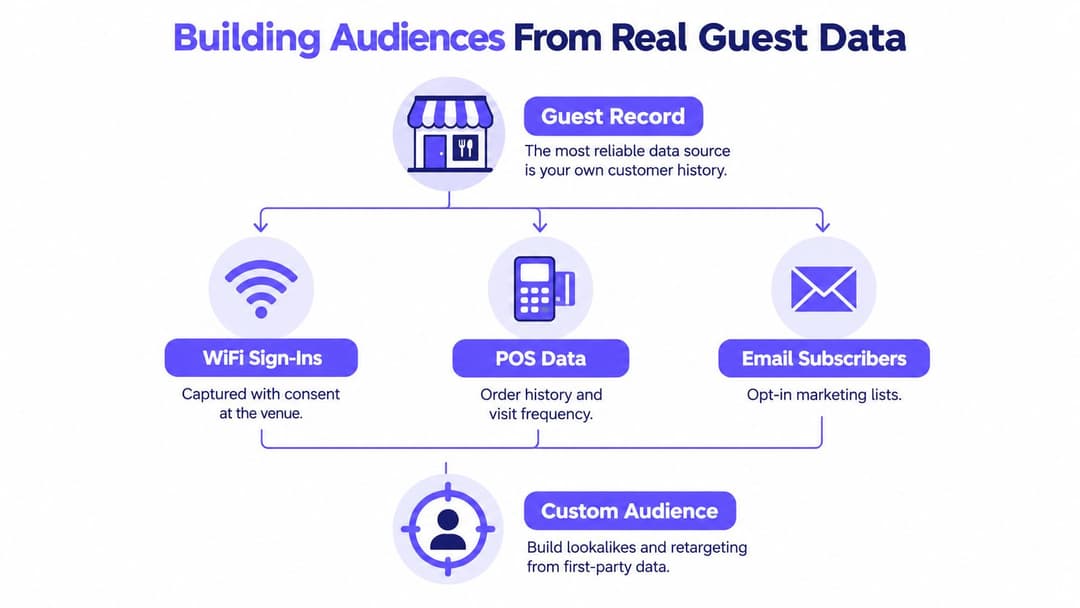
The strongest audience source is usually already in your system. A consented guest record from WiFi sign-ins, bookings, POS history, hotel stays, or email subscribers will usually beat a stack of vague interest categories, because it reflects actual behavior instead of inferred taste. That matters even more now that broader targeting is more dependable than narrow interest chasing.
Build from consented records, then layer behavior
Start with guest data you're allowed to use. WiFi sign-ins, POS receipts, reservations, and opt-in email lists can all become audience seeds when the consent trail is clean. From there, apply behavioral rules that matter operationally, such as no visit in the last 45 days, booked but not redeemed, or high spend in a recent period.
The practical value of those rules is that they map to real revenue opportunities. A lapsed regular doesn't need broad awareness. A VIP guest may deserve a different offer than a first-time prospect. A booked-but-not-redeemed guest needs a different message than someone who has never visited.
Let the customer record do the targeting work
A venue marketing platform can help if it supports one unified guest record. Purple Engage is one option here, because it combines WiFi, POS, booking, and stay data into audience segments that can be used for consented Meta ad targeting. The important point isn't the tool itself, the method, one history per guest, one consent ledger, one audience rule set.
For Facebook ads for restaurants, the best structure is usually:
- Geo radius first: keep the venue radius tight enough to match real travel behavior.
- First-party audiences next: build from consented guest history instead of broad interests.
- Lookalikes last: use high-value guest seeds to expand reach without losing local relevance.
- Recent redeemer exclusions: stop acquisition spend from subsidizing existing demand.
Purple Engage's Meta custom audience guidance is useful if you're mapping WiFi and venue data into those audiences. The objective is simple, make targeting do the bidding of the operator, not the other way around.
Creative That Does the Real Segmentation Work
Once the audience structure is cleaner, creative has to carry more of the job. If you're running one hero image across lunch, dinner, events, and win-back, the ad is doing too much with too little context. The better approach is to brief creative around the occasion.
Match the format to the visit reason
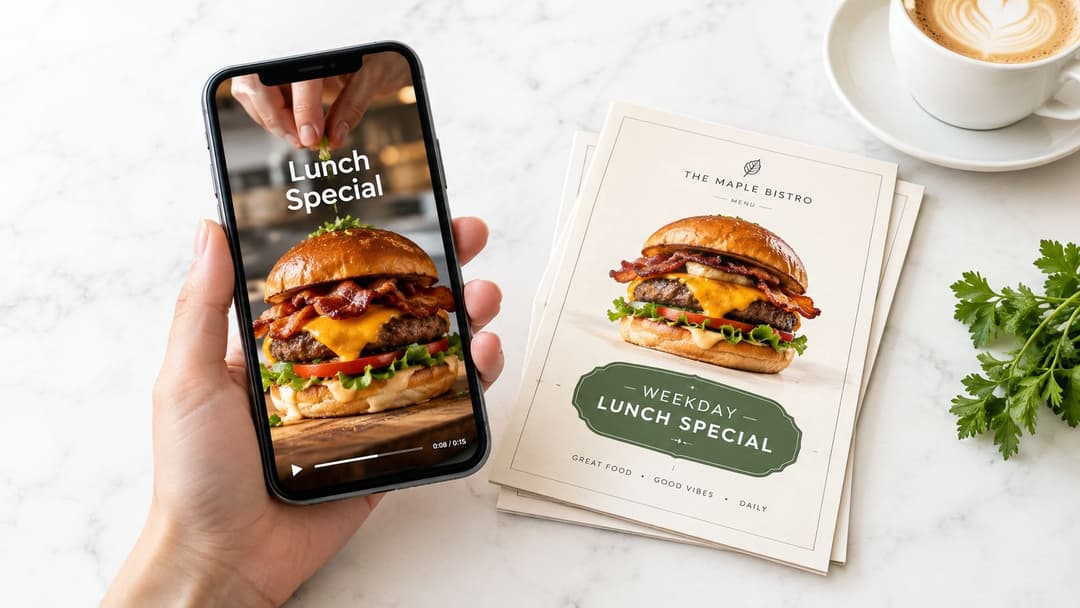
Short vertical video works well when the food has motion, steam, pouring drinks, a busy bar, a plated special. Carousel ads fit menu breadth, because you can show an appetizer, an entree, dessert, or different offers in one unit. Offer-led formats are better when the action needs urgency, such as a lunch special, weekday value, or a return-visit incentive.
Creative rule: the first frame should tell a hungry person why the ad is relevant right now.
That means the opening needs one clear cue, not five. If it's weekday lunch, say it and show the dish. If it's family dining, show the setting and a practical benefit. If it's an event, show the date and the reason to care. If it's a lapsed-guest win-back, the message should feel personal and time-aware, not generic.
Test the ad against the outcome
The only creative test that matters is the one tied to venue behavior. Run short vertical video, a menu-led carousel, and an offer-led format against the same audience with identical budgets, then compare the incremental bookings, redemptions, or visits they generate. A strong CTR with no lift at the venue isn't a win.
The video below is a good reference point for how Meta assets need to feel on cell phones.
Measuring Incremental Visits Instead of Clicks
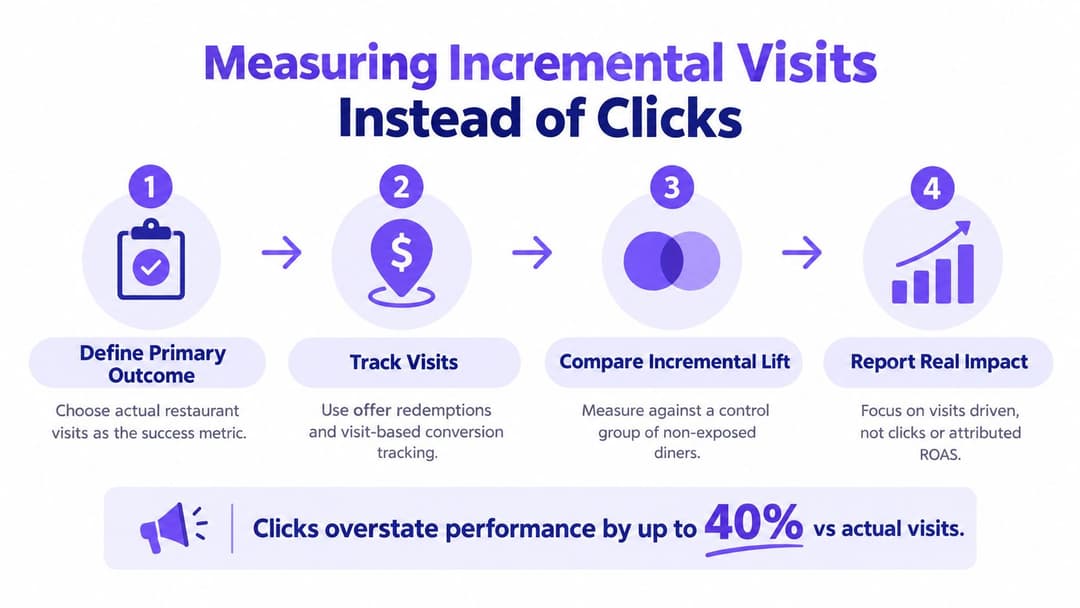
Clicks can flatter a campaign that never moved the business. A reservation click is not the same thing as an incremental visit, and a platform-attributed purchase is not always a sale that the ad caused. That's why restaurant measurement has to start with the outcome the venue wants, then work backward into the tracking setup.
Define the outcome before launch
Choose one primary metric before the campaign goes live, incremental covers, first-time guests, bookings, or revenue. Then attach campaign-specific signals that can help verify it, such as QR codes, reservation-source fields, offer redemptions, and matched POS or booking records. If the ad is driving people to a booking engine, the tracking should support that path, not just collect a web visit.
Purple Engage's Meta Conversions API guidance is relevant if you're wiring Meta to better event quality from venue systems. The point is to preserve signal quality, not to pretend every click is a guest.
Use holdouts when you can
The cleanest test is a deliberate holdout. Keep one audience exposed and one withheld over the same period, then compare incremental visits or purchases instead of trusting attributed revenue alone. That's the best way to see whether the campaign brought in new demand or just claimed credit for people who were already coming.
Important: a lower reported ROAS can still be the better campaign if it drives more new guests.
Common failure modes are predictable. Teams retarget existing customers as if they were new demand. They promote discounts without margin guardrails. They exclude offline sales from the measurement view. They forget to suppress converted users and end up paying twice for the same guest. Those mistakes can make a dashboard look efficient while the venue margin gets worse.
Meta's own newer measurement direction, including lift-style thinking and privacy-aware analysis, points in the same direction, closer to incremental impact and less dependence on last-click reporting (PPC Land on Meta measurement direction). That's the right model for restaurants too, because the sale often happens outside the browser window.
Launch Checklist and Decision Rules for Scaling
A restaurant Meta launch works best as a controlled venue test, not a one-day ad blast. In the first two weeks, validate the pixel and Conversion API, confirm the right confirmation page is firing, and build the audience from consented guest data. In week three, run the creative against one audience with clean budget splits. In week four, review the result against the venue outcome you chose at the start.
What to do in the first 30 days
Use a simple sequence.
- Weeks one and two. Validate tracking and build the audience set. Check exclusions, consent, and event quality.
- Week three. Run the creative flight with one goal and one primary conversion.
- Week four. Compare platform results with POS, booking, or redemption records.
If you want a broader launch discipline to borrow from outside hospitality, the guide to turning leads into booked jobs is a useful reminder that the handoff from interest to confirmed outcome has to be designed, not assumed. Restaurants need the same discipline, just with covers instead of jobs.
When to scale, hold, or pause
Scale only when incremental profit after food, labor, discount, and ad costs stays positive across repeated tests. Hold when the ads look efficient in-platform but you cannot verify the venue outcome. Pause when frequency keeps rising while incremental visits stall. That pattern usually means the audience is saturated or the offer has gone stale.
Guardrails matter too. Make sure guest consent is explicit, opt-out handling is durable, and converted users are suppressed from acquisition campaigns. Keep bookkeeping separate from measurement, because revenue recognition and incremental lift are not the same thing.
If you manage multiple venues and want a cleaner way to connect guest data, audience building, and Meta measurement in one place, see Purple Engage Meta Ads integration, which supports those workflows for venue teams.