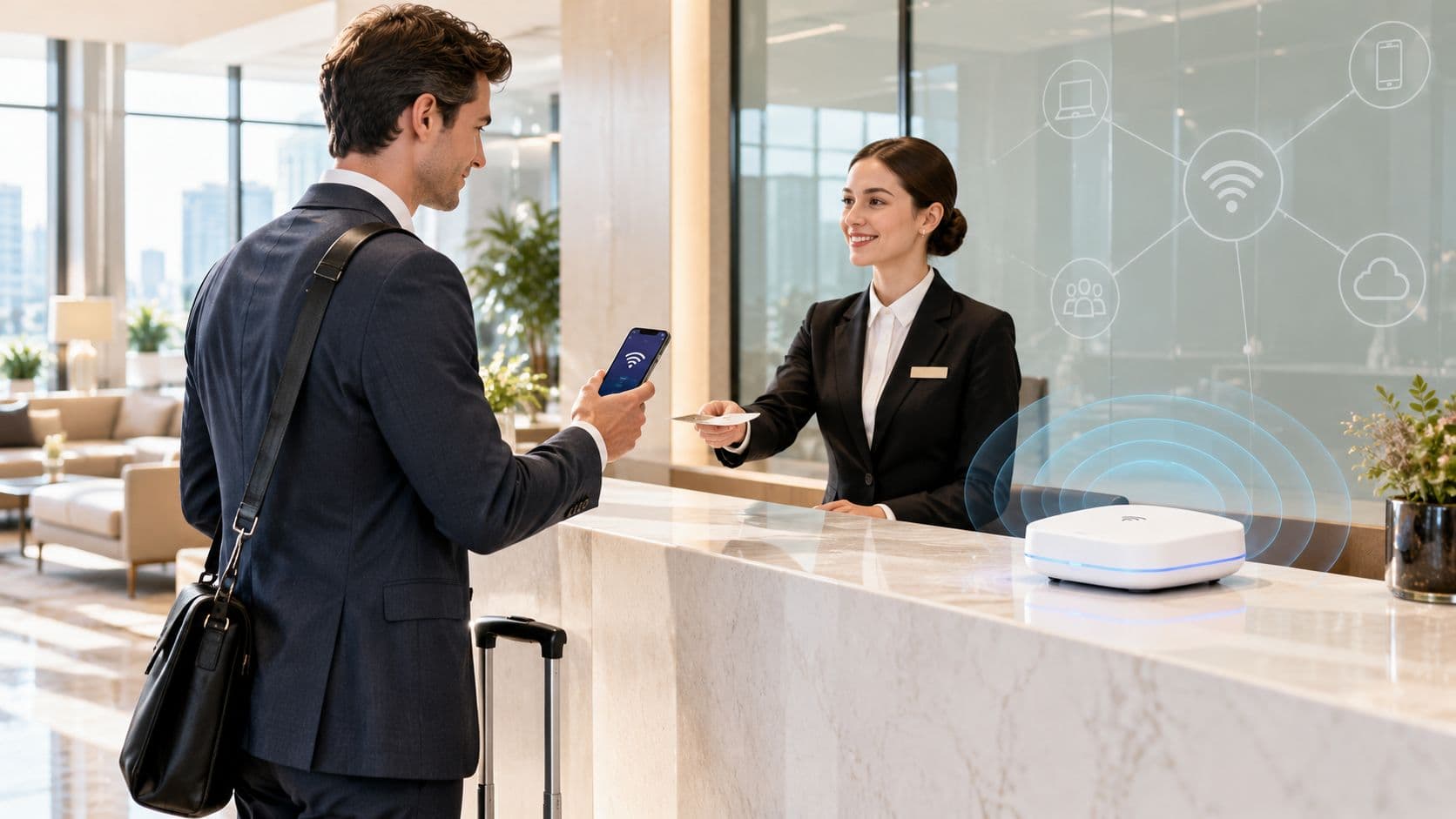
Providing public WiFi has evolved from an optional venue perk into an essential operational standard across retail stores, hospitality venues, healthcare facilities, transit hubs, and public spaces. However, opening an unmanaged wireless network to thousands of visiting devices creates distinct legal responsibilities for businesses under US law.
Venue operators that offer guest connectivity are accountable for how guest data is processed, how internet traffic is monitored, and how illegal online activity is prevented. Failure to satisfy statutory standards under the CCPA/CPRA, and telecommunications security laws exposes organizations to regulatory penalties, enforcement notices, and reputational risk. Understanding the legal landscape ensures venue owners provide seamless internet access while remaining 100% compliant.
Key US legal frameworks for public WiFi providers
When an organization provides internet access to customers, visitors, or contractors, it operates under several distinct regulatory regimes. The following matrix summarizes the core legal obligations applicable to public WiFi networks in the US.
| Legal domain | Statutory regulation | Key compliance requirement | Compliance solution |
|---|---|---|---|
| Data Privacy & Consent | CCPA/CPRA & state privacy laws | Transparent privacy notices, explicit consent for marketing, data minimization, and secure storage. | Branded captive portal with double opt-in consent checkboxes. |
| Network Security & Infrastructure | FCC Part 15 & state cybersecurity laws | Elimination of default passwords, isolated VLAN segmentation, and timely security patching. | Enterprise access point management with dynamic WPA3 / IPSK keys. |
| Content Safety & Duty of Care | CIPA Standards | Mandatory blocking of illegal child sexual abuse material (CSAM) and harmful content categories. | Automated DNS web filtering and CIPA compliant URL blocklists. |
| Log Retention & Law Enforcement | Electronic Communications Privacy Act (ECPA) | Retention of connection metadata (MAC addresses, IP assignments, timestamps) upon statutory request. | Centralized Cloud RADIUS authentication syslog archives. |
| Copyright & Liability Protection | Digital Millennium Copyright Act (DMCA) | Shielding venue operators from secondary liability for illegal peer-to-peer file sharing. | Mandatory clickthrough Terms of Service (ToS) and P2P port blocking. |
1. CCPA/CPRA and state data privacy compliance
Whenever a venue operates a public WiFi service that captures personal data - such as user names, email addresses, phone numbers, social login profiles, or MAC addresses - the business acts as a data controller under the FTC and state attorneys general guidelines.
To remain compliant under CCPA/CPRA, public WiFi networks must implement four essential privacy safeguards:
- Explicit opt-in consent: Marketing consent checkboxes must be unselected by default. Guest access to basic internet cannot be made conditional on consenting to receiving promotional newsletters.
- Clear privacy notices: Captive portal splash pages must present a prominent link to the venue's privacy policy, detailing who is collecting the data, why it is processed, and how long it is retained.
- Right to erasure and access: Users must be provided with a straightforward mechanism to exercise their Subject Access Rights or request immediate deletion of their personal details.
- Robust security controls: All captured user credentials and connection metadata must be encrypted both in transit (using HTTPS/TLS) and at rest within ISO 27001-certified cloud infrastructure.
For detailed technical architecture on securing user authentication data, explore our comprehensive enterprise WiFi security guide.
2. Content filtering and duty of care
Public venues, particularly those frequented by families, young adults, or vulnerable individuals, have a legal and moral duty of care to prevent guest networks from being used to access illegal or inappropriate digital material.
The US government and regulatory bodies strongly encourage all public internet providers to deploy automated content filtering aligned with Internet Watch Foundation (IWF) blocklists. Effective web filtering should block:
- Child sexual abuse material (CSAM) and illegal domains identified by law enforcement.
- Malicious phishing, malware distribution, and botnet command-and-control servers.
- Adult content, gambling portals, and illegal file-sharing sites in family-oriented venues.
Deploying cloud-managed DNS filtering ensures these safety policies update automatically without slowing down network performance for legitimate visitors.
3. User identification, connection logging, and the FTC requirements
Unrestricted open WiFi networks with zero user authentication present significant security risks, as anonymous bad actors can utilize the venue's internet connection for illegal activities. If law enforcement agencies investigate illegal activity originating from a venue's public IP address, the venue owner may receive a statutory request for information.
Under US communications laws, public communications providers may be required to maintain connection records. While small venue owners are not expected to inspect packet contents, best practice dictates implementing user identification via a captive portal solution.
By recording user authentication details alongside assigned internal IP addresses, MAC addresses, and connection timestamps, venues can provide law enforcement with accurate audit trails without invading individual user browsing privacy.
4. Protecting your venue against copyright infringement liability
Under federal copyright laws, including the DMCA, copyright holders monitor public networks for unauthorized downloading or streaming of copyrighted media. If a guest uses a coffee shop or hotel WiFi network to download torrents illegally, the venue owner receives the infringement notice as the registered broadband account holder.
To defend against secondary liability, venue operators must demonstrate reasonable preventative steps:
- Mandatory Terms of Service (ToS): Force every user to review and accept clear terms prohibiting illegal downloading before network access is granted.
- Protocol and port blocking: Block known peer-to-peer (P2P) file sharing protocols, BitTorrent ports, and unauthorized VPN tunnels at the firewall level.
- Bandwidth throttling: Limit individual session speeds to prevent high-bandwidth illegal file downloads while preserving smooth web browsing and video streaming for legitimate users.
5. Hardware security and SOC 2 Type II compliance
The FCC and state regulations enforce strict security standards on network hardware connected to public infrastructure. Venues must ensure their wireless access points and routers meet three fundamental technical criteria:
- No default credentials: Access points must not utilize universal factory passwords (such as "admin/admin").
- Vulnerability reporting policy: Hardware vendors must maintain a published policy for reporting software security flaws.
- Defined security update window: Network equipment must receive regular firmware patches throughout its deployed lifecycle.
Modern cloud-managed WiFi architectures automate these security updates across all access points, eliminating manual administrative burdens for IT managers.
Conclusion: Building a compliant and secure guest WiFi experience
Offering public WiFi offers massive benefits for venue owners, unlocking customer analytics, digital marketing channels, and improved visitor retention. However, long-term success requires embedding legal compliance directly into network design.
By partnering with an enterprise captive portal provider like Purple, venue operators automatically enforce CCPA/CPRA consent, apply IWF-aligned DNS content filtering, and maintain secure access logs while delivering an effortless, high-speed connection for guests.