A hotel manager notices the pattern every week. Guests connect to the venue WiFi, browse the restaurant menu, and leave. The CRM records a handful of email addresses, but nobody has time to identify who visited for the first time, who returns regularly, or who has stopped coming. Marketing sends the same campaign to everyone, while the network team sees useful activity that never reaches the customer journey.
Marketing automation in CRM closes that gap. It connects customer identity, behavior, consent, timing, and commercial outcomes so a visit can lead to a relevant welcome message, a loyalty prompt, a feedback request, or a carefully timed return offer. The important shift is not sending more messages. It's using reliable, first-party signals to decide which action deserves to happen next.
Why Marketing Automation in CRM Matters Right Now
Manual follow-up breaks down because customer activity happens faster than teams can interpret it. A restaurant may recognize a regular by face, but its CRM may not know that the same visitor connected to WiFi across several locations. A shopping center may collect newsletter registrations, yet lack a dependable way to distinguish a first visit from a returning customer. A residential operator may have tenant records, property data, and service requests in separate systems.
Automation turns those fragments into an operating rhythm. A verified profile enters the CRM, an event updates its lifecycle stage, and a rule selects the next appropriate action. The message might be a welcome email after an initial connection, a survey after a visit, or a reactivation journey for someone whose behavior indicates that they're no longer returning. The workflow only becomes useful when the underlying identity and consent records are trustworthy.
The commercial context is significant. The US marketing automation market was valued at about USD 3.37 billion in 2025 and is projected to reach roughly USD 5.36 billion by 2030, implying a 9.7% CAGR, according to US marketing automation market analysis. The source identifies reporting, analytics, and email marketing as major solution areas, which aligns with the way CRM-linked automation is moving beyond basic contact storage towards segmented journeys and performance tracking.
The practical question is no longer whether to automate. It's whether the trigger is reliable enough to justify an automated response.
By the end of this guide, you'll have a clearer way to separate the CRM's role from the automation layer, evaluate integration patterns, design WiFi-led journeys, and decide when a workflow should remain manual. The focus is venue data because an authenticated visit can provide a valuable first-party signal, provided the business handles consent, identity matching, and message frequency properly.
How Marketing Automation Works Inside Your CRM
Think of the CRM as a customer ledger. It stores the person or organization, contact details, history, preferences, lifecycle stage, and commercial interactions. Marketing automation acts like the operations manager reading that ledger, watching for changes, and applying rules without asking a team member to check every record manually.
A working system has several parts:
The identity record
The CRM profile contains fields such as email address, location, preferred venue, consent status, visit history, and lifecycle stage. Some fields describe the customer. Others describe what the customer has done. Keeping those categories distinct helps operators avoid treating an assumption, such as "loyal customer," as if it were a verified event.
The event
An event is something that happens. A visitor authenticates to WiFi, completes a form, attends an event, makes a purchase, answers a survey, or returns after a period of inactivity. An event should carry enough context for the CRM to record what occurred, where it occurred, and when it occurred.
The trigger and action
A trigger tells the automation engine when to start. The action tells it what to do. For example, a first authenticated connection can add a new contact to a welcome segment, while a post-visit survey response can update a preference field and route negative feedback to a service queue.
The decision logic
Rules prevent every customer from receiving the same treatment. The workflow can check consent, customer status, venue, previous contact, or recent message activity before selecting an email, SMS message, task, or suppression rule.
CRM stores the relationship. Automation applies timing and logic. A CDP, where used, helps unify identity and events before the CRM journey begins.
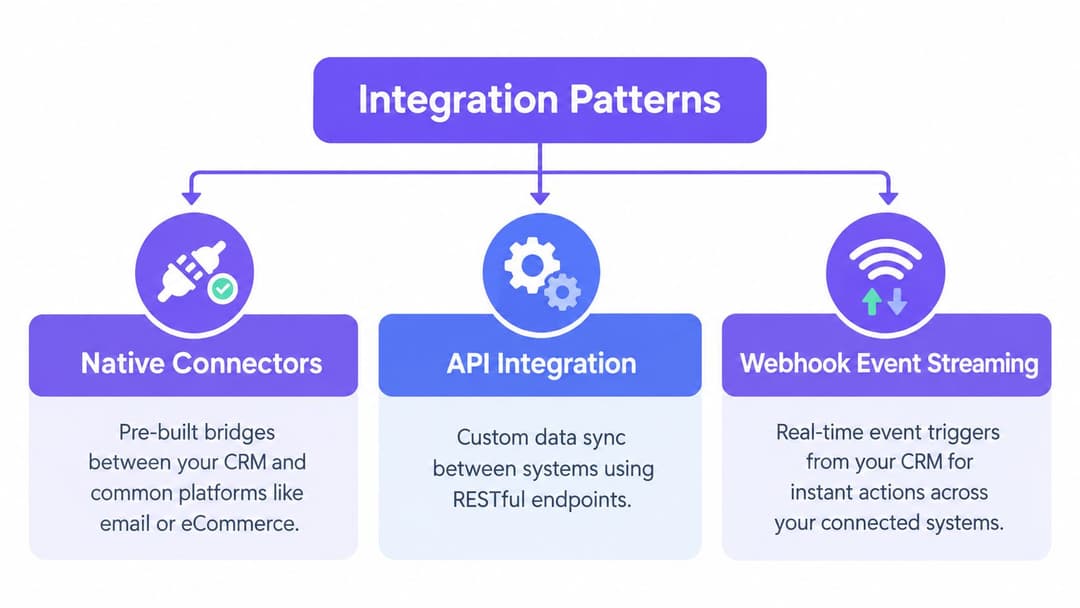
Integration architecture determines how quickly and safely those parts work together. The three common patterns are shown below.
For operators applying the model to property, hospitality, or residential environments, CRM workflow automation for real estate offers useful context on connecting lifecycle changes to practical follow-up. The principle applies across sectors, but the rule definitions should reflect the customer relationship. A hotel guest, patient, tenant, and retail visitor shouldn't share an identical journey because they appear in the same database.
Integration Patterns That Make Automation Reliable
A campaign builder can't compensate for weak data plumbing. If a visitor's consent status arrives late, the CRM has a duplicate profile, or the visit event never reaches the marketing platform, the workflow may make the wrong decision while appearing technically successful.
Native connectors
Native connectors are pre-built bridges between a CRM and common systems such as email platforms, commerce tools, forms, or survey applications. They're usually the quickest route to a working workflow because authentication, field mapping, and standard actions already exist.
Their limitation is coverage. A connector may pass contact creation and campaign membership but omit a venue-specific event, visit frequency, or consent change. Before relying on one, check which fields sync, which system owns each field, how updates are handled, and what happens when a record is deleted or merged.
API integration
An API integration gives technical teams more control. The CRM can receive a defined event, update a profile, request a segment, or return a delivery status through a structured interface. This is appropriate when the business has custom venue systems, multiple CRM objects, or rules that don't fit a standard connector.
The trade-off is maintenance. Your team must document field definitions, handle authentication securely, monitor failures, manage retries, and test changes when either platform updates its interface. An API can be reliable, but only when someone owns the contract between systems.
Webhook event streaming
Webhooks send an event when something happens, rather than waiting for a scheduled batch synchronization. That makes them useful for time-sensitive journeys, such as a welcome message after authentication or a service alert after a survey response. They also require careful handling of duplicate events, ordering, outages, and consent checks.
A CDP can sit between event sources and the CRM. The US customer data platform market was valued at USD 0.51 billion in 2025 and is projected to reach USD 1.87 billion by 2031 at a 24.67% CAGR, with the figures reflecting demand for identity resolution, real-time activation, and consent-managed orchestration in CRM-linked stacks, as reported in US customer data platform market research.
Identity resolution means deciding whether two records represent the same person. Deterministic matching, using a verified identifier such as an authenticated email address, is generally easier to govern than guessing from partial device or behavioral signals. Consent propagation means carrying the permission context with the profile and event, rather than assuming that a contact authorized for one purpose can receive every type of marketing.
Before adding another workflow, audit the following:
- Event freshness: Does the CRM receive the signal quickly enough for the journey?
- Identity quality: Can the system match a visit to the correct profile without creating duplicates?
- Consent visibility: Can the workflow read the current permission state before sending?
- Failure handling: Does a failed sync enter a monitored queue rather than disappear?
- Data minimization: Is each field necessary for the journey, or is the team collecting it because it might be useful later?
Teams connecting several customer systems can review the Purple connectors library alongside their existing CRM and marketing architecture. Email quality deserves similar attention. An Email Validation API can help a team assess whether addresses are deliverable before they become part of an automated audience, but validation doesn't replace consent or explain whether a person should receive a particular message.
Segmentation Triggers and Personalization in Practice
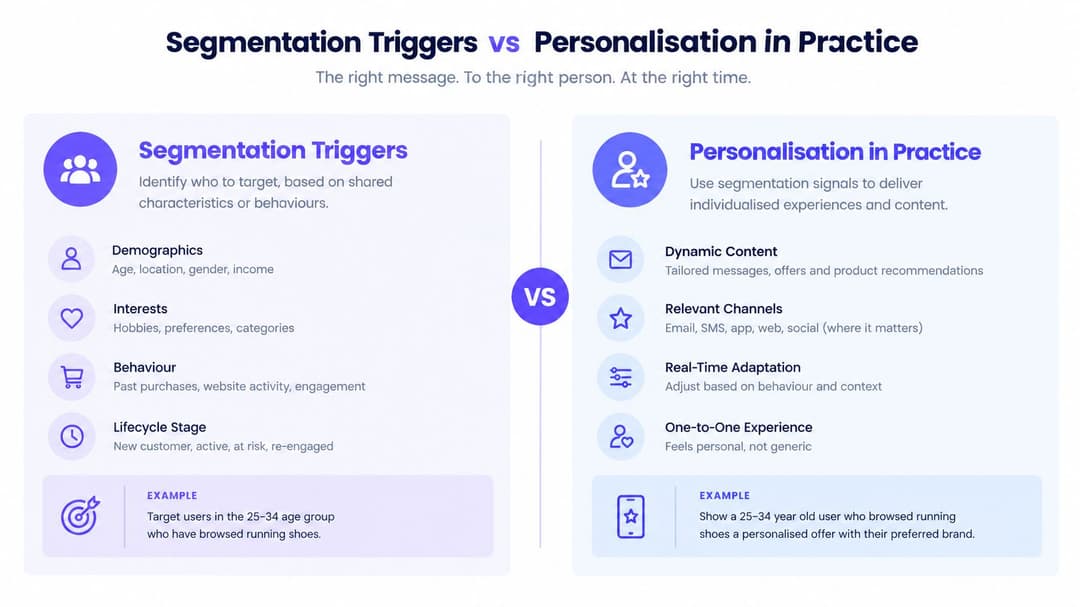
Segmentation, triggering, and personalization solve different problems. Confusing them produces workflows that are technically busy but commercially blunt.
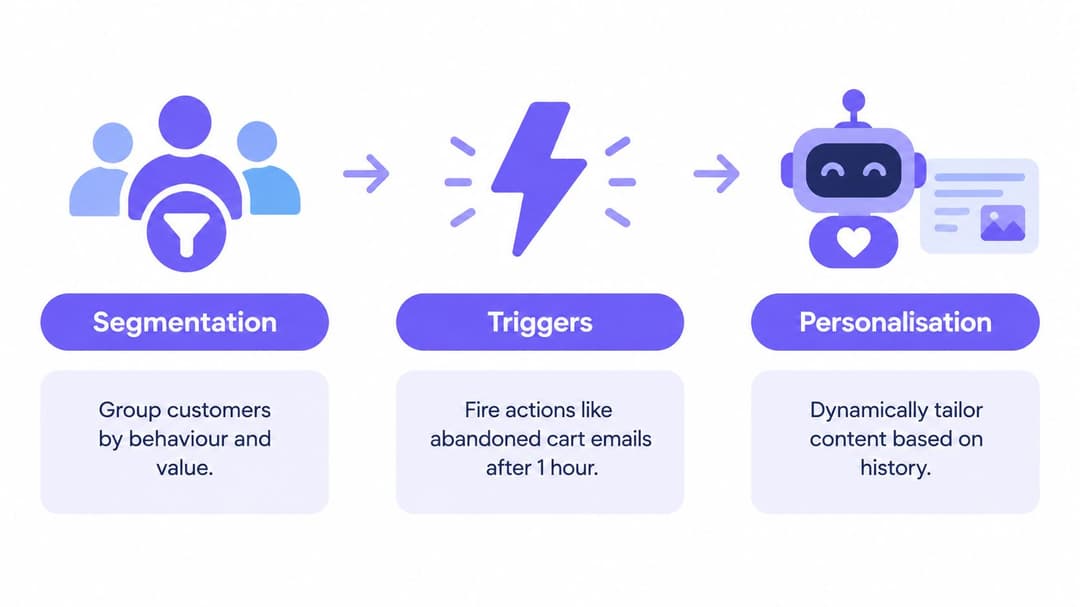
Segmentation answers, “Who belongs in this audience?” A venue might create groups for first-time visitors, returning guests, high-frequency users, customers who opted into offers, or visitors who have interacted with a particular location. Segments can be dynamic, which means a profile enters or leaves as its data changes.
Triggers answer, “When should the journey begin?” A first WiFi authentication, return visit, completed booking, lapsed pattern, or survey submission can start a workflow. The trigger should describe an event, not a vague label such as “engaged customer”.
Personalization answers, “What should this person see?” It can adapt the venue name, content, offer type, language, channel, or timing. Personalization becomes credible when it uses information the customer knowingly provided or generated through a clearly governed interaction.
| Automation Job | Best For | Data Required | Example Trigger |
|---|---|---|---|
| Segmentation | Grouping audiences for relevant campaigns | Consent, profile attributes, venue or visit history | Profile matches the returning-visitor segment |
| Triggers | Starting a journey at the right moment | A defined event and timestamp | First authenticated connection |
| Personalization | Adapting message and treatment | Preferences, context, history, content rules | Customer returns to a preferred venue |
A welcome journey might start after a first authenticated visit, then offer useful venue information rather than an immediate discount. A loyalty journey can recognize repeat behavior and invite the customer to take a relevant next step. A win-back journey should use a carefully defined inactivity condition and exclude people who have recently received another campaign.
The CRM should also apply suppression logic. If someone has already received a message, opted out, opened a service case, or is in a sensitive customer state, the automation may need to pause. Frequency controls protect the customer experience and make reporting easier because the team can distinguish the effect of a specific journey from a pile-up of overlapping campaigns.
The commercial backdrop is sizeable. The United States CRM marketing services market was valued at USD 1.93 billion in 2025 and is forecast to reach USD 3.11 billion by 2031, growing at 8.27% annually, according to US CRM marketing services market research. That growth creates pressure to deploy automation, but deployment alone doesn't prove that a journey creates incremental revenue. Define whether each workflow is intended to support acquisition, retention, reactivation, or operational efficiency before choosing its success measure.
Turning First-Party WiFi Identity Into Automated Journeys
A venue WiFi connection can become more than a network access event. With a clear authentication and consent flow, it can provide a first-party identity signal that links a real visit to a CRM profile. That gives marketing and IT a shared starting point, instead of asking marketers to infer behavior from anonymous browsing or asking network teams to export disconnected reports.
The sequence is straightforward:
- A visitor authenticates through an approved access flow.
- The system records the identity and consent context.
- A CRM connector creates or updates the profile.
- The visit event places the person in an appropriate segment.
- Automation checks suppression rules and sends the next permitted message.
- A later visit, purchase, survey, or response updates the profile.
Passwordless access and OpenRoaming can reduce the friction involved in returning connectivity, while the CRM still needs to distinguish authentication from marketing permission. A person may be entitled to network access without agreeing to promotional messages. The workflow must preserve that difference.

Applying the model across venues
A hotel can use a first authenticated connection to begin a guest information journey, then use a later visit signal to distinguish a returning guest from a new contact. A retail group can associate consented visitor profiles with location-level behavior and tailor communications to the relevant center or store.
Healthcare requires stricter boundaries. A WiFi identity should not be used to infer a medical condition or send sensitive promotional content. Appropriate uses may focus on service information, permitted feedback, or operational communications, subject to the organization's legal and governance requirements.
Residential operators can use authenticated connectivity as one signal in a broader tenant relationship. A property manager might connect access activity with community updates or service feedback, but should avoid turning ordinary network use into intrusive surveillance. The same principle applies to Student Housing and multi-family environments.
The maturity gap makes this approach relevant. One US industry summary reports that around 71% of US businesses use CRM systems, SMB adoption is growing by 12.6% year on year, 50% of US micro-businesses still don't use CRM, and 32% of US SMBs continue to manage customer data in spreadsheets, as detailed in US CRM adoption statistics. For those organizations, the first step may be a controlled profile sync and one journey, not a large automation program.
Purple provides guest WiFi authentication and CRM integrations that can sync verified visitor profile data, visit behavior, and consent information into tools such as Salesforce, HubSpot, Mailchimp, and Klaviyo. Teams considering this route can review first-party data through guest WiFi and assess which fields are necessary for a specific, consent-safe journey.
Common Pitfalls and When Not to Automate
The temptation to automate everything is understandable. Marketing teams want fewer manual tasks, IT teams want fewer ad hoc integrations, and operators want a measurable connection between visits and revenue. Yet an automated mistake travels faster and reaches more people than a manual mistake.
The first warning sign is uncertain identity. If the same person exists under several records, a return-visit journey may treat them as new, while a suppression rule may fail to recognize a previous contact. Stale consent creates a more serious problem. A workflow that cannot verify the current permission state should pause rather than guess.
Attribution creates another trap. Last-click reporting may credit the final message while ignoring the visit, service interaction, or earlier campaign that established the relationship. A closed-loop CRM design should connect events to outcomes and compare the result with a sensible baseline, without pretending that every outcome has a single cause.
Only 46% of organizations have integrated marketing automation and/or email marketing with CRM, leaving many teams with disconnected systems and weak handoff logic, according to US CRM marketing services research on integration. That makes a data audit more valuable than another campaign template.
Pause the workflow when
- Identity is ambiguous: Don't trigger a personalized journey until the matching rule is deterministic enough for the use case.
- Consent is incomplete: Separate network access, service communication, and marketing permission.
- The objective is unclear: Decide whether the workflow supports conversion, retention, reactivation, or operational efficiency.
- Ownership is missing: Assign responsibility for the event definition, CRM field, message, suppression rule, and result review.
- Measurement is premature: If the team can't connect the journey to a commercial or operational outcome, start with a smaller test and a clear reporting path.
Regulated sectors should set a higher threshold for automation. Human review may remain appropriate for sensitive communications, complaints, unusual customer situations, and any workflow based on inferred attributes rather than explicit information. Automation earns trust when it knows when to stop.
Putting Marketing Automation in CRM to Work for Your Venue
Start with one event and one commercial question. For example, ask whether a first authenticated visit should lead to a useful welcome journey, or whether a return-visit signal should support a loyalty message. Don't begin by mapping every possible customer journey. A narrow workflow makes the data, consent, ownership, and reporting requirements visible.
Define the record before defining the message. Decide which system owns identity, where consent is stored, how a visit is represented, what constitutes a repeat interaction, and how the CRM records the outcome. Then agree on a suppression rule so a person doesn't receive overlapping campaigns from different venues or teams.
Choose a measure that matches the purpose. A retention journey needs a return or repeat-relationship measure. A feedback journey needs response quality and service follow-up. An operational journey may focus on completed tasks and reduced manual handling. The point is to connect the trigger to a result that the business can inspect, rather than treating delivery or engagement as the final answer.
A practical launch sequence
- Select one venue use case: Choose a first-visit welcome, return-visit nurture, post-visit survey, or win-back journey.
- Map the data path: Document authentication, identity matching, consent, CRM update, segment entry, message delivery, and outcome capture.
- Test edge cases: Include an existing contact, an opted-out contact, a duplicate record, and a visitor with no marketing permission.
- Review with IT and marketing: IT should own integration reliability and security controls. Marketing should own content, audience logic, and journey intent.
- Expand only after evidence: Add complexity when the first workflow produces interpretable results and the data remains dependable.
Operators working in specialist venues can also examine how to streamline golf club campaigns for ideas on connecting member behavior with timely communications. The same discipline applies to hotels, retail centers, healthcare environments, and residential properties. Use the Purple implementation approach to assess network integration, authentication, CRM connectivity, and governance as one operational project rather than separate tasks.
The strongest CRM automation programs don't begin with a large catalog of messages. They begin with a trustworthy first-party event, a defined permission state, and a result that both marketing and IT agree to measure. A consented WiFi identity can supply that event, but the business still has to earn the right to act on it through relevant content, restrained frequency, and transparent data practices.
Purple connects consent-aware guest WiFi identity with CRM and marketing workflows, helping venues turn authenticated visits into organized segments, feedback journeys, loyalty actions, and measurable customer relationships. Visit Purple to see how first-party WiFi data can fit into your CRM automation architecture and discuss a practical starting workflow for your venue.