
2.4GHz vs 5GHz in the Enterprise: When to Use Which
A comprehensive technical reference guide for IT directors and network architects on optimizing enterprise WLANs. It details the physical characteristics of 2.4GHz and 5GHz bands, best practices for SSID segmentation, and how to configure band steering to maximize throughput while supporting legacy devices.
Video overview
Listen to this guide
View podcast transcript
Part of our core series: WiFi RF Engineering Guide →

Executive Summary
For enterprise venues - from high-density stadiums to large retail floors - choosing between 2.4GHz and 5GHz is no longer a simple choice. It is a strategic decision that directly impacts operational efficiency, guest experience, and the bottom line. This guide provides IT directors and network architects with practical insights on when to deploy which band, how to configure band steering effectively, and the real-world impacts of these choices.
The basic physics remains unchanged: 2.4GHz offers better penetration and range at the expense of channel capacity and congestion, while 5GHz provides massive throughput and channel availability but suffers from rapid attenuation. In modern deployments, success relies on intelligent coexistence. By leveraging both bands with purpose-built SSIDs and precise band steering, organizations can support legacy IoT devices while delivering gigabit speeds to modern consumer hardware.
This reference document outlines the technical architecture, implementation best practices, and risk mitigation strategies required to optimize your WLAN for both corporate operations and Guest WiFi monetization.
Technical Deep-Dive: Physics, Channels, and Capacity
Understanding the core differences between the two bands is essential for designing a robust network architecture.
The 2.4GHz Band: The Penetrating Workhorse
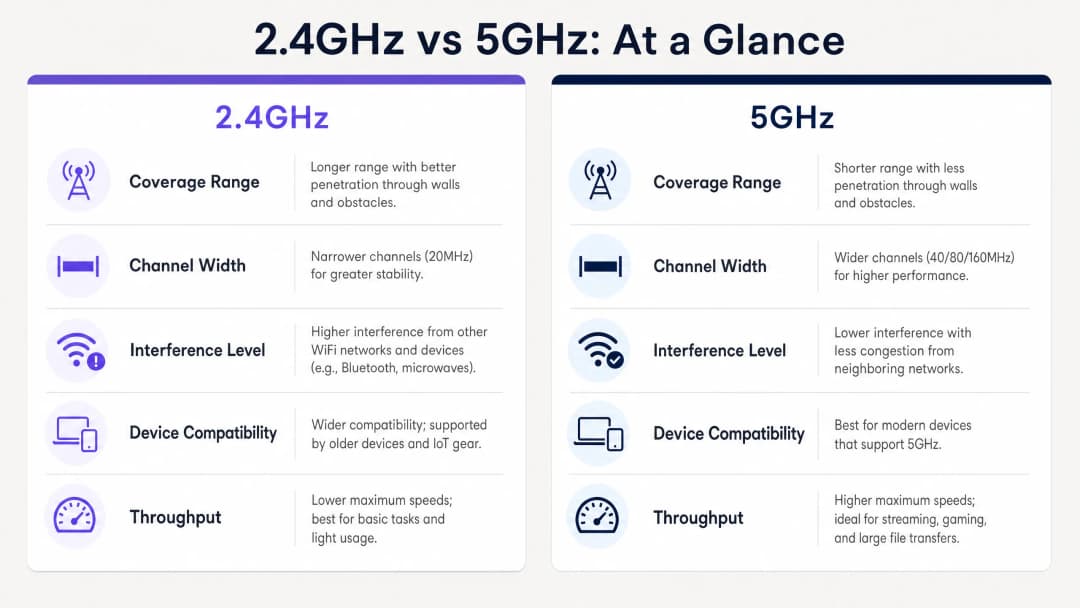
Operating at a lower frequency, the 2.4GHz band has longer wavelengths that easily penetrate physical obstacles such as concrete walls, steel shelving, and elevator shafts. This makes it ideal for Hospitality environments with thick internal walls or large warehouse spaces.
However, the 2.4GHz spectrum is severely limited by its channel architecture. In most regulatory domains, there are only three non-overlapping 20MHz channels (channels 1, 6, and 11). This scarcity leads to significant co-channel interference (CCI) and adjacent-channel interference (ACI), especially in dense environments where neighboring networks, Bluetooth devices, and even microwaves compete for airtime.
The 5GHz Band: The High-Capacity Highway
In contrast, the 5GHz band operates at a higher frequency, resulting in shorter wavelengths. While this reduces its ability to penetrate physical obstacles, it provides a vast expansion of available spectrum. Depending on the regulatory domain and the use of Dynamic Frequency Selection (DFS) channels, you can access up to 25 non-overlapping 20MHz channels.
This abundance allows for channel bonding (40MHz, 80MHz, or 160MHz widths), enabling the high throughput required for modern applications. Under IEEE 802.11ac (WiFi 5) and 802.11ax (WiFi 6), 5GHz networks can deliver gigabit speeds, making it the preferred band for high-density environments such as convention centers and Transport hubs.
Got questions about your specific setup?
Our team works with venue operators, IT managers, and network engineers across 80,000 venues. Book a 20-minute call and we will show you how others like you solved it.
Implementation Guide: Intelligent Co-existence
Deploying a modern enterprise WLAN requires a nuanced approach to band allocation. The goal is to steer capable devices to the 5GHz band while reserving the 2.4GHz band for devices that genuinely require it.
1. SSID Segmentation
The most effective strategy for managing a mixed device population is SSID segmentation. Create dedicated SSIDs for different use cases:
- Operational SSID (2.4GHz only): Reserved for legacy hardware, IoT sensors, barcode scanners, and POS terminals. This ensures clean airtime for critical operational devices.
- Guest/Corporate SSID (Dual-band or 5GHz primary): Designed for modern smartphones, tablets, and laptops. This SSID should leverage band steering to push capable clients to 5GHz.
2. Configuring Band Steering
Band steering is the mechanism by which wireless infrastructure encourages dual-band clients to connect to the 5GHz radio.

When configuring band steering, consider the following parameters:
- Probe Response Suppression: The AP ignores probe requests on the 2.4GHz band from clients it knows are 5GHz-capable, forcing them to connect on 5GHz.
- RSSI Thresholds: Implement strict Received Signal Strength Indicator (RSSI) thresholds. If a client's 5GHz signal drops below a certain level (e.g., -72 dBm), the AP should allow the client to smoothly fall back to 2.4GHz to prevent connection drops.
3. Verifying the RF Design
Band steering is not a silver bullet for poor network design. If there are gaps in your 5GHz coverage, aggressive band steering will result in frequent connection drops and a poor user experience. Always verify your RF design with a comprehensive site survey before enabling steering features.
Best Practices and Security Considerations
Channel Width Optimization
While 80MHz channels offer impressive theoretical throughput, they consume four standard 20MHz channels, increasing the likelihood of CCI in high-density deployments. For most enterprise environments, standardizing on 40MHz channel width on the 5GHz band provides the optimal balance of throughput and channel availability.
Security and Compliance
The congested nature of the 2.4GHz band makes it more susceptible to certain types of interference and de-authentication attacks. To maintain a robust security posture, especially for environments subject to PCI DSS or CCPA/CPRA:
- Enforce WPA3 with Protected Management Frames (PMF) across all corporate SSIDs.
- Ensure strict VLAN segregation between guest traffic and corporate/payment networks.
- Regularly audit your environment for rogue APs, which are more prevalent on the easily accessible 2.4GHz band.
For more information on securely managing network data, review our guide on The Hidden Cost of Telemetry Data on Corporate WLANs (also available in French: Le coût caché des données de télémétrie sur les WLAN d'entreprise).
-
Troubleshooting and Risk Mitigation
When issues arise, they often manifest as degraded connectivity or poor performance. Here are common failure modes and how to mitigate them:
- Sticky Clients: Devices that cling to a weak 2.4GHz signal even when a stronger 5GHz signal is available. Mitigation: Tune your RSSI thresholds and enable 802.11k/v/r (Fast BSS Transition) to assist client roaming decisions.
- DFS Channel Interference: Radar systems can force APs to vacate DFS channels, disrupting connectivity. Mitigation: Monitor controller logs for DFS events. If they occur frequently, exclude the affected channels from your dynamic channel assignment plan.
- IoT Connectivity Failures: Many smart devices lack 5GHz radios and struggle with complex authentication. Mitigation: Ensure your dedicated IoT SSID operates strictly on 2.4GHz and uses simpler authentication methods (e.g., WPA2-PSK or MAC authentication bypass) while maintaining strict network isolation.
-
ROI and Business Impact
Optimizing your band strategy directly impacts your organization's bottom line. A well-tuned network reduces support tickets, increases operational efficiency for staff using cell phones, and improves the guest experience.
When integrated with WiFi Analytics, a robust 5GHz deployment provides the high-accuracy location data required for advanced marketing initiatives. As seen in recent developments, such as how a WiFi assistant Enables Passwordless Access in 2026, seamless connectivity is the foundation for driving digital inclusion and maximizing the value of your physical space. Furthermore, features like Offline Maps Mode rely on a stable initial connection to download essential assets, underlining the importance of a reliable RF environment.
To delve deeper into these strategies, listen to our comprehensive podcast briefing below:
Key Definitions
Band Steering
A network infrastructure feature that detects dual-band capable clients and actively encourages them to connect to the less congested 5GHz band rather than the 2.4GHz band.
Crucial for optimizing airtime utilization in environments with a mix of modern smartphones and legacy IoT devices.
Co-Channel Interference (CCI)
Interference that occurs when two or more access points operate on the exact same frequency channel, forcing them to share the available airtime.
A primary cause of slow network performance on the 2.4GHz band due to the limited number of non-overlapping channels.
Dynamic Frequency Selection (DFS)
A mechanism that allows WiFi networks to use 5GHz channels typically reserved for radar systems, provided the AP can detect radar pulses and automatically switch to a different channel.
Unlocks additional 5GHz channels for enterprise use, but requires careful planning to avoid sudden channel changes that disconnect clients.
RSSI (Received Signal Strength Indicator)
A measurement of the power level being received by the antenna, typically expressed in negative decibels (dBm). Closer to zero is stronger.
Used by network administrators to set thresholds for roaming and band steering decisions (e.g., steering clients to 2.4GHz when 5GHz RSSI drops below -75 dBm).
SSID Segmentation
The practice of broadcasting different network names (SSIDs) for different user groups or device types, often tied to specific frequency bands or security policies.
Essential for isolating vulnerable IoT devices on 2.4GHz from high-speed corporate traffic on 5GHz.
Attenuation
The gradual loss of signal strength as radio waves travel through space or pass through physical objects like walls and floors.
Explains why 5GHz signals require denser AP placement compared to 2.4GHz signals in environments with heavy structural interference.
Spatial Stream
Multiple independent data signals transmitted simultaneously over different antennas using MIMO (Multiple Input, Multiple Output) technology to increase throughput.
Determines the maximum potential speed of a connection; modern 5GHz clients often support 2x2 or 3x3 spatial streams for gigabit performance.
Protected Management Frames (PMF)
A security standard (mandatory in WPA3) that encrypts the management frames used to control WiFi connections, preventing deauthentication attacks.
Critical for securing the easily accessible 2.4GHz band against malicious actors attempting to disrupt network operations.
Worked Examples
A 200-room hotel is experiencing poor guest WiFi performance in the lobby during peak check-in times, while in-room connectivity remains stable. The current configuration uses a single dual-band SSID across the entire property.
Implement a dual-strategy approach. First, enable band steering on the guest SSID with a strict RSSI threshold (-70 dBm) to force modern smartphones and laptops in the dense lobby area onto the high-capacity 5GHz band. Second, reduce the 2.4GHz transmit power on the lobby APs to shrink the cell size and reduce co-channel interference. Finally, ensure 5GHz channel widths are set to 40MHz to maximize available non-overlapping channels in the high-density space.
A large Retail chain is rolling out new 2.4GHz-only wireless barcode scanners for inventory management. Simultaneously, they want to offer high-speed Guest WiFi to shoppers. How should the network be configured to prevent the consumer devices from degrading scanner performance?
Deploy SSID segmentation. Create a dedicated 'Ops-Inventory' SSID broadcast only on the 2.4GHz radio, utilizing WPA3-Personal or 802.1X for security, and assign it to a restricted VLAN. Create a separate 'Guest-WiFi' SSID broadcast on both bands, but with aggressive band steering enabled to push consumer devices to 5GHz. Apply Quality of Service (QoS) policies prioritizing traffic from the operational VLAN.
Practice Questions
Q1. You are deploying a new WLAN in a large, open-plan warehouse. The primary devices are legacy 802.11b/g barcode scanners used by forklift operators. There are very few modern devices in the space. Which band strategy should you prioritize?
Hint: Consider the capabilities of the primary client devices and the physical environment.
View model answer
Prioritize a robust 2.4GHz design. Since the legacy scanners only support 2.4GHz, a 5GHz-focused design would be useless for operations. Ensure AP placement provides adequate 2.4GHz coverage and carefully manage channel planning (using only channels 1, 6, and 11) to minimize co-channel interference in the open space.
Q2. During a busy conference, attendees are complaining of slow WiFi speeds, despite showing full signal strength on their devices. A packet capture reveals heavy utilization on channels 1, 6, and 11, but channels 36-48 are relatively quiet. What is the most likely configuration issue?
Hint: Think about why modern devices might be congregating on the congested channels instead of the available ones.
View model answer
Band steering is likely disabled or configured incorrectly. The devices are defaulting to the 2.4GHz band (channels 1, 6, 11) because it often presents a stronger initial signal, leading to congestion. Enabling band steering would force the capable modern devices onto the quiet 5GHz channels (36-48), alleviating the congestion and improving speeds.
Q3. A hospital IT team wants to implement 80MHz channel widths on their 5GHz network to support high-resolution medical imaging transfers. However, they operate in a high-density environment with many APs deployed close together. What is the primary risk of this approach?
Hint: Consider the relationship between channel width and the number of available non-overlapping channels.
View model answer
The primary risk is a massive increase in Co-Channel Interference (CCI). Using 80MHz channels consumes four standard 20MHz channels per AP. In a high-density deployment, this drastically reduces the number of non-overlapping channels available, meaning neighboring APs will likely end up on the same frequency, causing interference that degrades overall network performance rather than improving it.
Continue reading in this series
Understanding RSSI and Signal Strength for Optimal Channel Planning
This guide provides a comprehensive technical deep-dive into RSSI, Signal-to-Noise Ratio (SNR), and RF propagation principles for optimal channel planning. It equips IT managers, network architects, and venue operations directors with actionable strategies to mitigate Co-Channel and Adjacent Channel Interference, optimize AP placement, and leverage analytics for measurable business impact across hospitality, retail, and public-sector environments.
20MHz vs 40MHz vs 80MHz: Which Channel Width Should You Use?
This guide provides a definitive, vendor-neutral technical reference for IT managers, network architects, and venue operations directors on selecting the correct WiFi channel width - 20MHz, 40MHz, or 80MHz - across enterprise deployments in hospitality, retail, events, and public-sector environments. It covers the underlying IEEE 802.11 mechanics, real-world capacity trade-offs, and step-by-step deployment guidance to help teams make the right call this quarter. Understanding channel width selection is one of the highest-leverage decisions in any wireless LAN design, directly impacting throughput, interference, client density support, and the reliability of guest-facing services.
WiFi 6 vs WiFi 5: Does it Solve Channel Interference?
This guide provides a technical deep dive into how WiFi 6 (802.11ax) addresses channel interference in high-density enterprise environments through OFDMA and BSS Coloring. It equips IT managers, network architects, and CTOs with actionable deployment strategies, real-world case studies from hospitality and healthcare, and a framework for evaluating the ROI of infrastructure upgrades in venues where wireless performance is business-critical.
Got questions about your specific setup?
Our team works with venue operators, IT managers, and network engineers across 80,000 venues. Book a 20-minute call and we will show you how others like you solved it.