
Captive Portal Best Practices: Designing for High Conversion and Compliance
This technical guide gives IT managers, network architects, and venue operations directors a complete blueprint for deploying captive portals that balance network security with high user conversion. It covers the full architecture from VLAN segmentation and RADIUS authentication to CCPA/CPRA-compliant consent design and authentication method selection. Drawn from Purple's operational experience across 80,000+ venues and 440 million logins in 2024, every recommendation is grounded in real deployment data.
Video overview
Listen to this guide
View podcast transcript
Part of our core series: Captive Portal Guide →

Executive Summary
A captive portal is the sign-in page on public WiFi. It is also your most critical network security decision and, if you run a marketing program, your most valuable data capture area. Both objectives - security and conversion - do not conflict. They require distinct configuration decisions, and this guide covers both.
The core architecture places each guest device in a quarantine VLAN until authentication is complete. A RADIUS server manages the session, and a Change of Authorization (CoA) message moves the device to the production VLAN. Network segmentation ensures that guest traffic never reaches corporate infrastructure or point-of-sale systems. In any environment where payment terminals share physical infrastructure with guest WiFi, this isolation is a PCI-DSS requirement, not just a recommendation.
In terms of conversion, each additional form field reduces opt-in rates by 8 to 12%. The right authentication method depends on your venue type and data objectives. Email capture provides 65 to 80% conversion with directly owned data. Social login via OAuth 2.0 reduces friction but introduces third-party dependencies. This guide provides the technical blueprint to balance these requirements, drawn from Purple's operational experience across 80,000+ venues and 440 million logins in 2024 (Purple internal data).
For more context on related network architecture decisions, see our guide How to Optimise Captive Portals for Maximum Network Security and User Conversion.
Technical Deep Dive
A captive portal intercepts HTTP or HTTPS requests from devices connected to your SSID, and redirects the user to a splash page before granting internet access. The underlying mechanism relies on network segmentation and RADIUS authentication working in tandem.
When a device connects, the access point - whether it is Cisco Meraki, HPE Aruba, Ruckus, Juniper Mist, Ubiquiti UniFi, Cambium, Extreme, or Fortinet - places it into a quarantine VLAN. In this state, the firewall blocks all traffic except for DNS queries and access to a specific list of allowed destinations (known as a walled garden). The walled garden must include the portal URL and any external authentication services (such as Google Workspace or Microsoft Entra ID). If the walled garden is misconfigured and the OS captivity probe (for example, captive.apple.com on iOS) is blocked, the portal will not load. This is the most common failure mode in this area.
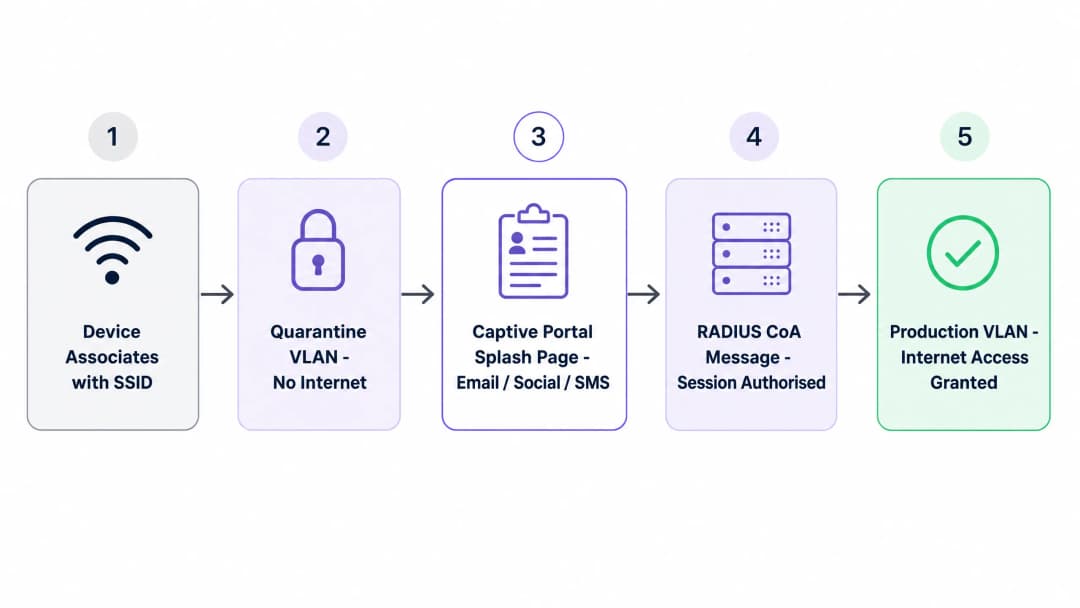
Once the user completes the login process, the portal communicates with your RADIUS server. The server sends a Change of Authorization (CoA) message to the access controller, instructing it to remove the quarantine state and move the device to the production VLAN. This isolation is critical: on a flat network, a compromised guest device can probe internal systems. VLAN segmentation ensures that unauthenticated devices cannot reach point-of-sale systems or corporate databases.
Comparison of Authentication Methods
Each of the five main captive portal authentication methods involves different trade-offs in terms of conversion rate, data quality, and compliance overhead. The table below summarizes the key variables.
| Method | Conversion Rate | Data Quality | CCPA/CPRA Overhead | Best Suited For |
|---|---|---|---|---|
| Click-through only / Terms & Conditions | 90-95% | Minimal (MAC + timestamp) | Low | Public sector, libraries, HIPAA |
| Email capture | 65-80% | High (directly owned) | Medium | Hospitality, retail, events |
| Social login (OAuth 2.0) | 55-70% | Medium (provider-dependent) | Medium-high | Consumer venues with Google/Apple users |
| SMS OTP | 45-60% | Very high (verified cell phone) | Medium | Loyalty-focused: QSR, stadiums, retail |
| Full form registration | 30-45% | Highest (rich profile) | High | Hotels, healthcare, high-end retail |
Source: Purple operational data, 440 million logins 2024.

For most venue operators, the optimal starting point is a dual-method portal: email capture as the primary option, and Google login as the secondary option. This combination typically achieves a conversion rate of 65 to 75% while building a directly owned email database. You are not entirely dependent on a third-party OAuth provider, but you offer a convenient option for users who prefer it.
For hospitality venues running loyalty programs, add SMS OTP as a third option or make it the primary method. A lower conversion rate is acceptable because the data quality justifies it. A verified cell phone number in your CRM is significantly more valuable than an unverified email address.
For public sector deployments - local governments, HIPAA-compliant healthcare providers, libraries - click-through with acceptance of terms is the right decision. The compliance overhead of collecting personal data in a public sector context is significantly higher, and the objective is connectivity, not building a CRM.
Compliance Architecture
Under CCPA/CPRA, you must separate connection from collection. You can provide network access based on legitimate business purposes. You cannot use the same justification to send marketing emails. Marketing requires explicit, affirmative opt-in consent.
Your portal must have separate, unchecked boxes. One covers the terms of service for WiFi access. The second, separate checkbox covers marketing consent. Pre-checked boxes do not constitute valid consent. The system must log each consent event, which must record who consented, when they consented, and the exact version of the privacy notice they viewed. This audit trail is proof of your compliance in the event of regulatory scrutiny by the FTC and state attorneys general.
For retail operators with on-site card payment terminals, PCI DSS requires that the cardholder data environment be isolated from all other network traffic. Proper VLAN segmentation can reduce the PCI DSS audit scope by 60 to 80% (Specgravity, 2024) and lower annual compliance costs.
Got questions about your specific setup?
Our team works with venue operators, IT managers, and network engineers across 80,000 venues. Book a 20-minute call and we will show you how others like you solved it.
Implementation Guide
Deploying a captive portal that is both secure and high-converting requires a structured approach. The following five-step framework applies across all hardware platforms.
Step 1 - Traffic categorization. Before touching a single switch port, document every device type and traffic class in your environment: guest devices, staff devices, IoT, payment terminals, building management systems, CCTV. Each requires a dedicated VLAN.
Step 2 - VLAN design. Assign a VLAN ID and IP subnet to each traffic class. Place the guest VLAN on a completely separate subnet with no routes to your internal address space. Your firewall must have an explicit 'deny-all' rule between the guest VLAN and everything internal, allowing only outbound internet access.
Step 3 - Walled garden configuration. Explicitly allow the portal URL, identity provider domains (Google Workspace, Microsoft Entra ID, Okta), and OS captivity probe URLs. Test on iOS, Android, and Windows devices prior to go-live.
Step 4 - Firewall policy. Explicitly document every permitted inter-VLAN flow. Default-deny everything else. This is where most deployments fall short: a VLAN architecture is only as strong as the firewall rules enforcing it.
Step 5 - Monitoring and validation. Deploy network monitoring and verify that the segmentation is working. Run periodic penetration tests, or at least use a scanning tool from a guest device to confirm you cannot reach internal subnets.
Purple's Guest WiFi platform integrates with all major enterprise wireless vendors via standard RADIUS and VLAN tagging. You do not need to replace existing access points. The platform handles captive portal rendering, consent management, and downstream WiFi Analytics across Cisco Meraki, HPE Aruba, Ruckus, Juniper Mist, Ubiquiti UniFi, Cambium, Extreme, and Fortinet deployments.
Best Practices
The following recommendations reflect operational patterns observed across Purple's network of 80,000+ venues.
Minimize form fields. Every field you add to your login form reduces your conversion rate. Only ask for data you actively use. An email address and first name are sufficient for most marketing use cases. Date of birth, zip code, and phone number should only appear if your CRM workflows genuinely require them.
Separate access and marketing consent. Ensure your captive portal has separate, unchecked checkboxes for WiFi terms and marketing opt-in. Bundling the two is the most common CCPA/CPRA compliance error we see in the field.
Enable client isolation. Configure the access controller to prevent devices on the guest SSID from communicating directly with each other. This eliminates peer-to-peer attack vectors on the guest network.
Manage bandwidth. Enforce per-client rate limits (typically 5 to 20 Mbps downstream) on the guest VLAN. This prevents a single user from saturating the uplink and degrading the experience for everyone else.
Plan for MAC randomization. Modern iOS and Android devices use randomized MAC addresses by default. A returning guest appears as a new user, and the portal challenges them again. Mitigate this by encouraging users to install a Passpoint profile or by using app-based authentication flows that rely on identity tokens rather than MAC addresses.
Keep SSID counts low. Every additional SSID you broadcast consumes airtime for beacon frames. In a dense venue with hundreds of access points, broadcasting more than four SSIDs per radio can significantly degrade throughput. Three is a practical target: guest, corporate, IoT.
For a comprehensive view on authentication standards, see our guide EAP Method WiFi: A Guide to Secure Network Access.
Troubleshooting and Risk Mitigation
The most frequent issue in this field is the portal failing to appear. This is almost always a walled garden configuration error. If the firewall blocks the device's OS captivity probe, the OS cannot detect the captive network, and the portal never launches. Check your walled garden entries first, every time.
The second common failure mode is DHCP pool exhaustion. In high-density environments like stadiums or conference centers, thousands of devices connect simultaneously. If your DHCP pool runs out of addresses, the authentication flow halts before the portal can be served. Size your infrastructure for peak concurrent connections, not average load.
The third risk is OAuth dependency without a fallback. If you deploy social login as your sole authentication method and the provider changes their API terms, your authentication flow breaks. This has happened with Facebook's Graph API. Always deploy at least one directly owned method alongside social login.
For transport hubs and large event venues, the fourth risk is DNS resolver overload. At scale, DNS query volume during peak connection events can overwhelm an undersized resolver. Deploy dedicated DNS infrastructure for the guest VLAN and monitor query rates.
For healthcare environments, the fifth consideration is clinical device isolation. In line with HIPAA guidelines, clinical devices must be on a separate VLAN from general-purpose guest WiFi. The captive portal architecture must not allow guest devices to access any subnets carrying clinical device traffic.
ROI and Business Impact
A well-structured captive portal turns guest WiFi from a cost center into a strategic asset. By capturing first-party data, you build a verified CRM database that drives loyalty programs and targeted marketing campaigns.
Success is measured by two primary metrics: conversion rate (the percentage of connected devices that complete authentication) and opt-in rate (the percentage of authenticated users who consent to marketing). A retail chain can track the conversion of WiFi users into loyalty members and measure subsequent footfall and spend lift.
For a 500-location retail estate running email capture at 70% conversion, 10,000 daily WiFi sessions across the estate generate 7,000 new or returning CRM contacts per day. At a conservative 2% email-to-visit conversion rate for marketing campaigns, that is 140 additional store visits per day driven by the WiFi channel.
Furthermore, proper network segmentation reduces the scope of PCI DSS audits. Proper segmentation can reduce the PCI DSS audit scope by 60 to 80% (Specgravity, 2024), lowering annual compliance costs and mitigating the financial risk of a data breach. Non-compliance with the CCPA/CPRA can result in significant fines and penalties, making a compliant portal architecture a direct financial risk mitigation measure.
Purple's platform is ISO 27001, GDPR, CCPA, and Cyber Essentials certified, providing the necessary compliance documentation for your legal and procurement teams. With 99.999% uptime across 80,000+ locations, the infrastructure is sized for enterprise-scale deployments.
For further reading on related network concepts, see our WAN Computer Definition: A Practical Guide for 2026.
Key Definitions
Captive Portal
A web page that intercepts network traffic and requires user interaction - authentication or terms acceptance - before granting full internet access. Defined in IETF RFC 8952.
The primary interface for guest onboarding, security enforcement, and first-party data capture at any public or semi-public WiFi venue.
VLAN (Virtual Local Area Network)
A logical grouping of network devices that behave as if they are on a single isolated LAN, regardless of physical location. Defined in IEEE 802.1Q.
Used to segment guest traffic from corporate infrastructure. Required by PCI-DSS to isolate the cardholder data environment.
Walled garden
A restricted network environment that allows access only to specific approved URLs and IP addresses before authentication completes.
Must include the portal URL, identity provider domains, and OS captivity probe URLs. Misconfiguration is the leading cause of portal failures.
RADIUS
Remote Authentication Dial-In User Service. A networking protocol providing centralized authorization, authentication, and accounting for network access.
The backend system that verifies credentials and instructs the access point to grant or deny network access. Required for enterprise captive portal deployments.
Change of Authorization (CoA)
A RADIUS message that dynamically alters the authorization state of an active user session without requiring re-authentication.
Used to move a device from the quarantine VLAN to the production VLAN after successful portal login, or to revoke access when a session policy changes.
Client isolation
A wireless controller feature that prevents devices connected to the same SSID from communicating directly with each other at Layer 2.
Essential for guest networks to prevent peer-to-peer attacks and lateral movement between guest devices.
Passpoint (Hotspot 2.0)
An IEEE 802.11u-based protocol that enables devices to automatically and securely connect to WiFi networks using credentials from a service provider, without requiring manual portal interaction.
Used to overcome MAC address randomization and provide seamless roaming across venues. Relevant for loyalty-focused deployments where session persistence matters.
PCI DSS
Payment Card Industry Data Security Standard. An information security standard for organizations that handle branded credit cards from major card schemes.
Requires strict network segmentation to isolate the cardholder data environment from guest WiFi traffic. Non-compliance carries financial penalties and loss of card processing rights.
OAuth 2.0
An open authorization framework that enables third-party applications to obtain limited access to user accounts on an HTTP service, such as Google Workspace or Microsoft Entra ID.
Used for social login on captive portals. Reduces friction but introduces dependency on the identity provider's API terms and availability.
Worked Examples
A 200-room hotel using HPE Aruba access points needs to provide tiered WiFi: basic free access for standard guests and high-speed access for loyalty members, without broadcasting multiple SSIDs.
Deploy a single guest SSID integrated with the Property Management System (PMS) via API. The portal presents two options: log in with room number and last name, or log in with loyalty program credentials. When a loyalty member authenticates, the portal queries the PMS via API, verifies the tier, and sends a RADIUS Change of Authorization (CoA) to the Aruba controller with a vendor-specific attribute (VSA) assigning the high-bandwidth role. Standard guests receive a rate-limited default role. One SSID, dynamic policy enforcement at the RADIUS layer, clean user experience with no additional RF overhead.
A national retail chain with 500 locations wants to capture email addresses for marketing across all sites, but the legal team has flagged CCPA/CPRA compliance concerns about the existing portal design.
Redesign the portal with a single email input field and two distinct checkboxes. The first checkbox is mandatory and reads: 'I accept the Terms of Service and Privacy Policy for network access.' The second checkbox is optional, unchecked by default, and reads: 'I consent to receive marketing communications and special offers from [Brand].' The backend logs the timestamp, IP address, portal version, and consent event for each user. The lawful basis for WiFi access is legitimate interest. The lawful basis for marketing is explicit consent. These are recorded separately in the CRM.
Practice Questions
Q1. A stadium IT director reports that during halftime, users can associate with the guest SSID but the captive portal fails to load for thousands of devices simultaneously. The walled garden has been verified as correct. What is the most likely architectural failure?
Hint: Consider the infrastructure resources required before a device can route HTTP traffic to the portal - specifically, what happens before DNS resolution.
View model answer
DHCP pool exhaustion or DNS resolver overload. In high-density environments, if the DHCP pool cannot assign IP addresses fast enough, or the DNS resolver cannot handle the query volume from thousands of simultaneous connections, the authentication flow stalls before the portal can be served. The infrastructure must be sized for peak concurrent connections, not average load. Separate DHCP and DNS infrastructure for the guest VLAN is the recommended mitigation.
Q2. A retail marketing team wants to collect customer dates of birth via the captive portal to send birthday offers. They plan to make the DOB field mandatory to access the WiFi. Is this compliant with CCPA/CPRA? If not, how should it be redesigned?
Hint: Review the principles of data minimization and the requirement for consent to be freely given under CCPA/CPRA.
View model answer
No. Making marketing data mandatory for service access violates the principle that consent must be freely given - a user cannot freely consent if refusal means losing access to a service. Furthermore, collecting DOB when it is not strictly necessary for network access violates data minimization principles. The correct design: DOB is an optional field, clearly labeled as optional, with a separate unchecked checkbox for birthday marketing consent. The lawful basis for WiFi access remains legitimate business interest. The lawful basis for birthday marketing is explicit consent.
Q3. A hotel's security audit reveals that a device connected to the guest WiFi can ping the IP address of a point-of-sale terminal in the restaurant. The IT team confirms that the guest network and POS network are on separate VLANs. What configuration step was missed?
Hint: VLANs provide logical separation, but traffic between VLANs must pass through a routing device. What governs what that device allows?
View model answer
Inter-VLAN routing rules on the firewall are misconfigured or absent. While the guest traffic and POS traffic are on separate VLANs, the firewall must enforce a default-deny policy between them with explicit permit rules for only the required flows. The guest VLAN should have rules permitting only outbound internet access - no routes to any internal subnet, including the POS VLAN. The fix is to audit and correct the inter-VLAN firewall policy, then validate by attempting to reach internal subnets from a guest device.
Q4. A conference center deploys social login (Google OAuth) as its only captive portal authentication method. Three months after launch, Google updates its OAuth API and the portal breaks for all users. How should the deployment have been architected to prevent this?
Hint: Consider the single point of failure and what a resilient multi-method design looks like.
View model answer
The deployment should have included at least one non-OAuth authentication method as a fallback - email capture being the most practical choice. A dual-method portal with email capture as primary and Google OAuth as secondary would have maintained continuity when the OAuth flow broke. The email capture method has no third-party dependency and provides a directly owned data asset. OAuth providers should always be treated as convenience options, not primary authentication infrastructure.
Continue reading in this series
Ubiquiti UniFi guest portal not redirecting: causes and fixes
This guide isolates a UniFi guest portal redirect failure by following the guest state, redirect, pre-authorization route and controller authorization in sequence. It gives venue IT teams a sourced method to address guest-network versus Hotspot confusion, external portal hand-offs, current UniFi OS account requirements and DNS isolation testing.
Cisco Meraki splash page not working: a troubleshooting flowchart
This practical day-two guide isolates where a Cisco Meraki splash flow has failed: client authorization, HTTP redirect initiation, walled-garden reachability or RADIUS sign-on. It gives venue IT teams a controlled evidence path, so they can restore Guest WiFi without making broad changes to a live estate.
Enterprise Guest WiFi Setup Guide: VLAN Segmentation, Security, and Captive Portals
This technical guide shows IT teams how to set up Guest WiFi as a controlled internet-access service, using VLAN segmentation, firewall policy, and a captive portal. It also explains how Purple's registration forms and onboarding controls support a proportionate visitor experience without weakening the boundary around staff, payment, and operational systems.
Got questions about your specific setup?
Our team works with venue operators, IT managers, and network engineers across 80,000 venues. Book a 20-minute call and we will show you how others like you solved it.