
How to leverage marketing SMS service to increase return visits
This technical reference guide explains how venue operators, IT managers, and marketing directors can deploy a marketing SMS service via enterprise WiFi networks to drive measurable increases in return visits. It covers the full data capture architecture from captive portal to SMS trigger, GDPR-compliant consent mechanisms, and proven deployment strategies across hospitality, retail, and large-venue environments. Purple Engage automates this entire workflow, turning every WiFi login into a verified, actionable contact.
Listen to this guide
View podcast transcript
Executive summary
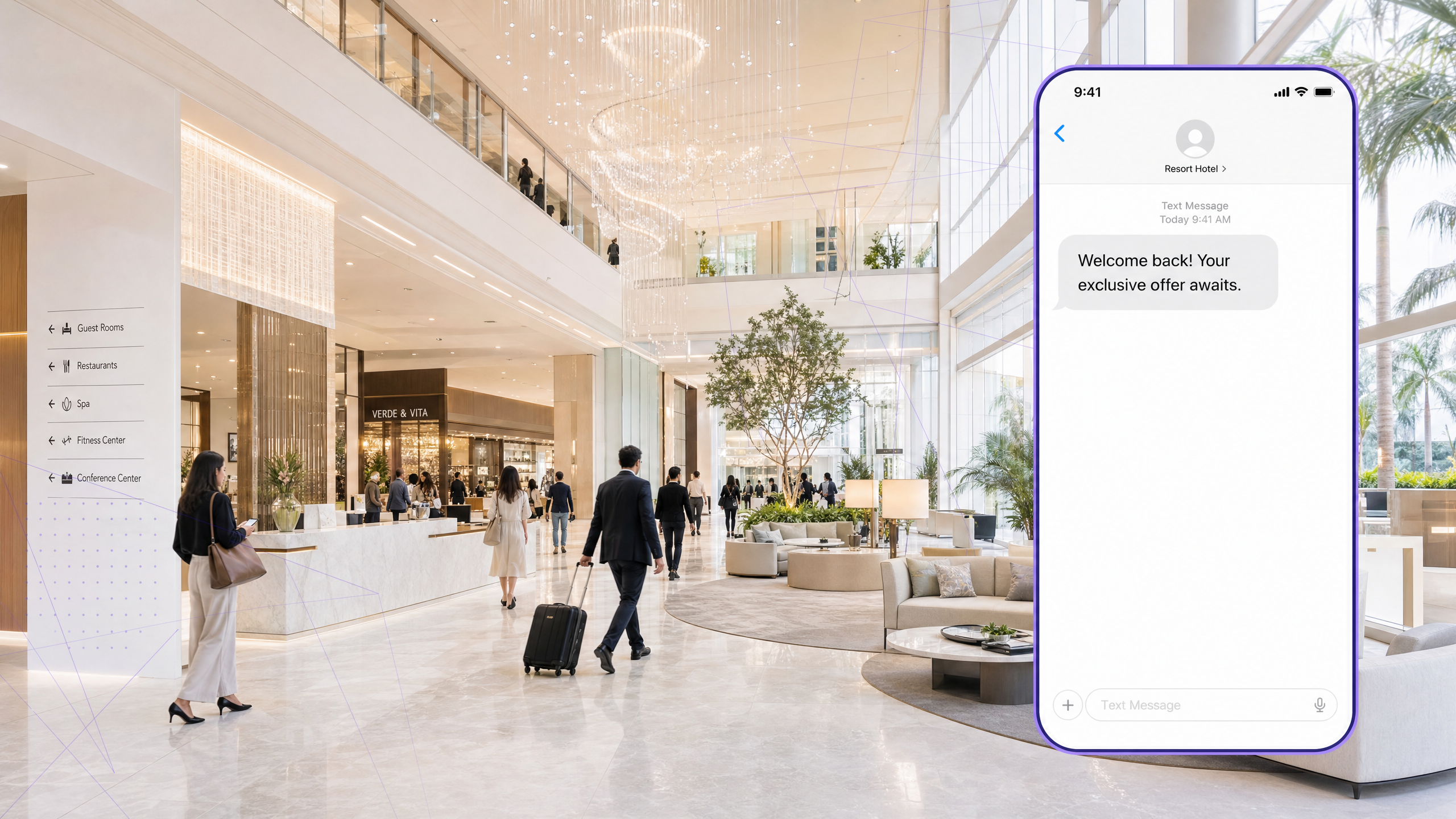
Your Guest WiFi network already captures the data you need to run a high-performance marketing SMS service. The gap, for most venue operators, is connecting that data to an automated campaign engine. SMS achieves a 98% open rate with 90% of messages read within three minutes of delivery - figures that email cannot approach. WiFi Analytics from Purple turns presence data into verified, segmented contact lists, and Purple Engage automates the SMS campaigns that bring visitors back. This guide covers the technical architecture required to capture first-party phone data compliantly, the integration layer between your network controllers and an SMS gateway, and the deployment steps needed to move from raw WiFi data to a live re-engagement campaign. Whether you operate a Premier Inn property, a retail chain, a stadium, or a conference centre, the underlying architecture is the same.
Technical deep-dive
Why SMS outperforms every other re-engagement channel
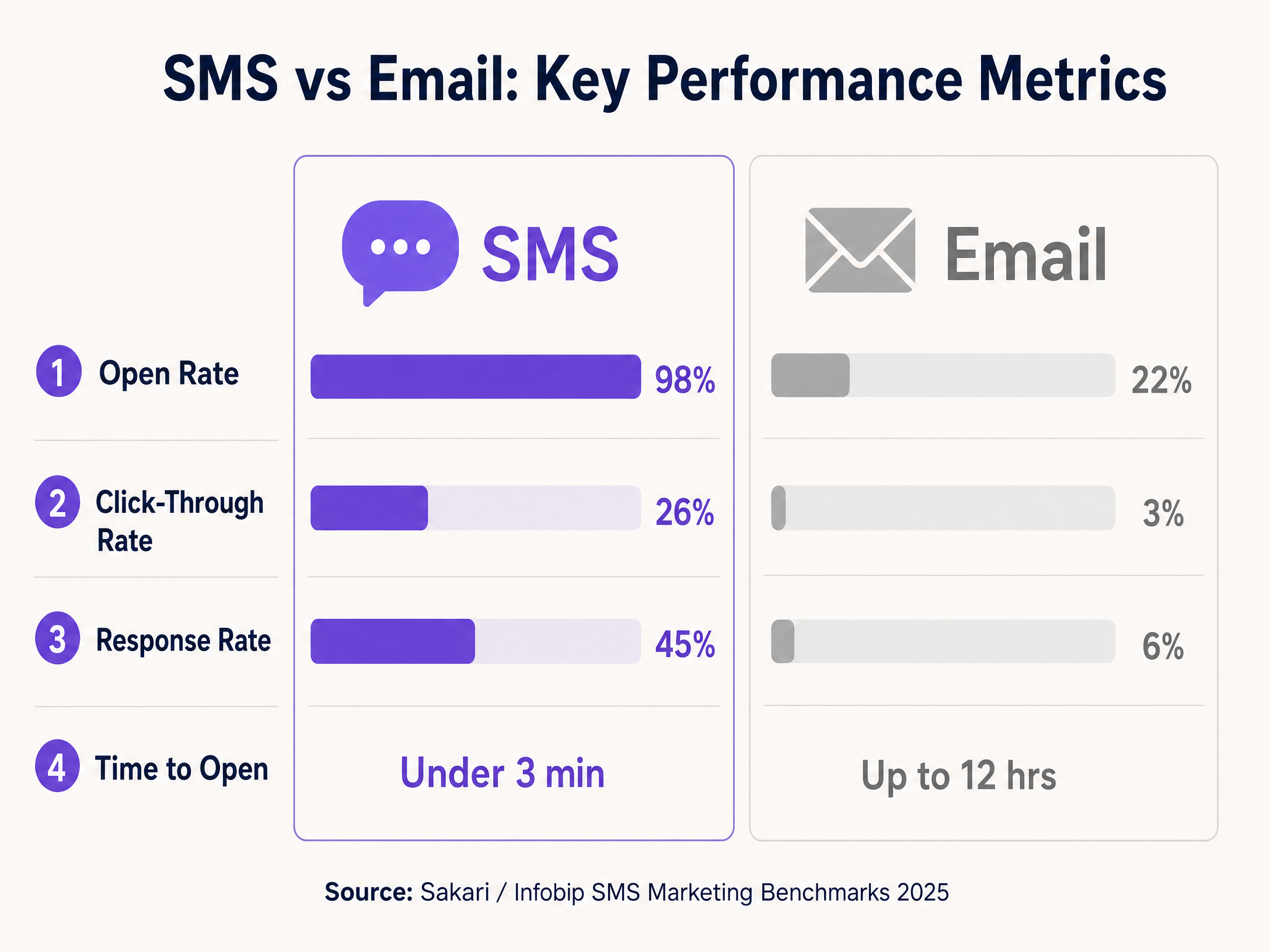
SMS open rates consistently reach 90-98%, with 80% of messages read within five minutes of delivery, according to Sakari's 2025 SMS Marketing Statistics report. Compare that to the 20-25% open rate typical of email marketing. Click-through rates for SMS campaigns average 18-35%, versus 2.5-3.5% for email. Response rates sit at approximately 45% for SMS, against roughly 6% for email. ROI estimates from Attentive's 2024 data place returns at up to $71 for every $1 spent during peak campaigns, with conservative benchmarks at $21-$41 per dollar.
The channel's effectiveness stems from a single behavioural fact: people carry their phones at all times and treat SMS as a personal communication channel. A message from a venue they have visited recently, offering a relevant and time-limited incentive, lands in a context that email cannot replicate.
Data capture architecture
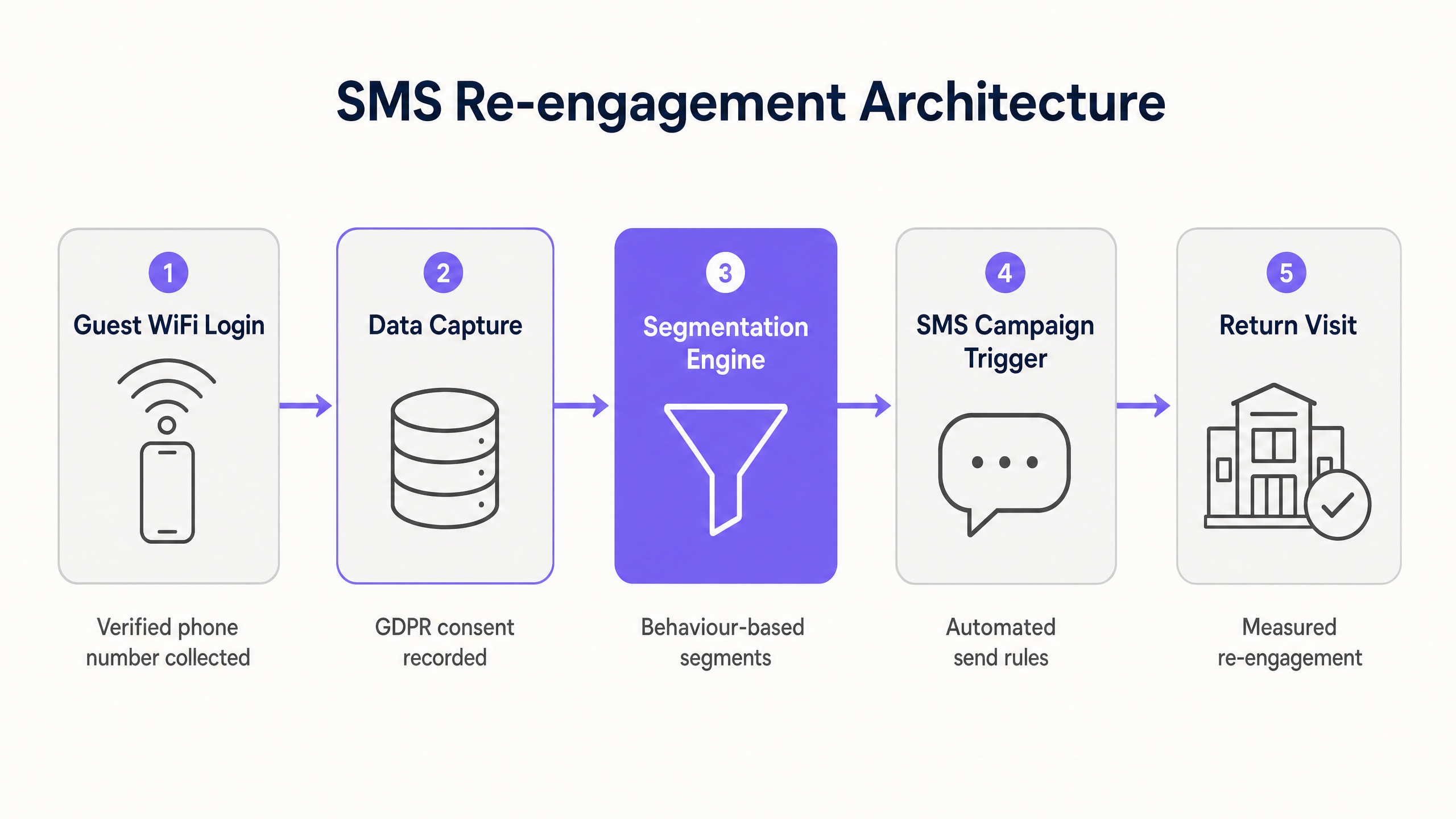
The foundation of an effective marketing SMS service is a verified, first-party phone number database. This begins at the network edge. When a visitor connects to your Guest WiFi , the wireless LAN controller (WLC) - whether running on Cisco Meraki, HPE Aruba, Ruckus, Juniper Mist, Ubiquiti UniFi, Cambium, Extreme, or Fortinet hardware - redirects unauthenticated traffic to a cloud-hosted captive portal. This portal is the primary data ingestion point.
The authentication flow must require phone number entry followed by verification via a one-time password (OTP) delivered by SMS. This step confirms the device possesses the claimed number and establishes the first communication. Without OTP verification, your database will contain invalid numbers that inflate costs and depress campaign metrics.
Once authenticated, the system binds the device's MAC address to the verified phone number and the associated consent record. On subsequent visits, the network recognises the returning device automatically. This persistent identity layer allows the analytics platform to track dwell time, visit frequency, and location-based movement patterns without requiring the visitor to log in again.
Integration and trigger mechanisms
Connecting the analytics platform to an SMS gateway requires a robust API integration layer. The platform must process real-time presence events - connection, disconnection, dwell time thresholds, and absence periods - and evaluate them against predefined campaign rules.
A typical trigger rule reads: "If a visitor's MAC address has not authenticated in 30 days, and the associated profile has opted into marketing communications, fire an API call to the SMS gateway with the win-back message template and the verified phone number." The platform monitors the database continuously and executes the call when conditions are met.
For large venues such as stadiums or shopping centres, simultaneous triggers for thousands of contacts will breach the SMS gateway's rate limits. The architecture must include a message queue between the analytics platform and the gateway. A queuing system releases outbound API calls in batches that respect the provider's throughput limits, ensuring reliable delivery without errors. AWS SQS, RabbitMQ, or equivalent managed queue services are appropriate here.
The integration must also handle inbound events. When a user replies "STOP" to an SMS, the gateway sends a webhook notification to the analytics platform, which immediately updates the contact's opt-out status. This automated opt-out handling is a legal requirement under GDPR and the UK's Privacy and Electronic Communications Regulations (PECR).
Compliance and data security
The architecture must satisfy GDPR, CCPA, and PECR from the point of data capture. Three requirements are non-negotiable.
First, explicit consent. The captive portal must present the marketing SMS opt-in as an unticked checkbox. Pre-ticked boxes are invalid under GDPR Article 7. The user must make a deliberate, affirmative choice.
Second, auditable consent records. The system must log the exact timestamp, the user's IP address, the device MAC address, and the specific version of the terms and conditions accepted at the moment of opt-in. Purple stores 29 billion data points and holds ISO 27001 certification, providing the infrastructure to maintain these records at scale.
Third, automated opt-out processing. The system must update the user's profile immediately upon receipt of an opt-out signal, preventing any further messages. Delays in processing opt-outs expose the operator to regulatory risk.
Data must be encrypted at rest using AES-256 and in transit using TLS 1.2 or higher. Access to personally identifiable information (PII) must be restricted to authorised personnel and systems via role-based access controls.
Implementation guide
Step 1: Configure the network infrastructure
Begin with the wireless LAN controller or cloud management dashboard. Define a dedicated SSID for Guest WiFi . Configure Walled Garden settings to allow pre-authentication traffic to reach the captive portal URLs and the SMS OTP gateway endpoints. Set RADIUS authentication and accounting to point to the analytics platform. This configuration is hardware-agnostic across Cisco Meraki, HPE Aruba, Ruckus, Juniper Mist, Ubiquiti UniFi, Cambium, Extreme, and Fortinet deployments.
Step 2: Design the authentication flow
Build the captive portal to prioritise phone number capture and consent. The portal must be mobile-optimised, as the majority of users will authenticate on a smartphone. Require phone number entry, display the marketing opt-in checkbox clearly with unticked default state, and integrate an SMS OTP service to verify the number in real time. The terms and conditions must explicitly describe how the phone number will be used for marketing SMS campaigns. For guidance on making a strong first impression at login, see How to make a great first impression with your guest WiFi .
Step 3: Define segmentation and triggers
Establish the rules that drive SMS campaigns from network data. Create segments based on visit frequency: first-time visitors, regular visitors (three or more visits in 90 days), and churned visitors (absent for 30 days or more). Define triggers based on presence events: 24 hours after a first visit, seven days after a second visit, and 30 days after the last visit. Draft concise SMS templates for each segment. Keep messages under 160 characters to avoid multi-part billing. Include a trackable link or unique discount code in every message to enable attribution.
Step 4: Test and validate before launch
Conduct structured testing before activating live campaigns. Verify the captive portal renders correctly on iOS and Android. Confirm OTP delivery speed is under 10 seconds. Test each automated trigger by simulating the relevant presence event in a staging environment. Validate that the opt-out mechanism updates the database within five seconds of receiving a STOP reply. Review the consent audit log to confirm all required fields are captured correctly.
Best practices
Prioritise relevance over frequency
Consumers tolerate SMS marketing only when it delivers immediate value. Limit promotional messages to two per month per contact. A message offering a discount on a coffee sent 10 minutes after a visitor connects to the WiFi in a shopping centre converts at a far higher rate than a generic broadcast sent on an arbitrary schedule. The presence data your network collects is the differentiator. Use it to make every message contextually relevant.
Maintain clean data
Implement automated processes to remove invalid phone numbers from the database. Monitor delivery failure rates and suppress numbers that consistently return errors. A clean list reduces costs and improves the deliverability metrics that SMS gateways use to assess sender reputation. Aim for a delivery rate above 95%, which Infobip identifies as the benchmark for well-maintained SMS marketing lists.
Use first-party data for personalisation
The behavioural data collected by the WiFi network is more accurate than any third-party data source. If the analytics platform shows a shopper frequently visits the sports section of a retail store, the SMS offer should reference relevant products. If a hotel guest visits the spa on every stay, the re-engagement message should highlight a spa promotion. Purple's WiFi Analytics platform provides the segmentation tools to act on these patterns at scale.
Integrate SMS with email for omnichannel uplift
Brands integrating SMS alongside email see engagement increases of approximately 47.7%, according to Sakari's 2025 benchmarks. Use email for longer-form content and SMS for time-sensitive, high-urgency messages. The two channels amplify each other. A visitor who receives an email about an upcoming event and then an SMS reminder on the day of the event is significantly more likely to attend than one who received only the email.
Troubleshooting & risk mitigation
Low opt-in rates
If the marketing opt-in rate on the captive portal is below 15%, the value proposition is not clear enough. Review the portal design and the incentive structure. Offer an immediate, tangible benefit - such as a discount code delivered via SMS upon successful opt-in - to align the action with an immediate reward. Ensure the opt-in checkbox is visible without scrolling on a mobile screen.
High unsubscribe rates
A spike in opt-outs signals message fatigue or irrelevant content. Review campaign frequency first. If you are sending more than two messages per month, reduce the cadence. Then review segmentation. Generic broadcasts sent to the entire database will always generate higher opt-out rates than targeted messages sent to relevant sub-segments.
Integration failures and missed triggers
If SMS messages are not triggering on schedule, check the API connection between the analytics platform and the SMS gateway. Verify API keys are valid and have not expired. Review the error logs for rate-limiting responses from the gateway. If the queue is backing up, increase the batch release rate or upgrade the gateway plan to a higher throughput tier. Monitor the webhook endpoint for opt-out events to confirm it is receiving and processing signals correctly.
Compliance audit failures
If an audit reveals gaps in consent records, review the captive portal logging configuration. Confirm that the timestamp, IP address, MAC address, and terms version are all written to the database at the point of opt-in. Test the flow end-to-end in a staging environment and inspect the resulting database record before re-enabling live capture.
ROI & business impact
A marketing SMS service built on WiFi-captured first-party data delivers a measurable and attributable return. The key metrics to track are opt-in rate, campaign open rate, click-through rate, conversion rate, and return visit rate.
Embed unique, trackable links or discount codes in every SMS campaign. This allows you to attribute specific return visits and revenue directly to the service. With conversion rates reaching 21-30% for well-targeted campaigns, the cost of the SMS gateway is offset rapidly by the increase in visitor lifetime value.
For hospitality operators, a 300-room hotel running a weekly in-venue offer to WiFi-opted-in guests can generate incremental restaurant and spa revenue that far exceeds the monthly SMS gateway cost. For retail venue operators, a 60-day win-back campaign targeting lapsed shoppers with a time-limited discount can recover a significant portion of churned foot traffic. For transport hubs and airports, SMS re-engagement drives repeat visits to retail and food and beverage concessions.
Purple Engage captures verified guest email and phone data at login and automates marketing campaigns across 80,000+ live venues. The platform has processed 440 million logins in 2024 and holds ISO 27001, GDPR, CCPA, and Cyber Essentials certifications. It operates as a cloud overlay across Cisco Meraki, HPE Aruba, Ruckus, Juniper Mist, Ubiquiti UniFi, Cambium, Extreme, and Fortinet hardware, meaning your existing infrastructure does not need to change.
For related deployment guidance, see How to leverage SMS marketing company to increase return visits .
Key Definitions
Captive portal
A web page that a network user must view and interact with before access to the wider internet is granted. In a Guest WiFi deployment, it serves as the primary interface for capturing verified phone numbers and recording marketing consent.
IT teams configure the WLC or cloud management platform to redirect unauthenticated traffic to the captive portal URL. The portal design directly determines opt-in rate and data quality.
MAC address
A unique identifier assigned to a network interface controller, used as a hardware address within a network segment. In the format XX:XX:XX:XX:XX:XX.
The analytics platform binds the verified phone number to the device's MAC address at first login. This allows the system to recognise returning devices without requiring repeated authentication, enabling dwell time and visit frequency tracking.
Walled Garden
A network configuration that restricts unauthenticated users to a defined set of IP addresses or domains before they complete the login process.
Configured on the WLC to allow pre-authentication traffic to reach the captive portal server and the SMS OTP gateway. Without correct Walled Garden configuration, users cannot complete the phone verification step.
One-time password (OTP)
A password valid for a single authentication session, typically delivered via SMS to verify that the user controls the device associated with the claimed phone number.
Sent during the captive portal flow to validate the phone number before it is written to the database. OTP verification is the mechanism that distinguishes a verified first-party number from an unverified, potentially invalid entry.
First-party data
Information collected directly from users by the organisation that owns the relationship, as opposed to data purchased from third-party brokers.
Phone numbers captured via Guest WiFi captive portals are first-party data. They are more accurate, more compliant, and more actionable than purchased lists because they are tied to a real, verified interaction with the venue.
API trigger
An automated action initiated by a software application in response to a specific event, executed via an application programming interface (API) call to an external service.
The analytics platform fires API triggers to the SMS gateway when a contact meets a predefined campaign rule, such as a 30-day absence. The trigger passes the verified phone number and the message template to the gateway for delivery.
Message queue
A software component that stores outbound messages and releases them to a recipient system at a controlled rate, decoupling the sender from the receiver's throughput constraints.
Required in any deployment where simultaneous triggers for large contact lists would exceed the SMS gateway's API rate limits. Services such as AWS SQS or RabbitMQ are appropriate implementations.
Opt-in rate
The percentage of users who explicitly agree to receive marketing communications, calculated as opted-in contacts divided by total authenticated users.
A direct indicator of captive portal effectiveness and the perceived value of the WiFi service. An opt-in rate below 15% typically indicates a weak value proposition or a poorly designed consent interface.
Dwell time
The duration a device remains connected to the network within a specific physical location, measured from authentication to disconnection.
Used as a segmentation variable in SMS campaign rules. For example, a trigger targeting visitors who have spent more than two hours in a venue is likely to reach engaged, high-value contacts rather than brief passers-by.
Worked Examples
A 300-room hotel wants to increase covers in their on-site restaurant during the typically quiet Tuesday evening service. They have 18 months of Guest WiFi data and a 22% marketing opt-in rate from the captive portal.
The IT team configures the Purple analytics platform to create a segment of guests who have authenticated on the Guest WiFi within the previous 48 hours but whose location data shows no visit to the restaurant area. At 16:00 on Tuesday, the system triggers an automated SMS to this segment: 'Dining in tonight? Enjoy a complimentary starter with any main course this evening. Book your table: [trackable link].' The message is 142 characters, fits within a single SMS, and includes a unique booking link for attribution. The trigger rule runs weekly and excludes any contact who has received a restaurant SMS in the previous 14 days.
A large retail shopping centre with 120 stores wants to re-engage shoppers who visited regularly but have not returned in over 60 days. Their WiFi database contains 85,000 opted-in contacts.
The venue operator configures an automated win-back campaign in the analytics platform. The system identifies MAC addresses that authenticated at least three times in the 90 days prior to the 60-day absence window. At 09:00 on the Thursday before a bank holiday weekend, the system triggers an SMS to this segment: 'We have missed you. Enjoy 15% off at any participating store this weekend. Show this message at the till: [unique code].' The message queue releases the 85,000 messages in batches of 500 per minute to stay within the SMS gateway's rate limits, completing delivery within approximately three hours. The unique discount code is tracked at point of sale to measure conversion.
Practice Questions
Q1. Your retail venue is capturing 5,000 phone numbers per week via Guest WiFi, but the marketing SMS opt-in rate is only 11%. The SMS campaigns are generating negligible return visit uplift. What are the two most likely causes and how would you address each?
Hint: Consider both the data quality issue and the campaign relevance issue separately.
View model answer
The first cause is a weak value proposition on the captive portal. At 11% opt-in, visitors do not see sufficient benefit in sharing their number for marketing purposes. The fix is to offer an immediate, tangible incentive - such as a discount code delivered via SMS upon opt-in - that makes the exchange of value explicit. The second cause is poor segmentation. If all 5,000 weekly numbers are receiving the same generic broadcast, the messages will not resonate with individual visitors. The fix is to implement behaviour-based segments using the presence data the network collects, targeting offers based on visit frequency, dwell time, and location patterns within the venue.
Q2. A stadium IT director needs to send an SMS offer to 25,000 fans at half-time of a major event. The SMS gateway has a rate limit of 300 messages per second. The half-time window is 15 minutes. Is this technically feasible, and what architecture is required?
Hint: Calculate the time required to send 25,000 messages at 300 per second, then consider the architectural component needed.
View model answer
At 300 messages per second, 25,000 messages require approximately 83 seconds to deliver - well within the 15-minute half-time window. The architecture requires a message queue between the analytics platform and the SMS gateway. When the half-time trigger fires, the platform pushes all 25,000 messages to the queue simultaneously. The queue then releases them to the gateway at 300 per second, preventing rate-limit errors. The queue also provides retry logic for any messages that fail on the first attempt, ensuring maximum delivery rate.
Q3. Following a GDPR audit, the data protection officer finds that the consent records in the analytics platform do not include the version of the terms and conditions accepted by each user. What is the risk, and what is the remediation?
Hint: Consider both the legal exposure and the technical fix required at the captive portal level.
View model answer
The risk is that the operator cannot demonstrate that users consented to the specific terms in force at the time of opt-in. If the terms have been updated since some users opted in, the operator cannot prove those users consented to the current version. Under GDPR Article 7, the controller bears the burden of demonstrating valid consent. The remediation requires two steps: first, update the captive portal logging to capture the terms version identifier alongside the timestamp, IP address, and MAC address at the point of opt-in. Second, for existing records without a terms version, the operator should consider running a re-consent campaign to obtain fresh, fully documented consent from affected contacts before continuing to send them marketing messages.