
Managed WiFi providers: a comprehensive guide for businesses
This guide equips property developers, landlords, and BTR operators with the technical architecture and implementation strategies required to select and deploy managed WiFi providers. It covers Identity PSK, VLAN segmentation, cloud management, and compliance standards, and shows how integrating Purple's intelligence layer turns a cost-centre network into a first-party data asset.
Video overview
Listen to this guide
View podcast transcript

Executive summary
Enterprise WiFi is no longer a basic utility; it is a critical operational platform. For IT managers, CTOs, and venue operations directors at multi-tenant properties, retail chains, and hospitality venues, selecting the right managed WiFi provider dictates network security, resident experience, and commercial return.
This guide details the technical architecture and implementation strategies required for a modern managed WiFi deployment. We examine the shift from unmanaged consumer hardware to centralised, cloud-managed infrastructure using Identity Pre-Shared Keys (iPSK) and IEEE 802.1Q VLAN segmentation. By partnering with a managed service provider and integrating an intelligence layer like Purple, operators eliminate IT overhead, secure resident data, and capture valuable first-party insights.
Whether you are designing a new build-to-rent (BTR) development or upgrading a legacy hotel network, this reference provides the vendor-neutral specifications needed to deploy a scalable, secure, and profitable wireless network. Purple operates across 80,000+ live venues and has processed 440 million logins in 2024 (Purple internal data), giving us direct visibility into what works in production.
Technical deep-dive
The shift to managed infrastructure
Historically, multi-dwelling units (MDUs) and BTR properties relied on residents sourcing their own internet service providers and installing consumer-grade routers. This model creates severe radio frequency (RF) interference, security vulnerabilities, and a disjointed onboarding experience. In a 200-unit building, 200 consumer routers competing for the same radio spectrum degrade performance for every resident simultaneously.
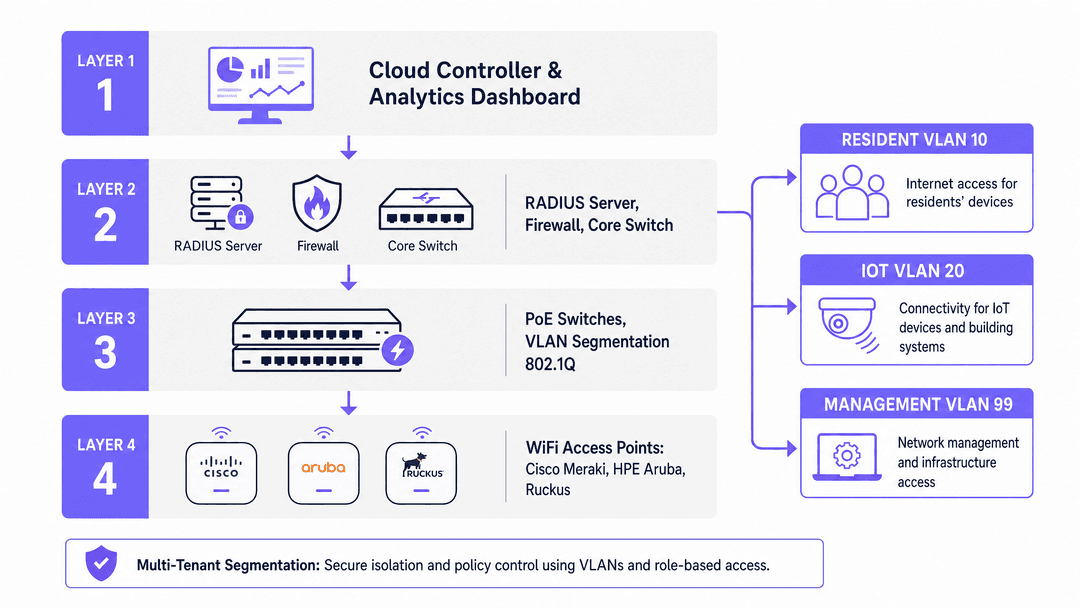
Modern managed WiFi providers deploy a single, building-wide enterprise network. Access points from vendors such as Cisco Meraki, HPE Aruba, Ruckus, Juniper Mist, Ubiquiti UniFi, Cambium, Extreme, or Fortinet provide blanket coverage. The intelligence sits in the cloud controller and the identity management platform, not in hardware bolted to each apartment wall.
Identity PSK (iPSK) and network segmentation
The cornerstone of a secure multi-tenant network is iPSK. Unlike standard WPA2-Personal, which uses a single shared password across all residents, iPSK generates a unique passphrase for every resident or room. When a device connects using its specific iPSK, the RADIUS server dynamically assigns it to a specific Virtual Local Area Network (VLAN) using IEEE 802.1Q standards.
This creates a Private Area Network (PAN) for the resident. Their devices - smartphones, laptops, smart TVs, and wireless printers - communicate with each other but are completely isolated from neighbouring apartments. Critically, this architecture supports 100% of consumer IoT devices, which often lack the supplicant required for 802.1X authentication, while maintaining enterprise-grade security. For a deeper comparison of authentication models, see our guide on PPSK adalah: comparing features and deployment models .
Security standards and compliance
A managed WiFi deployment must adhere to strict security protocols. Corporate and staff networks should use WPA3-Enterprise with IEEE 802.1X authentication, integrating with identity providers such as Microsoft Entra ID, Okta, or Google Workspace.
For retail and hospitality environments, guest traffic must be strictly segmented from payment systems to maintain PCI DSS compliance. Any guest data capture must align with GDPR and CCPA regulations. Purple's cloud overlay ensures conscious-choice opt-ins and secure first-party data collection, mitigating compliance risks for the venue operator. Purple holds ISO 27001, GDPR, CCPA, and Cyber Essentials certifications.
For healthcare and transport environments, additional regulatory frameworks apply. NHS Digital's Data Security and Protection Toolkit mandates specific controls around clinical network segmentation, while transport hubs must consider passenger data handling under sector-specific guidance.
Implementation guide
Step 1: Scoping and RF design
Never deploy access points based on floor plans alone. A managed provider must conduct a predictive RF survey to model signal propagation, wall attenuation, and capacity requirements. The design must account for 5GHz and 6GHz bands, minimising co-channel interference in high-density environments. Budget one access point per 30 to 50 concurrent users in standard environments, dropping to one per 15 to 20 in high-density spaces such as conference rooms or communal areas.
Step 2: Hardware selection and PoE infrastructure
Select enterprise-grade access points capable of handling high client densities. Ensure core and distribution switches support Power over Ethernet Plus (PoE+, IEEE 802.3at) to power access points without local power injectors. WiFi 6E access points with integrated IoT radios may require PoE++ at 60 watts; verify power budgets before specifying switches.
Step 3: Identity and access management
Integrate your property management system (PMS) with the network via API. When a lease is signed, the system automatically generates an iPSK and emails it to the resident. This delivers an instant-on experience; the resident connects immediately upon arrival without scheduling an engineer visit. When a tenant vacates, the key is revoked automatically, ensuring the next resident receives a fresh, isolated segment.
Step 4: Deploying the intelligence layer
For communal areas, retail spaces, or hospitality zones, deploy Guest WiFi to handle public access. Replace basic splash pages with a branded captive portal that captures verified identities. This transforms anonymous foot traffic into actionable WiFi Analytics . For a detailed look at SSID architecture across guest, staff, and IoT networks, see Three SSIDs to rule them all: guest, Passpoint, and IoT WiFi .
Step 5: Ongoing management and SLA governance
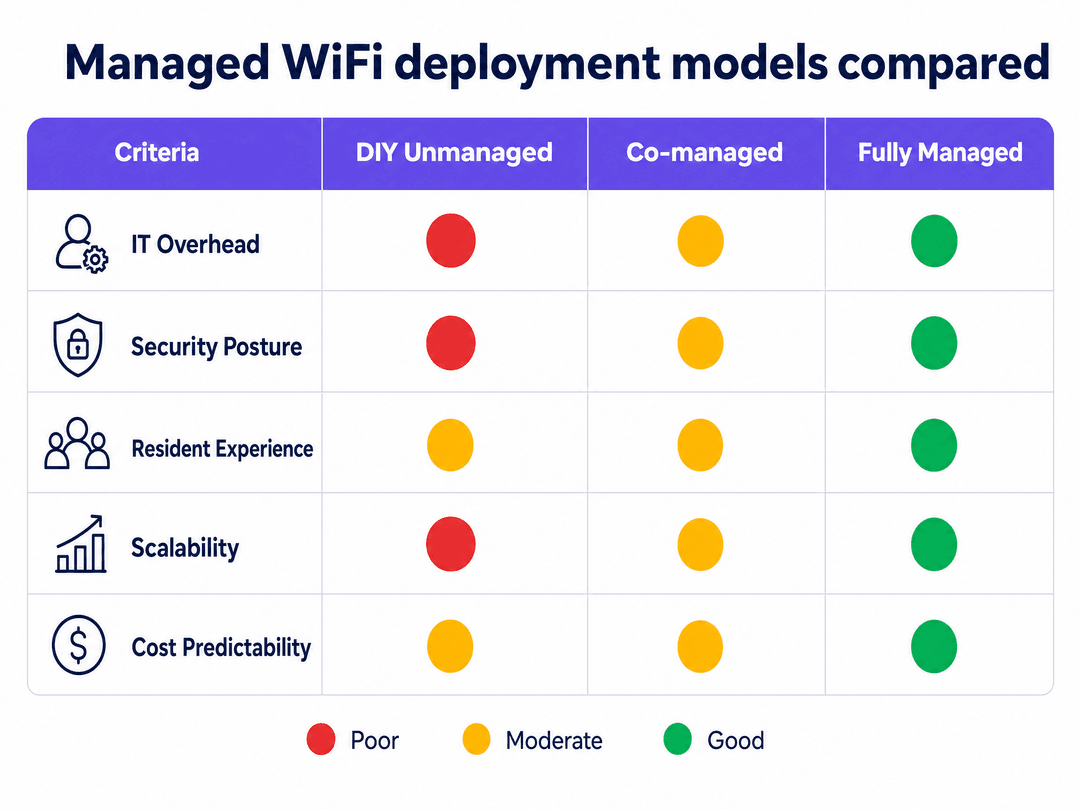
Define SLA terms before signing any managed service contract. Key metrics include uptime (Purple delivers 99.999% uptime across its platform), mean time to resolution for resident-reported faults, and proactive monitoring coverage. Ensure the contract includes a resident-facing helpdesk; if it does not, your building manager becomes the de facto IT support team.
Best practices
Mandate Dynamic VLAN Assignment. Use RADIUS and iPSK to isolate resident traffic. Never use a flat network for multi-tenant deployments; without segmentation, a resident on the second floor can access the building management system on the same subnet.
Prioritise cloud management. Eliminate on-premises hardware controllers. Cloud-managed platforms provide single-pane-of-glass visibility across your entire portfolio, enabling remote troubleshooting and firmware updates without dispatching engineers.
Implement strict traffic shaping. Apply bandwidth limits per iPSK or per VLAN to ensure fair use and prevent a single user from degrading network performance for the entire building.
Design for IoT from day one. Ensure your architecture supports headless devices - smart speakers, thermostats, security cameras - via iPSK. These devices cannot navigate captive portals or 802.1X prompts. Separating IoT traffic onto its own VLAN also contains the blast radius if a device is compromised.
Model the five-year total cost of ownership. Hardware typically represents 30 to 40% of the five-year TCO. Licensing, support contracts, cloud management subscriptions, and internal IT time make up the rest. Always compare vendors on five-year TCO, not hardware list price.
Troubleshooting and risk mitigation
RF interference
Risk: Too many access points transmitting at high power cause co-channel interference, degrading throughput across the building.
Mitigation: Rely on the managed provider's RF survey. Use dynamic radio management features within the cloud controller to automatically adjust transmit power and channel assignments based on real-time conditions.
Rogue DHCP servers
Risk: A resident plugs a consumer router into a wall port incorrectly, distributing invalid IP addresses to the building network and causing widespread connectivity failures.
Mitigation: Configure DHCP Snooping on all distribution switches to drop unauthorised DHCP offers. This is a standard switch feature on all enterprise hardware.
Support escalation
Risk: Building managers become de facto IT support for resident connectivity issues, consuming significant operational time.
Mitigation: Ensure your managed WiFi contract includes a 24/7 resident helpdesk. The provider must handle device onboarding, password resets, and connectivity troubleshooting directly, with escalation paths clearly defined in the SLA.
Compliance drift
Risk: GDPR consent flows or PCI DSS segmentation controls degrade over time as the network is modified without proper change management.
Mitigation: Schedule quarterly compliance reviews. Use Purple's audit trail and reporting features to demonstrate ongoing compliance to internal stakeholders and external auditors.
ROI and business impact
Deploying a managed WiFi network transitions internet provision from a sunk cost to a revenue-generating asset.
Increased asset value. High-performance, instant-on WiFi commands premium rental rates and reduces vacancy periods in BTR properties. Connectivity is now ranked as the top amenity by prospective residents in multiple UK BTR surveys.
Operational efficiency. Automating onboarding via PMS integration and offloading support to the managed provider eliminates significant IT and administrative overhead. Purple's automated tenant lifecycle management - from iPSK generation at lease signing to key revocation at checkout - removes manual processes entirely.
First-party data. In retail and hospitality contexts, the network captures visitor demographics and behaviour. Purple has collected 29 billion data points across 80,000+ live venues (Purple internal data), enabling targeted marketing and loyalty programs that drive direct revenue. Customers including Premier Inn, Whitbread, and Stonegate Pubs use this data to drive measurable re-engagement.
Future-proofing. A centralised, cloud-managed infrastructure can be upgraded via software licensing - increasing bandwidth tiers, adding security features, or enabling new analytics capabilities - without requiring hardware replacements in every unit.
Key Definitions
Identity PSK (iPSK)
A security protocol that allows multiple unique Pre-Shared Keys on a single SSID, with each key tying the connecting device to a specific VLAN or network policy via RADIUS.
Essential for MDU and BTR deployments where residents need to connect smart home devices securely without using complex 802.1X authentication.
IEEE 802.1Q
The networking standard that supports Virtual LANs (VLANs) on an Ethernet network, allowing multiple logically separated networks to share the same physical switch infrastructure.
Used by managed WiFi providers to segment resident traffic from building management systems and guest traffic on the same physical switches.
IEEE 802.1X
An IEEE standard for port-based Network Access Control (PNAC), providing an authentication mechanism to devices wishing to attach to a LAN or WLAN before granting network access.
The gold standard for authenticating corporate staff and IT administrators onto secure management networks, requiring a RADIUS server and an identity provider.
VLAN (Virtual Local Area Network)
A logical subnetwork that groups a collection of devices from different physical LANs, enforcing traffic isolation at the data link layer.
Crucial for security; ensures that a guest connecting in the lobby cannot access the servers running the building's HVAC or access control systems.
Captive portal
A web page that a user of a public-access network must view and interact with before internet access is granted, typically used for authentication and consent capture.
The primary mechanism used by Purple to capture first-party data, secure GDPR marketing consent, and authenticate guests in hospitality and retail environments.
RADIUS
Remote Authentication Dial-In User Service; a networking protocol providing centralised Authentication, Authorisation, and Accounting (AAA) management for network access.
The backend server that validates a user's credentials or iPSK and instructs the network switch which VLAN to assign the connecting device to.
WPA3-Enterprise
The latest Wi-Fi security protocol for enterprise networks, requiring a RADIUS server for authentication and mandating Protected Management Frames (PMF) to prevent deauthentication attacks.
Must be deployed for all internal corporate and staff networks. WPA3-Enterprise eliminates the vulnerabilities in WPA2's four-way handshake and supports an optional 192-bit cryptographic suite for regulated environments.
Multi-Dwelling Unit (MDU)
A building classification where multiple separate housing units are contained within one building or complex, such as apartment blocks, student accommodation, or build-to-rent developments.
The primary target market for managed iPSK deployments, requiring scalable multi-tenant network architectures that serve hundreds of residents from shared infrastructure.
PoE+ (IEEE 802.3at)
Power over Ethernet Plus; a standard that delivers up to 30 watts of power per port over standard Ethernet cabling, eliminating the need for separate power supplies at each access point.
The baseline PoE standard for enterprise access point installations. Wi-Fi 6E APs with integrated IoT radios may require PoE++ (IEEE 802.3bt) at 60 watts.
Cloud controller
A cloud-hosted network management platform that provides centralised configuration, monitoring, and policy enforcement across all access points in a deployment, without requiring on-premises controller hardware.
The standard architecture for multi-site managed WiFi deployments. Eliminates the single point of failure that on-premises controllers represent and enables remote management across entire property portfolios.
Worked Examples
A 300-unit build-to-rent property requires resident WiFi. The developer wants to avoid residents installing 300 individual consumer routers, which would cause severe RF interference, but needs to ensure residents can securely connect their smart TVs and wireless printers without neighbours seeing their devices.
Deploy a managed enterprise network using Cisco Meraki or HPE Aruba access points in the corridors and common areas, placed according to a predictive RF survey. Implement iPSK integrated with the property management system. When a resident moves in, they automatically receive a unique iPSK via email. The RADIUS server uses this key to assign their devices to a dedicated, isolated VLAN using IEEE 802.1Q. The resident connects all their devices - including headless IoT devices - using this single password. When they vacate, the key is revoked automatically.
A national retail chain with 50 locations wants to offer Guest WiFi to shoppers but needs to ensure that the guest network cannot access the Point of Sale (POS) terminals, maintaining PCI DSS compliance. They also want to capture shopper email addresses for marketing.
Configure core and edge switches with strict IEEE 802.1Q VLAN segmentation. Assign POS terminals to VLAN 10 and Guest WiFi to VLAN 20. Implement ACLs on the firewall to explicitly deny any routing between VLAN 20 and VLAN 10. Deploy Purple's captive portal on the Guest SSID. Configure the portal to present a GDPR-compliant privacy notice and request explicit marketing consent before granting internet access. Captured email addresses sync directly to the CRM via Purple's integration layer.
Practice Questions
Q1. You are deploying WiFi across a 500-unit student accommodation block. Students need to connect laptops, smartphones, and headless devices like gaming consoles and smart speakers. The IT security team mandates that each student's traffic must be isolated from other students. Which authentication method should you deploy, and why?
Hint: Consider the limitations of 802.1X when dealing with gaming consoles and smart speakers that have no browser or credential input capability.
View model answer
Deploy Identity PSK (iPSK). While 802.1X is highly secure, it requires a supplicant to enter a username and password, which headless devices lack. iPSK allows every student to have a unique password that dynamically assigns them to their specific VLAN via RADIUS, supporting all consumer devices while maintaining strict isolation between students.
Q2. A hotel operator reports that their guest WiFi is slow despite recently upgrading their internet circuit to 1Gbps. The building uses older access points placed roughly every 20 metres, and the IT manager suspects co-channel interference. What is the immediate recommended action?
Hint: Increasing bandwidth does not resolve RF physics problems. Think about what governs signal quality in the air.
View model answer
Commission a predictive and active RF site survey. Increasing upstream bandwidth does not resolve interference caused by poor channel planning or excessive transmit power. The survey will identify coverage overlap, co-channel interference sources, and guide the reconfiguration of radio resource management settings on the cloud controller. Access point placement may also need to be revised.
Q3. Your retail client wants to capture shopper email addresses for marketing purposes using in-store WiFi. They currently use a basic open network with no password and no splash page. How should you architect the solution to ensure GDPR compliance and effective data capture without replacing their existing hardware?
Hint: Think about how to overlay intelligence on the existing network without a hardware refresh.
View model answer
Deploy Purple's cloud overlay as a hardware-agnostic layer on top of the existing access points. Configure the network to route guest traffic to a branded captive portal before granting internet access. The portal must explicitly request marketing consent to comply with GDPR, capturing the email address securely and syncing it with the client's CRM. No hardware replacement is required; Purple integrates via RADIUS or API with the existing infrastructure.
Q4. A BTR developer asks whether they should deploy a co-managed or fully managed WiFi service across a portfolio of five new developments totalling 1,200 units. Their internal IT team consists of two people who manage corporate IT for the development company itself. What do you recommend?
Hint: Consider the IT team's capacity relative to the scale of the deployment and the resident-facing support requirement.
View model answer
Recommend a fully managed service. A two-person IT team cannot provide 24/7 resident support across 1,200 units while also managing corporate IT. A fully managed provider handles RF design, installation, monitoring, firmware updates, and resident helpdesk support under a single SLA. The five-year TCO of a fully managed service is typically lower than co-managed once internal IT time and the cost of poor resident experience are factored in.
Continue reading in this series
Staff WiFi vs. Guest WiFi: Best Practices for Corporate Network Segmentation
A comprehensive technical guide for IT leaders on segmenting staff and guest WiFi networks. It covers VLAN architecture, 802.1X authentication, firewall policies, and the business impact of secure network design.
Apartment WiFi solutions: a comprehensive guide for businesses
This guide covers the architecture, deployment, and business case for apartment WiFi solutions in Build to Rent and multi-dwelling unit properties. It explains how Identity Pre-Shared Key (iPSK) technology creates secure, isolated network bubbles for each resident while supporting smart devices and IoT. Property developers, landlords, and BTR operators will find actionable deployment guidance, ROI data, and worked implementation scenarios.
Cox business managed WiFi: a comprehensive guide for businesses
This guide details how property developers and BTR operators can deploy scalable, secure networks using Cox Business managed WiFi. It covers network architecture, vendor-neutral hardware deployment, and the business impact of transitioning connectivity from an operational headache to reliable infrastructure.