
What is Cloud RADIUS? A Comprehensive Guide to RADIUS as a Service
This comprehensive guide explores Cloud RADIUS (RADIUS as a Service), detailing its architecture, EAP methods, and implementation strategies. It provides IT leaders with actionable insights on migrating from on-premises servers to a scalable, secure, and compliant cloud-based authentication model.
Video overview
Listen to this guide
View podcast transcript
Part of our core series: Enterprise WiFi Security Guide →

Executive Summary
For modern enterprise networks, traditional on-premises RADIUS (Remote Authentication Dial-In User Service) architecture constitutes a significant operational bottleneck. Managing physical servers, patching operating systems, handling certificate authorities, and architecting multi-site redundancy consumes valuable IT resources. Cloud RADIUS (or RADIUS-as-a-Service) solves this problem by migrating the IEEE 802.1X authentication layer to managed, highly available cloud infrastructure. This guide provides a comprehensive technical overview of Cloud RADIUS for IT managers, network architects, and CTOs evaluating deployment strategies. By shifting from capex-heavy, manually maintained systems to an elastic, globally distributed model, organizations in the retail, hospitality and transport sectors can enforce robust access policies, achieve compliance (such as PCI-DSS and GDPR), and integrate seamlessly with modern identity providers like Microsoft Entra ID and Google Workspace.
Technical Deep-Dive
The Evolution of RADIUS Architecture
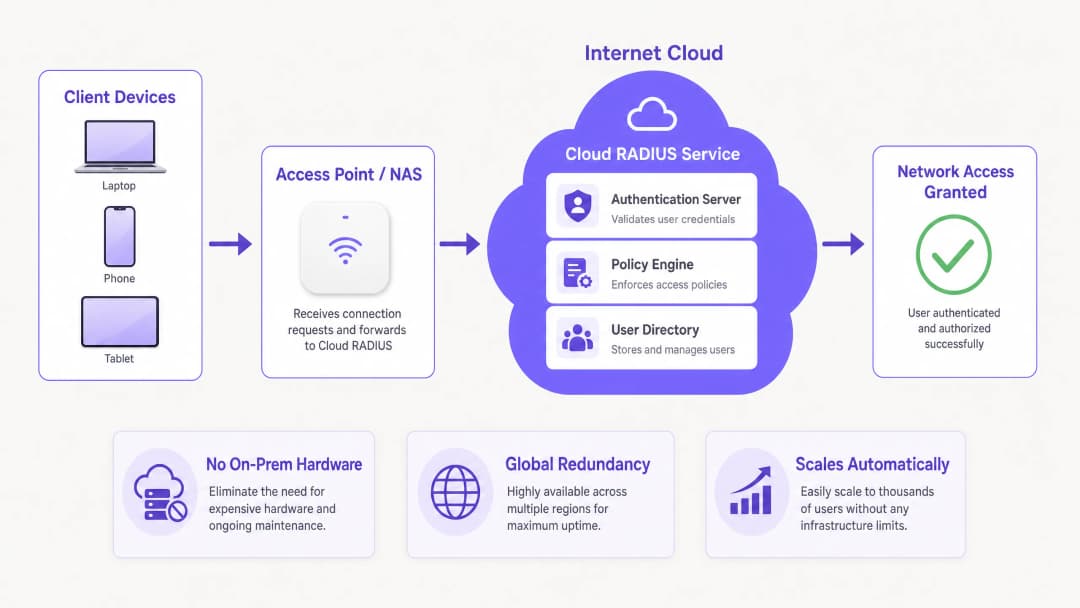
RADIUS, originally defined in RFC 2865, operates on a client-server model in which a Network Access Server (NAS) - such as a WiFi access point or a VPN concentrator - forwards authentication requests to a central server. Historically, this meant deploying FreeRADIUS or Microsoft Network Policy Server (NPS) on dedicated hardware. While this is workable for single-site deployments, scaling this architecture across distributed environments introduces significant latency and redundancy challenges.
Cloud RADIUS abstracts the underlying infrastructure. Authentication requests are routed to globally distributed cloud endpoints, ensuring response times below 100 milliseconds even under peak load. This elasticity is critical for high-density environments such as stadiums or conference centers.
EAP Methods and Security Posture
The choice of Extensible Authentication Protocol (EAP) method fundamentally determines your security posture:
- PEAP (Protected EAP): Establishes an MSCHAPv2 tunnel within a TLS session. While PEAP is widely supported and easy to integrate with Active Directory, it is vulnerable to credential theft via rogue access points if client devices are not strictly configured to validate the server certificate.
- EAP-TLS: The enterprise gold standard. It requires mutual certificate authentication - both the server and the client must present valid certificates. This completely eliminates password-based attacks, but demands a robust Public Key Infrastructure (PKI) and Mobile Device Management (MDM) integration for certificate deployment.
- EAP-TTLS and EAP-FAST: Provide alternatives suited to scenarios requiring broad client compatibility (including legacy or Linux systems), or where Protected Access Credentials (PACs) are needed to bypass certificate validation dependencies.
WPA3 and OpenRoaming Integration
Modern deployments must account for WPA3-Enterprise, which mandates 192-bit security mode for the highest security level, requiring specific cipher suites. Additionally, Cloud RADIUS facilitates participation in federation frameworks such as OpenRoaming. For example, Purple acts as a free identity provider for OpenRoaming under its Connect license, allowing seamless, secure authentication across participating networks worldwide.
Got questions about your specific setup?
Our team works with venue operators, IT managers, and network engineers across 80,000 venues. Book a 20-minute call and we will show you how others like you solved it.
Implementation Guide
Deploying Cloud RADIUS requires a systematic approach to ensure zero downtime during the transition.
Step 1: Identity Provider (IdP) Integration
Your Cloud RADIUS instance must synchronize with your authoritative user directory. Native SAML or SCIM provisioning with Microsoft Entra ID, Google Workspace, or Okta is preferable to manual LDAP proxies or CSV imports. This ensures that when an employee is offboarded in the HR system, their network access is revoked immediately.
Step 2: Certificate Management Strategy
If deploying EAP-TLS, define your certificate lifecycle. Choose a Cloud RADIUS provider that includes an integrated PKI or integrates seamlessly with your existing Certificate Authority (CA). Automate certificate issuance and revocation via your MDM platform (such as Intune or Jamf) to prevent authentication failures caused by expired certificates.
Step 3: Network Device Configuration
Configure your NAS devices (access points, switches) to point to the primary and secondary Cloud RADIUS IP addresses. Ensure shared secrets are cryptographically complex (a minimum of 32 random characters). Adjust failover timeout settings; a timeout of 3 to 5 seconds is optimal, preventing prolonged authentication delays if the primary node becomes unreachable.
Step 4: Policy Definition
Establish policies on a per-SSID basis. For example, enforce EAP-TLS for the corporate network, PEAP for legacy IoT devices, and isolate guest access. Note that RADIUS handles known users; for visitors, deploy a dedicated Guest WiFi solution with a Captive Portal to capture first-party data, integrated with a WiFi Analytics platform. For more on visitor engagement, refer to How to Improve Guest Satisfaction: The Ultimate Guide.
Best Practices
- Enforce strict server certificate validation: For PEAP deployments, push Group Policy or MDM profiles that force clients to validate the RADIUS server certificate and restrict trust to a specific root CA.
- Segment accounting and authentication traffic: Ensure RADIUS accounting data is actively monitored and retained. This audit trail is essential for compliance reporting (such as PCI DSS and HIPAA).
- Monitor authentication latency: High latency often indicates suboptimal routing or IdP synchronization issues. Use monitoring tools to track the time taken from the Access-Request to the Access-Accept packet.
- Optimize signal and channel planning: Reliable authentication depends on a stable physical layer. Review guides such as Understanding RSSI and Signal Strength for Optimal Channel Planning to ensure your RF environment supports seamless 802.1X roaming.
Troubleshooting and Risk Mitigation
Even with a managed service, misconfiguration can lead to access failures. Common failure modes include:
- Certificate expiry: The leading cause of EAP-TLS failures. Mitigation: Implement automated alerts 30 days before CA or server certificates expire.
- Shared secret mismatch: Typically occurs when adding new access points. Mitigation: Standardize configuration templates in your network management system.
- NAT and IP allowlisting issues: Cloud RADIUS providers typically require NAS IP allowlisting. If your branch sites use dynamic IPs or complex NAT configurations, authentication requests may be dropped. Mitigation: Use static egress IPs or deploy a local RADIUS proxy where necessary.
- IdP synchronization failures: If the cloud directory fails to synchronize with on-premises AD, new users will be unable to authenticate. Mitigation: Proactively monitor SCIM/LDAP connector status.
ROI and Business Impact
Transitioning to Cloud RADIUS delivers measurable business value:
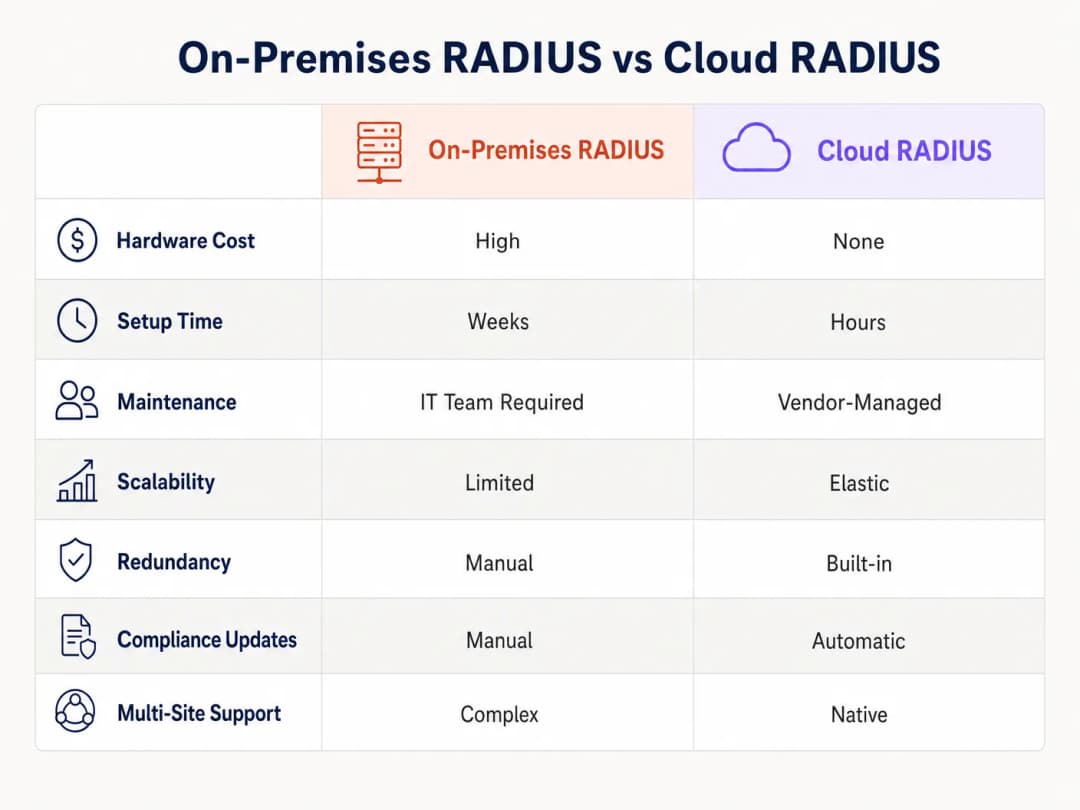
- Reduced infrastructure capital expenditure (Capex): No need to purchase, rack, and power physical RADIUS servers at every major site.
- Lower operational overhead: IT teams no longer spend hours patching operating system vulnerabilities or manually managing server failover. Vendor-managed updates ensure continuous compliance.
- Enhanced security posture: Transitioning to EAP-TLS via a cloud PKI reduces the risk of credential theft, directly lowering the potential cost of a data breach.
- Agility and scalability: When opening a new retail branch or hotel, network authentication can be provisioned in minutes rather than weeks. For practical rollout strategies, see Setting Up WiFi for Business: A 2026 Playbook.
With centralized access control, organizations not only secure their perimeter but also free up senior engineering talent to focus on strategic, high-impact projects rather than maintaining outdated legacy infrastructure.
Key Definitions
Cloud RADIUS
A managed service that hosts the Remote Authentication Dial-In User Service protocol in a highly available cloud environment, eliminating the need for on-premises authentication servers.
Evaluated by IT teams seeking to reduce hardware capex and operational overhead while maintaining secure 802.1X network access.
EAP-TLS (Extensible Authentication Protocol-Transport Layer Security)
A highly secure authentication method requiring both the client and the server to present digital certificates to prove their identity.
The recommended standard for enterprise networks to prevent password-based attacks, requiring PKI and MDM for deployment.
NAS (Network Access Server)
The device - such as a WiFi access point, switch, or VPN concentrator - that acts as the RADIUS client, forwarding user credentials to the RADIUS server.
Network engineers must configure the NAS with the correct RADIUS server IPs and shared secrets to enable 802.1X authentication.
Shared Secret
A cryptographic text string known only to the NAS and the RADIUS server, used to encrypt RADIUS packets and verify the sender's authenticity.
A weak shared secret is a major security vulnerability; enterprise deployments should use long, randomly generated strings.
SCIM (System for Cross-domain Identity Management)
An open standard that automates the exchange of user identity information between IT systems or cloud applications.
Used to automatically provision and de-provision users in the Cloud RADIUS directory when changes are made in the primary HR or IT identity system.
OpenRoaming
A federation framework developed by the Wireless Broadband Alliance that allows users to automatically and securely connect to participating WiFi networks globally.
Cloud RADIUS providers that support OpenRoaming (like Purple) allow venues to offer seamless, secure connectivity to visitors without captive portals.
Accounting Logs
Records generated by the RADIUS server detailing user connection events, including start time, end time, data transferred, and IP address assigned.
Critical for security audits, troubleshooting, and demonstrating compliance with frameworks like PCI-DSS and GDPR.
Change of Authorization (CoA)
A RADIUS feature that allows the server to dynamically modify a user's active session, such as changing their VLAN or disconnecting them, without requiring a reconnection.
Used by network administrators to instantly quarantine a compromised device or apply new policy restrictions mid-session.
Worked Examples
A 200-room hotel currently uses on-premises Microsoft NPS for staff WiFi authentication via PEAP. They are experiencing authentication timeouts during peak check-in hours and want to migrate to Cloud RADIUS with EAP-TLS for better security and reliability. How should the IT Director architect this migration?
- Deploy a Cloud RADIUS tenant and integrate it with the hotel's Microsoft Entra ID via SCIM for automated user lifecycle management. 2. Configure the Cloud RADIUS integrated PKI to issue client certificates. 3. Use the existing MDM (e.g., Intune) to push the Root CA, client certificates, and a new WiFi profile configured for EAP-TLS to all staff devices. 4. Configure the hotel's access points to point to the primary and secondary Cloud RADIUS IPs, using a new, complex 32-character shared secret. 5. Run both the old NPS and new Cloud RADIUS in parallel on different SSIDs for a two-week transition period before decommissioning the on-premises servers.
A national retail chain with 500 locations needs to ensure PCI DSS compliance for its point-of-sale (POS) terminals, which connect via WiFi. They are moving to Cloud RADIUS. What specific configurations are required to meet compliance?
- Implement strict network segmentation: POS terminals must authenticate to a dedicated, hidden SSID mapped to an isolated VLAN. 2. Enforce EAP-TLS authentication for all POS devices to ensure mutual authentication and prevent rogue devices from joining the POS network. 3. Configure the Cloud RADIUS service to retain all accounting logs (Access-Accept, Access-Reject, connection duration) for a minimum of one year, as mandated by PCI DSS. 4. Ensure the RADIUS shared secrets between the branch APs and the Cloud RADIUS service are rotated every 90 days using an automated script.
Practice Questions
Q1. Your organization is migrating from an on-premises Active Directory to Google Workspace. You currently use PEAP-MSCHAPv2 for WiFi authentication. Why is this a problem, and what is the recommended solution?
Hint: Consider how PEAP validates credentials against the directory protocol.
View model answer
PEAP-MSCHAPv2 relies on the NT hash of a user's password, which Google Workspace does not store or expose natively. The recommended solution is to migrate to EAP-TLS using a Cloud RADIUS provider that features an integrated PKI. The Cloud RADIUS service can sync user identities from Google Workspace via SAML/SCIM, and authenticate devices using client certificates rather than passwords.
Q2. A branch office reports that users are experiencing 30-second delays when connecting to the WiFi network, followed by a successful connection. The primary Cloud RADIUS IP in that region is currently undergoing maintenance. What configuration error is causing this delay?
Hint: Look at the communication between the NAS and the RADIUS servers.
View model answer
The NAS (Access Point or Switch) has the RADIUS server timeout configured too high (e.g., 30 seconds). It is waiting for the primary server to respond before failing over to the secondary server. The timeout should be reduced to 3-5 seconds to ensure rapid failover without impacting the user experience.
Q3. You are deploying Cloud RADIUS for a hospital. The security team mandates that only corporate-owned devices can connect to the internal network, even if an employee knows a valid username and password. How do you enforce this?
Hint: Which EAP method verifies the device's identity, not just the user's knowledge?
View model answer
Deploy EAP-TLS. Configure the hospital's MDM solution to push a unique client certificate only to enrolled, corporate-owned devices. Configure the Cloud RADIUS policy to reject any authentication request that does not present a valid certificate signed by the trusted internal PKI, effectively blocking BYOD or rogue devices regardless of password knowledge.
Continue reading in this series
The Security Benefits of RADIUS as a Service for Hybrid Workforces
This technical reference guide explains how RADIUS as a Service secures network access for hybrid workforces across distributed venues. It covers the architecture, security benefits, and deployment steps for replacing on-premises RADIUS infrastructure with a cloud-managed authentication service. For IT managers and network architects at hotels, retail chains, stadiums, and public-sector organizations, this guide provides the evidence needed to evaluate and act on a cloud RADIUS migration this quarter.
Integrating RADIUS as a Service with Cloud Directories (Azure AD & Google Workspace)
This technical reference guide details how to integrate RADIUS as a Service with cloud directories - Microsoft Entra ID and Google Workspace - for enterprise WiFi authentication. It covers the architectural shift from on-premise NPS to cloud-native RADIUS, the deployment of certificate-based EAP-TLS authentication, and the operational best practices for securing wireless access across hospitality, retail, and public-sector environments. For IT managers and network architects already invested in cloud identity, this guide bridges the gap between directory management and physical network security.
How to Implement 802.1X Authentication with Cloud RADIUS
This technical reference guide provides a comprehensive framework for implementing 802.1X authentication with Cloud RADIUS across distributed enterprise estates. It details the architecture, EAP method selection, deployment sequencing, and risk mitigation strategies required to secure network access while eliminating the operational overhead of on-premises infrastructure.
Got questions about your specific setup?
Our team works with venue operators, IT managers, and network engineers across 80,000 venues. Book a 20-minute call and we will show you how others like you solved it.