
How to leverage restaurant SMS marketing to increase return visits
This guide details how restaurant operators, IT managers, and venue operations directors can use Guest WiFi infrastructure to capture verified, consented first-party data and drive return visits through automated restaurant SMS marketing. It covers the full technical architecture from captive portal deployment on Cisco Meraki, HPE Aruba, and Ruckus hardware through to GDPR and TCPA-compliant automation in Purple Engage, with real-world implementation scenarios and measurable ROI benchmarks.
Listen to this guide
View podcast transcript
Executive summary
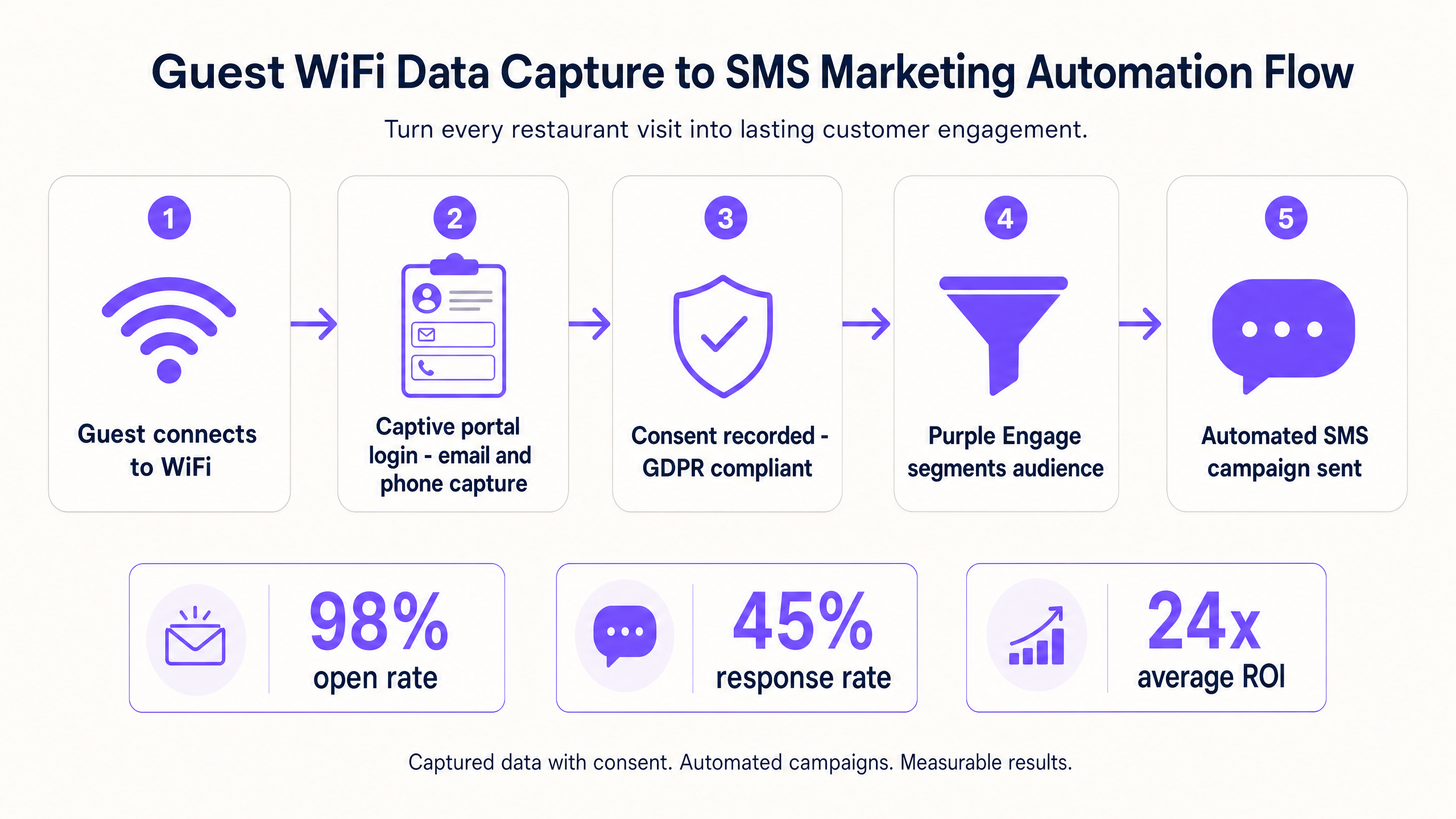
Capturing first-party guest data is no longer optional for hospitality venues. While email marketing remains a staple, restaurant SMS marketing delivers a 98% open rate and a 45% response rate - figures that email cannot match. The challenge for IT managers and venue operations directors is capturing this data cleanly, compliantly, and at scale, then activating it in a way that demonstrably drives return visits.
By integrating your Guest WiFi captive portal with Purple Engage, you transform anonymous foot traffic into a known, addressable audience. Purple operates across 80,000+ live venues and has processed 440 million logins in 2024, giving us a clear view of what works at scale. This guide details the technical architecture, compliance requirements, and implementation strategies to deploy restaurant SMS marketing effectively - moving from generic bulk messaging to automated, trigger-based campaigns that increase visit frequency and average spend.
Technical deep-dive: architecture and data flow
A successful SMS marketing programme requires a solid technical foundation. The data capture process begins the moment a guest connects to your network.
The data capture mechanism
When a guest selects your SSID, the network controller redirects them to a captive portal - a web page the guest must interact with before network access is granted. This portal is the primary data collection point. To ensure a seamless user experience and high opt-in rates, the portal must be hardware-agnostic and support social login alongside traditional email and phone number entry.
The architecture typically involves four layers working in sequence:
| Layer | Component | Role |
|---|---|---|
| Access layer | Cisco Meraki, HPE Aruba, Ruckus, Juniper Mist, Ubiquiti UniFi APs | Broadcast the SSID and detect unauthenticated clients |
| Authentication layer | RADIUS server | Handles Authentication, Authorisation, and Accounting (AAA) |
| Capture layer | Purple cloud overlay captive portal | Presents the splash page and data capture forms |
| Activation layer | Purple Engage | Stores data, applies behavioural tags, triggers automated workflows |
Purple's hardware-agnostic cloud overlay integrates with all of the above hardware vendors without requiring you to replace your existing infrastructure. This matters for multi-site operators who may have a mixed estate.
Compliance: GDPR and TCPA
Compliance is the most critical technical consideration in any restaurant SMS marketing deployment. The Telephone Consumer Protection Act (TCPA) in the US and the General Data Protection Regulation (GDPR) in Europe mandate explicit consent for marketing communications. Failure to comply with TCPA requirements can result in fines of up to $1,500 per message sent without consent.
You must implement a conscious-choice opt-in mechanism. Pre-ticked boxes are non-compliant under GDPR. The captive portal must clearly state what the guest is opting into and provide a link to your privacy policy. Every SMS message must include a clear opt-out mechanism (e.g., "Reply STOP to opt out"). Purple is ISO 27001, GDPR, and CCPA certified, and handles this consent state automatically, ensuring your database remains clean and audit-ready.
The consent record must capture: the timestamp of opt-in, the specific channel consented to (SMS, email, or both), the version of the privacy policy presented, and the IP address or device identifier. Purple Engage stores all of this automatically.
Network segmentation and security
Your Guest WiFi network should operate on a dedicated SSID, isolated from your staff and IoT networks via VLAN segmentation. This is a security baseline, not an optional extra. A guest who connects to your restaurant WiFi should never be able to reach your point-of-sale systems, kitchen display systems, or back-office infrastructure.
For a detailed breakdown of how to architect three separate SSIDs for guest, staff, and IoT traffic, see Three SSIDs to rule them all: guest, Passpoint, and IoT WiFi .
Implementation guide: deploying SMS marketing
Deploying restaurant SMS marketing requires coordination between IT and marketing teams. The following steps provide a structured deployment path.
Step 1: configure the captive portal
Design a splash page that aligns with your brand. Keep the data entry form concise - asking for too much information upfront reduces conversion rates. Focus on the essentials: name, phone number, and email address. A well-designed splash page makes a strong first impression and sets the tone for the guest relationship. For guidance on portal design, see How to make a great first impression with your guest WiFi .
Step 2: define audience segments
Do not send the same message to your entire database. Segment your audience based on behaviour captured through the WiFi network.
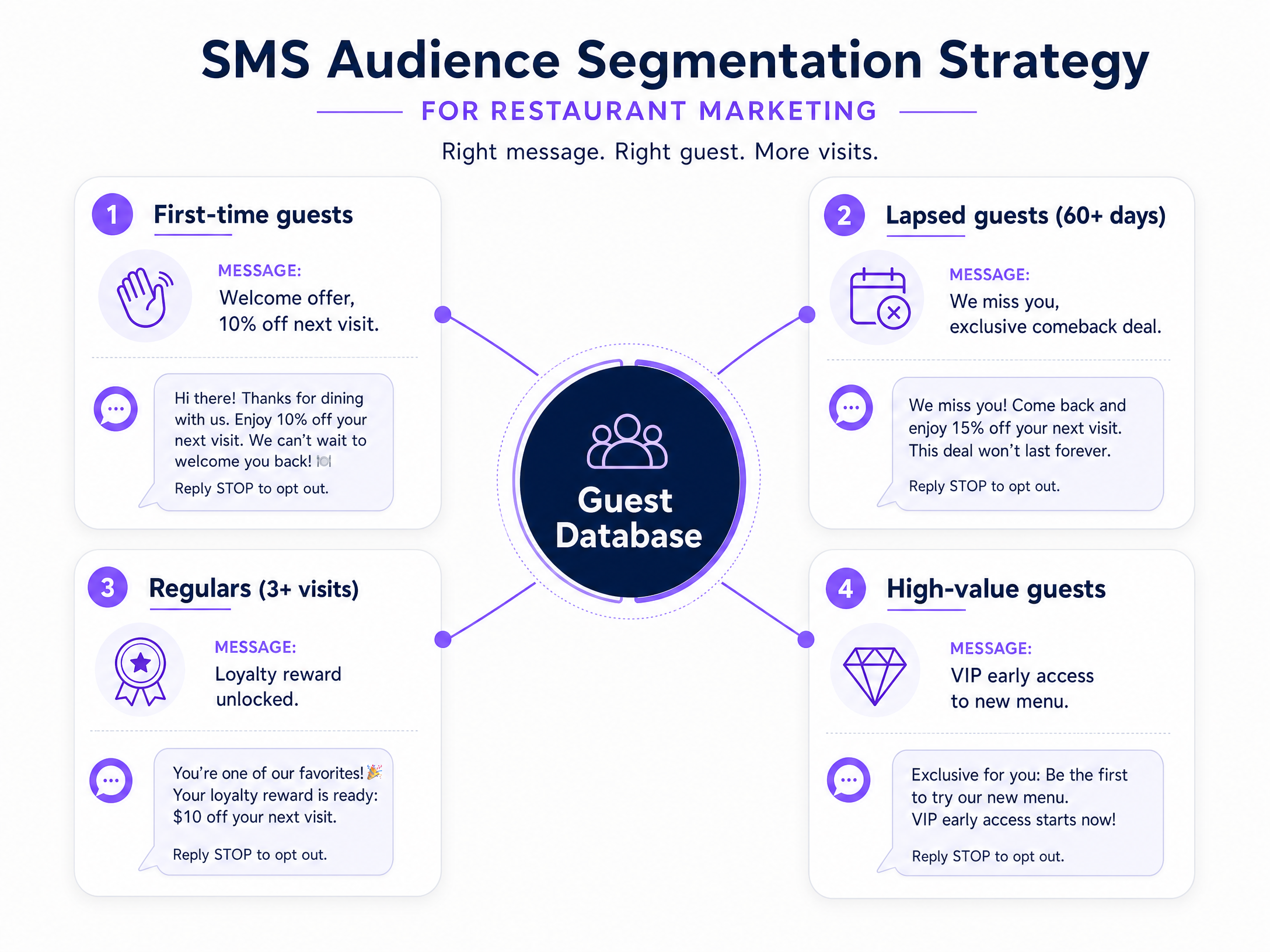
The four core segments for restaurant SMS marketing are:
First-time visitors. Trigger a welcome SMS 24 hours after their first visit, offering an incentive to return - typically a 10% discount or a complimentary item on their next visit.
Lapsed guests (60+ days). Identify guests who have not connected to the WiFi in two months. A targeted re-engagement offer with a time-limited incentive drives urgency.
Regulars (3+ visits). Reward your most loyal guests with exclusive access or loyalty perks. These guests have the highest lifetime value and respond well to recognition.
High-value guests. Identified by dwell time and visit frequency data from WiFi Analytics , these guests receive VIP treatment - early access to new menus, priority booking, or exclusive events.
Step 3: automate campaigns
Use Purple Engage to build automated workflows. For example, configure a rule that triggers an SMS containing a 10% discount code if a guest has not visited in 60 days. Automation ensures timely, relevant communication without manual intervention from your marketing team.
A well-structured automation library for a restaurant group typically includes:
| Trigger | Delay | Message type | Goal |
|---|---|---|---|
| First WiFi login | 24 hours | Welcome + return offer | Drive second visit |
| No visit in 60 days | Immediate | Re-engagement offer | Recover lapsed guest |
| Third visit in 30 days | Immediate | Loyalty reward unlock | Deepen loyalty |
| Birthday (if captured) | Day of | Birthday offer | Increase emotional connection |
| Post-visit (same day) | 2 hours | Feedback request | Gather insight |
Step 4: measure and optimise
Track performance at the campaign level and the segment level. The key metrics for restaurant SMS marketing are:
- Delivery rate: the percentage of messages that reach the handset. Below 95% indicates data quality issues.
- Open rate: industry average is 98% for SMS. Below 90% suggests timing or relevance issues.
- Click-through rate (CTR): 20-35% is the industry benchmark. Low CTR indicates the offer or CTA is weak.
- Redemption rate: the percentage of recipients who actually visit and redeem the offer. This is the metric that ties SMS to revenue.
- Closed-loop attribution rate: the percentage of SMS recipients who subsequently connect to the WiFi network, confirming a physical return visit.
Best practices
The following recommendations reflect industry-standard practice across the hospitality venues in Purple's 80,000+ venue network.
Timing drives conversion. Send messages when guests are making dining decisions. A lunch offer sent at 11:00 AM converts significantly better than one sent at 3:00 PM. A dinner promotion at 4:00 PM intercepts the guest precisely when they are deciding where to eat.
Keep it to 160 characters. SMS messages that exceed 160 characters are split into multiple messages by the carrier, increasing cost and reducing readability. Get straight to the point and include one clear call to action.
Provide immediate value. Every message should offer something tangible - a discount, early access to a new menu, or an invitation to an exclusive event. Messages that offer no immediate value drive opt-outs.
Integrate SMS with your analytics platform. Use the data gathered from your network to refine your messaging. If WiFi Analytics shows a drop in foot traffic on Tuesday evenings, deploy a targeted SMS campaign to drive visits during that specific window. For related guidance on SMS campaign examples, see How to use marketing SMS examples to increase return visits .
Limit frequency to 2-4 messages per month. SevenRooms data shows that operators who exceed four messages per month see a measurable increase in opt-out rates. Restraint preserves the channel's effectiveness.
Troubleshooting and risk mitigation
Low opt-in rates on the captive portal
If guests are not opting into SMS marketing, your captive portal is creating too much friction.
Root cause: The form requires too many fields, the value proposition is unclear, or the page loads slowly on mobile devices.
Remedy: Streamline the form to capture only name, phone number, and consent. Ensure the value proposition ("Sign up for exclusive offers") is prominent above the fold. Test page load time - anything above three seconds on a 4G connection will increase abandonment.
High unsubscribe rates
A high opt-out rate indicates that your messages are either too frequent or irrelevant to the recipient.
Root cause: Generic blasts to unsegmented lists, or messages sent at inconvenient times.
Remedy: Review your segmentation strategy. Ensure you are sending targeted messages based on guest behaviour rather than generic blasts. Audit your send times against your venue's peak trading hours.
Delivery failures
Messages may fail to deliver due to invalid phone numbers or carrier filtering.
Root cause: Phone numbers entered incorrectly at the captive portal, or messages flagged as spam by carriers due to content or send patterns.
Remedy: Implement phone number validation on the captive portal to ensure data accuracy at the point of entry. Use a reputable SMS gateway with carrier relationships. Avoid using URL shorteners that carriers associate with spam.
Compliance audit failure
If your consent records are challenged under GDPR or TCPA, you need to demonstrate that explicit opt-in was obtained.
Remedy: Ensure your platform stores the full consent record - timestamp, policy version, and channel. Purple Engage maintains this audit trail automatically. Conduct a quarterly review of your consent capture flow to ensure it remains compliant with any regulatory updates.
ROI and business impact
The ultimate goal of restaurant SMS marketing is to drive measurable business outcomes. The data from operators using this approach is compelling.
California Fish Grill, using an SMS marketing platform integrated with their WiFi data, found that SMS opted-in guests visited every 120 days on average, compared to 175 days for non-opted-in guests - a 46% improvement in visit frequency. Those guests also had a 4% higher average order value and a 69% higher guest lifetime value.
SevenRooms operators using text campaigns report a 24x average return on investment, with an average of $1,800 in revenue generated per text campaign.
Fabio Viviani Hospitality generated over $220,000 in revenue and brought in 3,635 guests in four months using text marketing across seven venues.
The key to replicating these results is closed-loop attribution. By tracking when a guest who received an SMS subsequently connects to your WiFi network, you can definitively prove the impact of your marketing efforts on physical visits. This is the true advantage of integrating WiFi analytics with SMS marketing - you are not relying on last-click digital attribution, you are measuring actual bodies through the door.
[1] SMS Marketing Statistics 2026: Open Rates, CTR, and ROI. SendHub, 2024. [2] Restaurant Text Marketing Guide: 6 Must-Know Best Practices. SevenRooms, 2025. [3] Why Every Restaurant Brand Should Use SMS Marketing. Olo, 2026.
Key Definitions
Captive portal
A web page that a user of a public access network is obliged to view and interact with before network access is granted. In the context of restaurant WiFi, it serves as the primary data capture and consent mechanism.
IT teams encounter this at every venue WiFi deployment. The design and configuration of the captive portal directly determines the quality and volume of first-party data captured.
First-party data
Information a company collects directly from its own customers or guests, which it owns entirely and can use without restriction (subject to consent).
Crucial for targeted marketing as third-party cookies are deprecated. WiFi login is one of the most reliable sources of first-party data in a physical venue context.
TCPA (Telephone Consumer Protection Act)
US federal legislation restricting telemarketing calls and the use of automated telephone equipment, including SMS. Requires prior express written consent for marketing texts.
Failure to comply can result in fines of $500-$1,500 per message. Any US-facing restaurant SMS programme must be built on TCPA-compliant consent capture.
GDPR (General Data Protection Regulation)
EU regulation on data protection and privacy, requiring explicit, freely given, specific, informed, and unambiguous consent for data collection and marketing communications.
Applies to any venue collecting data from EU residents. Pre-ticked consent boxes are non-compliant. Purple is GDPR certified and handles consent state management automatically.
Dwell time
The amount of time a visitor spends within a specific physical area, measured via WiFi probe requests or authenticated network sessions.
Used to segment audiences and infer intent. A guest who dwells for 90 minutes is a different prospect to one who stays for 15 minutes.
SSID (Service Set Identifier)
The primary name associated with an 802.11 wireless local area network (WLAN), broadcast by access points to identify the network to client devices.
The network name guests select to connect, initiating the captive portal authentication flow. Restaurants should operate separate SSIDs for guest, staff, and IoT traffic.
RADIUS (Remote Authentication Dial-In User Service)
A networking protocol providing centralised Authentication, Authorisation, and Accounting (AAA) management for users connecting to a network service.
The backend system that verifies guest credentials and grants network access. Purple integrates with RADIUS on Cisco Meraki, HPE Aruba, Ruckus, and other hardware.
Closed-loop attribution
The ability to tie a specific marketing action (e.g., an SMS send) directly to a physical visit or sale, closing the loop between digital communication and in-venue behaviour.
Achieved by tracking when a guest who received an SMS subsequently connects to the venue's WiFi network. This is the definitive proof of SMS campaign ROI for physical venues.
Conscious-choice opt-in
A consent mechanism where the user must actively and deliberately choose to opt in to a communication channel, rather than being opted in by default.
The GDPR-compliant standard for marketing consent. Pre-ticked boxes or opt-out mechanisms do not meet this standard. Purple uses conscious-choice opt-ins across all data capture flows.
Worked Examples
A 50-location casual dining chain wants to increase foot traffic during slow Tuesday dinner service. They run Cisco Meraki APs across all sites and use Purple Engage for their WiFi marketing. How do they deploy a targeted SMS campaign?
The IT team confirms that the captive portal on all Cisco Meraki sites is configured to capture phone numbers with explicit SMS opt-in at login. They verify that consent records include the timestamp and policy version.
The marketing team uses Purple Engage to build a behavioural segment: guests who have connected to the WiFi during lunch service (11:00 AM - 2:00 PM) but have never connected during dinner service (5:00 PM - 10:00 PM).
An automated SMS campaign is scheduled to send at 4:00 PM every Tuesday to this segment. The message reads: 'Hi [Name], join us for dinner tonight and enjoy a complimentary starter. Show this text at the bar. Offer ends 9 PM. Reply STOP to opt out.'
Purple Engage tracks which recipients subsequently connect to the WiFi network during Tuesday dinner service. This closed-loop attribution report is shared with the marketing director weekly.
After four weeks, the team analyses the redemption rate and adjusts the offer value or timing based on performance data.
A stadium hospitality group operates premium concourse restaurants across three venues, running HPE Aruba infrastructure. They want to drive repeat visits to their restaurants throughout the season, not just on event days. How do they build a year-round SMS programme?
The IT team deploys Purple's cloud overlay on the HPE Aruba infrastructure across all three venues. The captive portal is configured to capture phone numbers and explicit SMS consent during event-day WiFi logins.
Purple Engage applies a 'High-Value Attendee' tag to guests who dwell in the premium concourse areas for more than 90 minutes during events, indicating genuine engagement with the hospitality offering.
A post-event SMS is triggered 24 hours after each event for this segment, thanking them for attending and offering a 15% discount on their next concourse restaurant booking.
A separate automated campaign targets lapsed guests (those who attended an event but have not returned in 45 days) with an SMS offering priority booking for the next fixture.
The analytics team uses WiFi visit data to identify which guests are attending events but not visiting the restaurants, and builds a separate acquisition campaign targeting this group with a compelling first-visit offer.
Practice Questions
Q1. Your venue is experiencing a high bounce rate on the captive portal splash page, resulting in low SMS opt-ins. Guests are connecting to the WiFi but abandoning the login form before completing it. What is the most likely cause and what is your immediate technical remedy?
Hint: Consider the user experience and the amount of friction introduced before network access is granted. Think about what information is truly necessary at this stage versus what can be gathered later.
View model answer
The most likely cause is form fatigue combined with an unclear value proposition. If the captive portal requires too many fields (date of birth, postal code, full address) or fails to communicate the benefit of completing the form, guests will abandon it. The immediate remedy is to streamline the form to capture only three fields: name, phone number, and explicit SMS consent. Additional data can be gathered progressively through subsequent interactions or post-visit surveys. Ensure the value proposition ('Sign up for exclusive offers and discounts') is prominent above the fold. Also audit mobile page load time - anything above three seconds on a 4G connection will significantly increase abandonment rates.
Q2. A marketing director wants to send a promotional SMS to the entire WiFi guest database regarding a new menu launch. As the IT manager responsible for compliance, what checks must you enforce before authorising the broadcast?
Hint: Not all guests who connect to the WiFi have agreed to receive marketing communications. Consider the difference between network access consent and marketing consent.
View model answer
You must enforce three checks before authorising the broadcast. First, filter the audience list to include only guests who have provided explicit, conscious-choice consent for SMS marketing - guests who connected to the WiFi but did not check the specific SMS opt-in box must be excluded. Second, verify that the consent records are timestamped and include the version of the privacy policy presented at the time of opt-in, to ensure the consent is valid under GDPR or TCPA as applicable. Third, confirm that the message includes a clear opt-out mechanism ('Reply STOP to opt out') and that the opt-out process is functional and will update the consent record in Purple Engage immediately. Sending to non-consented contacts risks GDPR fines and TCPA penalties of up to $1,500 per message.
Q3. You have deployed an SMS re-engagement campaign targeting guests who have not visited in 60 days. After two weeks, the delivery rate is 97% but the redemption rate (guests who actually visited and redeemed the offer) is only 2%. How do you diagnose and address this?
Hint: A high delivery rate with a low redemption rate indicates the message is being received but not acted upon. Consider the offer, the timing, the audience definition, and the attribution method.
View model answer
A 2% redemption rate with a 97% delivery rate points to a message relevance or offer value problem, not a technical delivery issue. Diagnose in this order: First, review the offer itself - is the incentive compelling enough to motivate a 60-day lapsed guest to return? A 10% discount may not be sufficient; a more generous offer (free item, 20% off) typically performs better for lapsed guest re-engagement. Second, review the send timing - if the message is sent on a Monday morning, the guest may have forgotten it by the weekend. Consider sending on Thursday or Friday afternoon to intercept the guest when they are planning weekend dining. Third, review the audience definition - a 60-day lapse window may be too broad. Segment further by original visit frequency: a guest who visited weekly for three months and then lapsed is a different prospect to a guest who visited once and never returned. Finally, verify your closed-loop attribution method - ensure you are tracking WiFi reconnections from the targeted cohort, not just online redemptions, as some guests may visit and redeem without clicking a digital link.