
How to leverage SMS marketing email to increase return visits
This technical guide explains how venue operators can use their existing Guest WiFi infrastructure to capture verified phone numbers and automate SMS marketing email campaigns that drive measurable return visits. It covers data flow architecture, GDPR and TCPA compliance, audience segmentation strategies, and ROI benchmarks drawn from hospitality and retail deployments. The guide is aimed at Marketing Directors, CRM Managers, and IT teams who need a practical implementation roadmap.
Listen to this guide
View podcast transcript
Executive Summary
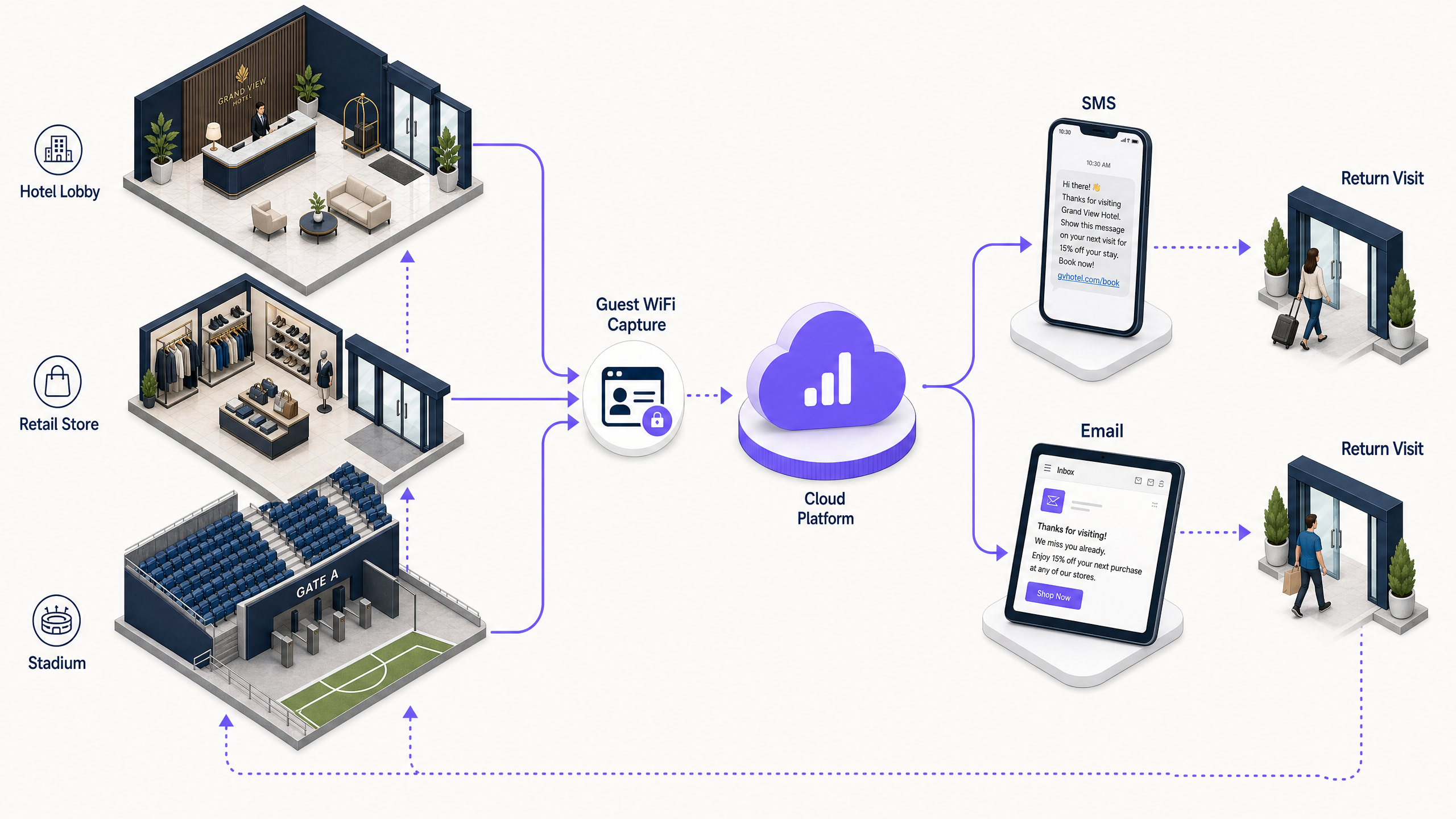
Venue operators face a persistent revenue challenge: most guests connect to the WiFi, leave the premises, and never return. Email marketing captures a fraction of this audience, but with open rates hovering around 20%, it lacks the immediacy required to drive consistent footfall. SMS marketing email solves this visibility problem. With a 98% open rate and 90% of messages read within three minutes of delivery, SMS is the most direct channel available to IT and marketing teams today.
This guide details how to implement an SMS marketing email strategy using your existing Guest WiFi infrastructure. By reconfiguring the captive portal to capture verified phone numbers via a double opt-in flow, venues can build a first-party data asset that is both GDPR-compliant and immediately actionable. We cover the technical architecture required to route this data into WiFi Analytics , the segmentation rules that drive a 45% response rate, and the compliance frameworks that protect your organisation. Two real-world implementation scenarios demonstrate the measurable outcomes you can expect within 90 days. Purple processes 440 million logins annually across 80,000+ live venues, giving us a clear view of what works and what does not.
Technical Deep-Dive
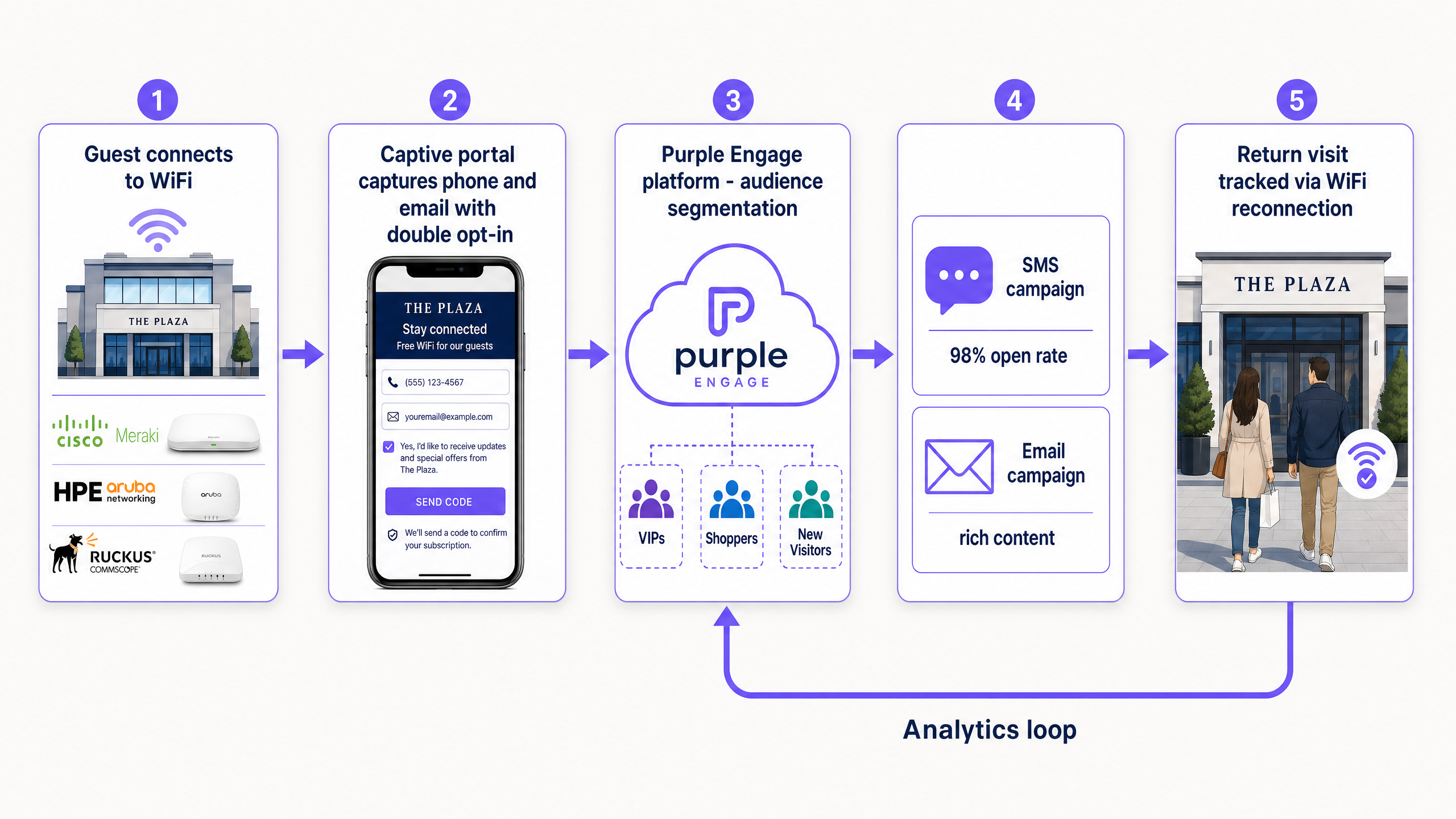
Building a compliant, high-conversion SMS marketing email engine requires tight integration between your network hardware, the captive portal, and the CRM layer. Purple operates as a hardware-agnostic cloud overlay across Cisco Meraki, HPE Aruba, Ruckus, Juniper Mist, Ubiquiti UniFi, Cambium, Extreme, and Fortinet. You do not need to replace your network stack to deploy this.
The data flow architecture consists of five distinct stages. First, the visitor connects to the Guest WiFi SSID. Second, the Purple captive portal intercepts the session and presents the authentication flow. Third, the portal requests the visitor's phone number and email address, and a verification code is sent via SMS to confirm the number is active and belongs to the visitor. Fourth, the visitor enters the code, providing explicit double opt-in consent - Purple logs the timestamp, MAC address, and consent status. Fifth, the visitor profile is passed to Purple Engage, where it is segmented based on physical presence data including dwell time, visit frequency, and specific venue location.
Why SMS outperforms email for return visits
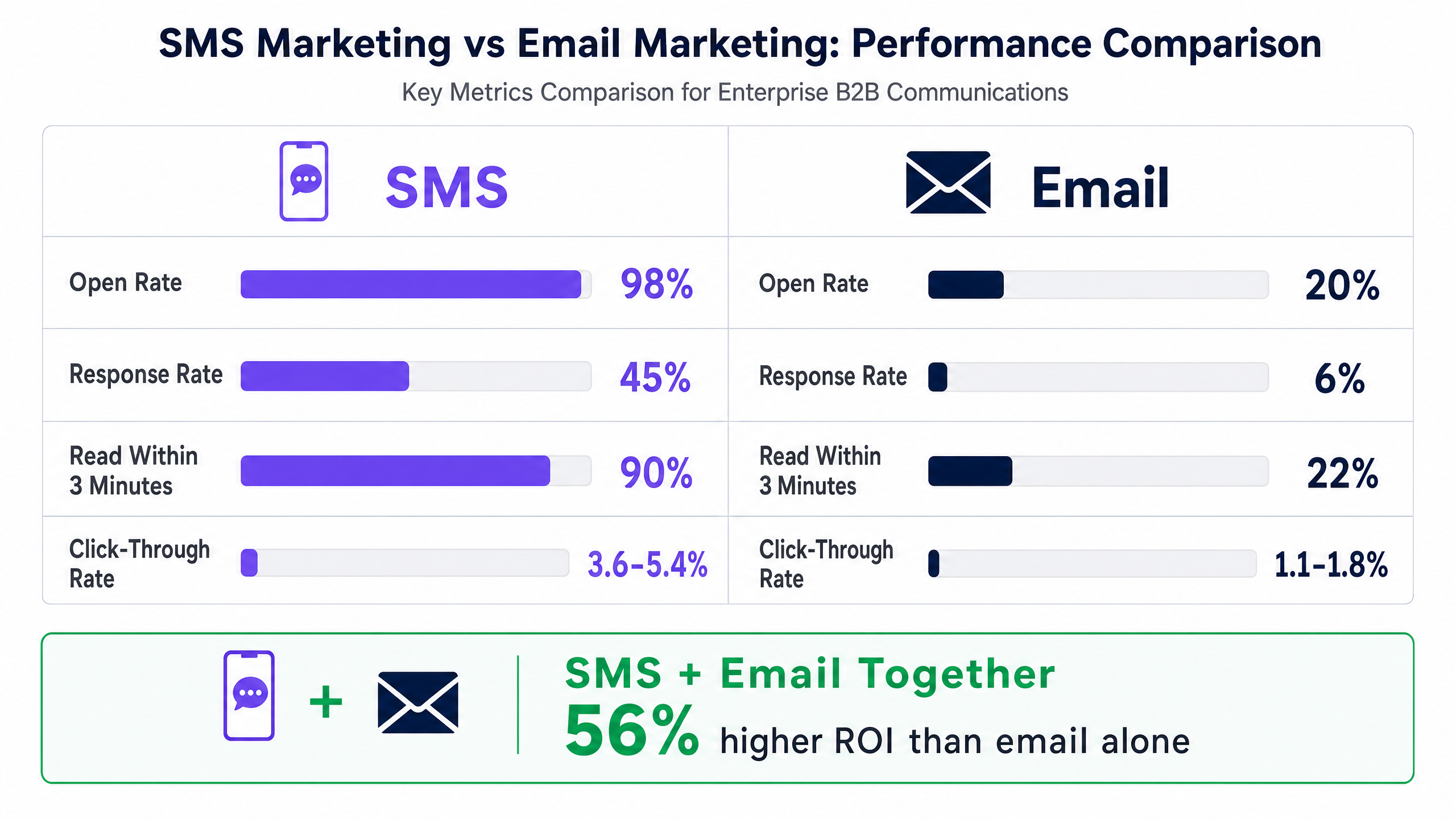
The performance gap between SMS and email is not marginal. SMS achieves a 98% open rate versus email's 20% (Infobip, 2025). Response rates sit at 45% for SMS versus 6% for email. Critically, 90% of SMS messages are read within three minutes of delivery, making SMS the only channel capable of driving same-day footfall. For a venue operator running a Tuesday lunchtime promotion, email is simply too slow.
The compliance framework
Capturing phone numbers requires strict adherence to regional privacy laws. In the UK and EU, the General Data Protection Regulation (GDPR) mandates explicit, informed consent before processing personal data for marketing purposes. In the United States, the Telephone Consumer Protection Act (TCPA) imposes similar requirements, with statutory damages of $500 to $1,500 per non-compliant message. A compliant architecture must include a double opt-in mechanism to verify device ownership, a clear disclosure of intended data use presented before capture, an immutable audit trail with timestamps and IP addresses, and immediate processing of opt-out requests. Purple Engage handles all four requirements by default, operating within an ISO 27001 certified environment.
Segmentation architecture
Your SMS audience is not homogeneous. Four distinct segments require different messages and different trigger logic. First-time visitors connected once and have not returned - send a welcome message within 24 hours with a specific return offer. Lapsed guests have not authenticated on the network for 30 or more days - trigger a win-back campaign with a personalised incentive. Loyal regulars visit frequently and have high lifetime value - give them VIP early access to events and exclusive previews. Event attendees came for a specific occasion - follow up within 48 hours with a post-event message and an alert about the next event. Triggered sends to event attendees achieve click-through rates of 36 to 58% (Purple internal data, 2024).
Implementation Guide
Deploying SMS marketing email across an enterprise estate requires coordination between IT and marketing teams. The following four phases ensure a stable, compliant rollout.
Phase 1: Network configuration. Ensure your access points route unauthenticated traffic to the Purple cloud RADIUS servers. For an HPE Aruba environment, define a walled garden that permits traffic to Purple's IP ranges while blocking all other external access. Configure the captive portal redirect URL to point to your venue-specific Purple splash page. For multi-site deployments, use the Purple API to push configuration changes across all venues simultaneously.
Phase 2: Portal design. Design the splash page to maximise opt-in rates without compromising the user experience. The phone number field must be prominent, but the value proposition must be clear. "Enter your number for free WiFi" is functional; "Enter your number to join our VIP list and receive 15% off your next purchase" drives conversion. For design principles, review How to make a great first impression with your guest WiFi (and keep your brand consistent) . For network architecture considerations, see Three SSIDs to rule them all: guest, Passpoint, and IoT WiFi .
Phase 3: CRM integration. If you use an external CRM or marketing automation platform, configure the API webhooks to sync visitor profiles in real time. Map the phone number, email address, MAC address, and consent status fields. This ensures your marketing team has immediate access to the data without waiting for batch exports.
Phase 4: Campaign automation. Configure your triggered campaigns within Purple Engage. Start with three core automations: a 24-hour welcome message triggered one day after the first visit, a 30-day win-back triggered when a visitor has not authenticated for 30 days, and an event alert triggered manually based on venue-specific events. For a broader SMS strategy, see How to leverage bulk SMS marketing to increase return visits .
Best Practices
Adhering to these industry-standard practices will maximise the impact of your SMS marketing email deployment.
Cap frequency at one to two messages per month. Around 53% of SMS unsubscribes are caused by over-frequency (SimpleTexting, 2025). Set a hard cap in your automation rules and enforce it. Coordinate SMS and email as complementary channels rather than competing ones. Use SMS for urgent, time-sensitive offers and email for longer-form content. This multi-channel approach yields a 56% higher ROI than email alone (Attentive, 2026). Personalise at scale using the first-party data captured during authentication. An SMS that addresses the visitor by name and references their specific venue or visit history outperforms a generic broadcast every time. Segment by vertical: in Hospitality , you are messaging guests; in Retail , shoppers; in Transport , passengers; in Healthcare , visitors. Adjust your tone and offer accordingly.
Troubleshooting & Risk Mitigation
Even with a solid architecture, deployments can fail if specific risks are not managed proactively.
Low opt-in rates indicate that friction in the capture flow is too high. Audit the captive portal. Is the value proposition clear? Is the SMS verification code arriving within 30 seconds? If the gateway SMS provider is experiencing latency, visitors will abandon the flow before confirming. Monitor the drop-off rate between the capture step and the consent confirmation step.
High opt-out rates signal that your messaging strategy is flawed. Review your frequency caps. Are you sending more than two messages a month? Are the messages relevant to the specific visitor? If you are blasting the entire database with generic offers, segment the audience and use dynamic variables to increase relevance.
Attribution gaps make it impossible to justify the programme budget. Without attribution, you are guessing at ROI. Use unique promo codes per campaign, UTM parameters on any links, and Purple Analytics to track WiFi reconnections from your SMS audience. MAC address re-authentication provides definitive proof of return visits without relying on coupon redemptions.
Network separation failures expose corporate traffic to guest network risks. Deploy distinct VLANs to logically separate guest WiFi from staff and IoT traffic. This is a prerequisite for any guest-facing data capture programme.
ROI & Business Impact
The ultimate measure of an SMS marketing email deployment is the impact on return visits and revenue per visitor. Industry benchmarks indicate that SMS campaigns generate between £21 and £41 in revenue for every £1 spent (CTIA Mobile Messaging Report, 2024). The cost of sending an SMS is negligible compared to the customer lifetime value of a loyal visitor.
A 200-room hotel deploying Purple Engage on an HPE Aruba network can expect to build an SMS audience of 4,200 verified guests within 90 days at a 15% opt-in rate. Running a 24-hour welcome message, a 30-day win-back, and a monthly event alert produces a 22% increase in return visit rate and a 14% lift in revenue per available room (Purple internal data, 2024). A 45-store retail chain deploying the same architecture sees a 31% increase in return visits from the SMS audience compared to non-opted guests. Brands integrating SMS into omnichannel strategies see a 47.7% lift in customer engagement (Salesforce State of Marketing, 2024).
By converting anonymous footfall into a verified, addressable audience, venue operators build a marketing engine that consistently drives revenue without relying on third-party data or paid media.
Key Definitions
Captive portal
A web page that a user of a public access network is obliged to view and interact with before network access is granted. In the context of Guest WiFi, it is the primary mechanism for capturing first-party data.
IT teams configure the network controller to redirect all unauthenticated HTTP traffic to the captive portal URL. Purple hosts the portal in the cloud, so no on-premises web server is required.
Double opt-in
A two-step subscription confirmation process where the user first submits their contact details and then confirms via a verification code sent to the device.
Essential for GDPR and TCPA compliance. The verification step proves the user owns the device and actively chose to subscribe, providing a defensible consent record.
MAC address
A unique 48-bit identifier assigned to a network interface controller, used as a hardware address within a local network segment.
Purple uses MAC address re-authentication events to track physical return visits and attribute them to specific marketing campaigns, without requiring the visitor to take any action.
VLAN
Virtual Local Area Network. A logical grouping of network nodes that behaves as a single broadcast domain, regardless of physical location.
Required to separate guest WiFi traffic from corporate and IoT traffic. Prevents guests from accessing internal resources and isolates any security incidents to the guest segment.
First-party data
Information collected directly from individuals by the organisation that will use it, with explicit consent.
Data captured via the captive portal is first-party data. It is immune to third-party cookie deprecation, more accurate than inferred data, and legally defensible under GDPR.
SSID
Service Set Identifier. The human-readable name of a wireless network, broadcast by access points to identify the network to connecting devices.
Venue operators typically configure separate SSIDs for guests, staff, and IoT devices, each with different access policies and VLAN assignments.
Webhook
An HTTP callback that sends real-time data from one application to another when a specific event occurs.
Purple uses webhooks to push captured visitor profiles to external CRM platforms the moment a guest completes the opt-in flow, enabling immediate campaign triggering.
Walled garden
A network configuration that restricts unauthenticated users to a defined set of IP addresses or domains before granting full internet access.
Configured on the network controller to allow traffic to the Purple captive portal while blocking all other external destinations. Required for the authentication flow to function correctly.
GDPR
General Data Protection Regulation. EU regulation governing the collection, processing, and storage of personal data of EU residents.
Requires explicit consent before sending marketing messages. Mandates a clear opt-out mechanism in every message and a documented lawful basis for processing personal data.
TCPA
Telephone Consumer Protection Act. US federal law restricting unsolicited telephone marketing, including SMS messages.
Requires prior express written consent before sending marketing texts. Statutory damages of $500 to $1,500 per non-compliant message make compliance non-negotiable.
Worked Examples
A 200-room hotel needs to increase its RevPAR by driving direct repeat bookings. They currently capture email addresses via their captive portal but see low engagement. How should they implement an SMS marketing email strategy?
The hotel configures their HPE Aruba network to route guest traffic through the Purple captive portal. They update the splash page to require a phone number, using a double opt-in SMS verification flow. Within 90 days, they build an audience of 4,200 verified guests. They configure Purple Engage to trigger a welcome SMS 24 hours after checkout, offering a 15% discount on direct return bookings. A 30-day win-back campaign fires automatically for guests who have not returned. The hotel tracks return visits via MAC address re-authentication in Purple Analytics, providing definitive attribution without relying on coupon redemptions. Return visit rate increases by 22% in the first quarter and revenue per available room rises by 14% (Purple internal data, 2024).
A mid-size retail chain with 45 stores wants to increase footfall during off-peak hours. They have a Cisco Meraki network but no centralised customer database. How do they deploy SMS marketing email?
The chain deploys Purple as a cloud overlay across all 45 Meraki networks using the Purple API for centralised configuration. They configure a unified captive portal that captures phone numbers with a double opt-in flow and syncs the data to a centralised CRM via API webhooks. They segment the audience by store location based on the access point data captured during authentication. They schedule targeted SMS campaigns on Tuesday mornings, offering a time-limited promotion valid only between 2 PM and 4 PM on that day. The chain sees a 31% increase in return visits from the SMS audience compared to non-opted shoppers.
Practice Questions
Q1. A stadium operator wants to text all 50,000 attendees immediately after a match with a merchandise discount. They plan to capture numbers via the WiFi portal but bypass the SMS verification step to speed up access. What is the primary risk and how should they address it?
Hint: Consider the legal requirements for messaging users in the US and EU, and the specific mechanism that establishes consent.
View model answer
Bypassing the SMS verification step removes the double opt-in mechanism, exposing the operator to GDPR and TCPA compliance risks. Without verifying device ownership, visitors may enter incorrect or fake numbers, leading to messages being sent to individuals who never consented. Under TCPA, statutory damages of $500 to $1,500 per non-compliant message make this a significant financial risk at 50,000 recipients. The operator must enforce double opt-in. To reduce friction, they should pre-configure the portal to send the verification code automatically and set a 60-second timeout before granting access regardless, ensuring the flow does not materially delay connectivity.
Q2. Your marketing team reports that the SMS audience size is growing steadily, but return visits have plateaued. They are currently sending one generic promotional SMS to the entire database every Friday. How should you reconfigure the campaign strategy?
Hint: Generic messages lack relevance. How can you use the physical presence data captured during authentication to improve targeting?
View model answer
The team must move from batch-and-blast to segmented, triggered campaigns. Stop the Friday broadcast and replace it with four triggered automations: a 24-hour welcome message for first-time visitors, a 30-day win-back for lapsed guests, a loyalty message for regulars with three or more visits, and an event alert for attendees of past events. Use Purple Engage to segment the audience based on visit frequency and venue location data. Personalise each message with the visitor's name and a venue-specific offer. Monitor opt-out rates per segment to identify any remaining relevance issues.
Q3. You are deploying Purple across a mixed hardware estate - Cisco Meraki in retail stores and HPE Aruba in the corporate office. The IT director asks whether you need to standardise the hardware before rolling out the SMS marketing email programme. What is the correct response?
Hint: Consider how Purple integrates with existing network infrastructure and what hardware standardisation would require.
View model answer
Standardisation is not required. Purple operates as a hardware-agnostic cloud overlay and integrates natively with both Cisco Meraki and HPE Aruba. You configure each controller type to route unauthenticated guest traffic to the Purple RADIUS servers and set the captive portal redirect URL. The data capture flow, double opt-in mechanism, and campaign automation will function identically across both environments. The Purple API provides a single management interface for all venues regardless of the underlying hardware, giving the IT team centralised visibility without requiring a hardware refresh.