
How to leverage SMS marketing platforms to increase return visits
This guide explains how venue operators - in hospitality, retail, events, and public-sector environments - can connect their guest WiFi infrastructure to SMS marketing platforms to drive measurable return visits. It covers the technical architecture from captive portal data capture through to automated SMS campaign delivery, the compliance requirements under GDPR and TCPA, and the business case backed by industry benchmarks. Purple Engage automates this entire pipeline, capturing verified first-party phone data at login and triggering personalised campaigns without manual intervention.
Listen to this guide
View podcast transcript
Executive summary
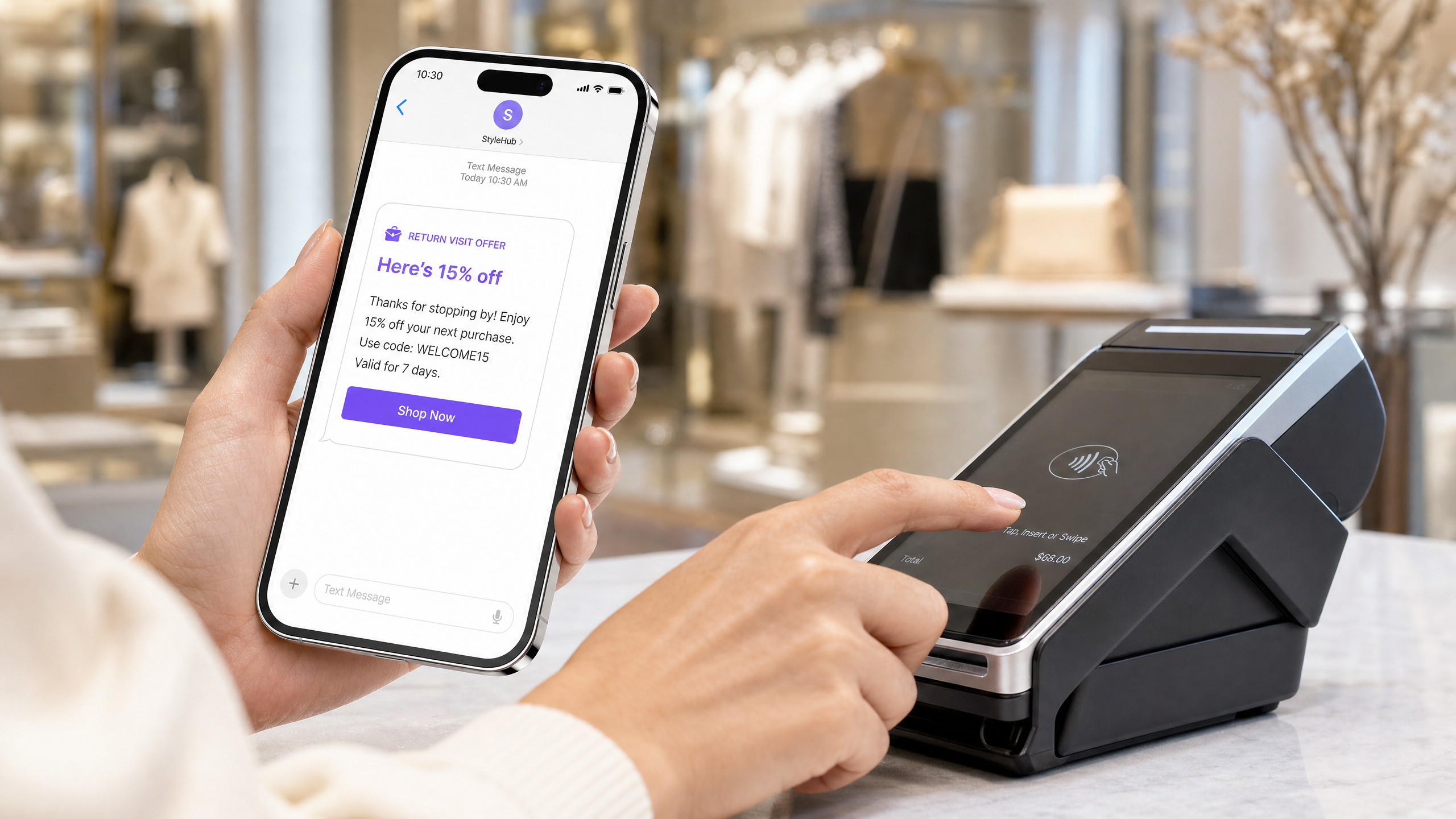
SMS marketing platforms deliver a 98% open rate and an average return of $71 for every $1 invested - figures that make them the highest-performing outbound channel available to venue operators today [Attentive, 2024; Emarsys, 2026]. The challenge is not the channel itself. It is the data. Without verified, first-party mobile numbers tied to physical visit history, SMS campaigns are generic and ineffective. Guest WiFi solves this. When guests connect to your network, Purple's captive portal captures their mobile number, verifies it via one-time passcode (OTP), and secures explicit marketing consent - all in a single, compliant login flow. That data then feeds directly into your SMS marketing platform, enabling automated, presence-triggered campaigns. This guide covers the full architecture: from 802.11 association through RADIUS authentication, captive portal data capture, API integration with SMS platforms, and return visit attribution. Whether you operate a hotel, a retail chain, a stadium, or a conference centre, the implementation steps are the same. The outcome is a reachable, segmented audience and a direct line to driving repeat footfall.
Technical deep-dive
The data capture architecture
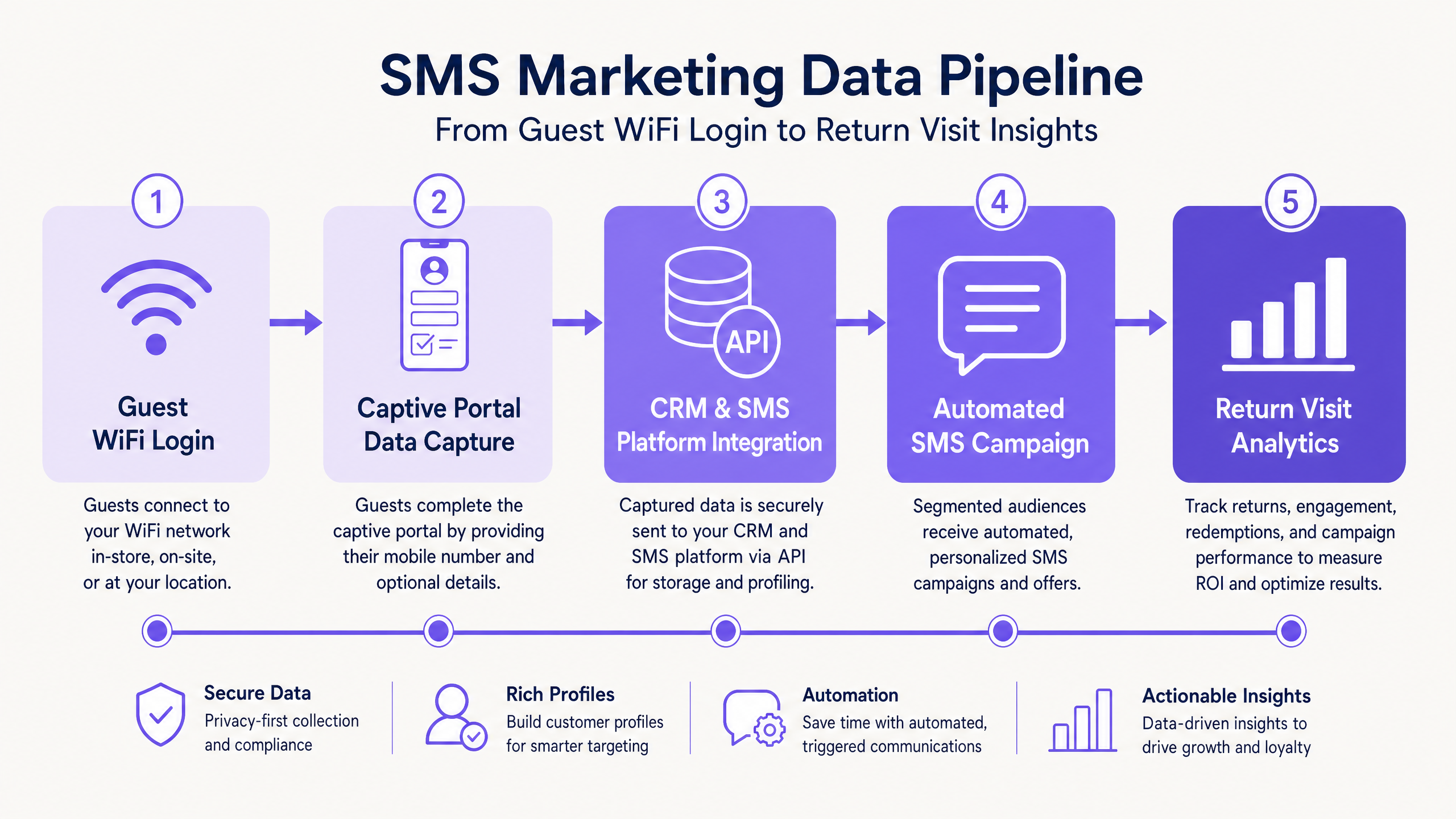
The foundation of a WiFi-to-SMS strategy is the wireless network itself. When a guest connects to your network - whether you run Cisco Meraki, HPE Aruba, Ruckus, Juniper Mist, or Ubiquiti UniFi - the access points handle the 802.11 association. Purple operates as a cloud overlay on top of your existing hardware, intercepting unauthenticated traffic and redirecting it to the captive portal via a RADIUS server.
At the captive portal, the guest is presented with a branded login screen. To build an SMS database, you configure the portal to request the user's mobile number as the authentication method. The critical control here is OTP verification. Purple sends a one-time passcode to the number provided. The guest must enter this code to gain internet access. This single step eliminates fake entries and guarantees that every number in your database is valid and belongs to the person on-site.
During the same login flow, Purple presents the marketing consent checkbox. This must be an unchecked, conscious-choice opt-in - not pre-ticked. The consent event is logged with a timestamp, the device MAC address, and the IP address. This audit trail is your evidence of compliance under GDPR, CCPA, and TCPA.
Presence tracking and profile enrichment
Once authenticated, Purple associates the device MAC address with the verified mobile number and creates a visitor profile. From this point, every time the device enters the venue and connects to the same SSID, Purple logs a presence event. This builds a visit history: first visit date, most recent visit date, visit frequency, and dwell time.
This data is the engine of your SMS campaigns. It tells you who is a first-time visitor, who is a loyal regular, and who has lapsed. Without it, every SMS you send is a guess. With it, every message is relevant.
A note on MAC randomisation: iOS 14 and Android 10 onwards use randomised MAC addresses to protect user privacy. However, devices typically maintain the same randomised MAC address for a specific SSID. As long as the guest connects to the same network, the presence tracking remains consistent. For a more robust, identity-based approach, deploy Passpoint (also known as Hotspot 2.0 or OpenRoaming). Passpoint authenticates users via a credential rather than a MAC address, making tracking reliable regardless of MAC randomisation. Purple supports Passpoint natively.
API integration with SMS platforms
Purple exposes a REST API and supports webhook delivery for presence events. Your SMS marketing platform - whether that is Klaviyo, Attentive, or a custom CRM - subscribes to these events. The data payload includes the mobile number, first name, visit count, last visit date, and venue identifier.
The SMS platform uses this data to trigger automated workflows. The integration is typically configured as follows:
| Trigger event | Campaign type | Timing |
|---|---|---|
| First WiFi login | Welcome offer | 2 hours after login |
| No visit in 30 days | Win-back offer | Day 30 |
| Visit on a specific date | Event promotion | Day before event |
| Nth visit milestone | Loyalty reward | On visit |
This is not a batch-and-blast model. Each message is triggered by a specific, real-world behaviour. That is why SMS campaigns built on WiFi data outperform generic broadcast campaigns.
WiFi Analytics and return visit attribution
Attribution is where most SMS programmes fail. They send messages and hope for the best. With Purple, attribution is direct. When a user who received an SMS offer subsequently connects to the WiFi network, Purple logs the visit. The time between message delivery and return visit is measurable. The conversion rate - the percentage of SMS recipients who return within a defined window - is a concrete KPI you can report to the board.
Purple's analytics dashboard surfaces this data natively. You can segment by campaign, by venue, by visit frequency, and by offer type. This closes the loop between your marketing spend and your physical footfall.
Implementation guide
Deploying a WiFi-to-SMS pipeline requires coordination between your network team and your marketing stack. Here is the sequence.
Step 1 - Audit your captive portal. Review your current login flow. If you are not capturing mobile numbers, update the portal to add this field. If you are capturing numbers but not verifying them with OTP, enable verification. This is the single most important data quality control in the entire system.
Step 2 - Define your consent wording. Work with your legal team to draft the opt-in statement. It must clearly state that the user is agreeing to receive marketing SMS messages from your organisation. Include a link to your privacy policy. Do not pre-tick the checkbox.
Step 3 - Configure the Purple API integration. In the Purple dashboard, navigate to the Integrations section. Select your SMS platform from the list of supported connectors. Map the data fields: mobile number, first name, last visit date, visit count, and venue ID. Test the webhook by triggering a test login and confirming the data arrives in your SMS platform.
Step 4 - Build your campaign workflows. In your SMS platform, create the automated sequences. Start with two campaigns: a welcome message for first-time visitors and a win-back message for users who have not visited in 30 days. Keep the messages short - under 160 characters where possible. Include a clear call to action and a link to your offer page.
Step 5 - Set frequency caps. Configure rate limiting in your CRM. A maximum of two to four messages per month per user is the industry standard. Exceeding this risks opt-outs. Research from SAP Engagement Cloud shows that 23% of consumers would stop supporting a brand that over-communicates via SMS.
Step 6 - Monitor and iterate. Review campaign performance weekly for the first month. Track open rates, click-through rates, and - most importantly - return visit rates as measured by Purple's presence data. Adjust message timing, offer type, and segmentation based on what the data shows.
For retail operators, the Thursday afternoon send time consistently outperforms other days for driving weekend footfall. For hospitality venues, the 48-hour post-checkout win-back message drives the highest re-booking rates. For transport hubs and event venues, real-time presence triggers outperform scheduled sends.
Best practices
The following principles apply across all verticals and all SMS platform configurations.
Verify every number. OTP verification at the captive portal is non-negotiable. A database of unverified numbers is a liability, not an asset. Bounce rates above 5% will damage your sender reputation and reduce deliverability across your entire list.
Segment before you send. The presence data captured by Purple gives you the raw material for meaningful segmentation. At minimum, distinguish between first-time visitors, regular visitors (three or more visits in 90 days), and lapsed visitors (no visit in 30 days). Each cohort requires a different message.
Personalise the offer. Address the recipient by first name. Reference the venue they visited. Make the offer specific - "10% off your next visit to our Manchester store" outperforms "10% off your next visit" every time. Purple captures the venue identifier at login, so this personalisation is automatic.
Time your messages correctly. SMS has a 90% read rate within three minutes of delivery [Emarsys, 2026]. This makes timing critical. Avoid sending messages early in the morning or late at night. For retail, Thursday afternoon drives weekend visits. For hospitality, Sunday evening drives mid-week bookings.
Include a clear opt-out. Every SMS must include a mechanism to unsubscribe. "Reply STOP to opt out" is the standard. Honour opt-outs immediately. Purple and most SMS platforms handle this automatically, but verify the configuration during testing.
Comply with GDPR and TCPA. GDPR requires a lawful basis for processing personal data. For SMS marketing, this is explicit consent. TCPA in the United States requires prior express written consent for marketing messages. Both require you to maintain auditable records of consent. Purple logs every consent event automatically.
Troubleshooting and risk mitigation
Low opt-in rates. If fewer than 20% of guests are opting into SMS marketing, review the captive portal design. The value exchange must be clear. Offer an immediate, tangible incentive - a discount code, free premium WiFi, or entry into a prize draw. Test different offer types and measure the opt-in rate for each. See our guide on how to make a great first impression with your guest WiFi for portal design principles.
High bounce rates. A bounce rate above 5% indicates poor data quality. Enable OTP verification if it is not already active. Audit your existing database for numbers that have never engaged with a campaign. Remove them.
Low return visit attribution. If the WiFi data shows low return visits from SMS recipients, check the attribution window. The default window in Purple is 30 days. If your venue has a longer natural visit cycle - for example, a quarterly trade show - extend the window accordingly. Also check that the SSID the guest connects to on their return visit is the same one they used on their first visit. MAC randomisation can cause tracking gaps if the SSID changes.
MAC randomisation gaps. As noted above, iOS and Android use randomised MAC addresses. If you see a high rate of "new" device connections that do not match existing profiles, this is likely MAC randomisation. The solution is to deploy Passpoint. Purple supports Passpoint natively on Cisco Meraki, HPE Aruba, and Juniper Mist hardware. For more detail on network design, see Three SSIDs to rule them all: guest, Passpoint, and IoT WiFi .
API integration failures. If presence events are not arriving in your SMS platform, check the webhook configuration in the Purple dashboard. Verify that the endpoint URL is correct and that the receiving server is returning a 200 status code. Check the Purple API logs for error responses. Most integration failures are caused by authentication errors - ensure your API key is current and has the correct permissions.
ROI and business impact
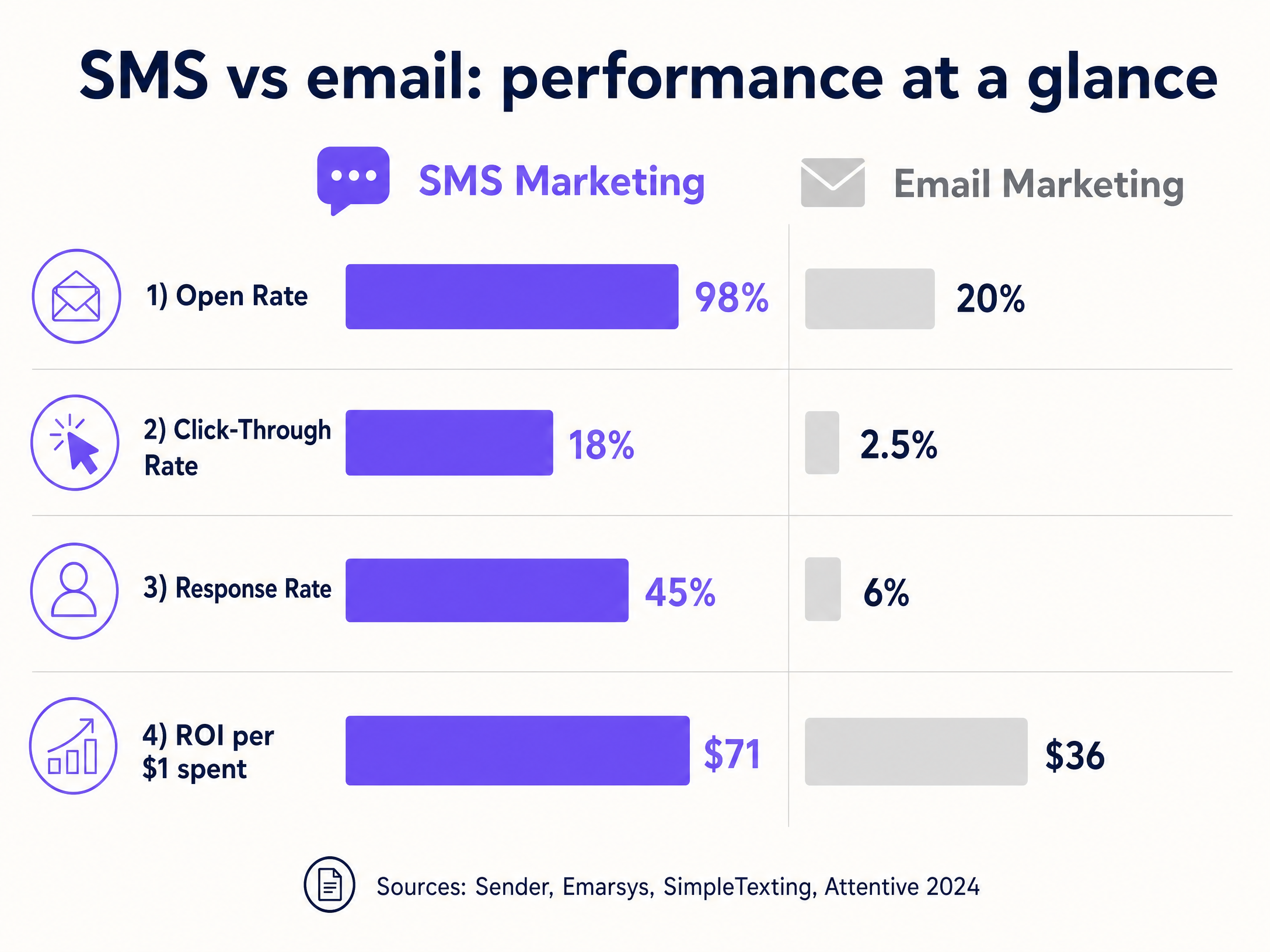
The business case for SMS marketing is well-established. SMS delivers a 98% open rate, an 18% click-through rate, and an average ROI of $71 per $1 spent [Attentive, 2024; Sender, 2026]. Brands that integrate SMS into their omnichannel strategies see a 47.7% lift in customer engagement [Omnisend]. Businesses that text customers are 683% more likely to report digital marketing success than those that do not [SimpleTexting, 2024].
When SMS is powered by first-party WiFi data, these numbers improve further. The campaigns are triggered by real behaviour, not calendar dates. The offers are relevant to the specific venue and visit history. The attribution is direct and measurable.
For a retail chain running 50 locations, a 10% increase in return visit rate across the existing customer base represents a significant revenue uplift without any additional acquisition cost. For a hospitality operator, a 5% improvement in re-booking rate from lapsed guests can offset a meaningful portion of the cost of new guest acquisition.
Purple's Engage plan automates this entire pipeline. It captures verified guest data at login, segments the audience based on visit behaviour, and triggers personalised SMS campaigns through your chosen platform. Across our 80,000+ live venues and 350 million unique users, the data consistently shows that venues using triggered, presence-based SMS campaigns outperform those using scheduled broadcast campaigns on every metric that matters: open rate, click-through rate, and return visit rate.
For further reading on related implementations, see our guides on Como alavancar a plataforma de marketing por SMS para aumentar as visitas de retorno and রিটার্ন ভিজিট বাড়ানোর জন্য কীভাবে SMS মার্কেটিং প্ল্যাটফর্মের সুবিধা নেওয়া যায় .
Key Definitions
Captive portal
A web page that a user of a public-access network must view and interact with before internet access is granted. Used to capture first-party data and secure marketing consent.
The captive portal is the primary data collection point in a WiFi-to-SMS pipeline. Its design directly affects opt-in rates and data quality.
One-time passcode (OTP)
A password valid for a single authentication session, sent to the user's mobile number to verify ownership.
OTP verification at the captive portal is the most important data quality control in the system. It eliminates fake entries and guarantees that every number in the database is valid.
First-party data
Data collected directly from your visitors by your own systems, as opposed to data purchased from a third party or inferred from third-party cookies.
Data captured through Purple's captive portal is first-party data. It is owned by the venue operator, compliant with GDPR and CCPA, and not subject to third-party data deprecation.
Conscious-choice opt-in
A consent mechanism where the user must take an active, deliberate step - such as ticking an empty checkbox - to agree to marketing communications. Pre-ticked boxes do not qualify.
Required for GDPR compliance. Purple's captive portal enforces this by design. Every consent event is logged with a timestamp and device identifier.
Webhook
An HTTP callback that sends real-time data from one application to another when a specific event occurs.
Purple uses webhooks to push presence events to your SMS platform in real-time. This enables triggered campaigns that fire within seconds of a guest connecting to the network.
MAC address
A unique hardware identifier assigned to a network interface. Used by the network to identify devices.
Purple associates the device MAC address with the verified user profile at login. This enables presence tracking across subsequent visits.
MAC randomisation
A privacy feature in iOS 14+ and Android 10+ that uses a different, randomised MAC address when scanning for or connecting to different networks.
MAC randomisation can affect presence tracking if the SSID changes between visits. Devices typically maintain the same randomised MAC per SSID. Passpoint eliminates this issue by using identity-based authentication.
Passpoint (Hotspot 2.0)
A protocol that enables automatic, secure WiFi authentication using a stored credential, without requiring the user to interact with a captive portal on subsequent visits.
Passpoint provides a more seamless connection experience and is not affected by MAC randomisation. Purple supports Passpoint natively on Cisco Meraki, HPE Aruba, and Juniper Mist hardware.
TCPA (Telephone Consumer Protection Act)
US federal legislation that restricts unsolicited marketing communications, including SMS. Requires prior express written consent before sending marketing text messages.
Any SMS campaign targeting US mobile numbers must comply with TCPA. Purple's consent logging provides the auditable record required for compliance.
RADIUS (Remote Authentication Dial-In User Service)
A networking protocol that provides centralised authentication, authorisation, and accounting for users who connect to a network.
Purple uses RADIUS to intercept unauthenticated traffic and redirect it to the captive portal. It operates as a cloud overlay on top of your existing hardware.
Worked Examples
A national retail chain with 50 locations wants to increase return visits from weekend shoppers. They currently offer free guest WiFi on Cisco Meraki hardware but do not capture phone numbers at login.
- Update the captive portal in the Purple dashboard to add a mobile number field with OTP verification as the authentication method. 2. Add a conscious-choice opt-in checkbox for SMS marketing, offering a 10% discount code upon successful signup. 3. Connect Purple to the retailer's SMS platform (Attentive in this case) via the Purple API. Map the fields: mobile number, first name, last visit date, venue ID. 4. In Attentive, create two automated workflows: a Welcome Campaign triggered two hours after first login, and a Win-Back Campaign triggered 30 days after the last recorded presence event. 5. For the Win-Back Campaign, schedule the send for Thursday at 2pm to influence weekend shopping behaviour. 6. After four weeks, review the return visit rate in Purple's analytics dashboard by comparing the visit frequency of opted-in users against the baseline.
A large stadium running HPE Aruba access points wants to drive merchandise sales during halftime. They have a high WiFi connection rate but no SMS database.
- Configure the captive portal to capture mobile numbers with OTP verification. Add a marketing opt-in for event-day offers. 2. Integrate Purple with the stadium's CRM via webhook. Configure the webhook to fire on each new presence event, passing the mobile number, first name, and event identifier. 3. In the CRM, create a real-time trigger: when a presence event fires with the current event identifier, add the user to the 'Halftime Offer' SMS segment. 4. Schedule the halftime SMS campaign to send 15 minutes before the scheduled break, offering a time-limited discount on merchandise. 5. After the event, pull the return visit data from Purple to measure how many SMS recipients attended a subsequent event.
Practice Questions
Q1. You are deploying a new captive portal across 20 hotel locations. You want to build an SMS marketing database. What is the single most critical technical control to implement to ensure the data is actionable?
Hint: Consider what happens if guests enter a fake phone number to bypass the portal quickly.
View model answer
Enable OTP verification. This requires the guest to receive an SMS and enter the code to gain internet access, guaranteeing that every number in the database is valid and belongs to the person on-site. Without OTP, a significant proportion of captured numbers will be invalid, resulting in high bounce rates and damaged sender reputation.
Q2. Your marketing team wants to send an SMS campaign to all guests who visited any of your venues in the past 12 months. Before sending, what compliance check must you run against the CRM data?
Hint: Think about what GDPR and TCPA require before you send a marketing message to a mobile number.
View model answer
Verify that each mobile number in the send list has an associated, explicit, conscious-choice marketing opt-in consent record, with a timestamp and venue identifier. Also confirm that none of these users have subsequently opted out by replying STOP or withdrawing consent through another channel. Sending to users without a valid consent record violates GDPR and TCPA and exposes the organisation to regulatory action.
Q3. A venue operator reports that their SMS win-back campaigns show very few return visits in the attribution data, despite a high SMS open rate and click-through rate. What is the most likely cause and how do you investigate it?
Hint: The open rate and click-through rate are high, so the message is being received and acted on. The gap is between the click and the physical return visit being recorded.
View model answer
The most likely cause is a misconfiguration in the return visit attribution. Check three things: first, that the attribution window in Purple's analytics is set correctly for the venue's natural visit cycle - if the window is too short, return visits are not being counted. Second, check whether MAC randomisation is causing returning devices to appear as new devices - if the SSID has changed since the original login, the device MAC will be different and the profile will not match. Third, confirm that the API or webhook integration between Purple and the SMS platform is passing the correct venue identifier, so that return visits to the correct location are attributed to the correct campaign.
Q4. You are advising a stadium operator who wants to send a real-time SMS offer to fans during a match. They have 40,000 fans connected to the HPE Aruba network. What architectural component must be in place to make this work, and what is the key timing consideration?
Hint: Think about what needs to happen between the presence event being logged and the SMS being delivered.
View model answer
The webhook integration between Purple and the SMS platform must be configured and tested before the event. Purple fires a presence event when each device connects. The SMS platform must receive this event, check whether the user is in the opted-in segment, and queue the message for delivery. The key timing consideration is to send the offer 10 to 15 minutes before halftime, not at the moment of connection. Sending at connection time means the message arrives when fans are focused on the match. Sending before halftime means the message arrives when fans are about to move to the concourse, maximising the chance of conversion at the merchandise stands.