
How to leverage SMS marketing programs to increase return visits
This technical guide details how to build an automated data capture pipeline using Guest WiFi to drive SMS marketing programs. It provides architecture specifications, compliance frameworks, and implementation workflows for IT and marketing teams to increase return visits and measure ROI.
Listen to this guide
View podcast transcript
Executive summary
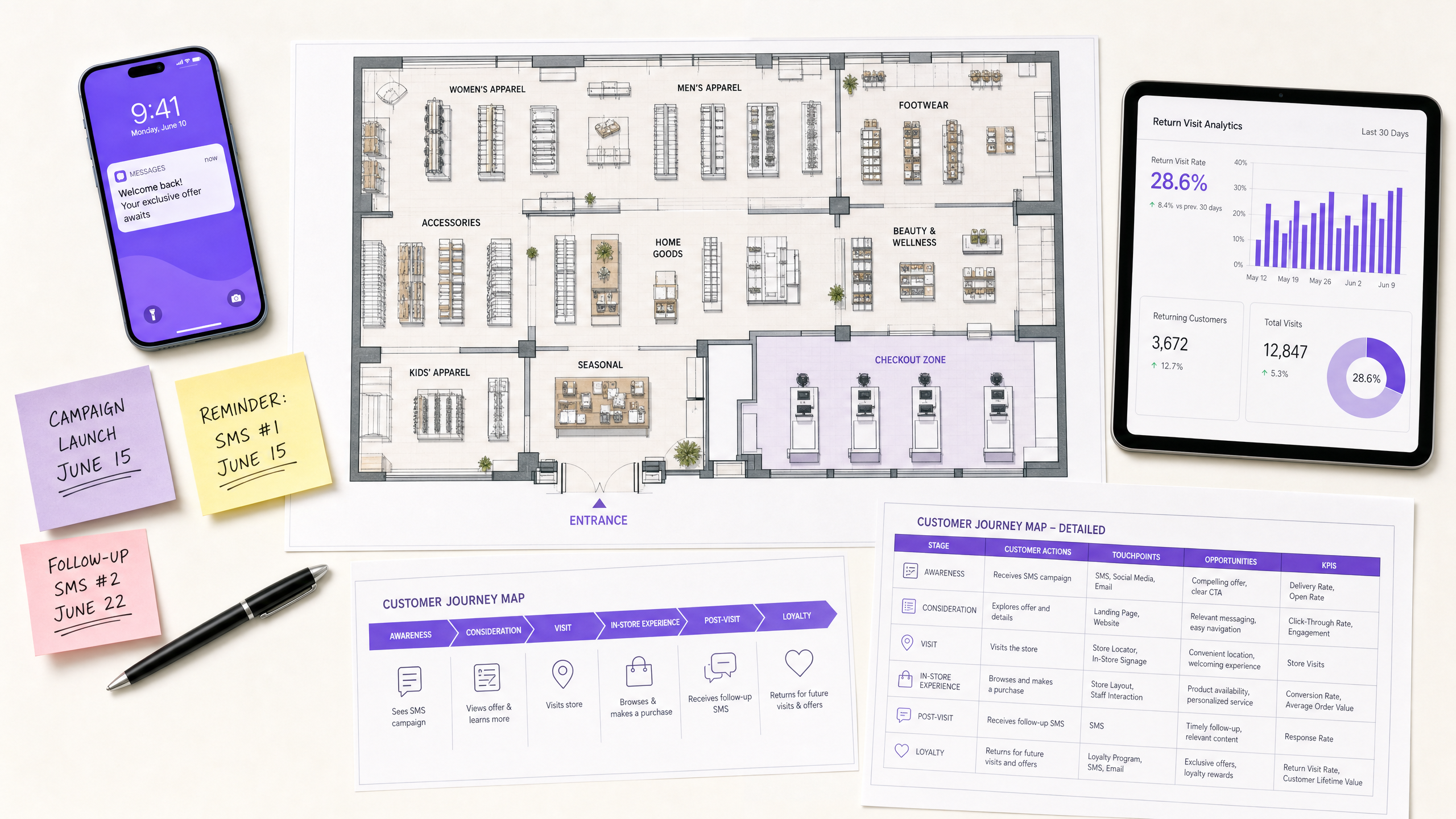
You already provide Guest WiFi. Visitors connect, browse, and leave. If you are not capturing verified contact data during that session, you are running an infrastructure cost centre instead of a revenue driver. An SMS marketing program built on first-party WiFi data changes that equation.
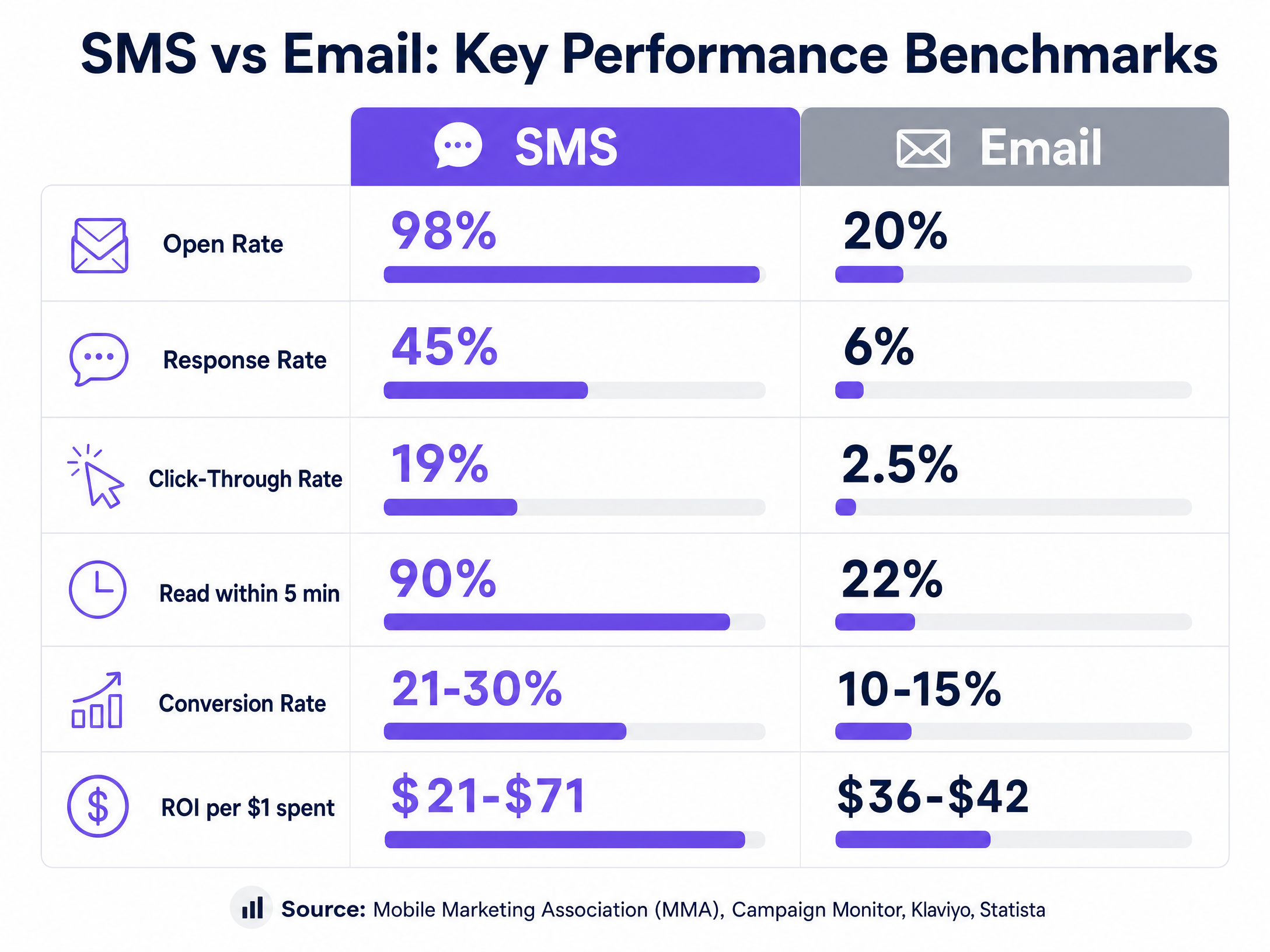
The metrics justify the investment. SMS messages achieve a 98% open rate, compared to 20% for email. More importantly, 90% of those messages are read within three minutes. When deployed correctly, automated SMS campaigns drive a 15% to 25% increase in return visits.
This guide details the technical architecture required to deploy SMS marketing programs at scale. We cover data capture via captive portals, consent architecture, segmentation logic, and campaign automation using Purple Engage. You will learn how to integrate this capability across Cisco Meraki, HPE Aruba, and other enterprise hardware, while maintaining strict GDPR and TCPA compliance.
Listen to the executive briefing podcast below for a 10-minute overview of the architecture and implementation pitfalls.
Technical deep-dive
The foundation of any SMS marketing program is verified first-party data. Buying lists or relying on third-party cookies yields poor engagement and creates legal exposure. The most reliable data capture mechanism in a physical venue is the Guest WiFi network.
The data capture architecture
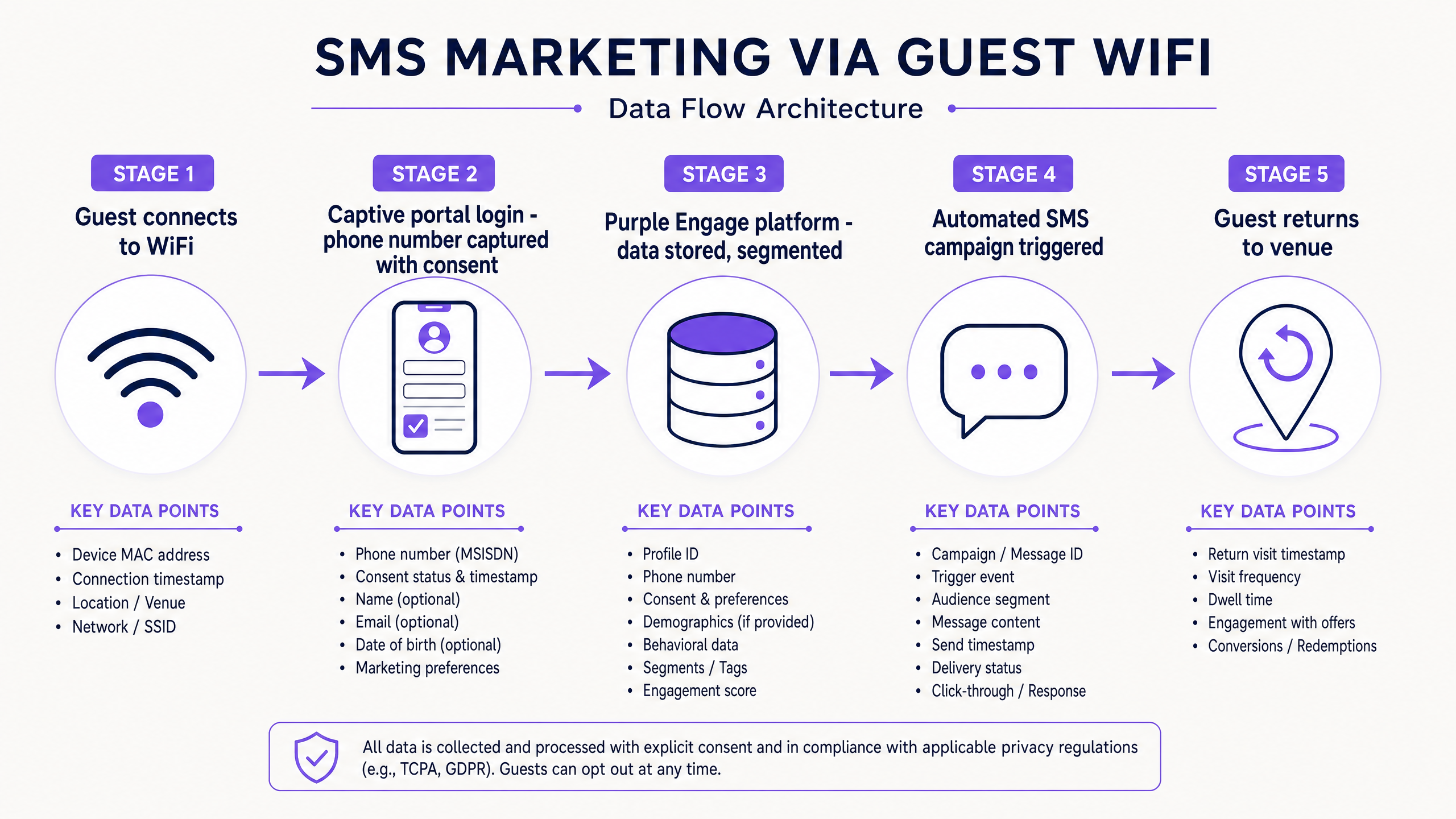
When a visitor connects to your SSID, the network hardware redirects them to a captive portal. This is the critical interaction point. Instead of an open network or a shared password, you require authentication.
- Trigger event: The device associates with the access point. The network controller intercepts the HTTP request and redirects to the Purple splash page.
- Authentication flow: The visitor selects their preferred login method. For SMS marketing programs, you present a form requesting their mobile number (MSISDN).
- Consent capture: You present an explicit, unticked checkbox requesting consent for SMS marketing. This satisfies GDPR and TCPA requirements.
- Verification: The system can optionally send a one-time password (OTP) via SMS to verify the number is active and belongs to the visitor.
- Profile creation: The MSISDN, consent timestamp, MAC address, and venue location are stored in the Purple platform.
Hardware integration
Purple operates as a cloud overlay. It integrates via RADIUS and API with your existing infrastructure. We support Cisco Meraki, HPE Aruba, Ruckus, Juniper Mist, Ubiquiti UniFi, Cambium, Extreme, and Fortinet. You configure your wireless LAN controller (WLC) to point to Purple's RADIUS servers for authentication and accounting.
This hardware-agnostic approach means you can standardise your SMS data capture across a mixed-vendor estate. If you acquire a venue running Ruckus, but your primary estate is Cisco Meraki, the captive portal experience and data flow remain identical.
Segmentation and triggering logic
Capturing the number is only the first step. Batch-and-blast SMS campaigns cause high opt-out rates. You must segment your audience based on their physical behaviour.
Purple Engage tracks presence analytics. Because the visitor authenticated via the captive portal, the platform links their device MAC address to their profile. When they return, even if they do not log in again, the network detects their probe requests.
This enables behavioural segmentation:
- Dwell time: Differentiate between a shopper who stayed for five minutes and one who stayed for two hours.
- Visit frequency: Identify first-time visitors, regular patrons, and lapsed customers.
- Zone analytics: If your network supports location services, identify which specific areas of the venue the visitor spent time in.
You configure automated triggers based on these segments. For example, a visitor who has not been detected on the network for 30 days triggers a "we miss you" SMS campaign.
Implementation guide
Deploying an SMS marketing program requires coordination between IT and marketing. Follow this vendor-neutral deployment sequence.
Phase 1: Network configuration
- Configure a dedicated Guest WiFi SSID. Do not mix staff and guest traffic. For guidance on network design, refer to Three SSIDs to rule them all: guest, Passpoint, and IoT WiFi .
- Set up the RADIUS authentication and accounting servers in your WLC, pointing to Purple.
- Configure the walled garden (allowed domains) to permit access to the captive portal and SMS gateway APIs before authentication.
Phase 2: Captive portal design
- Design the splash page. Keep it clean and aligned with your brand. Read How to make a great first impression with your guest WiFi for UX guidelines.
- Add the mobile number field to the login form.
- Implement the consent architecture. Include clear terms and conditions and an unticked opt-in box.
Phase 3: Campaign automation
- Define your core segments in Purple Engage (e.g., New Visitors, Regulars, Lapsed).
- Build your SMS templates. Keep them under 160 characters to avoid multi-part message billing. Include a clear call to action and a mandatory opt-out mechanism (e.g., "Reply STOP to cancel").
- Configure the trigger rules. Set a 24-hour delay for post-visit messages to avoid interrupting the visitor while they are still in the venue.
Best practices
To maximise return visits while minimising opt-outs, adhere to these industry standards.
Message frequency and timing
The primary reason consumers opt out of SMS marketing programs is excessive frequency. Limit your campaigns to two to four messages per month per visitor.
Timing is equally critical. Do not send SMS messages outside of normal waking hours. Use the visitor's local timezone, which Purple infers from the venue location. A promotional text at 3:00 AM will guarantee an opt-out.
Value exchange
Consumers protect their phone numbers more fiercely than their email addresses. You must offer a compelling value exchange. Offer high-speed WiFi access, an immediate discount code, or entry into a loyalty program in return for their number.
Cross-channel integration
SMS should not operate in a silo. Integrate your SMS marketing programs with your broader CRM strategy. If a visitor ignores three emails, trigger an SMS. If they engage with an SMS, suppress the follow-up email. Purple supports data export via API to platforms like Salesforce and Microsoft Dynamics.
Troubleshooting & risk mitigation
Delivery failures
If your SMS delivery rate drops below 95%, you have a list hygiene problem.
- Cause: Visitors entering fake numbers to access the WiFi.
- Solution: Implement SMS OTP verification during the login flow. This creates friction, which may reduce total logins, but guarantees 100% list accuracy.
Compliance breaches
Failing to manage consent correctly carries severe financial penalties under GDPR and the TCPA.
- Risk: Sending marketing SMS to visitors who only consented to operational messages (e.g., network terms of service).
- Mitigation: Use granular consent options. Separate the WiFi terms of service acceptance from the marketing opt-in. Ensure Purple is configured to suppress messages to any MSISDN without a valid marketing consent timestamp.
ROI & business impact
The business case for SMS marketing programs relies on measuring the uplift in return visits.
Attribution modelling
To prove ROI, you must close the loop between the SMS send and the physical visit. Purple provides this attribution natively.
- The system records the timestamp when the SMS is dispatched.
- The network detects the visitor's device MAC address when they return to the venue.
- If the return visit occurs within the attribution window (e.g., 7 days after the SMS send), the system credits the campaign.
Expected outcomes
Retail and hospitality venues deploying automated SMS marketing programs typically see:
- Data capture rate: 15% to 30% of total WiFi connections yield a verified phone number.
- Click-through rate (CTR): 15% to 20% on targeted, segment-based messages.
- Return visit uplift: A 15% to 25% increase in visit frequency among opted-in visitors compared to the control group.
By converting anonymous footfall into a contactable database, you shift Guest WiFi from an IT expense to a measurable marketing asset. For more details on measuring this impact, review our WiFi Analytics capabilities.
Key Definitions
MSISDN
Mobile Station International Subscriber Directory Number. The technical term for a mobile phone number.
When configuring API integrations between your WiFi platform and your SMS gateway, the primary key passed is the MSISDN.
Captive Portal
A web page that a user of a public access network is obliged to view and interact with before access is granted.
This is the primary data capture mechanism for SMS marketing programs in physical venues.
MAC Address
Media Access Control address. A unique identifier assigned to a network interface controller.
Used to track visitor presence and return visits without requiring them to log in to the WiFi again.
RADIUS
Remote Authentication Dial-In User Service. A networking protocol that provides centralised Authentication, Authorization, and Accounting (AAA) management.
The protocol used by your network hardware (e.g., Cisco Meraki) to communicate with Purple's servers during the captive portal login.
Walled Garden
A limited environment that controls the user's access to web content and services.
You must configure your network's walled garden to allow access to the Purple splash page and authentication APIs before the user is fully authenticated.
TCPA
Telephone Consumer Protection Act. US legislation regulating telemarketing calls, auto-dialled calls, prerecorded calls, text messages, and unsolicited faxes.
Requires explicit written consent before sending promotional SMS messages to US consumers.
Dwell Time
The duration a visitor's device remains connected to or detected by the venue's WiFi network.
A critical behavioural metric used to segment audiences. A 5-minute dwell time suggests a passerby; a 60-minute dwell time suggests an engaged customer.
Presence Analytics
The tracking of physical devices within a venue using WiFi probe requests, regardless of whether the device connects to the network.
Used to measure total footfall and attribute return visits to specific SMS campaigns.
Worked Examples
A 150-site pub group needs to drive footfall during quiet mid-week periods. They currently offer free WiFi with a simple click-through splash page. How should they deploy an SMS marketing program to solve this?
- Update the captive portal across all 150 sites to require phone number authentication with explicit SMS consent. 2. Configure Purple Engage to track visit times. 3. Build an audience segment of 'Weekend-Only Visitors'. 4. Automate an SMS campaign to this segment, sent on Tuesday at 11:00 AM, offering a 20% discount on food valid only between Monday and Wednesday. 5. Track redemption via point-of-sale integration or measure return visits via WiFi presence analytics during the targeted window.
A large shopping centre wants to send targeted SMS offers based on the specific stores a visitor browses. They use Cisco Meraki access points. How is this architected?
- Ensure the Meraki deployment has sufficient AP density to support location analytics. 2. Map the physical venue zones in the Purple portal (e.g., Food Court, High-End Fashion). 3. Capture the visitor's MSISDN via the captive portal upon entry. 4. As the visitor moves, Purple tracks their device MAC address across the zones. 5. If dwell time in 'High-End Fashion' exceeds 15 minutes, trigger a webhook to send an SMS with a relevant retailer offer 24 hours later.
Practice Questions
Q1. You are deploying Purple across 50 retail stores using HPE Aruba access points. The marketing team wants to send an SMS to every visitor immediately when they connect to the WiFi. What is the technical and operational recommendation?
Hint: Consider the user experience and message frequency rules.
View model answer
Advise against real-time immediate messaging. From a technical perspective, the captive portal handles the immediate interaction. Sending an SMS while the user is actively trying to get online creates friction and annoyance. Operationally, it violates the best practice of delaying messages. Recommend configuring Purple Engage to trigger the welcome SMS 24 hours after the visit, focusing the message on driving a return visit rather than interrupting their current one.
Q2. A hotel client reports a 12% SMS delivery failure rate on their 'Post-Checkout' campaign. They use Cisco Meraki hardware and the standard Purple login form. How do you resolve this?
Hint: What allows users to input invalid data during the authentication flow?
View model answer
The failure rate indicates users are entering fake MSISDNs to bypass the captive portal. The solution is to enable SMS OTP (One-Time Password) verification in the Purple portal configuration. This requires the user to receive and input a code sent to their device before internet access is granted, ensuring 100% data fidelity for the marketing database.
Q3. Your venue operates in California and the UK. How do you configure the captive portal to handle the different compliance regimes (CCPA and GDPR) for SMS marketing?
Hint: Look at the strictest standard.
View model answer
Deploy the strictest standard globally to ensure compliance and simplify architecture. Configure the captive portal to present an explicit, unticked opt-in checkbox for marketing communications. Ensure the terms of service (required for network access) are separate from the marketing consent (optional). Purple Engage will automatically record the consent timestamp and status, satisfying both GDPR and CCPA requirements.