
How to leverage SMS marketing tool to increase return visits
This technical reference guide details the architecture, implementation, and business impact of integrating SMS marketing tools with enterprise WiFi networks. It provides IT and operations leaders with actionable frameworks for capturing compliant first-party data and automating segmented campaigns to drive measurable return visits.
Listen to this guide
View podcast transcript
Executive Summary
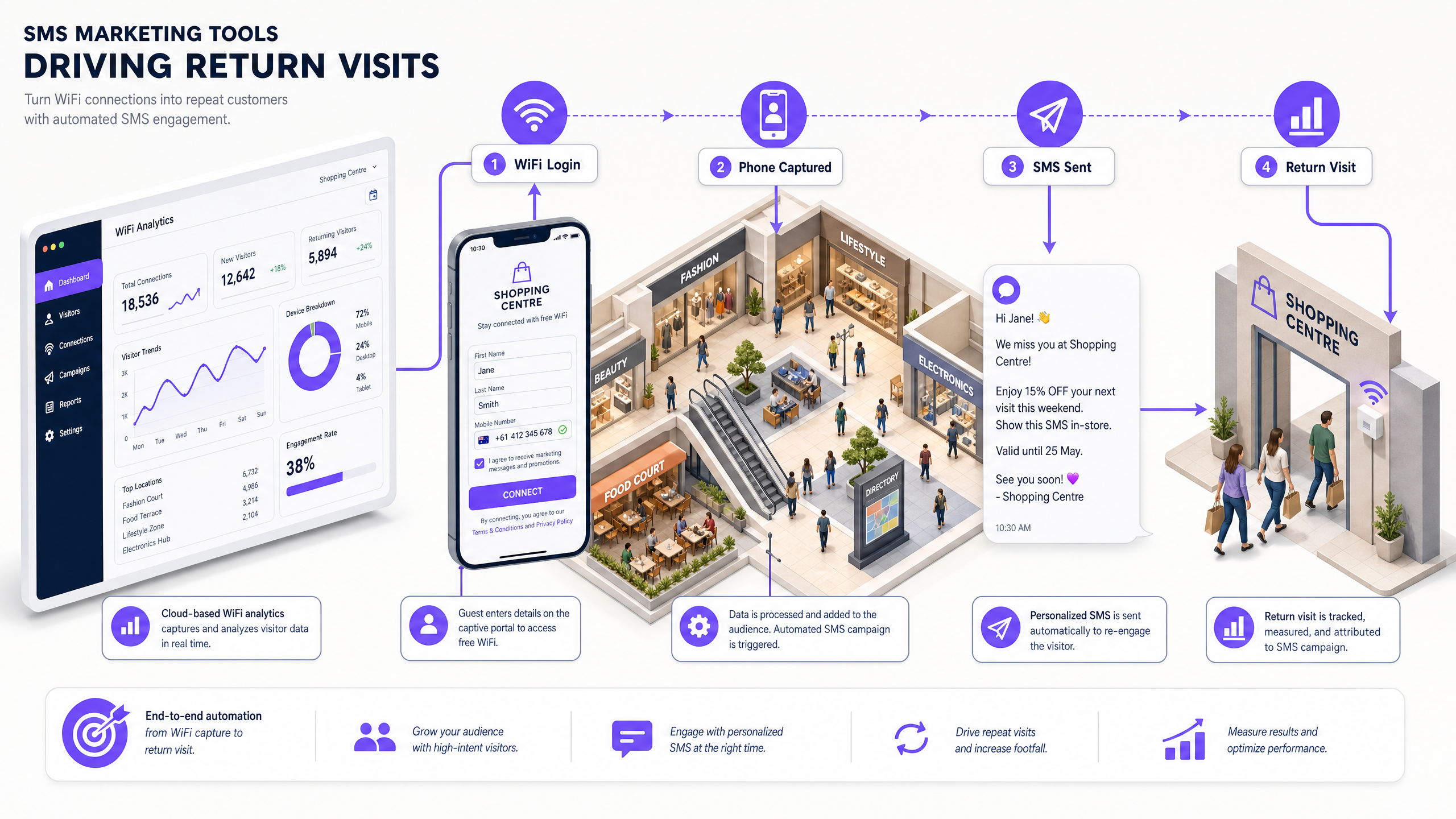
The transition from broadcast email to automated SMS marketing represents a fundamental shift in how venue operators engage their visitors. While email open rates stagnate around 20%, SMS commands a 98% open rate, with 90% of messages read within three minutes of delivery [1]. However, this high-attention channel requires a robust data capture mechanism. For enterprise venues—from Retail to Hospitality —the most effective acquisition point is the Guest WiFi network.
This guide details the technical architecture required to integrate a compliant SMS marketing tool with your existing network infrastructure. By deploying Purple Engage as a cloud overlay across hardware vendors like Cisco Meraki, HPE Aruba, or Juniper Mist, IT teams can securely capture verified phone numbers and visit data. This first-party data enables marketing teams to execute automated, segmented SMS campaigns that drive measurable return visits. We will cover deployment strategies, integration patterns, compliance requirements, and the business impact of a unified WiFi and SMS strategy.
Listen to the accompanying technical briefing podcast:
Technical Deep-Dive: Architecture and Data Flow
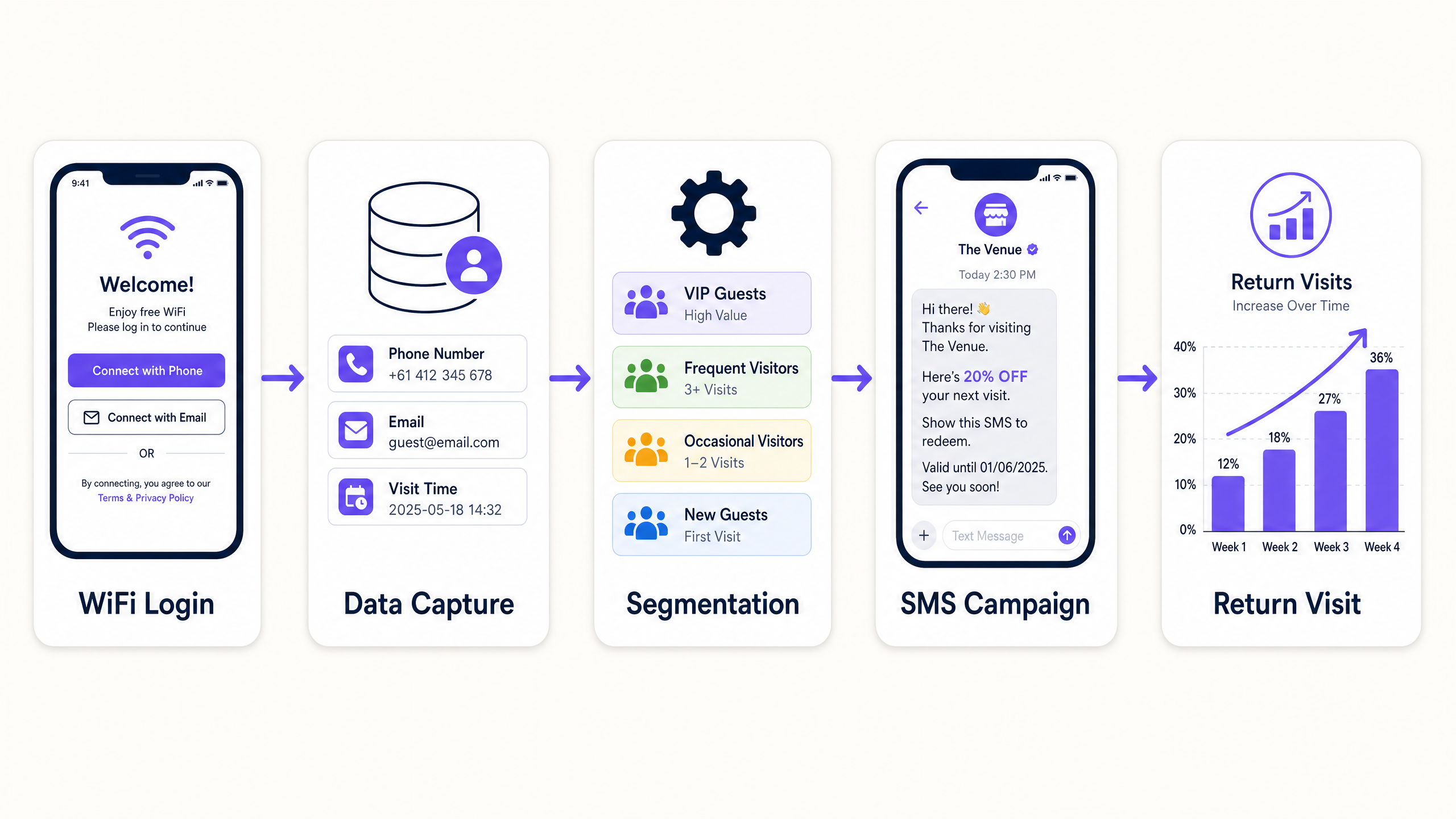
Implementing an effective SMS marketing tool requires a seamless data flow from the network edge to the messaging gateway. The architecture relies on three core components: the captive portal, the identity provider, and the segmentation engine.
Captive Portal and Data Capture
The guest experience begins at the captive portal. When a visitor connects to the Guest WiFi SSID, the network controller redirects their traffic to a Purple-hosted splash page. This page is the primary mechanism for capturing first-party data. To build a compliant SMS list, the portal must explicitly request a phone number alongside an unticked checkbox for marketing consent, adhering to GDPR and CCPA standards.
If you are looking to How to make a great first impression with your guest WiFi (and keep your brand consistent) , the portal design is critical. The data captured here—including device MAC address, connection timestamp, and verified phone number—is securely transmitted to the Purple cloud platform via API.
Cloud Overlay and Identity Resolution
Purple operates as a hardware-agnostic cloud overlay. It ingests RADIUS accounting data and API feeds from your access points (e.g., Ruckus, Extreme, Fortinet) to track the visitor's session. The platform resolves the device MAC address to the identity captured at the portal. This creates a persistent profile that tracks subsequent visits automatically, without requiring the guest to log in again. This passive tracking is the foundation of the return visit attribution model.
Segmentation and Automation Engine
The captured data feeds into the Purple WiFi Analytics engine. Here, IT and marketing teams can build dynamic segments based on network behaviour:
- Visit Frequency: Identifying first-time visitors versus regulars.
- Dwell Time: Segmenting based on session duration.
- Recency: Flagging guests who have not connected to the network in 30, 60, or 90 days.
These segments trigger automated workflows via API to the SMS gateway, ensuring messages are dispatched based on real-time venue interactions.
Implementation Guide
Deploying an SMS marketing tool integrated with Guest WiFi requires coordination between IT and marketing. Follow these vendor-neutral deployment steps to ensure a secure and scalable rollout.
Step 1: Network Configuration
Configure your wireless LAN controller (WLC) or cloud dashboard to point to Purple's RADIUS servers for authentication and accounting. Ensure the walled garden allows access to the Purple domains required for the captive portal to render correctly. If you are managing complex environments, consider reading Three SSIDs to rule them all: guest, Passpoint, and IoT WiFi for network segmentation best practices.
Step 2: Captive Portal Design and Compliance
Build the captive portal within the Purple dashboard. The critical technical requirement here is the separation of terms of service from marketing consent. Implement a mandatory checkbox for network terms, and a secondary, optional checkbox specifically stating: "I agree to receive SMS marketing messages." This ensures the data collected is legally usable for outbound campaigns.
Step 3: Integration and Webhooks
Connect Purple Engage to your existing CRM (e.g., Salesforce) and SMS gateway. Use Purple's REST API or configure outbound webhooks to push new contacts and visit events in real time. This ensures your CRM remains the single source of truth for customer data.
Step 4: Campaign Automation
Configure the trigger logic within the Purple platform. A standard baseline deployment includes:
- The Welcome Flow: Triggered 24 hours after a first-time connection.
- The Re-engagement Flow: Triggered when a device has not been seen on the network for 45 days.
- The Loyalty Flow: Triggered upon the fifth recorded connection.
Best Practices for SMS Marketing
To maximise return visits while minimising opt-outs, adhere to these industry standards.
Manage Frequency and Cadence
SMS is an intimate channel. Overuse leads to high opt-out rates and brand damage. The optimal cadence for venue operators is two to four messages per month per visitor. Ensure every message provides tangible value—whether an exclusive offer, critical venue information, or loyalty recognition.
Leverage Behavioural Triggers
Do not rely on batch-and-blast campaigns. The value of integrating SMS with WiFi analytics is the ability to trigger messages based on physical presence. A message sent 30 minutes after a guest leaves the venue (triggered by the RADIUS disconnect event) asking for feedback yields significantly higher engagement than a scheduled weekly blast.
Omnichannel Synchronisation
SMS should not operate in a silo. Coordinate your SMS strategy with your email marketing efforts. Use SMS for time-sensitive, high-impact alerts, and reserve email for longer-form content and newsletters. This approach respects the visitor's inbox and optimises the cost per send.
Troubleshooting & Risk Mitigation
When deploying SMS automation tied to network events, IT teams must monitor several potential failure modes.
Consent Drift and Compliance Failures
Risk: Capturing phone numbers without explicit marketing consent, leading to regulatory fines (GDPR, ICO). Mitigation: Audit the captive portal configuration quarterly. Ensure the SMS opt-in checkbox is never pre-ticked and that the consent version is logged against the user profile in the Purple database.
Stale Data and Misaligned Triggers
Risk: Sending a "we miss you" SMS to a guest who is currently connected to the network, damaging brand credibility. Mitigation: Monitor the webhook latency between the WiFi platform and the SMS gateway. Ensure the CRM updates visit recency fields in real time based on RADIUS accounting start/stop messages.
MAC Randomization
Risk: Modern operating systems use randomized MAC addresses, potentially fragmenting visitor profiles and artificially inflating new visitor counts. Mitigation: Purple's platform handles MAC randomization by relying on the authenticated identity (the phone number) as the primary key. Ensure the portal requires re-authentication periodically (e.g., every 90 days) to refresh the device-to-identity mapping.
ROI & Business Impact
The business case for an integrated SMS and WiFi marketing tool rests on attribution. Unlike traditional billboard or social media advertising, this architecture provides closed-loop reporting.
When an SMS is dispatched, the campaign ID is logged. When that specific guest returns to the venue and their device reconnects to the WiFi, the platform attributes that visit to the preceding SMS campaign. This allows venue operators to calculate the exact cost per acquisition and the revenue generated from return visits.
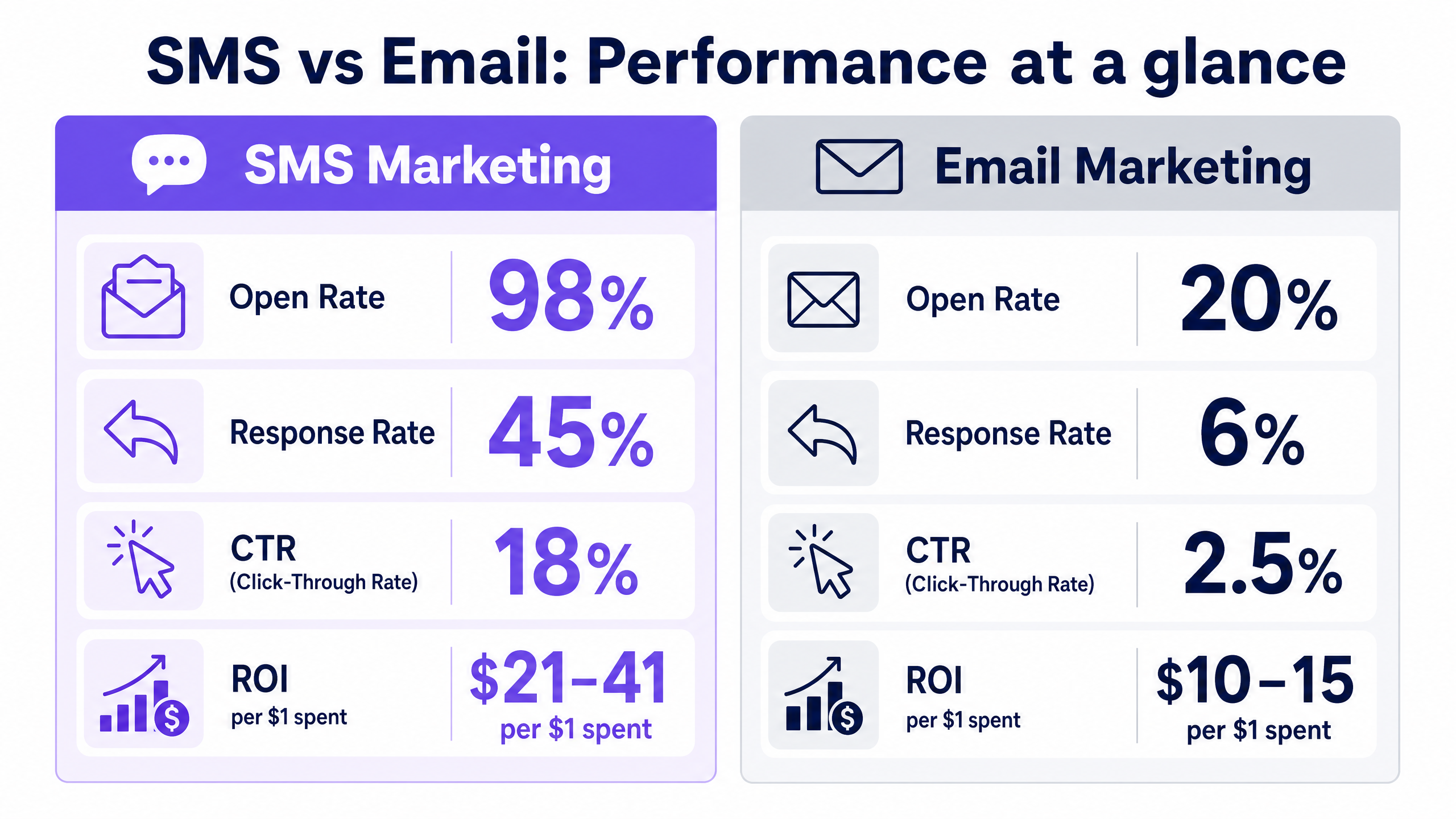
Industry benchmarks indicate that SMS marketing delivers a return of $21 to $41 for every dollar spent [2]. A quick-service restaurant chain deploying Purple Engage recorded a 31% increase in return visits from their SMS-opted audience compared to the control group. By capturing first-party data at the network edge and automating targeted engagement, IT and marketing teams can transform the Guest WiFi infrastructure from a cost centre into a measurable revenue driver. For further reading on platform selection, review How to leverage best SMS marketing platforms to increase return visits .
References
[1] MessageFlow. "SMS Marketing Benchmarks 2026: CTR, Open Rates by Industry." 2026. [2] Omnisend. "SMS Marketing Statistics and ROI." 2025.
Key Definitions
Captive Portal
A web page that a user of a public access network is obliged to view and interact with before access is granted.
This is the primary data capture point for IT teams to collect verified phone numbers and marketing consent for SMS campaigns.
First-Party Data
Information a company collects directly from its customers and owns entirely.
In a post-cookie landscape, capturing first-party data via Guest WiFi is critical for marketing teams to execute targeted SMS campaigns.
Cloud Overlay
A software architecture that sits above existing hardware infrastructure, providing centralized management and analytics without requiring hardware replacement.
Purple operates as a cloud overlay, allowing IT directors to deploy SMS data capture across mixed hardware environments (e.g., Cisco Meraki and Aruba) seamlessly.
Closed-Loop Attribution
The ability to track a marketing interaction directly to a physical or digital conversion event.
By tracking when a device reconnects to the WiFi after receiving an SMS, venues can prove the exact ROI and footfall generated by the campaign.
MAC Randomization
A privacy feature in modern operating systems that generates a temporary MAC address for different WiFi networks.
IT teams must rely on the authenticated identity (phone number) rather than just the MAC address to maintain accurate visitor profiles across multiple visits.
Webhook
A method for augmenting or altering the behaviour of a web page or web application with custom callbacks.
Used to push real-time visit events from the Purple platform to the SMS gateway, triggering automated messages the moment a guest leaves the venue.
Dynamic Segmentation
The process of automatically updating audience lists based on real-time behaviour and data inputs.
Essential for ensuring SMS campaigns are relevant, such as automatically removing a guest from a 'lapse risk' segment the moment their device reconnects to the network.
Opt-In Consent
Explicit permission granted by a user to receive marketing communications.
A strict legal requirement under GDPR. IT teams must ensure the captive portal logs the timestamp and version of the terms agreed to when the phone number is captured.
Worked Examples
A 40-property hotel group needs to drive direct bookings and reduce OTA commissions. They currently offer free WiFi but do not capture guest phone numbers effectively.
- Deploy Purple Engage across all 40 properties as a cloud overlay on their existing HPE Aruba infrastructure.
- Redesign the captive portal to require a phone number and include an explicit, unticked SMS marketing consent box.
- Integrate Purple with the Property Management System (PMS) via API to sync stay dates.
- Configure an automated SMS trigger: 3 days post-checkout, send an SMS offering an exclusive 15% discount on their next direct booking.
- Track returning MAC addresses to attribute subsequent visits and bookings to the SMS campaign.
A large retail shopping centre wants to re-engage shoppers who haven't visited in over 60 days, but their current email campaigns only achieve a 15% open rate.
- Audit the Purple WiFi Analytics dashboard to create a dynamic segment: 'Visitors with >1 previous visit AND last seen >60 days ago'.
- Verify SMS marketing consent status for all users in this segment.
- Configure an automated webhook to the SMS gateway to trigger a message when a user enters this segment.
- Send a targeted SMS: 'We miss you at [Venue Name]. Show this text at the information desk this weekend for a £10 gift card.'
- Monitor the Purple dashboard for device reconnections from this segment to measure the exact footfall driven by the campaign.
Practice Questions
Q1. Your marketing director wants to send an SMS blast to all 50,000 contacts in the WiFi database offering a 10% discount this Friday. As the IT manager, what is your primary technical and compliance concern, and how do you advise them?
Hint: Consider the difference between a captured phone number and an opted-in phone number, as well as the impact of batch sending.
View model answer
The primary concern is compliance and consent drift. Not all 50,000 contacts will have explicitly opted in to SMS marketing; many may have only accepted the network terms of service. Sending a blast to the entire database risks severe GDPR/PECR violations. I would advise filtering the database within the Purple platform to isolate only those users with a logged SMS consent timestamp. Furthermore, I would recommend segmenting this compliant list by recency (e.g., visited in the last 90 days) to improve relevance and avoid high opt-out rates.
Q2. A stadium operator notices that their 'Return Visit' metrics in the Purple dashboard seem artificially high during a single event, with devices showing as returning multiple times within a 3-hour window. What network configuration issue is likely causing this?
Hint: Think about how devices behave when moving between access points and how RADIUS accounting handles session timeouts.
View model answer
This is likely caused by an aggressive idle timeout configuration on the wireless LAN controller combined with roaming between access points. If the idle timeout is too short, the WLC sends a RADIUS 'Stop' accounting message when a fan puts their phone in their pocket. When they check their phone 15 minutes later in a different part of the stadium, a new 'Start' message is generated, which the analytics engine misinterprets as a new visit. The solution is to increase the idle timeout threshold (e.g., to 4 hours) for the stadium SSID to ensure the entire event is logged as a single continuous session.
Q3. You are integrating Purple Engage with a new SMS gateway via webhooks. The marketing team reports that the 'Welcome' SMS is triggering for guests every time they visit, rather than just on their first visit. Where is the logic failure occurring?
Hint: Review the difference between a connection event and a profile creation event in the data pipeline.
View model answer
The webhook trigger is incorrectly mapped to the 'Network Authentication' or 'Session Start' event rather than the 'New Profile Created' or 'First Visit' milestone. To fix this, the trigger logic in the Purple dashboard must be adjusted to fire only when the 'Visit Count' metric equals 1, or the webhook must be pointed specifically to the new user registration endpoint. This ensures the SMS gateway only receives the payload once per unique identity.