
La guía de cumplimiento: GDPR y la privacidad de datos en redes WiFi para invitados
Esta guía exhaustiva ofrece a los responsables de TI y operadores de recintos un marco técnico para diseñar redes WiFi para invitados que cumplan con el GDPR. Detalla los mecanismos de consentimiento, la segmentación de red, la retención automatizada de datos y cómo transformar el cumplimiento de una obligación regulatoria en un activo de datos de primera mano defendible.
Escuchar esta guía
Ver transcripción del podcast

Resumen ejecutivo
El WiFi para invitados es un punto de recopilación de datos regulado. Cada hotel, cadena de retail, estadio y centro de conferencias que ofrece acceso a una red pública se convierte en Responsable del Tratamiento bajo el Reglamento General de Protección de Datos (GDPR) en el momento en que un invitado se conecta. La Information Commissioner's Office (ICO) puede imponer multas de hasta 20 millones de euros o el 4 % de la facturación anual global por incumplimiento.
Esta guía proporciona a los responsables de TI, arquitectos de red y directores de operaciones un marco práctico y aplicable para garantizar que sus servicios de WiFi para invitados cumplan plenamente con la normativa. Exploramos los tipos específicos de datos recopilados a través del WiFi para invitados, los requisitos legales para el consentimiento y el manejo de datos, y las mejores prácticas independientes del proveedor para implementar una solución conforme a la ley.
Aprenderá a mitigar los riesgos legales y financieros asociados al incumplimiento mediante el diseño de un sistema seguro, desde el diseño del Captive Portal hasta la automatización de las políticas de retención de datos. Al seguir estos principios, las organizaciones pueden transformar su WiFi para invitados de una posible contingencia de cumplimiento en un activo estratégico que impulse el crecimiento empresarial al tiempo que respeta la privacidad del usuario.
Análisis técnico en profundidad
Comprender el cumplimiento del GDPR para el WiFi para invitados comienza con una evaluación clara de los datos que se procesan. Según el reglamento, los datos personales se definen de manera amplia como cualquier información relativa a una persona física identificada o identificable. En el contexto de una red WiFi para invitados, esto abarca una gama de puntos de datos más amplia de lo que muchas organizaciones asumen. No clasificar correctamente estos datos es un error fundamental en la estrategia de cumplimiento.
Categorías de datos en el WiFi para invitados
Los datos recopilados a través de una red WiFi para invitados se pueden segmentar en cuatro categorías principales. Cada una tiene distintas implicaciones para el cumplimiento del GDPR, en particular en lo que respecta a la base legal para el tratamiento y el período de retención requerido.
- Datos de registro: Nombre, dirección de correo electrónico, número de teléfono y datos de perfil de redes sociales. Esta es la información explícita que los invitados proporcionan en su Captive Portal. La base legal principal es el consentimiento, y este debe ser libre, específico, informado e inequívoco.
- Datos de dispositivo y sesión: Direcciones MAC, direcciones IP, marcas de tiempo de conexión y duración de la sesión. Esto se recopila automáticamente. La base legal suele ser el interés legítimo para la gestión y seguridad de la red, siempre que se haya realizado una Evaluación de Interés Legítimo.
- Datos de ubicación: Coordenadas de ubicación física, tiempo de permanencia y rutas de movimiento derivadas de la triangulación de puntos de acceso WiFi. Esto es procesado por los sistemas de WiFi Analytics . Dado que el seguimiento de la ubicación puede ser intrusivo, requiere una divulgación explícita y, a menudo, un consentimiento explícito, especialmente si se utiliza para la elaboración de perfiles.
- Datos de uso: Uso de aplicaciones, comportamiento de navegación y consumo de ancho de banda. Si está inspeccionando el contenido del tráfico, necesita una base legal muy clara. Para obtener orientación sobre cómo gestionar este tráfico de forma segura, consulte nuestra guía Gestión de ancho de banda: una guía práctica para 2026 .
Arquitectura de cumplimiento del Captive Portal
El Captive Portal es su interfaz de cumplimiento principal. Es donde se establece la base legal para el tratamiento de datos.
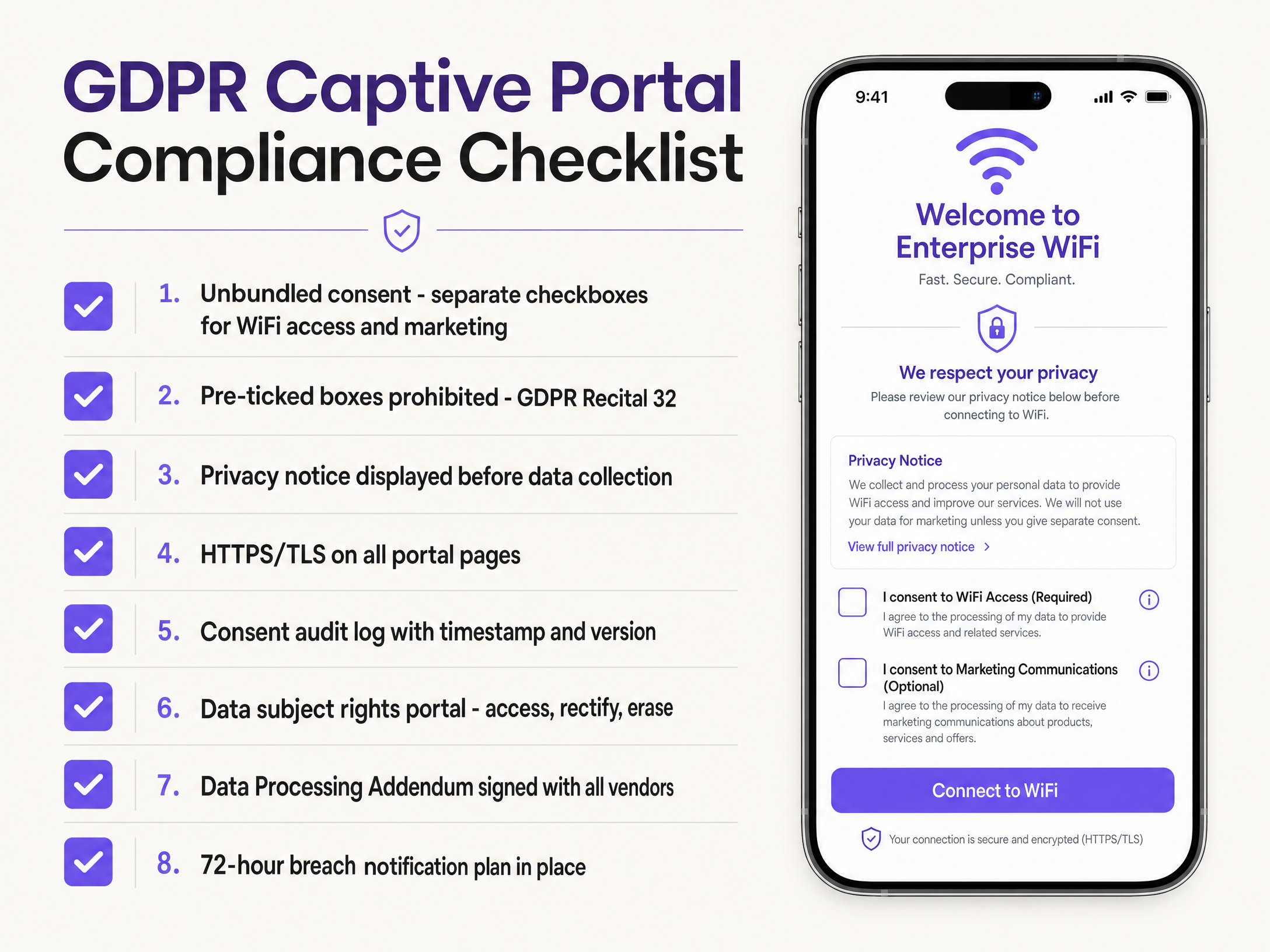
El fallo de arquitectura más común es la vinculación de consentimientos (bundling). Si obliga a un invitado a aceptar correos electrónicos de marketing para acceder a la red, ese consentimiento no se otorga libremente y no es válido según el Artículo 7 del GDPR. Debe implementar un consentimiento no vinculado.
Su Captive Portal debe presentar como mínimo dos elementos de consentimiento separados:
- Una casilla de verificación obligatoria para la aceptación de los términos de servicio para el acceso a la red.
- Una casilla de verificación opcional y desmarcada para el consentimiento de comunicaciones de marketing.
El Considerando 32 del GDPR prohíbe explícitamente las casillas premarcadas. Además, su portal debe mostrar un aviso de privacidad claro antes de que el usuario envíe cualquier dato, de conformidad con el Artículo 13. Este aviso debe explicar qué datos recopila, por qué, cuánto tiempo los conserva y con quién los comparte.
De manera crucial, su sistema debe mantener un registro de auditoría de consentimiento. Este registro debe indicar quién dio su consentimiento, cuándo lo dio, para qué lo dio y la versión exacta del aviso de privacidad que visualizó. Esta es su prueba de cumplimiento.
Segmentación y seguridad de la red
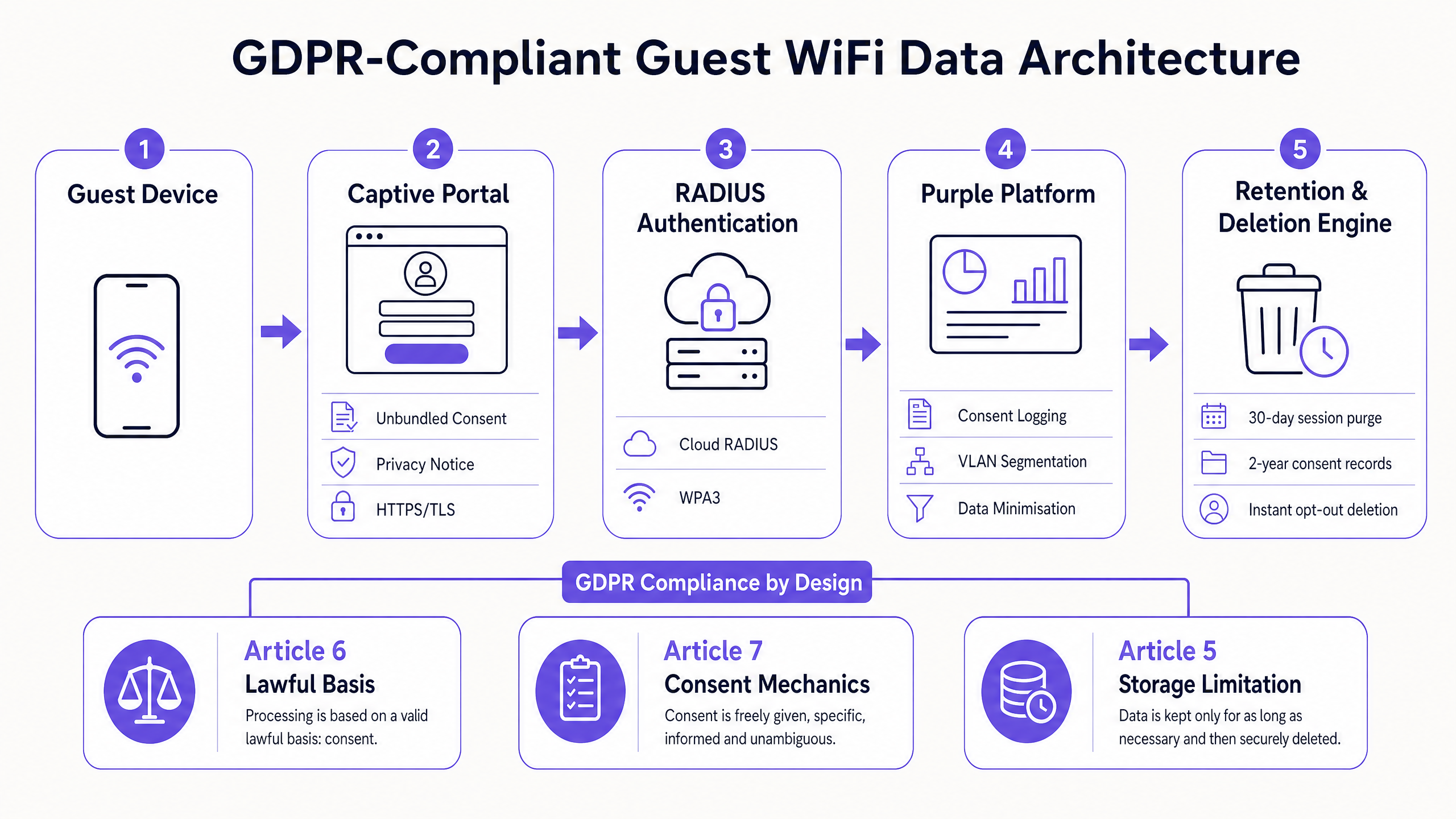
Desde la perspectiva de la arquitectura de red, la segmentación es innegociable. El tráfico de su WiFi para invitados debe estar aislado en una VLAN (red de área local virtual) dedicada, completamente separada de su red corporativa. Utilice listas de control de acceso para bloquear el acceso de los dispositivos de los invitados a las subredes internas y habilite el aislamiento de clientes para que los dispositivos de los invitados no puedan comunicarse entre sí. Esto protege tanto a los invitados como a sus activos corporativos. Para profundizar en estos principios, consulte Qué es un WiFi seguro: guía esencial para empresas de 2026 .
Para la autenticación, integre su controlador de LAN inalámbrica con un servidor RADIUS en la nube. Cuando un usuario completa el flujo del Captive Portal, la plataforma envía un mensaje RADIUS Access-Accept al controlador, otorgando el acceso. Esto crea una separación clara entre la capa de autenticación y la capa de recopilación de datos.
En cuanto al cifrado, su SSID para invitados debería utilizar WPA3 siempre que su hardware lo admita. Como mínimo, aplique WPA2 con cifrado AES. Y su Captive Portal debe servirse a través de HTTPS con un certificado TLS válido. Ofrecer un formulario que recopile datos personales a través de HTTP es un fallo de seguridad crítico.
Guía de implementación
La implementación de una red WiFi de invitados que cumpla con la normativa requiere un enfoque estructurado en las capas de hardware, software y políticas.
- Selección de hardware: Asegúrese de que sus puntos de acceso admitan etiquetado VLAN, aislamiento de clientes y WPA3. La plataforma de Purple es independiente del hardware y se integra a la perfección con Cisco Meraki, HPE Aruba, Ruckus, Juniper Mist, Ubiquiti UniFi, Cambium, Extreme y Fortinet. No utilice hardware de consumo; consulte Por qué los equipos WiFi de consumo no deben estar en su red de invitados .
- Diseño del Captive Portal: Cree una página de inicio con consentimiento desagregado. Asegúrese de que el aviso de privacidad sea accesible antes de enviar cualquier dato. Si opera en regiones que requieren inicios de sesión sociales específicos, asegúrese de que el intercambio de datos sea transparente. Por ejemplo, consulte nuestra guía sobre Integración de la autenticación WiFi de WeChat: incorporación de Captive Portal para clientes de APAC .
- Automatización de la retención de datos: Configure su plataforma para purgar datos automáticamente de acuerdo con su política de retención. La eliminación manual no es viable a gran escala.
- Acuerdos con proveedores: Asegúrese de tener un Anexo de Procesamiento de Datos (DPA) firmado con su proveedor de WiFi de invitados, su proveedor de CRM y cualquier otro tercero que procese estos datos.
Buenas prácticas
Para mantener el cumplimiento y generar confianza, siga estas buenas prácticas estándar del sector:
- Minimización de datos: Recopile únicamente los datos que necesite estrictamente. Si no tiene un caso de uso comercial definido para un número de teléfono, no lo solicite en el Captive Portal.
- Limitación automatizada del almacenamiento: Implemente periodos estrictos de retención de datos. Los registros de sesión deben purgarse después de 30 días. Los registros de consentimiento deben conservarse durante la vigencia de la relación de servicio más dos años. Los perfiles de marketing deben eliminarse inmediatamente tras la retirada del consentimiento.
- Habilitar los derechos de los interesados: Proporcione un centro de preferencias de autoservicio donde los invitados puedan gestionar su consentimiento, solicitar el acceso a sus datos o solicitar su eliminación (el derecho al olvido). Esto reduce drásticamente la carga operativa de gestionar las solicitudes de acceso de los interesados (DSAR).
- Realizar una DPIA: Una Evaluación de Impacto de la Protección de Datos (DPIA) es legalmente obligatoria según el Artículo 35 del GDPR si su implementación implica el seguimiento de ubicación a gran escala o la elaboración de perfiles de comportamiento.
Resolución de problemas y mitigación de riesgos
Incluso con una arquitectura sólida, siguen existiendo riesgos. Aborde estos fallos comunes de forma proactiva:
- Fatiga del consentimiento: Si su portal es excesivamente complejo, los usuarios abandonarán la conexión o harán clic sin leer. Mantenga claro el intercambio de valor: WiFi rápido y gratuito a cambio de una dirección de correo electrónico y marketing opcional.
- DPA no firmados: El proveedor de su plataforma de WiFi de invitados es un Encargado del Tratamiento. Si comparte datos personales con él sin un DPA firmado, estará cometiendo una infracción. Asegúrese de que los contratos estén en vigor antes de que se transfiera cualquier dato.
- Notificación de brecha retrasada: Según el Artículo 33 del GDPR, dispone de 72 horas para notificar a la ICO una brecha de datos personales desde el momento en que tenga conocimiento de ella. Integre este plazo en su plan de respuesta a incidentes; no espere a que concluya la investigación antes de realizar la notificación.
ROI e impacto empresarial
El cumplimiento no es solo un obstáculo normativo; es un habilitador estratégico. Una plataforma de WiFi de invitados que cumple con el GDPR le protege de multas de hasta el 4 % de la facturación global, pero también ofrece un ROI medible.
Al implementar opciones de inclusión (opt-in) desagregadas y de elección consciente, construye una base de datos de alta calidad con datos de origen (first-party data). Aunque el volumen bruto de suscripciones de marketing puede ser menor que con un enfoque agrupado que no cumpla con la normativa, las tasas de interacción (tasas de apertura, de clics y de conversión) son significativamente más altas porque la audiencia eligió activamente recibir noticias suyas.
Además, una plataforma que cumple con la normativa proporciona inteligencia empresarial de origen ético. En sectores como el Comercio minorista y la Hostelería , estos datos impulsan mejoras operativas, desde la optimización de los niveles de personal en función de la afluencia de público hasta la personalización de la experiencia del invitado. La plataforma de Purple, certificada según las normas ISO 27001, ha procesado 440 millones de inicios de sesión y ha recopilado 29 000 millones de puntos de datos, lo que demuestra que la escala y el cumplimiento estricto pueden coexistir de forma rentable.
Definiciones clave
Data Controller
The entity that determines the purposes and means of processing personal data. When a venue offers guest WiFi, it acts as the Data Controller and holds the primary legal responsibility.
IT managers must understand that outsourcing the WiFi platform does not outsource the legal liability.
Data Processor
An entity that processes personal data on behalf of the Data Controller. Purple, as the WiFi platform provider, acts as a Data Processor.
Requires a formal Data Processing Addendum (DPA) to legally handle the venue's guest data.
Captive Portal
The splash page or web page that a user must view and interact with before being granted access to a public network.
This is the primary interface where venues present privacy notices and capture lawful consent.
Unbundled Consent
The practice of separating requests for consent from other terms and conditions. Marketing consent cannot be a condition of service.
Essential for captive portal design to ensure consent is deemed 'freely given' under GDPR.
MAC Address
Media Access Control address; a unique identifier assigned to a network interface controller. Under GDPR, this is considered personal data when linked to a user.
Even if a user does not provide an email, logging their MAC address constitutes processing personal data.
VLAN Segmentation
Dividing a physical network into multiple logical networks. Guest WiFi traffic must be isolated from corporate traffic.
A foundational security control to prevent guest devices from accessing internal company assets.
RADIUS
Remote Authentication Dial-In User Service; a networking protocol that provides centralized Authentication, Authorization, and Accounting management.
Used to securely authenticate users who have completed the captive portal flow before granting network access.
DSAR
Data Subject Access Request; a mechanism for individuals to request a copy of their personal data, or ask for it to be rectified or erased.
Venues must have a process to handle these within 30 days. Self-service preference centres automate this burden.
Ejemplos prácticos
A 200-room hotel wants to collect guest emails to drive loyalty programme sign-ups. Their current system requires guests to accept marketing emails as a condition of getting online.
The hotel must deploy a compliant captive portal with unbundled consent. They must implement two separate checkboxes: a mandatory one for accepting the terms of service for network access, and an optional, unticked checkbox for marketing consent. The privacy notice must be clearly linked before the data submission button.
A stadium IT team wants to use WiFi analytics to monitor crowd density and manage safety at events. The legal team is concerned that tracking device locations without explicit consent violates GDPR.
The solution is two-fold. First, the captive portal privacy notice must be updated to explicitly disclose that location data is processed for crowd management and safety purposes under legitimate interest. Second, the IT team must implement MAC address pseudonymisation at the edge (on the access points) before the data reaches the cloud analytics platform.
Preguntas de práctica
Q1. Your marketing team wants to increase the size of their email database. They propose making the marketing opt-in checkbox on the guest WiFi captive portal pre-ticked by default to increase conversion. How do you advise them?
Sugerencia: Consider the GDPR definition of unambiguous consent and Recital 32.
Ver respuesta modelo
You must reject this proposal. GDPR Recital 32 explicitly states that silence, pre-ticked boxes, or inactivity does not constitute consent. Consent must require a clear affirmative action. Implementing pre-ticked boxes invalidates the consent and exposes the organisation to regulatory fines.
Q2. A guest connects to your WiFi but does not provide an email address, logging in via a 'skip' option. Your system logs their device MAC address, connection time, and the access point they connected to. Are you processing personal data?
Sugerencia: Consider the ICO's guidance on identifiers and the potential to single out an individual.
Ver respuesta modelo
Yes. Even without a name or email, a MAC address combined with location and time data can be used to single out an individual device and track its movements over time. The ICO considers this personal data. You must ensure you have a lawful basis (typically legitimate interest for basic network logging) and transparently disclose this processing in your privacy notice.
Q3. During a routine audit, you discover that your guest WiFi platform has been retaining detailed session logs (IP addresses, MAC addresses, connection times) for the past four years. What action should you take?
Sugerencia: Refer to the GDPR principle of storage limitation (Article 5).
Ver respuesta modelo
You must immediately implement an automated data deletion policy. Under the storage limitation principle, data must be kept no longer than necessary. Four years of session logs is excessive for network troubleshooting. You should purge historical session data older than 30 days and configure the platform to automatically delete future session logs at the 30-day mark.
Continúe leyendo esta serie
Integración de la autenticación de WeChat con Captive Portals de WiFi para invitados
Esta guía explica cómo integrar la autenticación OAuth 2.0 de WeChat en Captive Portals de WiFi para invitados empresariales. Cubre los requisitos de registro en doble plataforma, la selección de alcance (scope) para la captura de datos de primera mano, la aplicación de políticas de red a través de RADIUS Change of Authorization y el cumplimiento de GDPR y la PIPL de China. Los operadores de recintos en los sectores de hostelería, retail y eventos encontrarán pasos de implementación concretos, casos de estudio reales y directrices de endurecimiento de seguridad para desplegar el inicio de sesión de WeChat en WiFi para invitados a escala.
Cómo configurar un WiFi de invitados: Guía de configuración empresarial segura
Esta guía de referencia ofrece a los líderes de TI y arquitectos de red un plan definitivo para implementar un WiFi de invitados empresarial seguro. Cubre la arquitectura esencial, la migración a WPA3, la segmentación de VLAN y la integración de Captive Portal para proteger los sistemas internos al tiempo que se recopilan datos de primera mano conformes con la normativa.
Configuración del redireccionamiento de Captive Portal en controladores de red Enterprise
Esta guía autorizada detalla la arquitectura técnica y los pasos de configuración específicos de cada proveedor necesarios para implementar el redireccionamiento de Captive Portal en controladores de red enterprise. Proporciona orientación práctica para los equipos de TI sobre cómo configurar walled gardens, integrar la autenticación RADIUS y garantizar el cumplimiento de GDPR y PCI DSS.