
How to leverage SMS text marketing to increase return visits
This technical reference details the architecture and implementation of SMS text message marketing for venue operators. It explains how to capture verified phone numbers via Guest WiFi, maintain GDPR and CCPA compliance, and automate campaigns to increase return visits and revenue.
Listen to this guide
View podcast transcript
Executive Summary
Most venues face a critical gap between first-time visitors and repeat guests. While email has historically bridged this gap, its 20% open rate limits impact [1]. SMS text message marketing offers a structural advantage, delivering 98% open rates and driving measurable return visits [2]. This guide details the architecture for capturing verified phone numbers through Guest WiFi captive portals, maintaining strict GDPR and CCPA compliance, and deploying automated SMS campaigns. For IT managers and venue operations directors across hospitality, retail, and stadiums, SMS represents the most direct channel to activate first-party data. By using Purple Engage, venues can consolidate data capture, consent logging, and campaign execution into a single cloud overlay, reducing integration complexity while delivering return visit uplifts exceeding 20%.
Listen to the Briefing
Technical Deep-Dive
The foundation of effective SMS marketing is the data capture layer. Relying on point-of-sale data entry or manual sign-ups introduces friction and data quality issues. The modern approach uses the venue's existing WiFi infrastructure as the primary data ingestion point.
Architecture of WiFi Data Capture
When a visitor attempts to connect to the Guest WiFi network, the hardware controller redirects traffic to a cloud-hosted captive portal. During this authentication flow, Purple Engage requests the user's mobile number. To verify the number and establish consent, the system uses a double opt-in mechanism.
- The user enters their phone number.
- Purple sends an immediate SMS containing a verification code or link.
- The user inputs the code or clicks the link to complete authentication.
- The network grants internet access via RADIUS.
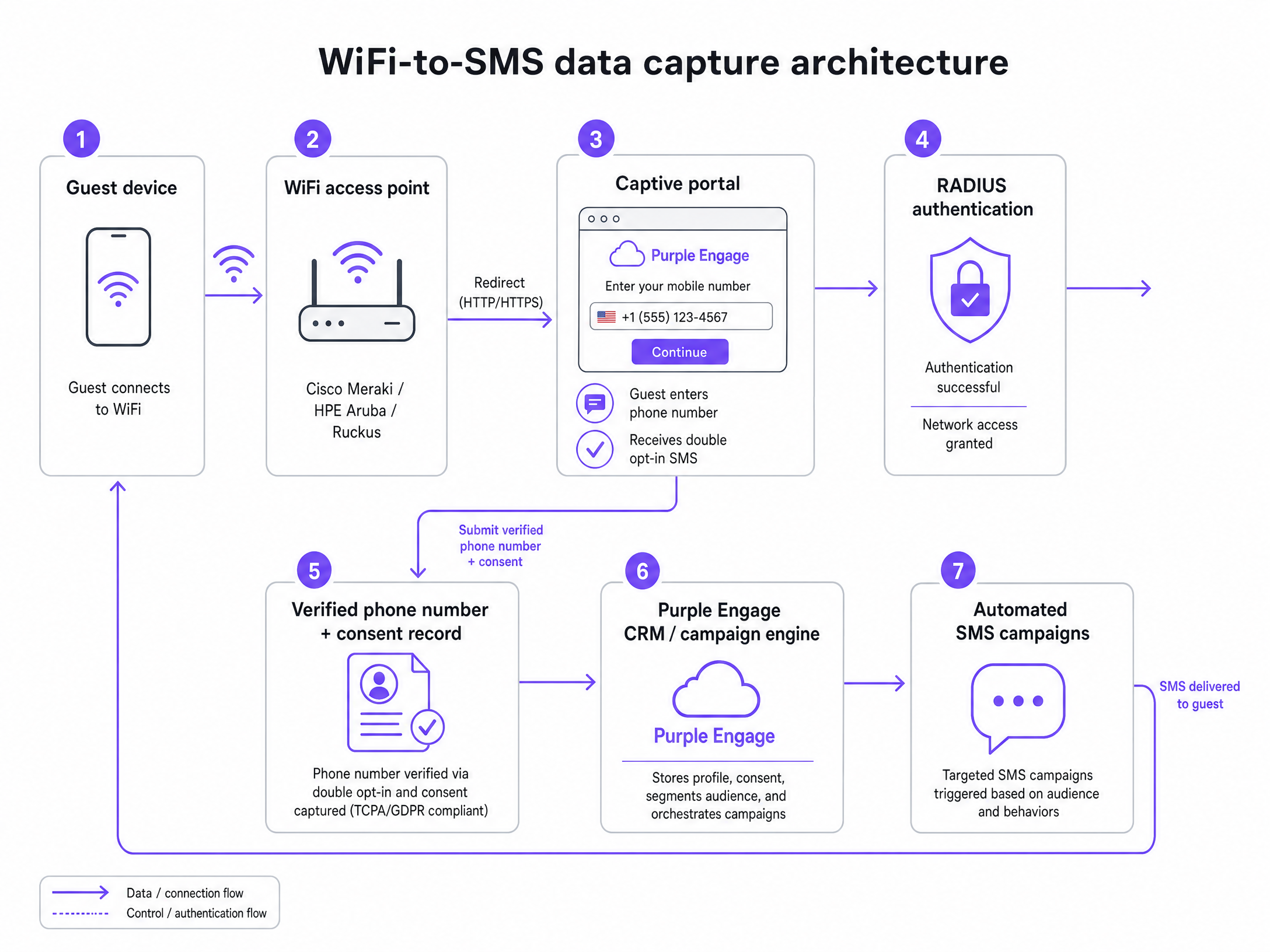
This flow ensures the phone number is active and the device is present in the venue. It prevents bad data entry and establishes a clear, auditable consent record. Purple operates as a hardware-agnostic cloud overlay, integrating natively with Cisco Meraki, HPE Aruba, Ruckus, Juniper Mist, Ubiquiti UniFi, Cambium, Extreme, and Fortinet.
Compliance Framework
Capturing phone numbers requires strict adherence to privacy regulations. Under GDPR in the UK and EU, and CCPA in California, venues must obtain explicit, freely given, specific, and informed consent before sending marketing communications [3].
The double opt-in flow satisfies these requirements. Purple logs the consent record, the timestamp, the MAC address, and the opt-in mechanism. Purple is ISO 27001 certified and GDPR compliant. This centralised consent architecture saves legal and IT teams from managing fragmented compliance records across multiple point solutions.
Implementation Guide
Deploying an SMS marketing programme requires configuration across the network layer and the CRM engine.
Step 1: Configure the Captive Portal
Update your Guest WiFi login flow to require phone number authentication. Ensure the terms and conditions explicitly state that the number will be used for marketing purposes, with a clear opt-in checkbox. Do not pre-tick the box.
Step 2: Define Audience Segments
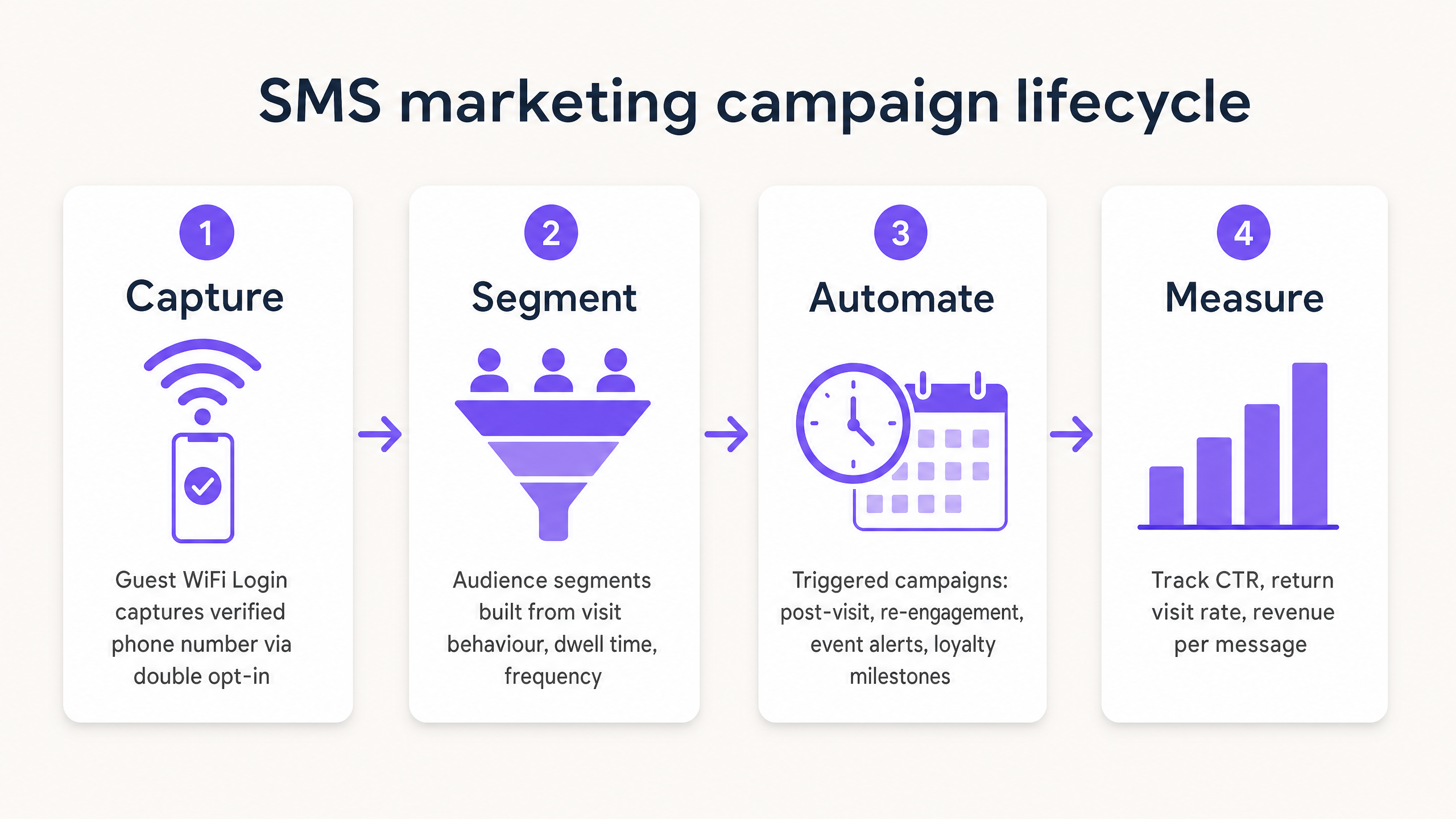
Purple Engage segments automatically based on visit behaviour. Create baseline segments:
- First-time visitors: Users with exactly one recorded login.
- Lapsed visitors: Users who have not logged in for 30, 60, or 90 days.
- High-frequency visitors: Users with 5+ logins in a 30-day window.
- Zonal visitors: Users who dwell in specific venue zones (e.g., the hotel restaurant vs. the gym).
Step 3: Build Automated Campaigns
Set up triggered campaigns that execute without manual intervention.
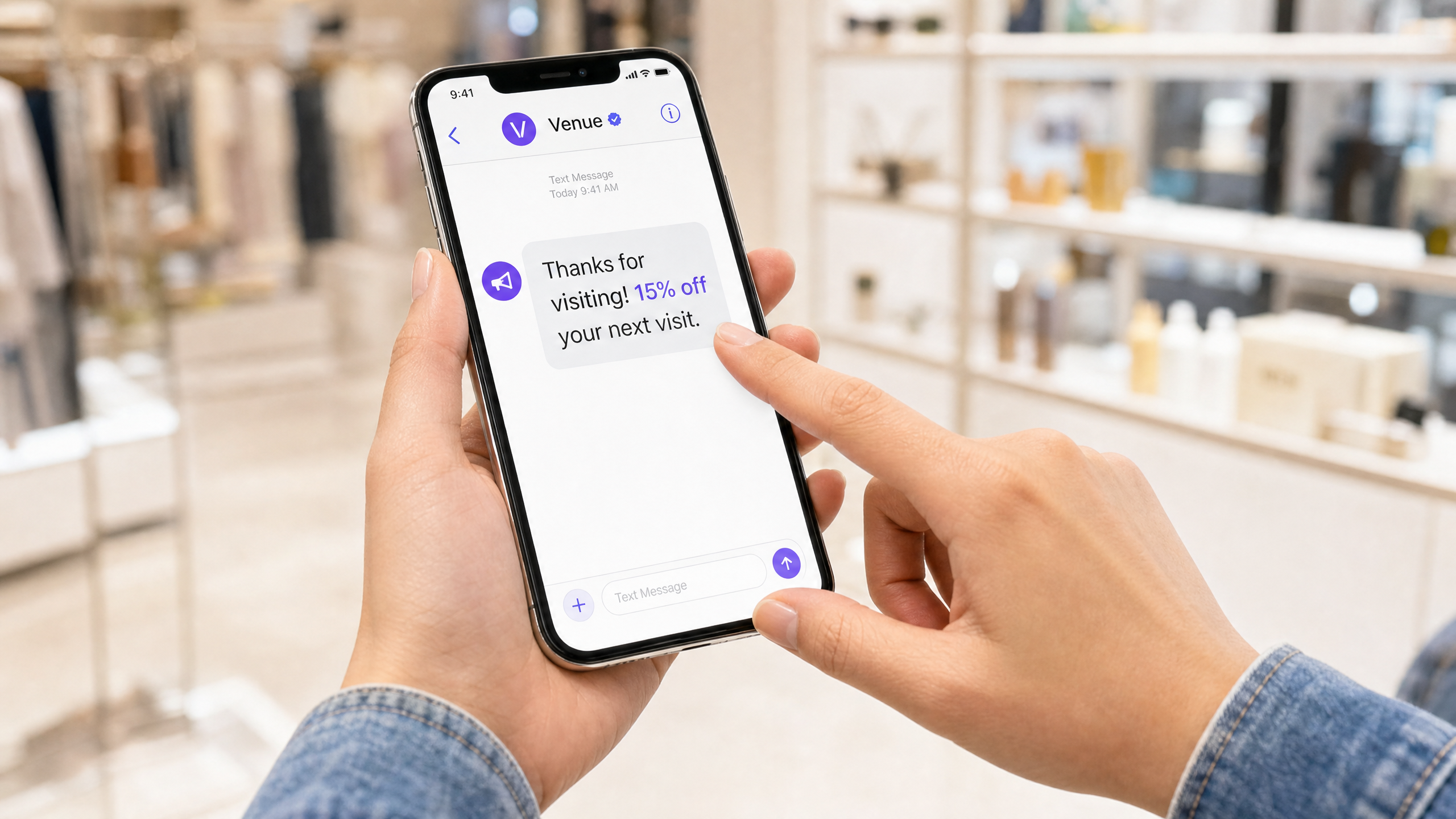
- Post-Visit: Triggered 24 hours after the WiFi session ends. Example: "Thanks for visiting us today. Here is 15% off your next stay - valid for 30 days."
- Re-Engagement: Triggered after 30 days of absence. Example: "We miss you! Show this text for a complimentary drink on your next visit."
- Loyalty Milestones: Triggered on the 5th or 10th visit. Example: "Congratulations on your 10th visit! Enjoy 20% off your bill today."
Best Practices
- Control Frequency: Send a maximum of 2-4 promotional messages per month. Over-frequency drives 61% of SMS opt-outs [4].
- Time Messages Appropriately: Restrict send windows to 09:00 - 20:00 in the recipient's local time zone.
- Provide Clear Opt-Outs: Ensure every message includes instructions to opt out (e.g., "Reply STOP to cancel"). Purple Engage processes STOP replies automatically and removes the number from future campaigns.
- Prioritise Relevance: Do not send generic blasts. Use dwell time data to target offers. A shopper who spent 40 minutes in the sports department should receive sports-related offers, not homeware promotions.
Troubleshooting & Risk Mitigation
| Failure Mode | Root Cause | Mitigation |
|---|---|---|
| High opt-out rates | Sending too many messages or irrelevant content. | Cap frequency at 2 messages per month. Refine audience segmentation based on dwell data. |
| Poor click-through rates | Generic offers with no urgency. | Add expiry dates to offers (e.g., "Valid for 48 hours"). Personalise the message based on previous visit behaviour. |
ROI & Business Impact
SMS marketing delivers substantial returns when executed correctly. Average SMS marketing ROI sits between $21 and $71 for every $1 spent [2].
To measure success, track:
- Return Visit Rate: Compare the return frequency of SMS recipients against a control group of non-recipients.
- Click-Through Rate (CTR): Monitor link clicks within the SMS. A healthy CTR for triggered SMS is 18-35% [4].
- Revenue Per Message: Calculate the total revenue generated by the campaign divided by the number of messages sent.
For example, a mid-scale hotel chain deployed Purple Engage across 40 properties. Within 90 days, they captured 60,000 verified phone numbers. Their 30-day post-visit SMS campaign achieved a return visit rate 31% higher than the control group, driving direct bookings and eliminating OTA commission costs.
References
[1] Infobip, "SMS marketing statistics: Key figures for 2026", https://www.infobip.com/blog/sms-marketing-statistics [2] MessageFlow, "SMS Marketing Benchmarks 2026: CTR, Open Rates, and Conversion Data by Industry", https://messageflow.com/blog/sms-marketing-benchmarks [3] IronWiFi, "How to Build a GDPR-Compliant Guest Wi-Fi Experience", https://www.ironwifi.com/blogs/gdpr-compliant-guest-wifi [4] Tabular, "SMS Marketing Statistics 2025", https://tabular.email/blog/sms-marketing-stats
Key Definitions
Double Opt-In
A consent mechanism where a user provides their phone number and then confirms their subscription by replying to an initial SMS or entering a verification code.
Mandatory for ensuring GDPR and CCPA compliance when capturing data via Guest WiFi.
Captive Portal
A web page that a user must view and interact with before access is granted to a public WiFi network.
The primary data capture layer for venue operators to collect guest phone numbers.
Click-Through Rate (CTR)
The percentage of recipients who click on a link contained within an SMS message.
Used to measure the immediate engagement and effectiveness of an SMS campaign.
Return Visit Rate
The percentage of first-time visitors who return to the venue within a specific timeframe.
The primary business metric that SMS marketing aims to increase.
RADIUS
Remote Authentication Dial-In User Service; a networking protocol that provides centralised authentication and authorisation.
Used by Purple Engage to securely grant WiFi access after a guest completes the SMS verification flow.
First-Party Data
Information collected directly from your audience or customers.
Phone numbers captured via Guest WiFi are highly valuable first-party data, unlike purchased third-party lists.
Triggered Campaign
An automated message sent based on a specific user action or behaviour, such as a WiFi session ending.
Drives higher engagement than generic broadcast messages because the timing is highly relevant.
Cloud Overlay
A software layer that operates on top of existing hardware infrastructure without requiring hardware replacement.
Purple Engage functions as a cloud overlay, integrating with existing Cisco Meraki, Aruba, or Ruckus access points.
Worked Examples
A 200-room hotel wants to increase direct bookings from past guests. They currently use email but see low engagement. How should they implement SMS marketing?
- Configure the Guest WiFi captive portal to require phone number authentication via double opt-in. 2. Build an audience segment of guests who checked out 30 days ago. 3. Trigger an automated SMS: "Planning your next trip? Book direct using code VIP20 for 20% off your next stay at [Hotel Name]." 4. Track the usage of the VIP20 promo code to measure direct revenue generated.
A retail chain with 30 stores wants to drive foot traffic during a quiet mid-week period. They have an opted-in SMS list of 50,000 shoppers.
- Segment the list to identify shoppers who have visited on a Tuesday or Wednesday in the past 6 months. 2. Send a targeted SMS on Tuesday morning: "Flash Sale! Show this text in-store today or tomorrow for 15% off all footwear at [Retailer Name]." 3. Measure the redemption rate at the point of sale.
Practice Questions
Q1. Your venue's legal team is concerned about GDPR compliance when capturing phone numbers for SMS marketing via the guest WiFi. They suggest adding a clause to the terms and conditions and pre-ticking the marketing opt-in box to maximise the database size. How do you respond?
Hint: Consider the requirements for explicit consent under GDPR.
View model answer
Pre-ticking the opt-in box violates GDPR requirements for explicit, freely given consent. Instead, implement a double opt-in flow where the guest actively ticks an unchecked box and then verifies their number via an SMS code. This ensures compliance and builds a high-quality, engaged database.
Q2. A stadium wants to use SMS to promote ticket sales for upcoming events. They plan to send a message to their entire database of 100,000 past attendees every Friday afternoon. What is the risk, and what is a better approach?
Hint: Consider frequency limits and audience relevance.
View model answer
Sending a weekly broadcast to the entire database will lead to high opt-out rates due to over-frequency and irrelevance. A better approach is to segment the audience based on the types of events they previously attended (e.g. sports vs. concerts) and target them with relevant alerts, limiting frequency to 2-4 messages per month.
Q3. A hotel general manager notes that their post-visit SMS campaign (sent 24 hours after checkout) has a high click-through rate but is not driving direct bookings. The message says: 'Thanks for staying! Book your next visit on our website.' How can this be improved?
Hint: Consider what drives immediate action and conversion.
View model answer
The message lacks urgency and a clear incentive. Improve it by adding a specific, time-limited offer. For example: 'Thanks for staying! Enjoy 15% off your next direct booking with code VIP15. Valid for 30 days.' This provides a tangible reason to book and a way to track the campaign's revenue impact.