

Purple vs. Tanaza: Comparación de Plataformas de Captive Portal
Esta guía de referencia técnica ofrece una comparación imparcial de Purple y Tanaza para implementaciones de Captive Portal en PYMES y el mercado medio. Evalúa ambas plataformas en cuanto a arquitectura técnica, compatibilidad de hardware, postura de cumplimiento y precios para ayudar a los líderes de TI a alinear su estrategia de acceso a la red con resultados de negocio medibles.
🎧 Escucha esta guía
Ver transcripción
Resumen Ejecutivo
Para los gerentes de TI y arquitectos de red que evalúan plataformas de Captive Portal, la elección entre Purple y Tanaza representa una decisión arquitectónica fundamental. Tanaza opera principalmente como una plataforma de gestión de red basada en la nube con funciones de Captive Portal integradas, diseñada para MSPs que gestionan implementaciones de PYMES de múltiples proveedores a través de firmware personalizado. Purple, por el contrario, funciona como una capa de inteligencia para invitados de nivel empresarial que se sitúa por encima de la infraestructura de red existente a través de redirecciones externas de Captive Portal, transformando el WiFi para Invitados estándar en un motor de captura y análisis de datos.
Esta guía desglosa las diferencias técnicas, los modelos de implementación y el costo total de propiedad para ambas plataformas. Ya sea que esté actualizando un solo hotel de 200 habitaciones o implementando en una cadena Minorista de 50 sitios, comprender dónde sobresale cada plataforma evitará costosas reestructuraciones arquitectónicas en el futuro.
Análisis Técnico Detallado
Enfoques Arquitectónicos
El diferenciador más significativo entre ambas plataformas es cómo interactúan con su hardware de red subyacente.
Tanaza se basa en TanazaOS, un sistema operativo basado en Linux que debe instalarse en puntos de acceso compatibles (o adquirirse preinstalado en Dispositivos Potenciados por Tanaza). Esto le da a Tanaza un control profundo sobre el punto de acceso, permitiendo el aprovisionamiento sin intervención, el monitoreo de carga en tiempo real y la optimización de canales directamente desde su panel de control en la nube. Sin embargo, este enfoque requiere reemplazar el firmware OEM, lo que puede anular las garantías y limita las opciones de hardware a modelos compatibles de proveedores como TP-Link, Ubiquiti y MikroTik.
Purple adopta una arquitectura de superposición. Se integra con más de 50 proveedores de hardware empresarial —incluyendo Cisco Meraki, Aruba, Ruckus y Juniper Mist— a través de redirecciones estándar de Captive Portal externo y autenticación RADIUS. No se requiere modificación de firmware. Esto hace que Purple sea significativamente de menor riesgo para implementaciones en el mercado medio y empresarial donde ya existe una infraestructura de alto rendimiento. Para más información sobre cómo esto se integra con un diseño de red más amplio, consulte nuestra Arquitectura del Internet de las Cosas: Una Guía Completa .
Capacidades del Captive Portal
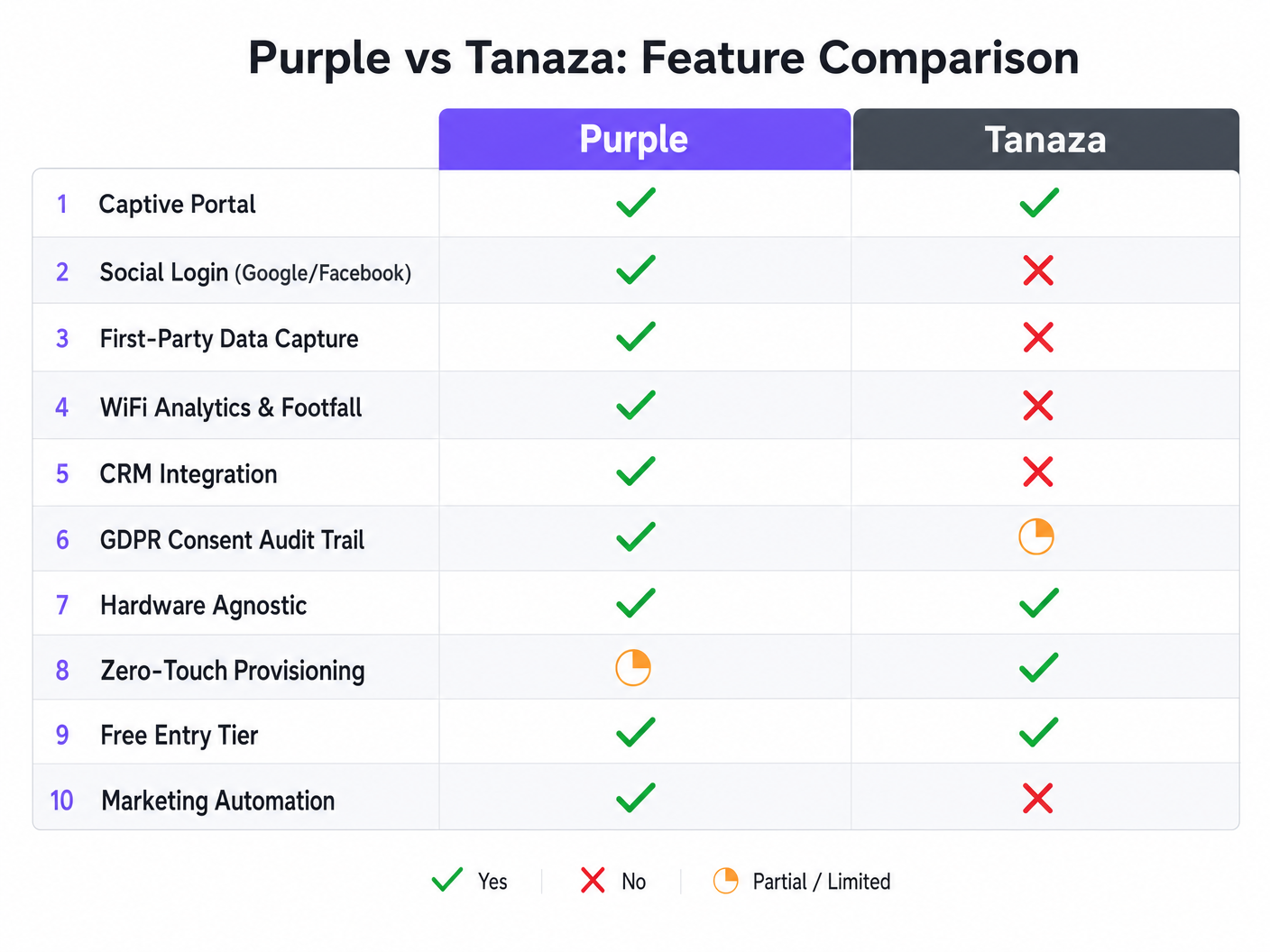
La página de bienvenida integrada de Tanaza proporciona un acceso funcional y sencillo para invitados. Soporta acuerdos de clic y inicios de sesión basados en código de forma nativa. Sin embargo, carece de capacidades nativas de inicio de sesión social (Google, Facebook, Apple) y requiere integraciones de terceros como DataWiFi para lograrlo.
El Captive Portal de Purple está diseñado para la adquisición de datos y el cumplimiento de marketing. Soporta de forma nativa una amplia gama de métodos de autenticación, incluyendo inicios de sesión sociales, SMS OTP y captura de correo electrónico con verificación en tiempo real. El constructor de arrastrar y soltar soporta 25 idiomas y permite una profunda personalización de marca.
Cumplimiento y Seguridad
Al implementar redes de invitados en Salud o sectores públicos, el cumplimiento es innegociable. Tanaza permite a los administradores configurar términos y condiciones, pero la carga de demostrar el cumplimiento del GDPR recae en gran medida en el operador.
Purple integra el cumplimiento en el flujo de incorporación. Mantiene un registro de auditoría completo del consentimiento del usuario, gestiona automáticamente las políticas de retención de datos y proporciona flujos de trabajo integrados para solicitudes de derecho al olvido. Esta arquitectura está diseñada para cumplir con los estrictos requisitos de GDPR, CCPA y LGPD de forma predeterminada. Para estrategias de cumplimiento regional específicas, consulte nuestra LGPD de Brasil y WiFi para Invitados: Una Guía de Cumplimiento .
Guía de Implementación
Implementación de Tanaza
- Selección de Hardware: Verifique que sus puntos de acceso estén en la lista de compatibilidad de Tanaza o adquiera Dispositivos Potenciados por Tanaza.
- Instalación de Firmware: Si utiliza hardware existente, siga las instrucciones de instalación específicas para instalar TanazaOS. Este paso requiere conocimientos técnicos y acceso físico a los APs o a un entorno de preparación.
- Aprovisionamiento en la Nube: Agregue las direcciones MAC al panel de control en la nube de Tanaza.
- Configuración de Red: Configure SSIDs, etiquetado de VLAN y límites de ancho de banda de forma centralizada.
- Configuración del Portal: Habilite la página de bienvenida integrada y configure los términos básicos de clic.
Implementación de Purple
- Integración de Infraestructura: Configure su WLC o controlador en la nube existente (por ejemplo, Meraki Dashboard, Aruba Central) para que apunte a las URL de Captive Portal externo y servidores RADIUS de Purple.
- Diseño del Portal: Utilice el constructor de portales de Purple para diseñar la página de bienvenida, configurar las APIs de inicio de sesión social y establecer los requisitos de captura de datos.
- Configuración de Cumplimiento: Establezca límites de retención de datos y configure los enlaces de la política de privacidad dentro del panel de control de Purple.
- Mapeo de CRM: Conecte Purple a su CRM (por ejemplo, Salesforce, HubSpot) y mapee los campos de datos demográficos capturados a sus registros de contacto.
Escuche el informe de nuestro consultor sénior para una inmersión más profunda en estas estrategias de implementación:
Mejores Prácticas
- Defina Primero el Resultado de Negocio: Si el objetivo es puramente la gestión operativa de la red para una pequeña implementación, priorice el aprovisionamiento sin intervención de Tanaza. Si el objetivo es la inteligencia de marketing y Análisis de WiFi , Purple es la arquitectura requerida.
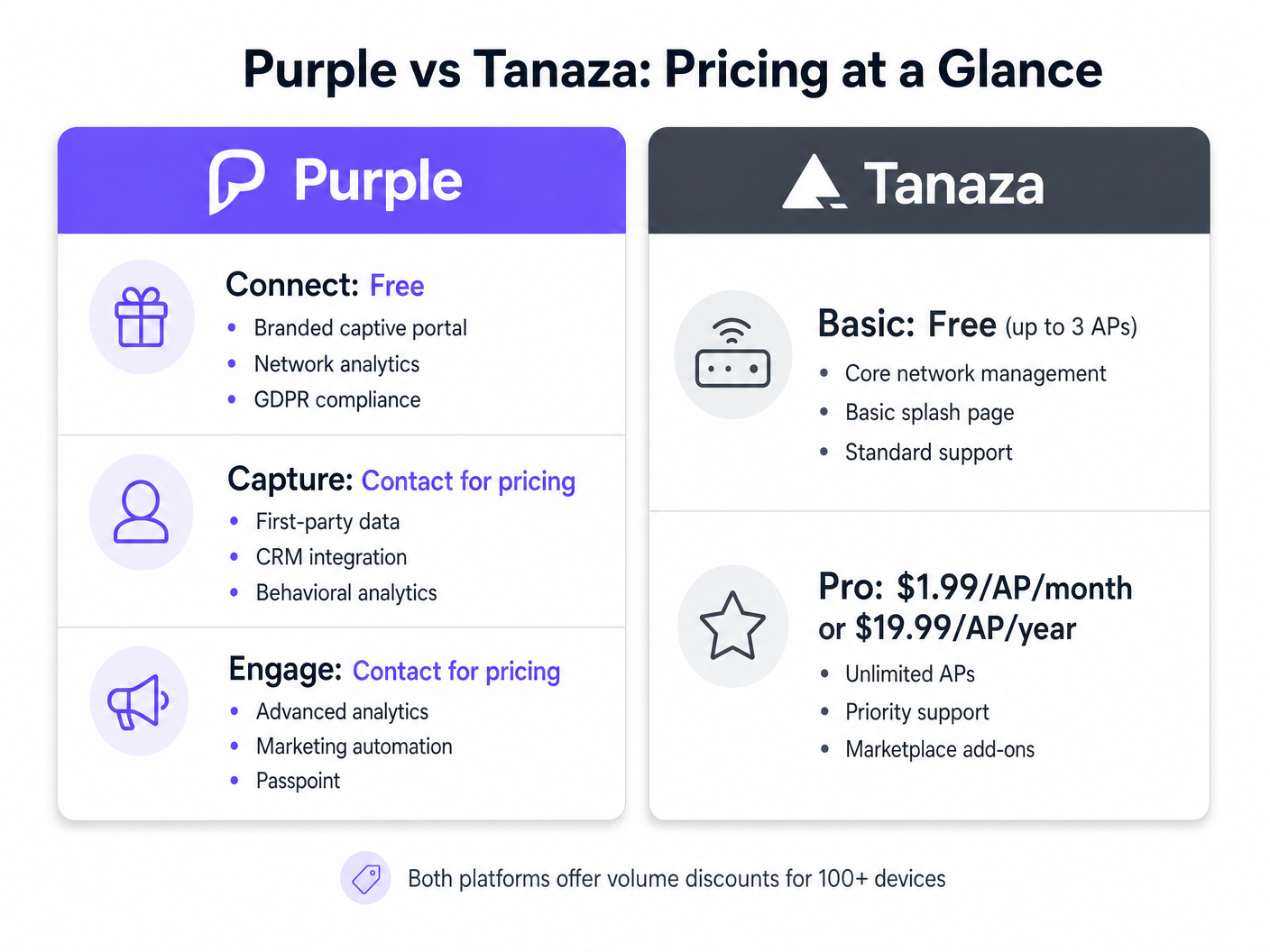
- Evalúe el Costo Total de Propiedad (TCO): El nivel Pro de Tanaza cobra una tarifa mensual fija por AP. Purple deofrece un nivel gratuito robusto (Connect) para acceso de marca básico y cumplimiento, con niveles de pago (Capture y Engage) que escalan según las necesidades de análisis avanzados e integración de CRM. Considere el costo de los complementos de terceros si intenta construir funcionalidades de marketing sobre Tanaza.
- Decisiones de Hardware a Prueba de Futuro: Confiar en firmware personalizado limita la flexibilidad futura del hardware. Las arquitecturas de superposición preservan su capacidad de migrar proveedores de hardware subyacentes sin reconstruir la experiencia del Captive Portal.
Resolución de Problemas y Mitigación de Riesgos
Riesgo: Expansión del Alcance en los Requisitos de Marketing Muchos equipos de TI implementan un Captive Portal básico solo para que el departamento de marketing solicite la integración de CRM y análisis de afluencia seis meses después. Mitigación: Si se anticipan los requisitos de marketing, implemente una arquitectura de superposición como Purple desde el primer día para evitar una migración de plataforma costosa más adelante.
Riesgo: Bloqueo de Firmware durante la Instalación Flashear firmware personalizado en los APs conlleva un riesgo pequeño pero no nulo de bloquear el dispositivo. Mitigación: Si implementa Tanaza, utilice un entorno de prueba para flashear y probar los APs antes de enviarlos al sitio de implementación, o adquiera Dispositivos Tanaza Powered pre-flasheados.
ROI e Impacto Empresarial
El retorno de la inversión para las plataformas de Captive Portal se mide de manera diferente según la arquitectura elegida.
Para las implementaciones de Tanaza, el ROI se mide típicamente en eficiencia operativa. La capacidad de gestionar APs de múltiples proveedores desde un único panel de control reduce los desplazamientos y simplifica la resolución de problemas para los MSPs.
Para las implementaciones de Purple, el ROI se mide en adquisición de datos e inteligencia operativa. Al capturar datos verificados de primera mano y rastrear los tiempos de permanencia física, los establecimientos pueden automatizar campañas de marketing que impulsan visitas repetidas. En entornos de Hostelería y comercio minorista, esto transforma la red WiFi de un gasto de TI en un motor de ingresos medible.
Términos clave y definiciones
External Captive Portal
A mechanism where the network controller redirects unauthenticated users to a splash page hosted on an external server, rather than serving the page locally from the access point.
This is the architecture Purple uses to remain hardware-agnostic and scalable across enterprise deployments.
Zero-Touch Provisioning
The ability to configure a network device remotely so that it automatically downloads its configuration from the cloud the moment it is connected to the internet.
Crucial for MSPs deploying Tanaza to multiple remote sites without sending specialized IT staff.
First-Party Data
Information a company collects directly from its customers, such as email addresses and demographics gathered during WiFi authentication.
The primary value driver for marketing teams utilizing Purple's Capture and Engage tiers.
Firmware Flashing
The process of overwriting the original manufacturer's operating system on a hardware device with a custom operating system.
Required when deploying Tanaza on third-party hardware to enable cloud management.
RADIUS
Remote Authentication Dial-In User Service; a networking protocol that provides centralized Authentication, Authorization, and Accounting (AAA) management.
Used by both platforms to securely authenticate users and enforce bandwidth or time limits.
Dwell Time
The measurable duration a visitor spends within a specific physical location or zone, tracked via their device's WiFi probe requests.
A key operational metric provided by Purple's analytics engine, used heavily in retail and hospitality.
Audit Trail
A secure, immutable record of user actions, specifically relating to when and how a user consented to data processing terms.
Essential for demonstrating compliance with GDPR and other privacy regulations during an audit.
Overlay Architecture
A software or service layer that operates independently of the underlying physical network infrastructure.
Allows platforms like Purple to provide unified analytics across disparate hardware environments.
Casos de éxito
A 350-room hotel chain needs to deploy a captive portal across 12 properties. They currently use a mix of older Ruckus ZoneDirectors and new Cisco Meraki MR access points. They require GDPR-compliant guest access and want to integrate guest emails with their central HubSpot CRM.
The IT team should deploy Purple using the overlay architecture. They will configure the Ruckus ZoneDirectors and Meraki dashboards to redirect guest traffic to Purple's external captive portal. In the Purple dashboard, they will build a unified splash page, enable the HubSpot native integration, and configure the GDPR consent workflows.
A regional Managed Service Provider (MSP) is deploying WiFi for 40 small independent coffee shops. The shops need basic click-through WiFi access. The MSP wants to minimize hardware costs and manage all 40 sites from a single dashboard.
The MSP should deploy Tanaza. They can purchase cost-effective access points (e.g., TP-Link or Ubiquiti), flash them with TanazaOS in a staging lab, and ship them to the coffee shops for zero-touch provisioning. They will use Tanaza's multi-site dashboard to monitor AP health and configure a basic click-through splash page for each location.
Análisis de escenarios
Q1. A stadium IT director wants to monetize their high-density WiFi network by displaying sponsor advertisements on the splash page and capturing fan emails for the ticketing CRM. They have a newly installed Cisco Catalyst network. Which platform should they choose?
💡 Sugerencia:Consider the requirement for CRM integration and the existing enterprise hardware.
Mostrar enfoque recomendado
They should choose Purple. Purple integrates natively with Cisco Catalyst WLCs without requiring firmware changes, which is critical for a high-density stadium deployment. Furthermore, Purple's native CRM integrations and advanced splash page builder support the marketing and monetization requirements, whereas Tanaza would require third-party add-ons and firmware flashing that is incompatible with enterprise Cisco controllers.
Q2. A franchise owner of 15 fast-food restaurants needs to replace aging consumer-grade routers. They have a very tight budget, no dedicated IT staff, and just want to offer customers 30 minutes of free WiFi without capturing data. What is the recommended approach?
💡 Sugerencia:Focus on the need for low-cost hardware and simplified multi-site management without marketing needs.
Mostrar enfoque recomendado
They should choose Tanaza. The franchise can purchase low-cost hardware like TP-Link or Ubiquiti, utilize Tanaza's zero-touch provisioning for easy deployment without on-site IT staff, and use the built-in splash page to enforce the 30-minute limit. The Tanaza Pro tier provides cost-effective centralized management for this exact scenario.
Q3. An enterprise retail chain operating in the EU is migrating to Juniper Mist access points. They need to ensure their guest WiFi captures explicit, auditable consent for marketing communications to comply with GDPR. How should they architecture this?
💡 Sugerencia:Evaluate how both platforms handle compliance and their compatibility with Juniper Mist.
Mostrar enfoque recomendado
They must deploy Purple as an overlay on the Juniper Mist infrastructure. Purple natively supports Juniper Mist via external captive portal integration. More importantly, Purple's architecture is designed to capture and store auditable GDPR consent records per user, providing the necessary legal protection for the retail chain's marketing activities.




