
Systèmes de positionnement WiFi intérieur : fonctionnement et déploiement
Ce guide complet détaille l'architecture technique, les stratégies de déploiement et la valeur commerciale des systèmes de positionnement intérieur basés sur le WiFi. Il fournit aux architectes réseau et aux directeurs informatiques des conseils pratiques sur le positionnement des AP, l'étalonnage RF et la gestion de la randomisation des adresses MAC pour obtenir des analyses spatiales précises.
Video overview
Écouter ce guide
Voir la transcription du podcast
Fait partie de notre série principale : Guide d'analyse WiFi →

Synthèse Décisionnelle
Pour les gestionnaires de grands espaces d'entreprise, comprendre les déplacements des visiteurs n'est plus un luxe - c'est une exigence fondamentale pour l'efficacité opérationnelle et l'optimisation commerciale. Les systèmes de positionnement WiFi intérieur transforment l'infrastructure réseau existante en un puissant moteur d'analyse spatiale. En exploitant les mesures de l'indicateur de puissance du signal reçu (RSSI) de vos points d'accès déployés, ces systèmes fournissent des informations exploitables sur la fréquentation, le temps de séjour et les transitions entre les zones, sans nécessiter de matériel supplémentaire tel que des balises Bluetooth ou des capteurs ultra-large bande.
Ce guide de référence technique détaille l'architecture, les aspects liés au déploiement et l'impact commercial du positionnement intérieur basé sur le WiFi. Conçu pour les architectes réseau et les directeurs informatiques, il fournit des conseils neutres vis-à-vis des constructeurs sur la configuration des points d'accès, les études de site et l'étalonnage radio, tout en démontrant comment l'intégration avec des plateformes comme l'outil de WiFi Analytics de Purple transforme les données de télémétrie brutes en un ROI mesurable. Que vous gériez un hôtel de 200 chambres, un espace de vente à plusieurs niveaux ou un grand établissement du secteur public, ce guide fournit les bases techniques nécessaires pour déployer des analyses de positionnement de manière efficace et conforme.
Analyse technique approfondie : Architecture et normes
Le défi fondamental du positionnement en intérieur réside dans le fait que les signaux GPS ne peuvent pas pénétrer de manière fiable les matériaux de construction des bâtiments. Par conséquent, les sites d'entreprise doivent s'appuyer sur une infrastructure de radiofréquence (RF) locale. Étant donné son déploiement omniprésent pour la connectivité, le WiFi s'impose comme un choix logique.
Fonctionnement de la trilatération RSSI
La métrique principale pour le positionnement WiFi est l'indicateur de force du signal reçu (RSSI). Chaque appareil compatible WiFi recherche constamment les réseaux disponibles, mesurant la puissance du signal des points d'accès (AP) à proximité. Le RSSI est exprimé en décibels par rapport à un milliwatt (dBm), allant généralement de -30 dBm (excellent signal) à -90 dBm (signal inutilisable).
Les plateformes de positionnement en intérieur utilisent la trilatération pour estimer l'emplacement d'un appareil. Lorsque le RSSI d'un appareil est mesuré par trois AP ou plus dotés de coordonnées physiques connues, le système calcule la distance estimée par rapport à chaque AP. L'intersection de ces rayons de probabilité détermine l'emplacement estimé.
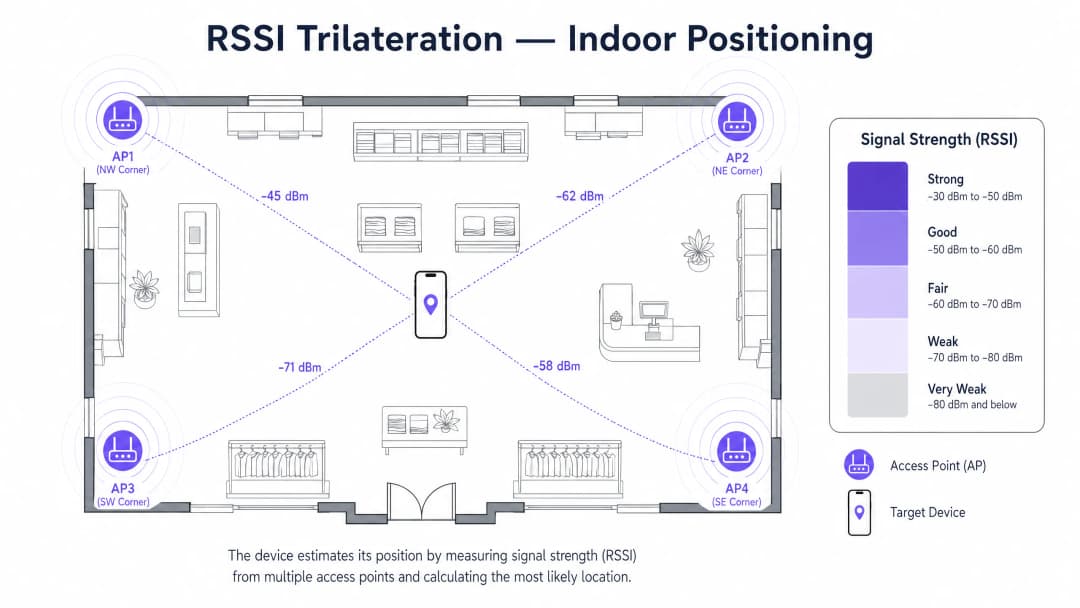
Bien que la trilatération fournisse la base mathématique, le RSSI brut est extrêmement instable en raison de l'évanouissement par trajets multiples, de l'absorption par des obstacles physiques et des interférences. C'est pourquoi les systèmes d'entreprise utilisent le fingerprinting RF - un processus d'étalonnage dans lequel des mesures empiriques de RSSI sont enregistrées à des endroits connus pour constituer une base de données de référence. En cours de fonctionnement, le système compare les relevés RSSI en temps réel à cette base de données d'empreintes à l'aide d'algorithmes probabilistes (tels que les k plus proches voisins ou l'inférence bayésienne) afin d'améliorer considérablement la précision.
Positionnement côté appareil vs. côté infrastructure
Il existe deux modèles architecturaux principaux pour le traitement des données de localisation :
- Positionnement côté appareil : L'appareil client (par exemple, un smartphone exécutant une application spécifique) mesure le RSSI des AP à proximité, calcule sa propre position et la transmet éventuellement à un serveur. Cette approche s'adapte bien à l'échelle mais nécessite un effort de l'utilisateur (installation de l'application) et reste sensible aux restrictions d'analyse en arrière-plan imposées par le système d'exploitation.
- Positionnement côté infrastructure : Les AP du réseau écoutent les requêtes de sonde émises par les appareils clients. Les AP transmettent ces mesures de RSSI à un contrôleur central ou à un moteur d'analyse cloud, qui calcule la position. C'est le modèle d'entreprise privilégié, car il ne nécessite aucun logiciel côté client et fournit des analyses passives pour tous les appareils émetteurs. La plateforme de Purple utilise cette approche côté infrastructure, en corrélant les données de localisation avec des profils authentifiés via le Captive Portal de Guest WiFi.
Normes IEEE pertinentes
Pour optimiser la précision du positionnement, les architectes réseau doivent s'assurer que leur infrastructure prend en charge les amendements IEEE 802.11 spécifiques :
- 802.11k (Radio Resource Measurement) : permet aux AP et aux clients d'échanger des informations sur l'environnement RF, offrant ainsi au réseau une meilleure visibilité sur le RSSI des clients.
- 802.11v (BSS Transition Management) : permet au réseau d'orienter les clients vers les AP optimaux, améliorant ainsi indirectement la qualité de la télémétrie de localisation en garantissant que les clients sont connectés aux AP présentant les meilleures caractéristiques de signal.
- 802.11ac (Wave 2) et 802.11ax (WiFi 6) : bien qu'ils soient principalement axés sur le débit et la capacité, les capacités avancées de beamforming et de MU-MIMO de ces normes offrent un environnement RF plus stable, ce qui favorise la stabilité du RSSI.
- 802.11az (Next Generation Positioning) : la norme émergente pour le Fine-Time Measurement (FTM), qui utilise le temps de vol (time-of-flight) au lieu du RSSI pour obtenir une précision inférieure au mètre. Bien qu'elle ne soit pas encore omniprésente, elle représente l'avenir du positionnement WiFi.
Guide d'implémentation : déploiement et configuration
Le déploiement d'un système de positionnement intérieur nécessite une planification méticuleuse. Une conception de réseau qui offre une excellente couverture de données ne garantit pas automatiquement une excellente précision de localisation.
Étape 1 : Étude de site RF
Une étude logicielle prédictive est insuffisante pour le positionnement. Vous devez réaliser une étude RF active sur site. Cela implique de parcourir le site avec des outils d'analyse de spectre spécialisés pour cartographier la propagation réelle du signal, identifier les sources d'interférences (par exemple, les systèmes de CVC, l'acier structurel) et détecter les zones mortes de signal. L'étude permet de déterminer où les AP doivent être ajoutés ou déplacés pour garantir que chaque zone à suivre bénéficie d'une ligne de visée directe ou d'une forte pénétration d'au moins trois AP. Pour des conseils détaillés sur la sécurisation de ces AP une fois déployés, consultez notre Access Point Security: Your 2026 Enterprise Guide.
Étape 2 : Stratégie d'implantation des Access Points
Pour la connectivité, les AP sont souvent placés dans les couloirs afin de maximiser la zone de couverture. Pour le positionnement, cette méthode est contre-productive. Les AP doivent être placés sur le périmètre et dans les angles des zones que vous souhaitez suivre, afin d'orienter le signal RF vers l'intérieur.
- Densité : essayez d'avoir au moins trois AP qui détectent un appareil client à tout moment (généralement à -75 dBm ou mieux).
- Géométrie : évitez de placer les AP en ligne droite. Un modèle en triangle équilatéral ou en grille décalée offre la meilleure géométrie pour les algorithmes de trilatération.
- Hauteur : installez les AP à une hauteur uniforme, généralement entre 3 et 4 mètres. Une hauteur excessive réduit la résolution RSSI horizontale requise pour un positionnement 2D précis.
Étape 3 : Étalonnage de la carte radio (Fingerprinting)
Une fois l'infrastructure déployée, vous devez calibrer le système. Cela consiste à charger un plan d'étage précis et à l'échelle sur la plateforme de positionnement. Un technicien parcourt ensuite le site, s'arrêtant à des points de grille définis (généralement tous les 2 à 5 mètres) pour enregistrer des échantillons RSSI empiriques. Ce processus d'empreinte radio (fingerprinting) apprend à l'algorithme comment les signaux RF se comportent réellement dans votre environnement physique spécifique, en prenant en compte les murs, les rayonnages et autres obstacles.
Étape 4 : Intégration de la plateforme et résolution d'identité
Les coordonnées X/Y brutes sont inutiles sans contexte commercial. Le moteur de positionnement doit alimenter un tableau de bord analytique. De plus, les systèmes d'exploitation mobiles modernes utilisent la randomisation des adresses MAC pour empêcher le suivi passif des appareils non authentifiés.
Pour surmonter cela, le système de positionnement doit être intégré à la couche d'authentification du réseau. Lorsqu'un utilisateur se connecte au Guest WiFi (par exemple, via un Captive Portal), son adresse MAC randomisée est temporairement associée à son profil authentifié. Cela permet à des plateformes comme Purple de fournir des analyses riches et longitudinales tout en restant pleinement conformes aux réglementations sur la confidentialité. Pour les espaces plus restreints souhaitant mettre en œuvre cette connectivité de base, consultez How to Set Up a WiFi Hotspot for Your Business (ou la version portugaise, Como Configurar um Hotspot WiFi para o Seu Negócio).
Vous avez des questions sur votre configuration spécifique ?
Notre équipe collabore avec des exploitants de sites, des responsables informatiques et des ingénieurs réseau au sein de 80 000 sites. Réservez un appel de 20 minutes et nous vous montrerons comment d'autres professionnels comme vous ont résolu ce problème.
Bonnes pratiques pour les environnements d'entreprise
Différents secteurs présentent des défis RF uniques. Adapter la stratégie technique à l'environnement physique est essentiel pour un déploiement réussi.
Hôtellerie et santé
Dans les environnements de l'Hôtellerie et de la Santé, le principal défi est l'atténuation du signal causée par les murs denses, les portes coupe-feu et les cages d'ascenseur.
- Bonne pratique : Déployez des AP à l'intérieur des pièces plutôt que de compter sur des AP de couloir pour traverser les murs. Cette architecture de micro-cellules fournit la signature RF distincte requise pour une précision à l'échelle de la pièce.
Commerce de détail et supermarchés
Les environnements du Commerce de détail sont confrontés à des dynamiques RF changeantes. Les étagères métalliques, la densité des stocks et les grandes foules absorbent et réfléchissent les signaux RF, ce qui signifie que l'environnement RF change entre les heures d'ouverture et les heures de pointe.
- Bonne pratique : Effectuez le calibrage radio pendant les heures d'ouverture avec une fréquentation normale, et non dans un magasin vide. Utilisez des algorithmes de calibrage dynamique si votre fournisseur les prend en charge.
Transports et stades
Dans les hubs de Transport et les grands espaces événementiels, le défi réside dans l'échelle même et la densité des AP. Une densité d'AP élevée peut entraîner des interférences co-canal.
- Bonne pratique : Gérez soigneusement la puissance de transmission. Les AP doivent être configurés avec une puissance de transmission inférieure pour réduire la taille des cellules et les interférences, en s'appuyant sur une densité d'AP plus élevée pour fournir la couverture chevauchante requise pour le positionnement.

Dépannage et atténuation des risques
Malgré une planification méticuleuse, les performances des systèmes de positionnement peuvent se dégrader. Les équipes informatiques doivent surveiller et atténuer de manière proactive ces modes de défaillance courants.
1. Le défi de la randomisation des adresses MAC
Comme mentionné, iOS et Android randomisent les adresses MAC pour empêcher le suivi passif. Si votre système repose entièrement sur des requêtes de sonde passives, vos analyses afficheront des volumes de visiteurs massivement gonflés et aucun visiteur récurrent.
- Atténuation : Imposez l'authentification par Captive Portal pour l'accès invité. L'échange de valeur (un accès WiFi gratuit en échange de coordonnées) fournit la base juridique et le mécanisme technique pour résoudre l'identité. Assurez-vous que votre réseau est protégé contre l'usurpation d'identité ; consultez Protect Your Network with Strong DNS and Security pour découvrir des stratégies de sécurisation de l'infrastructure.
2. Anomalies de firmware
Le comportement de rapport de l'RSSI peut changer radicalement d'une version de firmware de point d'accès à l'autre. Une mise à jour peut modifier la fréquence à laquelle un point d'accès signale les requêtes de sonde ou la façon dont il calcule la valeur RSSI.
- Atténuation : Standardisez le firmware sur l'ensemble du déploiement. Avant de déployer les mises à jour de firmware des fournisseurs, testez-les dans un environnement de préproduction pour vérifier qu'elles ne dégradent pas le flux de données d'analyse de localisation.
3. Dérive environnementale
Un site réaménagé avec de nouvelles structures métalliques ou des cloisons déplacées invalidera la cartographie existante des empreintes RF, entraînant une grave dégradation de la précision de la localisation.
- Atténuation : Mettez en œuvre une politique exigeant un examen informatique de tout changement physique important sur le site. Planifiez un réétalonnage périodique de la carte radio, en particulier dans les environnements dynamiques comme le commerce de détail.
ROI et impact commercial
La justification du déploiement d'un système de positionnement intérieur repose sur sa capacité à générer des renseignements commerciaux exploitables. Lorsqu'elle est intégrée à des plateformes comme l'outil WiFi Analytics de Purple, la télémétrie technique se traduit directement en valeur commerciale.
Mesurer le succès
Le succès doit être mesuré par rapport à des indicateurs clés de performance opérationnels spécifiques :
- Taux de capture : Le pourcentage de la fréquentation totale qui se connecte au WiFi et devient un profil authentifié et traçable.
- Conversion de zone : Analyse du parcours des visiteurs se déplaçant de l'entrée vers des zones spécifiques à forte valeur ajoutée (par exemple, le restaurant d'un hôtel ou un rayon spécifique dans un commerce de détail).
- Optimisation du temps de présence : Identification des zones où les visiteurs passent un temps excessif (indiquant des goulots d'étranglement, comme les files d'attente aux caisses) par rapport aux zones où ils s'attardent (indiquant un engagement, comme les salons ou les zones de présentation).
Analyse coûts-avantages
Le principal avantage financier du positionnement WiFi réside dans la valorisation des coûts déjà engagés. Les points d'accès, les commutateurs et le câblage requis pour la connectivité sont déjà déployés. Le coût marginal se limite aux licences logicielles de la plateforme d'analyse et à la main-d'œuvre nécessaire aux études de site et à l'étalonnage.
Les bénéfices se traduisent directement en efficacité opérationnelle. Par exemple, un stade peut affecter de manière dynamique le personnel de sécurité ou de restauration en fonction de cartes thermiques de densité de foule en temps réel. Une chaîne de magasins peut corréler les temps de séjour dans des rayons spécifiques avec les données des terminaux de point de vente afin de mesurer l'efficacité des présentoirs en tête de gondole. Alors que Purple continue d'étendre ses capacités d'analyse - illustrées récemment par des décisions stratégiques telles que la nomination du VP Education Tim Peers pour piloter des solutions sectorielles spécifiques - la capacité à extraire des analyses approfondies et contextuelles à partir d'une infrastructure réseau existante reste une proposition de valeur incontournable pour les leaders informatiques d'entreprise.
Définitions clés
RSSI (Received Signal Strength Indicator)
Mesure du niveau de puissance d'un signal RF reçu par un appareil client à partir d'un point d'accès, exprimée en décibels négatifs (dBm).
Le RSSI correspond aux données de télémétrie brutes utilisées par les algorithmes de trilatération pour estimer la distance entre un appareil et un AP.
Trilatération
Technique mathématique utilisée pour déterminer une position en mesurant la distance par rapport à trois points de référence connus ou plus.
Il s'agit de l'algorithme principal utilisé par l'infrastructure pour calculer les coordonnées X/Y à partir des valeurs RSSI de plusieurs AP.
Empreinte RF (RF Fingerprinting)
Processus consistant à mesurer et à enregistrer de manière empirique les valeurs RSSI à des coordonnées physiques spécifiques afin de créer une base de données de l'environnement radio unique du site.
Essentiel pour surmonter les interférences par trajets multiples et améliorer la précision au-delà de la simple trilatération mathématique.
Randomisation des adresses MAC
Fonctionnalité de confidentialité présente dans les systèmes d'exploitation mobiles modernes, permettant à l'appareil de diffuser une fausse adresse MAC tournante lors de la recherche de réseaux.
Cette fonctionnalité perturbe les systèmes de suivi passif, ce qui rend indispensable l'utilisation de portails captifs pour authentifier les utilisateurs et résoudre leur identité.
Requête de sonde (Probe Request)
Trame de gestion transmise par un appareil client pour découvrir les réseaux 802.11 disponibles à proximité.
Les systèmes de positionnement côté infrastructure écoutent ces requêtes pour collecter les données RSSI nécessaires au calcul de l'emplacement.
802.11k/v
Normes IEEE qui permettent aux AP et aux clients d'échanger des informations sur l'environnement RF et de gérer l'itinérance.
La prise en charge de ces normes garantit au réseau une meilleure visibilité sur le RSSI des clients, améliorant ainsi la précision du positionnement.
Interférences par trajets multiples
Un phénomène par lequel des signaux radio atteignent l'antenne de réception par deux chemins ou plus en raison de la réflexion sur des surfaces comme le métal ou le verre.
La propagation multi-trajet provoque des fluctuations de l'RSSI, c'est pourquoi la prise d'empreinte radio (RF fingerprinting) est nécessaire pour cartographier le comportement réel du signal dans l'établissement.
Durée de présence
La durée pendant laquelle un appareil spécifique reste à l'intérieur d'une zone physique définie.
Un indicateur commercial essentiel dérivé des données de géolocalisation, utilisé pour mesurer l'engagement dans les zones de vente ou la longueur des files d'attente dans les plateformes de transport.
Exemples concrets
Un hôtel de 300 chambres constate une mauvaise précision de localisation (plus de 15 mètres) dans les couloirs des clients, ce qui empêche de déterminer précisément dans quelle chambre se trouve un appareil. Le déploiement actuel utilise des AP haute puissance espacés tous de 20 mètres dans les couloirs principaux.
L'équipe informatique doit passer d'un modèle de couverture centré sur les couloirs à une architecture de micro-cellules. Elle doit déployer des AP muraux de plus faible puissance directement dans les chambres (par exemple, un AP pour deux chambres). Elle doit ensuite effectuer un nouvel étalonnage des empreintes RF. Cela crée des signatures RF distinctes pour chaque chambre, permettant au système de faire la différence entre un appareil situé dans la chambre 101 ou la chambre 102.
Un client du secteur de la vente au détail signale que son tableau de bord d'analyse WiFi passive indique 10 000 visiteurs uniques par jour, alors que les compteurs physiques aux portes n'en enregistrent que 2 000. De plus, le tableau de bord indique un taux de fidélité des visiteurs de 0 %.
Le système est victime de la randomisation des adresses MAC appliquée par les appareils iOS et Android modernes. L'équipe informatique doit configurer la plateforme d'analyse pour filtrer les adresses MAC administrées localement (randomisées) du flux d'analyse passive. Pour capturer des données longitudinales précises, elle doit implémenter un Captive Portal sur le WiFi invité, obligeant les utilisateurs à s'authentifier. Le moteur d'analyse suivra alors la session authentifiée plutôt que l'adresse MAC éphémère.
Questions d'entraînement
Q1. Vous concevez l'implantation des AP pour un nouveau magasin de vente au détail en espace ouvert de 500 m². La principale exigence est une géolocalisation en intérieur précise pour suivre le flux des clients. Devez-vous placer les AP en ligne droite le long de l'allée centrale pour maximiser l'esthétique et simplifier le câblage ?
Conseil : Pensez à la manière dont les algorithmes de trilatération calculent la distance en fonction de cercles sécants.
Voir la réponse type
Non. Placer les AP en ligne droite offre une très mauvaise géométrie pour la trilatération, car les cercles de probabilité d'intersection vont se chevaucher à deux endroits (images miroir de chaque côté de la ligne), ce qui empêche le système de déterminer de quel côté de l'allée se trouve le client. Les AP doivent être disposés en quinconce ou en périphérie pour entourer la zone suivie.
Q2. Votre établissement a récemment installé un grand mur d'eau en verre miroir du sol au plafond au centre du hall principal. Peu de temps après, la précision de la géolocalisation dans le hall se dégrade considérablement. Quelle est la cause technique probable et quelle est la solution ?
Conseil : Pensez à l'interaction des signaux radio avec les surfaces réfléchissantes.
Voir la réponse type
Le verre miroir et l'eau provoquent de graves interférences multi-trajets, réfléchissant les signaux radio et altérant les valeurs RSSI reçues par les AP. La solution consiste à réaliser une nouvelle étude de site radio et à recalibrer la carte d'empreintes radio pour le hall, afin d'enseigner à l'algorithme les nouvelles caractéristiques radio de l'espace.
Q3. Une partie prenante souhaite suivre les mouvements de chaque personne passant devant la vitrine du magasin, qu'elle se connecte ou non au Guest WiFi. Expliquez pourquoi cela est techniquement irréalisable et juridiquement problématique.
Conseil : Pensez aux fonctionnalités de confidentialité des OS mobiles et aux exigences de base légale du GDPR.
Voir la réponse type
Techniquement, les appareils iOS et Android utilisent la randomisation des adresses MAC lors de la recherche de réseaux, ce qui signifie qu'un seul appareil passant devant la vitrine apparaîtra comme plusieurs appareils distincts impossibles à suivre. Juridiquement, le suivi de personnes sans consentement ou sans base légale claire enfreint le GDPR. La bonne approche consiste à exiger que les utilisateurs se connectent au Guest WiFi via un captive portal, fournissant ainsi leur consentement et permettant au système de suivre une session authentifiée.
Continuer la lecture de cette série
Mesurer le ROI commercial du WiFi invité et de la Location Analytics
Cette référence technique montre aux équipes informatiques et de gestion de site comment mesurer le ROI du WiFi invité grâce à une chaîne de preuves justifiable, de l'état du réseau et des données consenties jusqu'aux résultats opérationnels ou commerciaux validés. Elle sépare les preuves mesurables des hypothèses, associe Purple Connect, Capture et Engage au bon niveau de mesure, et propose des scénarios de planification pour les hôtels, les parcs de commerces et les sites événementiels.
Privacy by Design : Anonymiser les données WiFi pour la conformité GDPR
Ce guide d'autorité détaille l'architecture technique et les stratégies de mise en œuvre pour anonymiser les données WiFi afin de garantir la conformité GDPR. Il fournit aux responsables informatiques et aux architectes réseau des cadres d'action pour concilier des analyses de fréquentation précises et des exigences strictes en matière de confidentialité des données.
Heatmapping vs Presence Analytics : Différences techniques
Ce guide technique de référence détaille les différences architecturales et opérationnelles critiques entre le WiFi heatmapping et le presence analytics pour les exploitants de sites d'entreprise. Il fournit aux responsables informatiques, architectes réseau et directeurs des opérations des cadres de déploiement exploitables, des scénarios d'implémentation réels et des meilleures pratiques neutres vis-à-vis des fournisseurs afin de maximiser le retour sur investissement de leur infrastructure sans fil existante.
Vous avez des questions sur votre configuration spécifique ?
Notre équipe collabore avec des exploitants de sites, des responsables informatiques et des ingénieurs réseau au sein de 80 000 sites. Réservez un appel de 20 minutes et nous vous montrerons comment d'autres professionnels comme vous ont résolu ce problème.