
Medindo o ROI do Guest WiFi: Um Framework para CMOs
Este guia técnico abrangente fornece um framework robusto para calcular o retorno sobre o investimento de implementações de Guest WiFi empresariais. Ele detalha as metodologias para atribuir receita em captura de dados, automação de marketing, aumento do tempo de permanência e retenção de clientes, oferecendo benchmarks acionáveis para líderes de TI e marketing.
Ouça este guia
Ver transcrição do podcast

कार्यकारी सारांश
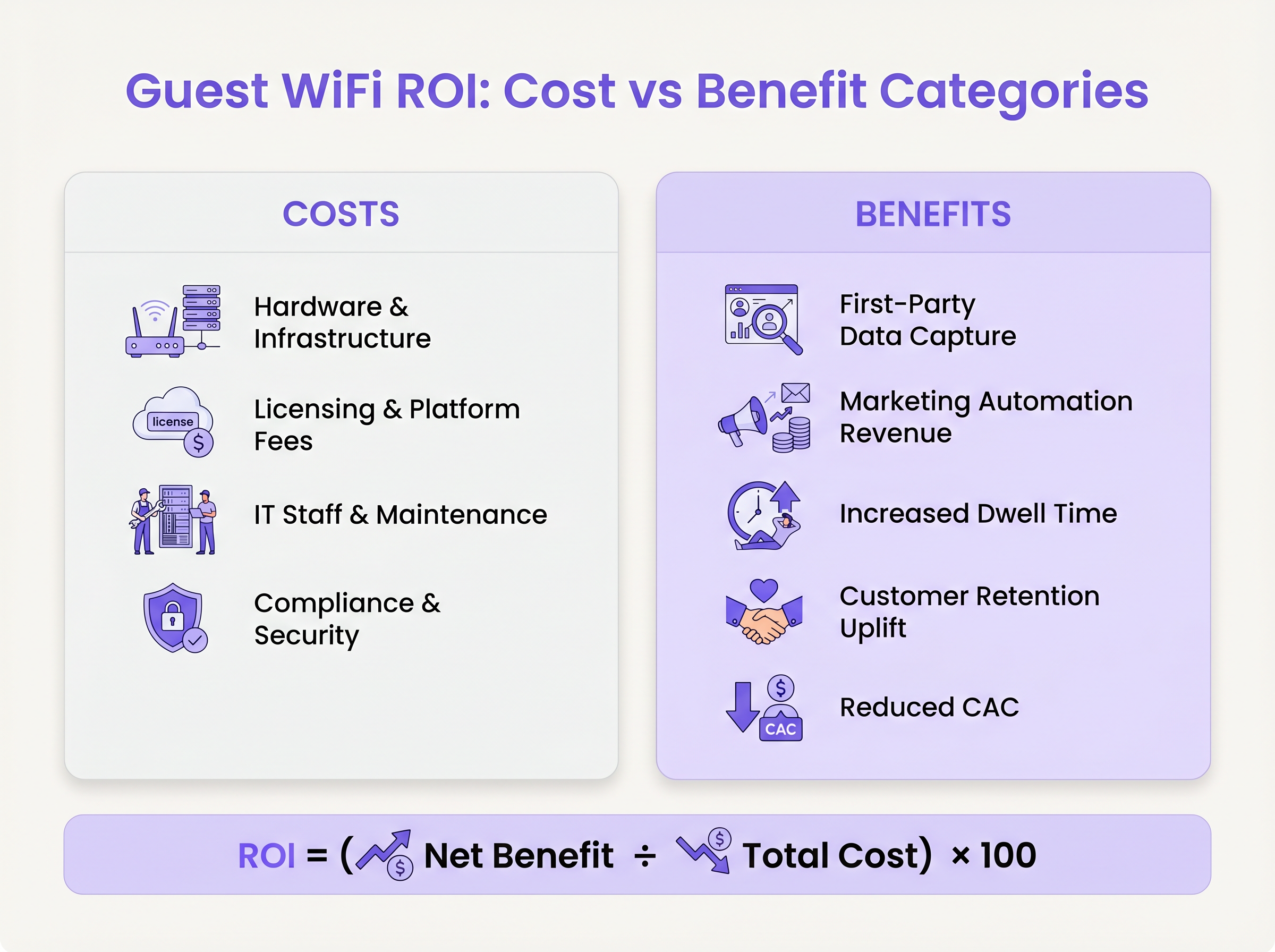
आधुनिक भौतिक स्थानों—विस्तृत रिटेल फ्लोर्स और उच्च-घनत्व वाले स्टेडियमों से लेकर मल्टी-प्रॉपर्टी हॉस्पिटैलिटी समूहों तक—के लिए, गेस्ट WiFi अब केवल एक शुद्ध उपयोगिता लागत नहीं है। यह एक महत्वपूर्ण डेटा अधिग्रहण और एंगेजमेंट इंजन है। हालाँकि, इन डिप्लॉयमेंट के लिए निवेश पर रिटर्न (ROI) की गणना करना अक्सर चुनौतीपूर्ण साबित होता है क्योंकि इसका मूल्य कई परिचालन और मार्केटिंग चैनलों में वितरित होता है। यह गाइड मुख्य विपणन अधिकारियों (CMOs) और उनके तकनीकी समकक्षों को गेस्ट WiFi निवेश के ROI को मापने, एट्रिब्यूट करने और अधिकतम करने के लिए एक निश्चित फ्रेमवर्क प्रदान करती है। वित्तीय प्रभाव को चार मुख्य स्तंभों—फर्स्ट-पार्टी डेटा कैप्चर, मार्केटिंग ऑटोमेशन रेवेन्यू, ड्वेल टाइम अपलिफ्ट, और कस्टमर रिटेंशन—में विभाजित करके, हम एक मजबूत बिजनेस केस बनाने के लिए एक वेंडर-न्यूट्रल, तकनीकी रूप से आधारित दृष्टिकोण प्रदान करते हैं。
तकनीकी डीप-डाइव: गेस्ट WiFi ROI के चार स्तंभ
Guest WiFi डिप्लॉयमेंट के ROI को समझने के लिए पारंपरिक नेटवर्क कॉस्ट-सेंटर अकाउंटिंग से आगे बढ़ने की आवश्यकता है। आधुनिक दृष्टिकोण नेटवर्क एज को राजस्व-उत्पन्न करने वाली संपत्ति के रूप में मानता है। यह आर्किटेक्चर वायरलेस LAN कंट्रोलर, Captive Portal ऑथेंटिकेशन सर्वर (अक्सर सुरक्षित ऑनबोर्डिंग के लिए RADIUS/802.1X का उपयोग करते हुए), और संगठन के कस्टमर रिलेशनशिप मैनेजमेंट (CRM) या मार्केटिंग ऑटोमेशन प्लेटफॉर्म के बीच निर्बाध एकीकरण पर निर्भर करता है।
स्तंभ 1: फर्स्ट-पार्टी डेटा कैप्चर
गेस्ट WiFi प्लेटफॉर्म से सबसे तत्काल और मात्रात्मक रिटर्न फर्स्ट-पार्टी डेटा का अधिग्रहण है। जब कोई उपयोगकर्ता Captive Portal के माध्यम से नेटवर्क से जुड़ता है, तो वे इंटरनेट एक्सेस के बदले में सत्यापन योग्य संपर्क जानकारी—आमतौर पर एक ईमेल पता या मोबाइल नंबर—प्रदान करते हैं। यह लेनदेन सख्त अनुपालन फ्रेमवर्क द्वारा नियंत्रित होता है, विशेष रूप से यूरोप में जनरल डेटा प्रोटेक्शन रेगुलेशन (GDPR) और अमेरिका में कैलिफोर्निया कंज्यूमर प्राइवेसी एक्ट (CCPA)।
तकनीकी तंत्र में एक वॉल्ड गार्डन दृष्टिकोण शामिल है जहां अनऑथेंटिकेटेड ट्रैफ़िक को इंटरसेप्ट किया जाता है और एक सुरक्षित, ब्रांडेड पोर्टल पर रीडायरेक्ट किया जाता है। सफल ऑथेंटिकेशन (उदा., SMS या ईमेल सत्यापन के माध्यम से) पर, उपयोगकर्ता का MAC एड्रेस उनके पहचान प्रोफ़ाइल से जुड़ जाता है। यहाँ ROI की गणना सीधी है: यह पेड मीडिया चैनलों के माध्यम से एक नेट-न्यू, सत्यापित संपर्क प्राप्त करने की लागत से बचाव है। ऑथेंटिकेशन विधियों में गहराई से जाने के लिए, SMS vs Email Verification for Guest WiFi: Which to Choose पर हमारी गाइड देखें।
स्तंभ 2: मार्केटिंग ऑटोमेशन रेवेन्यू एट्रिब्यूशन
डेटा कैप्चर करना केवल पहला कदम है; बाद का मूल्य लक्षित मार्केटिंग ऑटोमेशन के माध्यम से प्राप्त किया जाता है। एक बार उपयोगकर्ता प्रोफ़ाइल बन जाने के बाद, WiFi प्लेटफॉर्म इस डेटा को API या वेबहुक के माध्यम से CRM में पुश करता है। यह एकीकरण प्रारंभिक WiFi कनेक्शन के लिए डाउनस्ट्रीम राजस्व को एट्रिब्यूट करने के लिए महत्वपूर्ण है।
तकनीकी कार्यान्वयन के लिए मजबूत टैगिंग और ट्रैकिंग की आवश्यकता होती है। पोस्ट-कनेक्शन रीडायरेक्ट URL में तत्काल रूपांतरणों को ट्रैक करने के लिए UTM पैरामीटर शामिल होने चाहिए। इसके अलावा, CRM को संपर्क स्रोत को "In-Venue WiFi" के रूप में टैग करना चाहिए। जब इन सेगमेंट के खिलाफ मार्केटिंग अभियान चलाए जाते हैं, तो परिणामी राजस्व को सीधे WiFi इंफ्रास्ट्रक्चर में एट्रिब्यूट किया जा सकता है। यह क्लोज्ड-लूप रिपोर्टिंग व्यापक व्यवसाय के लिए प्लेटफॉर्म के मूल्य को प्रदर्शित करने के लिए आवश्यक है।
स्तंभ 3: ड्वेल टाइम और फुटफॉल एनालिटिक्स
स्पष्ट डेटा कैप्चर के अलावा, नेटवर्क इंफ्रास्ट्रक्चर WiFi Analytics के माध्यम से निष्क्रिय मूल्य उत्पन्न करता है। मोबाइल उपकरणों से प्रोब रिक्वेस्ट और एसोसिएशन इवेंट्स का विश्लेषण करके, सिस्टम पूरे स्थान पर सटीक फुटफॉल, ड्वेल टाइम और मूवमेंट पैटर्न की गणना कर सकता है।
यह स्थानिक बुद्धिमत्ता (spatial intelligence) परिचालन अनुकूलन के लिए अत्यधिक मूल्यवान है। Retail वातावरण में, विशिष्ट स्टोर लेआउट और बढ़े हुए ड्वेल टाइम के बीच संबंध को समझना सीधे मर्चेंडाइजिंग रणनीतियों को सूचित कर सकता है। Transport हब के लिए, यह भीड़ प्रबंधन और सत्यापित ट्रैफ़िक प्रवाह के आधार पर किरायेदार लीज मूल्यांकन को अनुकूलित करने में सहायता करता है। इन परिचालन सुधारों को लेनदेन की मात्रा या परिचालन दक्षता में संबंधित वृद्धि के साथ सहसंबंधित करके ROI की गणना की जाती है।
स्तंभ 4: कस्टमर रिटेंशन और लाइफटाइम वैल्यू
अंतिम स्तंभ ग्राहक वफादारी पर गेस्ट WiFi के दीर्घकालिक प्रभाव पर केंद्रित है। एक निर्बाध, उच्च-गुणवत्ता वाला कनेक्शन अनुभव प्रदान करके—अक्सर Passpoint/OpenRoaming जैसी तकनीकों द्वारा सुगम बनाया जाता है जो स्वचालित, सुरक्षित रीकनेक्शन सक्षम करते हैं—स्थान अतिथि अनुभव को काफी बढ़ा सकते हैं。
इस स्तंभ के लिए वित्तीय मॉडल WiFi उपयोगकर्ताओं के औपचारिक लॉयल्टी प्रोग्राम सदस्यों में रूपांतरण दर की गणना करने पर निर्भर करता है। गैर-सदस्यों की तुलना में इन सदस्यों का वृद्धिशील कस्टमर लाइफटाइम वैल्यू (CLV), नेटवर्क द्वारा उत्पन्न रिटेंशन मूल्य का प्रतिनिधित्व करता है।
कार्यान्वयन गाइड: ROI मॉडल बनाना
एक बचाव योग्य ROI मॉडल बनाने के लिए, संगठनों को कुल स्वामित्व लागत (TCO) और अनुमानित लाभ स्ट्रीम दोनों को सटीक रूप से कैप्चर करना चाहिए।
- TCO को परिभाषित करें: इसमें हार्डवेयर (एक्सेस पॉइंट, स्विच, केबलिंग) के लिए पूंजीगत व्यय (CapEx), प्लेटफॉर्म लाइसेंसिंग के लिए परिचालन व्यय (OpEx), और डिप्लॉयमेंट और चल रहे रखरखाव के लिए आवश्यक आंतरिक IT संसाधन शामिल हैं।
- डेटा कैप्चर वैल्यू की मात्रा निर्धारित करें: मासिक रूप से कैप्चर किए गए नए, सत्यापित संपर्कों की अनुमानित संख्या को समान गुणवत्ता वाले लीड के लिए आपके संगठन के औसत कॉस्ट पर एक्विजिशन (CPA) से गुणा करें।
- मार्केटिंग रेवेन्यू मॉडल करें: WiFi-सोर्स्ड सेगमेंट को लक्षित करने वाले मार्केटिंग अभियानों के लिए रूपांतरण दर और औसत ऑर्डर मूल्य का अनुमान लगाएं।
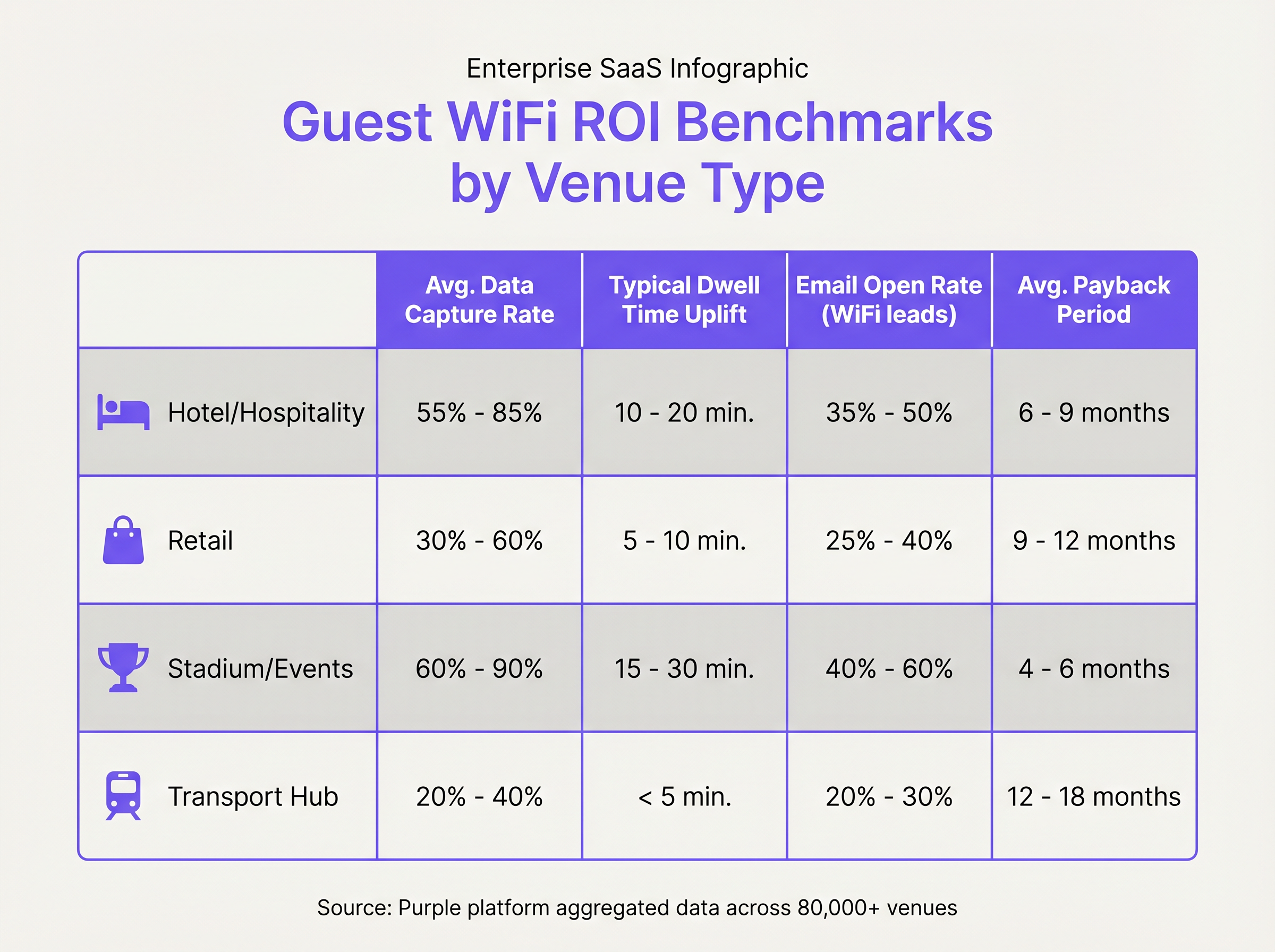
- ड्वेल टाइम अपलिफ्ट का अनुमान लगाएं: बढ़े हुए ड्वेल टाइम के राजस्व प्रभाव को प्रोजेक्ट करने के लिए उद्योग बेंचमार्क या पायलट डेटा का उपयोग करें (उदा., ड्वेल टाइम में 5% की वृद्धि से औसत बास्केट आकार में 2% की वृद्धि होती है)।
- रिटेंशन अपलिफ्ट की गणना करें: लॉयल्टी प्रोग्राम में परिवर्तित होने वाले उपयोगकर्ताओं की संख्या का अनुमान लगाएं और वृद्धिशील CLV से गुणा करें।
सर्वोत्तम प्रथाएँ और उद्योग मानक
सफल डिप्लॉयमेंट कड़े तकनीकी और परिचालन मानकों का पालन करते हैं।
- सुरक्षा और अनुपालन: सुनिश्चित करें कि Captive Portal और अंतर्निहित डेटाबेस PCI DSS (यदि अप्रत्यक्ष रूप से भुगतान डेटा को संभाल रहे हैं) और GDPR का अनुपालन करते हैं। मजबूत डेटा रिटेंशन नीतियां लागू करें, स्थानीय नियमों के अनुसार निष्क्रिय प्रोफाइल को स्वचालित रूप से हटा दें।
- नेटवर्क डिज़ाइन: उच्च-क्षमता वाले स्थानों के लिए, पर्याप्त RF प्लानिंग गैर-परक्राम्य है। यह सुनिश्चित करने के लिए कि इंफ्रास्ट्रक्चर प्रदर्शन को कम किए बिना अनुमानित समवर्ती उपयोगकर्ता लोड का समर्थन कर सकता है, High-Density WiFi Design: Stadium and Arena Best Practices पर हमारी व्यापक गाइड देखें।
- निर्बाध ऑथेंटिकेशन: ऑनबोर्डिंग प्रक्रिया में घर्षण (friction) को कम करें। बाद की यात्राओं पर स्वचालित रीकनेक्शन की सुविधा के लिए प्रोफ़ाइल-आधारित ऑथेंटिकेशन विधियों को लागू करने पर विचार करें, जिससे उपयोगकर्ता अनुभव में सुधार हो और डेटा कैप्चर दरें बढ़ें।
- API-फर्स्ट आर्किटेक्चर: WiFi एनालिटिक्स इंजन और व्यापक मार्केटिंग टेक्नोलॉजी स्टैक के बीच निर्बाध डेटा प्रवाह सुनिश्चित करने के लिए मजबूत, अच्छी तरह से प्रलेखित API वाले प्लेटफॉर्म का चयन करें।
समस्या निवारण और जोखिम न्यूनीकरण
यहां तक कि सावधानीपूर्वक नियोजित डिप्लॉयमेंट को भी उन चुनौतियों का सामना करना पड़ सकता है जो ROI को कम करती हैं।
- कम डेटा कैप्चर दरें: यह अक्सर खराब डिज़ाइन किए गए Captive Portal या अत्यधिक जटिल ऑथेंटिकेशन प्रवाह से उत्पन्न होता है। न्यूनीकरण: पोर्टल डिज़ाइनों का A/B परीक्षण करें, डेटा प्रविष्टि आवश्यकताओं को सरल बनाएं, और मूल्य विनिमय को स्पष्ट रूप से व्यक्त करें (उदा., "अपनी अगली खरीदारी पर 10% की छूट के लिए साइन इन करें")।
- एकीकरण विफलताएं: यदि WiFi प्लेटफॉर्म और CRM के बीच API कनेक्शन विफल हो जाता है, तो एट्रिब्यूशन श्रृंखला टूट जाती है। न्यूनीकरण: API टाइमआउट या डेटा सिंक विफलताओं के लिए स्वचालित अलर्टिंग लागू करें। अखंडता सुनिश्चित करने के लिए नियमित रूप से डेटा प्रवाह का ऑडिट करें।
- खराब नेटवर्क प्रदर्शन: यदि अंतर्निहित इंफ्रास्ट्रक्चर अपर्याप्त है, तो उपयोगकर्ता कनेक्शन प्रक्रिया को छोड़ देंगे। न्यूनीकरण: नियमित साइट सर्वेक्षण और क्षमता नियोजन अभ्यास आयोजित करें, विशेष रूप से प्रमुख घटनाओं या पीक सीज़न से पहले। इन डिप्लॉयमेंट का समर्थन करने वाले आधुनिक नेटवर्क आर्किटेक्चर की जानकारी के लिए, The Core SD WAN Benefits for Modern Businesses देखें।
ROI और व्यावसायिक प्रभाव: सफलता मापना
सफलता का अंतिम उपाय एक सकारात्मक, प्रदर्शन योग्य ROI है। एक अच्छी तरह से निष्पादित गेस्ट WiFi रणनीति को नेटवर्क को कॉस्ट सेंटर से प्रॉफिट सेंटर में बदलना चाहिए।
इस फ्रेमवर्क में उल्लिखित मेट्रिक्स—कॉस्ट पर एक्विजिशन, मार्केटिंग एट्रिब्यूशन, ड्वेल टाइम प्रभाव, और लॉयल्टी रूपांतरण—को सावधानीपूर्वक ट्रैक करके, IT और मार्केटिंग लीडर स्थान के डिजिटल इंफ्रास्ट्रक्चर में चल रहे निवेश के लिए एक सम्मोहक, डेटा-संचालित नैरेटिव बना सकते हैं। Sensors और Wayfinding तकनीकों का एकीकरण इस डेटासेट को और समृद्ध कर सकता है, जो आगंतुक व्यवहार की और भी अधिक सूक्ष्म समझ प्रदान करता है और अतिरिक्त परिचालन क्षमता को बढ़ाता है।
> [!TIP] > अपनी लीडरशिप टीम के लिए बिजनेस केस को सरल बनाने के लिए, अपने वेन्यू के आकार के आधार पर कैंपेन रेवेन्यू और डेटाबेस वैल्यू का अनुमान लगाने के लिए हमारे WiFi मार्केटिंग ROI कैलकुलेटर का उपयोग करें।
Definições principais
Captive Portal
A web page that the user of a public-access network is obliged to view and interact with before access is granted. It is the primary mechanism for first-party data capture.
Critical for IT teams to configure securely, ensuring seamless authentication while complying with data privacy regulations.
First-Party Data
Information a company collects directly from its customers and owns entirely, such as email addresses captured via a WiFi login.
Highly valuable for marketing teams as it reduces reliance on third-party cookies and paid advertising channels.
Probe Request
A frame sent by a client device (like a smartphone) to discover available 802.11 networks within its proximity.
Used by WiFi analytics engines to track footfall and device movement, even if the device does not fully authenticate to the network.
MAC Address Randomization
A privacy feature in modern mobile operating systems that periodically changes the device's MAC address to prevent persistent tracking.
IT teams must account for this when designing analytics solutions, often requiring authenticated sessions (profile-based authentication) to accurately track returning visitors over time.
Total Cost of Ownership (TCO)
The comprehensive assessment of all costs associated with deploying and maintaining the WiFi infrastructure, including CapEx (hardware) and OpEx (licensing, support).
Essential for finance and IT leaders to calculate accurately to determine the true ROI of the platform.
Customer Lifetime Value (CLV)
A prediction of the net profit attributed to the entire future relationship with a customer.
Used to model the long-term ROI of converting WiFi guests into loyalty program members.
UTM Parameters
Tags added to a URL that allow marketing teams to track the effectiveness of campaigns and identify the source of traffic.
Crucial for tracking post-connection redirects and attributing downstream revenue to the initial WiFi login event.
Passpoint / OpenRoaming
Protocols that enable seamless, secure, and automatic roaming between different Wi-Fi networks without requiring the user to repeatedly log in via a captive portal.
Improves the guest experience and increases connection rates, driving higher data capture volumes over time.
Exemplos práticos
A 200-room hotel chain is evaluating a guest WiFi platform upgrade. They currently spend £35 to acquire a new email lead via paid social. The proposed WiFi platform costs £2 per room per month in licensing. They expect 150 unique guests per day across the property, with a projected 60% captive portal completion rate. Calculate the monthly data capture value and the simple ROI based solely on this pillar (excluding hardware costs).
- Calculate monthly connections: 150 guests/day * 30 days = 4,500 total connections/month.
- Calculate successful captures: 4,500 * 0.60 = 2,700 verified emails/month.
- Calculate Data Capture Value: 2,700 emails * £35 CPA = £94,500 value generated/month.
- Calculate Platform Cost: 200 rooms * £2 = £400/month.
- Calculate ROI: ((£94,500 - £400) / £400) * 100 = 23,525%.
A large retail mall implements WiFi analytics to track dwell time. Baseline data shows an average dwell time of 45 minutes, with an average spend of £60 per visitor. Following a reconfiguration of the food court seating and the introduction of targeted push notifications via the captive portal, average dwell time increases to 55 minutes. Industry benchmarks suggest a 10% increase in dwell time yields a 5% increase in spend. Calculate the projected new average spend per visitor.
- Calculate the percentage increase in dwell time: ((55 - 45) / 45) * 100 = 22.2% increase.
- Apply the benchmark multiplier: If a 10% dwell increase = 5% spend increase, then a 22.2% dwell increase = (22.2 / 10) * 5 = 11.1% projected spend increase.
- Calculate new average spend: £60 * 1.111 = £66.66 per visitor.
Questões práticas
Q1. A stadium operations director is evaluating the ROI of a major network upgrade. The primary goal is to increase food and beverage (F&B) sales during halftime. The IT team proposes a high-density deployment with a sophisticated captive portal, while the marketing team wants to ensure seamless CRM integration. What is the most critical technical dependency to ensure the ROI can be accurately measured?
Dica: Consider how the initial connection event must be linked to the final purchase event.
Ver resposta modelo
The most critical dependency is establishing a closed-loop attribution system. This requires the WiFi platform to successfully push the captured user identity (e.g., email or phone number) via API to the CRM, and for the CRM to be integrated with the Point of Sale (POS) system. Without this end-to-end integration, the marketing team cannot definitively prove that a promotional offer sent via the WiFi platform resulted in a specific F&B transaction at the concession stand.
Q2. A retail chain is experiencing a high drop-off rate at the captive portal. Users connect to the SSID but fail to complete the registration form, resulting in poor data capture ROI. The current portal requires first name, last name, email, date of birth, and postal code. What is the recommended architectural or operational change?
Dica: Evaluate the balance between the value of the data requested and the friction introduced to the user.
Ver resposta modelo
The recommended approach is to reduce the friction in the onboarding process by simplifying the data requirements. The IT and marketing teams should implement progressive profiling. Initially, require only a single, high-value identifier (such as an email address or mobile number via SMS verification) to grant access. Subsequent data points (like date of birth or postal code) can be collected later through targeted marketing campaigns or upon subsequent visits, thereby significantly increasing the initial completion rate and overall data capture volume.
Q3. When building a Total Cost of Ownership (TCO) model for a multi-site hospitality deployment, the finance partner questions the inclusion of GDPR compliance auditing costs as a line item against the WiFi project. How should the IT architect justify this inclusion?
Dica: Consider the legal basis for processing the data captured by the network.
Ver resposta modelo
The IT architect must explain that the guest WiFi platform acts as a primary data controller/processor. Because the system is actively capturing Personally Identifiable Information (PII) to generate marketing ROI, it fundamentally alters the venue's risk profile compared to providing an open, unauthenticated network. Therefore, the costs associated with ensuring the captive portal's consent mechanisms, data retention policies, and subject access request workflows are compliant with GDPR are direct, unavoidable operational expenses (OpEx) of running the platform as a revenue-generating asset.
Continue a ler esta série
Privacidade desde a Concepção: Anonimizando Dados WiFi para Conformidade com a GDPR
Este guia autorizado detalha a arquitetura técnica e as estratégias de implementação para anonimizar dados WiFi, garantindo a conformidade com a GDPR. Ele fornece a líderes de TI e arquitetos de rede estruturas acionáveis para equilibrar análises robustas de locais com requisitos rigorosos de privacidade de dados.
Heatmapping vs Presence Analytics: Diferenças Técnicas
Este guia técnico e autoritário detalha as diferenças arquitetônicas e operacionais críticas entre WiFi heatmapping e presence analytics para operadores de locais empresariais. Ele fornece a líderes de TI, arquitetos de rede e diretores de operações estruturas de implantação acionáveis, cenários de implementação reais e melhores práticas neutras em relação a fornecedores para extrair o ROI máximo de sua infraestrutura sem fio existente.
Como Calcular o Tempo de Permanência Usando Análise de Localização WiFi
Este guia oferece uma referência técnica abrangente para calcular o tempo de permanência WiFi usando análise de localização WiFi, cobrindo a arquitetura completa, desde a captura de solicitações de sondagem 802.11, passando pela trilateração baseada em RSSI, até a análise de zonas geocercadas. Ele é projetado para gerentes de TI, arquitetos de rede e diretores de operações de locais que precisam implantar inteligência de localização precisa e escalável em ambientes de varejo, hotelaria, saúde e setor público. Os leitores obterão orientação de implementação acionável, estudos de caso reais e uma estrutura clara para traduzir dados espaciais brutos em resultados de negócios mensuráveis.