

O Guia Definitivo para Canais WiFi: 2.4GHz vs 5GHz Explicado
Este guia abrangente detalha as diferenças críticas entre os canais WiFi de 2.4GHz e 5GHz para ambientes corporativos. Ele fornece a gerentes de TI e arquitetos de rede estratégias acionáveis para planejamento de canais, mitigação de interferência e otimização de implantações em locais de alta densidade para impulsionar o ROI.
Ouça este guia
Ver transcrição do podcast
Resumo Executivo
Para gerentes de TI e arquitetos de rede que implementam infraestruturas sem fio de alta densidade, a escolha entre 2.4GHz e 5GHz não é mais um simples binário de alcance versus velocidade. Em ambientes corporativos modernos — de hotéis com 500 quartos a grandes complexos de varejo — a seleção de canais é a decisão arquitetônica fundamental que dita o throughput da rede, a experiência do cliente e a postura de segurança. Este guia oferece um aprofundamento técnico definitivo sobre o melhor canal para WiFi de 5GHz, mitigando a interferência de co-canal em 2.4GHz e estruturando um plano de canais escalável.
Ao padronizar em 5GHz para acesso primário de clientes, enquanto restringe 2.4GHz para dispositivos IoT legados, os operadores de locais podem aumentar drasticamente a capacidade agregada da rede. Quando combinado com Guest WiFi e robustas WiFi Analytics , um plano de canais limpo transforma um centro de custo em um motor confiável para captura de dados e engajamento do cliente.
Aprofundamento Técnico: Entendendo Bandas de Frequência e Canais
Para arquitetar uma rede resiliente, devemos distinguir entre bandas de frequência e os canais dentro delas. Uma banda de frequência representa o amplo espectro de rádio alocado para comunicação sem fio, enquanto os canais são as subdivisões específicas onde os pontos de acesso (APs) e os dispositivos clientes negociam conexões.
A Banda de 2.4GHz: Restrições Legadas e Interferência
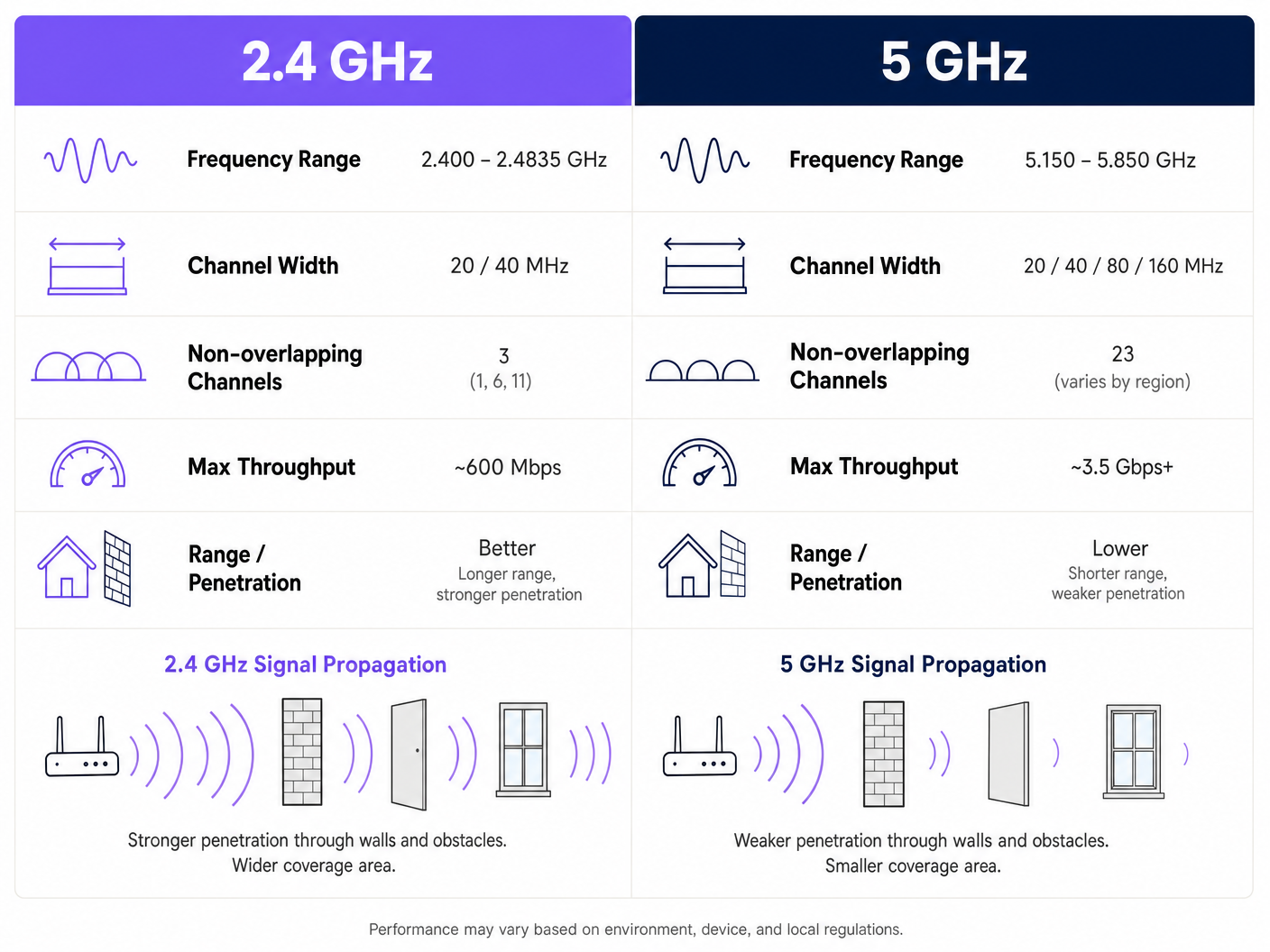
A banda de 2.4GHz (2.400 – 2.4835 GHz) é o pilar legado das redes sem fio. Sua principal vantagem é a propagação do sinal; ondas de frequência mais baixa penetram paredes, portas e pisos de forma mais eficaz do que frequências mais altas. No entanto, esse alcance vem com uma penalidade arquitetônica severa em implantações de alta densidade.
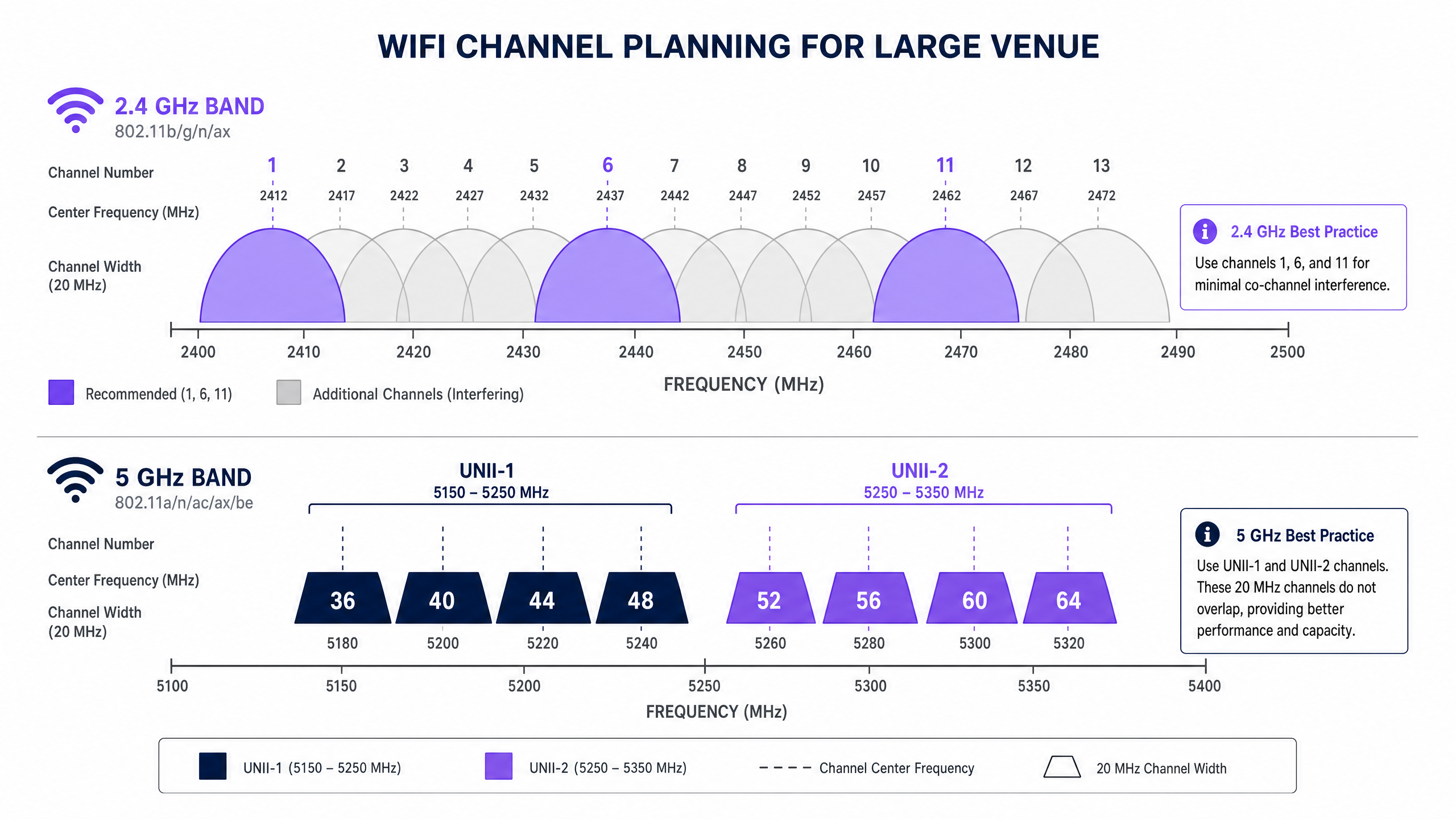
No Reino Unido e na Europa, a banda de 2.4GHz oferece 13 canais. Cada canal tem 20MHz de largura, mas eles estão espaçados em apenas 5MHz. Essa sobreposição estrutural significa que apenas três canais — 1, 6 e 11 — são genuinamente não sobrepostos. Em um ambiente denso, como um local de Hospitalidade com APs implantados em cada segundo quarto, forçar centenas de dispositivos em três canais leva inevitavelmente a uma severa interferência de co-canal (CCI). Além disso, o espectro de 2.4GHz é fortemente poluído por interferências não-WiFi, incluindo fornos de micro-ondas, dispositivos Bluetooth e telefones DECT.
A Banda de 5GHz: Capacidade e o Desafio DFS
A banda de 5GHz (5.150 – 5.850 GHz) altera fundamentalmente a equação de capacidade. Ela oferece um espectro significativamente mais utilizável, permitindo canais mais amplos e taxas de dados mais altas. No Reino Unido, a banda de 5GHz é segmentada em sub-bandas Unlicensed National Information Infrastructure (UNII), oferecendo até 19 canais de 20MHz não sobrepostos.
Ao determinar o melhor canal para WiFi de 5GHz, os arquitetos de rede devem navegar pela Seleção Dinâmica de Frequência (DFS). DFS é um requisito regulatório projetado para evitar que redes WiFi interfiram em sistemas de radar existentes, como radares meteorológicos e militares.
- UNII-1 (Canais 36, 40, 44, 48): Esses canais não exigem DFS. Eles são o padrão ouro para implantações corporativas porque os APs não mudarão repentinamente de canal se o radar for detectado, garantindo conectividade estável do cliente.
- UNII-2A e UNII-2C (Canais 52-144): Estes são canais DFS. Se um AP detectar uma assinatura de radar em seu canal de operação, ele deve desocupar imediatamente esse canal e mover-se para outro, potencialmente derrubando sessões de clientes ativas.
- UNII-3 (Canais 149-165): A disponibilidade varia por região, mas estes são geralmente canais não-DFS onde permitido.
Guia de Implementação: Construindo o Plano de Canais
Uma implantação bem-sucedida requer uma abordagem de planejamento de canais neutra em relação ao fornecedor e orientada por dados. Seja você implantando em um ambiente de Varejo ou atualizando um hub de Transporte , essas etapas formam a base para uma rede de alto desempenho.
1. Realize um Levantamento Ativo de RF do Local
Nunca confie apenas na modelagem preditiva. Realize um levantamento ativo usando um analisador de espectro para mapear o ambiente de RF existente. Identifique APs não autorizados, interferência não-WiFi e redes vizinhas. Esses dados empíricos são essenciais para atribuir canais que evitem o congestionamento existente.
2. Defina Larguras de Canal Conservadoramente
O instinto de maximizar o throughput unindo canais (por exemplo, usando larguras de 80MHz ou 160MHz) é um erro arquitetônico comum em locais densos.
- Em 5GHz: Padronize larguras de canal de 20MHz ou 40MHz. Embora as velocidades de pico por cliente sejam menores do que com canais de 80MHz, o throughput agregado da rede aumenta porque você preserva mais canais não sobrepostos, reduzindo assim o CCI.
- Em 2.4GHz: Imponha estritamente larguras de canal de 20MHz. Usar 40MHz em 2.4GHz em um ambiente corporativo garante interferência severa.
3. Implemente o Band Steering
APs corporativos modernos suportam band steering, um recurso que incentiva clientes com capacidade dual-band a se conectar à banda de 5GHz. Isso libera o espectro de 2.4GHz para dispositivos legados e sensores IoT, como os discutidos em nosso guia sobre BLE Low Energy Explained for Enterprise .
4. Otimize a Potência de Transmissão
Alta potência de transmissão não equivale a melhor desempenho; equivale a um domínio de interferência maior. Em uma implantação de alta densidade, diminua a potência de transmissão nos rádios de 2.4GHz (por exemplo, 8-11 dBm) para reduzir o tamanho da célula e limitar a CCI. Rádios de 5GHz podem operar com uma potência ligeiramente maior (por exemplo, 14-17 dBm) para compensar suas capacidades de penetração reduzidas.
Melhores Práticas e Padrões da Indústria
Para manter a conformidade e a excelência operacional, siga estas recomendações padrão da indústria:
- Padronize no UNII-1 para Infraestrutura Crítica: Use os canais 36, 40, 44 e 48 para áreas que exigem estabilidade absoluta, como salas de reuniões executivas ou clusters de ponto de venda (POS).
- Aproveite a Análise para Otimização Dinâmica: Utilize plataformas como Purple para monitorar continuamente o ambiente de RF. Se um inquilino vizinho implantar um AP não autorizado, sua análise deve detectar o aumento da utilização do canal e acionar um ajuste de canal automatizado ou manual. Para obter insights sobre a otimização de ambientes de escritório, consulte Office Wi Fi: Optimize Your Modern Office Wi-Fi Network .
- Audite o Comportamento DFS Antes da Implementação: Se estiver utilizando canais UNII-2, conduza testes rigorosos para monitorar a frequência com que os APs acionam eventos DFS. Se a detecção de radar for frequente (por exemplo, perto de um aeroporto), remova esses canais específicos da lista de canais permitidos do AP.
- Prepare-se para o Wi-Fi 6E: Se estiver realizando uma atualização de hardware, avalie o Wi-Fi 6E (802.11ax operando na banda de 6GHz). O espectro de 6GHz oferece até 500MHz de largura de banda adicional e livre de interferências no Reino Unido, resolvendo efetivamente o problema de capacidade de alta densidade. Leia mais em Wi Fi Frequencies: A Guide to Wi-Fi Frequencies in 2026 .
Solução de Problemas e Mitigação de Riscos
Mesmo com um planejamento meticuloso, os ambientes de RF são dinâmicos. Os modos de falha comuns incluem:
- O Problema do "Cliente Pegajoso": Clientes que se recusam a fazer roaming para um AP mais próximo, mantendo uma conexão fraca que prejudica o desempenho geral da célula. Mitigação: Implemente limites mínimos de RSSI e utilize protocolos 802.11k/v/r para facilitar o roaming contínuo.
- Catástrofes de Auto-Canal: Algoritmos de auto-canal baseados em controlador frequentemente convergem nos mesmos poucos canais, causando CCI generalizada. Mitigação: Use recursos de auto-canal apenas durante a implantação inicial ou janelas de manutenção programadas. Para operação contínua, confie em um mapa de canais estático e meticulosamente planejado, validado por análises.
- Degradação da Postura de Segurança: Um planejamento de canal deficiente pode mascarar a presença de APs não autorizados ou ataques de evil twin. Mitigação: Um ambiente de RF limpo torna a detecção de anomalias significativamente mais confiável. Garanta que sua arquitetura esteja alinhada com frameworks de segurança modernos, conforme discutido em La lista de verificación para migrar de NAC heredado a NAC nativo de la nube e A Lista de Verificação para Migrar de NAC Legado para NAC Nativo da Nuvem .
ROI e Impacto nos Negócios
O impacto nos negócios de uma rede sem fio corretamente projetada vai muito além da redução de tickets de suporte de TI. No varejo e na hotelaria, a rede WiFi é o principal canal para o engajamento de hóspedes e a aquisição de dados.
Quando a interferência de co-canal é eliminada e os clientes são direcionados com sucesso para canais 5GHz limpos, a rede pode suportar densidades de clientes mais altas sem degradação. Essa confiabilidade garante que os captive portals carreguem instantaneamente, aumentando a taxa de conversão de logins de Guest WiFi. A captura de dados primários resultante impulsiona campanhas de marketing direcionadas, impactando diretamente o resultado final.
Ouça nosso briefing técnico completo sobre este tópico:
Definições principais
Co-Channel Interference (CCI)
Interference caused when two or more access points operate on the exact same channel and their coverage areas overlap.
CCI forces devices to wait their turn to transmit, drastically reducing network throughput in dense deployments.
Dynamic Frequency Selection (DFS)
A regulatory mandate requiring WiFi devices operating in certain 5GHz bands to detect and avoid incumbent radar systems.
If an AP detects radar on a DFS channel, it must immediately switch channels, causing brief connectivity drops for connected clients.
Band Steering
A feature on enterprise APs that detects dual-band capable clients and actively encourages them to connect to the 5GHz band rather than 2.4GHz.
Essential for preserving the limited 2.4GHz spectrum for legacy IoT devices and ensuring high-performance clients get optimal speeds.
Channel Bonding
The practice of combining two or more adjacent 20MHz channels into a single wider channel (e.g., 40MHz, 80MHz) to increase data throughput.
While it increases speed, it reduces the total number of non-overlapping channels available, making it dangerous in high-density environments.
UNII-1 Band
The lower segment of the 5GHz spectrum (channels 36, 40, 44, 48) that does not require DFS compliance.
The most stable and reliable channels for mission-critical enterprise wireless traffic.
Adjacent Channel Interference (ACI)
Interference caused by transmissions on overlapping but not identical frequencies (e.g., using channel 3 and channel 6 in 2.4GHz).
ACI is more destructive than CCI because devices cannot properly decode the overlapping signals, leading to high packet loss.
RSSI (Received Signal Strength Indicator)
A measurement of the power present in a received radio signal.
Used by network administrators to set minimum connection thresholds, forcing 'sticky clients' to roam to closer access points.
BSS Coloring
A feature introduced in Wi-Fi 6 (802.11ax) that adds a 'color' identifier to transmissions, allowing APs on the same channel to ignore each other's traffic if the color doesn't match.
Significantly mitigates the impact of co-channel interference in extremely dense deployments like stadiums.
Exemplos práticos
A 400-room hotel in a dense urban environment is experiencing widespread guest complaints regarding WiFi speeds during the evening peak (7 PM - 10 PM). The current deployment uses dual-band APs in every other room, with auto-channel selection enabled and 80MHz channel widths on 5GHz.
- Disable auto-channel selection to prevent continuous channel thrashing. 2. Reduce 5GHz channel width from 80MHz to 20MHz to increase the number of available non-overlapping channels and eliminate co-channel interference. 3. Statically assign 5GHz channels, prioritizing UNII-1 (36, 40, 44, 48) and clean UNII-2 channels. 4. Reduce 2.4GHz transmit power to 8dBm and restrict to channels 1, 6, and 11 to minimize cell overlap.
A large retail chain is deploying a new point-of-sale (POS) system that relies on wireless connectivity. The store is located in a shopping centre with dozens of neighboring retail WiFi networks visible. The POS vendor recommends using 2.4GHz for 'better range'.
- Reject the vendor's 2.4GHz recommendation for critical infrastructure. 2. Configure a dedicated SSID for the POS system operating exclusively on the 5GHz band. 3. Assign this SSID to UNII-1 channels (36, 40, 44, 48) to avoid any potential DFS radar disruptions. 4. Implement band steering on the public Guest WiFi SSID to keep consumer devices off the 2.4GHz spectrum as much as possible.
Questões práticas
Q1. You are deploying WiFi in a hospital where life-critical telemetry equipment operates on 2.4GHz. The hospital also wants to offer high-speed Guest WiFi in the waiting areas. How do you architect the channel plan?
Dica: Consider physical separation and band dedication.
Ver resposta modelo
- Dedicate the 2.4GHz band entirely to the telemetry equipment, statically assigning channels 1, 6, and 11. 2. Disable the Guest WiFi SSID on the 2.4GHz radios completely. 3. Broadcast the Guest WiFi exclusively on the 5GHz band using UNII-1 and UNII-2 channels. This ensures the life-critical 2.4GHz spectrum remains uncontended while providing high capacity for guests.
Q2. A stadium deployment is suffering from massive interference on 5GHz, despite using 20MHz channels. The APs are mounted very high up and are 'hearing' each other across the bowl. What configuration change is required?
Dica: Think about how far the signal is traveling and how APs decide when the channel is clear.
Ver resposta modelo
- Significantly reduce the transmit (Tx) power on the 5GHz radios to shrink the cell size. 2. Increase the RX-SOP (Receive Start of Packet) threshold, which makes the AP 'deaf' to weak signals from distant APs across the stadium bowl, allowing it to transmit simultaneously without triggering carrier sense mechanisms.
Q3. Your corporate office is located less than 2 miles from a major commercial airport. You are currently using channels 36, 40, 44, 48, 52, 56, 60, and 64. Users are complaining of random, brief disconnects. What is the likely cause and solution?
Dica: Consider the regulatory requirements for specific 5GHz channels.
Ver resposta modelo
The disconnects are caused by DFS (Dynamic Frequency Selection) events. The APs on channels 52-64 are detecting airport radar and vacating the channel. The solution is to remove the UNII-2 DFS channels (52-64) from the allowed channel list and rely solely on the non-DFS UNII-1 channels (36-48), or upgrade to Wi-Fi 6E to utilize the non-DFS 6GHz band.