
Migrar de RADIUS Local (NPS) para RADIUS como Serviço
Este guia abrangente detalha a arquitetura técnica, a metodologia de implementação e o impacto nos negócios da migração do Microsoft Network Policy Server (NPS) local para um modelo RADIUS como Serviço nativo da cloud. Fornece a líderes de TI e arquitetos de rede estruturas práticas para reduzir os custos operacionais, eliminar pontos únicos de falha e proteger a autenticação empresarial em locais distribuídos.
Ouça este guia
Ver transcrição do podcast
Resumo Executivo
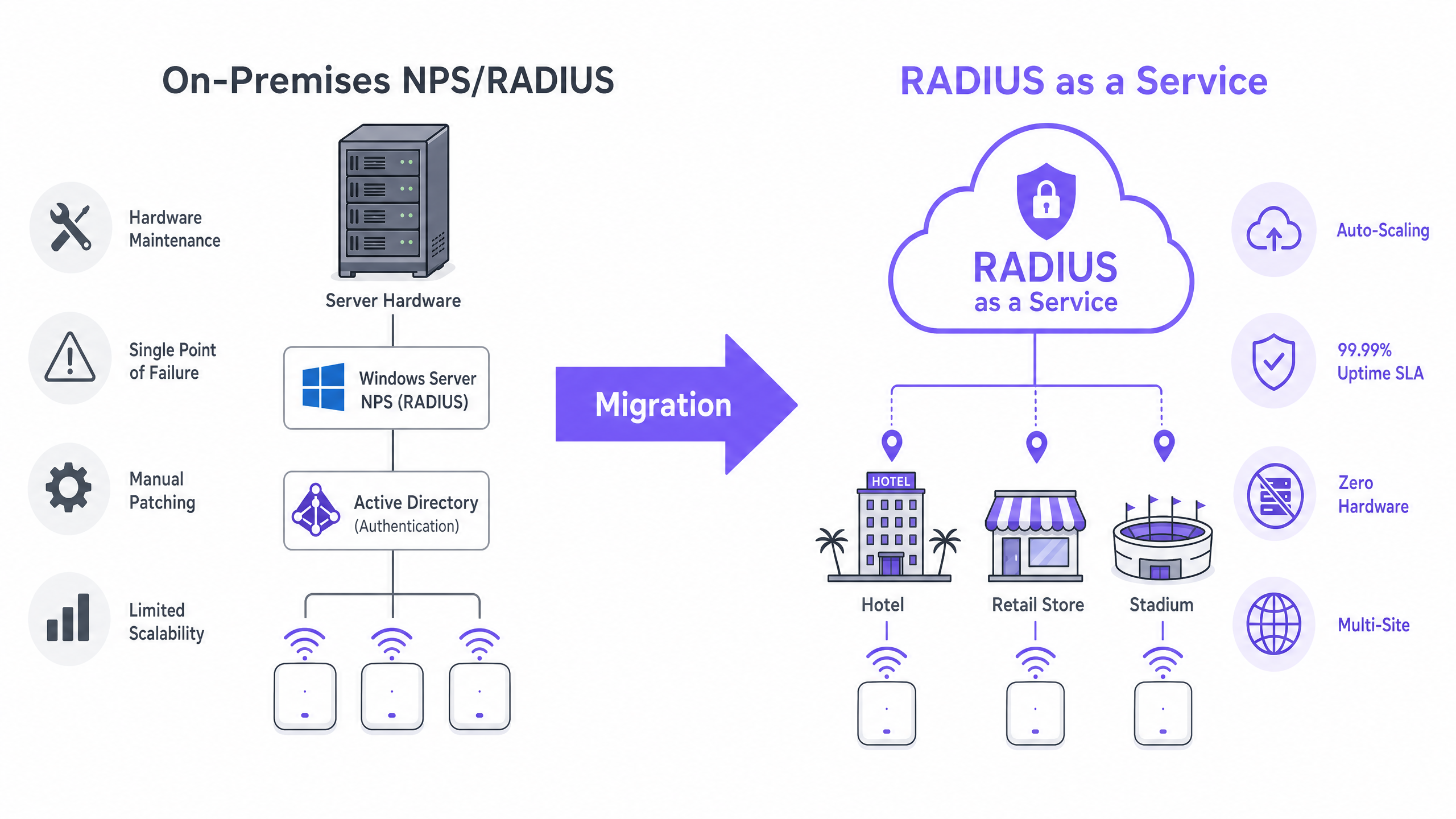
Durante quase duas décadas, o Network Policy Server (NPS) da Microsoft tem sido a implementação RADIUS padrão para redes empresariais. No entanto, à medida que os operadores de locais se expandem por localizações distribuídas — desde cadeias de retalho a grupos hoteleiros globais — o encargo operacional de gerir a infraestrutura de autenticação local tornou-se uma responsabilidade significativa.
A migração para RADIUS como Serviço transfere a autenticação de um componente de hardware gerido para um serviço cloud consumido. Esta transição arquitetónica elimina o ponto único de falha inerente às implementações NPS autónomas, remove os ciclos de atualização de hardware e fornece a escalabilidade elástica necessária para ambientes de alta densidade, como estádios e centros de conferências. Para gestores de TI e arquitetos de rede, este guia fornece uma metodologia estruturada e neutra em relação ao fornecedor para migrar a autenticação 802.1X para a cloud sem impactar o tráfego de produção, garantindo a conformidade com PCI DSS e GDPR e reduzindo o OpEx da infraestrutura de autenticação em até 80%.
Análise Técnica Detalhada: Arquitetura e Padrões
Para compreender a migração, devemos primeiro examinar a mudança arquitetónica na forma como o controlo de acesso baseado em porta IEEE 802.1X é fornecido.
As Limitações do NPS Local
Numa implementação tradicional, os pontos de acesso atuam como Network Access Server (NAS), encaminhando os pedidos de autenticação para um servidor NPS local. O servidor NPS avalia as políticas de pedido de ligação, valida as credenciais em relação a um arquivo de identidade (tipicamente Active Directory via LDAP) e retorna uma mensagem Access-Accept ou Access-Reject.
Este modelo apresenta três restrições críticas para redes modernas:
- Dependência e Manutenção de Hardware: O NPS requer máquinas físicas ou virtuais dedicadas, exigindo patching contínuo, planeamento de capacidade e gestão do ciclo de vida.
- Complexidade de Alta Disponibilidade: Atingir a redundância requer a implementação do NPS num par de failover, duplicando os custos de licenciamento sem fornecer verdadeira redundância geográfica.
- Estrangulamentos de Débito: Durante picos de concorrência — como a entrada num estádio ou horas de pico de vendas no retalho — uma única instância NPS pode tornar-se um estrangulamento, levando a tempos limite de autenticação e a uma experiência de utilizador degradada.
A Arquitetura RADIUS na Cloud
RADIUS como Serviço abstrai a camada de autenticação. Os fornecedores de cloud operam clusters de servidores RADIUS distribuídos e geo-redundantes. O NAS aponta para estes endpoints da cloud, e os pedidos são balanceados automaticamente.
Segurança de Transporte: O Papel do RadSec Ao mover o RADIUS para a cloud, o tráfego de autenticação atravessa a internet pública. Enquanto o RADIUS tradicional usa um segredo partilhado e hashing MD5, as implementações modernas devem implementar o RadSec (RADIUS over TLS, RFC 6614). O RadSec envolve toda a conversação RADIUS num túnel TLS (tipicamente porta TCP 2083), fornecendo encriptação da camada de transporte equivalente a HTTPS e autenticação mútua entre o NAS e o endpoint RADIUS da cloud.
Integração de Identidade O RADIUS na cloud não requer a migração do seu diretório de utilizadores. Os serviços tipicamente suportam ligações LDAPS de volta ao Active Directory local ou integrações nativas de API com o Azure Active Directory (Entra ID) via SAML ou SCIM. Isto garante que os seus processos de gestão do ciclo de vida do utilizador existentes permanecem intactos.
Para locais que utilizam plataformas Guest WiFi , o RADIUS na cloud integra-se diretamente, fornecendo um plano de controlo unificado para autenticação corporativa 802.1X e acesso à rede de convidados, completo com WiFi Analytics avançados.
Guia de Implementação: Uma Metodologia de 5 Fases
Executar uma migração sem tempo de inatividade requer uma abordagem estruturada e faseada.
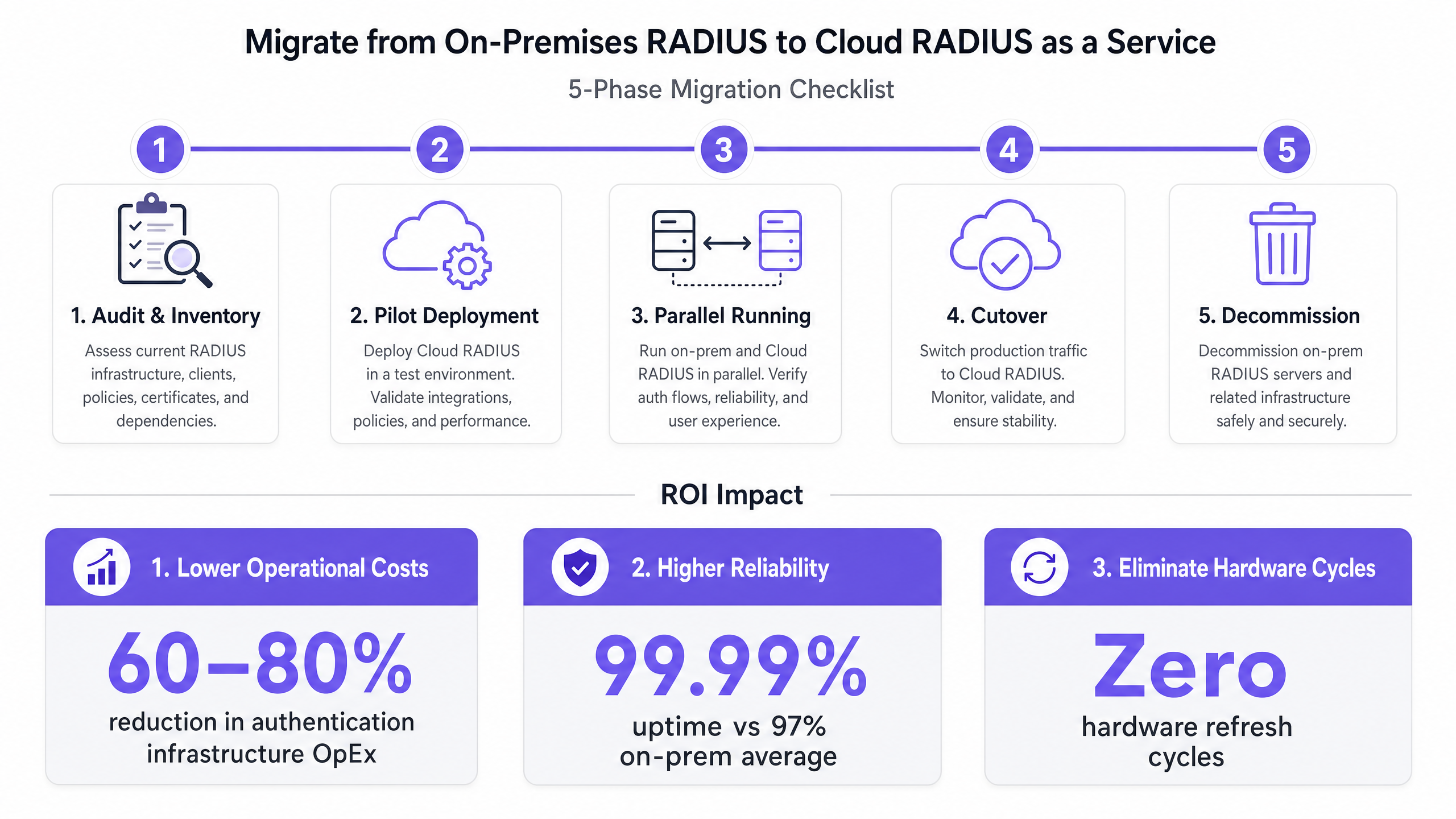
Fase 1: Auditoria e Inventário
Antes de fazer quaisquer alterações, documente o estado atual:
- Clientes RADIUS: Identifique cada NAS (pontos de acesso, switches, concentradores VPN).
- Políticas: Documente as políticas de pedido de ligação e de rede NPS existentes, incluindo os Atributos Específicos do Fornecedor (VSAs) utilizados para a atribuição de VLAN.
- Métodos EAP: Identifique quais os métodos de Extensible Authentication Protocol em uso (por exemplo, EAP-TLS, PEAP-MSCHAPv2).
Fase 2: Implementação Piloto
Provisione a instância RADIUS na cloud e configure um SSID não-produtivo ou um único site de teste. Valide a integração do diretório de identidade (por exemplo, sincronização Entra ID) e garanta que o método EAP funciona de ponta a ponta.
Fase 3: Execução Paralela (Mitigação de Risco)
Configure os dispositivos NAS de produção para usar tanto o servidor RADIUS na cloud (Primário) quanto o servidor NPS legado (Fallback). Execute esta configuração por um mínimo de duas semanas. Monitorize as taxas de sucesso de autenticação, métricas de latência e fluxos de dados de contabilidade para identificar quaisquer discrepâncias de política antes da transição.
Fase 4: Transição
Durante uma janela de manutenção programada, remova a configuração de fallback do NPS legado dos dispositivos NAS. Comprometa-se inteiramente com a infraestrutura da cloud. Garanta que o seu procedimento de rollback está documentado e testado.
Fase 5: Desativação
Após 30 dias de operação estável, desative de forma segura os servidores NPS legados e recupere os recursos de computação.
Melhores Práticas e Conformidade
Ao projetar a sua arquitetura RADIUS na cloud, siga os seguintes padrões:
- Obrigatoriedade do RadSec: Nunca envie tráfego RADIUS pela internet pública usando UDP padrão 1812/1813 se o RadSec (TCP 2083) for suportado pelo seu hardware NAS.
- Cadeias de Confiança de Certificados: Garanta que os dispositivos cliente confiam no CertAutoridade de Certificação (CA) que emitiu o certificado do servidor RADIUS na cloud. Envie a CA raiz para os dispositivos geridos via MDM ou Política de Grupo antes da migração.
- Postura de Conformidade: Selecione um fornecedor de RADIUS na cloud que mantenha a certificação SOC 2 Tipo II e a acreditação ISO 27001. Isto simplifica significativamente as suas avaliações anuais de PCI DSS, particularmente para ambientes de Retalho e Hotelaria .
Para princípios mais amplos de design de rede, consulte os nossos guias sobre Configurar WiFi para Empresas: Um Guia para 2026 e Compreender RSSI e Força do Sinal para um Planeamento Ótimo de Canais .
Resolução de Problemas e Mitigação de Riscos
| Modo de Falha | Causa Raiz | Estratégia de Mitigação |
|---|---|---|
| Tempos Limite de Autenticação | Firewall a bloquear UDP de saída 1812/1813 ou TCP 2083. | Verifique se as regras da firewall de perímetro permitem tráfego de saída para os intervalos de IP específicos do fornecedor de RADIUS na cloud. |
| Erros de Confiança de Certificado | Os dispositivos cliente não têm a CA Raiz na sua loja de confiança. | Implemente a CA Raiz via MDM/GPO antes da Fase 3 (Execução Paralela). |
| Falha na Atribuição de VLAN | Atributos Específicos do Fornecedor (VSAs) não mapeados corretamente nas políticas da cloud. | Replique os formatos exatos de string VSA do NPS para o motor de políticas RADIUS na cloud durante a Fase 1. |
| Impacto de Interrupção da WAN | A perda de internet impede o acesso ao RADIUS na cloud. | Implemente ligações WAN redundantes ou um proxy RADIUS local que armazene credenciais em cache para dispositivos conhecidos. |
ROI e Impacto no Negócio
A migração para RADIUS as a Service proporciona resultados de negócio mensuráveis:
- Redução de Custos: Elimina a aquisição de hardware, o licenciamento do Windows Server e as horas de engenharia gastas em patching e manutenção. A redução típica de OpEx é de 60-80%.
- SLA de Fiabilidade: Os fornecedores de cloud oferecem SLAs de tempo de atividade de 99,99% com suporte financeiro, em comparação com os típicos 97-98% alcançados por implementações NPS de site único.
- Agilidade: Novos sites podem ser ativados instantaneamente sem o provisionamento de hardware de autenticação local, acelerando os prazos de implementação para centros de Transporte e instalações de Saúde .
Ouça a nossa equipa de consultoria sénior discutir as implicações estratégicas nesta apresentação de 10 minutos:
Definições Principais
RADIUS (Remote Authentication Dial-In User Service)
A networking protocol that provides centralized Authentication, Authorization, and Accounting (AAA) management for users who connect and use a network service.
The core protocol used by enterprise WiFi networks to validate user credentials before granting network access.
NPS (Network Policy Server)
Microsoft's implementation of a RADIUS server and proxy, bundled as a role in Windows Server.
The legacy on-premises infrastructure that organizations are actively migrating away from to reduce maintenance overhead.
NAS (Network Access Server)
The device that acts as the gateway to the network and passes authentication requests to the RADIUS server.
In a wireless context, the NAS is typically the WiFi Access Point or Wireless LAN Controller.
RadSec (RADIUS over TLS)
A protocol defined in RFC 6614 that transports RADIUS packets over a TCP connection encrypted with TLS.
Essential for cloud RADIUS deployments to ensure credential data is encrypted while traversing the public internet.
EAP (Extensible Authentication Protocol)
An authentication framework frequently used in wireless networks and point-to-point connections.
Determines how the client and server securely exchange credentials (e.g., certificates via EAP-TLS, or passwords via PEAP).
VSA (Vendor-Specific Attribute)
Custom attributes defined by hardware vendors within the RADIUS protocol to support proprietary features.
Crucial during migration; VSAs are often used to assign authenticated users to specific network VLANs dynamically.
LDAPS (Lightweight Directory Access Protocol over SSL)
A secure protocol for querying and modifying directory services like Active Directory.
Used by cloud RADIUS services to securely query on-premises identity stores without migrating the user directory to the cloud.
802.1X
An IEEE standard for port-based network access control (PNAC).
The underlying standard that uses RADIUS to ensure only authenticated devices can pass traffic onto the enterprise LAN or WLAN.
Exemplos Práticos
A 200-property hotel group currently runs local NPS servers at each site for staff 802.1X authentication. They are migrating to Entra ID (Azure AD) and want to decommission the local servers. How should they approach the migration?
- Deploy a cloud RADIUS service that integrates natively with Entra ID via SAML/SCIM.
- Configure the cloud RADIUS policies to map Entra ID groups (e.g., 'Front Desk', 'Management') to specific VLAN VSAs.
- At a pilot property, configure the access points to use RadSec to connect to the cloud RADIUS endpoint.
- Push the cloud RADIUS server's Root CA to all staff devices via Microsoft Intune.
- Run parallel authentication at the pilot site, then execute a phased rollout across the remaining 199 properties.
A stadium with 50,000 capacity experiences authentication failures on their corporate SSID during major events because their on-premises NPS server cannot handle the throughput of thousands of devices roaming simultaneously.
- Audit the existing NPS policies and EAP methods.
- Provision a cloud RADIUS service capable of auto-scaling to handle high authentications per second (APS).
- Establish an LDAPS connection from the cloud RADIUS service to the stadium's on-premises Active Directory.
- Update the stadium's high-density wireless LAN controllers to point to the cloud RADIUS endpoints as the primary authentication servers.
Perguntas de Prática
Q1. Your organization is migrating to Cloud RADIUS. The security team mandates that no authentication traffic can be sent over the internet in cleartext or using deprecated hashing algorithms like MD5. What protocol must you configure on your wireless LAN controllers?
Dica: Look for the protocol that wraps RADIUS in a TLS tunnel.
Ver resposta modelo
You must configure RadSec (RADIUS over TLS). RadSec establishes a TLS tunnel over TCP port 2083 between the NAS and the cloud RADIUS server, providing transport-layer encryption and mutual authentication, satisfying the security team's requirements.
Q2. During Phase 3 (Parallel Running) of your migration, you notice that users are authenticating successfully against the cloud RADIUS server, but they are not being placed in the correct network segments. What is the most likely configuration gap?
Dica: How does a RADIUS server tell an access point which network segment to use?
Ver resposta modelo
The Vendor-Specific Attributes (VSAs) for dynamic VLAN assignment have not been configured correctly in the cloud RADIUS policies. You must ensure the exact VSA strings used in the legacy NPS server are replicated in the cloud environment so the NAS knows which VLAN to assign to the user.
Q3. A client device is repeatedly failing EAP-TLS authentication against the new cloud RADIUS service, but it works fine against the legacy NPS server. The device logs show an 'untrusted server' error. How do you resolve this?
Dica: EAP-TLS requires the client to trust the server's identity.
Ver resposta modelo
The client device does not have the Root Certificate Authority (CA) that issued the cloud RADIUS server's certificate in its trusted root store. You must deploy the Root CA to the client device using a Mobile Device Management (MDM) solution or Group Policy.