
Migration de RADIUS sur site (NPS) vers RADIUS en tant que Service
Ce guide faisant autorité détaille l'architecture technique, la méthodologie de mise en œuvre et l'impact commercial de la migration du Microsoft Network Policy Server (NPS) sur site vers un modèle RADIUS en tant que Service natif du cloud. Il fournit aux leaders informatiques et aux architectes réseau des cadres pratiques pour réduire les frais opérationnels, éliminer les points de défaillance uniques et sécuriser l'authentification d'entreprise sur des sites distribués.
Écouter ce guide
Voir la transcription du podcast
Résumé Exécutif
Pendant près de deux décennies, le Network Policy Server (NPS) de Microsoft a été l'implémentation RADIUS par défaut pour les réseaux d'entreprise. Cependant, à mesure que les opérateurs de sites se développent sur des emplacements distribués – des chaînes de magasins aux groupes hôteliers mondiaux – le fardeau opérationnel de la gestion de l'infrastructure d'authentification sur site est devenu un passif important.
La migration vers RADIUS as a Service transforme l'authentification d'un composant matériel géré en un service cloud consommé. Cette transition architecturale élimine le point de défaillance unique inhérent aux déploiements NPS autonomes, supprime les cycles de renouvellement matériel et offre l'évolutivité élastique requise pour les environnements à haute densité comme les stades et les centres de conférence. Pour les responsables informatiques et les architectes réseau, ce guide fournit une méthodologie structurée et neutre vis-à-vis des fournisseurs pour migrer l'authentification 802.1X vers le cloud sans impacter le trafic de production, garantissant la conformité avec PCI DSS et GDPR, et réduisant les dépenses d'exploitation de l'infrastructure d'authentification jusqu'à 80 %.
Approfondissement Technique : Architecture et Normes
Pour comprendre la migration, nous devons d'abord examiner le changement architectural dans la manière dont le contrôle d'accès basé sur les ports IEEE 802.1X est fourni.
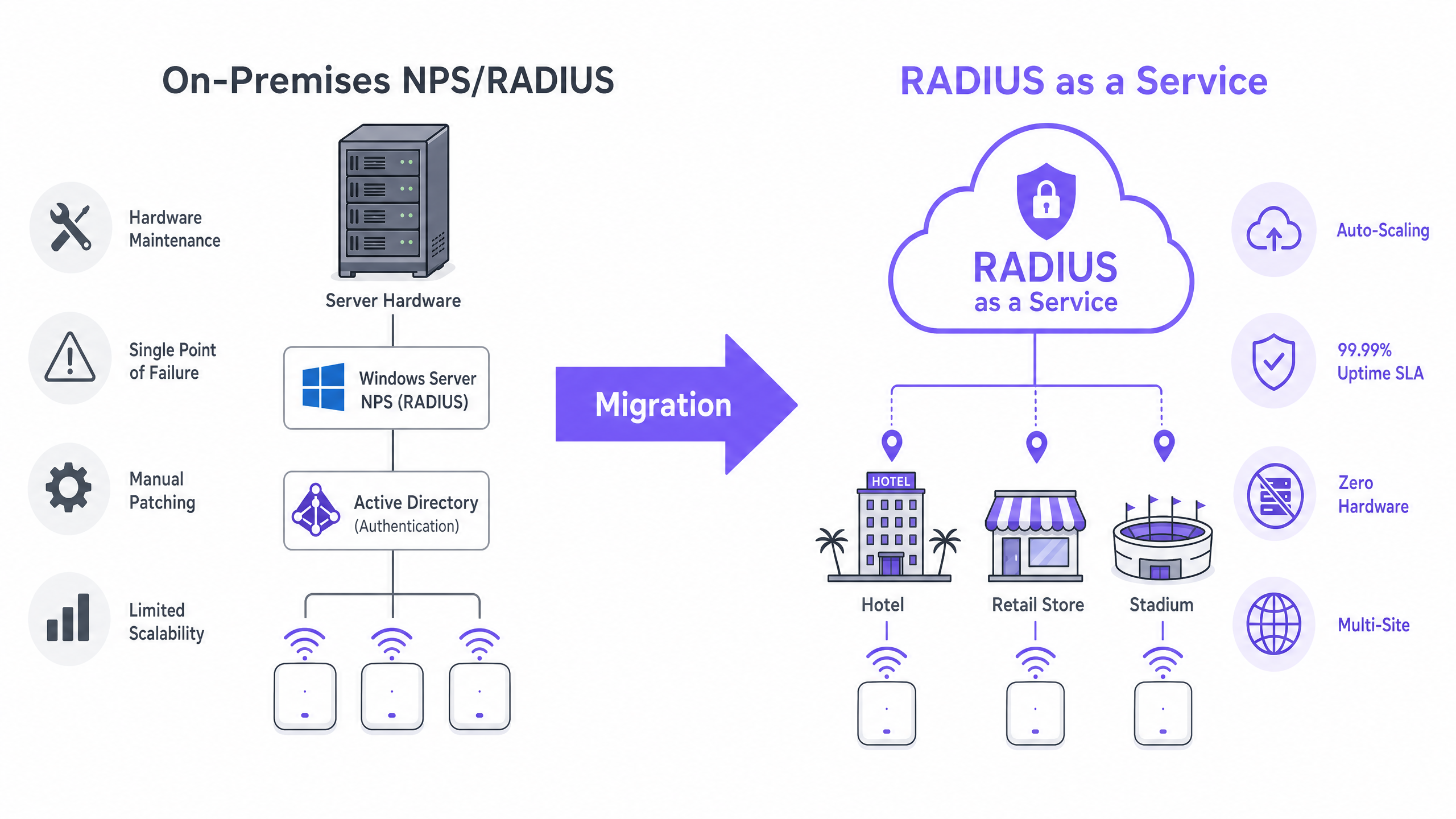
Les Limites du NPS sur Site
Dans un déploiement traditionnel, les points d'accès agissent comme le Network Access Server (NAS), transmettant les requêtes d'authentification à un serveur NPS sur site. Le serveur NPS évalue les politiques de requête de connexion, valide les identifiants par rapport à un magasin d'identités (généralement Active Directory via LDAP) et renvoie un message Access-Accept ou Access-Reject.
Ce modèle présente trois contraintes critiques pour les réseaux modernes :
- Dépendance et Maintenance Matérielles : NPS nécessite des machines physiques ou virtuelles dédiées, exigeant des correctifs continus, une planification de capacité et une gestion du cycle de vie.
- Complexité de la Haute Disponibilité : Atteindre la redondance nécessite le déploiement de NPS en paire de basculement, doublant les coûts de licence sans fournir une véritable redondance géographique.
- Goulots d'Étranglement de Débit : Pendant les pics de concurrence – comme l'entrée d'un stade ou les heures de pointe commerciales – une seule instance NPS peut devenir un goulot d'étranglement, entraînant des délais d'authentification et une expérience utilisateur dégradée.
L'Architecture RADIUS Cloud
RADIUS as a Service abstrait la couche d'authentification. Les fournisseurs de cloud exploitent des clusters de serveurs RADIUS distribués et géo-redondants. Le NAS pointe vers ces points de terminaison cloud, et les requêtes sont automatiquement équilibrées en charge.
Sécurité du Transport : Le Rôle de RadSec Lors du déplacement de RADIUS vers le cloud, le trafic d'authentification traverse l'internet public. Alors que RADIUS traditionnel utilise un secret partagé et le hachage MD5, les déploiements modernes doivent implémenter RadSec (RADIUS over TLS, RFC 6614). RadSec encapsule l'intégralité de la conversation RADIUS dans un tunnel TLS (généralement le port TCP 2083), fournissant un chiffrement de couche de transport équivalent à HTTPS et une authentification mutuelle entre le NAS et le point de terminaison RADIUS cloud.
Intégration d'Identité RADIUS cloud ne nécessite pas la migration de votre annuaire d'utilisateurs. Les services prennent généralement en charge les connexions LDAPS vers Active Directory sur site ou les intégrations API natives avec Azure Active Directory (Entra ID) via SAML ou SCIM. Cela garantit que vos processus de gestion du cycle de vie des utilisateurs existants restent intacts.
Pour les sites utilisant des plateformes Guest WiFi , RADIUS cloud s'intègre directement, offrant un plan de contrôle unifié pour l'authentification d'entreprise 802.1X et l'accès au réseau invité, avec des WiFi Analytics avancés.
Guide d'Implémentation : Une Méthodologie en 5 Phases
L'exécution d'une migration sans interruption nécessite une approche structurée et progressive.
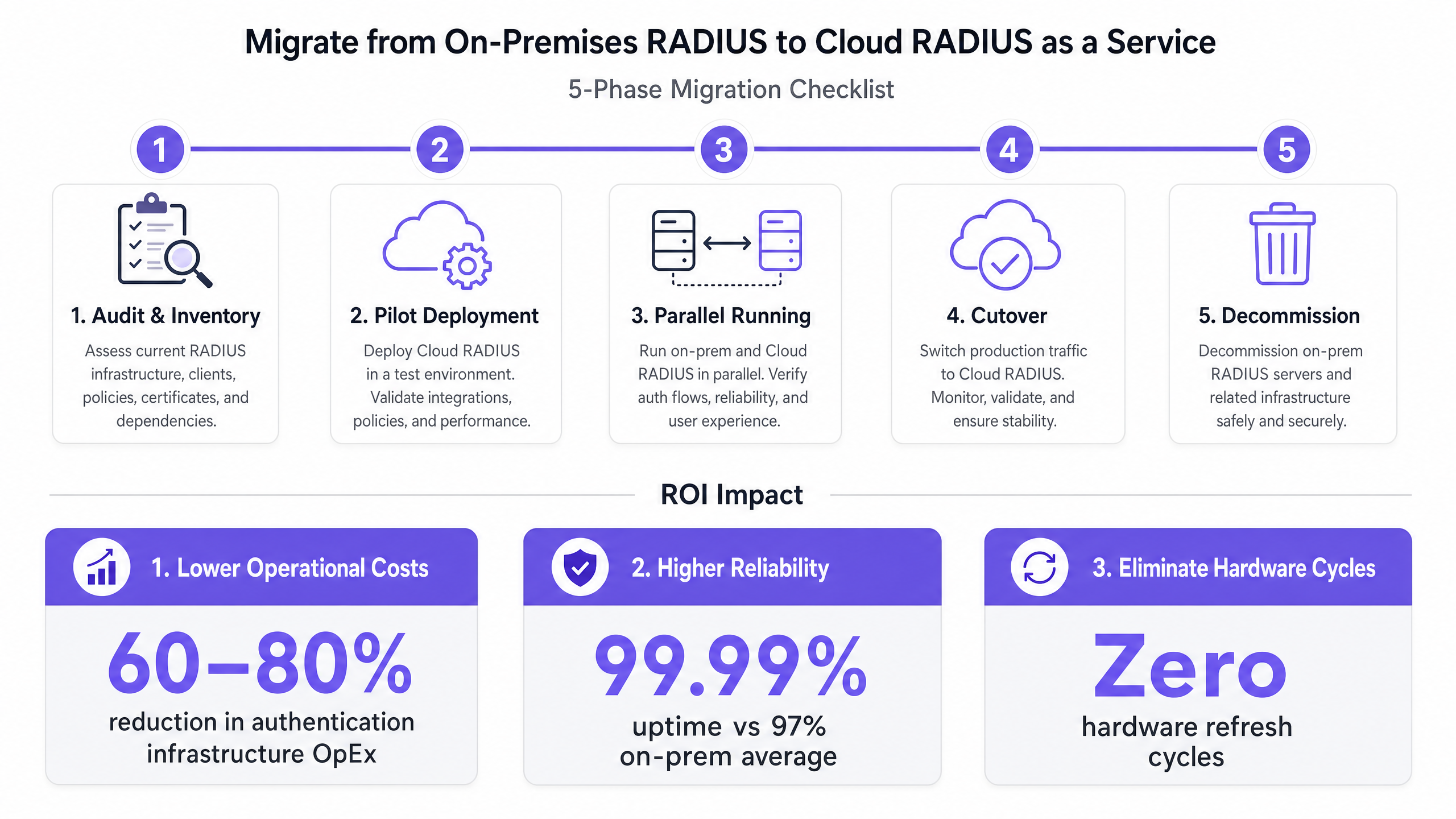
Phase 1 : Audit et Inventaire
Avant d'apporter des modifications, documentez l'état actuel :
- Clients RADIUS : Identifiez chaque NAS (points d'accès, commutateurs, concentrateurs VPN).
- Politiques : Documentez les politiques de requête de connexion et de réseau NPS existantes, y compris les attributs spécifiques au fournisseur (VSAs) utilisés pour l'affectation de VLAN.
- Méthodes EAP : Identifiez les méthodes Extensible Authentication Protocol en cours d'utilisation (par exemple, EAP-TLS, PEAP-MSCHAPv2).
Phase 2 : Déploiement Pilote
Provisionnez l'instance RADIUS cloud et configurez un SSID non-production ou un seul site de test. Validez l'intégration de l'annuaire d'identités (par exemple, la synchronisation Entra ID) et assurez-vous que la méthode EAP fonctionne de bout en bout.
Phase 3 : Fonctionnement en Parallèle (Atténuation des Risques)
Configurez les périphériques NAS de production pour utiliser à la fois le serveur RADIUS cloud (Principal) et le serveur NPS hérité (Secours). Exécutez cette configuration pendant au moins deux semaines. Surveillez les taux de réussite d'authentification, les métriques de latence et les flux de données de comptabilité pour identifier toute divergence de politique avant le basculement.
Phase 4 : Basculement
Lors d'une fenêtre de maintenance planifiée, supprimez la configuration de secours NPS héritée des périphériques NAS. Engagez-vous entièrement dans l'infrastructure cloud. Assurez-vous que votre procédure de restauration est documentée et testée.
Phase 5 : Décommissionnement
Après 30 jours de fonctionnement stable, décommissionnez en toute sécurité les serveurs NPS hérités et récupérez les ressources de calcul.
Bonnes Pratiques et Conformité
Lors de la conception de votre architecture RADIUS cloud, respectez les normes suivantes :
- Exiger RadSec : N'envoyez jamais de trafic RADIUS sur l'internet public en utilisant les ports UDP standard 1812/1813 si RadSec (TCP 2083) est pris en charge par votre matériel NAS.
- Chaînes de Confiance des Certificats : Assurez-vous que les périphériques clients font confiance au CertAutorité de certification (CA) qui a émis le certificat du serveur RADIUS cloud. Poussez l'autorité de certification racine vers les appareils gérés via MDM ou une stratégie de groupe avant la migration.
- Posture de conformité : Sélectionnez un fournisseur RADIUS cloud qui maintient la certification SOC 2 Type II et l'accréditation ISO 27001. Cela simplifie considérablement vos évaluations annuelles PCI DSS, en particulier pour les environnements de Commerce de détail et d' Hôtellerie .
Pour des principes de conception de réseau plus larges, consultez nos guides sur La configuration du WiFi pour les entreprises : Un guide stratégique pour 2026 et Comprendre le RSSI et la force du signal pour une planification optimale des canaux .
Dépannage et atténuation des risques
| Mode de défaillance | Cause première | Stratégie d'atténuation |
|---|---|---|
| Délais d'authentification | Pare-feu bloquant le trafic sortant UDP 1812/1813 ou TCP 2083. | Vérifiez que les règles du pare-feu périmétrique autorisent le trafic sortant vers les plages d'adresses IP spécifiques du fournisseur RADIUS cloud. |
| Erreurs de confiance de certificat | Les appareils clients ne disposent pas de l'autorité de certification racine dans leur magasin de confiance. | Déployez l'autorité de certification racine via MDM/GPO avant la phase 3 (Fonctionnement en parallèle). |
| Échec d'attribution de VLAN | Attributs spécifiques au fournisseur (VSA) non mappés correctement dans les politiques cloud. | Reproduisez les formats de chaîne VSA exacts de NPS vers le moteur de politique RADIUS cloud pendant la phase 1. |
| Impact d'une panne WAN | La perte d'internet entraîne la perte d'accès au RADIUS cloud. | Déployez des liens WAN redondants ou implémentez un proxy RADIUS local qui met en cache les identifiants des appareils connus. |
Retour sur investissement et impact commercial
La migration vers RADIUS as a Service offre des résultats commerciaux mesurables :
- Réduction des coûts : Élimine l'acquisition de matériel, les licences Windows Server et les heures d'ingénierie consacrées aux correctifs et à la maintenance. La réduction typique des OpEx est de 60 à 80 %.
- SLA de fiabilité : Les fournisseurs cloud offrent des SLA de disponibilité de 99,99 % garantis financièrement, comparés aux 97-98 % typiques atteints par les déploiements NPS sur site unique.
- Agilité : De nouveaux sites peuvent être mis en ligne instantanément sans provisionnement de matériel d'authentification local, accélérant les délais de déploiement pour les pôles de Transport et les établissements de Santé .
Écoutez notre équipe de consultants seniors discuter des implications stratégiques dans ce briefing de 10 minutes :
Définitions clés
RADIUS (Remote Authentication Dial-In User Service)
A networking protocol that provides centralized Authentication, Authorization, and Accounting (AAA) management for users who connect and use a network service.
The core protocol used by enterprise WiFi networks to validate user credentials before granting network access.
NPS (Network Policy Server)
Microsoft's implementation of a RADIUS server and proxy, bundled as a role in Windows Server.
The legacy on-premises infrastructure that organizations are actively migrating away from to reduce maintenance overhead.
NAS (Network Access Server)
The device that acts as the gateway to the network and passes authentication requests to the RADIUS server.
In a wireless context, the NAS is typically the WiFi Access Point or Wireless LAN Controller.
RadSec (RADIUS over TLS)
A protocol defined in RFC 6614 that transports RADIUS packets over a TCP connection encrypted with TLS.
Essential for cloud RADIUS deployments to ensure credential data is encrypted while traversing the public internet.
EAP (Extensible Authentication Protocol)
An authentication framework frequently used in wireless networks and point-to-point connections.
Determines how the client and server securely exchange credentials (e.g., certificates via EAP-TLS, or passwords via PEAP).
VSA (Vendor-Specific Attribute)
Custom attributes defined by hardware vendors within the RADIUS protocol to support proprietary features.
Crucial during migration; VSAs are often used to assign authenticated users to specific network VLANs dynamically.
LDAPS (Lightweight Directory Access Protocol over SSL)
A secure protocol for querying and modifying directory services like Active Directory.
Used by cloud RADIUS services to securely query on-premises identity stores without migrating the user directory to the cloud.
802.1X
An IEEE standard for port-based network access control (PNAC).
The underlying standard that uses RADIUS to ensure only authenticated devices can pass traffic onto the enterprise LAN or WLAN.
Exemples concrets
A 200-property hotel group currently runs local NPS servers at each site for staff 802.1X authentication. They are migrating to Entra ID (Azure AD) and want to decommission the local servers. How should they approach the migration?
- Deploy a cloud RADIUS service that integrates natively with Entra ID via SAML/SCIM.
- Configure the cloud RADIUS policies to map Entra ID groups (e.g., 'Front Desk', 'Management') to specific VLAN VSAs.
- At a pilot property, configure the access points to use RadSec to connect to the cloud RADIUS endpoint.
- Push the cloud RADIUS server's Root CA to all staff devices via Microsoft Intune.
- Run parallel authentication at the pilot site, then execute a phased rollout across the remaining 199 properties.
A stadium with 50,000 capacity experiences authentication failures on their corporate SSID during major events because their on-premises NPS server cannot handle the throughput of thousands of devices roaming simultaneously.
- Audit the existing NPS policies and EAP methods.
- Provision a cloud RADIUS service capable of auto-scaling to handle high authentications per second (APS).
- Establish an LDAPS connection from the cloud RADIUS service to the stadium's on-premises Active Directory.
- Update the stadium's high-density wireless LAN controllers to point to the cloud RADIUS endpoints as the primary authentication servers.
Questions d'entraînement
Q1. Your organization is migrating to Cloud RADIUS. The security team mandates that no authentication traffic can be sent over the internet in cleartext or using deprecated hashing algorithms like MD5. What protocol must you configure on your wireless LAN controllers?
Conseil : Look for the protocol that wraps RADIUS in a TLS tunnel.
Voir la réponse type
You must configure RadSec (RADIUS over TLS). RadSec establishes a TLS tunnel over TCP port 2083 between the NAS and the cloud RADIUS server, providing transport-layer encryption and mutual authentication, satisfying the security team's requirements.
Q2. During Phase 3 (Parallel Running) of your migration, you notice that users are authenticating successfully against the cloud RADIUS server, but they are not being placed in the correct network segments. What is the most likely configuration gap?
Conseil : How does a RADIUS server tell an access point which network segment to use?
Voir la réponse type
The Vendor-Specific Attributes (VSAs) for dynamic VLAN assignment have not been configured correctly in the cloud RADIUS policies. You must ensure the exact VSA strings used in the legacy NPS server are replicated in the cloud environment so the NAS knows which VLAN to assign to the user.
Q3. A client device is repeatedly failing EAP-TLS authentication against the new cloud RADIUS service, but it works fine against the legacy NPS server. The device logs show an 'untrusted server' error. How do you resolve this?
Conseil : EAP-TLS requires the client to trust the server's identity.
Voir la réponse type
The client device does not have the Root Certificate Authority (CA) that issued the cloud RADIUS server's certificate in its trusted root store. You must deploy the Root CA to the client device using a Mobile Device Management (MDM) solution or Group Policy.