

O Guia Completo para WiFi de Convidados para Empresas
Este guia técnico definitivo oferece a líderes de TI e arquitetos de rede um plano abrangente para implementar, proteger e monetizar o WiFi de convidados empresarial. Ele preenche a lacuna entre a infraestrutura de rede física, padrões de conformidade como GDPR e PCI DSS, e o valor comercial desbloqueado através da captura de dados primários.
🎧 Ouça este Guia
Ver Transcrição
Resumo Executivo
Para as empresas modernas, o WiFi de convidados evoluiu de um simples centro de custo para um ativo de infraestrutura crítico capaz de gerar um retorno comercial significativo. Quer operem em Retalho , Hotelaria ou grandes espaços públicos, os líderes de TI enfrentam um duplo mandato: fornecer conectividade contínua e de alto desempenho, enquanto simultaneamente capturam dados primários de forma segura e em conformidade.
Este guia fornece um plano arquitetónico definitivo para o WiFi de convidados empresarial. Detalhamos os requisitos técnicos para a segmentação de rede, os padrões criptográficos necessários para uma autenticação segura e as metodologias de implementação exigidas para prevenir a saturação da rede. Além disso, examinamos como plataformas como a Purple preenchem a lacuna entre o hardware de rede e a tecnologia de marketing, transformando endereços MAC anónimos em perfis de clientes acionáveis através de captive portals em conformidade. Ao tratar o WiFi de convidados como uma implementação estratégica, em vez de uma utilidade, as organizações podem alcançar um ROI mensurável, mitigando os riscos de segurança inerentes às redes de acesso público.
Ouça o podcast de briefing técnico complementar:
Análise Técnica Aprofundada: Arquitetura e Padrões
A base de qualquer implementação de WiFi de convidados empresarial é uma segmentação de rede rigorosa e protocolos de autenticação robustos. Implementar um SSID aberto sem salvaguardas estruturais introduz um risco inaceitável para os dados corporativos e sistemas de pagamento.
Segmentação de Rede e Etiquetagem VLAN
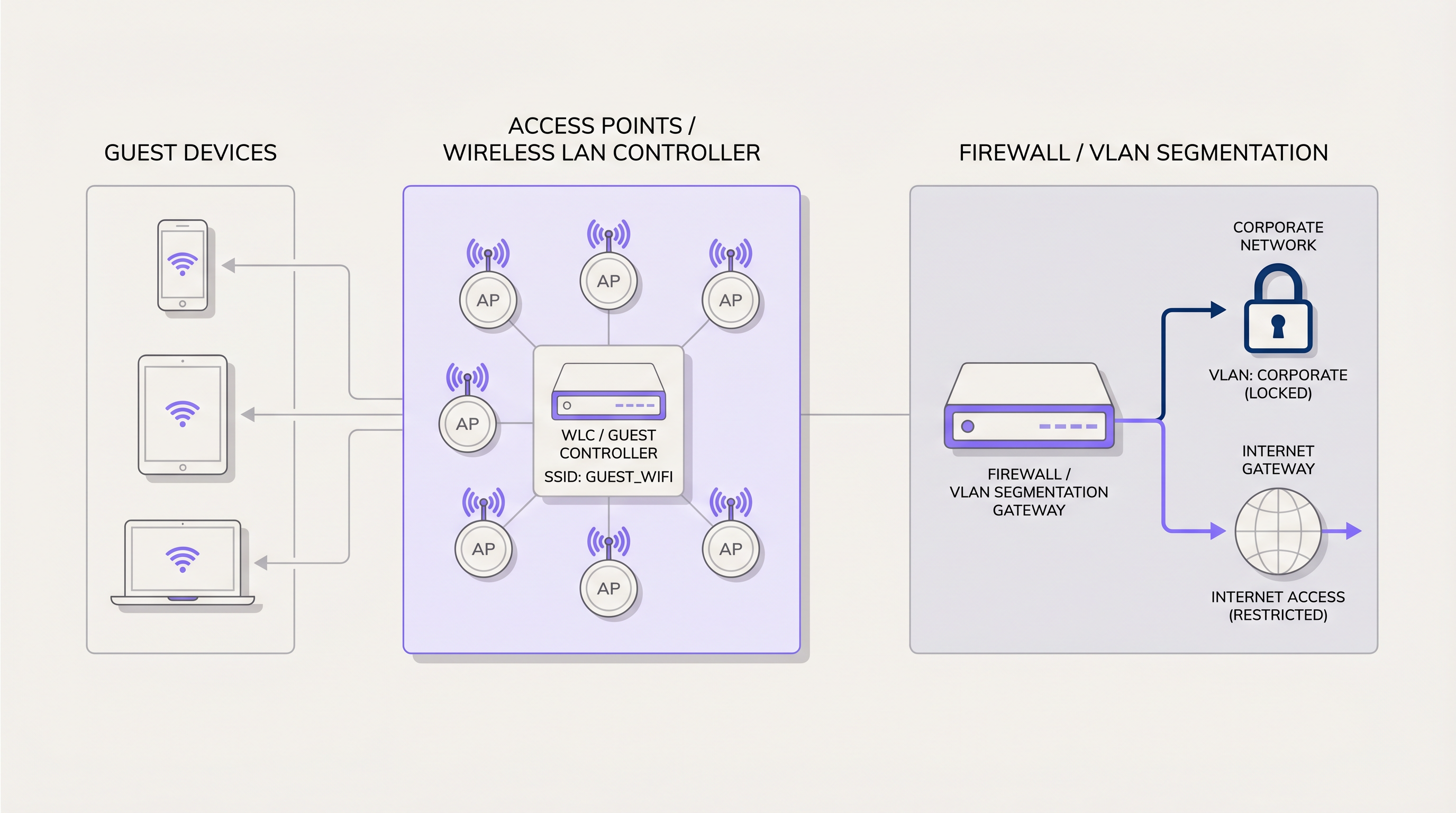
O tráfego de convidados deve ser isolado nas Camadas 2 e 3. O modelo de implementação padrão exige o mapeamento do SSID de convidados para uma Rede Local Virtual (VLAN) dedicada no Ponto de Acesso (AP) ou Controlador de Rede Local Sem Fios (WLC). Esta VLAN deve ser interligada através da infraestrutura de switching central diretamente para a firewall de borda.
Na firewall, Listas de Controlo de Acesso (ACLs) rigorosas devem impor uma política de "negar tudo" para o tráfego destinado a sub-redes corporativas internas. O tráfego de convidados só deve ser permitido para rotear para o gateway da internet. Esta segmentação não é meramente uma boa prática; é um requisito fundamental para estruturas de conformidade como o PCI DSS. Se um dispositivo de convidado comprometido puder rotear pacotes para um terminal de ponto de venda, toda a rede fica fora de conformidade.
Padrões de Autenticação e Criptografia
A era das redes de convidados abertas e não encriptadas está a terminar. Para proteger os dados do utilizador de escutas passivas e ataques man-in-the-middle, as implementações devem utilizar WPA3. Especificamente, WPA3-SAE (Simultaneous Authentication of Equals) oferece sigilo de encaminhamento, garantindo que, mesmo que a palavra-passe da rede seja conhecida, o tráfego de sessão individual permanece encriptado e não pode ser desencriptado retrospetivamente.
Para ambientes que exigem controlo de acesso granular, o IEEE 802.1X com autenticação de backend RADIUS oferece segurança de nível empresarial. Ao transmitir pedidos de autenticação através de Redes de Longa Distância (WANs) para fornecedores de identidade na cloud, proteger o próprio tráfego RADIUS é crítico. As equipas de TI devem implementar RadSec: Securing RADIUS Authentication Traffic with TLS para prevenir a interceção de credenciais. A Purple atua como um fornecedor de identidade robusto nestas arquiteturas, integrando-se perfeitamente com a infraestrutura RADIUS existente e suportando padrões de roaming modernos como o OpenRoaming.
Planeamento de Débito e Capacidade
Em ambientes de alta densidade, o débito é limitado não pelo uplink da internet, mas pela equidade do tempo de antena e pela utilização do canal. A implementação de APs que suportam Wi-Fi 6 (802.11ax) é essencial para mitigar estes estrangulamentos. As capacidades de Acesso Múltiplo por Divisão de Frequência Ortogonal (OFDMA) do Wi-Fi 6 permitem que um único AP comunique com múltiplos clientes simultaneamente, reduzindo drasticamente a latência em áreas lotadas.
Além disso, as equipas de TI devem implementar limitação de taxa por utilizador ao nível do controlador ou da firewall. A atribuição de um limite de largura de banda rigoroso (por exemplo, 10 Mbps de download / 2 Mbps de upload por utilizador) impede que um único cliente monopolize o uplink da internet com aplicações de alta largura de banda, garantindo uma experiência de base consistente para todos os convidados.
Guia de Implementação: Do Hardware ao Portal
A implementação de uma rede WiFi de convidados resiliente requer uma abordagem sistemática, integrando o planeamento de RF físico com plataformas de análise baseadas na cloud.
Fase 1: Planeamento de RF e Levantamento do Local
Antes da aquisição de hardware, um levantamento preditivo de RF do local é obrigatório. A utilização de ferramentas de software para modelar o ambiente físico — considerando a atenuação das paredes, alturas dos tetos e densidade de utilizadores — permite aos arquitetos de rede determinar o posicionamento ideal dos APs e a alocação de canais. Isto mitiga a interferência de co-canal e garante uma relação sinal-ruído (SNR) suficiente em todo o local.
Fase 2: Configuração da Infraestrutura
Uma vez que o hardware esteja fisicamente implementado, configure o WLC para difundir o SSID de convidados dedicado. Certifique-se de que a VLAN correspondente está corretamente etiquetada em todas as portas trunk do switch. Na borda da firewall, verifique se os âmbitos DHCP têm o tamanho adequado para o número esperado de utilizadores concorrentes; uma sub-rede /24 (254 endereços) raramente é suficiente para locais empresariais. Implemente filtragem DNS para bloquear domínios maliciosos e conteúdo adulto ao nível da rede.
Fase 3: Integração do Captive Portal
O captive portal é o ponto de integração crítico entre a infraestrutura de rede e a to objetivo de negócio. Em vez de uma página de apresentação genérica, o WLC é configurado para redirecionar o tráfego de convidados não autenticados para um Captive Portal externo alojado por uma plataforma de Guest WiFi como a Purple.
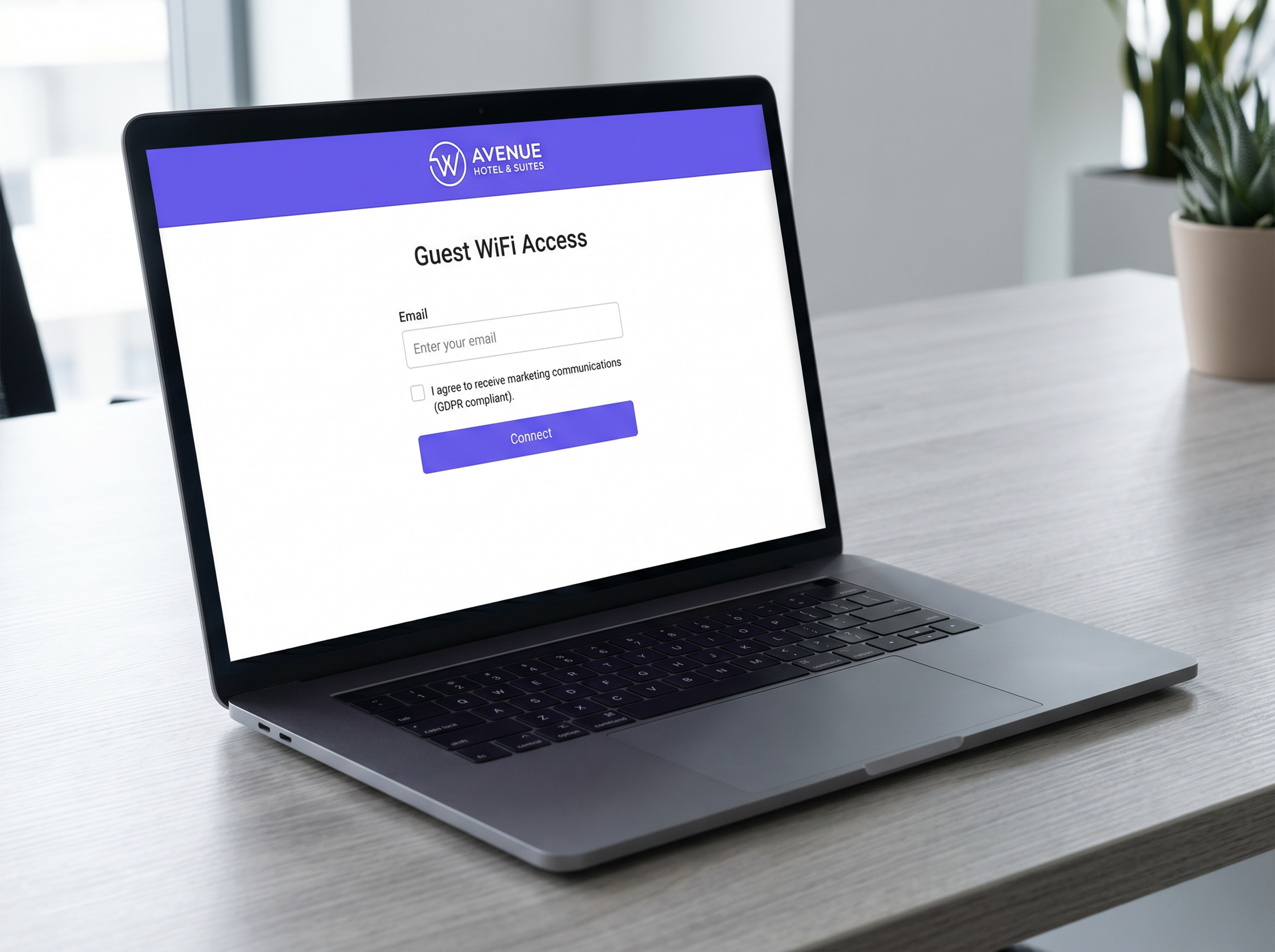
Este portal deve ser concebido para autenticar utilizadores através de métodos padrão (email, SMS, login social) enquanto capta dados primários. Crucialmente, o portal deve gerir os requisitos complexos de conformidade com o GDPR, apresentando opções de consentimento granular e registando a data e hora exatas e os termos acordados pelo utilizador.
Fase 4: Analytics e Automação de Marketing
Uma vez autenticado, o endereço MAC do dispositivo do utilizador é associado ao seu perfil demográfico. Estes dados fluem para um dashboard de WiFi Analytics , proporcionando à TI visibilidade sobre os tempos de permanência e o fluxo de visitantes, ao mesmo tempo que capacita as equipas de marketing a desencadear campanhas automatizadas com base na frequência de visitas.
Melhores Práticas e Conformidade
A adesão aos padrões da indústria protege o negócio de multas regulatórias e danos à reputação.
- Mecanismos de Consentimento Explícito: Ao abrigo do GDPR e da Lei de Proteção de Dados do Reino Unido, o consentimento para comunicações de marketing deve ser dado livremente, ser específico e inequívoco. Caixas pré-selecionadas em Captive Portals são estritamente proibidas. A plataforma deve manter um registo auditável de todas as transações de consentimento.
- Políticas de Retenção de Dados: Implemente políticas automatizadas de purga de dados. Os dados de convidados não devem ser retidos indefinidamente. Configure a plataforma de analytics para anonimizar ou eliminar registos após um período definido de inatividade (por exemplo, 24 meses).
- Filtragem de Conteúdo: As redes públicas devem implementar filtragem de conteúdo baseada em DNS para prevenir o acesso a material ilegal ou inapropriado, protegendo o local de responsabilidade e garantindo um ambiente familiar.
Resolução de Problemas e Mitigação de Riscos
Mesmo redes bem concebidas encontram problemas. Compreender os modos de falha comuns acelera o tempo de resolução.
Esgotamento de DHCP
Sintoma: Os convidados conseguem associar-se ao AP, mas recebem um endereço APIPA (169.254.x.x) e não conseguem aceder ao portal. Mitigação: Diminua os tempos de concessão de DHCP (por exemplo, para 2 horas em vez de 24 horas) em ambientes de alta rotatividade, como lojas de retalho. Garanta que o tamanho da sub-rede corresponde às estimativas de pico de fluxo de visitantes.
Falhas de Interceção do Captive Portal
Sintoma: Os convidados conectam-se à rede, mas o Captive Portal não aparece automaticamente (falha de CNA). Mitigação: Garanta que o "Walled Garden" ou as ACLs de pré-autenticação no WLC permitem o tráfego para os endereços IP do Captive Portal e os domínios CDN necessários. Se o sistema operativo não conseguir alcançar o seu URL de deteção de Captive Portal (por exemplo, captive.apple.com), o portal não será acionado.
Pontos de Acesso Maliciosos
Sintoma: APs não autorizados a difundir SSIDs semelhantes ou conectados à LAN corporativa. Mitigação: Ative os Sistemas de Deteção de Intrusão Sem Fios (WIDS) no WLC para detetar e conter automaticamente APs maliciosos, enviando frames de desautenticação para clientes conectados.
ROI e Impacto no Negócio
A transição de uma rede padrão para uma plataforma WiFi inteligente produz resultados de negócio mensuráveis. Ao alavancar os dados capturados através do Captive Portal, as empresas podem gerar receita tangível.
Por exemplo, em Healthcare , os analytics podem otimizar o fluxo de pacientes e reduzir os tempos de espera. No retalho, a integração de dados WiFi com sistemas CRM permite campanhas de retargeting direcionadas — enviando uma oferta promocional a um cliente que não visitou em 90 dias. Além disso, a adoção de paradigmas de rede modernos, como os discutidos em Os Principais Benefícios do SD WAN para Empresas Modernas , permite que operadores multi-site gerenciem centralmente estas políticas em centenas de localizações, reduzindo significativamente os custos operacionais.
Termos-Chave e Definições
VLAN (Virtual Local Area Network)
A logical grouping of network devices that acts as if they are on their own independent network, regardless of physical location.
Used to isolate guest WiFi traffic from corporate traffic on the same physical switches and access points.
Captive Portal
A web page that a user of a public-access network is obliged to view and interact with before access is granted.
The primary interface for authenticating users, capturing first-party marketing data, and securing GDPR consent.
Walled Garden
A limited environment that controls the user's access to web content and services before they have fully authenticated.
Essential for allowing devices to load the captive portal page and associated assets (like logos or social login APIs) before internet access is granted.
WPA3-SAE
Wi-Fi Protected Access 3 with Simultaneous Authentication of Equals. The modern standard for wireless encryption.
Replaces WPA2-PSK to provide forward secrecy, preventing attackers from decrypting captured traffic even if they later discover the network password.
OFDMA
Orthogonal Frequency Division Multiple Access. A feature of Wi-Fi 6 that allows an access point to divide a channel into smaller sub-channels.
Crucial for high-density venues (stadiums, conferences) as it allows simultaneous transmission to multiple clients, drastically reducing latency.
MAC Address
Media Access Control address. A unique identifier assigned to a network interface controller for use as a network address.
Used by analytics platforms to track unique device visits, dwell time, and return frequency, even before the user authenticates.
DHCP Exhaustion
A state where a network's DHCP server has no more IP addresses available to assign to new clients.
A common failure in retail environments where footfall is high but the IP subnet is too small or lease times are set too long.
PCI DSS
Payment Card Industry Data Security Standard. A set of security standards designed to ensure that all companies that accept, process, store or transmit credit card information maintain a secure environment.
The primary regulatory reason why guest WiFi must be strictly segmented from point-of-sale (POS) systems.
Estudos de Caso
A 400-room luxury hotel is experiencing severe guest complaints regarding WiFi speeds during the evening hours (7 PM - 10 PM). The internet uplink is a dedicated 1 Gbps fibre circuit. Network monitoring shows the uplink is fully saturated during these times.
The IT team must implement per-device bandwidth rate limiting. On the Wireless LAN Controller or edge firewall, a QoS policy should be applied to the guest VLAN, capping individual client throughput to 15 Mbps download and 5 Mbps upload. Additionally, application-layer filtering should be enabled to throttle peer-to-peer (P2P) file sharing protocols.
A national retail chain wants to implement a captive portal to collect customer emails for marketing, but the legal team is concerned about GDPR compliance following recent ICO fines in the sector.
The deployment must utilize a dedicated Guest WiFi platform like Purple that handles consent natively. The captive portal must be configured with an unticked checkbox explicitly stating: 'I consent to receive marketing communications.' The platform must automatically record the user's MAC address, IP address, timestamp, and the exact text of the consent agreement. A secondary option to connect without providing marketing consent must be available.
Análise de Cenários
Q1. A stadium IT director is planning a network upgrade for a 50,000-seat venue. The current Wi-Fi 5 (802.11ac) network collapses during half-time. They are considering deploying more APs of the same model to increase coverage. Do you agree with this approach?
💡 Dica:Consider the difference between coverage and capacity, and how Wi-Fi 5 handles concurrent client transmissions.
Mostrar Abordagem Recomendada
No. Deploying more Wi-Fi 5 APs in a high-density environment will likely increase co-channel interference without solving the capacity issue. The venue requires an upgrade to Wi-Fi 6 (802.11ax) APs. The OFDMA technology in Wi-Fi 6 is specifically designed for high-density environments, allowing the AP to communicate with multiple clients simultaneously, rather than the sequential transmission limitation of Wi-Fi 5.
Q2. A retail client wants to use their guest WiFi to track how many people walk past their store versus how many enter, using MAC address probing. However, they are concerned about MAC randomization features in modern iOS and Android devices. How should you advise them?
💡 Dica:Consider the limitations of passive tracking versus active authentication.
Mostrar Abordagem Recomendada
Advise the client that while passive MAC tracking (probing) can provide directional trends, MAC randomization significantly reduces its absolute accuracy for unique user counts. The architectural solution is to incentivize active connection to the captive portal. Once a user authenticates, the platform associates the current MAC address with a known identity (e.g., email), providing highly accurate analytics for that session.
Q3. During a network audit, you discover that the guest WiFi subnet (10.0.50.0/24) can ping the IP address of the venue's internal Active Directory server (10.0.10.5). What is the immediate architectural remediation?
💡 Dica:Focus on Layer 3 routing and firewall policies.
Mostrar Abordagem Recomendada
Immediate remediation requires updating the Access Control Lists (ACLs) on the core firewall/router. A rule must be placed at the top of the ACL for the guest VLAN interface that explicitly denies all traffic destined for RFC 1918 private IP space (10.0.0.0/8, 172.16.0.0/12, 192.168.0.0/16), followed by a rule permitting traffic to the internet (0.0.0.0/0).




