

La Guida Completa al Guest WiFi per le Aziende
Questa guida tecnica definitiva fornisce ai leader IT e agli architetti di rete un progetto completo per la distribuzione, la sicurezza e la monetizzazione del guest WiFi aziendale. Colma il divario tra l'infrastruttura di rete fisica, gli standard di conformità come GDPR e PCI DSS, e il valore commerciale sbloccato attraverso l'acquisizione di dati di prima parte.
🎧 Ascolta questa guida
Visualizza trascrizione
Riepilogo Esecutivo
Per le aziende moderne, il guest WiFi si è evoluto da un semplice centro di costo a un asset infrastrutturale critico in grado di generare un significativo ritorno commerciale. Sia che operino nel Retail , nell' Hospitality o in grandi luoghi pubblici, i leader IT affrontano un duplice mandato: fornire connettività senza interruzioni e ad alte prestazioni, catturando al contempo dati di prima parte in modo sicuro e conforme.
Questa guida fornisce un progetto architettonico definitivo per il guest WiFi aziendale. Dettagliamo i requisiti tecnici per la segmentazione della rete, gli standard crittografici necessari per l'autenticazione sicura e le metodologie di distribuzione richieste per prevenire la saturazione della rete. Inoltre, esaminiamo come piattaforme come Purple colmino il divario tra l'hardware di rete e la tecnologia di marketing, trasformando gli indirizzi MAC anonimi in profili cliente utilizzabili tramite Captive Portal conformi. Trattando il guest WiFi come una distribuzione strategica piuttosto che come un'utilità, le organizzazioni possono ottenere un ROI misurabile mitigando al contempo i rischi di sicurezza intrinseci delle reti ad accesso pubblico.
Ascolta il podcast tecnico di accompagnamento:
Approfondimento Tecnico: Architettura e Standard
La base di qualsiasi distribuzione di guest WiFi aziendale è una rigorosa segmentazione della rete e robusti protocolli di autenticazione. La distribuzione di un SSID aperto senza salvaguardie strutturali introduce un rischio inaccettabile per i dati aziendali e i sistemi di pagamento.
Segmentazione della Rete e Tagging VLAN
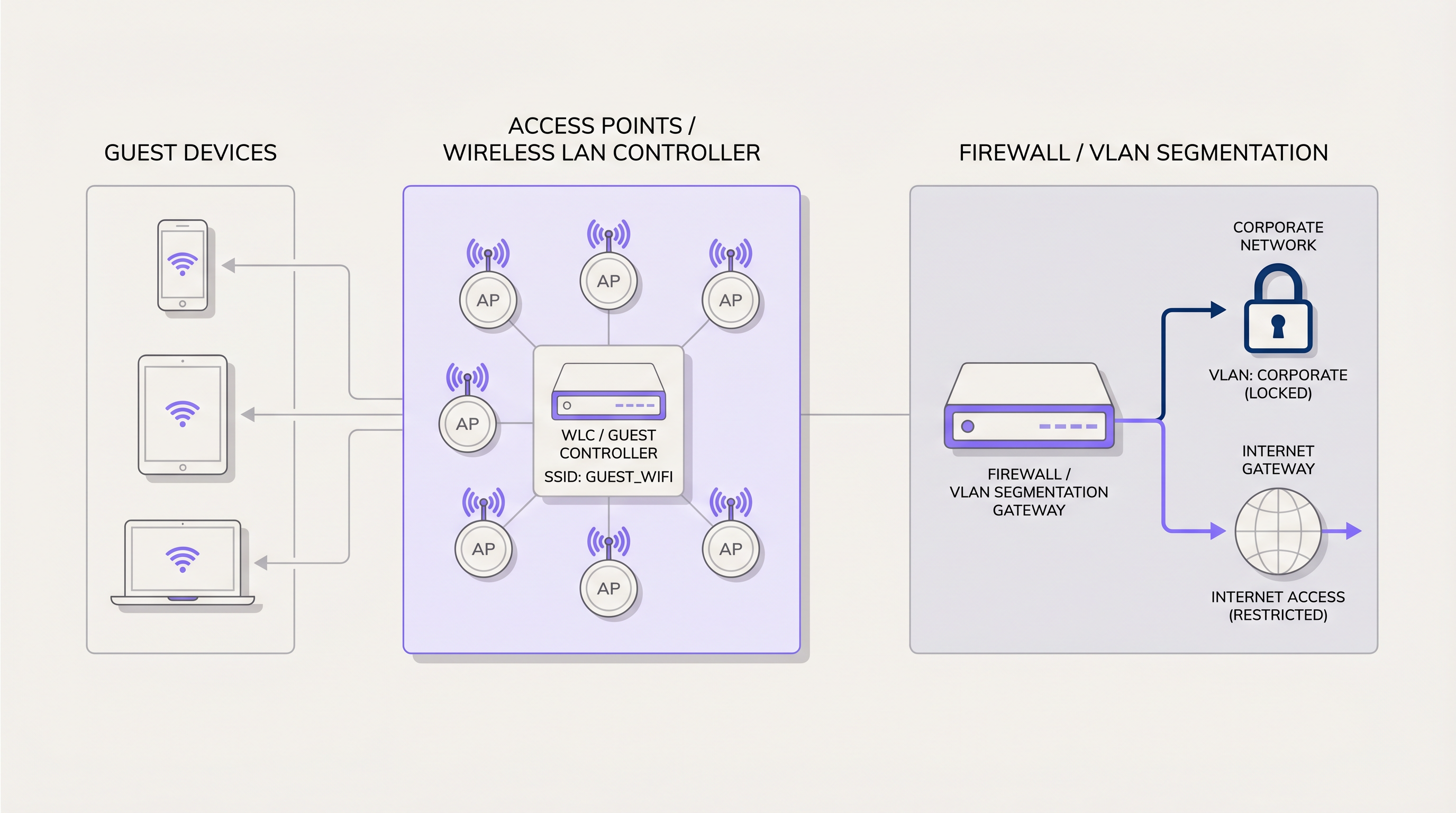
Il traffico guest deve essere isolato a Livello 2 e Livello 3. Il modello di distribuzione standard richiede la mappatura dell'SSID guest a una Virtual Local Area Network (VLAN) dedicata sull'Access Point (AP) o sul Wireless LAN Controller (WLC). Questa VLAN deve essere instradata attraverso l'infrastruttura di switching centrale direttamente al firewall di bordo.
Sul firewall, le rigide Access Control Lists (ACL) devono imporre una politica di "deny all" per il traffico destinato alle sottoreti aziendali interne. Il traffico guest dovrebbe essere consentito solo per l'instradamento al gateway internet. Questa segmentazione non è solo una best practice; è un requisito fondamentale per i framework di conformità come PCI DSS. Se un dispositivo guest compromesso può instradare pacchetti a un terminale punto vendita, l'intera rete non è più conforme.
Standard di Autenticazione e Crittografia
L'era delle reti guest aperte e non crittografate sta finendo. Per proteggere i dati degli utenti da intercettazioni passive e attacchi man-in-the-middle, le distribuzioni dovrebbero sfruttare WPA3. Nello specifico, WPA3-SAE (Simultaneous Authentication of Equals) fornisce la forward secrecy, garantendo che anche se la passphrase di rete è nota, il traffico delle singole sessioni rimanga crittografato e non possa essere decifrato retrospettivamente.
Per gli ambienti che richiedono un controllo granulare degli accessi, IEEE 802.1X con autenticazione backend RADIUS fornisce sicurezza di livello enterprise. Quando si trasmettono richieste di autenticazione attraverso Wide Area Networks (WAN) a fornitori di identità cloud, la protezione del traffico RADIUS stesso è fondamentale. I team IT dovrebbero implementare RadSec: Securing RADIUS Authentication Traffic with TLS per prevenire l'intercettazione delle credenziali. Purple agisce come un robusto fornitore di identità in queste architetture, integrandosi senza soluzione di continuità con l'infrastruttura RADIUS esistente e supportando standard di roaming moderni come OpenRoaming.
Throughput e Pianificazione della Capacità
Negli ambienti ad alta densità, il throughput è limitato non dall'uplink internet, ma dall'equità del tempo di trasmissione e dall'utilizzo del canale. La distribuzione di AP che supportano Wi-Fi 6 (802.11ax) è essenziale per mitigare questi colli di bottiglia. Le capacità Orthogonal Frequency Division Multiple Access (OFDMA) del Wi-Fi 6 consentono a un singolo AP di comunicare con più client contemporaneamente, riducendo drasticamente la latenza nelle aree affollate.
Inoltre, i team IT devono implementare la limitazione della velocità per utente a livello di controller o firewall. L'allocazione di un limite di banda rigoroso (ad esempio, 10 Mbps in download / 2 Mbps in upload per utente) impedisce a un singolo client di monopolizzare l'uplink internet con applicazioni ad alta larghezza di banda, garantendo un'esperienza di base coerente per tutti gli ospiti.
Guida all'Implementazione: Dall'Hardware al Portale
La distribuzione di una rete WiFi guest resiliente richiede un approccio sistematico, che integri la pianificazione RF fisica con piattaforme di analisi basate su cloud.
Fase 1: Pianificazione RF e Site Survey
Prima dell'acquisto dell'hardware, è obbligatoria una site survey RF predittiva. L'utilizzo di strumenti software per modellare l'ambiente fisico – tenendo conto dell'attenuazione delle pareti, delle altezze dei soffitti e della densità degli utenti – consente agli architetti di rete di determinare il posizionamento ottimale degli AP e l'allocazione dei canali. Ciò mitiga l'interferenza co-canale e garantisce un sufficiente rapporto segnale/rumore (SNR) in tutta la sede.
Fase 2: Configurazione dell'Infrastruttura
Una volta che l'hardware è fisicamente distribuito, configurare il WLC per trasmettere l'SSID guest dedicato. Assicurarsi che la VLAN corrispondente sia correttamente taggata su tutte le porte trunk dello switch. Al bordo del firewall, verificare che gli ambiti DHCP siano dimensionati adeguatamente per il numero di utenti concorrenti previsto; una sottorete /24 (254 indirizzi) è raramente sufficiente per le sedi aziendali. Implementare il filtraggio DNS per bloccare domini dannosi e contenuti per adulti a livello di rete.
Fase 3: Integrazione del Captive Portal
Il Captive Portal è il punto di integrazione critico tra l'infrastruttura di rete e l'l'obiettivo aziendale. Invece di una pagina splash generica, il WLC è configurato per reindirizzare il traffico guest non autenticato a un Captive Portal esterno ospitato da una piattaforma Guest WiFi come Purple.
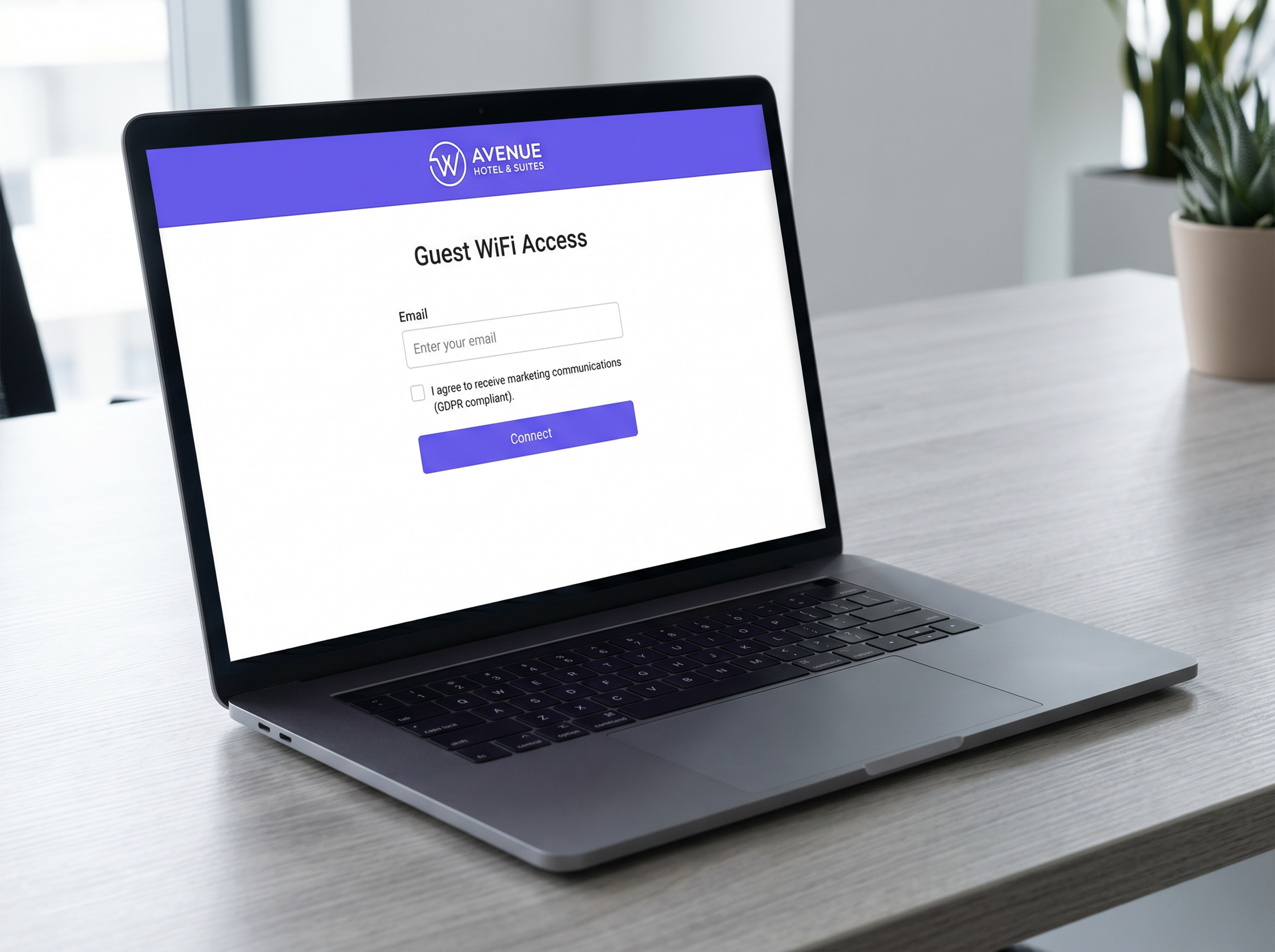
Questo portale deve essere progettato per autenticare gli utenti tramite metodi standard (email, SMS, social login) acquisendo al contempo dati di prima parte. Fondamentale è che il portale gestisca i complessi requisiti di conformità GDPR, presentando opzioni di consenso granulari e registrando l'esatto timestamp e i termini accettati dall'utente.
Fase 4: Analisi e Automazione del Marketing
Una volta autenticato, l'indirizzo MAC del dispositivo dell'utente viene associato al suo profilo demografico. Questi dati confluiscono in una dashboard di WiFi Analytics , fornendo all'IT visibilità sui tempi di permanenza e sull'affluenza, e consentendo ai team di marketing di attivare campagne automatizzate basate sulla frequenza delle visite.
Best Practice e Conformità
L'adesione agli standard di settore protegge l'azienda da sanzioni normative e danni alla reputazione.
- Meccanismi di Consenso Esplicito: Ai sensi del GDPR e del UK Data Protection Act, il consenso per le comunicazioni di marketing deve essere dato liberamente, essere specifico e inequivocabile. Le caselle preselezionate sui Captive Portal sono severamente proibite. La piattaforma deve mantenere un registro verificabile di tutte le transazioni di consenso.
- Politiche di Conservazione dei Dati: Implementare politiche automatizzate di eliminazione dei dati. I dati degli ospiti non devono essere conservati indefinitamente. Configurare la piattaforma di analisi per anonimizzare o eliminare i record dopo un periodo definito di inattività (es. 24 mesi).
- Filtro Contenuti: Le reti pubbliche devono implementare un filtro contenuti basato su DNS per prevenire l'accesso a materiale illegale o inappropriato, proteggendo la sede da responsabilità e garantendo un ambiente adatto alle famiglie.
Risoluzione dei Problemi e Mitigazione dei Rischi
Anche le reti ben progettate incontrano problemi. Comprendere le modalità di guasto comuni accelera i tempi di risoluzione.
Esaurimento DHCP
Sintomo: Gli ospiti possono associarsi all'AP ma ricevono un indirizzo APIPA (169.254.x.x) e non possono accedere al portale. Mitigazione: Diminuire i tempi di lease DHCP (es. a 2 ore invece di 24 ore) in ambienti ad alto turnover come i negozi al dettaglio. Assicurarsi che la dimensione della sottorete corrisponda alle stime di affluenza massima.
Errori di Intercettazione del Captive Portal
Sintomo: Gli ospiti si connettono alla rete ma il Captive Portal non appare automaticamente (errore CNA). Mitigazione: Assicurarsi che il "Walled Garden" o le ACL di pre-autenticazione sul WLC consentano il traffico verso gli indirizzi IP del Captive Portal e i domini CDN necessari. Se il sistema operativo non riesce a raggiungere il suo URL di rilevamento del Captive Portal (es. captive.apple.com), il portale non si attiverà.
Access Point Rogue
Sintomo: AP non autorizzati che trasmettono SSID simili o sono collegati alla LAN aziendale. Mitigazione: Abilitare i Wireless Intrusion Detection Systems (WIDS) sul WLC per rilevare e contenere automaticamente gli AP rogue inviando frame di de-autenticazione ai client connessi.
ROI e Impatto sul Business
La transizione da una rete standard a una piattaforma WiFi intelligente produce risultati aziendali misurabili. Sfruttando i dati acquisiti tramite il Captive Portal, le aziende possono generare ricavi tangibili.
Ad esempio, nel settore Healthcare , l'analisi può ottimizzare il flusso dei pazienti e ridurre i tempi di attesa. Nel commercio al dettaglio, l'integrazione dei dati WiFi con i sistemi CRM consente campagne di retargeting mirate, inviando un'offerta promozionale a un cliente che non ha visitato il negozio da 90 giorni. Inoltre, l'adozione di paradigmi di networking moderni, come quelli discussi in I Vantaggi Chiave dell'SD WAN per le Aziende Moderne , consente agli operatori multi-sito di gestire centralmente queste politiche in centinaia di sedi, riducendo significativamente i costi operativi.
Termini chiave e definizioni
VLAN (Virtual Local Area Network)
A logical grouping of network devices that acts as if they are on their own independent network, regardless of physical location.
Used to isolate guest WiFi traffic from corporate traffic on the same physical switches and access points.
Captive Portal
A web page that a user of a public-access network is obliged to view and interact with before access is granted.
The primary interface for authenticating users, capturing first-party marketing data, and securing GDPR consent.
Walled Garden
A limited environment that controls the user's access to web content and services before they have fully authenticated.
Essential for allowing devices to load the captive portal page and associated assets (like logos or social login APIs) before internet access is granted.
WPA3-SAE
Wi-Fi Protected Access 3 with Simultaneous Authentication of Equals. The modern standard for wireless encryption.
Replaces WPA2-PSK to provide forward secrecy, preventing attackers from decrypting captured traffic even if they later discover the network password.
OFDMA
Orthogonal Frequency Division Multiple Access. A feature of Wi-Fi 6 that allows an access point to divide a channel into smaller sub-channels.
Crucial for high-density venues (stadiums, conferences) as it allows simultaneous transmission to multiple clients, drastically reducing latency.
MAC Address
Media Access Control address. A unique identifier assigned to a network interface controller for use as a network address.
Used by analytics platforms to track unique device visits, dwell time, and return frequency, even before the user authenticates.
DHCP Exhaustion
A state where a network's DHCP server has no more IP addresses available to assign to new clients.
A common failure in retail environments where footfall is high but the IP subnet is too small or lease times are set too long.
PCI DSS
Payment Card Industry Data Security Standard. A set of security standards designed to ensure that all companies that accept, process, store or transmit credit card information maintain a secure environment.
The primary regulatory reason why guest WiFi must be strictly segmented from point-of-sale (POS) systems.
Casi di studio
A 400-room luxury hotel is experiencing severe guest complaints regarding WiFi speeds during the evening hours (7 PM - 10 PM). The internet uplink is a dedicated 1 Gbps fibre circuit. Network monitoring shows the uplink is fully saturated during these times.
The IT team must implement per-device bandwidth rate limiting. On the Wireless LAN Controller or edge firewall, a QoS policy should be applied to the guest VLAN, capping individual client throughput to 15 Mbps download and 5 Mbps upload. Additionally, application-layer filtering should be enabled to throttle peer-to-peer (P2P) file sharing protocols.
A national retail chain wants to implement a captive portal to collect customer emails for marketing, but the legal team is concerned about GDPR compliance following recent ICO fines in the sector.
The deployment must utilize a dedicated Guest WiFi platform like Purple that handles consent natively. The captive portal must be configured with an unticked checkbox explicitly stating: 'I consent to receive marketing communications.' The platform must automatically record the user's MAC address, IP address, timestamp, and the exact text of the consent agreement. A secondary option to connect without providing marketing consent must be available.
Analisi degli scenari
Q1. A stadium IT director is planning a network upgrade for a 50,000-seat venue. The current Wi-Fi 5 (802.11ac) network collapses during half-time. They are considering deploying more APs of the same model to increase coverage. Do you agree with this approach?
💡 Suggerimento:Consider the difference between coverage and capacity, and how Wi-Fi 5 handles concurrent client transmissions.
Mostra l'approccio consigliato
No. Deploying more Wi-Fi 5 APs in a high-density environment will likely increase co-channel interference without solving the capacity issue. The venue requires an upgrade to Wi-Fi 6 (802.11ax) APs. The OFDMA technology in Wi-Fi 6 is specifically designed for high-density environments, allowing the AP to communicate with multiple clients simultaneously, rather than the sequential transmission limitation of Wi-Fi 5.
Q2. A retail client wants to use their guest WiFi to track how many people walk past their store versus how many enter, using MAC address probing. However, they are concerned about MAC randomization features in modern iOS and Android devices. How should you advise them?
💡 Suggerimento:Consider the limitations of passive tracking versus active authentication.
Mostra l'approccio consigliato
Advise the client that while passive MAC tracking (probing) can provide directional trends, MAC randomization significantly reduces its absolute accuracy for unique user counts. The architectural solution is to incentivize active connection to the captive portal. Once a user authenticates, the platform associates the current MAC address with a known identity (e.g., email), providing highly accurate analytics for that session.
Q3. During a network audit, you discover that the guest WiFi subnet (10.0.50.0/24) can ping the IP address of the venue's internal Active Directory server (10.0.10.5). What is the immediate architectural remediation?
💡 Suggerimento:Focus on Layer 3 routing and firewall policies.
Mostra l'approccio consigliato
Immediate remediation requires updating the Access Control Lists (ACLs) on the core firewall/router. A rule must be placed at the top of the ACL for the guest VLAN interface that explicitly denies all traffic destined for RFC 1918 private IP space (10.0.0.0/8, 172.16.0.0/12, 192.168.0.0/16), followed by a rule permitting traffic to the internet (0.0.0.0/0).




