

Le Guide Complet du WiFi Invité pour les Entreprises
Ce guide technique définitif fournit aux leaders informatiques et aux architectes réseau un plan complet pour le déploiement, la sécurisation et la monétisation du WiFi invité d'entreprise. Il comble le fossé entre l'infrastructure réseau physique, les normes de conformité comme le GDPR et le PCI DSS, et la valeur commerciale débloquée grâce à la capture de données de première partie.
🎧 Écouter ce guide
Voir la transcription
Résumé Exécutif
Pour les entreprises modernes, le WiFi invité a évolué d'un simple centre de coûts vers un actif d'infrastructure critique capable de générer un retour commercial significatif. Qu'elles opèrent dans le Commerce de Détail , l' Hôtellerie ou de grands lieux publics, les leaders informatiques sont confrontés à un double mandat : fournir une connectivité fluide et performante tout en capturant simultanément des données de première partie de manière sécurisée et conforme.
Ce guide fournit un plan architectural définitif pour le WiFi invité d'entreprise. Nous détaillons les exigences techniques pour la segmentation du réseau, les normes cryptographiques nécessaires à une authentification sécurisée et les méthodologies de déploiement requises pour prévenir la saturation du réseau. De plus, nous examinons comment des plateformes comme Purple comblent le fossé entre le matériel réseau et la technologie marketing, transformant les adresses MAC anonymes en profils clients exploitables via des Captive Portals conformes. En traitant le WiFi invité comme un déploiement stratégique plutôt qu'une utilité, les organisations peuvent atteindre un ROI mesurable tout en atténuant les risques de sécurité inhérents aux réseaux d'accès public.
Écoutez le podcast technique complémentaire :
Plongée Technique : Architecture et Normes
La base de tout déploiement de WiFi invité d'entreprise est une segmentation réseau rigoureuse et des protocoles d'authentification robustes. Le déploiement d'un SSID ouvert sans mesures de protection structurelles introduit un risque inacceptable pour les données d'entreprise et les systèmes de paiement.
Segmentation Réseau et Marquage VLAN
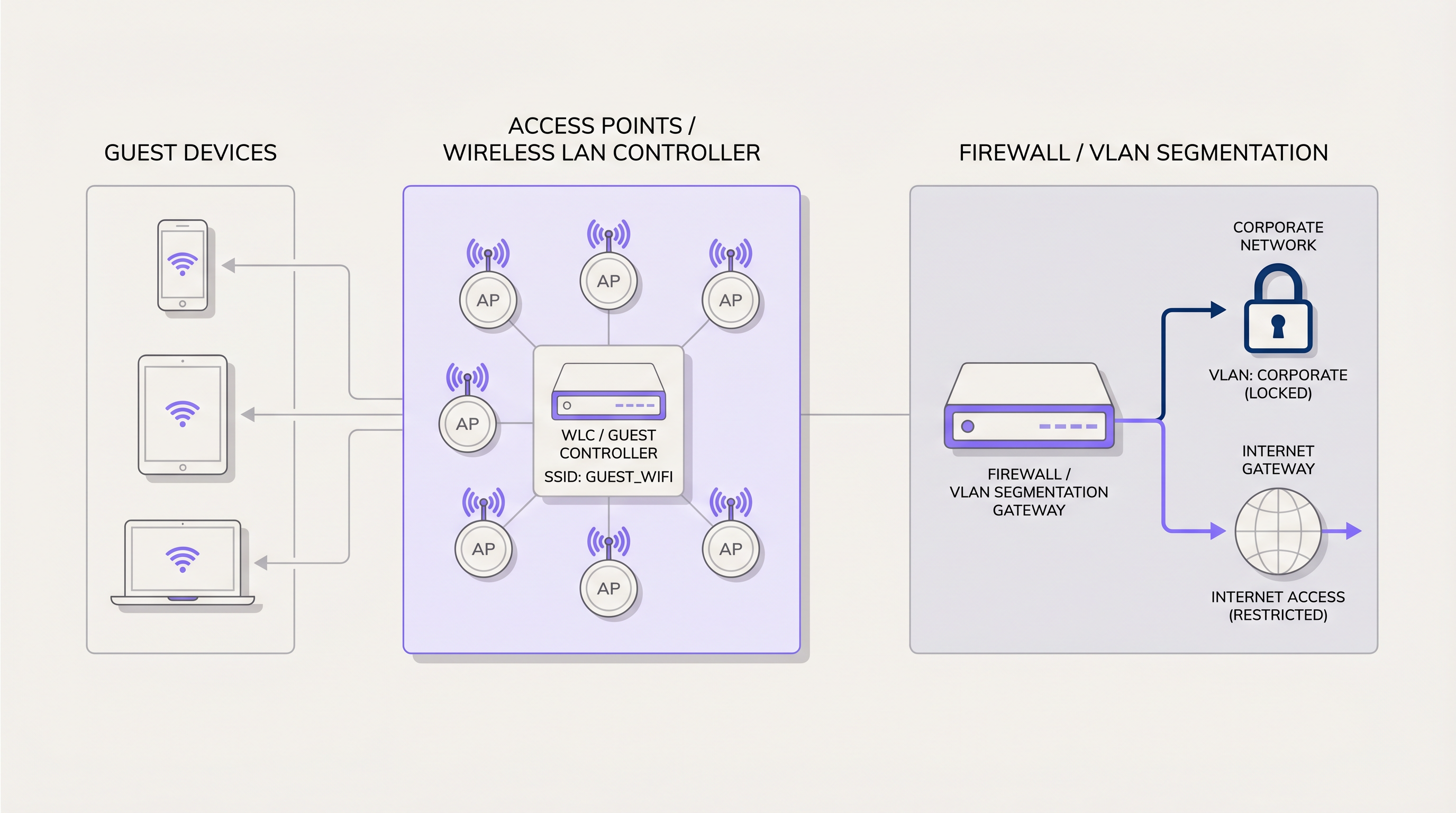
Le trafic invité doit être isolé aux couches 2 et 3. Le modèle de déploiement standard exige le mappage du SSID invité à un Réseau Local Virtuel (VLAN) dédié au niveau du Point d'Accès (AP) ou du Contrôleur de Réseau Local Sans Fil (WLC). Ce VLAN doit être acheminé via l'infrastructure de commutation centrale directement vers le pare-feu de périphérie.
Au niveau du pare-feu, des Listes de Contrôle d'Accès (ACL) strictes doivent appliquer une politique de « tout refuser » pour le trafic destiné aux sous-réseaux internes de l'entreprise. Le trafic invité ne doit être autorisé à router que vers la passerelle Internet. Cette segmentation n'est pas seulement une bonne pratique ; c'est une exigence fondamentale pour les cadres de conformité tels que PCI DSS. Si un appareil invité compromis peut acheminer des paquets vers un terminal de point de vente, l'ensemble du réseau n'est plus conforme.
Normes d'Authentification et de Chiffrement
L'ère des réseaux invités ouverts et non chiffrés touche à sa fin. Pour protéger les données des utilisateurs contre l'écoute passive et les attaques de l'homme du milieu, les déploiements devraient tirer parti du WPA3. Plus précisément, WPA3-SAE (Simultaneous Authentication of Equals) offre une confidentialité persistante, garantissant que même si la phrase secrète du réseau est connue, le trafic de session individuel reste chiffré et ne peut pas être déchiffré rétrospectivement.
Pour les environnements nécessitant un contrôle d'accès granulaire, IEEE 802.1X avec authentification RADIUS backend offre une sécurité de niveau entreprise. Lors de la transmission de requêtes d'authentification sur des Réseaux Étendus (WAN) vers des fournisseurs d'identité cloud, la sécurisation du trafic RADIUS lui-même est essentielle. Les équipes informatiques devraient implémenter RadSec : Sécurisation du trafic d'authentification RADIUS avec TLS pour prévenir l'interception des identifiants. Purple agit comme un fournisseur d'identité robuste dans ces architectures, s'intégrant de manière transparente à l'infrastructure RADIUS existante et prenant en charge les normes d'itinérance modernes comme OpenRoaming.
Débit et Planification de la Capacité
Dans les environnements à haute densité, le débit n'est pas limité par la liaison montante Internet, mais par l'équité du temps d'antenne et l'utilisation des canaux. Le déploiement de points d'accès (AP) prenant en charge le Wi-Fi 6 (802.11ax) est essentiel pour atténuer ces goulots d'étranglement. Les capacités d'Accès Multiple par Répartition Orthogonale de la Fréquence (OFDMA) du Wi-Fi 6 permettent à un seul AP de communiquer simultanément avec plusieurs clients, réduisant drastiquement la latence dans les zones très fréquentées.
De plus, les équipes informatiques doivent implémenter une limitation de débit par utilisateur au niveau du contrôleur ou du pare-feu. L'allocation d'un plafond de bande passante strict (par exemple, 10 Mbps en téléchargement / 2 Mbps en téléversement par utilisateur) empêche un seul client de monopoliser la liaison montante Internet avec des applications gourmandes en bande passante, garantissant une expérience de base cohérente pour tous les invités.
Guide d'Implémentation : Du Matériel au Portail
Le déploiement d'un réseau WiFi invité résilient nécessite une approche systématique, intégrant la planification RF physique avec des plateformes d'analyse basées sur le cloud.
Phase 1 : Planification RF et Étude de Site
Avant l'acquisition de matériel, une étude de site RF prédictive est obligatoire. L'utilisation d'outils logiciels pour modéliser l'environnement physique — en tenant compte de l'atténuation des murs, des hauteurs de plafond et de la densité d'utilisateurs — permet aux architectes réseau de déterminer le placement optimal des AP et l'allocation des canaux. Cela atténue les interférences de co-canal et assure un rapport signal/bruit (SNR) suffisant sur l'ensemble du site.
Phase 2 : Configuration de l'Infrastructure
Une fois le matériel physiquement déployé, configurez le WLC pour diffuser le SSID invité dédié. Assurez-vous que le VLAN correspondant est correctement marqué sur tous les ports trunk du commutateur. Au niveau du pare-feu de périphérie, vérifiez que les plages DHCP sont dimensionnées de manière adéquate pour le nombre d'utilisateurs simultanés attendu ; un sous-réseau /24 (254 adresses) est rarement suffisant pour les sites d'entreprise. Implémentez le filtrage DNS pour bloquer les domaines malveillants et le contenu pour adultes au niveau du réseau.
Phase 3 : Intégration du Captive Portal
Le Captive Portal est le point d'intégration critique entre l'infrastructure réseau et l'l'objectif commercial. Au lieu d'une page d'accueil générique, le WLC est configuré pour rediriger le trafic invité non authentifié vers un Captive Portal externe hébergé par une plateforme Guest WiFi comme Purple.
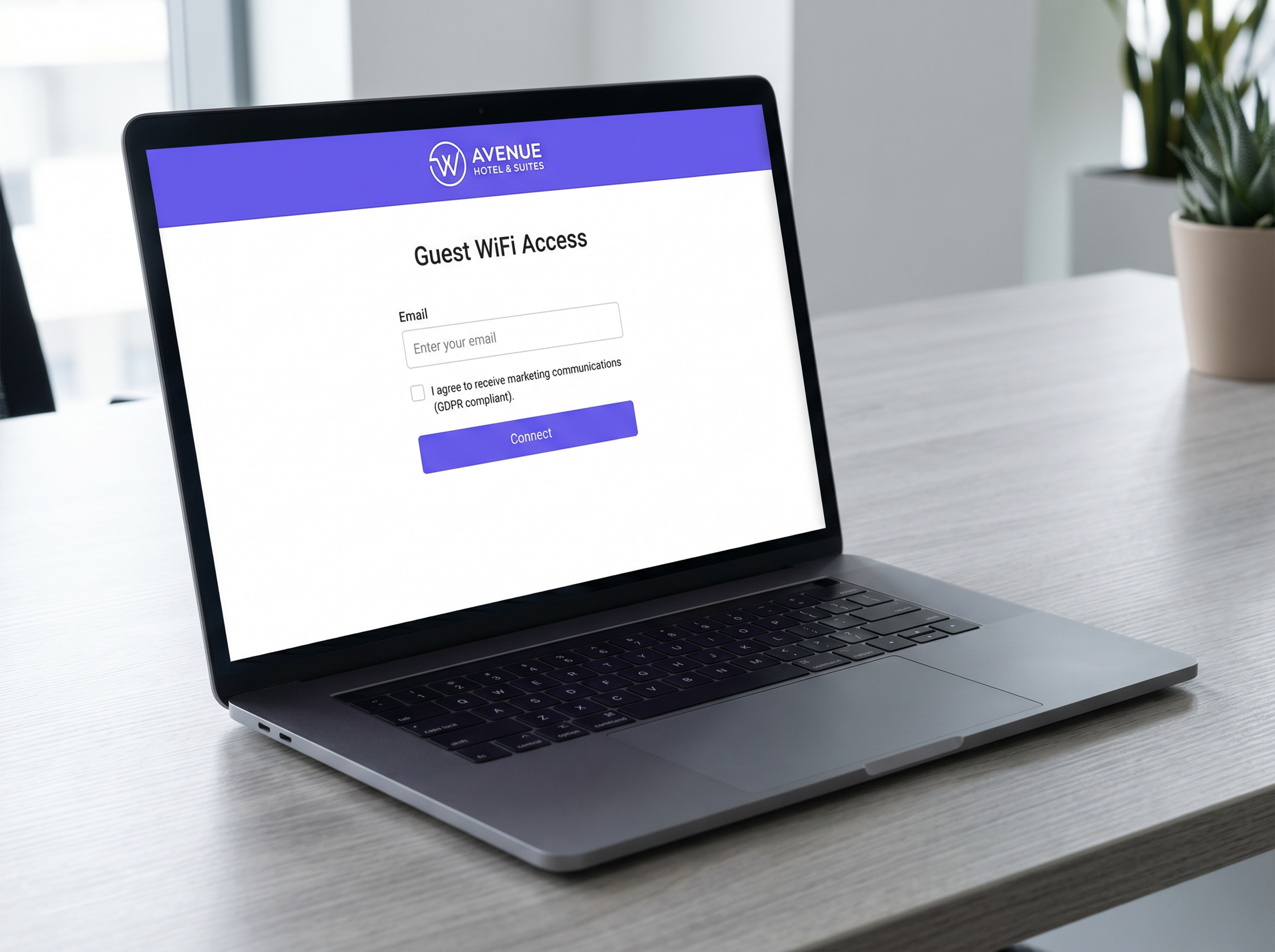
Ce portail doit être conçu pour authentifier les utilisateurs via des méthodes standard (e-mail, SMS, connexion sociale) tout en capturant des données de première partie. Il est crucial que le portail gère les exigences complexes de la conformité GDPR, en présentant des options de consentement granulaires et en enregistrant l'horodatage exact et les conditions acceptées par l'utilisateur.
Phase 4 : Analyse et automatisation du marketing
Une fois authentifiée, l'adresse MAC de l'appareil de l'utilisateur est associée à son profil démographique. Ces données alimentent un tableau de bord WiFi Analytics , offrant à l'IT une visibilité sur les temps de présence et la fréquentation, tout en permettant aux équipes marketing de déclencher des campagnes automatisées basées sur la fréquence des visites.
Bonnes pratiques et conformité
Le respect des normes de l'industrie protège l'entreprise des amendes réglementaires et des atteintes à la réputation.
- Mécanismes de consentement explicite : En vertu du GDPR et du UK Data Protection Act, le consentement pour les communications marketing doit être donné librement, spécifiquement et sans ambiguïté. Les cases pré-cochées sur les Captive Portals sont strictement interdites. La plateforme doit maintenir un journal auditable de toutes les transactions de consentement.
- Politiques de rétention des données : Mettez en œuvre des politiques automatisées de purge des données. Les données des invités ne doivent pas être conservées indéfiniment. Configurez la plateforme d'analyse pour anonymiser ou supprimer les enregistrements après une période d'inactivité définie (par exemple, 24 mois).
- Filtrage de contenu : Les réseaux publics doivent mettre en œuvre un filtrage de contenu basé sur DNS pour empêcher l'accès à des contenus illégaux ou inappropriés, protégeant ainsi le lieu de toute responsabilité et garantissant un environnement familial.
Dépannage et atténuation des risques
Même les réseaux bien conçus rencontrent des problèmes. Comprendre les modes de défaillance courants accélère le temps de résolution.
Épuisement DHCP
Symptôme : Les invités peuvent s'associer à l'AP mais reçoivent une adresse APIPA (169.254.x.x) et ne peuvent pas accéder au portail. Atténuation : Diminuez les durées de bail DHCP (par exemple, à 2 heures au lieu de 24 heures) dans les environnements à forte rotation comme les magasins de détail. Assurez-vous que la taille du sous-réseau correspond aux estimations de fréquentation maximale.
Échecs d'interception du Captive Portal
Symptôme : Les invités se connectent au réseau mais le Captive Portal n'apparaît pas automatiquement (échec CNA). Atténuation : Assurez-vous que le "Walled Garden" ou les ACL de pré-authentification sur le WLC autorisent le trafic vers les adresses IP du Captive Portal et les domaines CDN nécessaires. Si le système d'exploitation ne peut pas atteindre son URL de détection de Captive Portal (par exemple, captive.apple.com), le portail ne se déclenchera pas.
Points d'accès non autorisés
Symptôme : APs non autorisés diffusant des SSID similaires ou connectés au LAN de l'entreprise. Atténuation : Activez les systèmes de détection d'intrusion sans fil (WIDS) sur le WLC pour détecter et contenir automatiquement les APs non autorisés en envoyant des trames de désauthentification aux clients connectés.
ROI et impact commercial
La transition d'un réseau standard vers une plateforme WiFi intelligente génère des résultats commerciaux mesurables. En exploitant les données capturées via le Captive Portal, les entreprises peuvent générer des revenus tangibles.
Par exemple, dans le Healthcare , l'analyse peut optimiser le flux de patients et réduire les temps d'attente. Dans le commerce de détail, l'intégration des données WiFi avec les systèmes CRM permet des campagnes de reciblage ciblées, en envoyant une offre promotionnelle à un client qui n'a pas visité depuis 90 jours. De plus, l'adoption de paradigmes de réseau modernes, tels que ceux abordés dans The Core SD WAN Benefits for Modern Businesses , permet aux opérateurs multi-sites de gérer ces politiques de manière centralisée sur des centaines d'emplacements, réduisant considérablement les frais généraux d'exploitation.
Termes clés et définitions
VLAN (Virtual Local Area Network)
A logical grouping of network devices that acts as if they are on their own independent network, regardless of physical location.
Used to isolate guest WiFi traffic from corporate traffic on the same physical switches and access points.
Captive Portal
A web page that a user of a public-access network is obliged to view and interact with before access is granted.
The primary interface for authenticating users, capturing first-party marketing data, and securing GDPR consent.
Walled Garden
A limited environment that controls the user's access to web content and services before they have fully authenticated.
Essential for allowing devices to load the captive portal page and associated assets (like logos or social login APIs) before internet access is granted.
WPA3-SAE
Wi-Fi Protected Access 3 with Simultaneous Authentication of Equals. The modern standard for wireless encryption.
Replaces WPA2-PSK to provide forward secrecy, preventing attackers from decrypting captured traffic even if they later discover the network password.
OFDMA
Orthogonal Frequency Division Multiple Access. A feature of Wi-Fi 6 that allows an access point to divide a channel into smaller sub-channels.
Crucial for high-density venues (stadiums, conferences) as it allows simultaneous transmission to multiple clients, drastically reducing latency.
MAC Address
Media Access Control address. A unique identifier assigned to a network interface controller for use as a network address.
Used by analytics platforms to track unique device visits, dwell time, and return frequency, even before the user authenticates.
DHCP Exhaustion
A state where a network's DHCP server has no more IP addresses available to assign to new clients.
A common failure in retail environments where footfall is high but the IP subnet is too small or lease times are set too long.
PCI DSS
Payment Card Industry Data Security Standard. A set of security standards designed to ensure that all companies that accept, process, store or transmit credit card information maintain a secure environment.
The primary regulatory reason why guest WiFi must be strictly segmented from point-of-sale (POS) systems.
Études de cas
A 400-room luxury hotel is experiencing severe guest complaints regarding WiFi speeds during the evening hours (7 PM - 10 PM). The internet uplink is a dedicated 1 Gbps fibre circuit. Network monitoring shows the uplink is fully saturated during these times.
The IT team must implement per-device bandwidth rate limiting. On the Wireless LAN Controller or edge firewall, a QoS policy should be applied to the guest VLAN, capping individual client throughput to 15 Mbps download and 5 Mbps upload. Additionally, application-layer filtering should be enabled to throttle peer-to-peer (P2P) file sharing protocols.
A national retail chain wants to implement a captive portal to collect customer emails for marketing, but the legal team is concerned about GDPR compliance following recent ICO fines in the sector.
The deployment must utilize a dedicated Guest WiFi platform like Purple that handles consent natively. The captive portal must be configured with an unticked checkbox explicitly stating: 'I consent to receive marketing communications.' The platform must automatically record the user's MAC address, IP address, timestamp, and the exact text of the consent agreement. A secondary option to connect without providing marketing consent must be available.
Analyse de scénario
Q1. A stadium IT director is planning a network upgrade for a 50,000-seat venue. The current Wi-Fi 5 (802.11ac) network collapses during half-time. They are considering deploying more APs of the same model to increase coverage. Do you agree with this approach?
💡 Astuce :Consider the difference between coverage and capacity, and how Wi-Fi 5 handles concurrent client transmissions.
Afficher l'approche recommandée
No. Deploying more Wi-Fi 5 APs in a high-density environment will likely increase co-channel interference without solving the capacity issue. The venue requires an upgrade to Wi-Fi 6 (802.11ax) APs. The OFDMA technology in Wi-Fi 6 is specifically designed for high-density environments, allowing the AP to communicate with multiple clients simultaneously, rather than the sequential transmission limitation of Wi-Fi 5.
Q2. A retail client wants to use their guest WiFi to track how many people walk past their store versus how many enter, using MAC address probing. However, they are concerned about MAC randomization features in modern iOS and Android devices. How should you advise them?
💡 Astuce :Consider the limitations of passive tracking versus active authentication.
Afficher l'approche recommandée
Advise the client that while passive MAC tracking (probing) can provide directional trends, MAC randomization significantly reduces its absolute accuracy for unique user counts. The architectural solution is to incentivize active connection to the captive portal. Once a user authenticates, the platform associates the current MAC address with a known identity (e.g., email), providing highly accurate analytics for that session.
Q3. During a network audit, you discover that the guest WiFi subnet (10.0.50.0/24) can ping the IP address of the venue's internal Active Directory server (10.0.10.5). What is the immediate architectural remediation?
💡 Astuce :Focus on Layer 3 routing and firewall policies.
Afficher l'approche recommandée
Immediate remediation requires updating the Access Control Lists (ACLs) on the core firewall/router. A rule must be placed at the top of the ACL for the guest VLAN interface that explicitly denies all traffic destined for RFC 1918 private IP space (10.0.0.0/8, 172.16.0.0/12, 192.168.0.0/16), followed by a rule permitting traffic to the internet (0.0.0.0/0).




