
Vergleich von controllerbasierten und Cloud-managed Access Points
Dieser technische Leitfaden vergleicht controllerbasierte und Cloud-managed Access Point-Architekturen für Enterprise-Umgebungen. Er bietet IT-Verantwortlichen einen herstellerneutralen Rahmen zur Bewertung von Bereitstellungsmodellen, Gesamtbetriebskosten und Integrationsmöglichkeiten mit Plattformen für Guest Intelligence wie Purple.
Video overview
Diesen Leitfaden anhören
Podcast-Transkript ansehen
Teil unserer Kernserie: Guest WiFi Leitfaden →
Executive Summary
Für Betreiber von Enterprise-Standorten bestimmt die architektonische Entscheidung zwischen controllerbasierten und cloudgesteuerten Access Points (APs) die operative Agilität, das Sicherheitsniveau und die Gesamtbetriebskosten (TCO) ihres Netzwerks für die nächsten fünf bis sieben Jahre. Da Standorte in den Bereichen Gastgewerbe, Einzelhandel und Transport ihre physischen Räume digitalisieren, ist WiFi kein bloßer Service mehr; es ist die kritische Transportschicht für IoT-Sensoren, Point-of-Sale-Systeme (POS) und Plattformen zur Gewinnung von Gast-Daten.
Historisch gesehen erforderten die hohen Dichteanforderungen von Stadien und großen Kongresszentren physische Wireless LAN Controller (WLCs) vor Ort, um die komplexe RF-Koordination und das nahtlose Roaming zu bewältigen. Moderne cloudgesteuerte Architekturen, ergänzt durch KI-gestütztes Radio Resource Management (RRM), haben diese Leistungslücke jedoch weitgehend geschlossen und gleichzeitig den operativen Aufwand für die Verwaltung physischer Controller-Hardware eliminiert.
Dieser technische Leitfaden bietet Netzwerkarchitekten und IT-Leitern einen herstellerneutralen Rahmen zur Bewertung von AP-Architekturen. Er detailliert die technischen Unterschiede in der Steuerungsebene (Control Plane), untersucht reale Bereitstellungsszenarien und zeigt auf, wie diese Architekturen mit Plattformen für Guest WiFi und WiFi Analytics im Unternehmen integriert werden, um messbare Geschäftsergebnisse zu erzielen.
Technischer Deep-Dive: Architektur und Control Plane
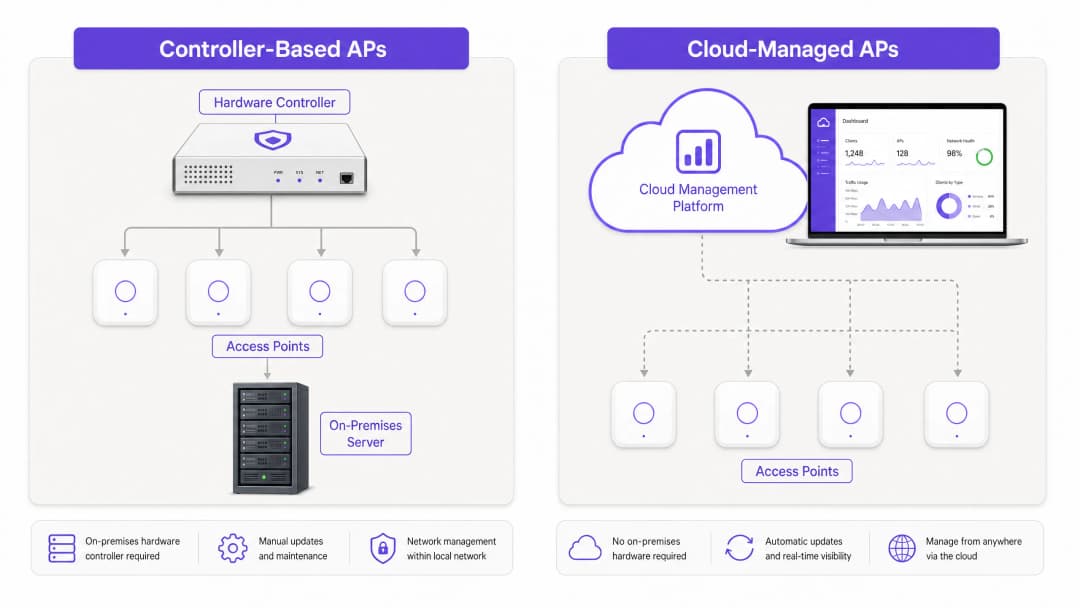
Der grundlegende Unterschied zwischen Controller-basierten und Cloud-managed APs liegt darin, wo sich die Management- und Control Planes befinden und wie die APs mit der restlichen Netzwerkinfrastruktur interagieren.
Controller-basierte Architektur
In einem traditionellen Controller-basierten Modell terminieren "Lightweight" APs ihren Management- und oft auch ihren Datenverkehr auf einer zentralisierten Hardware oder virtuellen Appliance - einem Wireless LAN Controller (WLC). Die APs übernehmen die physischen Layer-1- und Layer-2-Funkfunktionen (RF), aber die Intelligenz ist zentralisiert.
- Protokollabhängigkeit: APs kommunizieren mit dem WLC über das Control and Provisioning of Wireless Access Points (CAPWAP) Protokoll (RFC 5415).
- Zentralisierte Verarbeitung: Roaming-Entscheidungen, Authentifizierungs-Handshakes (wie 802.1X/EAP) und die dynamische RF-Kanalzuweisung werden vom Controller verarbeitet.
- Datenpfad-Tunnelung: In vielen Implementierungen wird der Client-Datenverkehr über einen Tunnel an den WLC zurückübertragen, bevor er in das kabelgebundene Netzwerk ausgeleitet wird. Dies ermöglicht eine zentralisierte Richtliniendurchsetzung und ein vereinfachtes VLAN-Management über einen großen Campus hinweg, stellt jedoch einen potenziellen Engpass dar.
Vorteile für High-Density-Umgebungen: Controller-basierte Systeme zeichnen sich in Umgebungen mit extrem hoher Dichte aus (z. B. Stadien, große Auditorien). Da der WLC einen ganzheitlichen Echtzeit-Blick auf die RF-Umgebung über Hunderte von APs hinweg hat, kann er die Eindämmung von Gleichkanalstörungen koordinieren und das 802.11r Fast BSS Transition (FT) Roaming mit Millisekundenpräzision steuern.
Cloud-managed Architektur
Cloud-managed Architekturen dezentralisieren die Control Plane. Die APs selbst sind in Bezug auf lokales RF-Management und Datenweiterleitung eigenständig ("Fat APs"), werden jedoch über eine in der Cloud gehostete Management-Plattform zentral orchestriert.
- Out-of-Band-Management: Der AP baut einen sicheren Management-Tunnel (in der Regel HTTPS/TLS) zur Cloud des Herstellers auf. Konfigurationen, Telemetrie und Firmware-Updates laufen über diese Verbindung.
- Lokales Breakout: Der Client-Datenverkehr wird nicht in die Cloud getunnelt. Er wird lokal am Switch-Port ausgeleitet, an den der AP angeschlossen ist.
- Lokale Ausfallsicherheit: Wenn die Internetverbindung zur Cloud unterbrochen wird, bedient der AP weiterhin bestehende Clients, authentifiziert neue Clients (wenn lokales RADIUS oder PSK verwendet wird) und leitet den Datenverkehr weiter. Das IT-Team verliert jedoch die Echtzeit-Sichtbarkeit und die Möglichkeit, Konfigurationsänderungen zu übertragen, bis die Verbindung wiederhergestellt ist.
Auswirkungen auf Sicherheit und Compliance
Beide Architekturen unterstützen Sicherheitsstandards der Enterprise-Klasse, einschließlich WPA3-Enterprise, 802.1X-Authentifizierung und die Erkennung von Rogue APs. Der Aufwand für die Einhaltung von Compliance-Vorgaben variiert jedoch.
Bei Cloud-managed Systemen müssen IT-Teams sicherstellen, dass die Cloud-Plattform des Anbieters die relevanten regulatorischen Anforderungen erfüllt (z. B. SOC 2 Type II, ISO 27001) und dass die Datenspeicherung der GDPR oder lokalen Datenschutzgesetzen entspricht. Für hochsensible Umgebungen, die eine strikte physische Trennung erfordern - wie etwa bestimmte Regierungs- oder Verteidigungseinrichtungen - bleibt ein Controller-basiertes System, das vollständig innerhalb des lokalen LAN betrieben wird, der Standard.
Für Umgebungen, in denen Zahlungsdaten verarbeitet werden, können beide Architekturen eine PCI-DSS-Konformität erreichen. Die Netzwerksegmentierung ist jedoch von entscheidender Bedeutung. Unabhängig von der AP-Architektur müssen das Gastnetzwerk, die Unternehmensgeräte und die POS-Terminals in separaten VLANs isoliert werden.
Haben Sie Fragen zu Ihrem spezifischen Setup?
Unser Team arbeitet mit Standortbetreibern, IT-Managern und Netzwerktechnikern an über 80.000 Standorten zusammen. Buchen Sie ein 20-minütiges Gespräch und wir zeigen Ihnen, wie andere diese Herausforderungen gelöst haben.
Implementierungsleitfaden: Bereitstellung und Integration
Die betrieblichen Auswirkungen der von Ihnen gewählten Architektur zeigen sich am deutlichsten bei der Bereitstellung und dem laufenden Management, insbesondere in Szenarien mit mehreren Standorten.
Zero-Touch Provisioning im Vergleich zu gestufter Bereitstellung
Cloud-Managed: Der wichtigste betriebliche Vorteil von Cloud-managed APs ist das Zero-Touch Provisioning (ZTP). Ein AP kann direkt an eine entfernte Filiale oder ein Hotel geliefert werden. Nach dem Einstecken bezieht er eine IP-Adresse über DHCP, stellt eine Verbindung zur Cloud her, lädt sein vorkonfiguriertes Profil herunter und beginnt mit der Übertragung. Dadurch erübrigen sich kostspielige Vor-Ort-Einsätze oder der Einsatz hochqualifizierter Netzwerktechniker an entfernten Standorten.
Controller-Based: Controller-basierte APs erfordern in der Regel mehr Vorbereitung bei der Bereitstellung. Der AP muss in der Lage sein, den WLC zu finden (häufig über die DHCP-Option 43 oder DNS-Auflösung). Die Firmware muss oft manuell zwischen dem WLC und den APs abgeglichen werden. Bei Rollouts an mehreren Standorten erfordert dies häufig eine zentrale Bereitstellung der Hardware vor dem Versand oder den Einsatz von Technikern an jedem Standort.
Integration von Guest Intelligence und Analytics
Die Bereitstellung physischer APs ist nur das Fundament. Um einen geschäftlichen Nutzen aus dem Netzwerk zu ziehen, müssen Veranstaltungsorte ihre Hardware in eine Guest Intelligence Plattform wie Purple integrieren.
Purple fungiert als hardwareunabhängiges Overlay, das sich nahtlos in Controller-basierte und Cloud-managed Systeme der führenden Hersteller (Cisco, Meraki, Aruba, Ruckus, Extreme) integrieren lässt.
- Authentifizierung und Onboarding: Purple übernimmt die Bereitstellung des Captive Portal und die Authentifizierung (über Social-Login, Formularausfüllung oder How a WiFi Assistant Enables Passwordless Access in 2026). Die AP-Architektur muss lediglich RADIUS-Authentifizierung und -Accounting unterstützen, wodurch nicht authentifizierte Benutzer zum Purple-Portal weitergeleitet werden.* Analytics-Daten: Purple empfängt Präsenz- und Standortdaten von den APs, um sein Analytics-Dashboard zu betreiben. Ob die Daten per API aus einem Cloud-Dashboard übertragen oder direkt von einem lokalen WLC gesendet werden - die resultierenden Erkenntnisse wie Verweildauer, Wiederkehrraten und Besucherzahlen sind identisch. Um tiefer in die Entstehung dieser Daten einzusteigen, lesen Sie unseren Leitfaden zu Heatmapping vs. Presence Analytics: Technische Unterschiede.

Best Practices und Risikominderung
Unabhängig von der gewählten Architektur minimieren bestimmte grundlegende Best Practices die Bereitstellungsrisiken und gewährleisten eine langfristige Stabilität.
- Management-Traffic priorisieren: Bei Cloud-managed Bereitstellungen ist die Verbindung der APs zur Cloud geschäftskritisch. Stellen Sie sicher, dass der Management-Traffic auf der WAN-Leitung mittels QoS priorisiert wird. Wenn sich der Standort eine einzige Internetverbindung für den Gast-Traffic und das Management teilt, kann eine ausgelastete Leitung in Stoßzeiten dazu führen, dass APs im Cloud-Dashboard als offline angezeigt werden.
- Gestaffelte Firmware-Upgrades: Cloud-Plattformen spielen Firmware-Updates oft automatisch ein. Dies stellt zwar sicher, dass Sicherheits-Patches zeitnah angewendet werden, birgt jedoch das Risiko unvorhergesehener Fehler. Konfigurieren Sie Ihr Cloud-Dashboard so, dass Updates gestaffelt durchgeführt werden - testen Sie neue Firmware auf einer kleinen Gruppe von APs (z. B. im IT-Büro), bevor Sie sie auf den gesamten Bestand ausrollen.
- Planung für Dichte, nicht nur für Abdeckung: Moderne Bereitstellungen scheitern selten an mangelndem Signal; sie scheitern an mangelnder Kapazität oder an Gleichkanalstörungen. Führen Sie gründliche prädiktive und aktive RF-Messungen durch und stellen Sie eine angemessene Kanalüberlappung sowie passende Sendeleistungseinstellungen sicher, insbesondere in Bereichen mit hoher Dichte wie Lobbys oder Konferenzräumen. Für Einblicke zur Verbesserung des Gesamterlebnisses lesen Sie Wie Sie die Gästezufriedenheit verbessern: Das ultimative Playbook.
- VLAN-Architektur standardisieren: Implementieren Sie ein konsistentes VLAN-Schema über alle Standorte hinweg. Trennen Sie Management-Schnittstellen, Unternehmensgeräte, IoT-Sensoren und den Gast-Traffic.
ROI und geschäftliche Auswirkungen
Die Entscheidung zwischen Controller-basierten und Cloud-managed APs sollte auf einer Gesamtbetriebskosten-Analyse (TCO) über einen Lebenszyklus von 5 bis 7 Jahren basieren.
- Investitionsausgaben (CapEx): Controller-basierte Systeme verursachen oft höhere anfängliche CapEx aufgrund der Kosten für WLC-Hardware und der damit verbundenen Redundanzanforderungen. Cloud-managed APs haben in der Regel geringere Hardwarekosten, erfordern jedoch laufende Abonnementlizenzen.
- Betriebskosten (OpEx): Cloudgesteuerte Systeme weisen bei Bereitstellungen an mehreren Standorten durchgehend niedrigere Betriebskosten auf. Die Einsparungen durch Zero-Touch-Bereitstellung, zentrale Fehlerbehebung und automatisiertes Firmware-Management gleichen die wiederkehrenden Lizenzkosten oft mehr als aus.
- Geschäftliche Agilität: Die Fähigkeit, neue Standorte schnell bereitzustellen, Richtlinienänderungen sofort netzwerkweit durchzusetzen und sich nahtlos in Analyseplattformen zu integrieren, bietet einen klaren Wettbewerbsvorteil - insbesondere in schnelllebigen Branchen wie dem Einzelhandel und dem Gastgewerbe.
Durch die Auswahl einer Architektur, die auf ihre operativen Fähigkeiten und Standorttopologien abgestimmt ist, und die Implementierung einer hardwareunabhängigen Intelligence-Plattform wie Purple, können IT-Teams in Unternehmen ihr WiFi-Netzwerk von einer notwendigen Kostenstelle in ein strategisches, umsatzförderndes Asset verwandeln.
Schlüsseldefinitionen
WLC (Wireless LAN Controller)
Eine zentrale Hardware- oder virtuelle Appliance, die Konfigurationen, RF-Koordination und Sicherheitsrichtlinien für mehrere "Lightweight" Access Points verwaltet.
Die Kernkomponente einer controllerbasierten Architektur, die sowohl ein leistungsstarkes Management-Tool als auch eine potenzielle Schwachstelle darstellt (Single Point of Failure).
CAPWAP
Control and Provisioning of Wireless Access Points. Ein Standardprotokoll (RFC 5415), das von WLCs zur Verwaltung einer Gruppe von APs verwendet wird.
Der Tunnel, über den controllerbasierte APs Anweisungen empfangen und oft den Datenverkehr der Clients weiterleiten.
Zero-Touch Provisioning (ZTP)
Die Möglichkeit, Netzwerk-Hardware an einem Remote-Standort ohne manuelle Konfiguration bereitzustellen; das Gerät verbindet sich automatisch mit einer Cloud-Plattform, um sein Profil herunterzuladen.
Der Hauptfaktor für Einsparungen bei den Betriebskosten (OpEx) in Cloud-managed Bereitstellungen an mehreren Standorten.
Local Survivability
Die Fähigkeit eines Cloud-managed APs, den lokalen Datenverkehr weiterhin weiterzuleiten und Benutzer zu authentifizieren, selbst wenn die WAN-Verbindung zum Cloud-Dashboard unterbrochen ist.
Ein kritisches Bewertungskriterium für Cloud-Plattformen, um sicherzustellen, dass ein WAN-Ausfall nicht zu einem vollständigen LAN-Ausfall führt.
Out-of-Band Management
Eine Architektur, bei der der Management-Datenverkehr (Telemetrie, Konfiguration) vom Datenverkehr der Benutzer getrennt ist.
Das grundlegende Sicherheitsprinzip von Cloud-managed APs, das sicherstellt, dass die Benutzerdaten im lokalen Netzwerk verbleiben.
802.11r (Fast BSS Transition)
Ein IEEE-Standard, der eine kontinuierliche Verbindung für mobile drahtlose Geräte mit schnellen und sicheren Übergaben von einem AP zum anderen ermöglicht.
Entscheidend für nahtloses Roaming in Umgebungen mit hoher Dichte; in der Vergangenheit von zentralen Controllern besser gelöst.
Datensouveränität
Das Konzept, dass digitale Daten den Gesetzen des Landes unterliegen, in dem sie sich befinden.
Eine wichtige Überlegung bei der Bewertung von Cloud-managed Plattformen, um die Einhaltung von Vorschriften wie der GDPR sicherzustellen.
Air-Gapped Network
Eine Netzwerksicherheitsmaßnahme, die sicherstellt, dass ein sicheres Computernetzwerk physisch von unsicheren Netzwerken wie dem öffentlichen Internet isoliert ist.
Umgebungen, die echtes Air-Gapping erfordern, zwingen zum Einsatz von On-Premises-Controller-basierten Architekturen.
Ausgearbeitete Beispiele
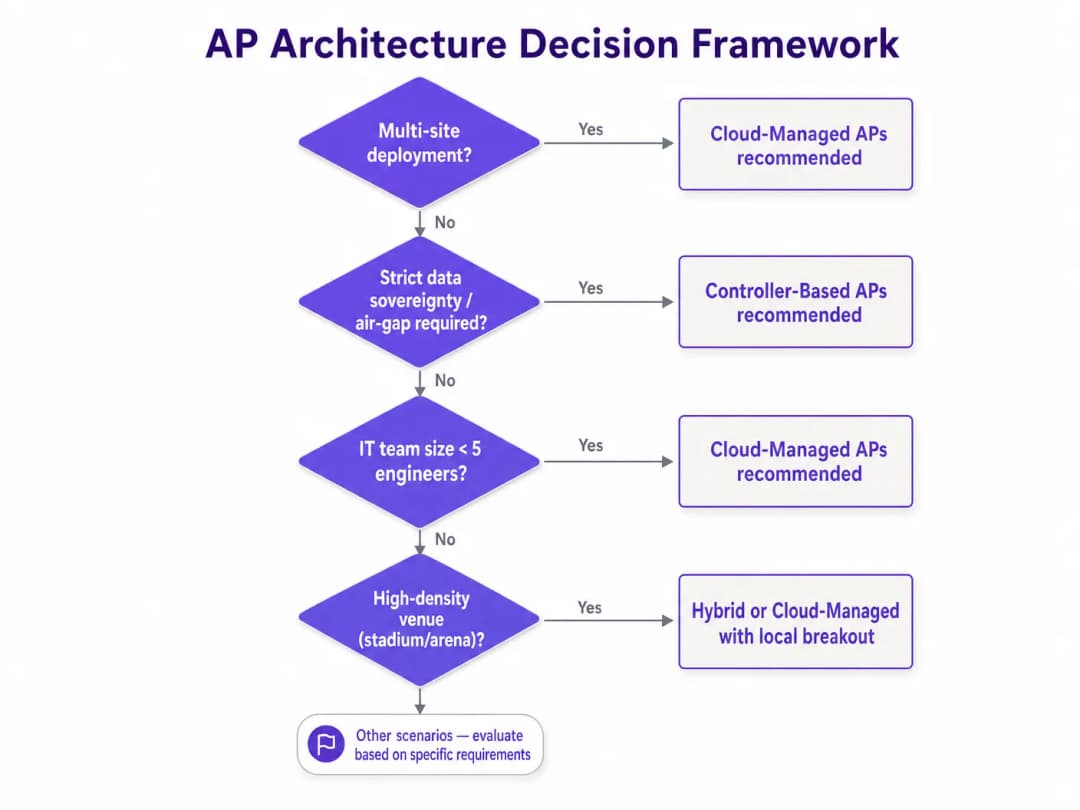
Eine nationale Einzelhandelskette führt Guest WiFi in 300 mittelgroßen Filialen ein. Sie verfügt über ein kleines, zentrales IT-Team von vier Ingenieuren und kein technisches Personal vor Ort. Benötigt werden Analysen zur Erfassung von Verweildauer und Besucherzahlen.
Stellen Sie an allen Standorten Cloud-managed APs bereit. Nutzen Sie Zero-Touch Provisioning (ZTP), um APs direkt an die Filialleiter zu senden, die diese einfach an den PoE-Switch anschließen. Konfigurieren Sie das Cloud-Dashboard so, dass eine standardisierte SSID- und VLAN-Konfiguration übertragen wird. Integrieren Sie den Cloud-Controller über API/RADIUS mit Purple für das Captive Portal und Analysen.
Ein neu erbautes Sportstadion mit 60.000 Sitzplätzen erfordert flächendeckendes WiFi für Fan-Interaktion, Ticketing und POS-Systeme. Die Umgebung ist mit einer massiven, gleichzeitigen Anmeldung von Endgeräten konfrontiert und erfordert nahtloses Roaming, wenn sich die Zuschauer durch die Gänge bewegen.
Stellen Sie eine controllerbasierte Architektur mit redundanten, hochverfügbaren WLC-Appliances im lokalen Rechenzentrum bereit. Nutzen Sie hochverdichtete Richtantennen. Konfigurieren Sie den WLC für aggressives Load Balancing, Band Steering und 802.11r Fast BSS Transition.
Übungsfragen
Q1. Eine Boutique-Hotelkette aktualisiert ihr WiFi an 15 Standorten. Der IT-Leiter möchte auf Cloud-verwaltete APs umsteigen, aber der Compliance-Beauftragte hat Bedenken hinsichtlich der PCI-DSS-Compliance für die POS-Terminals in den Restaurants. Was ist der richtige architektonische Ansatz?
Hinweis: Überlegen Sie, wie der Datenverkehr der Datenebene bei Cloud-basierten Implementierungen gehandhabt wird und welche Anforderungen an die Netzwerksegmentierung gestellt werden.
Musterlösung anzeigen
Cloud-verwaltete APs sind bestens geeignet, sofern eine ordnungsgemäße Netzwerksegmentierung implementiert wird. Das IT-Team muss separate VLANs für das Gäste-WiFi und das POS-Netzwerk konfigurieren. Da Cloud-verwaltete APs Out-of-Band-Management nutzen, bricht der POS-Datenverkehr lokal aus und durchquert nicht die Cloud des Anbieters, was die PCI-DSS-Anforderungen für die Datenebene erfüllt. Die Cloud-Plattform des Anbieters muss über entsprechende Sicherheitszertifikate (z. B. SOC 2) für die Verwaltungsebene verfügen.
Q2. Während einer Hauptgeschäftszeit fällt die primäre WAN-Verbindung in einer Filiale aus. Die Filiale weicht auf eine 4G-Verbindung mit geringer Bandbreite aus. Die Cloud-verwalteten APs bleiben online, aber das IT-Team meldet, dass es keine Konfigurationsänderungen über das Dashboard an die Filiale übertragen kann. Warum passiert das, und wie hätte das Netzwerk konzipiert sein müssen, um dies zu verhindern?
Hinweis: Berücksichtigen Sie die Beziehung zwischen Management-Verkehr, Datenverkehr und QoS auf bandbreitenbeschränkten Verbindungen.
Musterlösung anzeigen
Die APs arbeiten im Modus "Local Survivability". Die bandbreitenarme 4G-Verbindung ist wahrscheinlich durch den kritischen POS- oder Gästeverkehr ausgelastet, was dazu führt, dass die Management-Tunnel (HTTPS/TLS) zum Cloud-Controller abbrechen oder in ein Timeout laufen. Um dies zu verhindern, hätte der Netzwerkarchitekt Quality of Service (QoS) Regeln auf dem Edge-Router oder der Firewall implementieren müssen, um eine Mindestbandbreite zu garantieren und den Management-Verkehr der APs über die Failover-Verbindung zu priorisieren.
Q3. Ein Universitätsgelände mit einer bestehenden Controller-basierten Architektur möchte Purple für Gäste-Analysen einsetzen. Das Netzwerkteam behauptet, dass eine Integration nicht möglich ist, da keine Cloud-verwalteten APs verwendet werden. Ist das korrekt?
Hinweis: Berücksichtigen Sie die Integrationsmethode von Purple und die Hardware-Abhängigkeiten.
Musterlösung anzeigen
Nein, das ist nicht korrekt. Purple ist hardwareunabhängig und erfordert keine Cloud-verwaltete Architektur. Die vorhandenen Wireless LAN Controller (WLCs) der Universität können so konfiguriert werden, dass sie über Standard-RADIUS-Authentifizierungs- und Accounting-Protokolle mit Purple integriert werden und den Gästeverkehr zum Purple Captive Portal umleiten. Die Analysedaten werden identisch mit einer Cloud-verwalteten Bereitstellung generiert.
Weiterlesen in dieser Reihe
Was ist ein WLC (Wireless LAN Controller) und benötigen Sie heute noch einen?
Dieser umfassende Leitfaden untersucht die Entwicklung von Wireless LAN Controllern (WLCs) und bietet einen technischen Rahmen zur Bestimmung der richtigen Architektur im Jahr 2026. Er behandelt traditionelle Hardware, cloud-gesteuerte sowie controller-lose Modelle und detailliert deren Auswirkungen auf Compliance, Skalierbarkeit und das Gästeerlebnis.
Mesh Network vs Access Points: Was ist besser für große Veranstaltungsorte?
Dieser technische Leitfaden bietet einen definitiven Vergleich zwischen Mesh-Netzwerken und traditionellen kabelgebundenen Access Points für große Veranstaltungsorte und deckt Architektur, Performance-Kompromisse sowie Bereitstellungsstrategien ab. Er rüstet IT-Manager, Netzwerkarchitekten und CTOs mit umsetzbaren Frameworks aus, um hochperformante, konforme WiFi-Infrastrukturen für das Gastgewerbe, den Einzelhandel, Veranstaltungen und den öffentlichen Sektor zu entwerfen. Der Leitfaden verknüpft diese architektonischen Entscheidungen auch mit der herstellerunabhängigen Gast-WiFi- und Analyseplattform von Purple und zeigt, wie die richtige Wahl der Infrastruktur messbare Geschäftsergebnisse liefert.
Cisco Meraki vs. Aruba: Ein technischer Vergleich für Gäste WiFi
Ein maßgeblicher technischer Vergleich von Cisco Meraki und HPE Aruba für Enterprise Gäste WiFi Bereitstellungen. Dieser Leitfaden bietet IT-Managern und -Architekten praxisnahe Einblicke in Architektur, Authentifizierung, Netzwerksegmentierung und hardwareunabhängige Analytics-Integration.
Haben Sie Fragen zu Ihrem spezifischen Setup?
Unser Team arbeitet mit Standortbetreibern, IT-Managern und Netzwerktechnikern an über 80.000 Standorten zusammen. Buchen Sie ein 20-minütiges Gespräch und wir zeigen Ihnen, wie andere diese Herausforderungen gelöst haben.