
GDPR und Guest WiFi: Compliance-Leitfaden für Venue-Marketer und die IT
Dieser Leitfaden bietet IT-Managern und Venue-Betreibern einen praktischen Rahmen, um sicherzustellen, dass Guest WiFi-Dienste vollständig GDPR-konform sind. Er behandelt die technische Architektur, Einwilligungsmechanismen, Datenaufbewahrung und wie Compliance in ein sicheres First-Party-Daten-Asset transformiert werden kann.
Diesen Leitfaden anhören
Podcast-Transkript ansehen
Executive Summary
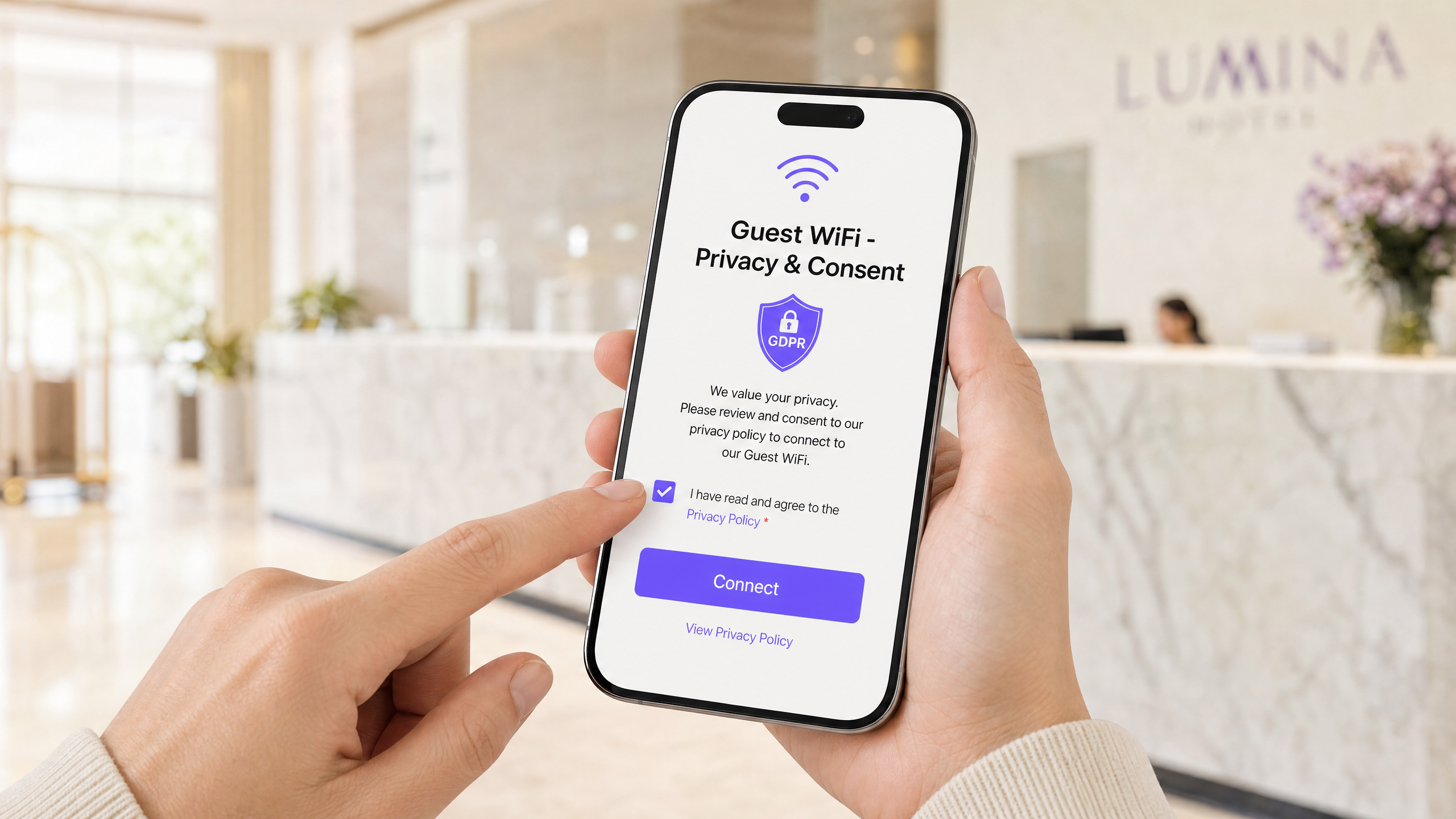
Guest WiFi ist ein regulierter Endpunkt für die Datenerfassung. Jedes Hotel, jede Einzelhandelskette, jedes Stadion und jedes Konferenzzentrum, das einen öffentlichen Netzwerkzugang bereitstellt, wird in dem Moment, in dem sich ein Gast verbindet, zum Datenverantwortlichen im Sinne der Datenschutz-Grundverordnung (GDPR). Die Aufsichtsbehörden können bei Nichteinhaltung Geldbußen von bis zu 20 Millionen Euro oder 4 % des weltweiten Jahresumsatzes verhängen. Marriott International erhielt nach einer Datenschutzverletzung eine angedrohte Geldstrafe von 124 Millionen US-Dollar von der ICO.
Dieser Leitfaden bietet IT-Managern, Netzwerkarchitekten und Venue-Betreibern einen praktischen, handlungsorientierten Rahmen, um sicherzustellen, dass ihre Guest WiFi-Dienste vollständig konform sind. Wir untersuchen die spezifischen Datenkategorien, die über Guest WiFi erfasst werden, die rechtlichen Anforderungen an die Einwilligung und Datenverarbeitung sowie herstellerunabhängige Best Practices für die Implementierung einer konformen Lösung. Für den Chief Technology Officer zeigt dieses Dokument auf, wie rechtliche und finanzielle Risiken minimiert werden können. Für den Operations Director wird demonstriert, wie eine konforme Guest WiFi-Bereitstellung das Kundenvertrauen stärken und wertvolle, ethisch einwandfreie Business Intelligence liefern kann.
Technical Deep-Dive
Das Verständnis der GDPR-Compliance für Guest WiFi beginnt mit einer klaren Bewertung der verarbeiteten Daten. Gemäß der Verordnung werden personenbezogene Daten weit gefasst als alle Informationen definiert, die sich auf eine identifizierte oder identifizierbare natürliche Person beziehen. Im Kontext eines Guest WiFi-Netzwerks umfasst dies ein breiteres Spektrum an Datenpunkten, als viele Organisationen annehmen.
Data Categories in Guest WiFi
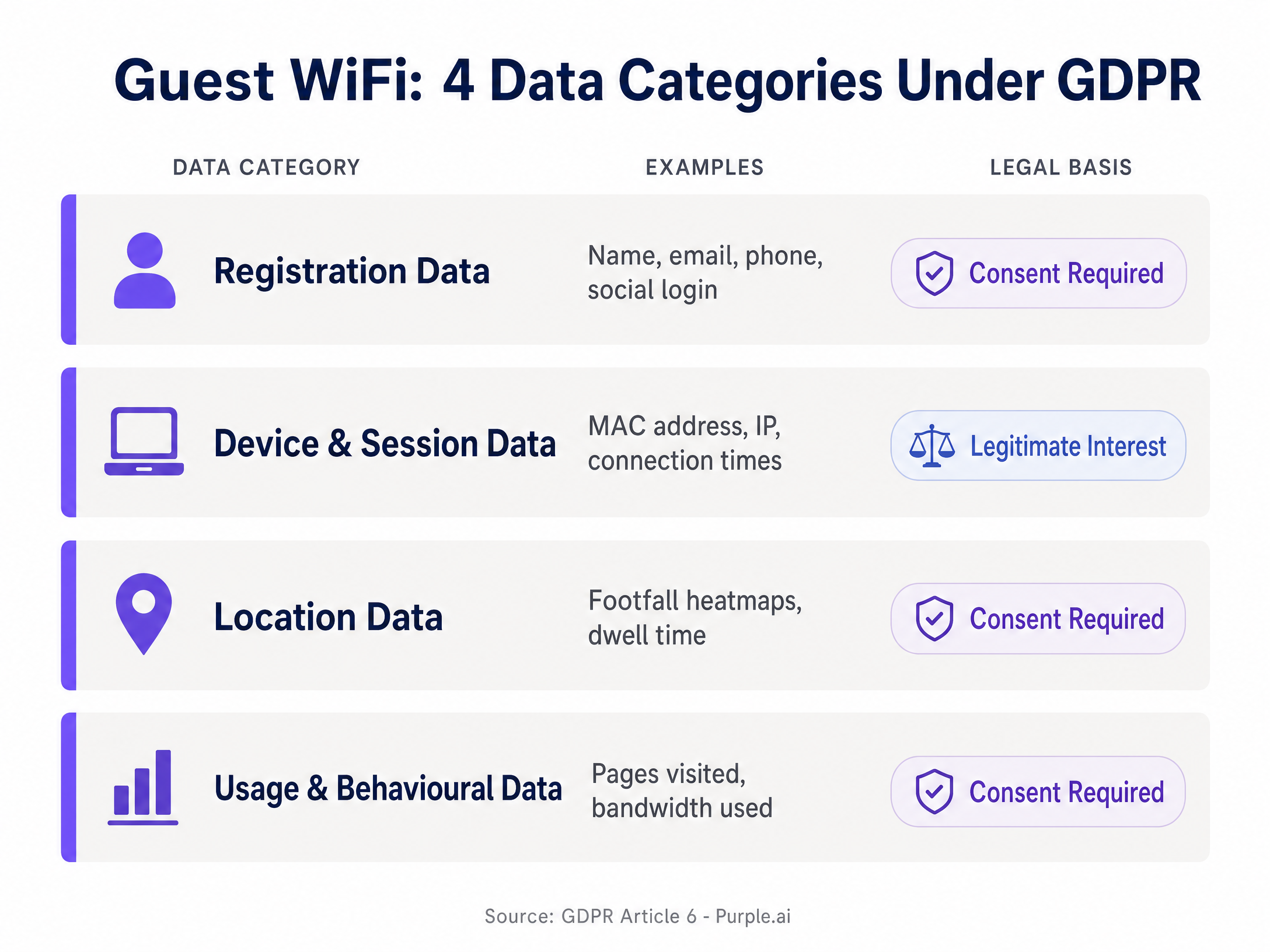
Die über ein Guest WiFi-Netzwerk erfassten Daten lassen sich in vier Hauptkategorien unterteilen. Jede hat spezifische Auswirkungen auf die GDPR-Compliance, insbesondere im Hinblick auf die Rechtsgrundlage für die Verarbeitung und die erforderliche Aufbewahrungsfrist.
- Registrierungsdaten: Name, E-Mail-Adresse, Telefonnummer und Social-Media-Profildaten. Die Rechtsgrundlage ist die Einwilligung. Sie müssen eine ausdrückliche Einwilligung zur Erfassung dieser Daten einholen und die Grundsätze der Datenminimierung anwenden, um nur das abzufragen, was unbedingt erforderlich ist.
- Geräte- und Sitzungsdaten: MAC-Adresse, IP-Adresse, Verbindungszeiten und Sitzungsdauer. Die Rechtsgrundlage ist in der Regel das berechtigte Interesse für Netzwerksicherheit und Fehlerbehebung, vorausgesetzt, Sie führen eine Interessenabwägung (Legitimate Interest Assessment) durch und dokumentieren diese.
- Standortdaten: Besucherstrom-Heatmaps und Verweildauer-Tracking. Die Rechtsgrundlage ist die Einwilligung. Selbst im aggregierten Zustand handelt es sich bei der ersten Erfassung von einem einzelnen Gerät um personenbezogene Daten.
- Nutzungs- und Verhaltensdaten: Besuchte Seiten und verbrauchte Bandbreite. Die Rechtsgrundlage ist die Einwilligung. Sie müssen genau angeben, was Sie erfassen und warum.
Captive Portal-Einwilligungsmechanismen
Das Captive Portal ist Ihre primäre Compliance-Schnittstelle. Es ist die Begrüßungsseite (Splash Page), die Gäste sehen, bevor sie auf das Internet zugreifen. Der häufigste Compliance-Fehler ist die Kopplung (Bundling), bei der ein Veranstaltungsort von einem Gast verlangt, Marketing-E-Mails zu akzeptieren, um online gehen zu können. Unter der GDPR muss die Einwilligung freiwillig erteilt werden. Wenn Sie den Netzwerkzugang mit der Marketing-Einwilligung koppeln, ist die Einwilligung ungültig.
Ihr Captive Portal muss mindestens zwei separate Einwilligungselemente aufweisen:
- Ein obligatorisches Kontrollkästchen zur Annahme Ihrer Nutzungsbedingungen für den Netzwerkzugang.
- Ein optionales, nicht vorab ausgewähltes Kontrollkästchen für die Einwilligung zum Erhalt von Marketingmitteilungen.
Erwägungsgrund 32 der GDPR verbietet ausdrücklich vorab angekreuzte Kästchen. Über die Einwilligungsstruktur hinaus muss Ihr Portal eine klare und prägnante Datenschutzerklärung bereitstellen, bevor der Nutzer Daten übermittelt. Darin muss erklärt werden, welche Daten Sie erfassen, warum Sie sie erfassen, wie lange Sie sie aufbewahren und mit wem Sie sie teilen. Ihr System muss jedes Einwilligungsereignis protokollieren: wer eingewilligt hat, wann eingewilligt wurde, worin eingewilligt wurde und welche genaue Version der Datenschutzerklärung angezeigt wurde. Dieser Einwilligungs-Audit-Trail ist Ihr Nachweis der Compliance.
Netzwerkarchitektur und Sicherheit
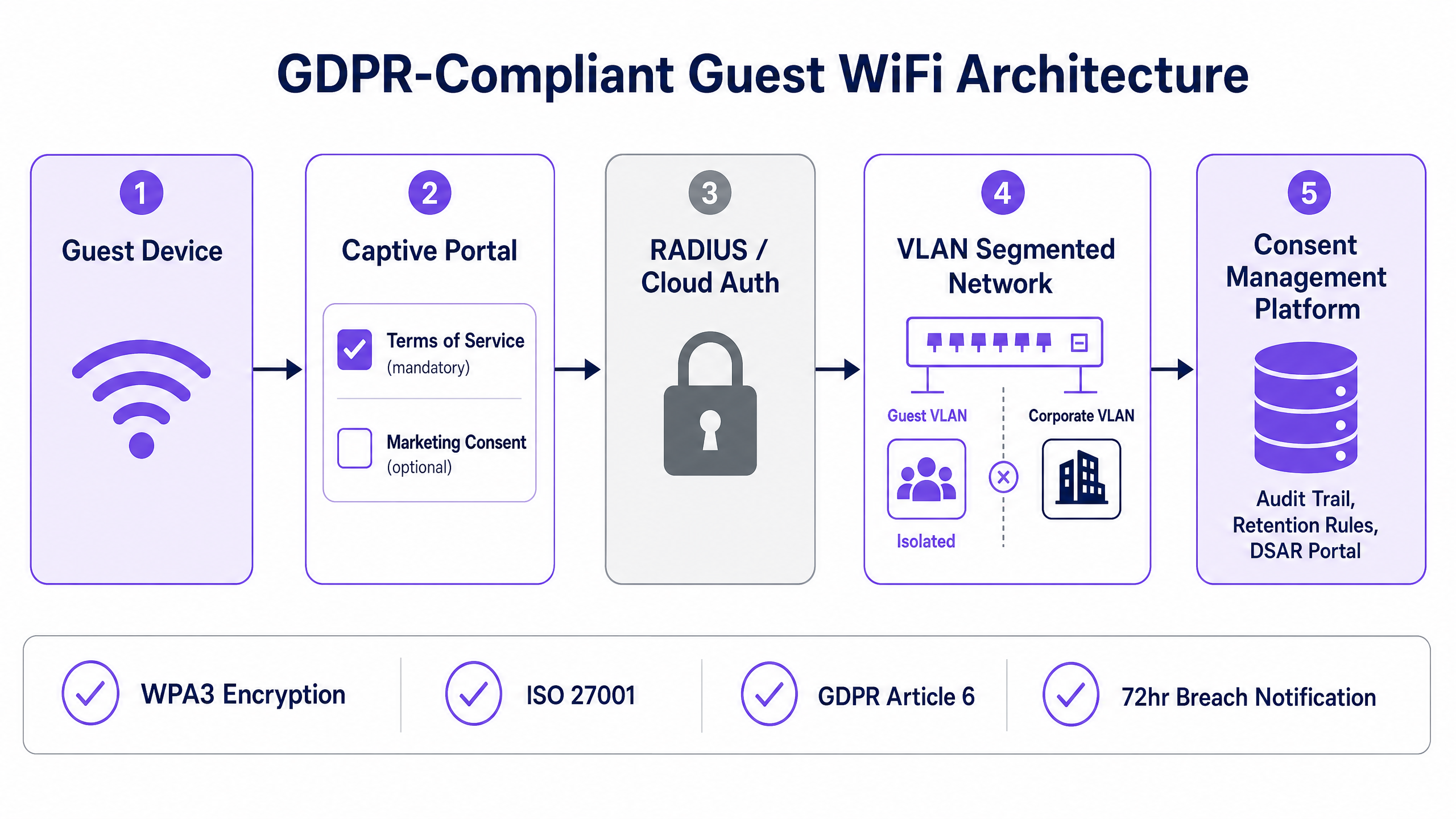
Aus Sicht der Netzwerkarchitektur ist eine VLAN-Segmentierung unumgänglich. Der Guest WiFi-Datenverkehr muss auf einem dedizierten VLAN isoliert werden, das vollständig von Ihrem Unternehmensnetzwerk getrennt ist. Verwenden Sie Zugriffskontrolllisten (ACLs), um den Zugriff von Gastgeräten auf interne Subnetze zu blockieren, und aktivieren Sie die Client-Isolierung, damit Gastgeräte nicht untereinander kommunizieren können. Dies gilt unabhängig davon, ob Sie Cisco Meraki, HPE Aruba, Ruckus, Juniper Mist oder Ubiquiti UniFi einsetzen.
Integrieren Sie für die Authentifizierung Ihren Wireless-LAN-Controller mit einem Cloud-RADIUS-Server. Wenn ein Benutzer den Captive Portal-Flow abschließt, sendet die Plattform eine RADIUS-Access-Accept-Nachricht an den Controller, um den Netzwerkzugriff zu gewähren. Dies schafft eine saubere Trennung zwischen der Authentifizierungsschicht und der Datenerfassungsschicht.
Zur Verschlüsselung: Setzen Sie WPA3 ein, sofern Ihre Hardware dies unterstützt. WPA3 verwendet „Simultaneous Authentication of Equals“, was die Schwachstellen des WPA2-Vier-Wege-Handshakes eliminiert und einen stärkeren Schutz gegen Offline-Wörterbuchangriffe bietet. Erzwingen Sie mindestens WPA2 mit AES-Verschlüsselung. Ihr Captive Portal muss über HTTPS mit einem gültigen TLS-Zertifikat bereitgestellt werden. Die Bereitstellung eines Formulars zur Erfassung personenbezogener Daten über HTTP ist ein schwerwiegender Sicherheitsmangel.
Implementierungsleitfaden
Die Bereitstellung einer konformen Guest WiFi-Lösung erfordert eine sorgfältige Planung und Ausführung. Die folgenden Schritte beschreiben einen herstellerneutralen Ansatz für die Implementierung.
Schritt 1: Audit der aktuellen Datenflüsse
Erfassen Sie genau, welche Daten Ihr aktuelles Guest WiFi-Netzwerk sammelt. Identifizieren Sie jedes Feld auf Ihrem Captive Portal, jede von Ihrem Wireless-Controller generierte Protokolldatei und jede Integration von Drittanbietern. Dokumentieren Sie den Zweck für jeden Datenpunkt. Wenn Sie die Erfassung eines bestimmten Datenpunkts nicht rechtfertigen können, entfernen Sie ihn.
Schritt 2: Redesign des Captive Portals
Implementieren Sie ein konformes Captive Portal mit separaten, nicht vorab ausgewählten Kontrollkästchen für die Netzwerkbedingungen und die Einwilligung zu Marketingzwecken. Stellen Sie sicher, dass die Sprache verständlich und der Mehrwert klar erkennbar ist. Verlinken Sie direkt auf Ihre vollständige Datenschutzerklärung.
Schritt 3: Datenaufbewahrung automatisieren
Konfigurieren Sie automatisierte Löschrichtlinien in Ihrer WiFi Analytics -Plattform. Eine manuelle Löschung ist bei großen Datenmengen nicht praktikabel.
- Sitzungsprotokolle: Nach 30 Tagen löschen.
- Netzwerksicherheitsprotokolle: Bis zu 12 Monate aufbewahren.
- Einwilligungsnachweise: Für die Dauer der Servicebeziehung plus zwei Jahre aufbewahren.
- Marketingprofile: Sofort löschen, wenn ein Nutzer seine Einwilligung widerruft.
Schritt 4: Absicherung des Network Edge
Segmentieren Sie den Gast-Traffic in ein dediziertes VLAN. Implementieren Sie Client-Isolation. Erzwingen Sie WPA3-Verschlüsselung, wo diese unterstützt wird. Stellen Sie sicher, dass Ihr Captive Portal über HTTPS bereitgestellt wird.
Schritt 5: Implementieren Sie ein Preference Center
Bieten Sie Gästen ein Self-Service Preference Center, in dem sie ihre Einwilligungseinstellungen verwalten und Auskunftsbegehren (DSARs) einreichen können. Dies reduziert den operativen Aufwand für Ihr IT-Team und stellt sicher, dass Sie die Rechte der betroffenen Personen effizient wahren können.
Best Practices
Um die Compliance zu wahren und eine robuste Guest WiFi -Strategie aufzubauen, halten Sie sich an diese branchenüblichen Best Practices:
- Führen Sie eine DSFA durch: Eine Datenschutz-Folgenabschätzung (DPIA) ist gemäß GDPR Artikel 35 gesetzlich vorgeschrieben, bevor Sie großflächiges Standort-Tracking oder Verhaltens-Profiling einsetzen.
- Unterzeichnen Sie einen AVV: Stellen Sie sicher, dass Sie mit jeder Drittanbieter-Plattform, die Gästedaten in Ihrem Auftrag verarbeitet, einen Auftragsverarbeitungsvertrag (DPA) abgeschlossen haben.
- Datenminimierung: Fragen Sie nur nach den Daten, die Sie tatsächlich benötigen und nutzen wollen. Wenn Sie ein Retail -Standort sind, benötigen Sie dann wirklich das Geburtsdatum eines Gastes, um Internetzugang bereitzustellen?
- Bereiten Sie sich auf Datenpannen vor: Die 72-Stunden-Meldefrist beginnt in dem Moment, in dem Sie von einer Verletzung erfahren. Integrieren Sie diesen Zeitrahmen in Ihren Incident-Response-Plan und stellen Sie sicher, dass Ihr Team weiß, dass die ICO innerhalb von 72 Stunden benachrichtigt werden muss, selbst wenn die Untersuchung noch nicht abgeschlossen ist.
Fehlerbehebung & Risikominderung
Häufige Fehlerquellen bei Guest WiFi-Bereitstellungen resultieren oft aus einem Missverständnis der GDPR-Anforderungen.
Fehlerquelle: Einwilligungs-Müdigkeit (Consent Fatigue) Wenn Ihr Portal zu komplex ist, brechen Gäste die Verbindung ab oder klicken blindlings. Halten Sie die Sprache einfach. Erklären Sie den Mehrwert klar. Zum Beispiel: „Geben Sie Ihre E-Mail-Adresse an, um schnelles, kostenloses WiFi und gelegentliche Angebote von uns zu erhalten.“
Fehlerquelle: Ignorieren von Betroffenenrechten Unter der GDPR haben Gäste das Recht auf Auskunft, Berichtigung und Löschung ihrer Daten. Wenn Ihnen ein Prozess zur Bearbeitung dieser Anfragen fehlt, setzen Sie sich einem erheblichen Risiko aus. Ein Self-Service Preference Center ist die effektivste Strategie zur Risikominderung.
Fehlerquelle: Unbegrenzte Datenaufbewahrung Die unbegrenzte Aufbewahrung von Daten verstößt direkt gegen den Grundsatz der Speicherbegrenzung der GDPR. Wenn Sie keine automatisierten Löschrichtlinien eingerichtet haben, häufen Sie mit jedem Tag Risiken an. Konfigurieren Sie Aufbewahrungsregeln in Ihrer Plattform, um Datensätze nach Ablauf ihrer Aufbewahrungsfrist automatisch zu löschen.
ROI & geschäftliche Auswirkungen
GDPR-Compliance für Guest WiFi ist nicht nur ein Kostenfaktor, sondern ein strategischer Erfolgsfaktor. Eine konforme Plattform mindert das Risiko von behördlichen Bußgeldern, baut Kundenvertrauen auf und liefert ethisch einwandfreie Business Intelligence.
Wenn sich ein Gast über ein konformes Captive Portal aktiv für Marketing-Kommunikation entscheidet (Opt-in), ist die Qualität dieses Kontakts deutlich höher als bei einem gekoppelten Opt-in. Gäste, die ihre ausdrückliche Einwilligung geben, interagieren mit höherer Wahrscheinlichkeit mit nachfolgenden Mitteilungen, was zu höheren Konversionsraten für Ihre Marketingkampagnen.
Darüber hinaus liefert eine gut strukturierte Guest WiFi-Plattform wertvolle Einblicke in das Besucherverhalten. In Hospitality -Umgebungen können diese Daten zur Personalplanung beitragen, das Layout optimieren und das gesamte Gästeerlebnis verbessern. Indem Sie Compliance als grundlegendes Element Ihrer Guest WiFi-Strategie betrachten, verwandeln Sie eine regulatorische Anforderung in einen messbaren Geschäftswert.
Hören Sie sich unseren Podcast an, um tiefer in diese Themen einzutauchen:
Schlüsseldefinitionen
Data Controller
The entity that determines the purposes and means of processing personal data. When you provide Guest WiFi, you are the Data Controller.
This designation makes the venue legally responsible for compliance, regardless of which vendor supplies the WiFi hardware or software.
Data Processor
The entity that processes personal data on behalf of the Data Controller. Your WiFi analytics vendor is a Data Processor.
A signed Data Processing Addendum (DPA) is legally required before sharing data with a Processor.
MAC Address
Media Access Control address. A unique identifier assigned to a network interface controller for use as a network address in communications within a network segment.
Under GDPR, a MAC address is considered personal data when it can be linked to an identifiable individual.
Captive Portal
A web page that the user of a public-access network is obliged to view and interact with before access is granted.
This is the primary interface for collecting consent and serving privacy notices to guests.
VLAN Segmentation
The practice of dividing a physical network into multiple logical networks.
Guest WiFi traffic must be isolated on a dedicated VLAN to prevent access to the corporate network.
Legitimate Interest
A lawful basis for processing personal data when the processing is necessary for your legitimate interests or the legitimate interests of a third party, unless there is a good reason to protect the individual's personal data which overrides those legitimate interests.
Often used as the basis for basic session logging for network security and troubleshooting.
Data Subject Access Request (DSAR)
A request made by an individual to access the personal data an organisation holds about them.
Venues must have a process to handle DSARs efficiently, often facilitated by a self-service preference centre.
WPA3
Wi-Fi Protected Access 3. The latest security certification program developed by the Wi-Fi Alliance.
Provides stronger encryption and protection against offline dictionary attacks compared to WPA2. Should be deployed where hardware supports it.
Ausgearbeitete Beispiele
A 200-room hotel wants to collect guest emails to drive loyalty programme sign-ups. Their current system requires guests to accept marketing to get online.
Deploy a compliant captive portal with separate consent checkboxes. The mandatory checkbox covers terms of service. The optional, unticked checkbox covers marketing consent. The hotel will likely see a lower raw volume of marketing opt-ins compared to the bundled approach, but the quality and legality of the list improves dramatically. Guests who actively opt in are far more likely to engage with subsequent communications. Premier Inn, which uses Purple across its estate, operates exactly this model.
A stadium IT team wants to use WiFi analytics to monitor crowd density and manage safety, but the legal team is concerned that tracking device locations without consent is a GDPR violation.
Update the captive portal privacy notice to explicitly disclose that location data is processed for crowd management and safety purposes. Implement MAC address pseudonymisation at the edge, on the access points themselves, before the data reaches the cloud analytics platform. The analytics system then works with pseudonymous identifiers rather than raw MAC addresses.
Übungsfragen
Q1. A retail chain wants to implement WiFi footfall tracking across 50 stores to measure dwell time. The IT Director suggests logging raw MAC addresses centrally for analysis. Is this compliant?
Hinweis: Consider the definition of personal data and the principle of data minimisation.
Musterlösung anzeigen
No, this is high risk. Raw MAC addresses are personal data. The recommended approach is to implement MAC address pseudonymisation at the edge (on the access points) before transmitting the data to the central analytics platform. Additionally, a Data Protection Impact Assessment (DPIA) must be conducted before deployment, and clear signage must inform shoppers that analytics are in operation.
Q2. During an audit, you discover that your captive portal requires users to accept both the network terms of service and marketing emails via a single checkbox to connect to the WiFi. What is the immediate required action?
Hinweis: Review the requirements for valid consent under GDPR Article 6.
Musterlösung anzeigen
Immediately redesign the captive portal to unbundle the consent. Implement two separate checkboxes: a mandatory one for the network terms of service, and an optional, unticked checkbox for marketing consent. The current bundled approach renders all collected marketing consent invalid under GDPR.
Q3. A guest submits a Data Subject Access Request (DSAR) asking for all data your venue holds on them, including WiFi session logs. Your current retention policy is to keep session logs indefinitely. What are the implications?
Hinweis: Consider the storage limitation principle.
Musterlösung anzeigen
Keeping session logs indefinitely violates the GDPR storage limitation principle. You must fulfill the DSAR by providing the requested data, but you must also urgently implement an automated data retention policy. Session logs should typically be purged after 30 days. Holding them indefinitely exposes the venue to significant regulatory risk.
Weiterlesen in dieser Reihe
Konfiguration der Captive Portal-Weiterleitung auf Enterprise-Netzwerk-Controllern
Dieser maßgebliche Leitfaden beschreibt die technische Architektur und die herstellerspezifischen Konfigurationsschritte, die für die Implementierung der Captive Portal-Weiterleitung auf Enterprise-Netzwerk-Controllern erforderlich sind. Er bietet IT-Teams praxisnahe Anleitungen zur Konfiguration von Walled Gardens, zur Integration der RADIUS-Authentifizierung und zur Gewährleistung der Compliance mit GDPR und PCI DSS.
Enterprise-Gast-WiFi-Einrichtungsleitfaden: VLAN-Segmentierung, Sicherheit und Captive Portals
Dieser Leitfaden bietet einen technischen Entwurf für die Bereitstellung von Enterprise-Gast-WiFi mit Fokus auf VLAN-Segmentierung, Sicherheitsprotokolle und die Architektur von Captive Portals. Er beschreibt im Detail, wie Datenverkehr isoliert, Verschlüsselungsstandards durchgesetzt und First-Party-Daten an komplexen Standorten sicher erfasst werden.
So konfigurieren Sie die WeChat-OAuth-Authentifizierung für Captive Portals
Dieser technische Leitfaden erklärt, wie Sie die WeChat-OAuth-Authentifizierung für Captive Portals konfigurieren. Er beschreibt detailliert die erforderlichen Plattformregistrierungen, den OAuth 2.0-Ablauf, die Scope-Auswahl und die Mechanismen zur Netzwerkdurchsetzung, die erforderlich sind, um First-Party-Daten von chinesischen Besuchern sicher zu erfassen.