

Indoor WiFi-Positionierungssysteme: Funktionsweise und Implementierung
Dieser umfassende Leitfaden erläutert die technische Architektur, Implementierungsstrategien und den Geschäftswert von WiFi-basierten Indoor-Positionierungssystemen. Er bietet Netzwerkarchitekten und IT-Direktoren praktische Anleitungen zur AP-Platzierung, RF-Kalibrierung und zur Überwindung der MAC randomization, um präzise räumliche Analysen zu liefern.
Listen to this guide
View podcast transcript
Executive Summary
Für Betreiber von Unternehmensstandorten ist das Verständnis der Besucherbewegungen kein Luxus mehr – es ist eine grundlegende Anforderung für betriebliche Effizienz und kommerzielle Optimierung. Indoor WiFi-Positionierungssysteme verwandeln die bestehende network infrastructure in eine leistungsstarke spatial analytics engine. Durch die Nutzung von Received Signal Strength Indicator (RSSI)-Messungen Ihrer eingesetzten access points liefern diese Systeme verwertbare Informationen über Besucherfrequenz, Verweildauer und Zonenübergänge, ohne dass zusätzliche Hardware-Overlays wie Bluetooth beacons oder ultra-wideband sensors erforderlich sind.
Dieser technische Referenzleitfaden beschreibt die Architektur, Implementierungsaspekte und geschäftlichen Auswirkungen von WiFi-basierten Indoor-Positionierungssystemen. Er wurde für network architects und IT directors entwickelt und bietet herstellerneutrale Anleitungen zur access point-Konfiguration, Standortvermessung und Funkkalibrierung, während er zeigt, wie die Integration mit Plattformen wie Purple’s WiFi Analytics Rohdaten in messbaren ROI verwandelt. Egal, ob Sie ein Hotel mit 200 Zimmern, eine mehrstöckige Einzelhandelsumgebung oder eine große Einrichtung des öffentlichen Sektors verwalten, dieser Leitfaden bietet die technische Grundlage, die für die effektive und konforme Bereitstellung von Positionierungsanalysen erforderlich ist.
Technical Deep-Dive: Architecture and Standards
Die grundlegende Herausforderung der Indoor-Positionierung besteht darin, dass GPS-Signale Gebäudematerialien nicht zuverlässig durchdringen können. Folglich müssen sich Unternehmensstandorte auf lokale radio frequency (RF)-Infrastruktur verlassen. WiFi ist die logische Wahl, da es allgegenwärtig für Konnektivität eingesetzt wird.
The Mechanics of RSSI Trilateration
Die Kernmetrik für die WiFi-Positionierung ist der Received Signal Strength Indicator (RSSI). Jedes WiFi-fähige Gerät scannt kontinuierlich nach verfügbaren Netzwerken und misst die Signalstärke nahegelegener access points (APs). RSSI wird in Dezibel relativ zu einem Milliwatt (dBm) ausgedrückt und reicht typischerweise von -30 dBm (ausgezeichnetes Signal) bis -90 dBm (unbrauchbares Signal).
Indoor-Positionierungsplattformen nutzen die Trilateration, um den Gerätestandort zu schätzen. Wenn der RSSI eines Geräts von drei oder mehr APs mit bekannten physischen Koordinaten gemessen wird, berechnet das System die wahrscheinliche Entfernung von jedem AP. Der Schnittpunkt dieser Wahrscheinlichkeitsradien bestimmt den geschätzten Standort.
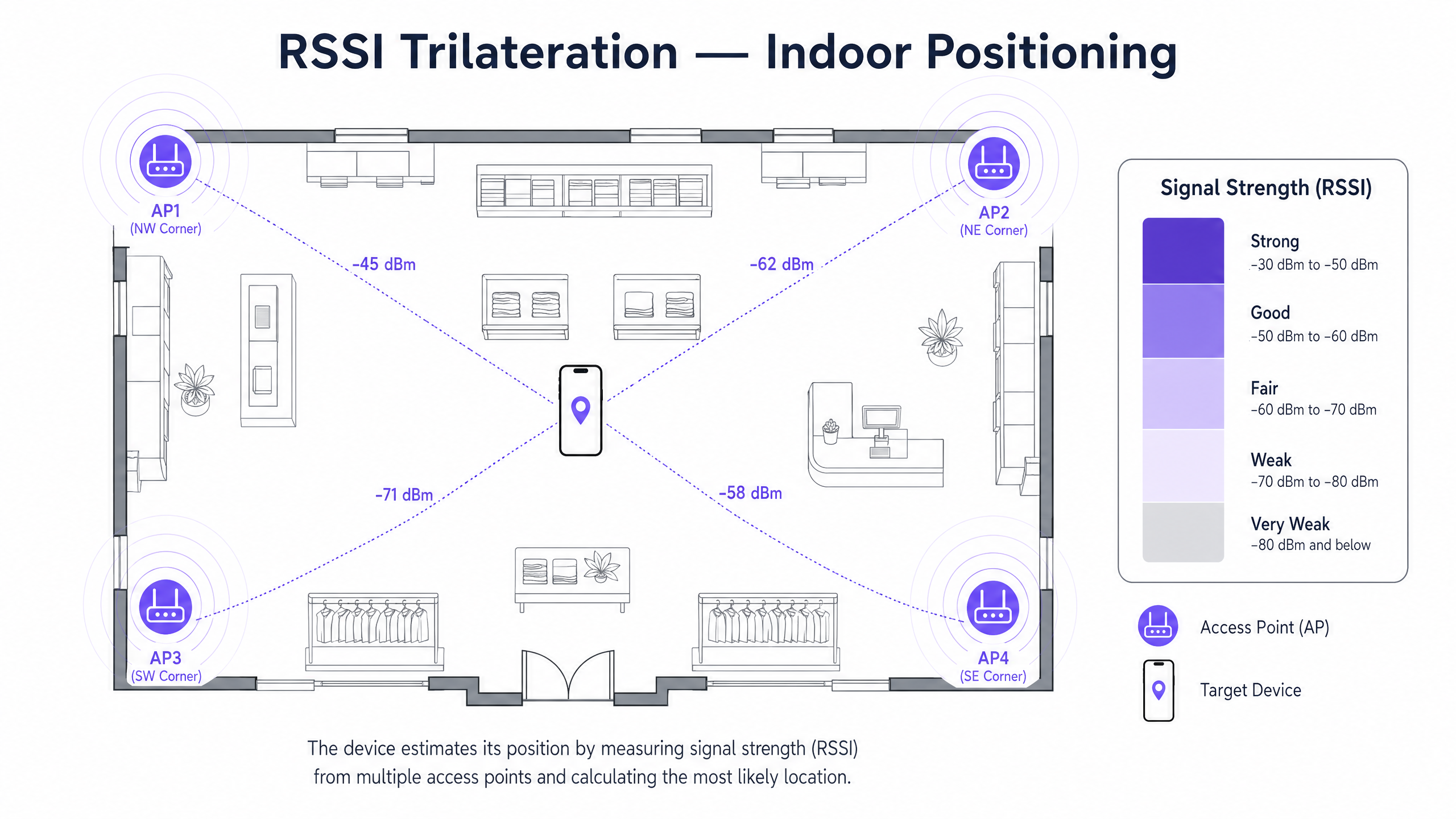
Während die Trilateration die mathematische Grundlage bildet, ist der Roh-RSSI aufgrund von Mehrwegeausbreitung, Absorption durch physische Hindernisse und Interferenzen sehr volatil. Daher verwenden Unternehmenssysteme RF fingerprinting – einen Kalibrierungsprozess, bei dem empirische RSSI-Messungen an bekannten Standorten aufgezeichnet werden, um eine Referenzdatenbank zu erstellen. Während des Betriebs vergleicht das System Echtzeit-RSSI-Messwerte mit dieser Fingerprint-Datenbank unter Verwendung probabilistischer Algorithmen (wie k-nearest neighbors oder Bayesian inference), um die Genauigkeit erheblich zu verbessern.
Device-Side vs. Infrastructure-Side Positioning
Es gibt zwei primäre Architekturmodelle für die Verarbeitung von Standortdaten:
- Device-Side Positioning: Das Client-Gerät (z. B. ein Smartphone mit einer bestimmten App) misst den RSSI von nahegelegenen APs, berechnet seine eigene Position und meldet diese optional an einen Server zurück. Dieser Ansatz skaliert gut, erfordert jedoch Benutzerinteraktion (App-Installation) und ist anfällig für OS-Einschränkungen beim Hintergrund-Scanning.
- Infrastructure-Side Positioning: Die Netzwerk-APs lauschen auf Probe Requests, die von Client-Geräten ausgesendet werden. Die APs leiten diese RSSI-Messungen an einen zentralen Controller oder eine Cloud-Analyse-Engine weiter, die die Position berechnet. Dies ist das bevorzugte Unternehmensmodell, da es keine clientseitige Software erfordert und passive Analysen für alle sendenden Geräte bereitstellt. Die Plattform von Purple nutzt diesen Infrastructure-Side-Ansatz und korreliert Standortdaten mit authentifizierten Profilen über das Guest WiFi Captive Portal.
Relevant IEEE Standards
Um die Positionierungsgenauigkeit zu optimieren, müssen Netzwerkarchitekten sicherstellen, dass ihre Infrastruktur spezifische IEEE 802.11-Erweiterungen unterstützt:
- 802.11k (Radio Resource Measurement): Ermöglicht APs und Clients den Austausch von Informationen über die RF-Umgebung, wodurch das Netzwerk eine bessere Sichtbarkeit des Client-RSSI erhält.
- 802.11v (BSS Transition Management): Ermöglicht dem Netzwerk, Clients zu optimalen APs zu leiten, wodurch die Qualität der Standorttelemetrie indirekt verbessert wird, indem sichergestellt wird, dass Clients mit den APs mit den besten Signalcharakteristiken verbunden sind.
- 802.11ac (Wave 2) und 802.11ax (WiFi 6): Obwohl sie sich hauptsächlich auf throughput und capacity konzentrieren, bieten die erweiterten beamforming- und MU-MIMO-Funktionen dieser Standards stabilere RF-Umgebungen, was der RSSI-Konsistenz zugutekommt.
- 802.11az (Next Generation Positioning): Der aufkommende Standard für Fine-Time Measurement (FTM), der die Laufzeit anstelle von RSSI verwendet, um eine Genauigkeit im Submeterbereich zu erreichen. Obwohl noch nicht allgegenwärtig, stellt er die Zukunft der WiFi-Positionierung dar.
Implementation Guide: Deployment and Configuration
Die Bereitstellung eines Indoor-Positionierungssystems erfordert eine sorgfältige Planung. Das network design, das eine hervorragende Datenabdeckung bietet, liefert nicht automatisch eine hervorragende Standortgenauigkeit.
Step 1: The RF Site Survey
Eine prädiktive Software-Vermessung ist für die Positionierung unzureichend. Sie müssen eine aktive, Vor-Ort-RF survey durchführen. Dies beinhaltet das Begehen des Veranstaltungsortes mit spezialisierter spectrum analysis, umTools, um die tatsächliche Signalausbreitung abzubilden, Störquellen (z. B. HLK-Systeme, Baustahl) zu identifizieren und Funkschatten zu lokalisieren. Die Untersuchung legt fest, wo APs hinzugefügt oder neu positioniert werden müssen, um sicherzustellen, dass jede verfolgbare Zone Sichtverbindung oder starke Durchdringung von mindestens drei APs hat. Detaillierte Anleitungen zur Sicherung dieser APs nach der Bereitstellung finden Sie in unserem Access Point Security: Your 2026 Enterprise Guide .
Schritt 2: Strategie zur Platzierung von Access Points
Für die Konnektivität werden APs oft in Fluren platziert, um die Abdeckungsfläche zu maximieren. Für die Positionierung ist dies kontraproduktiv. APs müssen am Umfang und in den Ecken der Zonen platziert werden, die Sie verfolgen möchten, um das RF-Signal nach innen zu ziehen.
- Dichte: Streben Sie an, dass mindestens drei APs ein Client-Gerät an jedem beliebigen Punkt erkennen (typischerweise -75 dBm oder besser).
- Geometrie: Vermeiden Sie die Platzierung von APs in einer geraden Linie. Ein gleichseitiges Dreieck oder ein versetztes Rastermuster bietet die beste Geometrie für Trilaterationsalgorithmen.
- Höhe: Montieren Sie APs in gleichmäßigen Höhen, typischerweise zwischen 3 und 4 Metern. Übermäßige Höhe beeinträchtigt die horizontale RSSI-Differenzierung, die für eine genaue 2D-Positionierung erforderlich ist.
Schritt 3: Funkkartenkalibrierung (Fingerprinting)
Sobald die Infrastruktur bereitgestellt ist, müssen Sie das System kalibrieren. Dies beinhaltet das Hochladen eines genauen, maßstabsgetreuen Grundrisses auf die Positionierungsplattform. Ein Techniker geht dann durch den Veranstaltungsort und hält an definierten Gitterpunkten (typischerweise alle 2 bis 5 Meter) an, um empirische RSSI-Samples aufzuzeichnen. Dieser Fingerprinting-Prozess lehrt den Algorithmus, wie sich RF-Signale in Ihrer spezifischen physischen Umgebung tatsächlich verhalten, unter Berücksichtigung von Wänden, Regalen und anderen Hindernissen.
Schritt 4: Plattformintegration und Identitätsauflösung
Rohe X/Y-Koordinaten sind ohne Geschäftskontext nutzlos. Die Positionierungs-Engine muss in ein Analyse-Dashboard einspeisen. Darüber hinaus verwenden moderne mobile Betriebssysteme die MAC-Adressen-Randomisierung, um die passive Verfolgung nicht authentifizierter Geräte zu verhindern.
Um dies zu überwinden, muss das Positionierungssystem in die Netzwerkauthentifizierungsschicht integriert werden. Wenn sich ein Benutzer beim Guest WiFi anmeldet (z. B. über ein Captive Portal), wird seine randomisierte MAC-Adresse vorübergehend seinem authentifizierten Profil zugeordnet. Dies ermöglicht Plattformen wie Purple, umfassende, longitudinale Analysen bereitzustellen und gleichzeitig die Datenschutzbestimmungen vollständig einzuhalten. Für kleinere Veranstaltungsorte, die diese grundlegende Konnektivität implementieren möchten, siehe How to Set Up a WiFi Hotspot for Your Business (oder die portugiesische Version, Como Configurar um Hotspot WiFi para o Seu Negócio ).
Best Practices für Unternehmensumgebungen
Verschiedene Branchen stellen einzigartige RF-Herausforderungen dar. Eine erfolgreiche Bereitstellung erfordert die Anpassung der technischen Strategie an die physische Umgebung.
Gastgewerbe und Gesundheitswesen
In Umgebungen des Gastgewerbes und des Gesundheitswesens ist die größte Herausforderung die Signaldämpfung, die durch dichte Wände, Brandschutztüren und Aufzugsschächte verursacht wird.
- Best Practice: Setzen Sie APs innerhalb der Räume ein, anstatt sich auf Flur-APs zu verlassen, die Wände durchdringen müssen. Diese Mikrozellenarchitektur liefert die eindeutigen RF-Signaturen, die für raumgenaue Präzision erforderlich sind.
Einzelhandel und Supermärkte
Einzelhandelsumgebungen kämpfen mit sich ändernden RF-Dynamiken. Metallregale, Bestandsdichte und große Menschenmengen absorbieren und reflektieren RF-Signale, was bedeutet, dass sich die RF-Umgebung zwischen Öffnungszeiten und Spitzenzeiten ändert.
- Best Practice: Führen Sie die Funkkalibrierung während der Betriebszeiten mit typischem Fußgängerverkehr durch, nicht in einem leeren Geschäft. Nutzen Sie dynamische Kalibrierungsalgorithmen, falls von Ihrem Anbieter unterstützt.
Transport und Stadien
In Verkehrsknotenpunkten und großen Veranstaltungsorten ist die Herausforderung die schiere Größe und AP-Dichte. Eine hohe AP-Dichte kann zu Gleichkanalstörungen führen.
- Best Practice: Verwalten Sie die Sendeleistung sorgfältig. APs sollten mit geringerer Sendeleistung konfiguriert werden, um die Zellengröße und Interferenzen zu reduzieren, wobei sie sich auf die hohe Dichte der APs verlassen, um die notwendige überlappende Abdeckung für die Positionierung bereitzustellen.
Fehlerbehebung & Risikominderung
Selbst bei sorgfältiger Planung können Positionierungssysteme eine Verschlechterung erfahren. IT-Teams müssen diese häufigen Fehlerquellen proaktiv überwachen und mindern.
1. Die Herausforderung der MAC-Randomisierung
Wie erwähnt, randomisieren iOS und Android MAC-Adressen, um passives Tracking zu verhindern. Wenn Ihr System ausschließlich auf passiven Probe-Requests basiert, zeigen Ihre Analysen massiv überhöhte Besucherzahlen und keine wiederkehrenden Besucher.
- Minderung: Erzwingen Sie die Captive Portal-Authentifizierung für den Gastzugang. Der Wertetausch (kostenloses WiFi für Kontaktdaten) bietet die rechtliche Grundlage und den technischen Mechanismus zur Identitätsauflösung. Stellen Sie sicher, dass Ihr Netzwerk vor Spoofing geschützt ist; lesen Sie Protect Your Network with Strong DNS and Security für Strategien zur Infrastrukturhärtung.
2. Firmware-Inkonsistenzen
Das RSSI-Reporting-Verhalten kann sich zwischen AP-Firmware-Versionen drastisch ändern. Ein Update könnte die Häufigkeit, mit der ein AP Probe-Requests meldet, oder die Art und Weise, wie er den RSSI-Wert berechnet, ändern.
- Minderung: Standardisieren Sie die Firmware über die gesamte Bereitstellung hinweg. Bevor Sie ein Anbieter-Firmware-Update einführen, testen Sie es in einer Staging-Umgebung, um zu überprüfen, ob es den Standortanalyse-Feed nicht beeinträchtigt.
3. Umweltdrift
Ein Veranstaltungsort, der mit neuen Metallvorrichtungen renoviert oder dessen Trennwände versetzt wurden, macht die bestehende RF-Fingerprint-Karte ungültig, was zu einem drastischen Rückgang der Standortgenauigkeit führt.
- Minderung: Implementieren Sie eine Richtlinie, die eine IT-Überprüfung aller wesentlichen physischen Änderungen am Veranstaltungsort vorschreibt. Planen Sie regelmäßigeerneute Kalibrierung der Funkkarte, insbesondere in dynamischen Umgebungen wie dem Einzelhandel.
ROI & Geschäftlicher Nutzen
Die Rechtfertigung für den Einsatz eines Indoor-Positionierungssystems liegt in seiner Fähigkeit, umsetzbare Business Intelligence zu generieren. Bei Integration mit einer Plattform wie Purple's WiFi Analytics wird die technische Telemetrie direkt in kommerziellen Wert umgewandelt.
Erfolgsmessung
Der Erfolg sollte anhand spezifischer operativer KPIs gemessen werden:
- Capture Rate: Der Prozentsatz des gesamten Besucheraufkommens, das sich mit dem WiFi verbindet und zu einem authentifizierten, verfolgbaren Profil wird.
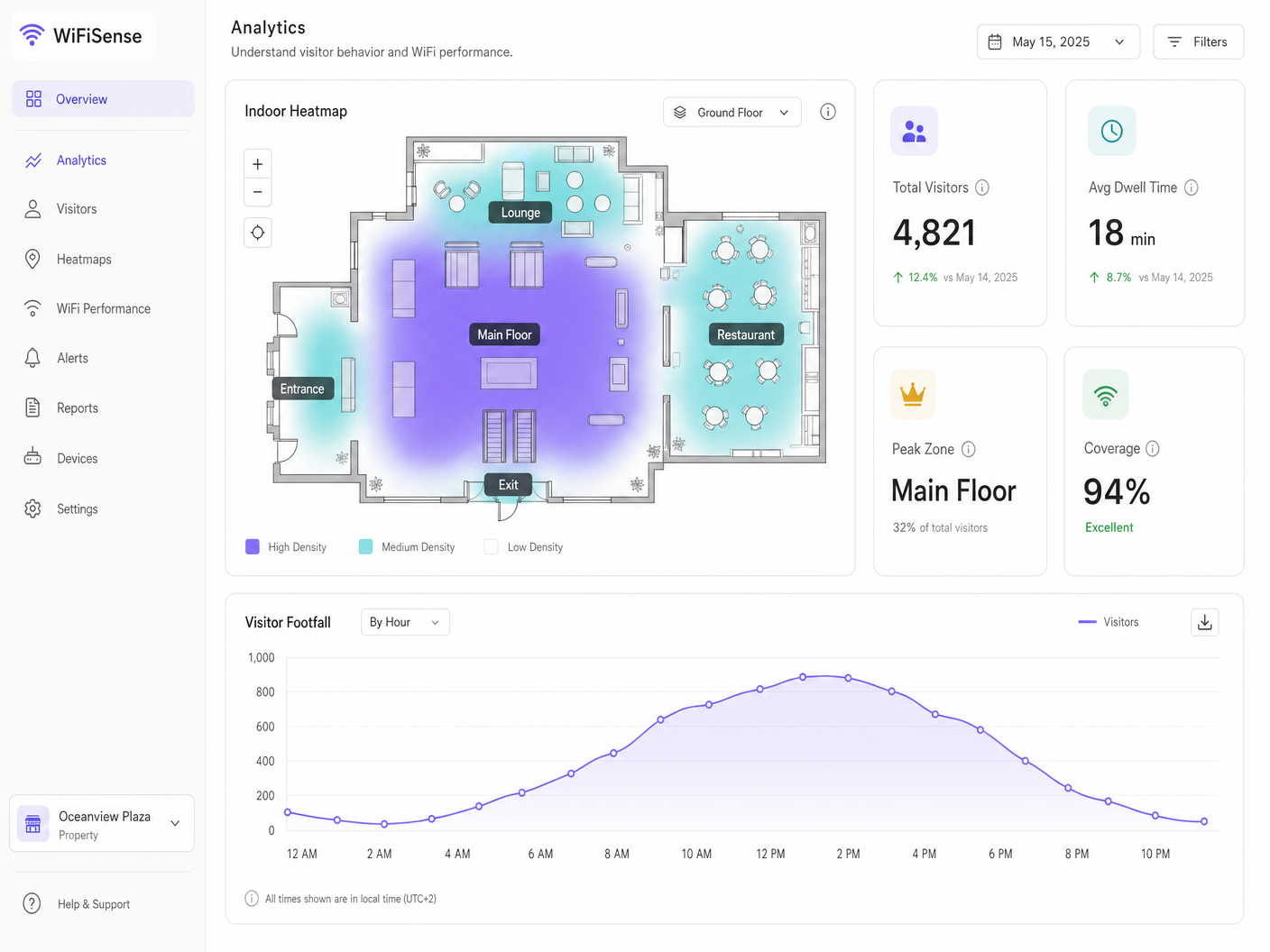
- Zonenkonversion: Analyse des Besucherflusses vom Eingang zu spezifischen hochwertigen Zonen (z.B. das Restaurant in einem Hotel oder eine bestimmte Abteilung im Einzelhandel).
- Optimierung der Verweildauer: Identifizierung von Bereichen, in denen Besucher übermäßig viel Zeit verbringen (was auf Engpässe wie Kassenschlangen hindeutet), im Vergleich zu Bereichen, in denen sie verweilen (was auf Engagement hindeutet, wie Lounges oder Produktpräsentationen).
Die Kosten-Nutzen-Analyse
Der primäre Kostenvorteil der WiFi-Positionierung besteht darin, dass sie bereits getätigte Investitionen nutzt. Die APs, Switches und Verkabelung sind bereits für die Konnektivität installiert. Die zusätzlichen Kosten umfassen die Softwarelizenzierung für die Analyseplattform und den Arbeitsaufwand für die Standortbegehung und Kalibrierung.
Die Vorteile ergeben sich aus operativen Effizienzen. Zum Beispiel kann ein Stadion Sicherheitspersonal oder Personal für Konzessionen dynamisch basierend auf Echtzeit-Heatmaps der Personendichte einsetzen. Eine Einzelhandelskette kann die Verweildauer in bestimmten Gängen mit Point-of-Sale-Daten korrelieren, um die Effektivität von Kopfregalplatzierungen zu messen. Da Purple seine Analysefähigkeiten kontinuierlich erweitert – kürzlich hervorgehoben durch strategische Schritte wie die Ernennung von VP Education Tim Peers zur Förderung sektorspezifischer Lösungen – bleibt die Fähigkeit, tiefe, kontextbezogene Einblicke aus der bestehenden Netzwerkinfrastruktur zu gewinnen, ein überzeugendes Wertversprechen für IT-Führungskräfte in Unternehmen.
Key Definitions
RSSI (Received Signal Strength Indicator)
A measurement of the power level of an RF signal received by a client device from an access point, expressed in negative decibels (dBm).
RSSI is the raw telemetry data used by trilateration algorithms to estimate the distance between a device and an AP.
Trilateration
A mathematical technique used to determine location by measuring the distance from three or more known reference points.
This is the core algorithm used by the infrastructure to calculate X/Y coordinates based on RSSI values from multiple APs.
RF Fingerprinting
The process of empirically measuring and recording RSSI values at specific physical coordinates to create a database of the venue's unique radio environment.
Essential for overcoming multipath interference and improving accuracy beyond basic mathematical trilateration.
MAC Address Randomization
A privacy feature in modern mobile OSs where the device broadcasts a fake, rotating MAC address when scanning for networks.
This breaks passive tracking systems, necessitating the use of captive portals to authenticate users and resolve their identity.
Probe Request
A management frame transmitted by a client device to discover available 802.11 networks in its vicinity.
Infrastructure-side positioning systems listen for these requests to gather the RSSI data needed for location calculation.
802.11k/v
IEEE standards that allow APs and clients to exchange information about the RF environment and manage roaming.
Supporting these standards ensures the network has better visibility into client RSSI, improving positioning accuracy.
Multipath Interference
A phenomenon where radio signals reach the receiving antenna by two or more paths due to reflection off surfaces like metal or glass.
Multipath causes RSSI fluctuations, which is why RF fingerprinting is required to map the actual signal behavior in the venue.
Dwell Time
The duration a specific device remains within a defined physical zone.
A critical business metric derived from positioning data, used to measure engagement in retail displays or queue lengths in transport hubs.
Worked Examples
A 300-room hotel is experiencing poor location accuracy (15+ meters) in its guest corridors, making it impossible to determine which specific room a device is in. The current deployment uses high-powered APs spaced every 20 meters in the main hallways.
The IT team must transition from a hallway-centric coverage model to a micro-cell architecture. They should deploy lower-powered wall-plate APs directly inside the guest rooms (e.g., one AP for every two rooms). They must then perform a new RF fingerprint calibration. This creates distinct RF signatures for each room, allowing the system to differentiate between a device in Room 101 versus Room 102.
A large retail client reports that their passive WiFi analytics dashboard shows 10,000 unique visitors per day, but door counters only register 2,000. Furthermore, the dashboard shows a 0% repeat visitor rate.
The system is falling victim to MAC address randomization from modern iOS and Android devices. The IT team must configure the analytics platform to filter out locally administered (randomized) MAC addresses from the passive analytics feed. To capture accurate, longitudinal data, they must implement a captive portal on the Guest WiFi, requiring users to authenticate. The analytics engine will then track the authenticated session rather than the ephemeral MAC address.
Practice Questions
Q1. You are designing the AP layout for a new 5,000 sq ft open-plan retail store. The primary requirement is accurate indoor positioning to track customer flow. Should you place the APs in a straight line down the center aisle to maximize aesthetic appeal and simplify cabling?
Hint: Consider how trilateration algorithms calculate distance based on intersecting circles.
View model answer
No. Placing APs in a straight line provides terrible geometry for trilateration, as the intersecting probability circles will overlap in two places (mirror images on either side of the line), making it impossible for the system to determine which side of the aisle the customer is on. APs must be placed in a staggered or perimeter configuration to surround the tracked area.
Q2. Your venue has recently installed a large, floor-to-ceiling mirrored glass water feature in the center of the main lobby. Shortly after, the location accuracy in the lobby degrades significantly. What is the likely technical cause, and what is the remediation?
Hint: Consider how RF signals interact with reflective surfaces.
View model answer
The mirrored glass and water are causing severe multipath interference, reflecting the RF signals and altering the RSSI values received by the APs. The remediation is to perform a new RF site survey and recalibrate the radio fingerprint map for the lobby, teaching the algorithm the new RF characteristics of the space.
Q3. A stakeholder wants to track the movement of every single person who walks past the storefront, regardless of whether they connect to the Guest WiFi. Explain why this is technically unfeasible and legally problematic.
Hint: Think about mobile OS privacy features and GDPR lawful basis requirements.
View model answer
Technically, iOS and Android devices use MAC address randomization when probing for networks, meaning a single device walking past will appear as multiple different, untrackable devices. Legally, tracking individuals without consent or a clear lawful basis violates GDPR. The correct approach is to require users to connect to the Guest WiFi via a captive portal, providing consent and allowing the system to track an authenticated session.