
Kostenloses vs. kostenpflichtiges Hotel WiFi: Welches Modell ist das richtige für Ihre Unterkunft?
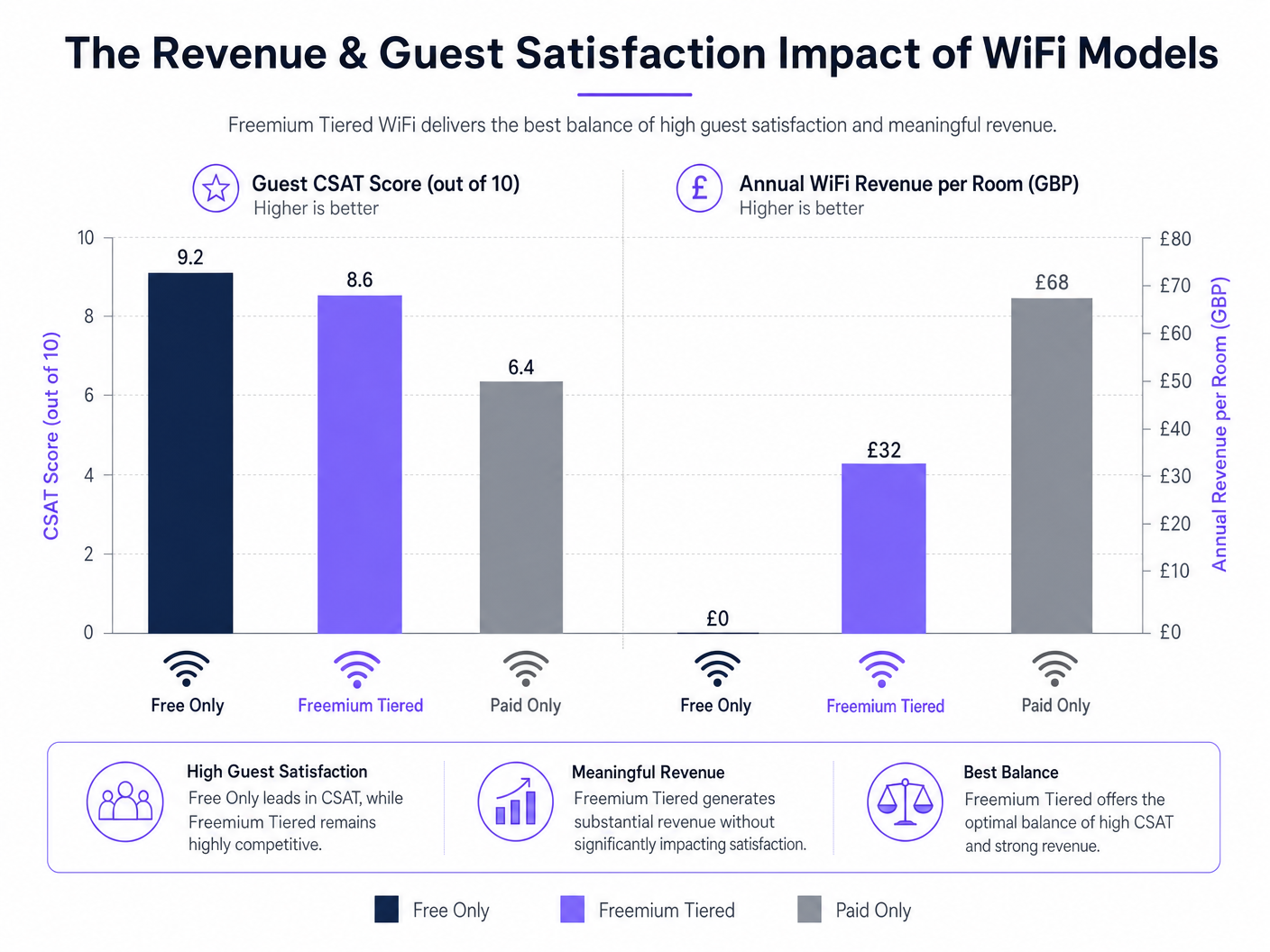
Dieser Leitfaden bietet IT-Führungskräften und Betreibern von Veranstaltungsorten einen definitiven Rahmen für die Wahl zwischen kostenlosen, kostenpflichtigen und gestuften WiFi-Modellen in Gastgewerbeumgebungen. Er analysiert die technische Architektur, die geschäftlichen Auswirkungen und die Kennzahlen zur Gästezufriedenheit, die erforderlich sind, um die Konnektivität erfolgreich zu monetarisieren und gleichzeitig Sicherheit auf Unternehmensniveau und die Einhaltung der GDPR zu gewährleisten. Betreiber, die das Freemium-Stufenmodell implementieren, können signifikante Zusatzumsätze generieren und gleichzeitig die hohen CSAT-Werte erhalten, die zu wiederholten Buchungen führen.
Diesen Leitfaden anhören
Podcast-Transkript ansehen
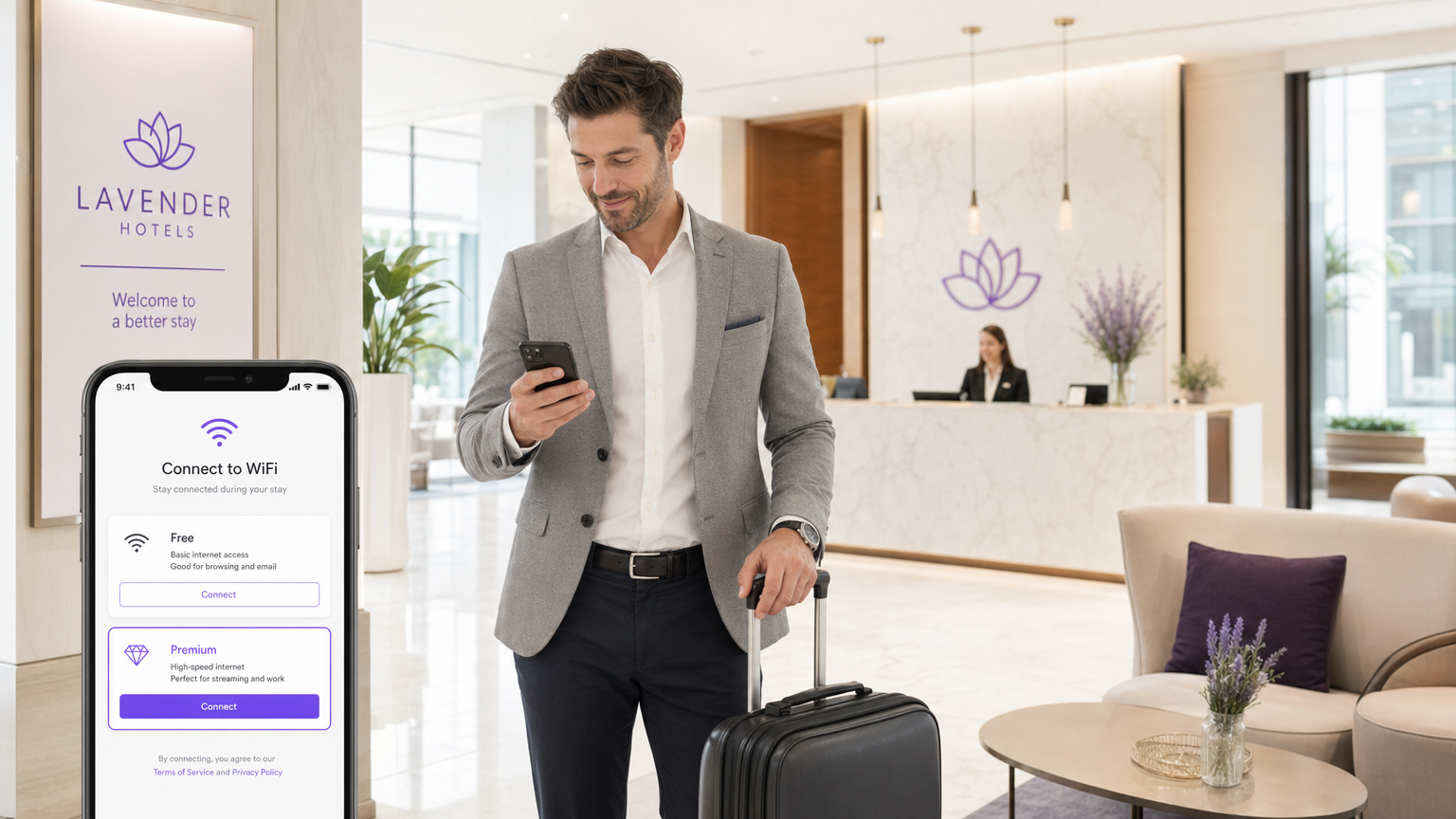
Zusammenfassung für Führungskräfte
Die Debatte zwischen kostenlosem und kostenpflichtigem WiFi im Gastgewerbe und in großen Veranstaltungsorten ist keine binäre Entscheidung mehr. Da die Bandbreitenanforderungen aufgrund von 4K-Streaming, cloudbasierten Konferenzen und einer Explosion von Headless-IoT-Geräten eskalieren, gerät das traditionelle „Free-for-all“-Modell unter Druck. Umgekehrt schaden strikte „Pay-to-play“-Modelle aktiv den Bewertungen der Gästezufriedenheit (CSAT) und führen zu negativen Online-Bewertungen.
Für IT-Manager, Netzwerkarchitekten und CTOs liegt die optimale Lösung im Freemium-Stufenmodell. Dieser Ansatz bietet eine Basis an kostenloser, funktionaler Konnektivität für alle Gäste und gleichzeitig Hochgeschwindigkeits-Premium-Stufen für Power-User. Dieser Leitfaden untersucht die technische Architektur, die zur Implementierung gestufter Bandbreiten erforderlich ist, das Geschäftsmodell für die Generierung von Zusatzumsätzen und wie Plattformen wie Guest WiFi und WiFi Analytics ein Kostenfaktor in einen strategischen Vorteil verwandeln. Die folgende Analyse ist relevant für jeden Betreiber eines Veranstaltungsortes, von einem Boutique-Hotel mit 50 Zimmern bis zu einem großen Konferenzzentrum oder Stadion – überall dort, wo eine Entscheidung über einen kostenpflichtigen WiFi-Dienst mit Zuversicht getroffen werden muss.
Das Geschäftsmodell: Kostenlos vs. Kostenpflichtig vs. Gestuft
Bei der Bewertung eines kostenpflichtigen WiFi-Dienstes müssen Betreiber von Veranstaltungsorten die Kosten der Infrastruktur mit den Erwartungen des modernen Gastes abwägen. Die Branche hat sich weitgehend auf drei primäre Modelle geeinigt, jedes mit unterschiedlichen finanziellen und operativen Kompromissen.
1. Das „Nur Kostenlos“-Modell
Das Anbieten von vollständig kostenlosem WiFi wird oft als Grundvoraussetzung angesehen, insbesondere in Budget- und Mittelklasse- Gastgewerbe und Einzelhandels Umgebungen. Über 84 % der Hotelgäste nennen kostenloses WiFi als Schlüsselfaktor bei ihren Buchungsentscheidungen, was es zu einer nahezu obligatorischen Annehmlichkeit macht.
Vorteile: Hohe anfängliche Gästezufriedenheit; beseitigt Reibung beim Onboarding; positiver Einfluss auf OTA-Bewertungsergebnisse.
Nachteile: Kein direkter ROI zur Deckung steigender Bandbreitenkosten; Netzwerküberlastung durch Vielnutzer beeinträchtigt das Erlebnis für alle Gäste; verpasste Gelegenheit zur Erfassung von Erstanbieterdaten, wenn nicht mit einem Captive Portal und ordnungsgemäßer Authentifizierung implementiert.
2. Das „Nur Kostenpflichtig“-Modell
Jeden Gast für den Zugang zu berechnen, ist zunehmend selten und im Allgemeinen auf Ultra-Budget-Anbieter, spezifische Transport -Drehkreuze oder veraltete Implementierungen beschränkt, die nicht modernisiert wurden.
Vorteile: Direkte Umsatzgenerierung; natürliche Begrenzung des Bandbreitenverbrauchs; einfache Implementierung auf älterer Hardware.
Nachteile: Stark negative Auswirkungen auf CSAT; hohe Reibung beim Onboarding; schreckt aktiv von Buchungen ab in einem Markt, in dem Konnektivität als Recht und nicht als Privileg angesehen wird.
3. Das „Freemium-Stufenmodell“
Der Unternehmensstandard.
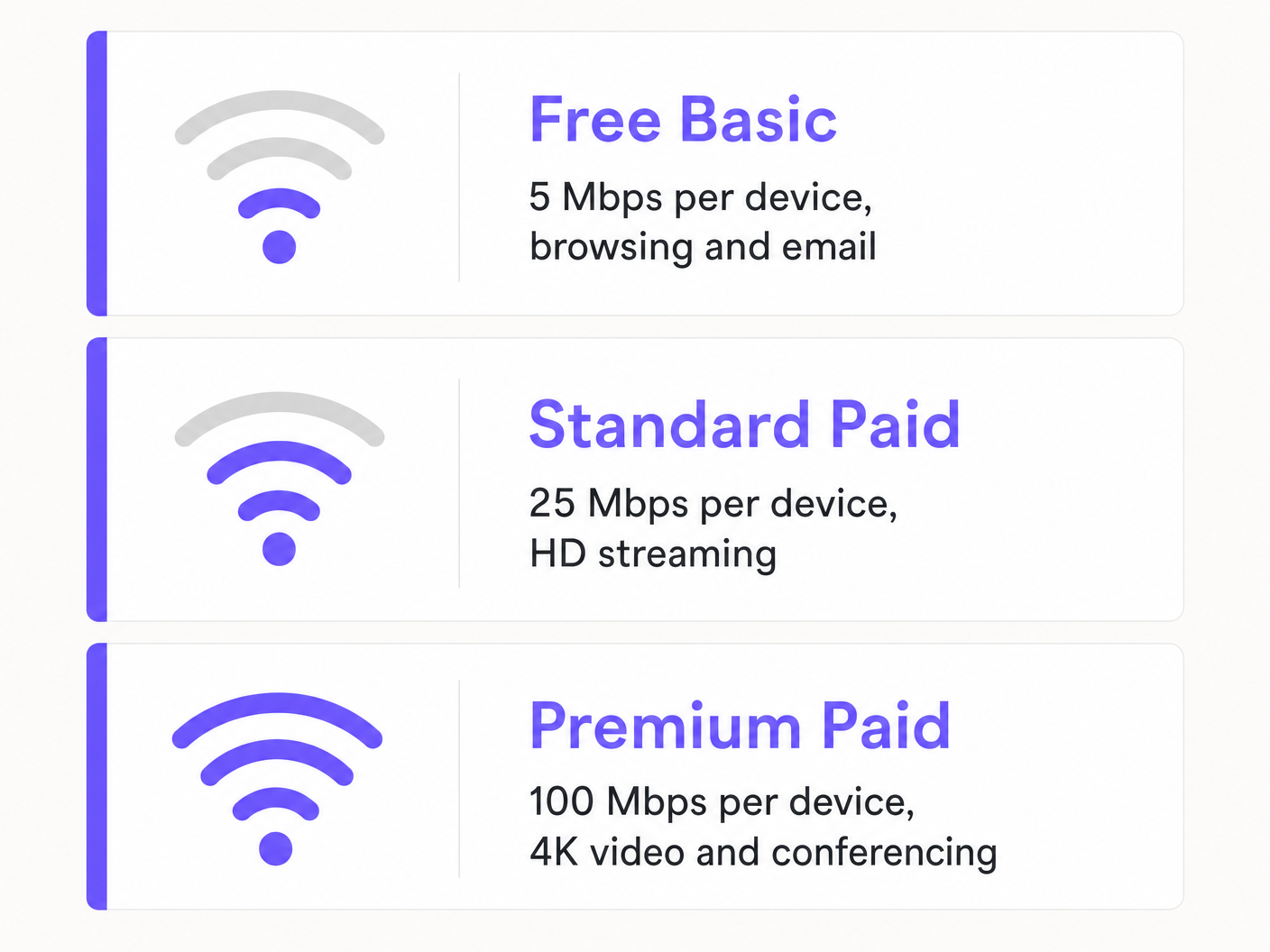
Eine Basisgeschwindigkeit (z.B. 5 Mbit/s pro Gerät) wird kostenlos im Austausch für Gästedaten über eine Splash-Page bereitgestellt, während höhere Geschwindigkeiten (z.B. 25 Mbit/s oder 100 Mbit/s) durch eine tägliche oder pro-Aufenthalt-Gebühr monetarisiert werden.
Vorteile: Gleicht Gästeerwartungen mit Umsatzgenerierung aus; ermöglicht gezieltes Marketing durch Erfassung von Erstanbieterdaten; gewährleistet faire Bandbreitenzuweisung über QoS; integriert sich in Treueprogramme.
Nachteile: Erfordert ausgeklügeltes Netzwerkmanagement, ein leistungsfähiges WiFi-Gateway und nahtlose Integration mit Property Management Systemen (PMS).
Technischer Einblick: Architektur für gestuften Zugang
Die Implementierung eines gestuften Modells erfordert eine robuste Netzwerkarchitektur. Es ist nicht einfach eine Frage der Drosselung eines Routers; es erfordert Access Points auf Unternehmensniveau, intelligente Controller und sichere Authentifizierungsframeworks, die den Standards IEEE 802.1X und WPA3 entsprechen.
Bandbreitenzuweisung und Quality of Service (QoS)
Um einen kostenpflichtigen WiFi-Dienst erfolgreich bereitzustellen, muss das Netzwerk Bandbreite dynamisch zuweisen. Dies wird durch Quality of Service (QoS)-Richtlinien erreicht, die auf Controllerebene verwaltet werden – entweder vor Ort oder, zunehmend, über eine cloudverwaltete Plattform.
| Stufe | Durchsatzbegrenzung | Typischer Anwendungsfall | QoS-Priorität |
|---|---|---|---|
| Kostenlos Basic | 5 Mbit/s pro Gerät | E-Mail, Surfen, soziale Medien | Niedrig |
| Standard | 25 Mbit/s pro Gerät | HD-Streaming, Standard-VPN | Mittel |
| Premium | 100 Mbit/s pro Gerät | 4K-Video, Konferenzen, große Uploads | Hoch |
Wie in unserem Leitfaden zu Hotel WiFi-Geschwindigkeit: Was Gäste erwarten und wie man es liefert besprochen, ist die korrekte Einstellung dieser Schwellenwerte entscheidend, um Gästefrustration zu vermeiden. Eine schlecht kalibrierte kostenlose Stufe, die keinen grundlegenden YouTube-Stream aufrechterhalten kann, wird mehr negative Bewertungen generieren als ein reines Bezahlmodell.
Sichere Authentifizierung und Integration
Ein nahtloses Onboarding-Erlebnis ist von größter Bedeutung. Der veraltete Ansatz gemeinsamer Passwörter (PSK) ist eine Sicherheitslücke und erzeugt Reibung. Moderne Implementierungen nutzen einen mehrschichtigen Authentifizierungsansatz.
Captive Portals: Für die kostenlose Stufe authentifizieren sich Gäste über eine gebrandete Splash-Page, akzeptieren die Bedingungen und stellen Daten bereit (z.B. E-Mail, Opt-in-Marketing-Zustimmung). Dies ist die Grundlage der WiFi Analytics -Datenpipeline und speist sich direkt in CRM-Systeme ein.
PMS-Integration: Für Premium-Stufen integriert sich das WiFi-Gateway direkt in das PMS des Hotels (z.B. Oracle Opera, Mews oder Apaleo). Gäste authentifizieren sich mit ihrer Zimmernummer und ihrem Nachnamen, und die Premium-Gebühr wird automatisch auf ihre Rechnung gebucht – keine Kreditkarte am Portal erforderlich.
Passpoint / OpenRoaming (IEEE 802.11u): Für wiederkehrende Gäste oder Treuemitglieder ermöglicht Passpoint einen nahtlosen, passwortlosen und individuell verschlüsselten (WPA3-Enterprise)-Verbindungen, wodurch das Captive Portal vollständig eliminiert und ein zelluläres Roaming-Erlebnis geboten wird.
Netzwerksegmentierung und Sicherheit
Die Netzwerksegmentierung über VLANs ist eine nicht verhandelbare Sicherheitsanforderung, insbesondere für die PCI DSS-Konformität in Einzelhandel und Gastgewerbe. Gast-, Mitarbeiter- und IoT-/Betriebsdatenverkehr müssen sich auf vollständig getrennten logischen Netzwerken befinden, selbst wenn sie dieselben physischen Access Points nutzen.
Ein kompromittiertes Gastgerät in einem unsegmentierten Netzwerk kann auf POS-Systeme, intelligente Schlösser und interne Verwaltungsschnittstellen zugreifen. VLANs verhindern diese laterale Bewegung vollständig.
Implementierungsleitfaden
Die Bereitstellung eines gestuften WiFi-Modells erfordert eine sorgfältige Planung, um Compliance, Sicherheit und ein reibungsloses Gästeerlebnis zu gewährleisten. Die folgenden Schritte gelten sowohl für Greenfield-Bereitstellungen als auch für Upgrades bestehender Infrastruktur.
Schritt 1: Bestandsaufnahme. Führen Sie eine umfassende Standortbegehung durch. Bewerten Sie die aktuelle Bandbreitenauslastung, identifizieren Sie Abdeckungslücken und beurteilen Sie die vorhandene Hardware. Stellen Sie sicher, dass der Backhaul – typischerweise eine dedizierte Glasfaser-Standleitung – die prognostizierte Spitzenlast unterstützen kann. Weitere Informationen zu den Backhaul-Anforderungen finden Sie unter Was ist eine Standleitung? Dediziertes Business Internet .
Schritt 2: Definition der Stufen. Legen Sie klare, kommunizierbare Stufen mit Preisen fest, die den gebotenen Wert widerspiegeln. Eine gängige Struktur ist: Basic (kostenlos, 5 Mbps), Business (5–10 £/Tag, 25 Mbps) und Pro (15+ £/Tag, 100 Mbps unbegrenzt).
Schritt 3: Gestaltung des Captive Portal. Das Portal muss gebrandet, mobilfreundlich und rechtlich konform sein. Stellen Sie explizite, nicht angekreuzte Opt-in-Kontrollkästchen für Marketingzwecke sicher, um die GDPR einzuhalten. Das Portal sollte das Wertversprechen der Premium-Stufen klar darstellen und die Upgrade-Hürde reduzieren.
Schritt 4: Implementierung der Netzwerksegmentierung. Konfigurieren Sie VLANs auf dem Controller, um Gast-, Mitarbeiter- und Betriebsdatenverkehr zu trennen. Wenden Sie QoS-Richtlinien pro VLAN an, um die Stufenbegrenzungen durchzusetzen.
Schritt 5: Integration mit PMS und CRM. Verbinden Sie das WiFi-Gateway mit dem PMS für die automatisierte Rechnungsstellung. Speisen Sie erfasste Gastdaten in das CRM für Marketingkampagnen nach dem Aufenthalt ein.
Schritt 6: Testen und Überwachen. Führen Sie Lasttests vor dem Go-Live durch. Richten Sie fortlaufende Überwachungs-Dashboards ein, um die Bandbreitenauslastung, die Akzeptanzraten der Stufen und den Umsatz pro verfügbarem Zimmer (RevPAR-Beitrag durch WiFi) zu verfolgen.
Best Practices
Die folgenden Empfehlungen spiegeln herstellerneutrale Industriestandards und operative Erfahrungen in den Bereichen Gastgewerbe, Einzelhandel und Veranstaltungen wider.
WPA3 auf allen Stufen durchsetzen. WPA3 bietet eine individualisierte Datenverschlüsselung pro Gerät, was bedeutet, dass selbst auf der gemeinsam genutzten kostenlosen Stufe ein Gast den Datenverkehr eines anderen nicht abfangen kann. Dies ist eine erhebliche Verbesserung gegenüber WPA2 und wird mittlerweile von allen modernen Client-Geräten unterstützt.
Client-Isolation im Gast-VLAN verwenden. Selbst innerhalb desselben VLANs sollten Gastgeräte daran gehindert werden, direkt miteinander zu kommunizieren. Dies mindert Peer-to-Peer-Angriffsvektoren.
Ratenbegrenzung auf AP-Ebene implementieren, nicht nur am Gateway. Controller-basierte QoS ist granularer und reaktionsschneller als Gateway-basiertes Throttling und verhindert, dass ein einzelnes Gerät die Funkressourcen eines gemeinsam genutzten Access Points monopolisiert.
GDPR-Compliance vierteljährlich prüfen. Stellen Sie sicher, dass der Zustimmungsmechanismus des Captive Portal, die Datenaufbewahrungsrichtlinien und die Vereinbarungen zur Datenweitergabe an Dritte regelmäßig überprüft werden. Die durchschnittliche GDPR-Strafe im Vereinigten Königreich für eine Datenschutzverletzung ist erheblich, und das Gastgewerbe ist ein Hochrisikosektor.
ROI und Geschäftsauswirkungen
Der Übergang zu einem gestuften Modell verwandelt WiFi von einer versunkenen Kostenposition in eine messbare Einnahmequelle mit mehreren Beitragsvektoren.
Direkte Einnahmen: Käufe von Premium-Stufen generieren direkte, margenstarke Nebeneinnahmen. In einem Hotel mit 200 Zimmern und 70 % Auslastung, wenn 10 % der Gäste ein Premium-Upgrade für 10 £ kaufen, generiert das Hotel etwa 5.110 £ pro Monat an direkten WiFi-Einnahmen – ausreichend, um die jährlichen Infrastrukturkosten in vielen mittelgroßen Hotels auszugleichen.
Indirekte Einnahmen (Datenerfassung): Die kostenlose Stufe fungiert als Lead-Generierungsmaschine. Durch die Erfassung verifizierter E-Mails und CRM-Daten können Veranstaltungsorte Direktbuchungen fördern, Speisen und Getränke vor Ort bewerben und die Mitgliedschaft in Treueprogrammen erhöhen – jeweils unter Umgehung von OTA-Provisionsgebühren, die typischerweise 15–25 % des Zimmerumsatzes betragen.
Operative Intelligenz: WiFi Analytics -Plattformen wie Purple bieten Heatmaps der Besucherfrequenz, Verweildaueranalysen und die Verfolgung wiederholter Besuche. Diese Daten fließen in Personalentscheidungen, die Planung von Werbeaktionen und die Raumnutzung ein – was zu operativen Einsparungen führt, die sich im Laufe der Zeit summieren.
Risikominderung: Ein schlecht verwaltetes, offenes Netzwerk birgt erhebliche rechtliche und rufschädigende Risiken. Ein ordnungsgemäß architektonisch gestaltetes, gestuftes System mit WPA3, Client-Isolation und VLAN-Segmentierung mindert Man-in-the-Middle-Angriffsvektoren und demonstriert die Sorgfaltspflicht gemäß GDPR und PCI DSS.
Für Betreiber in angrenzenden Sektoren gelten dieselben Prinzipien. Der Wi-Fi in Auto: The Complete 2026 Enterprise Guide zeigt, wie gestufte Konnektivitätsmodelle im Automobilhandel und in Serviceumgebungen eingesetzt werden, und der Healthcare -Sektor übernimmt zunehmend ähnliche Rahmenwerke für Patienten- und Besucher-WiFi.
Fehlerbehebung und Risikominderung
Problem: Premium-Gäste melden trotz Bezahlung der höchsten Stufe langsame Geschwindigkeiten. Grundursache: QoS-Richtlinien werden nicht auf AP-Ebene, sondern nur am Gateway angewendet. Ein einzEin AP, der über 40 Geräte bedient, kann unabhängig von Gateway-Richtlinien zu einem Funkengpass werden. Lösung: Implementieren Sie eine Airtime Fairness pro AP und stellen Sie sicher, dass die AP-Dichte für die erwartete Anzahl gleichzeitiger Geräte ausreicht. Eine allgemeine Regel ist ein AP pro 20–25 gleichzeitige Geräte in Umgebungen mit hoher Dichte.
Problem: Gäste können Smart-TVs oder Spielekonsolen nicht verbinden. Grundursache: Headless-Geräte können keine Captive Portals navigieren. Lösung: Implementieren Sie iPSK (Individual Pre-Shared Keys), um ein zimmerspezifisches Geräte-Onboarding ohne Browser zu ermöglichen. Gäste generieren den Schlüssel über die Hotel-App oder einen QR-Code im Zimmer.
Problem: Bedenken hinsichtlich der GDPR-Konformität bei der Datenerfassung. Grundursache: Schlecht gestaltete Einwilligungsabläufe auf dem Captive Portal. Lösung: Stellen Sie sicher, dass das Portal explizite, nicht angekreuzte Opt-in-Kontrollkästchen für Marketingzwecke verwendet. Implementieren Sie eine klare Datenaufbewahrungsrichtlinie und stellen Sie sicher, dass die Datenschutzerklärung verlinkt und zugänglich ist. Enterprise-Plattformen handhaben dies automatisch.
Schlüsseldefinitionen
Captive Portal
A web page that users must view and interact with before access is granted to a public WiFi network, typically used for authentication, marketing consent capture, or payment.
Essential for enforcing the free tier, capturing GDPR-compliant marketing data, and presenting the upsell options for premium tiers. The design of the portal directly impacts both conversion rates and compliance posture.
Quality of Service (QoS)
Network management technologies that prioritise certain types of traffic or limit the bandwidth available to specific users, devices, or traffic classes.
The core mechanism used to enforce bandwidth caps on the free tier and guarantee throughput for paying premium guests. Must be configured at both the controller and AP level for maximum effectiveness.
Property Management System (PMS)
The central software system used by hotels to manage reservations, billing, room assignments, and guest profiles.
The WiFi gateway must integrate with the PMS to authenticate guests by room number and automatically post premium WiFi charges to their folio, enabling frictionless billing without a separate payment step.
Passpoint (Hotspot 2.0 / IEEE 802.11u)
A Wi-Fi Alliance protocol that enables seamless, secure, passwordless roaming between different WiFi networks using WPA3-Enterprise certificates.
Allows returning guests or loyalty members to connect automatically and securely without interacting with a captive portal, delivering a cellular-like roaming experience and eliminating the primary source of onboarding friction.
VLAN (Virtual Local Area Network)
A logical subnetwork that groups a collection of devices from different physical network segments, enforcing traffic isolation at the software level.
Used to securely segment guest traffic from operational traffic (POS systems, smart locks, staff devices) on the same physical access points. A mandatory control for PCI DSS compliance and general risk mitigation.
Ancillary Revenue
Income generated from goods or services other than a company's primary product offering — in hospitality, anything beyond the base room rate.
Premium WiFi tiers represent a high-margin form of ancillary revenue. Unlike F&B or spa services, WiFi upgrades have near-zero marginal cost once the infrastructure is deployed, making them exceptionally profitable.
iPSK (Individual Pre-Shared Key)
A security method that provides a unique WiFi password for each user, room, or device on the same SSID, without requiring a full 802.1X infrastructure.
Crucial for securely connecting headless IoT devices — smart TVs, gaming consoles, streaming sticks — that cannot navigate a captive portal. Each room receives a unique key, maintaining isolation between guests.
Freemium Tiered Model
A service delivery model in which a baseline level of service is provided for free, with enhanced features or performance available at a premium price.
The dominant WiFi business model in modern hospitality. The free tier drives CSAT and data capture; the premium tier drives direct revenue. The model is only viable with robust QoS enforcement to ensure the paid tier delivers a meaningfully better experience.
RevPAR (Revenue Per Available Room)
A hotel performance metric calculated by multiplying the average daily room rate by the occupancy rate.
WiFi revenue and the indirect bookings driven by WiFi data capture both contribute to RevPAR. London hotel forecasts for 2026 project approximately 1.8% RevPAR growth, with tech-enabled guest experiences cited as a key driver.
Ausgearbeitete Beispiele
A 300-room luxury hotel is experiencing guest complaints about slow WiFi during peak evening hours. They currently offer a single, free, unthrottled network with a shared password. They need to improve performance for business travellers without alienating leisure guests. How should the IT team restructure the deployment?
Step 1: Replace the shared PSK with a Captive Portal integrated with the PMS (Oracle Opera). Step 2: Implement a Freemium Tiered model with three tiers: Free (10 Mbps, email authentication for CRM data capture), Business (50 Mbps, £8/day, PMS-authenticated and billed to folio), and Premium (100 Mbps, £15/day, same billing mechanism). Step 3: Configure QoS policies at the controller level to enforce per-device bandwidth caps on the free tier and guarantee throughput for paid tiers. Step 4: Deploy Passpoint profiles via the hotel loyalty app so that elite loyalty members automatically receive the Business tier for free upon arrival, with no portal interaction. Step 5: Implement VLAN segmentation to isolate guest traffic from POS and operational systems.
A large conference centre is hosting a 2,000-person technology summit. The event organiser requires a dedicated, secure network for exhibitors running POS and demo hardware, and a separate general-access network for attendees. The venue's IT team must deliver both on the existing physical AP infrastructure. How is this architected?
Step 1: Utilise VLAN segmentation on the existing cloud-managed AP infrastructure to create two logical networks on the same physical hardware. Step 2: Create a dedicated SSID for Exhibitors (e.g., 'TechSummit_Exhibitor') using WPA3-Enterprise or iPSK for secure, isolated connectivity. Each exhibitor receives a unique iPSK for their stand, preventing cross-exhibitor traffic. Guarantee 20 Mbps per exhibitor stand via QoS. Step 3: Create a public SSID for attendees (e.g., 'TechSummit_Guest') with a branded captive portal capturing attendee data for the event organiser. Apply a 5 Mbps per-device cap to manage the high concurrent device count. Step 4: Charge the event organiser a premium for the dedicated, high-SLA exhibitor network as a venue service.
Übungsfragen
Q1. A mid-scale hotel chain's Operations Director wants to charge all guests £5 per day for WiFi to recoup hardware costs quickly. As the Network Architect, how do you advise them, and what alternative do you propose?
Hinweis: Consider the impact on OTA rankings, CSAT scores, and the indirect revenue potential of the free tier.
Musterlösung anzeigen
A Paid Only model should be strongly discouraged. Over 80% of guests consider free WiFi a prerequisite, and charging a baseline fee actively damages CSAT scores, OTA review ratings, and booking conversion. Instead, recommend a Freemium Tiered approach: provide a free 5 Mbps tier in exchange for email capture via a captive portal, and offer a premium £8/day tier at 50 Mbps for power users. The free tier generates CRM data that drives direct bookings, reducing OTA commission costs. The premium tier generates direct ancillary revenue. At 70% occupancy with 10% premium adoption, a 200-room property generates over £5,000/month — sufficient to offset infrastructure costs without damaging the brand.
Q2. You are deploying a tiered WiFi system. How do you ensure that free-tier guests do not consume all available bandwidth and degrade the experience for paying premium guests?
Hinweis: Think about controller-level traffic shaping and where QoS policies are applied.
Musterlösung anzeigen
This is managed through strict Quality of Service (QoS) policies at the network controller level. When a guest authenticates via the captive portal and selects the Free tier, the controller assigns their MAC address to a specific user group or VLAN with a bandwidth cap (e.g., 5 Mbps up/down). For Premium guests authenticated via PMS integration, they are assigned to a separate group with uncapped bandwidth and higher traffic priority. Additionally, per-AP airtime fairness settings prevent any single device from monopolising the shared radio medium. This ensures the backhaul is never saturated by non-paying users, and the premium tier consistently delivers the experience guests paid for.
Q3. A luxury resort wants to offer seamless, passwordless WiFi to its top-tier loyalty members the moment they walk onto the property, without them ever seeing a captive portal. How is this technically achieved, and what security protocol underpins it?
Hinweis: Consider how cellular networks handle roaming authentication, and the WiFi equivalent.
Musterlösung anzeigen
This is achieved using Passpoint (Hotspot 2.0), based on IEEE 802.11u. The hotel's loyalty app distributes a Passpoint profile containing a secure digital certificate to the member's device. When the member arrives, their device automatically discovers the Passpoint-enabled SSID, exchanges the certificate in the background using WPA3-Enterprise and 802.1X authentication, and connects without any user interaction or captive portal. The network controller validates the certificate, confirms elite status, and assigns the device to the Premium QoS VLAN. Each connection is individually encrypted, providing far stronger security than a shared PSK. The experience is identical to how a mobile phone automatically connects to a roaming cellular network in a foreign country.
Q4. A hotel is planning to deploy smart TVs and Apple TV devices in all 150 guest rooms. These devices cannot navigate a captive portal. How should the IT team handle their network onboarding?
Hinweis: Consider authentication methods that do not require a browser.
Musterlösung anzeigen
The correct approach is to deploy Individual Pre-Shared Keys (iPSK). Each guest room is assigned a unique, secure WiFi password that is different from every other room. Guests can retrieve their room-specific key via a QR code on the in-room welcome card or through the hotel app. They enter this key directly into the smart TV or Apple TV settings. The network controller recognises the unique key, authenticates the device, and assigns it to the correct room's VLAN — ensuring the device is isolated from other guests' devices. This approach maintains enterprise-grade security without requiring a browser-based captive portal interaction.
Weiterlesen in dieser Reihe
Was ist eine Probe Request? Verstehen, wie Geräte Netzwerke entdecken
Dieser technische Leitfaden bietet einen tiefen Einblick in IEEE 802.11 Probe Requests, aktives versus passives Scannen und die Auswirkungen der MAC randomisation auf Standortanalysen. Er liefert umsetzbare Implementierungsstrategien für Netzwerkarchitekten zur Optimierung von High-Density-Bereitstellungen, zur Minderung von Probe Storms und zur Sicherstellung einer genauen, GDPR-konformen Datenerfassung mithilfe authentifizierter Identitätsschichten.
Wie man langsames WiFi behebt, ohne Ihr Internetpaket zu aktualisieren
Ein umfassender technischer Leitfaden für IT-Manager und Netzwerkarchitekten zur Optimierung der Unternehmens-WiFi-Leistung, ohne die ISP-Bandbreite zu erhöhen. Behandelt HF-Tuning, Client-Dichte-Management, QoS-Implementierung und wie man WiFi-Analysen nutzt, um Engpässe zu diagnostizieren und zu beheben.
Die Checkliste für die Migration von Legacy NAC zu Cloud-Native NAC
Dieser maßgebliche technische Leitfaden bietet eine strukturierte, dreiphasige Checkliste für die Migration von der traditionellen Netzwerkzugriffskontrolle (NAC) zu einer Cloud-nativen Architektur. Er stattet IT-Manager und Netzwerkarchitekten mit umsetzbaren Strategien aus, um die Identitätsintegration, Richtlinienkonsistenz und Compliance zu gewährleisten, ohne den Veranstaltungsbetrieb zu stören.