
NAC Posture Assessment: Gewährleistung der Compliance verwalteter Geräte vor dem Netzwerkzugriff
Dieses technische Referenzhandbuch bietet einen tiefen Einblick in das NAC Posture Assessment und beschreibt die Architektur, Standards und Bereitstellungsstrategien, die zur Durchsetzung der Compliance verwalteter Geräte erforderlich sind. Es bietet IT-Managern und Netzwerkarchitekten umsetzbare Erkenntnisse zur Risikominderung und zur Gewährleistung eines sicheren Netzwerkzugriffs in verteilten Unternehmensumgebungen.
Diesen Leitfaden anhören
Podcast-Transkript ansehen
Teil unserer Kernserie: Enterprise WiFi Security Guide →
Executive Summary
For enterprise IT leaders managing complex and multi-site environments, identity alone is no longer a sufficient metric for network access. Knowing who is connecting is less critical than knowing the security state of the device they are using. Network Access Control (NAC) posture assessment is the mechanism that bridges this gap, ensuring that only managed and compliant devices gain access to corporate infrastructure before a single packet of production traffic is transmitted.
This guide provides a comprehensive technical reference for designing, deploying, and managing NAC posture assessment. We explore its underlying architecture, including 802.1X, RADIUS, and EAP-TLS, evaluate the pros and cons of agent-based versus agentless interrogation, and outline a phased deployment strategy that minimises operational disruption. Whether you are securing a corporate headquarters, a distributed retail estate, or hospitality back-office operations, implementing a robust posture assessment is a critical step in mitigating risk and enforcing compliance.
Listen to our 10-minute technical briefing podcast below for an executive overview of the key concepts and common deployment pitfalls.
Technical Deep-Dive
Posture Assessment Architecture
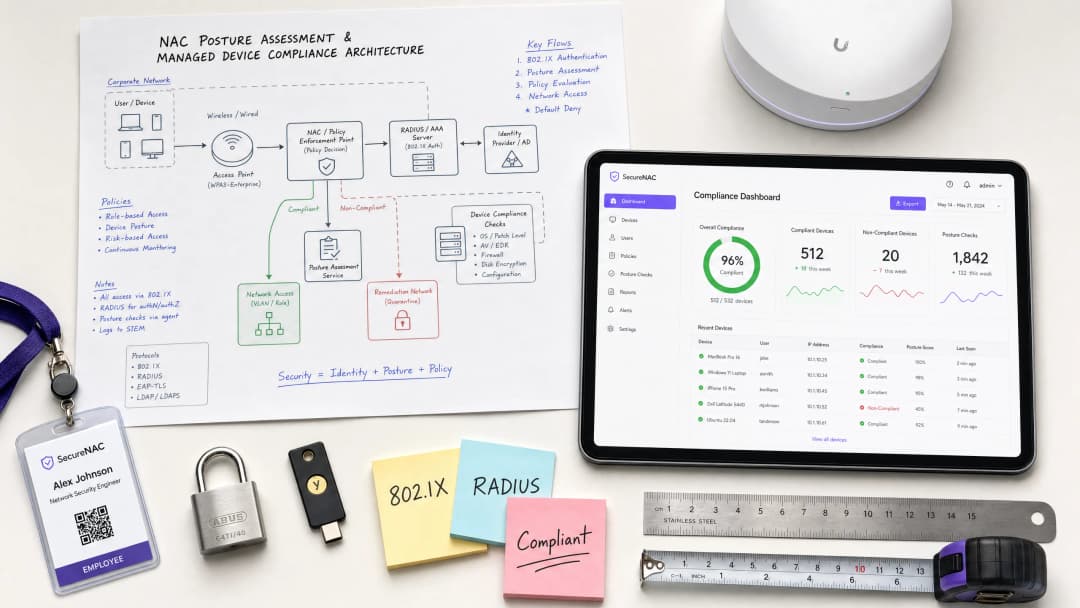
Network Access Control controls device connectivity, but posture assessment is the specific interrogation of a device's security health. Its architecture relies primarily on three main components working in unison:
- Policy Enforcement Point (PEP): This is the physical or logical gatekeeper - typically a wireless access point, switch port, or wireless LAN controller. The PEP physically controls the flow of traffic based on directives from the policy engine.
- Policy Decision Point (PDP): Often integrated with a RADIUS or AAA server, the PDP is the brains of the NAC architecture. It receives posture data, evaluates it against defined compliance policies, and issues enforcement directives to the PEP.
- Posture Assessment Engine: This component gathers the actual health data from the endpoint. This can be an agent running locally on the device, or an agentless mechanism using network protocols (such as SNMP, WMI) or API integration with a Mobile Device Management (MDM) platform.

The Role of IEEE 802.1X and EAP-TLS
The foundation of enterprise NAC is the IEEE 802.1X standard, which defines port-based network access control. Within this framework, three roles are defined:
- Supplicant: The endpoint device attempting to connect.
- Authenticator: The PEP (switch or access point) facilitating the connection.
- Authentication Server: The RADIUS server validating the credentials.
Communication between the Supplicant and the Authentication Server occurs via Extensible Authentication Protocol (EAP), tunnelled through the Authenticator. For managed corporate devices, EAP-TLS is the gold standard. It mandates mutual authentication using X.509 digital certificates, ensuring that both the device and the network cryptographically verify each other's identity. This prevents credential theft and rogue access point attacks.
Posture Check Categories
When a device attempts to connect, the posture assessment engine evaluates several critical vectors:
- OS and Patch Management: Verifying that the operating system is supported and that critical patches have been applied within defined SLAs.
- Endpoint Security (AV/EDR): Ensuring that approved anti-virus or Endpoint Detection and Response agents are installed, active, and running updated definitions.
- Firewall Status: Confirming that host-based firewalls are enabled and their policies have not been tampered with.
- Disk Encryption: Verifying that full-disk encryption (e.g., BitLocker, FileVault) is active and not suspended.
- Certificate Validation: Checking for the presence and validity of required machine certificates.
- Configuration Compliance: Ensuring the device's security baseline aligns with corporate policy (e.g., screen lock timers, disabled USB mass storage).

WPA3-Enterprise and Cryptographic Strength
As network security evolves, so do its underlying cryptographic standards. WPA3-Enterprise, particularly when operating in 192-bit mode, provides significant advancements over WPA2. It mandates the use of GCMP-256 for encryption and HMAC-SHA-384 for integrity. For organisations handling sensitive data - such as retail environments subject to PCI DSS or healthcare facilities under strict data governance - transitioning to WPA3-Enterprise is a necessary step to future-proof network infrastructure.
Haben Sie Fragen zu Ihrem spezifischen Setup?
Unser Team arbeitet mit Standortbetreibern, IT-Managern und Netzwerktechnikern an über 80.000 Standorten zusammen. Buchen Sie ein 20-minütiges Gespräch und wir zeigen Ihnen, wie andere diese Herausforderungen gelöst haben.
Implementation Guide
Deploying NAC posture assessment requires careful planning to avoid widespread network outages. The following phased approach is recommended for enterprise environments:
Phase 1: Infrastructure Readiness and PKI Design
Before enabling posture checks, ensure your underlying infrastructure can support the architecture. If deploying EAP-TLS, a robust Public Key Infrastructure (PKI) is essential. Certificates must be automatically provisioned and renewed via your MDM or Group Policy. Manual certificate management will inevitably lead to connectivity failures when certificates expire.
Phase 2: Monitor Mode (Visibility Phase)
The most critical phase of any NAC deployment is Monitor Mode. During this phase, the NAC system evaluates device posture and logs the results, but does not enforce policies. The PEP allows full access regardless of the posture outcome.
Run Monitor Mode for at least 2-4 weeks. This provides visibility into the actual compliance state of your estate. You will identify devices failing checks due to broken agents, pending reboots, or misconfigurations. Use this data to proactively remediate the estate.
Phase 3: Segmented Enforcement
Once the compliance baseline reaches an acceptable level, begin enforcement. Based on policy evaluation, devices are categorised into three states:
- Compliant: The device passes all critical checks and is assigned to the production VLAN with full required access.
- Conditional: The device fails a non-critical check (e.g., a minor OS update is pending). It may be granted restricted access (e.g., internet only) and the user is notified to remediate within a specified grace period.
- Non-Compliant: The device fails a critical check (e.g., AV is disabled). The PEP assigns the device to a quarantine VLAN.
Phase 4: Remediation Architecture
The quarantine VLAN must be strictly isolated. It should only permit traffic to the remediation portal, necessary update servers (e.g., Windows Update, AV definition servers), and internal IT support resources. If a quarantined device can route traffic to production subnets, the NAC architecture has failed.
Best Practices
- Continuous Assessment: Legacy NAC only evaluates posture at the time of connection. Modern deployments must support continuous assessment, re-evaluating posture at regular intervals or in response to events (e.g., an EDR alert) and dynamically updating the device's access level via Change of Authorization (CoA).
- Agent vs. Agentless: For managed corporate devices, an agent-based approach provides the deepest visibility and continuous monitoring capabilities. Agentless interrogation is suitable for unmanaged devices or environments where deploying an agent is administratively prohibited.
- MAC Authentication Bypass (MAB): MAB is required for devices incapable of 802.1X (e.g., legacy printers, IoT sensors). However, MAB is inherently insecure as MAC addresses can be spoofed. MAB devices must be deeply profiled and placed in strictly controlled, isolated VLANs.
- Aligning with Standards: Base your posture policies on established frameworks such as CIS Benchmarks. This ensures your compliance checks are vendor-neutral and aligned with industry best practices.
- Isolating Guest Traffic: Corporate NAC posture assessment should never intersect with public access networks. In venues where both are required, use a dedicated Guest WiFi platform to manage public access on entirely separate infrastructure, such as Purple's WiFi Analytics solution.
Troubleshooting and Risk Mitigation
Common Failure Modes
- 'Big Bang' Enforcement: Transitioning from open access to strict enforcement across the entire estate all at once is a guaranteed recipe for operational disruption. Always use a phased rollout by site or department.
- PKI Failure: Expired root or intermediate certificates, or failures in the Certificate Revocation List (CRL) / Online Certificate Status Protocol (OCSP) infrastructure, will cause widespread authentication failures. Implement robust monitoring for your PKI.
- Remediation Loops: Ensure that devices in the quarantine VLAN have sufficient network access to download the updates required to become compliant. If they cannot reach update servers, they will remain permanently quarantined.
ROI and Business Impact
Implementing NAC posture assessment delivers measurable business value beyond simple security metrics:
- Risk Mitigation: By ensuring only healthy devices gain access to the network, the lateral spread of malware and ransomware is significantly reduced, decreasing the likelihood of costly data breaches.
- Compliance Verification: For highly regulated sectors such as hospitality and transport, automated posture assessment provides continuous proof of compliance with standards like PCI DSS and GDPR, simplifying the audit process.
- Operational Efficiency: Automating the quarantine and remediation process reduces the burden on the IT helpdesk, allowing engineers to focus on strategic initiatives rather than manually cleaning infected endpoints.
Schlüsseldefinitionen
802.1X
Ein IEEE-Standard für portbasierte Netzwerkzugriffskontrolle, der einen Authentifizierungsmechanismus für Geräte bereitstellt, die eine Verbindung zu einem LAN oder WLAN herstellen möchten.
Das grundlegende Protokoll, das sicherstellt, dass sich ein Gerät authentifizieren muss, bevor der Switch-Port oder Access Point IP-Datenverkehr zulässt.
EAP-TLS
Extensible Authentication Protocol - Transport Layer Security. Ein Authentifizierungs-Framework, das digitale X.509-Zertifikate für die gegenseitige Authentifizierung verwendet.
Der empfohlene Standard für verwaltete Unternehmensgeräte, da er auf kryptografischen Zertifikaten anstelle von leicht kompromittierbaren Passwörtern basiert.
Posture Assessment
Der Prozess der Bewertung des Sicherheitsstatus und der Konfiguration eines Endgeräts im Vergleich zu einer definierten Unternehmensrichtlinie.
Stellt sicher, dass ein Gerät nicht nur authentifiziert, sondern auch "gesund" ist (aktualisiert, verschlüsselt, geschützt), bevor ihm Netzwerkzugriff gewährt wird.
Policy Enforcement Point (PEP)
Das Netzwerkgerät (Switch, Wireless-Controller oder Access Point), das den Datenverkehr basierend auf der NAC-Richtlinie physisch blockiert oder zulässt.
Die Komponente, die den vom NAC-Server erteilten Befehl "Zulassen" oder "Quarantäne" tatsächlich ausführt.
Policy Decision Point (PDP)
Der zentrale Server oder die Engine (häufig ein RADIUS-Server), die Authentifizierungsanfragen und Posture-Daten auswertet, um Zugriffsrechte zu bestimmen.
Das Gehirn des Systems, das die Regelbasis enthält und entscheidet, welche Zugriffsebene ein bestimmtes Gerät erhalten soll.
MAC Authentication Bypass (MAB)
Eine Fallback-Authentifizierungsmethode, die die MAC-Adresse eines Geräts als Anmeldeinformation verwendet, wenn dieses kein 802.1X ausführen kann.
Wird für bildschirmlose Geräte wie Drucker oder IoT-Sensoren verwendet. Es ist von Natur aus unsicher und muss mit einer strengen Netzwerksegmentierung kombiniert werden.
Change of Authorization (CoA)
Eine RADIUS-Erweiterung, die es dem NAC-Server ermöglicht, den Autorisierungsstatus einer aktiven Sitzung dynamisch zu ändern.
Entscheidend für die kontinuierliche Bewertung; wenn ein Gerät während der Verbindung nicht mehr richtlinienkonform ist, ermöglicht CoA dem NAC-Server, es sofort in ein Quarantäne-VLAN zu verschieben, ohne dass eine Trennung der Verbindung erforderlich ist.
Quarantine VLAN
Ein streng isoliertes Netzwerksegment, das für nicht richtlinienkonforme Geräte entwickelt wurde und nur Zugriff auf Ressourcen zur Fehlerbehebung bietet.
Verhindert, dass ein infiziertes oder gefährdetes Gerät mit Produktionssystemen kommuniziert, während es erforderliche Updates oder Patches herunterlädt.
Ausgearbeitete Beispiele
Ein Hotel mit 400 Zimmern benötigt einen sicheren Zugriff für die Laptops der Hotelmitarbeiter auf das Property Management System (PMS) im Back-of-House-Bereich. Das Hotel beherbergt jedoch auch zahlreiche nicht verwaltete IoT-Geräte (intelligente Thermostate, digitale Beschilderung), auf denen kein NAC-Agent ausgeführt werden kann.
Implementieren Sie eine 802.1X EAP-TLS-Richtlinie für alle Laptops der Hotelmitarbeiter, die strenge Posture-Prüfungen vorschreibt (AV aktiv, Festplatte verschlüsselt, Patches installiert). Diese Geräte werden nach erfolgreicher Compliance-Prüfung dynamisch dem Corporate VLAN zugewiesen. Implementieren Sie für die IoT-Geräte einen MAC Authentication Bypass (MAB) in Kombination mit einem detaillierten Device Profiling. Stellen Sie sicher, dass diese MAB-Geräte in isolierten, dedizierten IoT-VLANs platziert werden, wobei ACLs deren Zugriff ausschließlich auf die spezifischen Controller beschränken, mit denen sie kommunizieren müssen. Unter keinen Umständen darf das IoT-VLAN zum Corporate VLAN oder zum PMS geroutet werden.
Eine Einzelhandelskette führt an 50 Standorten neue Point-of-Sale-Terminals (POS) ein. Das IT-Team möchte die Posture-Compliance durchsetzen, um die PCI-DSS-Anforderungen zu erfüllen, befürchtet jedoch, dass der Ladenbetrieb während des Rollouts gestört werden könnte.
Stellen Sie die NAC-Architektur für 30 Tage im Monitor Mode bereit. Während dieses Zeitraums authentifiziert das NAC-System die POS-Terminals und bewertet deren Posture anhand der PCI-DSS-Baseline (z. B. Firewall aktiv, keine nicht autorisierte Software), protokolliert jedoch Fehler, ohne den Zugriff zu blockieren. Das IT-Team überprüft die Protokolle wöchentlich, identifiziert Terminals, bei denen die Prüfungen fehlschlagen, und behebt die Probleme über die MDM-Plattform. Sobald die Compliance-Rate 100 % erreicht, wird die Richtlinie während der Wartungsfenster Standort für Standort in den Enforcement Mode umgeschaltet.
Übungsfragen
Q1. Eine kürzlich implementierte NAC-Lösung in einer Unternehmenszentrale verursacht weitreichende Verbindungsprobleme. Geräte, die gestern noch konform waren, werden heute in das Quarantäne-VLAN verschoben. Der IT-Helpdesk berichtet, dass die Geräte fehlerfrei erscheinen, Antivirensoftware läuft und Patches installiert sind. Was ist die wahrscheinlichste architektonische Fehlerquelle?
Hinweis: Berücksichtigen Sie den Lebenszyklus der bei EAP-TLS verwendeten Anmeldedaten.
Musterlösung anzeigen
Die wahrscheinlichste Ursache ist ein Fehler in der Public-Key-Infrastruktur (PKI). Wenn die für die EAP-TLS-Authentifizierung verwendeten Maschinenzertifikate abgelaufen sind oder der NAC-Server die Zertifikatssperrliste (CRL) bzw. den OCSP-Responder nicht erreichen kann, schlägt die Authentifizierung unabhängig vom tatsächlichen Sicherheitsstatus des Geräts fehl. Das NAC-System wechselt standardmäßig in einen Fail-Closed- oder Quarantänestatus.
Q2. Sie entwerfen die VLAN-Architektur für eine neue NAC-Implementierung. Das Sicherheitsteam besteht darauf, dass das Quarantäne-VLAN Zugriff auf den Proxy-Server des Unternehmens ermöglichen muss, damit Benutzer im Internet surfen können, während ihre Geräte bereinigt werden. Ist dies ein solides Design?
Hinweis: Bewerten Sie das Risiko, einem potenziell kompromittierten Gerät Zugriff auf die gemeinsame Infrastruktur zu gewähren.
Musterlösung anzeigen
Nein, das ist ein fehlerhaftes Design. Wenn ein unter Quarantäne gestelltes Gerät Zugriff auf den Unternehmens-Proxy erhält, birgt dies ein erhebliches Risiko. Wenn das Gerät mit Malware infiziert ist, könnte es den Proxy nutzen, um eine Command-and-Control-Kommunikation aufzubauen oder zu versuchen, auf andere interne Systeme zuzugreifen, die über den Proxy erreichbar sind. Das Quarantäne-VLAN muss strikt isoliert sein und darf nur Zugriff auf bestimmte Bereinigungsserver (z. B. Windows Update, AV-Signaturserver) und das Bereinigungsportal selbst erlauben.
Q3. Ein IT-Team im Krankenhaus muss den Netzwerkzugriff für eine Flotte neuer drahtloser medizinischer Infusionspumpen sichern. Diese Geräte unterstützen keine 802.1X-Supplicants und können keinen Posture-Agenten ausführen. Wie sollte der Netzwerkzugriff für diese Geräte gesteuert werden?
Hinweis: Berücksichtigen Sie alternative Authentifizierungsmethoden und das Prinzip der minimalen Rechtevergabe.
Musterlösung anzeigen
Die Geräte müssen mittels MAC Authentication Bypass (MAB) authentifiziert werden. Da MAB von Natur aus unsicher ist (MAC-Adressen können gefälscht werden), muss der Netzwerkzugriff stark eingeschränkt werden. Die Infusionspumpen sollten in ein dediziertes, isoliertes Medical-IoT-VLAN verschoben werden. Auf dieses VLAN müssen Zugriffskontrolllisten (ACLs) angewendet werden, die die Kommunikation nur mit den für ihren Betrieb erforderlichen zentralen Verwaltungsservern erlauben und jede andere laterale Bewegung oder den Internetzugriff blockieren.
Weiterlesen in dieser Reihe
PPSK WPA3: Vergleich von Funktionen und Bereitstellungsmodellen
Dieser technische Leitfaden vergleicht PPSK und WPA3-SAE und erläutert deren architektonische Unterschiede sowie Bereitstellungsmodelle für Multi-Tenant-Umgebungen. Er bietet IT-Managern und Projektentwicklern praktische Anleitungen zur Einrichtung sicherer, isolierter WiFi-Netzwerke mithilfe der identitätsbasierten Lösungen von Purple.
Verwalten der Bandbreite für das Staff WiFi: Shaping, QoS und Reduzierung des Traffics
Dieser Leitfaden beschreibt praktische Methoden zur Bandbreitenverwaltung für das Staff WiFi in Unternehmen. Er behandelt Traffic Shaping, QoS-Implementierung und wie der Einsatz von Purple Shield die Netzwerklast ohne Hardware-Upgrades reduziert.
So reduzieren Sie die Anzahl der WiFi SSIDs mit Per-Device PSK (iPSK, DPSK, MPSK)
Dieser maßgebliche technische Referenzleitfaden erklärt, wie IT-Teams die durch den SSID-Beacon-Overhead verursachte WiFi-Leistungsbeeinträchtigung eliminieren können, indem sie mehrere zweckgebundene Netzwerke mithilfe von Per-Device PSK (xPSK) in einer einzigen SSID zusammenfassen. Er deckt die Herstellerlandschaft mit Cisco iPSK, HPE Aruba MPSK, Ruckus DPSK, Juniper Mist PPSK und Ubiquiti UniFi PPSK ab und bietet praktische Implementierungshinweise zur dynamischen VLAN-Zuweisung, zum IoT-Onboarding und zur PCI-DSS-Compliance. Betreiber von Veranstaltungsorten in der Hotellerie, im Einzelhandel, in Stadien und in Organisationen des öffentlichen Sektors finden hier umsetzbare Architekturrichtlinien und praxisnahe Beispiele.
Haben Sie Fragen zu Ihrem spezifischen Setup?
Unser Team arbeitet mit Standortbetreibern, IT-Managern und Netzwerktechnikern an über 80.000 Standorten zusammen. Buchen Sie ein 20-minütiges Gespräch und wir zeigen Ihnen, wie andere diese Herausforderungen gelöst haben.