
PIPEDA-Compliance für Gäste-WiFi in Kanada
This guide provides a definitive technical and operational reference for Canadian venue operators deploying guest WiFi under PIPEDA. It covers the OPC's meaningful consent framework, the accountability principle, enforcement precedents from the Tim Hortons and Google WiFi investigations, and the architectural changes required to meet the incoming Consumer Privacy Protection Act (CPPA) under Bill C-27. IT managers and compliance leads will find actionable captive portal design specifications, data minimisation requirements, and a clear roadmap for future-proofing against GDPR-scale penalties.
Diesen Leitfaden anhören
Podcast-Transkript ansehen

Executive Summary
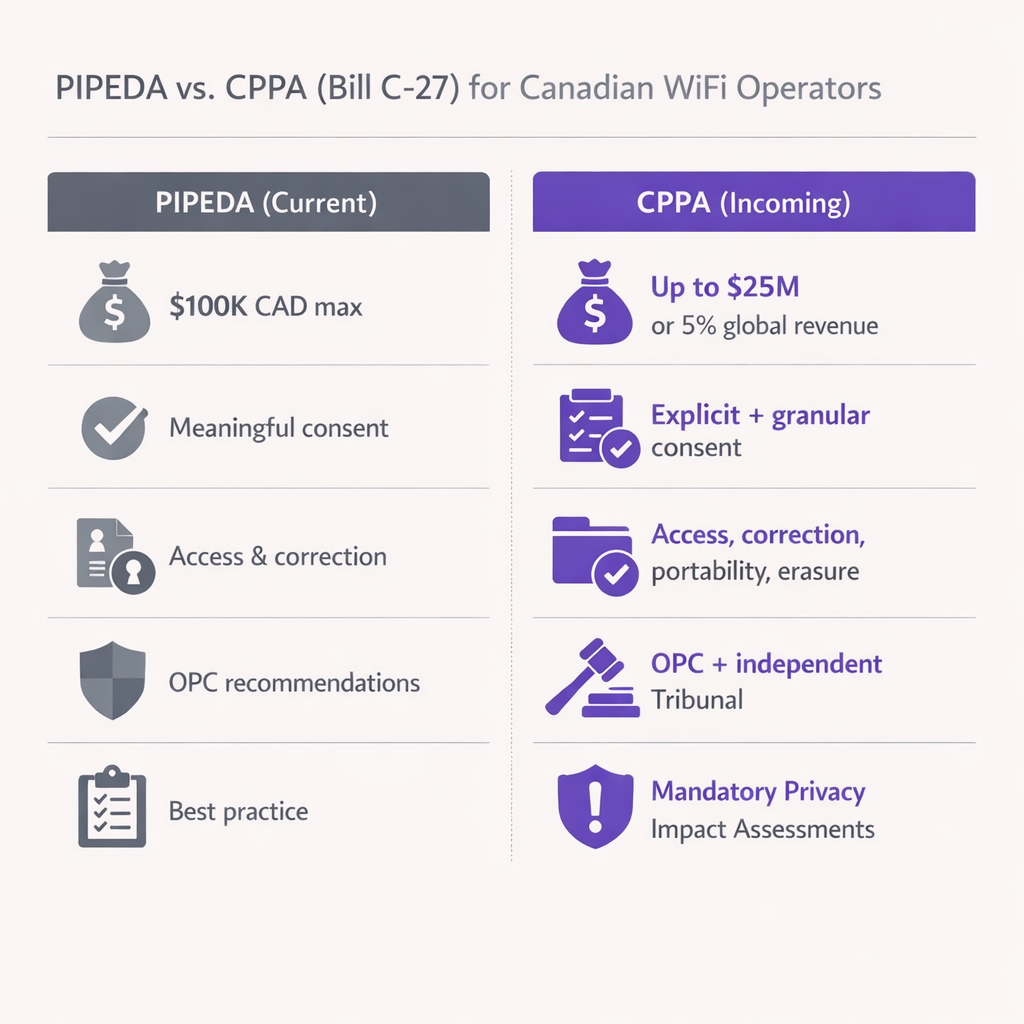
Für kanadische Veranstaltungsortbetreiber und IT-Führungskräfte ist das Angebot von Gäste-WiFi nicht mehr nur eine Frage der Konnektivität – es ist ein entscheidender Kanal zur Datengewinnung. Die regulatorischen Rahmenbedingungen für die Erfassung und Nutzung dieser Daten werden jedoch immer strenger. Der Personal Information Protection and Electronic Documents Act (PIPEDA) schreibt strenge Anforderungen für die Einholung einer „aussagekräftigen Zustimmung“ vor, bevor Benutzerdaten an Captive Portals erfasst werden. Darüber hinaus wird Compliance mit dem bevorstehenden Consumer Privacy Protection Act (CPPA), der Strafen im GDPR-Stil (bis zu 25 Mio. CAD oder 5 % des weltweiten Umsatzes) einführen soll, nun zu einer Priorität für das Risikomanagement auf Vorstandsebene.
Dieser Leitfaden bietet eine technische und operative Roadmap für Architekten und IT-Manager, die Gäste-WiFi -Lösungen in Kanada bereitstellen. Wir analysieren die Durchsetzungshaltung des Office of the Privacy Commissioner (OPC), die technischen Anforderungen für eine mehrstufige Zustimmung und umsetzbare Schritte, um Ihre Netzwerkarchitektur zukunftssicher gegen kommende Gesetzesänderungen zu machen. Unabhängig davon, ob Sie in den Bereichen Einzelhandel , Gastgewerbe oder Transport tätig sind, übersetzt dieses Dokument rechtliche Verpflichtungen in konkrete technische Spezifikationen.
Technischer Deep-Dive: PIPEDA und das Captive Portal
PIPEDA gilt für die Erfassung, Nutzung und Offenlegung personenbezogener Daten im Rahmen kommerzieller Aktivitäten in Kanada. Bei einem WiFi Captive Portal gehen „personenbezogene Daten“ über Namen und E-Mail-Adressen hinaus; sie umfassen auch Geräte-MAC-Adressen, Standortanalysen und das Surfverhalten. Das Gesetz ist um zehn Fair Information Principles strukturiert, die in Anhang 1 verankert sind. Davon sind Prinzip 3 (Zustimmung), Prinzip 2 (Festlegung der Zwecke), Prinzip 4 (Begrenzung der Erfassung) und Prinzip 1 (Rechenschaftspflicht) für Gäste-WiFi-Bereitstellungen am direktesten relevant.
Das Mandat zur aussagekräftigen Zustimmung
Die Richtlinien des OPC zur Einholung einer aussagekräftigen Zustimmung, die 2018 gemeinsam mit den Provinzbeauftragten von Alberta und British Columbia herausgegeben wurden, haben grundlegend verändert, wie Veranstaltungsorte ihre Onboarding-Flows gestalten müssen. Das Verstecken von Datenerfassungspraktiken in einem 5.000 Wörter umfassenden Dokument mit Allgemeinen Geschäftsbedingungen ist ausdrücklich nicht konform. Die Richtlinien legen sieben Prinzipien fest, von denen drei architektonisch entscheidend für das Design eines Captive Portal sind.
Erstens, Hervorhebung von Schlüsselelementen: Die Splash-Page muss gut sichtbar anzeigen, welche Daten erfasst werden, mit wem sie geteilt werden, zu welchen Zwecken die Erfassung erfolgt und welche bedeutsamen Restrisiken für Schäden bestehen. Vage Formulierungen wie „Serviceverbesserung“ sind unzureichend – die Zwecke müssen spezifisch sein und zwischen solchen, die für die Servicebereitstellung unerlässlich sind, und solchen, die optional sind, unterscheiden.
Zweitens, granulare Auswahl: Benutzer müssen in der Lage sein, sekundären Nutzungen (Marketing, Verhaltensprofiling, Analysen) unabhängig vom primären Service (WiFi-Zugang) zuzustimmen (Opt-in) oder diese abzulehnen (Opt-out). Die Bündelung der Marketingzustimmung als Bedingung für den Netzwerkzugang verstößt direkt gegen PIPEDA-Prinzip 3, da dies eine Zustimmung erfordert, die über das für die Bereitstellung des Dienstes erforderliche Maß hinausgeht.
Drittens, dynamische Transparenz: Die Zustimmung ist kein einmaliges Ereignis. Wenn Sie Ihre WiFi-Analyse -Engine aktualisieren, um neue Metriken zu verfolgen oder Daten mit einem neuen Drittanbieter zu teilen, müssen Sie bestehende Benutzer benachrichtigen und eine neue Zustimmung für den neuen Zweck einholen, bevor die Änderung in Kraft tritt.
Der Präzedenzfall Tim Hortons: Eine Warnung für Standortanalysen
Im Jahr 2022 schuf die gemeinsame Untersuchung des OPC zur mobilen App von Tim Hortons (PIPEDA Findings #2022-001) einen wegweisenden Präzedenzfall für das Standort-Tracking, den jedes IT-Team eines Veranstaltungsortes verstehen muss. Die Untersuchung ergab, dass die App granulare GPS-Daten erfasste, selbst wenn die Anwendung geschlossen war – bei einem Benutzer mehr als 2.700 Mal in weniger als fünf Monaten –, angeblich für gezielte Werbung, ein Zweck, der nie tatsächlich erfüllt wurde. Das OPC entschied, dass für diese Erfassung kein „legitimes Bedürfnis“ bestand und dass die eingeholte Zustimmung irreführend war, da den Benutzern mitgeteilt wurde, dass Daten nur erfasst würden, während die App geöffnet war.
Für IT-Teams von Veranstaltungsorten, die ein Indoor Positioning System: UWB, BLE & WiFi Guide bereitstellen, ist die Lektion klar: Sie dürfen Standortdaten nicht „für alle Fälle“ im Übermaß erfassen. Wenn Ihre Access Points nach nicht assoziierten MAC-Adressen suchen, um Footfall-Heatmaps zu erstellen, müssen Sie diese Daten am Edge mithilfe rotierender kryptografischer Hashes anonymisieren oder eine ausdrückliche Zustimmung einholen, bevor sich der Benutzer überhaupt mit der SSID verbindet. Das OPC wird bewerten, ob Ihr angegebener Zweck mit Ihrer tatsächlichen Nutzung übereinstimmt und ob das Volumen der erfassten Daten in einem angemessenen Verhältnis zum erzielten Nutzen steht.
Implementierungsleitfaden: Aufbau eines konformen Onboarding-Flows
Die Bereitstellung eines PIPEDA-konformen Captive Portal erfordert die Koordination zwischen Netzwerktechnik, Rechtsabteilung und Marketing. Die folgende Blaupause gilt für jeden Veranstaltungsort, der Gäste-WiFi in Kanada bereitstellt.
Schritt 1: Datenminimierung am Edge
Konfigurieren Sie Ihre WLAN-Controller so, dass unnötige Payload-Daten verworfen werden. Wie in der Google Street View-Untersuchung von 2011 (PIPEDA Findings #2011-001) festgestellt wurde, verstößt die Erfassung von Payload-Daten aus unverschlüsselten Netzwerken gegen PIPEDA. Stellen Sie sicher, dass Ihre RADIUS-Server und Captive Portal-Gateways nur die Attribute protokollieren, die für das Sitzungsmanagement und ausdrücklich genehmigte Analysen erforderlich sind. Implementieren Sie für MAC-Adressen-basierte Präsenzanalysen eine rotierende Hash-Funktion auf AP- oder Controller-Ebene, sodass die rohe MAC-Adresse niemals in den persistenten Speicher geschrieben wird.
Schritt 2: Mehrstufige Captive Portal UI-Architektur
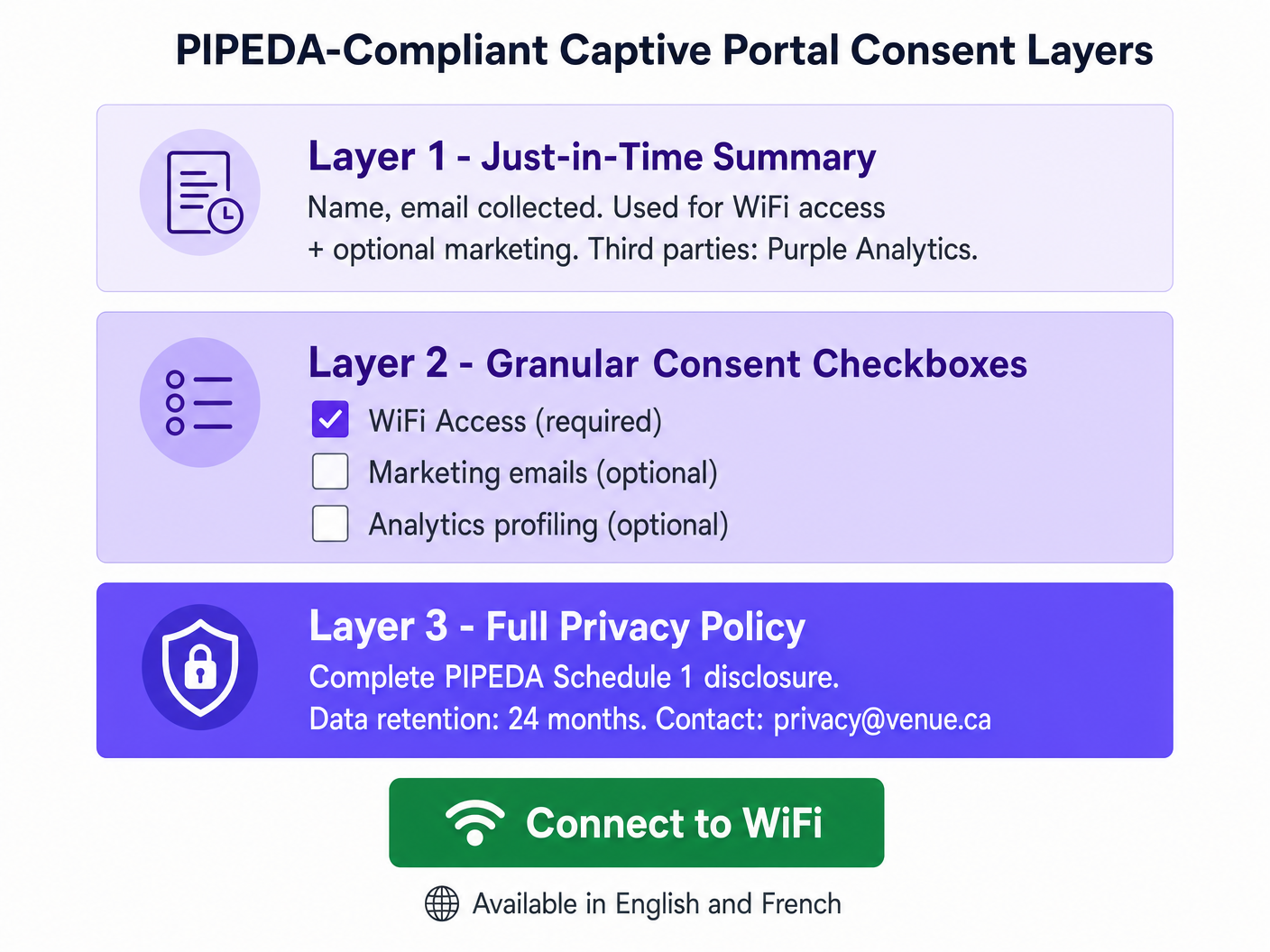
Gestalten Sie die Splash-Page mit einem dreistufigen Ansatz, der auf die Richtlinien des OPC für mehrstufige Hinweise abgestimmt ist. Ebene 1 (der Splash-Screen) präsentiert eine klare, leicht verständliche Zusammenfassung: Welche Daten werden erfasst, wer verarbeitet sie und zu welchen Zwecken. Ebene 2 präsentiert granulare Checkboxen für die Zustimmung – standardmäßig für alle optionalen Zwecke deaktiviert –, die Marketingkommunikation, Verhaltensanalysen und jegliche Datenweitergabe an Dritte abdecken, die über das für die Servicebereitstellung erforderliche Maß hinausgeht. Ebene 3 bietet einen Hyperlink zur vollständigen Datenschutzrichtlinie, die auf einer sicheren, responsiven Seite gehostet wird und von jedem Gerät aus zugänglich ist. Wenn Ihr Marketingteam Hilfe beim Verfassen prägnanter, rechtlich einwandfreier Zusammenfassungen benötigt, sollten Sie die Nutzung von Generativer KI für Captive Portal-Texte und -Kreationen oder für französischsprachige Bereitstellungen IA générative pour le texte et les créatifs de Captive Portal in Betracht ziehen.
Schritt 3: API-Integration und Datenresidenz
Wenn Sie Ihr Captive Portal in ein CRM oder eine Marketing-Automatisierungsplattform integrieren, stellen Sie sicher, dass die Daten über sichere, verschlüsselte APIs fließen (mindestens TLS 1.2, bevorzugt TLS 1.3). Priorisieren Sie für kanadische Bereitstellungen Anbieter, die eine lokale Datenresidenz (z. B. AWS Canada Central, ca-central-1) anbieten, um die Risiken grenzüberschreitender Übertragungen zu mindern. Dies ist besonders wichtig für Veranstaltungsorte, die in Quebec unter Gesetz 25 operieren, welches ein Privacy Impact Assessment (PIA) vor der Übertragung personenbezogener Daten außerhalb von Quebec vorschreibt und verlangt, dass die empfangende Gerichtsbarkeit einen gleichwertigen Schutz bietet.
Schritt 4: Zweisprachige Compliance
Alle Zustimmungshinweise, Datenschutzrichtlinien und Informationen zu den Rechten der betroffenen Personen müssen für Veranstaltungsorte in Quebec sowohl in Englisch als auch in Französisch verfügbar sein. Dies ist eine Anforderung sowohl nach Gesetz 25 als auch nach der Charta der französischen Sprache von Quebec. Für Bundeseinrichtungen (Flughäfen, Bahnhöfe, Bundesgebäude) ist die zweisprachige Bereitstellung eine Grunderwartung gemäß dem Official Languages Act.
Schritt 5: Datenschutz-Management-Programm
Das Rechenschaftsprinzip von PIPEDA (Prinzip 1) verlangt, dass Ihre Organisation einen Datenschutzbeauftragten benennt, dokumentierte Richtlinien und Verfahren pflegt und in der Lage ist, dem OPC auf Anfrage die Compliance nachzuweisen. Für Betreiber mehrerer Standorte – wie eine nationale Einzelhandelskette mit über 50 Standorten, die jeweils ein Captive Portal betreiben – bedeutet dies ein zentralisiertes Datenschutz-Management-Programm (PMP), das alle Standorte konsistent abdeckt, mit Audit-Trails für Zustimmungsereignisse, Anfragen betroffener Personen und Aufbewahrungsfristen.
Best Practices und Zukunftssicherheit für Bill C-27 (CPPA)
Obwohl Bill C-27 – der Consumer Privacy Protection Act – aufgrund der Vertagung des Parlaments im Januar 2025 ins Stocken geraten ist, repräsentieren seine Kernprinzipien die unvermeidliche Zukunft des kanadischen Datenschutzrechts. Ab Anfang 2026 wird voraussichtlich ein neuer bundesstaatlicher Gesetzentwurf zum Datenschutz ins Parlament eingebracht, der viele CPPA-Bestimmungen enthält. Der umsichtige Ansatz besteht darin, Kontrollen auf CPPA-Niveau bereits heute als Ihr Implementierungsziel zu betrachten.
Die wichtigsten Änderungen, auf die Sie sich vorbereiten sollten, sind wie folgt. Strafeskalation ist das unmittelbarste Anliegen: Der CPPA würde Geldstrafen von bis zu 25 Mio. CAD oder 5 % des weltweiten Jahresumsatzes einführen, ein Quantensprung gegenüber dem aktuellen Maximum von 100.000 CAD unter PIPEDA. Obligatorische Privacy Impact Assessments werden für risikoreiche Verarbeitungsaktivitäten erforderlich sein, einschließlich Standortanalysen, Verhaltensprofiling und jeglicher Verarbeitung, die sensible personenbezogene Daten betrifft. Ausdrückliche Rechte auf Datenübertragbarkeit und Löschung erfordern automatisierte Workflows, die in der Lage sind, den Datensatz eines Benutzers innerhalb eines definierten Reaktionsfensters aus allen Systemen – lokaler Datenbank, Cloud-Controller, nachgelagerten CRMs – zu bereinigen. De-Identifizierungsstandards werden präskriptiver; stellen Sie sicher, dass Ihre Analyseplattform MAC-Adressen mit rotierenden Salts hasht und dass eine Re-Identifizierung technisch nicht machbar ist.
Für Betreiber von Einrichtungen im Gesundheitswesen schafft die Überschneidung von WiFi-Analysen und Patientendaten zusätzliche Verpflichtungen unter PIPEDA und den provinziellen Gesundheitsdatenschutzgesetzen. Weitere branchenspezifische Bereitstellungsüberlegungen finden Sie in unserem Branchenleitfaden für das Gesundheitswesen .
Fehlerbehebung und Risikominderung
Fehlermodus: Das Alles-oder-Nichts-Portal. Viele ältere Captive Portal-Bereitstellungen präsentieren einen einzigen „Ich stimme zu“-Button, der WiFi-Zugang, Marketingzustimmung und Analyse-Profiling in einem Klick bündelt. Dies ist ein direkter PIPEDA-Verstoß und der häufigste Fehlermodus, auf den das OPC bei Beschwerden stößt. Die Abhilfe ist unkompliziert: Entkoppeln Sie die Netzwerkauthentifizierung von Marketing-Opt-ins durch separate, klar beschriftete Checkboxen. Der Netzwerkzugang sollte ohne jegliche sekundäre Zustimmung gewährt werden können.
Fehlermodus: Stilles MAC-Tracking. Einige Bereitstellungen protokollieren die MAC-Adressen von Geräten, die am Veranstaltungsort vorbeigehen, sich aber nie mit der SSID verbinden, und nutzen diese Daten zur Erstellung von Footfall-Analysen. Unter PIPEDA stellt dies die Erfassung personenbezogener Daten ohne Wissen oder Zustimmung dar. Die Abhilfe besteht darin, die Unterstützung für MAC-Randomisierung auf AP-Ebene zu implementieren und sicherzustellen, dass alle Präsenzanalyse-Dashboards Daten vor der Speicherung aggregieren und anonymisieren. Rohe MAC-Adressen von nicht assoziierten Geräten dürfen niemals in den persistenten Speicher geschrieben werden.
Fehlermodus: Veraltete Zustimmung. Ein Veranstaltungsort stellt ein konformes Captive Portal bereit und fügt sechs Monate später eine neue Analyseintegration hinzu, die Sitzungsdaten an eine Werbeplattform von Drittanbietern sendet. Bestehende Benutzer, die den ursprünglichen Bedingungen zugestimmt haben, haben dieser neuen Offenlegung nicht zugestimmt. Dies verstößt gegen die PIPEDA-Anforderung, vor jedem neuen Zweck eine Zustimmung einzuholen. Die Abhilfe besteht in der Implementierung eines Zustimmungs-Versionierungssystems, das eine erneute Zustimmungsaufforderung für bestehende Benutzer auslöst, wenn wesentliche Änderungen an den Datenverarbeitungsaktivitäten vorgenommen werden.
Fehlermodus: Unzureichende Verträge mit Dritten. Wie in der Tim Hortons-Untersuchung hervorgehoben wurde, stellt eine vage Vertragssprache mit Drittanbietern – die es ihnen erlaubt, Daten für eigene Zwecke zu nutzen – keinen angemessenen Schutz dar. Stellen Sie sicher, dass alle Datenverarbeitungsverträge mit Analyseanbietern, CRM-Providern und Marketingplattformen ausdrückliche Beschränkungen für die sekundäre Nutzung, Datenaufbewahrungslimits und Kontrollen für Unterauftragsverarbeiter enthalten.
ROI und geschäftliche Auswirkungen
Compliance ist keine Kostenstelle – sie ist ein Vertrauensmultiplikator mit messbaren kommerziellen Ergebnissen. Veranstaltungsorte, die transparente, nutzerzentrierte Zustimmungs-Flows implementieren, berichten durchweg von höheren Opt-in-Raten für Marketingprogramme, da die Benutzer das Gefühl haben, die Kontrolle über ihre Daten zu behalten. Ein gut gestaltetes, PIPEDA-konformes Captive Portal, das den Werteaustausch klar erklärt – kostenloses WiFi im Austausch für eine E-Mail-Adresse und optionale Marketingzustimmung –, konvertiert mit deutlich höheren Raten als ein Portal, das die Zustimmung in Juristensprache versteckt.
Aus Sicht der Risikominderung ist das finanzielle Kalkül einfach. Eine einzige Durchsetzungsmaßnahme des OPC, selbst unter dem aktuellen PIPEDA-Maximum von 100.000 CAD, verursacht erhebliche Reputationsschäden und Rechtskosten, die die Investition in eine konforme Bereitstellung bei weitem übersteigen. Unter dem kommenden CPPA-Regime skaliert das finanzielle Risiko auf unternehmensbedrohende Ausmaße. Die Standardisierung auf eine Enterprise-Grade-Plattform wie Purple, die zentralisiertes Consent-Management, Audit-Trails und automatisierte Workflows für Anfragen betroffener Personen bietet, reduziert den operativen Aufwand für die Verwaltung der Datenschutz-Compliance über einen Multi-Site-Bestand hinweg und liefert den dokumentierten Nachweis, den das OPC erwartet.
Für Transportbetreiber, die vernetzte Fahrzeuge und In-Transit-WiFi-Bereitstellungen in Betracht ziehen, gelten dieselben PIPEDA-Prinzipien. Weitere bereitstellungsspezifische Überlegungen finden Sie in unserem Leitfaden zu Ihrem Leitfaden für Enterprise In-Car Wi-Fi-Lösungen .
Referenzen
[1] Office of the Privacy Commissioner of Canada. „The Personal Information Protection and Electronic Documents Act (PIPEDA).“ priv.gc.ca.
[2] Office of the Privacy Commissioner of Canada. „Guidelines for obtaining meaningful consent.“ priv.gc.ca, Mai 2018.
[3] Office of the Privacy Commissioner of Canada. „PIPEDA Fair Information Principles — Schedule 1.“ priv.gc.ca.
[4] Office of the Privacy Commissioner of Canada. „Joint investigation into location tracking by the Tim Hortons App (PIPEDA Findings #2022-001).“ priv.gc.ca, Juni 2022.
[5] Office of the Privacy Commissioner of Canada. „Report of Findings: Google Inc. WiFi Data Collection (PIPEDA Findings #2011-001).“ priv.gc.ca, 2011.
[6] Commission d'accès à l'information du Québec. „Law 25: Act to modernize legislative provisions as regards the protection of personal information.“ cai.gouv.qc.ca.
[7] IAPP. „What 2026 may bring for Canada's privacy reform efforts.“ iapp.org, Februar 2026.
Schlüsseldefinitionen
PIPEDA (Personal Information Protection and Electronic Documents Act)
Canada's federal private-sector privacy law governing the collection, use, and disclosure of personal information in commercial activities. Structured around ten Fair Information Principles in Schedule 1. Applies to all provinces except Alberta, British Columbia, and Quebec, which have substantially similar provincial legislation.
The primary compliance framework for any Canadian venue offering guest WiFi. IT teams encounter PIPEDA when designing captive portals, configuring analytics platforms, and responding to data subject requests.
Meaningful Consent
The OPC's standard for valid consent under PIPEDA, requiring that individuals genuinely understand what they are consenting to — specifically: what data is collected, who receives it, the purposes of collection, and any meaningful risks of harm. Consent buried in lengthy T&Cs, or obtained through a single bundled 'I Accept' button, does not meet this standard.
The central compliance requirement for captive portal design. Every element of the splash page UI must be evaluated against this standard.
Captive Portal
A network gateway that intercepts HTTP/HTTPS traffic from newly associated WiFi clients and redirects them to a web page for authentication, consent collection, and/or payment before granting internet access. Technically implemented via WLAN controller redirect rules, DNS spoofing, or a dedicated gateway appliance.
The primary point of consent collection for guest WiFi deployments. The design of the captive portal UI directly determines PIPEDA compliance status.
MAC Address (Media Access Control Address)
A 48-bit hardware identifier assigned to a network interface controller, used to uniquely identify a device at the data link layer (Layer 2). Under PIPEDA, MAC addresses are personal information because they can be used to identify an individual's device and, by extension, their movements and behaviour.
Encountered in WiFi analytics deployments, probe-based footfall counting, and session logging. Must be anonymised or handled with explicit consent.
OPC (Office of the Privacy Commissioner of Canada)
The independent federal authority responsible for overseeing compliance with PIPEDA and the Privacy Act. The OPC investigates complaints, conducts audits, publishes guidance, and can apply to the Federal Court to enforce its recommendations. Current maximum fine under PIPEDA is $100,000 CAD per violation.
The primary regulatory body IT teams must satisfy. OPC findings are publicly published and serve as binding precedents for compliance interpretation.
CPPA (Consumer Privacy Protection Act)
The proposed replacement for PIPEDA, introduced as part of Bill C-27 in 2022. Would introduce GDPR-scale penalties (up to $25M CAD or 5% of global revenue), mandatory Privacy Impact Assessments, explicit data portability and erasure rights, and a new independent enforcement tribunal. Bill C-27 stalled due to parliamentary prorogation in January 2025; a successor bill is anticipated in 2026.
The future compliance target for Canadian venue operators. IT teams should begin implementing CPPA-level controls now to avoid costly remediation when the legislation passes.
Law 25 (Quebec Act to Modernize Legislative Provisions as Regards the Protection of Personal Information)
Quebec's provincial privacy legislation, which imposes requirements that exceed PIPEDA. Key provisions include mandatory Privacy Impact Assessments before new projects involving personal information, explicit consent for cross-border data transfers, French-language consent notices, and fines up to $25M CAD or 10% of worldwide turnover. Fully in force as of September 2023.
Applies to all venues operating in Quebec. IT teams must implement enhanced consent flows, bilingual notices, and PIAs for any Quebec deployment.
Privacy Impact Assessment (PIA)
A structured risk assessment process that evaluates the privacy implications of a new project, system, or data processing activity before deployment. Identifies data flows, assesses risks to individuals, and documents mitigation measures. Currently a best practice under PIPEDA; mandatory under Quebec's Law 25 for new projects involving personal information; expected to become mandatory federally under the CPPA.
Required before deploying new analytics features, location tracking systems, or third-party data integrations. Provides the documented evidence trail the OPC expects to see in an enforcement scenario.
Layered Notice
A consent architecture that presents privacy information at multiple levels of detail: a brief, prominent summary for the average user; granular options for those who want more control; and a full privacy policy for those who want complete information. Recommended by the OPC as the preferred method for obtaining meaningful consent in digital environments.
The architectural pattern that all PIPEDA-compliant captive portals should implement. Directly addresses the OPC's concern that information buried in lengthy T&Cs is functionally invisible to users.
Accountability Principle (PIPEDA Schedule 1, Principle 1)
The requirement that an organisation is responsible for personal information under its control and must designate an individual (a Privacy Officer) accountable for compliance. Includes implementing policies and practices, training staff, and being able to demonstrate compliance to the OPC on request.
The organisational governance requirement that underpins all other PIPEDA compliance activities. Multi-site venue operators must have a documented Privacy Management Programme covering all locations.
Ausgearbeitete Beispiele
A 300-room hotel in Toronto wants to offer free guest WiFi and use sign-up data to drive repeat bookings and promotional email campaigns. The hotel's current captive portal uses a single 'I Accept' button that links to a 4,000-word Terms and Conditions document. The IT director has been asked to assess compliance risk and redesign the flow before the next OPC audit cycle.
The existing single-button flow is non-compliant and must be replaced with a three-layer architecture. On the WLAN controller (e.g., Cisco Catalyst Centre or Aruba Central), configure the captive portal redirect to the new splash page hosted over HTTPS. Layer 1 of the splash page presents a plain-language summary panel: 'We collect your name, email address, and device identifier to provide WiFi access. We share this data with Purple (our WiFi analytics provider). You can optionally receive promotional emails from us.' Layer 2 presents two checkboxes: Checkbox A (pre-checked, mandatory): 'I agree to the WiFi Terms of Use and Privacy Policy.' Checkbox B (unchecked, optional): 'I would like to receive promotional offers and news from [Hotel Name].' Layer 3 provides a hyperlink 'Full Privacy Policy' opening the complete PIPEDA-compliant policy in a new tab. The policy must specify: data categories collected (name, email, MAC address, session timestamps), purposes (WiFi access delivery; marketing if opted-in), third parties (Purple, email marketing platform), retention period (12 months for marketing, 90 days for session logs), and a privacy contact email. The hotel must also configure its CRM integration to tag records with consent status, so that only users who checked Checkbox B receive marketing communications. Implement a consent versioning system so that if the hotel adds a new analytics partner in future, existing users are prompted to re-consent.
A large shopping centre operator in Montreal wants to deploy a WiFi analytics system to generate zone-level footfall heatmaps across 120,000 square feet of retail space. The proposed system uses WiFi probe requests from unassociated devices (i.e., phones that have not connected to the network) to estimate visitor counts and dwell times. The CTO wants to understand the PIPEDA and Law 25 compliance requirements before procurement.
This deployment involves processing personal information (MAC addresses are personal information under PIPEDA) without the knowledge or consent of the individuals whose devices are being probed. Under both PIPEDA and Quebec's Law 25, this requires careful architectural controls. The compliant approach is as follows: First, conduct a Privacy Impact Assessment (PIA) before procurement, as required by Law 25 for any new project involving personal information. The PIA must assess the necessity and proportionality of the data collection. Second, implement MAC address anonymisation at the access point or controller level using a rotating cryptographic hash (e.g., HMAC-SHA256 with a key that rotates every 24 hours). This ensures that the same device cannot be tracked across days, and that the raw MAC address is never written to persistent storage. Third, configure the analytics platform to store and display only aggregate, zone-level counts — not individual device trajectories. The dashboard should show 'Zone A: 450 visitors, avg dwell 8 minutes' rather than individual movement paths. Fourth, post clear, visible signage at all venue entrances disclosing that WiFi-based analytics are in use for footfall measurement, with a QR code linking to the full privacy notice. This satisfies the 'openness' principle and provides constructive notice. Fifth, for the connected WiFi network (the SSID guests can join), implement a standard three-layer captive portal as described in the hotel scenario above. The Law 25 requirement for French-language consent notices applies to all captive portal text.
A national retail chain with 85 stores across Canada is preparing for the incoming CPPA regime. Their current PIPEDA compliance is adequate, but the CTO wants to understand what architectural changes are needed to meet CPPA-level requirements, particularly around data subject rights, de-identification, and the increased penalty exposure.
The transition from PIPEDA to CPPA compliance requires three primary architectural investments. First, implement automated data subject rights workflows. The CPPA introduces explicit rights to data portability and erasure. The chain's WiFi platform must expose an API endpoint that, when triggered by a verified data subject request, can: (a) export all personal data associated with a given email address or device identifier in a machine-readable format (JSON or CSV); and (b) purge that record from the local captive portal database, the cloud analytics platform, and all downstream CRM and marketing automation systems simultaneously. This must be achievable within a defined SLA — 30 days is the CPPA's proposed response window. Second, upgrade de-identification protocols. Current PIPEDA guidance on de-identified data is relatively permissive. The CPPA will introduce a higher bar: de-identified data must be processed in a manner that makes re-identification 'not reasonably foreseeable.' For MAC-based analytics, this means implementing rotating hash keys (as described above) and ensuring that the analytics platform cannot be used to re-identify individuals even by the operator. Third, conduct mandatory Privacy Impact Assessments for all high-risk processing activities. For a retail chain, this includes any deployment involving location analytics, behavioural profiling for targeted advertising, or data sharing with advertising technology platforms. PIAs should be documented and retained as evidence of accountability. The chain should also review all third-party data processing agreements and update them to include CPPA-compliant clauses covering data retention, sub-processor restrictions, and breach notification timelines.
Übungsfragen
Q1. Your venue's current captive portal collects name, email, and device MAC address. The splash page has a single 'Connect to WiFi' button that, when clicked, is deemed acceptance of the Terms and Conditions (which include consent to receive marketing emails). A user complains to the OPC. What specific PIPEDA violations has your venue committed, and what is the minimum remediation required?
Hinweis: Consider PIPEDA Principles 1, 2, 3, and 4. Focus on the bundling of consent and the adequacy of the notice provided.
Musterlösung anzeigen
The venue has committed at least three violations. First, under Principle 3 (Consent), the bundling of marketing consent with WiFi access is non-compliant — users cannot be required to consent to marketing as a condition of receiving the service. Second, under Principle 2 (Identifying Purposes), the purposes are not clearly identified at the point of collection; the user must read the full T&Cs to discover the marketing purpose. Third, the consent is not 'meaningful' under the OPC's 2018 guidelines because key elements (what data, why, who gets it) are not prominently displayed. Minimum remediation: redesign the portal with a three-layer architecture, decouple marketing consent into a separate unchecked checkbox, and add a plain-language summary to the splash page. The venue must also implement a consent versioning system and update its Privacy Management Programme documentation.
Q2. You are the IT director of a conference centre in Vancouver. A vendor proposes deploying a WiFi analytics system that tracks the MAC addresses of all devices in the venue — including those that never connect to the WiFi network — to generate session-level movement analytics for exhibitors. The vendor says the data is 'de-identified' because they hash the MAC addresses. Is this deployment compliant with PIPEDA? What additional controls, if any, are required?
Hinweis: Consider whether hashing alone constitutes de-identification under PIPEDA. Think about the difference between a static hash and a rotating hash, and the concept of re-identification risk.
Musterlösung anzeigen
The deployment is potentially compliant but requires additional controls. A static hash of a MAC address is not true de-identification under PIPEDA because the same device will always produce the same hash, allowing cross-session tracking and, potentially, re-identification if the hash table is compromised or if the MAC address is known. To achieve genuine de-identification, the hash key must rotate at regular intervals (e.g., every 24 hours), ensuring that the same device cannot be tracked across sessions. Additionally, the venue must post clear, visible signage at all entrances disclosing that WiFi-based analytics are in use, satisfying the Openness principle. The analytics platform must store and display only aggregate, zone-level data — not individual device trajectories. If the vendor intends to share session-level data with exhibitors (third parties), this constitutes a disclosure of personal information and requires explicit consent from users who have connected to the network, or robust anonymisation that makes re-identification 'not reasonably foreseeable.' A Privacy Impact Assessment is strongly recommended before deployment.
Q3. A hotel chain with properties in Ontario, Alberta, and Quebec is standardising its guest WiFi platform. The CTO wants a single consent flow that works across all provinces. The legal team has flagged that Quebec's Law 25 imposes additional requirements. Design the minimum viable consent architecture that satisfies PIPEDA in Ontario and Alberta, Law 25 in Quebec, and is forward-compatible with the incoming CPPA.
Hinweis: Identify the highest common denominator across all three regimes. Consider language, PIA requirements, consent granularity, and data subject rights.
Musterlösung anzeigen
The minimum viable architecture should be designed to the highest standard across all applicable regimes, which means treating Law 25 as the baseline. The consent flow must: (1) Present a bilingual (English and French) splash page with a plain-language just-in-time summary; (2) Provide separate, unchecked-by-default checkboxes for WiFi access terms, marketing consent, and analytics profiling; (3) Link to a full privacy policy available in both languages, specifying data categories, purposes, third parties, retention periods, and data subject rights contact; (4) Support data subject rights for access, correction, and deletion — with automated workflows capable of purging records across all systems within 30 days; (5) Implement rotating-hash MAC anonymisation at the edge. Before deploying the system in Quebec, conduct a Privacy Impact Assessment as required by Law 25. For CPPA forward-compatibility, ensure the platform supports data portability export in machine-readable format and can generate audit trails of all consent events. This single architecture satisfies PIPEDA in Ontario and Alberta, Law 25 in Quebec, and is well-positioned for CPPA compliance when the legislation passes.
Q4. Six months after deploying a compliant captive portal, your marketing team wants to add a new integration that sends guest session data (email, visit frequency, dwell time) to a third-party programmatic advertising platform for retargeting campaigns. Existing users consented to the original terms, which did not mention this platform. What are your obligations under PIPEDA before activating this integration?
Hinweis: Focus on the 'new purpose' requirement under PIPEDA and the OPC's guidance on dynamic consent. Consider what constitutes a 'significant change' to privacy practices.
Musterlösung anzeigen
Under PIPEDA, sharing personal information with a third-party advertising platform for retargeting constitutes a new purpose that was not anticipated in the original consent. Before activating the integration, you must: (1) Update your privacy policy to disclose the new third party and the retargeting purpose; (2) Notify all existing users of the material change to your privacy practices — this can be done via email to those who provided their address during WiFi sign-up; (3) Obtain fresh consent from existing users for the new purpose before their data is shared with the advertising platform — this means presenting them with a new opt-in opportunity, not assuming their original consent covers the new use; (4) Ensure that users who do not consent to the new purpose continue to receive WiFi access without interruption; (5) Review the data processing agreement with the advertising platform to ensure it includes adequate protections against secondary use by the platform. Failing to obtain fresh consent before activating the integration would constitute a disclosure of personal information for a purpose beyond what was originally consented to — a direct violation of PIPEDA Principle 3.
Weiterlesen in dieser Reihe
Die Zukunft der Wi-Fi-Sicherheit: KI-gesteuertes NAC und Bedrohungserkennung
Dieser maßgebliche Leitfaden beleuchtet die Entwicklung der Unternehmens-Wi-Fi-Sicherheit von veraltetem WPA2 zu KI-gesteuerter Netzwerkzugangskontrolle (NAC) und Bedrohungserkennung. Er wurde für IT-Führungskräfte entwickelt und bietet umsetzbare Bereitstellungsstrategien zur Sicherung von Umgebungen mit hoher Dichte wie Einzelhandel, Gastgewerbe und Stadien mithilfe der identitätsbasierten Netzwerke von Purple.
Verwaltung der IoT-Gerätesicherheit mit NAC und MPSK
Dieser technische Leitfaden beschreibt, wie Unternehmen ihre Headless-IoT-Geräte mithilfe der Multiple Pre-Shared Key (MPSK)-Architektur und Network Access Control (NAC) sichern können. Er bietet umsetzbare Implementierungsschritte zur Erreichung von Mikrosegmentierung, zur Eindämmung von Sicherheitsrisiken und zur Einhaltung von Vorschriften, ohne die Skalierbarkeit zu beeinträchtigen.
RadSec: Wie RADIUS über TLS die Sicherheit der WiFi-Authentifizierung verbessert
Diese maßgebliche technische Referenz erklärt, wie RadSec (RFC 6614) die Sicherheit der Unternehmens-WiFi-Authentifizierung verbessert, indem es den traditionellen RADIUS-Verkehr in TLS-Verschlüsselung einhüllt. Für IT-Manager und Netzwerkarchitekten konzipiert, behandelt sie Architektur, Bereitstellungsstrategien und praktische Schritte zur Minderung der Risiken von unverschlüsseltem UDP RADIUS-Verkehr in Unternehmens- und Gastnetzwerken.