
Die Zukunft der Wi-Fi-Sicherheit: KI-gestützte NAC und Bedrohungserkennung
Dieser maßgebliche Leitfaden untersucht die Entwicklung der Wi-Fi-Sicherheit in Unternehmen von veraltetem WPA2 hin zu KI-gestützter Network Access Control (NAC) und Bedrohungserkennung. Er wurde für IT-Führungskräfte entwickelt und bietet praxisnahe Bereitstellungsstrategien zur Absicherung von Umgebungen mit hoher Benutzerdichte wie Einzelhandel, Hotellerie und Stadien unter Verwendung der identitätsbasierten Netzwerke von Purple.
Diesen Leitfaden anhören
Podcast-Transkript ansehen
📚 Teil unserer Kernserie: Enterprise WiFi Security Guide →

Executive Summary
For IT managers and network architects managing high-density environments—such as retail chains, stadiums, and hospitality venues—the stakes for wireless security have never been higher. Legacy authentication methods like WPA2 Personal and static Pre-Shared Keys (PSKs) are fundamentally broken, offering zero visibility into device posture and exposing networks to credential sharing and lateral movement attacks.
The future of enterprise wireless security is identity-driven and AI-powered. This guide provides a technical deep-dive into deploying AI-driven Network Access Control (NAC) and continuous threat detection. By shifting to 802.1X, dynamic VLAN steering, and machine learning-based anomaly detection, IT teams can achieve zero-trust network access (ZTNA) at the edge. We will explore how platforms like Purple's Guest WiFi and WiFi Analytics integrate with these advanced security frameworks to deliver seamless, compliant, and highly secure connectivity without increasing IT overhead.
Technical Deep-Dive: The Shift to AI-Driven NAC
The Failure of Legacy Wireless Security
Traditional enterprise networks often rely on static VLAN assignments and shared credentials. In a sprawling Hospitality or Retail environment, this approach fails on three fronts:
- Lack of Identity Context: A device connected via a shared PSK is just a MAC address. There is no cryptographic link to a user identity.
- Vulnerability to Lateral Movement: Once an attacker compromises a shared key, they gain unfettered access to the broadcast domain.
- Operational Overhead: Managing MAC allowlists and rotating keys manually across hundreds of locations is unsustainable.
AI-Driven NAC Architecture
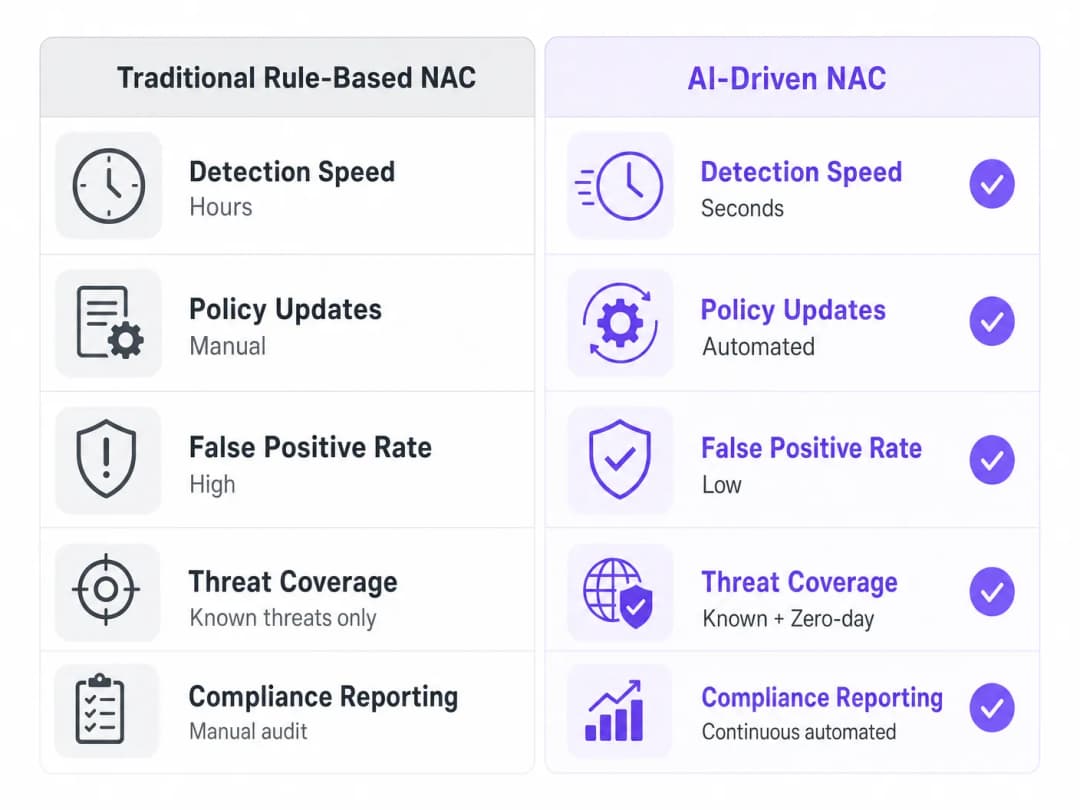
Modern Network Access Control replaces static rules with dynamic, context-aware policies. When integrated with AI and machine learning, the NAC engine doesn't just authenticate the user; it continuously evaluates the device's behaviour.

Core Components:
- 802.1X / WPA3-Enterprise: The foundation of secure access. It uses EAP (Extensible Authentication Protocol) to validate credentials against a RADIUS server or Identity Provider (IdP) before granting network access.
- Dynamic VLAN Steering: Upon successful authentication, the RADIUS server returns specific attributes (e.g., Filter-Id or Tunnel-Private-Group-Id). The access point or switch uses these attributes to dynamically place the device into the correct network segment (e.g., Staff, Guest, IoT). For specific vendor implementations, see our guide on How to Configure NAC Policies for VLAN Steering in Cisco Meraki .
- Behavioural Baselining: Machine learning algorithms establish a baseline of normal behaviour for different device types. For instance, a smart thermostat should only communicate with its designated cloud controller.
- Real-Time Threat Detection: If the thermostat suddenly initiates an SSH connection to a Point of Sale (POS) terminal, the AI engine flags this anomaly in milliseconds and triggers an automated policy response—such as quarantining the device or terminating the session.
Haben Sie Fragen zu Ihrem spezifischen Setup?
Unser Team arbeitet mit Standortbetreibern, IT-Managern und Netzwerktechnikern an über 80.000 Standorten zusammen. Buchen Sie ein 20-minütiges Gespräch und wir zeigen Ihnen, wie andere diese Herausforderungen gelöst haben.
Implementation Guide: A Phased Approach
Deploying AI-driven NAC across a distributed enterprise requires a structured approach to avoid business disruption.
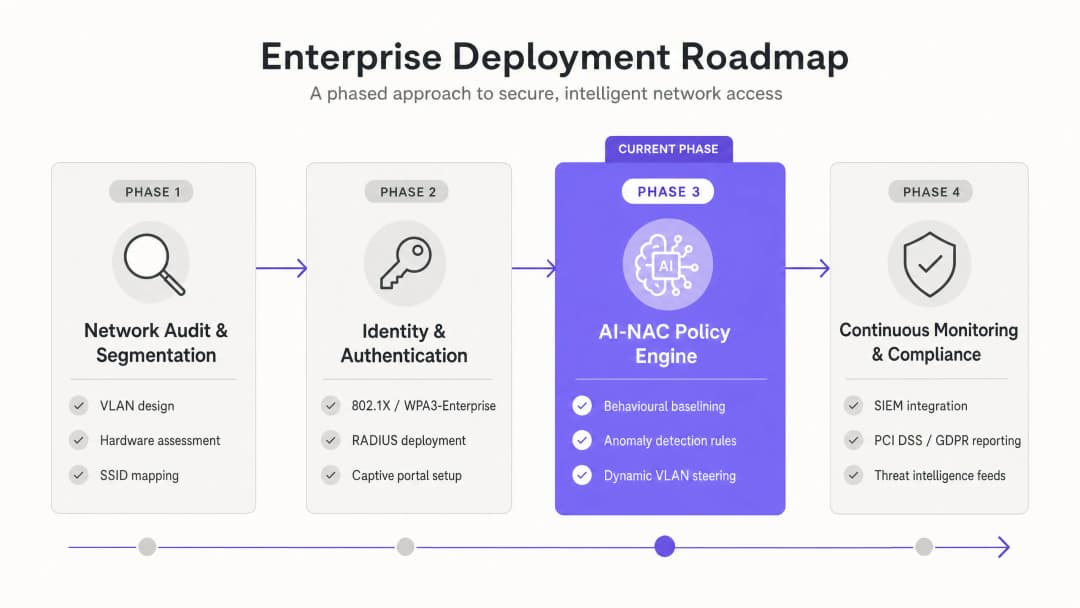
Phase 1: Network Audit & Segmentation
Before implementing NAC, the underlying network architecture must support granular segmentation.
- Map all existing SSIDs and VLANs.
- Design a robust VLAN schema isolating Guests, Staff, IoT devices, and PCI-regulated endpoints.
- Ensure existing access points and switches support 802.1X and RADIUS Change of Authorization (CoA).
Phase 2: Identity & Authentication
Move away from shared passwords to identity-based access.
- Deploy a cloud-native RADIUS infrastructure (like Purple's RADIUS-as-a-Service) to eliminate on-premise hardware.
- Integrate with corporate IdPs (e.g., Microsoft Entra ID, Okta) for staff authentication using EAP-TLS (certificate-based) or PEAP-MSCHAPv2.
- Implement secure onboarding for visitors using a compliant Captive Portal.
Phase 3: AI-NAC Policy Engine Configuration
Enable the intelligent routing and monitoring features.
- Configure RADIUS return attributes to enforce dynamic VLAN steering based on user group or device profiling.
- Enable machine learning traffic analysis on the wireless controller or overlay platform.
- Define automated quarantine policies for devices exhibiting high-risk behaviour (e.g., port scanning or excessive failed authentications).
Phase 4: Continuous Monitoring & Compliance
Integrate the wireless security posture with broader enterprise security operations.
- Forward wireless telemetry and authentication logs to a SIEM (Security Information and Event Management) platform.
- Automate compliance reporting for PCI DSS and GDPR. Purple's platform, for instance, ensures that guest data collection adheres strictly to UK GDPR and PECR frameworks.
Best Practices for Enterprise Wi-Fi Security
- Enforce Certificate-Based Authentication (EAP-TLS): For staff and corporate devices, EAP-TLS is the gold standard. It eliminates credential theft because the authentication relies on a cryptographic certificate installed on the device via MDM (Mobile Device Management), rather than a password.
- Leverage Identity-Based Guest Wi-Fi: For public access in Transport hubs or retail stores, use a managed captive portal that links the MAC address to a verified identity (email, SMS, or social login). This provides an audit trail and enables powerful marketing analytics.
- Implement Micro-Segmentation: Do not rely on a single 'IoT' VLAN. Segment devices by function (e.g., HVAC, security cameras, digital signage) to limit the blast radius of a compromised endpoint.
- Adopt WPA3: Mandate WPA3 for all new deployments. WPA3-Enterprise introduces mandatory Protected Management Frames (PMF), which defend against deauthentication attacks.
Troubleshooting & Risk Mitigation
Even with automated systems, IT teams must anticipate failure modes:
- RADIUS Timeout/Failure: If the NAC engine cannot reach the cloud RADIUS server, devices will fail to authenticate. Mitigation: Implement a 'fail-open' policy for critical infrastructure on a restricted VLAN, or ensure multi-region RADIUS failover.
- False Positives in Anomaly Detection: Overly aggressive AI models may quarantine legitimate devices, causing operational downtime. Mitigation: Run the AI engine in 'monitor-only' mode for the first 14-30 days to build an accurate baseline before enabling automated enforcement.
- Legacy Device Incompatibility: Older IoT devices (e.g., legacy barcode scanners) may not support 802.1X. Mitigation: Use Identity PSK (iPSK) or MAC Authentication Bypass (MAB) specifically for these devices, assigning them unique passphrases and restricting their access via strict ACLs.
ROI & Business Impact
Transitioning to an AI-driven NAC architecture delivers measurable business value beyond risk reduction:
- Reduced IT OpEx: Automating device onboarding and VLAN assignment significantly reduces helpdesk tickets related to Wi-Fi connectivity and password resets.
- Simplified Compliance: Automated reporting and strict segmentation streamline PCI DSS audits, often reducing the scope of the audit and saving thousands in compliance costs.
- Enhanced Customer Insights: By integrating secure identity validation with platforms like Purple, venues can safely gather demographic data and dwell times, driving targeted marketing campaigns while maintaining GDPR compliance.
Schlüsseldefinitionen
Network Access Control (NAC)
Eine Sicherheitslösung, die Richtlinien für Geräte durchsetzt, die versuchen, auf ein Netzwerk zuzugreifen, um sicherzustellen, dass nur authentifizierte und richtlinienkonforme Endpunkte Zugriff erhalten.
Entscheidend für IT-Teams, die von statischen Passwörtern zu identitätsbasierten Zero-Trust-Netzwerkarchitekturen übergehen.
802.1X
Ein IEEE-Standard für portbasierte Network Access Control, der einen Authentifizierungsmechanismus für Geräte bereitstellt, die eine Verbindung zu einem LAN oder WLAN herstellen möchten.
Das Fundament der Enterprise-Wi-Fi-Sicherheit, das einen RADIUS-Server zur Validierung von Anmeldedaten erfordert, bevor Netzwerkverkehr zugelassen wird.
Dynamic VLAN Steering
Der Prozess der automatischen Zuweisung eines Geräts zu einem bestimmten Virtual Local Area Network (VLAN) basierend auf seiner Identität oder Rolle, anstatt auf der SSID, mit der es sich verbunden hat.
Ermöglicht es Veranstaltungsorten, eine einzige SSID auszustrahlen und gleichzeitig Personal, Gäste und IoT-Geräte im Backend sicher zu segmentieren.
RADIUS (Remote Authentication Dial-In User Service)
Ein Netzwerkprotokoll, das eine zentrale AAA-Verwaltung (Authentication, Authorization, and Accounting) für Benutzer bereitstellt, die sich mit einem Netzwerkdienst verbinden und diesen nutzen.
Das Herzstück des Enterprise-Wi-Fi, das häufig als Cloud-Dienst (RADIUS-as-a-Service) bereitgestellt wird, um die Infrastruktur vor Ort zu reduzieren.
EAP-TLS
Extensible Authentication Protocol-Transport Layer Security. Eine Authentifizierungsmethode, die digitale Zertifikate sowohl auf dem Client als auch auf dem Server für eine hochsichere, gegenseitige Authentifizierung verwendet.
Die sicherste Authentifizierungsmethode für Unternehmensgeräte, die die mit Passwörtern verbundenen Schwachstellen beseitigt.
Identity PSK (iPSK)
Eine Funktion, mit der mehrere eindeutige Pre-Shared Keys auf einer einzigen SSID verwendet werden können, wobei jeder Schlüssel an eine bestimmte Geräte-MAC-Adresse und -Richtlinie gebunden ist.
Unerlässlich für die Absicherung von bildschirmlosen IoT-Geräten (wie Druckern oder Smart-TVs), die keine 802.1X-Authentifizierung unterstützen.
Behavioural Baselining
Die Nutzung von maschinellem Lernen, um im Laufe der Zeit ein normales Muster der Netzwerkaktivität für ein bestimmtes Gerät oder einen bestimmten Benutzer zu etablieren.
Ermöglicht es KI-gesteuerten Systemen zur Bedrohungserkennung, Anomalien zu identifizieren, wie z. B. einen Thermostat, der plötzlich versucht, auf eine Datenbank zuzugreifen.
Protected Management Frames (PMF)
Eine Wi-Fi-Sicherheitsfunktion, die Management-Action-Frames verschlüsselt und verhindert, dass Angreifer diese fälschen, um die Verbindung von Clients zu trennen.
In WPA3 obligatorisch, mildert es Deauthentifizierungsangriffe ab, die von Hackern häufig genutzt werden, um Handshakes abzufangen oder den Dienst zu stören.
Ausgearbeitete Beispiele
Ein Hotel mit 400 Zimmern muss sein Netzwerk absichern. Derzeit teilen sich Personal, Gäste und Smart-TVs dasselbe WPA2-Personal-Netzwerk mit einem einzigen Passwort. Wie sollte der IT-Leiter diese Architektur mithilfe von KI-gestützter NAC neu gestalten?
- Stellen Sie einen Cloud-RADIUS-Server bereit und konfigurieren Sie die Access Points für die 802.1X-Authentifizierung.
- Integrieren Sie den RADIUS-Server in das Azure AD des Hotels für den Mitarbeiterzugriff über PEAP oder EAP-TLS.
- Implementieren Sie Purple Guest WiFi mit einem Captive Portal für Besucher und platzieren Sie diese in einem isolierten Gäste-VLAN (z. B. VLAN 100) mit aktivierter Client-Isolierung.
- Verwenden Sie Identity PSK (iPSK) für die Smart-TVs. Die NAC-Engine weist jedem Fernseher einen eindeutigen Pre-Shared Key zu und steuert sie automatisch in ein eingeschränktes IoT-VLAN (z. B. VLAN 200), das nur mit dem IPTV-Management-Server kommunizieren kann.
- Aktivieren Sie die KI-gestützte Verhaltens-Baselining-Funktion, um die Smart-TVs auf anomalen ausgehenden Datenverkehr zu überwachen.
Eine Einzelhandelskette führt mobile Point-of-Sale (mPOS)-Tablets an 50 Standorten ein. Wie können sie sicherstellen, dass diese Geräte im drahtlosen Netzwerk sicher und konform mit PCI DSS bleiben?
- Registrieren Sie alle mPOS-Tablets in einer MDM-Lösung und verteilen Sie eindeutige Client-Zertifikate an jedes Gerät.
- Konfigurieren Sie das drahtlose Netzwerk so, dass WPA3-Enterprise mit EAP-TLS-Authentifizierung erforderlich ist.
- Konfigurieren Sie die NAC-Engine so, dass sie während der Authentifizierung eine Statusprüfung (z. B. Überprüfung des MDM-Profils und der OS-Version) durchführt.
- Nach erfolgreicher Authentifizierung und Statusprüfung werden die Tablets dynamisch in ein dediziertes, streng eingeschränktes PCI-VLAN gesteuert.
- Nutzen Sie die KI-Bedrohungserkennung, um die Tablets kontinuierlich zu überwachen. Wenn ein Tablet versucht, eine Verbindung zu einer nicht autorisierten externen IP-Adresse herzustellen, sendet die NAC-Engine automatisch ein RADIUS CoA, um das Gerät unter Quarantäne zu stellen.
Übungsfragen
Q1. Ein IT-Leiter eines Krankenhauses rüstet das Drahtlosnetzwerk auf. Er verfügt über 500 ältere Infusionspumpen, die nur WPA2-Personal unterstützen und nicht für 802.1X aufgerüstet werden können. Wie sollten diese Geräte gesichert werden, während der Rest des Netzwerks auf WPA3-Enterprise migriert wird?
Hinweis: Überlegen Sie, wie Sie eindeutige Anmeldeinformationen auf Geräten anwenden können, die keine Enterprise-Authentifizierungsprotokolle unterstützen.
Musterlösung anzeigen
Der IT-Leiter sollte Identity PSK (iPSK) oder MAC Authentication Bypass (MAB) für die Infusionspumpen implementieren. Durch die Zuweisung einer eindeutigen Passphrase zur MAC-Adresse jeder Pumpe über den NAC/RADIUS-Server kann das Netzwerk diese Altgeräte dynamisch in ein stark eingeschränktes Medical IoT VLAN umleiten. Der Rest des Netzwerks (Mitarbeiter-Laptops, Tablets) kann auf derselben physischen Infrastruktur sicher WPA3-Enterprise mit EAP-TLS nutzen.
Q2. Nach der Bereitstellung einer KI-gesteuerten NAC-Lösung erhält das Network Operations Team Warnmeldungen, dass mehrere Smart-TVs im Konferenzzentrum automatisch unter Quarantäne gestellt werden, was eine Großveranstaltung stört. Was ist die wahrscheinliche Ursache und wie sollte sie behoben werden?
Hinweis: Denken Sie an den Lebenszyklus bei der Bereitstellung von Anomalieerkennung auf Basis von maschinellem Lernen.
Musterlösung anzeigen
Die wahrscheinliche Ursache ist, dass die KI-Anomalieerkennung im "Enforcement"-Modus aktiviert wurde, bevor sie Zeit hatte, eine genaue Verhaltens-Baseline für die Smart-TVs zu erstellen. Zur Behebung sollte das IT-Team die KI-Policy-Engine sofort in den Modus "Monitor-only" versetzen, die Quarantäne der TVs aufheben und dem System ermöglichen, die normalen Datenverkehrsmuster der Geräte 14 bis 30 Tage lang zu erlernen, bevor die automatisierte Durchsetzung wieder aktiviert wird.
Q3. Ein Einzelhandelsunternehmen möchte kostenloses Guest WiFi in 200 Filialen anbieten und gleichzeitig Kundendaten für das Marketing erfassen. Sie müssen auch sicherstellen, dass dieses öffentliche Netzwerk ihre PCI DSS-Compliance für die Point-of-Sale-Terminals nicht gefährdet. Was ist die empfohlene Architektur?
Hinweis: Konzentrieren Sie sich auf die Segmentierung und die Rolle des Captive Portal.
Musterlösung anzeigen
Das Unternehmen sollte eine verwaltete Captive Portal-Lösung wie Purple Guest WiFi auf einer offenen SSID bereitstellen, um das Onboarding der Benutzer, die Einwilligungserfassung (GDPR) und die Authentifizierung abzuwickeln. Entscheidend ist, dass die zugrunde liegende Netzwerkinfrastruktur eine VLAN-Segmentierung nutzt. Der Gast-Datenverkehr muss auf ein isoliertes Gast-VLAN geleitet werden, das direkt zum Internet routet, wobei die Client-Isolierung aktiviert ist. Die POS-Terminals müssen sich in einem völlig separaten, eingeschränkten PCI-VLAN befinden, das über 802.1X oder iPSK gesichert ist, um sicherzustellen, dass das Gastnetzwerk für das PCI DSS-Audit völlig außer Reichweite ist.
Weiterlesen in dieser Reihe
Cisco SUDI verstehen: Hardware-verankerte Identität bei der sicheren Netzwerk-Zugangskontrolle
Dieser Leitfaden erklärt, wie Cisco SUDI eine hardware-verankerte, kryptografisch sichere Identität für die IT-Infrastruktur von Unternehmen bereitstellt. Erfahren Sie, wie Sie fälschbare MAC-Adressen durch unveränderliche 802.1AR-Zertifikate ersetzen, um die Netzwerk-Zugangskontrolle Ihres Standorts zu sichern.
So konfigurieren Sie SCEP für die automatisierte Zertifikatsregistrierung für Enterprise-WiFi
Dieser Leitfaden erklärt, wie Sie SCEP (Simple Certificate Enrollment Protocol) für die automatisierte Zertifikatsregistrierung für Enterprise-WiFi konfigurieren, und deckt die gesamte Architektur von PKI und NDES bis hin zur MDM-Profilbereitstellung und RADIUS-Validierung ab. Er richtet sich an IT-Manager, Netzwerkarchitekten und CTOs in Hotels, Einzelhandelsketten, Stadien, Konferenzzentren und Organisationen des öffentlichen Sektors, die von Pre-Shared Keys auf eine skalierbare, identitätsbasierte 802.1X-EAP-TLS-Authentifizierung umsteigen möchten. Die hardwareunabhängige Cloud-Overlay-Plattform von Purple lässt sich direkt in diese Architektur integrieren und bietet die Gäste- und BYOD-WiFi-Schicht, die parallel zu Ihrem zertifikatsauthentifizierten Mitarbeiter-WiFi läuft.
So implementieren Sie SCEP für die automatisierte WiFi-Zertifikatsregistrierung
Dieser Leitfaden erklärt, wie Sie SCEP (Simple Certificate Enrollment Protocol) für die automatisierte WiFi-Zertifikatsregistrierung in Unternehmensstandorten implementieren. Er deckt den gesamten architektonischen Entwurf ab – vom PKI-Design und der MDM-Integration bis hin zur obligatorischen dreistufigen Bereitstellungssequenz – und zeigt IT-Managern und Netzwerkarchitekten, wie sie gemeinsame Anmeldeinformationen eliminieren, das Lebenszyklusmanagement von Zertifikaten automatisieren und PCI DSS- und GDPR-Anforderungen in großem Maßstab erfüllen.
Haben Sie Fragen zu Ihrem spezifischen Setup?
Unser Team arbeitet mit Standortbetreibern, IT-Managern und Netzwerktechnikern an über 80.000 Standorten zusammen. Buchen Sie ein 20-minütiges Gespräch und wir zeigen Ihnen, wie andere diese Herausforderungen gelöst haben.