
Wie man das Kundenerlebnis in Restaurants verbessert
Dieser maßgebliche technische Leitfaden beschreibt, wie IT-Verantwortliche und Betreiber von Restaurants Unternehmens-Gast-WiFi, Analysen und CRM-Integration nutzen können, um das Essenserlebnis zu transformieren. Er behandelt Architektur, Datenerfassungsstrategien und den realen ROI, um wiederkehrende Besuche und Kundenbindung zu fördern.
Diesen Leitfaden anhören
Podcast-Transkript ansehen
Zusammenfassung für die Geschäftsleitung
Für moderne Gastronomiebetriebe ist Gast-WiFi kein Kostenfaktor mehr – es ist ein entscheidender Kanal zur Datenerfassung und eine tragende Säule des Kundenerlebnisses. IT-Manager, CTOs und Betriebsleiter stehen vor der doppelten Herausforderung, sichere Konnektivität mit hohem Durchsatz bereitzustellen und gleichzeitig verwertbare Erstanbieterdaten zu erfassen. Dieser Leitfaden beschreibt, wie das Kundenerlebnis in einem Restaurant verbessert werden kann, indem die Standard-Netzwerkinfrastruktur in eine umsatzgenerierende Analyse-Engine umgewandelt wird. Durch die Integration von Guest WiFi mit CRM-Systemen und Treueprogrammen können Restaurants personalisiertes Engagement erreichen, den Betriebsablauf optimieren und die Anzahl der wiederkehrenden Buchungen erheblich steigern.
Technischer Einblick: Architektur und Datenerfassung
Um zu verstehen, wie das Kundenerlebnis in Restaurantumgebungen verbessert werden kann, müssen wir zunächst die zugrunde liegende technische Architektur untersuchen. Eine robuste Bereitstellung erfordert hochdichte Access Points (APs), die in der Lage sind, gleichzeitige Verbindungen ohne Leistungsabfall zu verarbeiten. Der Übergang zu Wi-Fi 6 (IEEE 802.11ax) ist unerlässlich, um Latenzzeiten in dichten Umgebungen wie belebten Speisesälen zu mindern.
Das Captive Portal als Datengateway
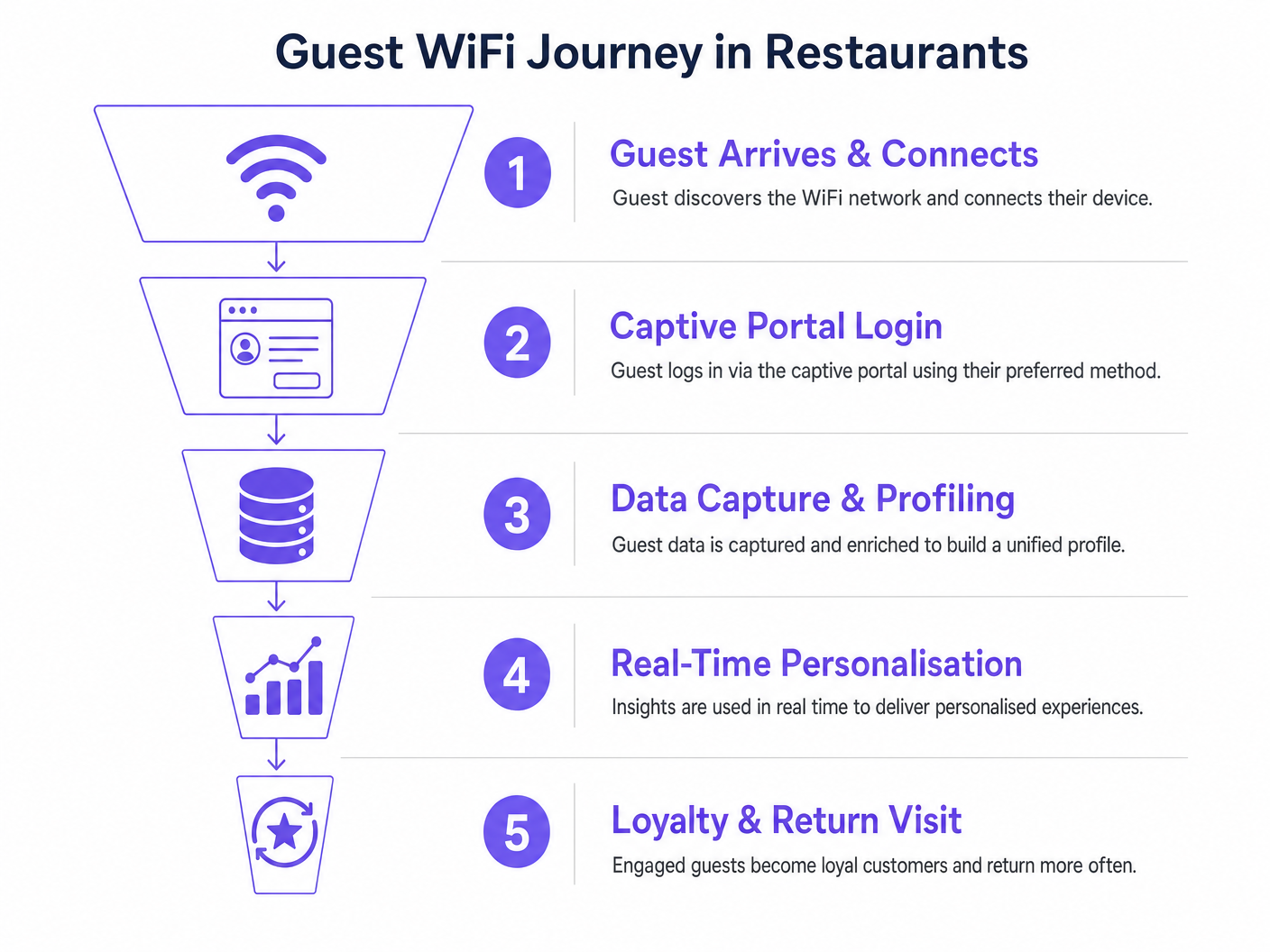
Das Captive Portal ist die primäre Schnittstelle für die Interaktion mit Gästen. Wenn Benutzer sich verbinden, werden sie auf eine gebrandete Anmeldeseite weitergeleitet. Dies ist der Kern dessen, was Restaurant-WiFi-Marketing ausmacht. Anstelle eines geteilten WPA3-Passworts authentifizieren sich Gäste per E-Mail, Telefonnummer oder Social Media. Dieser Austausch von Konnektivität gegen Daten ermöglicht es dem Veranstaltungsort, umfassende Gästeprofile zu erstellen.
Nahtlose Authentifizierung und OpenRoaming
Um Reibungsverluste zu reduzieren, nutzen Unternehmenslösungen eine nahtlose Authentifizierung. Technologien wie Passpoint (Hotspot 2.0) und OpenRoaming ermöglichen es Geräten, sich nach der Ersteinrichtung automatisch zu verbinden. Purple fungiert als kostenloser Identitätsanbieter für OpenRoaming unter der Connect-Lizenz und gewährleistet ein sicheres, reibungsloses Erlebnis bei gleichzeitiger Datenerfassung.
Implementierungsleitfaden: Bereitstellung und Integration
Die Bereitstellung von WiFi für Marketing erfordert einen strategischen Ansatz für das HF-Design und die Systemintegration.
HF-Planung und Heatmapping
Führen Sie vor der Bereitstellung eine gründliche Standortanalyse durch. Restaurantumgebungen stellen einzigartige HF-Herausforderungen dar, einschließlich Interferenzen durch Küchengeräte (Mikrowellen) und Signaldämpfung durch dicke Wände oder Metallvorrichtungen. Heatmapping gewährleistet eine optimale AP-Platzierung, um Funklöcher zu eliminieren und einen konsistenten Durchsatz zu gewährleisten.
CRM- und Analyse-Integration
Der Wert von Gast-WiFi für Restaurants liegt in den Daten. Das Captive Portal muss sich nahtlos über API in bestehende CRM- und Marketing-Automatisierungsplattformen integrieren lassen. Wenn sich ein Gast anmeldet, wird seine MAC-Adresse seinem Profil zugeordnet. Dies ermöglicht Präsenzanalyse – die Verfolgung von Verweildauer, Besuchshäufigkeit und Bewegung über verschiedene Standorte hinweg. Für eine umfassendere Perspektive auf Konnektivität, ziehen Sie Was ist eine Standleitung? Dediziertes Business Internet in Betracht, um eine zuverlässige Backhaul-Verbindung zu gewährleisten.
Best Practices für Hospitality WiFi
- Branding des Portals: Stellen Sie sicher, dass das Captive Portal die Markenidentität des Restaurants widerspiegelt. Verwenden Sie klare UI-Elemente und vermeiden Sie übermäßig komplexe Formulare.
- Sicherheit priorisieren: Implementieren Sie Client-Isolation auf der Gast-SSID, um seitliche Bewegungen zwischen verbundenen Geräten zu verhindern. Stellen Sie die Einhaltung von PCI DSS für alle Zahlungsnetzwerke und der GDPR für die Datenverarbeitung sicher.
- Erlebnis personalisieren: Nutzen Sie die erfassten Daten, um gezielte Angebote zu unterbreiten. Wenn ein Gast ein häufiger Besucher ist, lösen Sie eine automatisierte E-Mail oder SMS mit einer Treueprämie aus. Weitere Einblicke finden Sie unter Wie Personalisierung Kundenbindung und Umsatz steigert .
- Bandbreitenmanagement: Implementieren Sie Traffic Shaping am Gateway, um kritische Anwendungen (wie Kassensysteme) gegenüber dem Video-Streaming von Gästen zu priorisieren.
Fehlerbehebung & Risikominderung
Häufige Fehlerursachen
- Gleichkanalinterferenz: Eine schlechte AP-Platzierung oder eine falsche Kanalkonfiguration kann zu Interferenzen führen, die die Leistung beeinträchtigen. Nutzen Sie dynamisches Funkmanagement zur Optimierung der Kanalauswahl.
- Abbrüche im Captive Portal: Wenn der Anmeldevorgang zu lange dauert oder nicht geladen wird, brechen Gäste die Verbindung ab. Überwachen Sie die Erfolgsraten der Authentifizierung und optimieren Sie das Portal für mobile Geräte.
- MAC-Randomisierung: Moderne Betriebssysteme (iOS, Android) verwenden randomisierte MAC-Adressen, um die Privatsphäre zu verbessern. Obwohl dies die Nachverfolgung erschwert, behalten Geräte in der Regel dieselbe zufällige MAC für eine bestimmte SSID bei. Die Ermutigung der Benutzer, eine Treue-App zu installieren, bietet eine persistente Identität und mindert dieses Problem.
ROI & Geschäftsauswirkungen
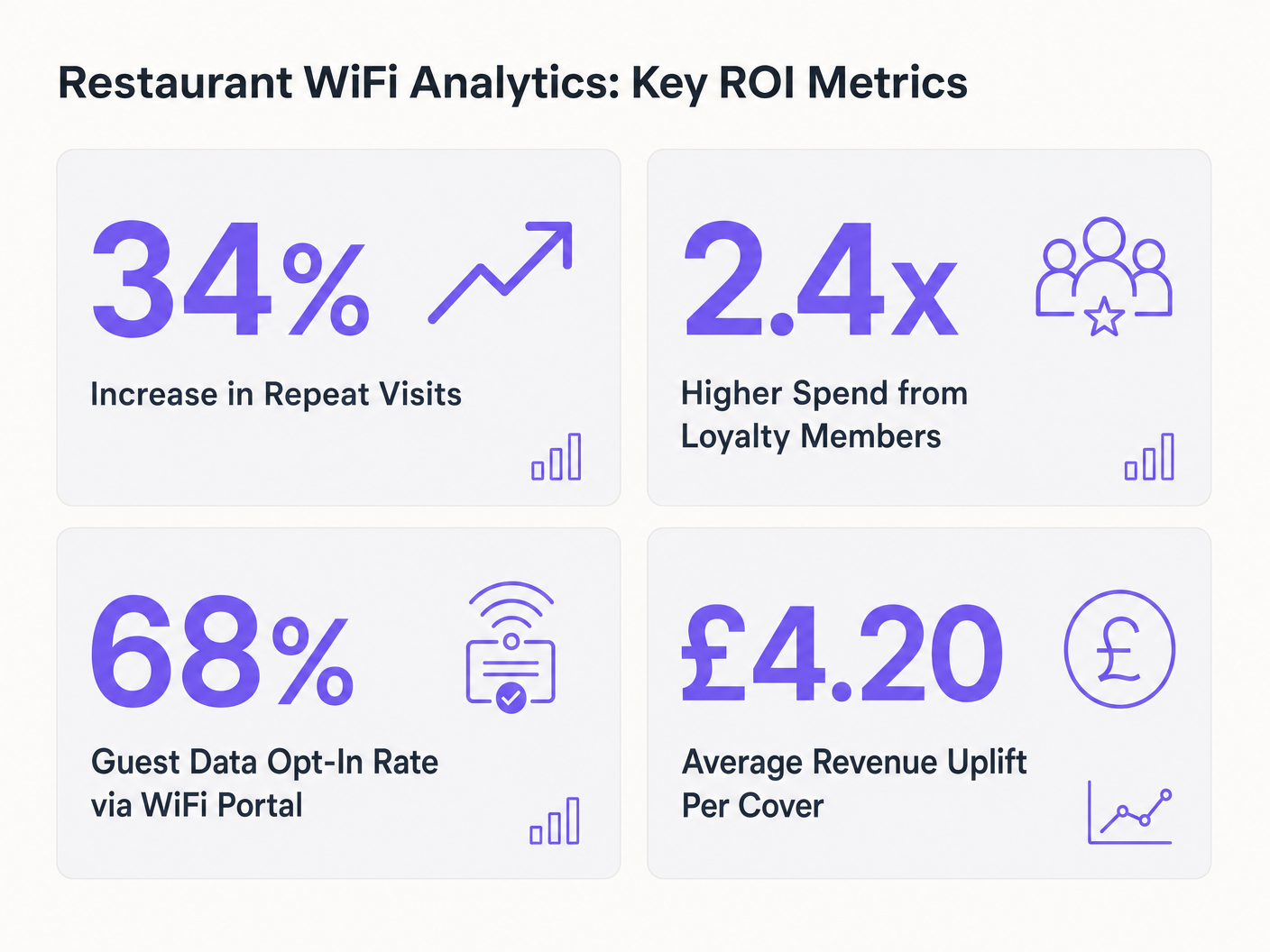
Das ultimative Ziel der Bereitstellung einer Unternehmens- WiFi Analytics -Plattform ist ein messbarer ROI. Durch die Analyse von Präsenzdaten und Kampagnenleistung können Veranstaltungsorte den Einfluss ihrer WiFi-Strategie quantifizieren. Wichtige Kennzahlen sind die Zunahme wiederkehrender Besuche, die Opt-in-Rate für Marketingkommunikation und der durchschnittliche Umsatzanstieg pro Gast. Zum Beispiel kann eine gezielte E-Mail-Kampagne an Gäste, die seit 30 Tagen nicht mehr zu Besuch waren, ausgelöst durch ihre Abwesenheit im Netzwerk, eine erhebliche Rückkehrfrequenz bewirken.
Schlüsseldefinitionen
Captive Portal
A web page that the user of a public-access network is obliged to view and interact with before access is granted.
The primary mechanism for data capture in restaurant WiFi deployments.
Presence Analytics
The use of WiFi network data (like probe requests and MAC addresses) to track the physical location and movement of devices within a venue.
Used by operations directors to measure dwell time, foot traffic patterns, and repeat visit rates.
MAC Randomization
A privacy feature in modern OS where the device uses a temporary, random MAC address instead of its true hardware address when connecting to networks.
An important consideration for IT teams when designing tracking and loyalty systems, requiring strategies like persistent SSIDs or app integrations.
Client Isolation
A security feature that prevents devices connected to the same wireless network from communicating directly with one another.
Crucial for protecting guest devices from potential threats originating from other compromised devices on the public network.
OpenRoaming
A roaming federation service enabling an automatic and secure Wi-Fi experience globally.
Reduces friction for guests by allowing seamless, automatic connection to the restaurant's network without manual login, while still supporting secure authentication.
Traffic Shaping
The control of computer network traffic to optimize or guarantee performance, improve latency, or increase usable bandwidth for some kinds of packets by delaying other kinds.
Used to ensure that critical restaurant operations (like POS systems) are not impacted by heavy guest WiFi usage.
First-Party Data
Information a company collects directly from its customers and owns.
The primary output of a successful WiFi marketing strategy, highly valuable for personalized CRM campaigns.
Dwell Time
The length of time a visitor spends in a specific area or venue.
A key metric derived from presence analytics, used to understand customer engagement and optimize table turnover rates.
Ausgearbeitete Beispiele
A 150-cover fine dining restaurant in a historic building with thick stone walls is experiencing poor WiFi coverage and low captive portal completion rates.
- Conduct a predictive and active RF site survey to identify attenuation caused by the stone walls. 2. Deploy additional Wi-Fi 6 APs in strategic locations, potentially using directional antennas for specific zones. 3. Simplify the captive portal to require only an email address or social login, reducing friction. 4. Implement OpenRoaming to allow seamless reconnection for returning guests.
A fast-casual chain with 50 locations wants to understand cross-venue loyalty and standardize their marketing data collection.
- Deploy a unified enterprise WiFi management platform across all 50 locations. 2. Configure a single, standardized captive portal that feeds data into a centralized CRM. 3. Utilize presence analytics to track MAC addresses across different venues, identifying customers who visit multiple locations. 4. Create segmented marketing campaigns based on visit frequency and location preferences.
Übungsfragen
Q1. A new marketing director wants to capture 15 different data points (including physical address and birthday) on the captive portal to build detailed profiles. As the IT manager, how should you advise them?
Hinweis: Consider the relationship between form length and conversion rates.
Musterlösung anzeigen
Advise against it. Long forms cause high abandonment rates. Recommend capturing only essential data (e.g., email or phone number) initially. Use progressive profiling—capturing additional data points during subsequent visits or through post-visit email surveys—to build the profile over time without causing friction at the point of connection.
Q2. Your restaurant chain is experiencing intermittent POS connectivity issues during peak dining hours. The POS and guest WiFi share the same physical infrastructure. What is the immediate technical remediation?
Hinweis: Look at bandwidth allocation and network segregation.
Musterlösung anzeigen
Implement traffic shaping and Quality of Service (QoS) rules at the gateway to prioritize POS traffic over the guest SSID. Additionally, ensure the POS system is on a separate, hidden VLAN with dedicated bandwidth allocation to prevent guest usage from impacting critical operations.
Q3. A venue operator is concerned that MAC randomization in newer iOS devices will completely break their presence analytics and loyalty tracking. How do you explain the reality of the situation and the mitigation strategy?
Hinweis: How do devices handle MAC randomization for known networks?
Musterlösung anzeigen
Explain that while the MAC is randomized, devices typically use the same randomized MAC address for a specific SSID upon returning. Therefore, repeat visits to the same venue can still be tracked. To build a more robust, cross-venue identity, recommend integrating the WiFi authentication with a loyalty app or utilizing OpenRoaming, which provides a persistent identity beyond the hardware MAC.
Weiterlesen in dieser Reihe
Privacy by Design: Anonymisierung von WiFi-Daten für die GDPR-Konformität
Dieser maßgebliche Leitfaden beschreibt die technische Architektur und Implementierungsstrategien zur Anonymisierung von WiFi-Daten, um die GDPR-Konformität sicherzustellen. Er bietet IT-Führungskräften und Netzwerkarchitekten umsetzbare Frameworks, um robuste Standortanalysen mit strengen Datenschutzanforderungen in Einklang zu bringen.
Heatmapping vs. Presence Analytics: Technische Unterschiede
Dieser maßgebliche technische Leitfaden beschreibt die entscheidenden architektonischen und operativen Unterschiede zwischen WiFi Heatmapping und Presence Analytics für Betreiber von Unternehmensstandorten. Er bietet IT-Führungskräften, Netzwerkarchitekten und Betriebsleitern umsetzbare Bereitstellungs-Frameworks, reale Implementierungsszenarien und herstellerneutrale Best Practices, um den maximalen ROI aus ihrer bestehenden drahtlosen Infrastruktur zu erzielen.
Wie man die Verweildauer mit WiFi Location Analytics berechnet
Dieser Leitfaden bietet eine umfassende technische Referenz zur Berechnung der WiFi-Verweildauer mittels WiFi Location Analytics. Er deckt die gesamte Architektur ab, von der Erfassung von 802.11 Probe Requests über die RSSI-basierte Trilateration bis zur Analyse von Geofence-Zonen. Er richtet sich an IT-Manager, Netzwerkarchitekten und Betriebsleiter von Veranstaltungsorten, die präzise, skalierbare Standortinformationen in Einzelhandel, Gastgewerbe, Gesundheitswesen und im öffentlichen Sektor implementieren müssen. Die Leser erhalten umsetzbare Implementierungsanleitungen, Fallstudien aus der Praxis und einen klaren Rahmen für die Umwandlung von Rohdaten in messbare Geschäftsergebnisse.