
Airport WiFi platform providers: what to require in the RFP
You will be able to choose between a hardware-agnostic cloud overlay, a bundled managed service and a concession model before writing scoring criteria. You can then set testable RFP clauses for peak concurrency, Passpoint and OpenRoaming, accessible multilingual portals, UK and EU GDPR, zone dwell analytics, app integration and service levels. A weighted table scores each vendor only on documented evidence.
Video overview
Part of our core series: Guest WiFi Guide →
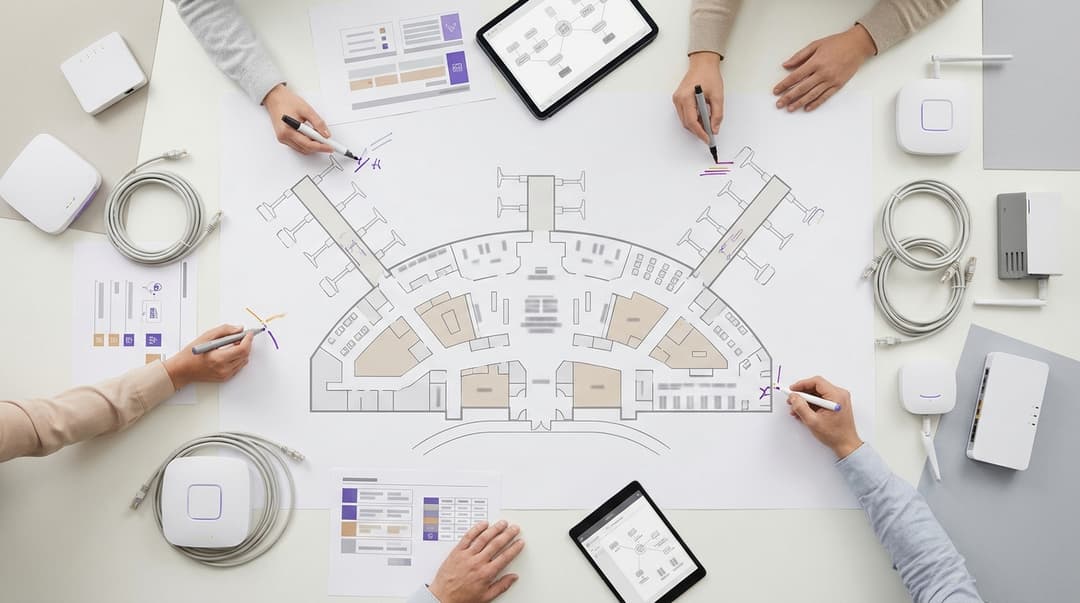
An airport WiFi RFP should demand evidence in seven areas. Vendors must prove concurrency at your busiest departure wave and support Passpoint and OpenRoaming. They need a multilingual captive portal meeting WCAG 2.2 AA, plus UK GDPR and EU GDPR data handling. Add zone-level dwell-time analytics, documented APIs for your airport app and an uptime SLA with service credits.
Which airport WiFi platform provider model should you choose?
Airport WiFi platform providers fall into three commercial models. Each model decides who owns the access points, who controls passenger data and how easily you can change direction later. Settle the model before you write scoring criteria, because it changes what you can reasonably ask each vendor to prove.
| Hardware-agnostic cloud overlay | Bundled managed service | Concession operator (revenue share) | |
|---|---|---|---|
| Hardware needed | Your existing access points | New access points supplied by the provider | Provider-owned access points and backhaul |
| Contract tied to | Software licence term you set | Provider's hardware refresh cycle | Concession agreement with the airport |
| Route to first live terminal | Configuration on installed access points | Survey, cabling and installation | Survey, build and commercial negotiation |
| Who controls passenger data | You, as controller, with the provider as processor | You, if the contract names you as controller | The operator, unless the concession reserves it to you |
| Passpoint and OpenRoaming | Platform feature, confirmed against your AP firmware | Bundled with the provider's hardware | Set by the operator's roaming agreements |
| Exit cost | Low: access points stay in place | High: hardware removal or buyback | High: rebuild or transfer of network assets |
| Suits | Airports with a current WiFi 6 or 6E estate | Airports with end-of-life access points and a small network team | Airports wanting zero capex and accepting less data control |
Purple runs as a hardware-agnostic cloud overlay on Cisco Meraki, HPE Aruba, Ruckus, Juniper Mist, Ubiquiti UniFi, Cambium, Extreme and Fortinet. If your access points are less than a refresh cycle old, read Why your next WiFi upgrade doesn't need new hardware before you scope a rip and replace.
Where airport WiFi platform providers genuinely differ
Most vendors tick every line on a feature checklist. Six areas separate them once you ask for evidence rather than a yes or no.
Throughput and concurrency at peak departures
Average load tells you nothing useful. The test is the departure wave, when security releases hundreds of passengers airside within minutes. Many of them reach for a phone at once.
Two numbers matter. The first is concurrent sessions per zone. The second is new authentications per second through the captive portal, the web page a passenger sees before getting online. Raw throughput depends mostly on your access points and backhaul. The platform's job is to authenticate the burst without a queue.
Ask each vendor for:
- The highest concurrent session count the platform has handled at a single venue, with the venue type and date.
- Authentications per second sustained in load testing, with the test method written down.
- What happens to login when your CRM or app integration responds slowly, and whether the portal fails open or closed.
- Per-device bandwidth caps and fair-use controls by SSID (the network name a passenger sees) and VLAN, a virtual LAN that separates traffic on shared infrastructure.
- Support for 6 GHz clients. In the UK, Ofcom opened 5925-6425 MHz for licence-exempt WiFi in July 2020.
The evidence to request is a load-test report, a reference venue with a comparable peak and an architecture diagram showing where authentication runs. As a reference point, Purple processed 440 million logins in 2024 across 80,000+ live venues in over 90 countries.
Passpoint and OpenRoaming for returning passengers
Passpoint, also called Hotspot 2.0, builds on IEEE 802.11u. It lets a device discover a network and join it automatically using a stored credential, with no captive portal. The connection uses 802.1X, the IEEE standard for authenticating a device before it joins, so traffic is encrypted with WPA2-Enterprise or WPA3-Enterprise. A RADIUS server, the system that checks each credential, sits behind it.
OpenRoaming is a federation run by the Wireless Broadband Alliance. It uses Passpoint and a shared certificate framework, so a credential from one identity provider works on any participating network. For an airport, that means frequent flyers and business travellers connect on arrival without re-registering.
Which airports use Passpoint or OpenRoaming? No public register lists every Passpoint airport deployment, and the picture changes quickly. Ask vendors to name live references instead of trusting a feature list.
Put these questions in the RFP:
- Is the vendor an OpenRoaming identity provider, an access network provider, or both?
- Can the captive portal issue a Passpoint profile after first login, on both iOS and Android?
- Which named airport or transport venues run Passpoint live today, with a reference contact?
- How do Passpoint passengers appear in analytics when they never see the portal?
- Which access point models and firmware versions in your estate support Passpoint? Confirm this with your hardware vendor.
Purple supports OpenRoaming and cloud RADIUS. Our transport deployments include AGS Airports, Manchester Airports Group, c2c Rail and Avanti West Coast. See how the same approach works on Trains.
Multilingual and accessible captive portals
An airport portal serves passengers from dozens of countries, often on their first minutes in the UK. It should detect the browser language and offer a visible language switcher. Every element needs translating, including the terms of use and privacy notice, not just the login button. Right-to-left scripts such as Arabic and Hebrew must render correctly.
Accessibility is a legal question as well as a service one. Require conformance with WCAG 2.2 at level AA, which the W3C published in October 2023. Where you operate in the EU, the European Accessibility Act has applied since 28 June 2025, and air passenger transport services fall within its scope. A publicly owned UK airport may also fall under the Public Sector Bodies (Websites and Mobile Applications) Accessibility Regulations 2018.
Ask for an independent accessibility audit of the live portal, not a design mock-up. Test it yourself inside the captive network assistant, the small pop-up browser iOS and Android open on connection. Many portals that pass in a desktop browser break in that window.
Data protection for international travellers
A UK airport processes guest WiFi data under UK GDPR and the Data Protection Act 2018. EU GDPR applies where you operate airports in the EU, or where processing otherwise falls within its Article 3 scope. Groups with airports in both jurisdictions need a platform that handles both regimes without separate builds.
Require each vendor to answer these points in writing:
- Roles. Confirm you are the controller and the vendor is your processor, under an Article 28 processing agreement.
- Location and transfers. Name where passenger data is stored and processed. Any transfer outside the UK or EEA needs the UK International Data Transfer Agreement or EU standard contractual clauses.
- Lawful basis. Separate network access, analytics and marketing. In the UK, email marketing also falls under the Privacy and Electronic Communications Regulations 2003.
- Consent design. Marketing opt-ins should be unticked and specific. Purple calls these conscious-choice opt-ins.
- Age. The UK sets 13 as the age of digital consent. EU GDPR defaults to 16, and member states may lower it to 13.
- Retention and requests. State retention periods per data type, and how the vendor supports subject access requests in multiple languages.
- Assurance. Request the ISO 27001 certificate and its scope, plus the sub-processor list.
Purple is ISO 27001, GDPR, CCPA, Cyber Essentials and B Corp certified. Ask the vendor to contribute to your data protection impact assessment, which Article 35 requires for high-risk processing.
Dwell time analytics by zone
Airports measure WiFi dwell time by grouping access points into zones: landside, security, airside central, retail, gate piers and lounges. Dwell is the time between a device's first and last association within a zone. Aggregated across thousands of passengers, it shows where time is spent between security and boarding.
MAC address randomisation complicates this. Apple introduced private WiFi addresses in iOS 14, and Android 10 randomises by default per network. Counts of unauthenticated devices therefore overstate unique visitors. Authenticated sessions give a stable identity, so they produce the most reliable dwell figures.
Ask vendors whether you can define and edit zones yourself, and whether a minimum dwell threshold filters out passers-by. Confirm reports show medians as well as averages, and that data exports to your business intelligence tools by API. WiFi Analytics shows how Purple reports dwell by zone. Commercial teams use these figures for concession planning, gate staffing and cleaning schedules.
Integration with your airport app
Your app and your WiFi should recognise the same passenger. Ask whether app members can sign in to WiFi with their existing app account, using single sign-on through SAML or OAuth. SAML is the Security Assertion Markup Language, a standard for passing a sign-in between systems.
Require documented REST APIs, webhooks on login events and named CRM connectors. Ask whether portal content can change by terminal or zone, so a gate pier can promote different offers from landside. Purple integrates with CRM and marketing platforms through the Guest WiFi product.
Got questions about your specific setup?
Our team works with venue operators, IT managers, and network engineers across 80,000 venues. Book a 20-minute call and we will show you how others like you solved it.
What service levels should an airport WiFi provider offer?
An outage during a departure wave means queues at information desks and missed retail revenue. Write service levels into the contract with measured evidence behind them.
| Service level | What to require | Downtime this allows | Evidence to request |
|---|---|---|---|
| Portal and authentication availability | 99.95% monthly minimum | About 22 minutes a month | 12 months of measured availability |
| Platform availability, higher tier | 99.999% annual | About five minutes a year | Public status page history |
| Priority 1 response | 15 minutes, 24 hours a day | Not applicable | Support process document |
| Priority 1 restoration target | 4 hours | Not applicable | Incident reports from the last 12 months |
| Planned maintenance | Outside 05:00-22:00 local time, 7 days' notice | Excluded from availability only with notice | Maintenance calendar for the past year |
| Breach notification to you | Within 24 hours of discovery | Not applicable | Incident response plan |
| Service credits | Percentage of monthly fee per breach | Not applicable | Draft contract clause |
For comparison, 99.9% allows about 43 minutes of downtime a month, or nearly nine hours a year. Purple's platform runs at 99.999% uptime. The breach notification line protects your own 72-hour deadline to notify the regulator under Article 33.
When a hardware-agnostic cloud overlay is the right call
Choose an overlay when your access points are current and your network team wants to keep control of radio design. You change the captive portal and RADIUS configuration, not the hardware. That keeps exit costs low and lets you replace the platform without touching a ceiling tile.
An overlay also suits airport groups with mixed estates. One terminal might run HPE Aruba and another Cisco Meraki after an acquisition. A hardware-agnostic platform gives you one portal, one data set and one consent record across both.
When a bundled managed service or concession is the right call
Choose a bundled managed service when your access points are end of life and you lack the team to run a refresh. You buy coverage, hardware and support as one contract. Accept a longer term and higher exit cost in return.
A concession operator suits airports that want zero capital spend and treat WiFi as a utility. The trade-off is data. If the operator acts as controller, your commercial team may never see passenger dwell or opt-in data. If you take this route, reserve controller rights and a full data feed in the concession agreement.
What each model costs to run
Compare total cost over the same term, not the headline licence. Ask every vendor to price an identical three-year scope covering:
- Platform licences per venue or per terminal.
- Hardware capital spend, if any, and the refresh date it implies.
- Installation, cabling and survey work.
- Internet transit and backhaul.
- Support at your required service levels.
- Professional services for portal design, translation and integrations.
- Exit costs, including data export and hardware removal.
Then set revenue against cost. Premium speed tiers and time-limited passes generate direct income, as the guide to Paid WiFi monetisation: vouchers, tiered access and payment gateways compared explains. Portal media and first-party data can support car parking, fast-track and lounge sales. Purple licenses Guest WiFi in three plans, Connect, Capture and Engage, so you can add capability as the business case matures.
Worked scenarios: two airports, two RFP clauses
These scenarios are planning examples. The inputs are assumptions a buyer would replace with their own figures; the outputs are the RFP numbers those inputs produce.
Scenario 1: a council-owned regional airport sizes its concurrency clause
Situation. A regional airport owned by two local councils runs one terminal. Its peak morning wave puts 3,000 passengers airside within 90 minutes, alongside 400 staff and concession workers on a separate network. The previous RFP asked only for "high capacity", and the incumbent's portal stalled every summer Saturday.
What was done. The IT director modelled the wave with conservative inputs: 1.5 devices per passenger and 50% take-up. That gives 3,000 × 1.5 × 0.5 = 2,250 concurrent guest sessions. Adding 30% headroom raised the requirement to 2,925, rounded up to 3,000 sessions. The team assumed 40% of sessions start in the 15 minutes after a security surge. That is 900 new logins in 900 seconds, or one authentication per second sustained.
Because the airport is a public sector body, the team also required WCAG 2.2 AA and an independent audit.
Outcome. The RFP now states two testable numbers: 3,000 concurrent guest sessions and one authentication per second sustained for 15 minutes, with a burst test at triple that rate. Vendors without a load-test report covering those figures were removed at the first stage. The accessibility clause now names a standard and an audit, not an intention.
Scenario 2: an airside retail team defines dwell time before it buys
Situation. The commercial director at a mid-sized airport wanted to know whether passengers lingered in a walk-through duty-free zone or passed straight through. Concession rents were due for review. The previous WiFi reports counted devices, including unauthenticated ones, so randomised MAC addresses inflated every zone.
What was done. The team grouped access points into five zones: landside, security exit, walk-through retail, central food court and gate piers. They set a two-minute minimum dwell threshold to exclude passers-by. The RFP required dwell reports based on authenticated sessions only, with medians by zone and hour, exported daily by API.
Outcome. With an assumed 20,000 airside passengers a day and 35% logging in, the sample is 7,000 sessions a day. That is over 200,000 sessions a month, enough to compare zones week on week with confidence. The commercial team went into the rent review with a defined metric rather than a device count. See how Purple supports Retail venues with the same zone approach.
If your estate includes an airport hotel, the same platform and consent record can extend there. Purple's approach for Hotels applies directly.
How to score airport WiFi platform providers for your terminal estate
Weight each area by its effect on passengers and revenue, then score only against evidence. A vendor that answers "yes" without a document scores zero for that line.
| Area | Weight | Question to ask | Evidence to request |
|---|---|---|---|
| Concurrency at peak | 20% | What is your highest sustained authentication rate at one venue? | Load-test report and a reference venue |
| Data protection | 20% | Where is passenger data stored, and under which transfer mechanism? | Article 28 agreement, sub-processor list, ISO 27001 certificate |
| Passpoint and OpenRoaming | 15% | Which named transport venues run Passpoint live today? | Reference contact and a live returning-device demonstration |
| Dwell time analytics | 15% | Can we define zones and export authenticated dwell data by API? | Sample report and API documentation |
| Multilingual and accessible portal | 10% | Which languages ship, and who translates the legal text? | Independent WCAG 2.2 AA audit |
| App and CRM integration | 10% | Can app members sign in to WiFi with their app account? | SSO documentation and named connectors |
| Service levels | 10% | What availability did you measure over the last 12 months? | Status page history and incident reports |
Shortlist two or three vendors on paper. Then run a proof of concept in one zone through at least one real peak departure wave. Make the reference calls yourself, and ask each reference what broke in the first month.
Frequently asked questions
How much does an airport guest WiFi platform cost?
A hardware-agnostic platform costs a software licence per venue, with no access point capex if your estate is current. Bundled managed services add hardware, installation and a longer term. Concession models can cost nothing upfront but trade away revenue and often data control. Ask every vendor to price the same three-year scope, including support and exit costs, so you compare like for like.
Can an airport WiFi platform run on our existing access points?
Yes, if the platform is hardware-agnostic. Purple runs as a cloud overlay on Cisco Meraki, HPE Aruba, Ruckus, Juniper Mist, Ubiquiti UniFi, Cambium, Extreme and Fortinet. Your access points, switching and backhaul stay in place. Check two things in the RFP: that your access point models and firmware support Passpoint, and that the captive portal handles your peak authentication rate.
How do we switch airport WiFi provider without disrupting passengers?
Run the new platform on one SSID or one zone first, then cut over terminal by terminal. With an overlay, you change captive portal and RADIUS settings rather than hardware, so rollback means restoring the old configuration. Schedule cutover outside your peak departure waves. Ask the incumbent for a data export and written confirmation of deletion under the existing processing agreement.
Does EU GDPR apply to a UK airport's guest WiFi?
UK GDPR and the Data Protection Act 2018 govern a UK airport's guest WiFi. EU GDPR applies where you operate airports in the EU, or where processing otherwise falls within its Article 3 scope. Many airport groups face both regimes. Require the vendor to support both, document data location, and use the UK IDTA or EU standard contractual clauses for transfers.
Which airports use Passpoint or OpenRoaming?
No public register lists every airport running Passpoint or OpenRoaming, and deployments change quickly. The Wireless Broadband Alliance publishes OpenRoaming announcements, and credible vendors name their live airport and transport references. In your RFP, ask each vendor for a named venue, a reference contact and a live demonstration of a returning device joining without a captive portal.
How do airports measure WiFi dwell time by zone?
Airports group access points into zones, such as landside, security, airside retail and gate piers. They then measure the time between a device's first and last association in each zone. Authenticated sessions give the most reliable figures, because MAC address randomisation on iOS and Android distorts unauthenticated counts. Report medians alongside averages, so a few long-stay devices do not skew results.
What uptime should an airport WiFi provider guarantee?
Require at least 99.95% monthly availability for the captive portal and authentication service, with service credits below that level. That still allows about 22 minutes of downtime a month. Purple's platform runs at 99.999% uptime, about five minutes a year. Ask for 12 months of measured availability, not just the contractual figure, and confirm how planned maintenance is treated.
Key Definitions
Captive portal
A web page served before network access is granted, used to present terms of use, a privacy notice, consent options and login. Mobile operating systems open it in a captive network assistant, a restricted pop-up browser.
Every guest login at a departure wave passes through the portal, so its authentication rate, translations and WCAG 2.2 AA conformance are scored directly in the RFP.
IEEE 802.1X
The IEEE standard for port-based network access control. It authenticates a device before it joins, using the Extensible Authentication Protocol between the device, the access point and an authentication server.
Passpoint connections use 802.1X, so traffic is encrypted with WPA2-Enterprise or WPA3-Enterprise. Your access point firmware must support it for returning passengers to join automatically.
RADIUS
Remote Authentication Dial-In User Service, specified in IETF RFC 2865. The server checks each credential presented through 802.1X and tells the access point whether to grant access.
With a cloud overlay you change captive portal and RADIUS configuration rather than hardware, which keeps exit costs low and makes rollback a configuration restore.
Passpoint (Hotspot 2.0)
A certification programme built on the IEEE 802.11u amendment, which adds network discovery and selection before association. A device joins automatically with a stored credential and no captive portal.
Returning passengers connect on arrival without re-registering. The RFP should ask whether the portal issues a Passpoint profile on iOS and Android, and how these passengers appear in analytics.
OpenRoaming
A roaming federation run by the Wireless Broadband Alliance. It uses Passpoint and a shared certificate framework, so a credential from one identity provider works on any participating network.
Vendors may act as an identity provider, an access network provider or both. Ask which role they hold and for a live demonstration of a returning device joining.
WCAG 2.2 level AA
Web Content Accessibility Guidelines 2.2, a W3C Recommendation published in October 2023. Level AA is the conformance tier most often cited in accessibility law and procurement.
Name WCAG 2.2 AA in the RFP and require an independent audit of the live portal, not a design mock-up. Publicly owned UK airports may also fall under the 2018 accessibility regulations.
European Accessibility Act
Directive (EU) 2019/882, setting accessibility requirements for listed products and services. It has applied since 28 June 2025, and air passenger transport services fall within its scope.
Airport groups operating in the EU must treat portal accessibility as a legal requirement, which raises the weight of the accessible portal line in scoring.
Article 28 processing agreement
The contract required by Article 28 of the GDPR (Regulation (EU) 2016/679), and its UK GDPR equivalent, when a processor handles personal data on a controller's behalf.
The RFP should confirm you are controller and the vendor is processor. In a concession model the operator may become controller unless the agreement reserves that role to you.
UK International Data Transfer Agreement
The UK IDTA is the ICO-issued transfer mechanism for personal data leaving the UK. EU standard contractual clauses serve the same purpose for transfers out of the EEA under EU GDPR.
Ask each vendor to name where passenger data is stored and processed, and which mechanism covers any transfer outside the UK or EEA.
MAC address randomisation
Operating system behaviour that replaces a device's hardware address with a private one. Apple introduced private WiFi addresses in iOS 14, and Android 10 randomises by default per network.
Unauthenticated device counts overstate unique visitors, so require dwell reports built on authenticated sessions to get stable figures for concession planning.
SAML
Security Assertion Markup Language, an OASIS standard for passing a sign-in assertion from an identity provider to another system. OAuth serves a similar delegated sign-in role.
Single sign-on through SAML or OAuth lets airport app members sign in to WiFi with their existing app account, so app and network recognise the same passenger.
VLAN
A virtual LAN, defined in IEEE 802.1Q, that separates traffic logically on shared switching and wireless infrastructure.
The RFP should ask for per-device bandwidth caps and fair-use controls by SSID and VLAN, keeping guest traffic apart from staff and concession networks.
Worked Examples
A council-owned regional airport with one terminal puts 3,000 passengers airside within 90 minutes at its morning peak. Its last RFP asked only for "high capacity", and the incumbent portal stalled every summer Saturday. How should it size the concurrency clause?
The IT director modelled the wave with conservative inputs: 1.5 devices per passenger and 50% take-up. That gives 3,000 × 1.5 × 0.5 = 2,250 concurrent guest sessions. Adding 30% headroom raised the figure to 2,925, rounded up to 3,000 sessions. Assuming 40% of sessions start in the 15 minutes after a security surge gives 900 logins in 900 seconds, or one authentication per second. The RFP now requires 3,000 concurrent sessions and one authentication per second sustained for 15 minutes, with a burst test at triple that rate. Vendors without a matching load-test report fell at the first stage. As a public sector body, the airport also named WCAG 2.2 AA and an independent audit.
The commercial director at a mid-sized airport needs to know whether passengers linger in a walk-through duty-free zone before a concession rent review. Existing reports count all devices, so randomised MAC addresses inflate every zone. What should the RFP require?
The team grouped access points into five zones: landside, security exit, walk-through retail, central food court and gate piers. They set a two-minute minimum dwell threshold to exclude passers-by. The RFP required dwell reports based on authenticated sessions only, with medians by zone and hour, exported daily by API. Authenticated sessions give a stable identity, which randomised addresses do not. With an assumed 20,000 airside passengers a day and 35% logging in, the sample is 7,000 sessions a day. That is over 200,000 sessions a month, enough to compare zones week on week. The commercial team entered the rent review with a defined metric rather than a device count.
Frequently asked questions
How much does an airport guest WiFi platform cost?
A hardware-agnostic platform costs a software licence per venue, with no access point capex if your estate is current. Bundled managed services add hardware, installation and a longer term. Concession models can cost nothing upfront but trade away revenue and often data control. Ask every vendor to price the same three-year scope, including support and exit costs, so you compare like for like.
Can an airport WiFi platform run on our existing access points?
Yes, if the platform is hardware-agnostic. Purple runs as a cloud overlay on Cisco Meraki, HPE Aruba, Ruckus, Juniper Mist, Ubiquiti UniFi, Cambium, Extreme and Fortinet. Your access points, switching and backhaul stay in place. Check two things in the RFP: that your access point models and firmware support Passpoint, and that the captive portal handles your peak authentication rate.
How do we switch airport WiFi provider without disrupting passengers?
Run the new platform on one SSID or one zone first, then cut over terminal by terminal. With an overlay, you change captive portal and RADIUS settings rather than hardware, so rollback means restoring the old configuration. Schedule cutover outside your peak departure waves. Ask the incumbent for a data export and written confirmation of deletion under the existing processing agreement.
Does EU GDPR apply to a UK airport's guest WiFi?
UK GDPR and the Data Protection Act 2018 govern a UK airport's guest WiFi. EU GDPR applies where you operate airports in the EU, or where processing otherwise falls within its Article 3 scope. Many airport groups face both regimes. Require the vendor to support both, document data location, and use the UK IDTA or EU standard contractual clauses for transfers.
Which airports use Passpoint or OpenRoaming?
No public register lists every airport running Passpoint or OpenRoaming, and deployments change quickly. The Wireless Broadband Alliance publishes OpenRoaming announcements, and credible vendors name their live airport and transport references. In your RFP, ask each vendor for a named venue, a reference contact and a live demonstration of a returning device joining without a captive portal.
How do airports measure WiFi dwell time by zone?
Airports group access points into zones, such as landside, security, airside retail and gate piers. They then measure the time between a device's first and last association in each zone. Authenticated sessions give the most reliable figures, because MAC address randomisation on iOS and Android distorts unauthenticated counts. Report medians alongside averages, so a few long-stay devices do not skew results.
What uptime should an airport WiFi provider guarantee?
Require at least 99.95% monthly availability for the captive portal and authentication service, with service credits below that level. That still allows about 22 minutes of downtime a month. Purple's platform runs at 99.999% uptime, about five minutes a year. Ask for 12 months of measured availability, not just the contractual figure, and confirm how planned maintenance is treated.
Sources
- W3C Web Content Accessibility Guidelines (WCAG) 2.2
- Wireless Broadband Alliance: OpenRoaming
- Regulation (EU) 2016/679 (General Data Protection Regulation)
- Data Protection Act 2018
- Privacy and Electronic Communications (EC Directive) Regulations 2003
- Public Sector Bodies (Websites and Mobile Applications) Accessibility Regulations 2018
- Directive (EU) 2019/882 (European Accessibility Act)
Continue reading in this series
Paid WiFi monetisation: vouchers, tiered access and payment gateways compared
Compare five ways to charge for WiFi - vouchers, tiered access, hosted card gateways, PMS posting and sponsorship - on PCI DSS scope, refund route, network requirements and running cost. You will be able to match your venue's money flow to a model and model the break-even against free WiFi with first-party data capture.
Multi-site guest WiFi for franchises: central control with local branding
You will be able to choose an operating model for guest WiFi across your franchise estate and decide who controls guest data under GDPR. You can then lock brand and consent centrally, give franchisees venue-scoped access and plan a vendor-grouped rollout. The approach runs as a cloud overlay on mixed Cisco Meraki, HPE Aruba, Ruckus and Ubiquiti UniFi hardware.
Council public WiFi providers: procurement routes and what to specify
You will be able to pick the right procurement route for council public WiFi, splitting the cloud platform from the physical build. You will also be able to write a specification bidders can price against and you can test at handover. It covers coverage, peak concurrency, IWF filtering, WCAG 2.2 AA, a UK GDPR lawful basis and evidence-based supplier scoring.
Got questions about your specific setup?
Our team works with venue operators, IT managers, and network engineers across 80,000 venues. Book a 20-minute call and we will show you how others like you solved it.